“You’ve got seven hours, boy.”
Silas “Grip” Henderson stood in the doorway of Ward’s Garage with one hand resting on the handlebar of a motorcycle that had already humiliated five respected repair shops across California.
“Fix it,” he said, “or this place won’t be standing by sunset.”
Nobody in the garage laughed.
Silas was six feet four and built like a steel door. At fifty-eight, his beard had turned gray at the edges, but nothing else about him appeared softened by age. His leather vest was sun-faded, his knuckles were scarred, and the small silver skull fixed to his collar had belonged to the same motorcycle club for more than three decades.
Behind him, three riders waited beside their bikes.
None removed their helmets.
None spoke.
The motorcycle Silas pushed across the concrete was a black 1948 Harley-Davidson Panhead, though almost nothing on it remained factory original. The frame had been stretched slightly. The exhaust pipes were handmade. The fuel tank carried hundreds of tiny scratches beneath a coat of deep black paint, and a narrow silver line ran along each side like a blade.
Painted beneath the seat were four words.
NO BROTHER RIDES ALONE.
Caleb Ward stood near the workbench holding a coffee cup that tasted burned enough to dissolve metal.
He owned the garage.
He was forty-seven, broad-shouldered, exhausted, and three months behind on nearly every bill attached to the building.
His son, Noah, stood beside an open toolbox.
Noah was nineteen.
Thin.
Quiet.
Grease stained the knees of his jeans, and a pencil rested behind his right ear. Most customers assumed he swept floors and handed tools to his father.
They rarely noticed that he was usually the one listening when engines made sounds other mechanics could not explain.
Caleb set down the coffee.
“Silas, we talked on the phone.”
“We did.”
“I told you I wouldn’t accept the job under threats.”
Silas looked around the garage.
Old fluorescent lights hummed overhead. A rusted heater stood in one corner. Three customer motorcycles waited on lifts, and a faded sign above the office door read:
WARD’S GARAGE — WE FIX WHAT OTHERS REPLACE
Silas looked back at Caleb.
“And yet here I am.”
“You also said five shops already worked on it.”
“Five shops charged me.”
“That isn’t the same as fixing it.”
Silas’s eyes moved toward Noah.
“That the kid?”
Caleb stepped slightly in front of his son.
“He’s my mechanic.”
“He looks like he still needs permission to stay out past midnight.”
Noah did not react.
Silas rolled the motorcycle farther inside.
“She runs cold. Starts clean. Sounds perfect for twelve minutes.”
He tapped the fuel tank.
“Then she loses power.”
Caleb listened.
“Misfire?”
“No.”
“Fuel starvation?”
“No.”
“Overheating?”
“Every shop said that. Every shop was wrong.”
“What happens?”
Silas looked toward the Panhead.
“At seventeen minutes, the oil pressure begins to fall. At twenty-three, the rear cylinder starts knocking. At twenty-seven, the engine locks.”
“Every time?”
“Every time.”
“Then it cools?”
“Forty minutes. After that, she starts again like nothing happened.”
Caleb frowned.
“And five shops couldn’t find it?”
Silas removed a folded paper from his vest and threw it onto the workbench.
The repair history covered nearly three years.
New oil pump.
Rebuilt top end.
Replacement pistons.
Reground crankshaft.
New main bearings.
Rebuilt carburetor.
Replacement magneto.
New camshaft.
New tappets.
Two complete engine removals.
One shop claimed the rear cylinder had warped.
Another blamed fuel mixture.
A third said the frame flexed enough to pinch the oil line.
The most recent shop replaced nearly everything except the crankcases.
The problem remained.
Caleb read the final invoice.
“Thirty-eight thousand dollars?”
“Forty-three after towing.”
“Why didn’t you replace the engine?”
Silas’s expression changed.
Only slightly.
But Noah saw it.
“That engine does not get replaced,” Silas said.
Caleb looked at the four words beneath the seat.
“No brother rides alone.”
Silas’s jaw tightened.
“The bike belonged to my brother, Daniel.”
The garage became quieter.
“He built most of it himself. Rode it for thirty-one years. When he got sick, he made me promise I’d lead his memorial ride on it.”
“When is the ride?” Caleb asked.
Silas looked at the clock.
“Seven hours.”
Caleb stared at him.
“You waited until today?”
“I didn’t wait. The fifth shop called last night and admitted defeat.”
“And the threat?”
Silas stepped closer.
“Two hundred ninety-eight riders are meeting outside this town at five.”
His voice lowered.
“My brother was the two hundred ninety-ninth member.”
Caleb looked toward the motorcycle again.
Silas continued.
“If this bike does not lead them, his place in that line stays empty.”
“That still doesn’t give you the right to threaten my shop.”
“No.”
Silas glanced toward the three silent riders outside.
“But grief doesn’t ask permission before it turns ugly.”
Noah moved closer to the Panhead.
“Did the problem begin before or after your brother died?”
Silas looked at him for the first time with real attention.
“Before.”
“How long before?”
“Six weeks.”
“Did anyone work on it immediately before the first lockup?”
Silas paused.
“Daniel did.”
“What did he replace?”
“Cam cover gasket. Oil lines. Maybe the breather gear.”
“Maybe?”
“He was sick. His hands shook. He wouldn’t let anyone help.”
Noah crouched beside the motorcycle.
Caleb recognized the expression on his son’s face.
It was the look Noah had worn at fourteen when he discovered why an old generator stopped only during rainstorms.
At sixteen, when he found a hairline fracture inside a tractor fuel pickup tube three experienced mechanics had missed.
At eighteen, when he listened to a customer’s transmission for ten seconds and correctly identified a loose compensator nut before opening the primary case.
Noah did not begin with the repair history.
He began with what the machine had done before people tried to explain it.
“Can I start it?”
Silas looked toward Caleb.
Caleb nodded once.
Noah checked the oil.
Then the fuel.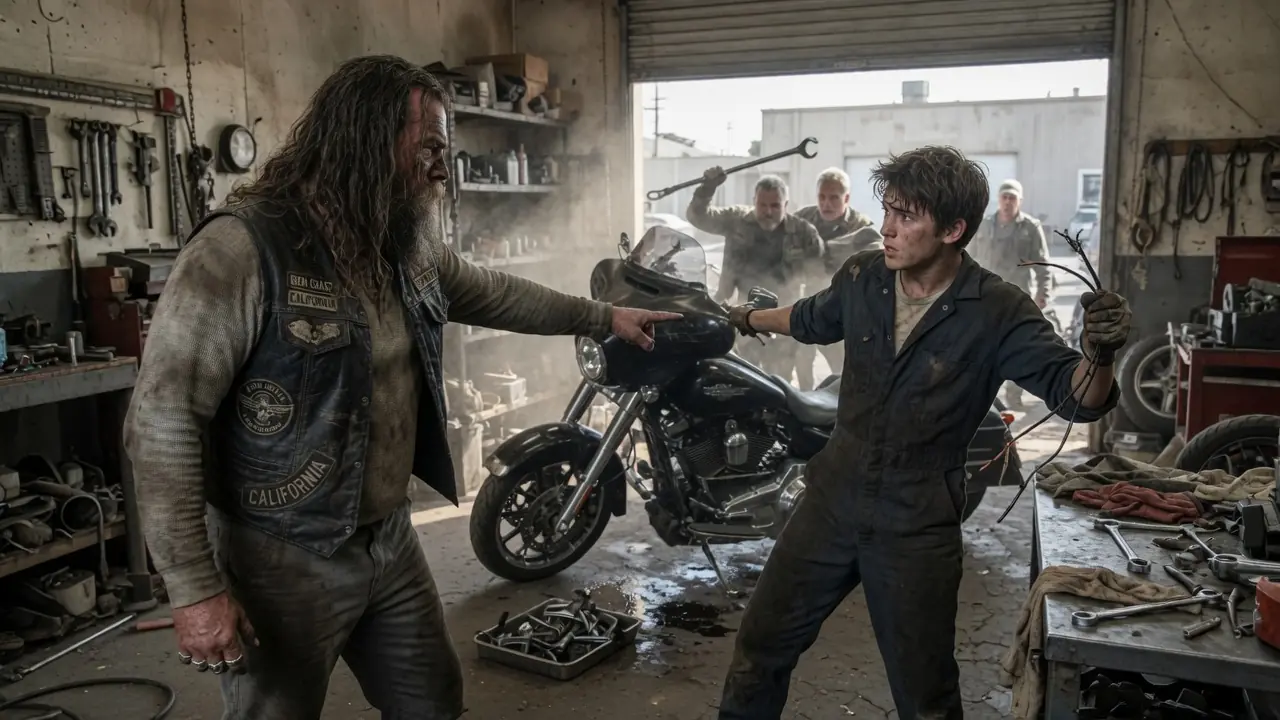
He turned the petcock, retarded the ignition, and kicked the engine through twice.
The Panhead fired on the third kick.
Its idle settled into the slow, uneven rhythm unique to old Harley engines.
The sound filled the garage.
Deep.
Mechanical.
Alive.
Noah did not touch the throttle.
He placed two fingers against the oil tank.
Then the return line.
Then the cam cover.
Silas watched with open impatience.
“You going to fix it by petting it?”
Noah ignored him.
He knelt near the rear cylinder and listened.
Caleb rolled a large fan toward the motorcycle.
“You should keep air over it.”
“No,” Noah said.
Caleb stopped.
“I want it to fail the way it fails on the road.”
Silas looked at the clock.
“You have six hours and forty-nine minutes.”
Noah found a piece of chalk and marked the pressure reading on the workbench.
At five minutes, the oil pressure was normal.
At ten, still normal.
At twelve, the engine sounded healthy.
Noah stood with one hand near the kill switch.
At seventeen minutes, the pressure needle trembled.
Then dropped slightly.
Silas stepped forward.
“That’s how it starts.”
Noah touched the return line.
Oil still flowed back toward the tank.
At twenty minutes, the rear cylinder developed a faint metallic click.
Caleb heard it.
“Piston?”
Noah shook his head.
“Too fast.”
“Valve train?”
“Maybe.”
At twenty-three minutes, the click became a knock.
The engine slowed.
Silas watched the clock.
Noah moved his hand toward the cam cover.
It was hot.
But not hot enough to explain the seizure.
At twenty-six minutes and forty seconds, the rear wheel shifted slightly on the lift.
The engine tightened.
Noah killed the ignition before it fully locked.
Silence returned.
“What did you hear?” Caleb asked.
“Not enough.”
Silas’s face darkened.
“You knew exactly when it would happen.”
“I knew when to stop it.”
“That isn’t fixing it.”
Noah removed the pencil from behind his ear.
“Who adjusted the breather timing?”
Silas looked at the repair sheet.
“Third shop.”
“After Daniel?”
“Yes.”
“Did they replace the breather gear?”
“They said they did.”
Noah studied the engine.
Caleb lowered his voice.
“What are you thinking?”
“Everyone treated the falling pressure as the cause.”
“It isn’t?”
“I think it’s an effect.”
“Of what?”
Noah looked at the clock.
“I need to take the engine apart.”
Silas stared at him.
“How far apart?”
“All the way.”
Caleb stepped in.
“Noah.”
“If I only pull the top end, I’ll see what the other shops saw.”
“We have less than seven hours.”
“I know.”
Silas moved toward the boy.
“Five shops opened that engine.”
“They opened the parts they expected to fail.”
“And you’re different?”
“No.”
Noah looked at him.
“I’m the sixth person who might be wrong.”
Silas’s mouth tightened.
The honesty caught him off guard.
Noah continued.
“But if you want another mechanic to replace the same parts, take it somewhere else.”
One of the riders outside entered the garage.
He was older than Silas, with a white beard and a patch that read CHAPLAIN.
“Grip.”
Silas did not look away from Noah.
The chaplain spoke quietly.
“Daniel trusted strange people.”
“That supposed to help?”
“He trusted you.”
Silas looked toward the motorcycle.
Then back at Noah.
“Take it apart.”
Caleb’s stomach tightened.
“You heard him,” Silas said. “All the way.”
Noah pushed the motorcycle toward the largest lift.
He drained the oil first.
The oil looked clean.
No metal flakes.
No burnt smell.
That eliminated several theories but solved nothing.
Caleb removed the fuel tank while Noah disconnected the battery and ignition wiring. Together they removed the exhaust, carburetor, primary cover, clutch, and drive components.
The three bikers carried parts to a clean bench without being asked.
Silas stood near the clock.
At four hours and fifty-eight minutes remaining, the engine came out of the frame.
At four hours and thirty-six minutes, the cylinder heads were removed.
The rear piston showed light scuffing.
Nothing severe enough to cause the repeated lockup.
At four hours and eleven minutes, Noah removed the cylinders.
The connecting rods moved freely.
Crankshaft endplay remained within specification.
Caleb wiped his hands.
“The bottom end looks good.”
Noah rotated the crank slowly.
“Cold.”
“What?”
“It always looks good cold.”
Silas heard him.
“You going to put it in an oven?”
Noah turned toward the parts washer.
“Maybe.”
Caleb knew that tone.
“Noah, what are you looking for?”
“A part that changes shape.”
“Everything changes shape when it heats.”
“Not enough to shut off oil flow at the same time every run.”
Noah removed the cam cover.
Inside were the camshaft, breather gear, oil passages, and a replacement gasket that appeared almost new.
He held the cover beneath a bright lamp.
Caleb examined the gasket.
“Installed correctly.”
Noah did not answer.
He removed the breather gear.
The timing marks aligned.
The oil pump drive showed no damage.
Silas paced.
Three hours and forty minutes.
Outside, the first distant motorcycle arrived.
Then another.
No engines approached the garage itself. The riders stopped near the abandoned feed store half a mile away, where the memorial procession was supposed to assemble.
Silas looked through the open door.
“They’re early.”
The chaplain shook his head.
“They’re on time.”
Noah placed the cam cover on the bench and measured it.
Then he heated it gently with an industrial heat gun.
Caleb watched.
“Careful.”
“I’m not testing strength.”
“What are you testing?”
Noah placed a straightedge across the inner surface.
At room temperature, it appeared flat.
After heating, a narrow gap appeared near the lower oil passage.
Caleb leaned closer.
“Warped cover?”
“Barely.”
“Enough to leak pressure?”
“Maybe. But leaking pressure wouldn’t lock only the rear cylinder.”
Noah let the cover cool.
Then reheated it.
The gap returned.
He checked the gasket impression.
One edge showed a darker oil stain leading toward the breather cavity.
Silas approached.
“You found it?”
“No.”
The answer made him turn away in frustration.
Noah examined the crankcase opening.
A small brass insert sat inside an oil passage near the cam chest.
It had been pressed into the aluminum decades earlier.
“What is that?” Noah asked.
Caleb looked.
“Restrictor.”
“For the top-end feed?”
“Looks like it.”
Noah cleaned the opening.
Then used a magnifying lens.
The brass insert was not circular.
One side appeared slightly collapsed.
Caleb frowned.
“Someone hit it.”
“Or pressed it with the wrong tool.”
“Wouldn’t five shops see that?”
“They weren’t looking inside the passage.”
Noah found a thin piece of safety wire and passed it through.
The wire stopped.
He tried from the opposite direction.
It stopped again.
“There’s something inside.”
Silas leaned over the bench.
“What?”
Noah did not answer.
He removed the oil pump and pushed low-pressure air through the passage.
Nothing came out.
Then he heated the crankcase around the brass insert.
A dark speck appeared inside the opening.
Noah used tweezers.
Slowly, he pulled out a thin curved fragment of black material.
It was less than half an inch long.
Caleb stared at it.
“Rubber?”
Noah rolled it between his fingers.
“Old gasket.”
Silas looked from the fragment to the engine.
“That caused all this?”
“Not by itself.”
Noah pushed the wire through again.
It traveled farther but still caught.
He heated the case more.
Another fragment emerged.
Then another.
The pieces formed part of a narrow rubber seal.
Caleb looked at the repair history.
“Daniel replaced the cam cover gasket and oil lines.”
Noah nodded.
“He may have cut an oil-line seal during installation.”
“The fragments entered the passage?”
“Maybe.”
“How would that produce the timing?”
Noah placed the brass insert under the lamp.
“When the engine is cold, the rubber pieces sit loose enough for oil to pass.”
He heated one fragment with the gun.
It softened and expanded.
“When the oil gets hot, they swell.”
Caleb understood.
“They collect against the damaged restrictor.”
“Like a valve.”
“Blocking flow to the rear top end.”
“Pressure falls because the pump begins cavitating against the restriction. The rear rocker assembly runs dry. Heat builds. The valve stem tightens in the guide or the piston expands from the extra heat.”
“And the engine locks.”
“Then the rubber cools and shrinks.”
“Oil passes again.”
“Everything looks normal by the time the shop opens it.”
Silas stared at the tiny fragments.
“Five shops missed that?”
Noah looked at the piles of replaced parts covering the benches.
“They kept finding damage caused by the blockage.”
Caleb picked up the rear rocker arm.
“Scuffing.”
“Then they replaced the damaged part without finding what damaged it.”
Silas checked the clock.
Two hours and fifty-four minutes remained.
“Can you fix it?”
Noah did not answer immediately.
The damaged brass restrictor had to be removed without cracking the seventy-eight-year-old crankcase.
A replacement did not exist in the garage.
Even if they cleared the passage, reassembling the engine before the memorial ride seemed impossible.
Caleb knew what his son was calculating.
Time.
Risk.
What could be reused.
What required measurement.
What might fail if rushed.
“Noah,” he said quietly.
The boy looked at him.
“Tell him the truth.”
Noah faced Silas.
“I can clear the passage.”
“But?”
“I cannot promise the damaged restrictor will seal properly afterward.”
“Make one.”
“From what?”
Silas looked around the garage as if metal itself should obey him.
“You’re the mechanic.”
Noah’s eyes moved toward the old manual lathe in the corner.
It had belonged to his grandfather.
Caleb kept it covered because the motor overheated and the lead screw slipped under load.
Noah walked toward it.
“Dad.”
Caleb already knew.
“No.”
“I need brass stock.”
“That lathe hasn’t held tolerance in years.”
“I need two thousandths.”
“It won’t give you two.”
“It might give me three.”
Silas approached.
“What does that mean?”
“It means the part may work.”
“May?”
Caleb stepped between them.
“You wanted honesty.”
Silas looked toward the motorcycle frame.
Outside, more riders arrived.
The distant sound grew into a low, continuous thunder.
Then, one by one, the engines stopped.
Silence spread across the outskirts of town.
Silas closed his eyes.
“Make the part.”
Caleb uncovered the lathe.
Noah searched through an old drawer and found a short length of brass rod.
He measured the original restrictor as closely as possible.
Then began machining.
The lathe shook.
The cutting tool squealed.
Caleb controlled the feed while Noah watched the dial indicator.
The first attempt came out too narrow.
Noah dropped it into the scrap tray.
Silas looked at the clock.
Two hours and six minutes.
The second attempt developed a taper.
Scrap.
One hour and forty-four minutes.
Sweat ran down Noah’s face.
Caleb adjusted the tool post with a strip of folded steel beneath it.
“Again.”
The third piece measured three thousandths oversized.
Noah polished it by hand with fine abrasive cloth.
Two thousandths.
One and a half.
He stopped.
“That’s it.”
They heated the crankcase and cooled the brass insert.
Noah pressed it into place.
It seated cleanly.
Then he flushed the entire oil system.
Black fragments appeared in the cleaning tray.
More than twenty pieces.
Some were soft.
Others had hardened like plastic.
Caleb looked at them.
“That seal was coming apart for years.”
Noah nodded.
“Daniel may have disturbed what was already failing.”
One hour and eleven minutes remained.
Reassembly began.
There was no conversation.
Only tools.
Torque values.
Oil.
Gaskets.
Hands moving faster than thought.
The riders inside the garage helped without touching any part that mattered. They cleaned bolts, carried tools, and held lights.
Silas stood near the door.
For the first time all day, he stopped watching the clock.
At forty-three minutes remaining, the cylinders were installed.
At twenty-eight, the heads were torqued.
At nineteen, the engine returned to the frame.
At eleven, the carburetor and ignition were connected.
At six minutes, Noah poured oil into the tank.
Caleb looked at him.
“We don’t have time for a twenty-seven-minute test.”
Silas heard.
“Start it.”
Noah kicked the engine.
Nothing.
He tried again.
The Panhead coughed.
On the third kick, it fired.
The exhaust shook the windows.
Oil began returning to the tank.
The pressure remained steady.
Silas looked toward the clock.
Five o’clock.
Noah listened to the rear cylinder.
“No knock.”
“You don’t know yet,” Caleb said.
“No.”
Silas walked toward the motorcycle.
“Then I’ll find out on the road.”
Caleb blocked him.
“If it locks at speed, you could die.”
Silas looked into his eyes.
“I made a promise.”
“That promise won’t matter if you’re under a truck.”
The chaplain approached.
“Grip.”
Silas did not turn.
The older rider placed one hand on his shoulder.
“Daniel asked you to lead the ride.”
“I know.”
“He did not ask you to die proving you loved him.”
Silas looked toward the motorcycle.
The engine continued idling.
Five minutes.
Six.
Seven.
Oil pressure steady.
Noah touched the return line.
Then the rear rocker box.
“Temperature is even.”
At ten minutes, the idle remained clean.
Outside, the riders began walking toward the garage.
Not riding.
Walking.
Hundreds of boots moved along the road without engines.
Caleb heard them before he saw them.
The sound was low and rhythmic.
Silas stepped outside.
Men and women in leather vests filled the road from shoulder to shoulder.
Two hundred ninety-eight riders.
They came without shouting.
Without revving engines.
Without the spectacle the town had expected.
At the front walked a woman carrying Daniel Henderson’s helmet.
Beside her, a young man held a folded club flag.
The procession stopped outside Ward’s Garage.
Noah looked at the clock.
Twelve minutes.
The Panhead continued running.
The oil pressure needle did not move.
Fifteen minutes.
Silas returned inside.
He stood beside the bike but did not touch it.
“Why are they walking?” Noah asked.
The chaplain answered.
“Daniel hated noise when people were speaking about the dead.”
Twenty minutes.
Still no knock.
Twenty-three.
The rear cylinder remained smooth.
Twenty-seven minutes arrived.
Everyone watched the engine.
Nothing happened.
The pressure held.
The Panhead continued its slow, heavy rhythm as if it had never failed at all.
Twenty-eight minutes.
Silas placed one hand on the fuel tank.
For the first time that day, the anger left his face.
He lowered his head.
The two hundred ninety-eight bikers outside remained silent.
No cheering.
No applause.
Only the motorcycle’s exhaust beating steadily inside the garage.
Silas looked toward Noah.
“You fixed it.”
Noah wiped his hands on a cloth.
“I removed what was blocking it.”
“You fixed it.”
The young mechanic glanced toward the old engine.
“Your brother built most of that machine. I only found one thing he couldn’t see.”
Silas removed his wallet.
Caleb shook his head.
“We’ll invoice you.”
“I’m not paying an invoice.”
Caleb’s expression hardened.
Silas pulled a folded document from his vest.
The garage deed.
Caleb stared at it.
“What is that?”
“Your building belongs to West County Bank.”
Caleb’s face changed.
“How do you know?”
“Daniel handled property recovery for the club’s legal fund.”
Silas placed the document on the bench.
“The bank scheduled foreclosure next month.”
Noah looked toward his father.
Caleb had hidden the notices.
The unpaid mortgage.
The overdue taxes.
The possibility that Ward’s Garage would close before Noah’s twentieth birthday.
Silas continued.
“The debt was purchased this morning.”
“By who?” Caleb asked.
Silas looked toward the riders outside.
“By two hundred ninety-nine people who needed a mechanic to keep a promise.”
Caleb stared at him.
Silas tore the document in half.
Then again.
The pieces fell onto the workbench.
“The garage is yours.”
Caleb could not speak.
Noah looked toward the tiny black gasket fragments in the metal tray.
“You planned this?”
“I planned to pay your father if you fixed the bike.”
Silas glanced toward Caleb.
“If you failed, I planned to take the building.”
Caleb stepped closer.
“So the threat was real.”
Silas met his eyes.
“Yes.”
The chaplain shook his head.
“Grip.”
Silas ignored him.
Noah looked at the torn papers.
“Why help us after threatening us?”
Silas considered the question.
“Because I came here believing five grown mechanics had proven you would fail.”
He looked at the boy.
“You took apart the only thing in the world I was afraid to lose.”
“You hated me for that.”
“I did.”
“And now?”
Silas glanced toward the motorcycle.
“Now I understand why Daniel trusted young mechanics.”
The woman carrying the helmet entered the garage.
She was Daniel’s widow, Maria.
She placed the helmet on the seat.
“You are Noah?”
“Yes, ma’am.”
“My husband mentioned this garage.”
Caleb looked surprised.
“When?”
“Three years ago.”
She touched the fuel tank.
“He stopped here during a storm. The boy repaired a charging wire and refused payment.”
Noah remembered.
An older rider with shaking hands.
A black Panhead.
He had fixed a loose generator connection in the parking lot because the garage was closing.
“That was Daniel?”
Maria nodded.
“He came home and said a kid had listened to the motorcycle before touching a tool.”
Silas looked at Noah.
“That is why we came here.”
Noah glanced at his father.
Caleb’s eyes were wet.
Silas mounted the Panhead.
Before starting toward the memorial procession, he looked at Noah.
“What should I watch?”
“Pressure.”
“What else?”
“If the rear cylinder begins ticking, stop immediately.”
“It won’t.”
“You asked what to watch.”
Silas nodded.
Then looked around the garage.
“I owe you an apology.”
Caleb folded his arms.
“For threatening to burn the building?”
“Yes.”
“That’s a large apology.”
Silas considered it.
“I won’t burn it.”
Caleb stared at him.
“That is not an apology.”
The corner of Silas’s mouth moved.
It was almost a smile.
“I was wrong to threaten you.”
“Better.”
Silas turned toward Noah.
“And I was wrong to call you boy.”
Noah handed him the damaged brass restrictor.
“Keep this.”
Silas looked at the tiny part.
“Why?”
“Because that was the real problem.”
Silas closed his fist around it.
“No.”
He looked toward the riders waiting outside.
“That was only the problem with the motorcycle.”
The Panhead rolled from the garage.
Two hundred ninety-eight riders returned to their bikes.
Still no one cheered.
Still no engines revved.
Silas moved to the front of the line.
Maria placed Daniel’s helmet on the empty motorcycle mounted to a small memorial trailer.
The chaplain raised one hand.
Engines started one after another.
Not in chaos.
In sequence.
A low wave of thunder moved down the road until all two hundred ninety-nine places in the procession carried sound.
Silas led them north.
The repaired Panhead did not hesitate.
At twenty-seven minutes, Noah stood outside Ward’s Garage watching the distant line of motorcycles disappear into the hills.
Caleb joined him.
“You knew about the debt?” Noah asked.
Caleb looked toward the road.
“I knew enough.”
“Why didn’t you tell me?”
“Because you’re nineteen.”
“I work here.”
“I wanted you to have a future that wasn’t tied to my mistakes.”
Noah looked around the garage.
“You almost lost the future without telling me.”
Caleb nodded.
“That was another mistake.”
The torn deed fragments remained on the bench.
The next morning, Caleb called the bank.
The debt had indeed been paid.
Not postponed.
Not transferred under hidden conditions.
Paid in full.
Over the following weeks, stories about the repair spread through motorcycle shops across California.
Most versions became exaggerated.
Some claimed Noah rebuilt the entire engine in six hours with only a pocketknife.
Others said Silas held a gun throughout the job.
One story claimed all 298 bikers entered the garage at once and knelt when the Panhead started.
None of that happened.
The truth was quieter.
A nineteen-year-old mechanic listened.
He questioned the explanation everyone else had accepted.
He took apart an engine people were afraid to disturb.
Then he found fragments of an old rubber seal hiding inside an oil passage no one had thought to inspect.
Silas returned one month later.
This time, he arrived alone.
The Panhead had traveled nearly two thousand miles since the repair.
No pressure loss.
No knock.
No lockup.
He placed the motorcycle on the lift.
“Service.”
Noah looked at him.
“You made an appointment?”
“No.”
Caleb called from the office.
“Then you wait.”
Silas frowned.
For several seconds, the old threat seemed ready to return.
Then he looked toward Noah.
The young mechanic said nothing.
Silas sat in a plastic chair.
“How long?”
“Two hours,” Caleb answered.
Silas waited.
That became the beginning of an unusual friendship.
Silas never became gentle.
Noah never became intimidated.
When the club’s motorcycles developed problems other shops could not solve, they came to Ward’s Garage.
The riders paid full price.
They followed the schedule.
They stopped threatening the building.
Most of the time.
Noah eventually became a respected specialist in vintage motorcycle engines.
He kept the damaged restrictor in a glass case above his workbench.
Beneath it, he placed a handwritten card.
DO NOT REPLACE THE DAMAGE UNTIL YOU FIND THE CAUSE.
Years later, a journalist asked Silas why nearly three hundred bikers walked toward the garage in silence that afternoon.
People online believed it had been a show of intimidation.
Silas shook his head.
“We weren’t there to scare the kid.”
“Then why?”
“We thought the bike had failed again.”
He looked toward Daniel’s old helmet displayed inside the clubhouse.
“If it could not lead the ride, we planned to walk the first mile.”
“All of you?”
“All of us.”
“Why?”
Silas looked at the four words painted beneath the Panhead’s seat.
“No brother rides alone.”
The journalist asked about the threat to burn Ward’s Garage.
Silas did not deny it.
“I was angry.”
“That excuses it?”
“No.”
“Would you have done it?”
Silas remained quiet for a long moment.
“I used to believe grief gave me permission to become the worst version of myself.”
“And now?”
“A nineteen-year-old taught me that breaking something is easy.”
Silas looked toward the repaired motorcycle.
“Understanding why it broke is harder.”
The memorial ride became an annual event.
Every year, the same Panhead led the procession.
Every year, the riders stopped outside Ward’s Garage.
They shut off their engines.
For one full minute, the road remained silent.
It was not for the motorcycle.
It was for Daniel.
For the mechanics who had failed honestly.
For the father who almost lost his garage.
For the son who saw a hidden cause beneath visible damage.
And for the lesson Silas carried long after the tiny brass part disappeared into a drawer.
Five professionals had repaired everything the broken engine showed them.
Scuffed pistons.
Damaged rockers.
Falling pressure.
Overheated components.
Noah Ward repaired the thing those failures were trying to say.
The motorcycle had not needed a stronger piston.
A larger oil pump.
A better carburetor.
It needed someone patient enough to understand why the same wound kept returning.
That was why two hundred ninety-eight bikers came to Ward’s Garage.
Not because a teenager had performed a miracle.
Not because fear had made him work faster.
They came because one empty place waited inside their procession.
And a quiet nineteen-year-old mechanic had just made certain their lost brother would not ride alone.