The silence inside Iron Summit Dojo felt heavier than the snow resting on the Rocky Mountains beyond the windows.
Marcus Brooks remained on one knee near the center of the mat, one palm pressed against the floor as he tried to understand how he had fallen.
Only seconds earlier, the twenty-eight-year-old regional champion had charged forward with the confidence of a man who had not lost a serious match in four years. He stood six feet four inches tall, weighed nearly two hundred forty pounds, and had built his reputation on speed no one expected from a man of his size.
Across from him had stood Thomas Hale.
Sixty-two years old.
Silver-gray hair.
Faded brown jacket.
Loose training pants.
No belt.
No reputation anyone in the room recognized.
Marcus had thrown one hard punch.
Thomas had shifted half a step, touched his arm, and sent him across the mat so easily that several students had assumed Marcus slipped.
Marcus knew better.
He rose slowly.
Sweat glistened on his shoulders. His breathing remained heavy, but the anger that had burned in his face moments earlier had changed.
The humiliation was still there.
So was something more dangerous to his pride.
Curiosity.
Thomas picked up his jacket from the edge of the mat and slipped it over his shoulders.
The fabric was worn pale at the elbows. It smelled faintly of sawdust, pine resin, and coffee.
Marcus looked at him.
“Again.”
Thomas adjusted one sleeve.
“No.”
A few students exchanged glances.
Marcus stepped closer.
“I wasn’t ready.”
“You were.”
“I underestimated you.”
“That was part of the attack.”
Marcus’s jaw tightened.
Around them, nearly forty students and parents remained completely still. Even Master Robert Kim, who had owned Iron Summit for sixteen years, seemed uncertain whether to intervene.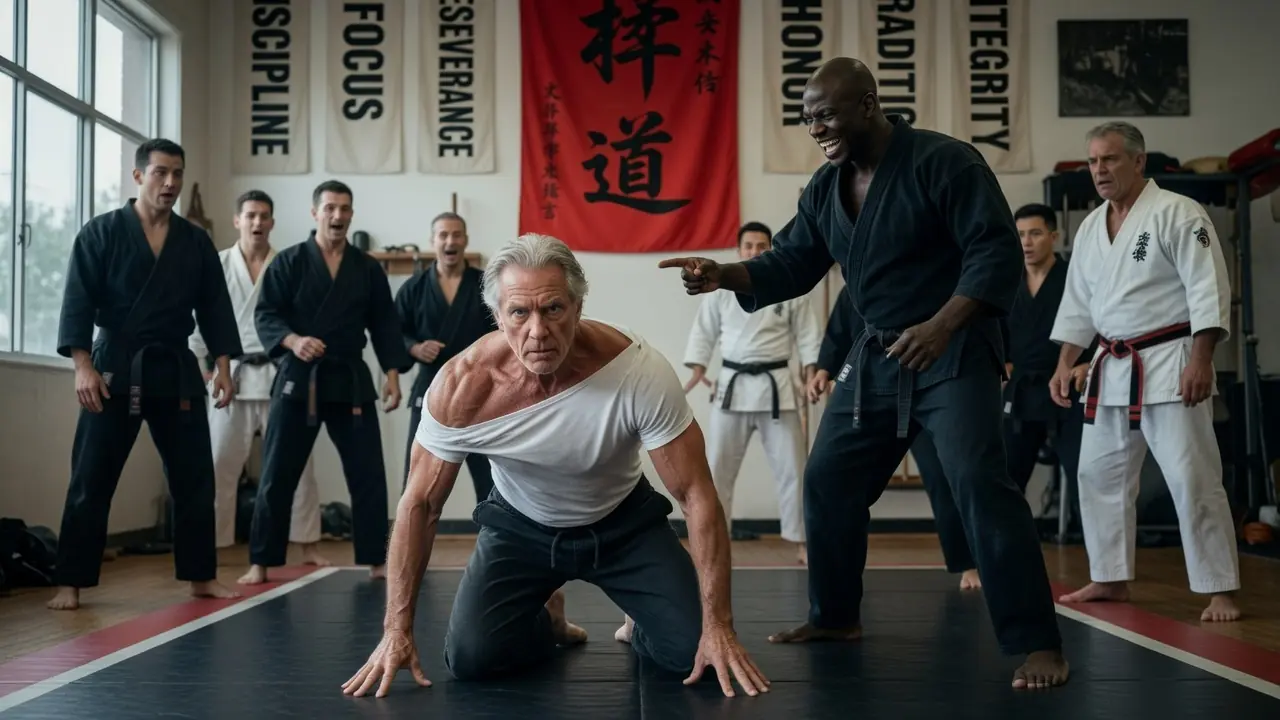
Marcus lowered his voice.
“Please.”
The word changed the room.
No one had heard Marcus Brooks say it often.
Thomas studied him for several seconds.
Then he removed the jacket again.
“All right.”
Marcus returned to his position.
This time, he did not smile.
Thomas stood ten feet away with his hands relaxed at his sides.
“Do I attack however I want?”
“Yes.”
“Full speed?”
“Not yet.”
Marcus frowned.
“You think I can’t control myself?”
“I think you are still trying to win.”
“That’s the point.”
Thomas shook his head.
“That is the problem.”
A trace of irritation returned to Marcus’s face.
Thomas stepped closer and pointed toward his chest.
“You are thinking about what you want to do to me.”
“Of course.”
“You are not looking at what is actually in front of you.”
“I am looking right at you.”
“No. You are looking at the version of me you already decided to fight.”
Marcus glanced toward Master Kim.
The instructor said nothing.
Thomas continued.
“Attack at three-quarter speed.”
Marcus settled into his stance.
His feet moved lightly despite his size. He feinted with his left hand, shifted his weight, and launched a powerful right roundhouse kick toward Thomas’s ribs.
Thomas did not retreat.
He stepped slightly inside the arc.
His left hand touched Marcus’s knee with almost no force. His right hand guided the younger man’s shoulder in the same direction the kick was already traveling.
Marcus spun past him.
Before he could recover, Thomas stood behind him with one palm resting lightly between his shoulder blades.
He did not push.
He did not need to.
Marcus stumbled forward and caught himself near the edge of the mat.
A child in the front row gasped.
Marcus turned quickly.
“How?”
“I barely touched you.”
Thomas smiled.
“Exactly.”
Marcus looked down at his feet.
Thomas motioned for him to return.
“Again.”
For the next twenty minutes, Marcus attacked in different ways.
Straight punches.
Hooks.
Low kicks.
A rushing clinch.
Every time, Thomas moved less than Marcus expected.
Sometimes he turned his hips.
Sometimes he shifted only one foot.
Once, he redirected Marcus with two fingers against the wrist.
The champion grew more frustrated with each failed attempt.
Finally, he stopped.
“What are you doing?”
“Listening.”
“With your hands?”
“With everything.”
Marcus wiped sweat from his forehead.
“That doesn’t explain anything.”
Thomas pointed toward the windows.
Beyond the glass, wind moved snow across the high ridges.
“Have you ever stood in a river?”
“Yes.”
“If you fight the current directly, what happens?”
“You get tired.”
“If you move with it?”
“You can redirect yourself.”
Thomas nodded.
“Power is easy when you are young and strong. Direction is harder.”
He walked toward the center of the mat.
“A flood has more force than any man in this room. But without a riverbed, it destroys everything and wastes itself.”
He looked at Marcus.
“Skill is the riverbed.”
Master Kim stepped closer.
“Thomas, would you explain the timing?”
Thomas glanced at him.
“You already know it.”
“I want them to hear it from you.”
Thomas hesitated, then motioned for Marcus to approach.
“Throw a slow punch.”
Marcus extended his right fist.
Thomas stopped it midway.
“Most beginners watch the hand.”
He touched Marcus’s shoulder.
“More experienced fighters watch the shoulder.”
He moved his fingers toward Marcus’s ribs.
“But intention begins before either one moves.”
Marcus raised an eyebrow.
“Where?”
“In the breath.”
Thomas placed his palm lightly against Marcus’s upper chest.
“Before you strike, your breathing changes. Your center tightens. Your heel prepares to release from the floor. Your eyes choose the target even when you believe they do not.”
He stepped back.
“If I wait for the fist, I am late. If I see you preparing to become the punch, I have time.”
One of the black belts asked, “Can that actually be trained?”
Thomas looked at him.
“It can be noticed.”
“That isn’t the same thing.”
“No.”
Thomas smiled faintly.
“Training begins when you understand the difference.”
What began as a challenge slowly became a lesson.
Students moved away from the walls and formed a wide circle around the mat. Parents settled onto benches. Master Kim turned off the music that usually played during open practice.
Thomas demonstrated how changing the rhythm of a breath could hide an attack.
He showed how peripheral vision allowed someone to read the whole body instead of staring at one moving limb.
He asked two students to push him simultaneously, then shifted his balance so their force passed around him.
Nothing he did looked dramatic.
That made it more difficult to dismiss.
Marcus followed every movement.
The arrogance had not disappeared completely, but it no longer controlled his questions.
“When you moved inside my kick,” he said, “weren’t you afraid I would adjust?”
“Yes.”
Marcus stared.
“You were afraid?”
“Fear gives information.”
“I thought hesitation gets people hurt.”
“It does.”
Thomas looked directly at him.
“Fear and hesitation are not the same thing.”
Marcus folded his arms.
“How do you keep fear from becoming hesitation?”
“You stop arguing with it.”
The answer irritated Marcus.
“That sounds like philosophy.”
“It is also mechanics.”
Thomas took his wrist.
“When fear tightens this, your movement shortens.”
He touched Marcus’s shoulder.
“When it lifts this, you lose structure.”
Then he pressed two fingers against Marcus’s jaw.
“When it locks this, you stop breathing.”
He released him.
“If you pretend fear is not there, it controls the body without permission. If you acknowledge it, you can still choose.”
Master Kim watched Thomas with growing fascination.
He had known the older man for almost six months.
Thomas had first entered the dojo to repair a damaged wooden weapons rack. A parent recommended him because he was a master carpenter known for restoring old timber-frame homes in the foothills.
He completed the repair in one afternoon.
Afterward, he stayed to watch class.
Kim offered him a free week.
Thomas declined.
Then he returned the following Saturday carrying coffee and asked whether he could sit near the back.
For months, he trained quietly during beginner sessions.
He never mentioned previous experience.
He never corrected anyone.
When advanced students sparred, he usually swept the floor or helped younger children tie their belts.
Marcus had mistaken that silence for ignorance.
That morning, he mocked Thomas after seeing him practice a slow balance drill near the wall.
“Careful, old man,” Marcus said loudly. “You might hurt yourself moving that fast.”
Thomas ignored him.
Marcus continued.
“Master Kim, are we giving belts for standing still now?”
Several students laughed.
Kim warned him to stop.
Marcus did not.
He invited Thomas onto the mat, claiming he wanted to demonstrate how traditional movement failed against modern fighting.
Thomas refused twice.
On the third invitation, Marcus grabbed the sleeve of his faded jacket.
Thomas asked him to release it.
Marcus tightened his grip.
A second later, he was on the floor.
Now, hours after the laughter died, Marcus stood before the same man asking questions like a beginner.
“How long have you trained?” he asked.
Thomas considered the question.
“On purpose?”
A few students smiled.
Marcus did not.
“What does that mean?”
“I wrestled with my brothers when I was a boy. Learned boxing in a church basement. Trained judo during the Army. Studied wherever people knew something I didn’t.”
“You were in the military?”
“Army engineers.”
“When?”
“Late seventies.”
“You never told anyone.”
“No one asked.”
Master Kim sat cross-legged near the edge of the mat.
“Who taught you that entry against the kick?”
Thomas’s expression softened.
“A man named Kenji Sato.”
The name meant nothing to most of the room.
Thomas looked toward the mountains before continuing.
“When I was forty-one, a timber beam fell during a house raising.”
He touched his left shoulder.
“It crushed this side. Broke the collarbone, shoulder blade, and three ribs.”
Marcus looked at the way Thomas held himself.
There was no visible weakness.
“The doctors said I might never lift my arm properly again,” Thomas said. “For a carpenter, that sounded like the end of the world.”
“What did you do?” a young student asked.
“I became unpleasant.”
Several parents laughed softly.
Thomas did not.
“I blamed the crew. The weather. The doctor. My wife. Anyone close enough to hear me.”
His face changed as he remembered.
“Maria finally told me that pain explained my anger but did not excuse making everyone else live inside it.”
The room grew quiet.
“A physical therapist introduced me to Mr. Sato. He ran a tiny basement dojo in Los Angeles behind a grocery store. No sign outside. Six mats. One leaking pipe.”
“What style?” Marcus asked.
Thomas smiled.
“That was my first question too.”
“What did he say?”
“He told me style was the name people gave the cup after forgetting to taste the water.”
Marcus shook his head.
“I would’ve left.”
“I almost did.”
Thomas raised his left arm slowly above his head.
“Then he helped me move this.”
For three years, Thomas trained with Sato.
At first, there were no throws or strikes.
Only breathing.
Walking.
Standing.
Learning to let the injured shoulder move without forcing it.
Sato had been born in California in 1924. As a teenager, he and his family were sent to an internment camp during World War II.
He rarely spoke about it.
When Thomas complained that recovery felt unfair, Sato gave him one answer.
“Unfairness is not a direction.”
Thomas repeated the sentence to the class.
Marcus stared at the mat.
“What happened to him?”
“He died at ninety-three.”
“Did he promote you?”
“No.”
“No belt?”
Thomas shook his head.
“He said I had enough things around my waist.”
The children laughed.
Even Marcus smiled.
By late afternoon, parents who had planned to leave hours earlier remained seated. Someone ordered pizza. Master Kim brought out folding chairs.
Thomas finally stopped when he noticed several young students losing concentration.
“That is enough.”
Marcus looked disappointed.
Thomas pointed toward him.
“Especially for you.”
“I can keep going.”
“I know.”
“Then why stop?”
“Because exhaustion makes people believe struggle is always progress.”
Marcus opened his mouth, then closed it.
Thomas put on his jacket.
Master Kim approached.
“Will you come back next Saturday?”
“I usually do.”
“I mean teach.”
Thomas shook his head.
“I am not an instructor here.”
“You are if I ask you.”
Thomas looked around at the students.
“I will help.”
“That is a careful answer.”
“It has kept me out of trouble.”
Marcus stood near the center of the mat.
“Will you work with me?”
Thomas looked at him.
“If you come as a student.”
“What else would I come as?”
“The man who wants to prove the first fall was an accident.”
Marcus’s face tightened.
The old instinct returned.
Then he exhaled.
“A student.”
Thomas nodded.
“Then yes.”
The following Saturday, Marcus arrived before the doors opened.
He swept the entryway without being asked.
Master Kim noticed but said nothing.
Thomas arrived carrying a large thermos and a bag of paper cups.
“Coffee?” Marcus asked.
“Hot chocolate.”
“For the children?”
“And anyone wise enough not to drink dojo coffee.”
Their first private session lasted forty minutes.
Marcus expected advanced counters.
Thomas made him walk.
Forward.
Backward.
Sideways.
Then the same movements with his eyes closed.
“This is ridiculous,” Marcus said after the sixth repetition.
Thomas tapped his rear ankle with a wooden stick.
Marcus lost balance.
“Again.”
For three weeks, they worked almost entirely on posture, breathing, and balance.
Marcus became impatient.
“My next tournament is in six weeks.”
Thomas poured coffee from a second thermos.
“Then you have six weeks to stop leaning before your right hand.”
“I’ve knocked out eleven people with that right hand.”
“And announced it to every one of them first.”
Marcus glared.
Thomas sipped his coffee.
“Again.”
The change came slowly.
Marcus began noticing small things.
The way his opponent’s front foot rotated before a kick.
The way tension entered the neck before a combination.
The way his own anger shortened his vision until only the target remained.
During sparring, he stopped chasing every opening.
He allowed attacks to reveal themselves.
Students who once avoided him began asking to train with him because he no longer treated every round as a public execution.
One evening, a sixteen-year-old beginner froze after being struck in the ribs.
The old Marcus would have told him to toughen up.
Instead, he stepped back.
“Breathe.”
The boy shook his head.
“I can’t.”
“Yes, you can.”
Marcus lowered his hands.
“Look at me. Slow breath in. Longer breath out.”
Thomas watched from the wall.
After class, Marcus approached him.
“You saw that?”
“Yes.”
“I did what you said.”
“No.”
Thomas put on his jacket.
“You did what he needed.”
Winter deepened around Denver.
Snow piled against the dojo windows. Students tracked slush across the entry mats. The furnace rattled every morning before producing enough heat.
Thomas became a weekly presence.
He never accepted payment.
Master Kim finally persuaded him to lead a thirty-minute segment after Saturday class.
Thomas called it balance practice.
The students called it Old Man Class until Marcus heard them.
After that, they called it Thomas’s session.
He worked especially well with children.
He turned footwork into games about mountain winds. He asked them to stand like pine trees, flexible above and rooted below.
A shy nine-year-old named Lily refused to spar because she was afraid of being hit.
Thomas never forced her.
Instead, he placed both palms against hers.
“Push me.”
She barely moved.
“Harder.”
“I can’t.”
“You haven’t tried.”
Lily pushed.
Thomas shifted one foot and stepped backward dramatically.
She laughed.
“Again,” he said.
Each time, he moved at the exact moment her balance aligned.
By the end of the session, she was crossing the mat confidently.
Marcus watched.
“You let her move you.”
“Yes.”
“She thinks she’s stronger than she is.”
Thomas shook his head.
“She learned that timing can make small strength useful.”
“Wouldn’t it be better to tell her the truth?”
“That was the truth.”
News of the old man at Iron Summit spread through Denver’s martial arts community.
Some visitors came respectfully.
Others came to expose an exaggeration.
Elena Vargas belonged to the second group.
She ran a respected kickboxing gym across town and had fought professionally for nearly twelve years. At forty-five, she remained fast, disciplined, and famous for leg kicks that left experienced fighters limping.
She arrived during an open session wearing black training clothes and an expression that discouraged conversation.
After watching Thomas work with children for fifteen minutes, she crossed her arms.
“This is the man everyone is talking about?”
Marcus stepped forward.
Elena ignored him.
Thomas was collecting foam pads.
“You don’t look like much,” she said.
Thomas placed the pads on a shelf.
“I’ve heard that before.”
“People say you embarrassed Marcus.”
“I helped him fall.”
Marcus frowned.
Elena stepped onto the mat.
“Will you help me?”
Thomas looked toward Master Kim.
Kim gave a slight nod.
“No competition,” Thomas said.
Elena removed her shoes.
“Of course.”
Her first kick arrived hard enough to crack against the pad Thomas lifted at the final instant.
The sound echoed through the dojo.
Thomas moved backward.
Elena followed with a left hook and another low kick.
He avoided both.
For ten minutes, she attacked with professional precision.
Thomas did not dominate her.
He gave ground.
Redirected.
Touched her shoulder when her stance opened.
Tapped her hip when she overcommitted.
Once, he stopped two fingers an inch from her throat before stepping away.
Elena became more serious with every exchange.
Finally, she lowered her hands.
Her breathing was heavy.
Thomas’s was not.
“You had at least six clean openings,” she said.
“Seven.”
Marcus smiled near the wall.
Elena shot him a look.
Then she faced Thomas again.
“I’ve been training wrong for years.”
“No.”
“You could have countered every time.”
“That does not make your training wrong.”
“What does it make it?”
“Built for a different question.”
Elena frowned.
Thomas continued.
“You trained to win exchanges under rules. You became very good at it.”
“And you?”
“I trained to leave without needing the exchange.”
She studied him.
Then bowed deeply.
The visit began an alliance between Iron Summit and Elena’s gym. Students crossed between schools for workshops. Rivalry became cooperation.
Thomas insisted each instructor teach what they actually knew.
“No one person has the whole mountain,” he said.
During one winter session, Marcus asked about Maria.
Thomas had mentioned his wife often but never explained why she no longer came to the dojo.
“She died six years ago,” he said.
The room quieted.
“Cancer.”
“I’m sorry,” Marcus replied.
Thomas nodded.
“She was sick for almost three years.”
He sat near the wooden weapons rack.
“I used to think strength meant fixing things.”
He looked at his carpenter’s hands.
“A roof leaks, you find the gap. A beam sags, you support it. A joint fails, you cut another.”
His voice softened.
“Then Maria became ill, and nothing I built could hold her here.”
No one interrupted.
“The hardest thing I ever did was wake each morning and help her through a day I could not repair.”
Marcus sat beside him.
“How did you handle it?”
“Badly, sometimes.”
“What kept you going?”
“She did.”
Thomas smiled faintly.
“She never asked me to save her. She asked me not to disappear while she was still there.”
That lesson changed Marcus more than any throw.
At his next regional tournament, Marcus advanced to the final.
His opponent, Andre Lewis, injured his ankle during the semifinal but refused to withdraw.
Marcus noticed the swelling during warm-ups.
The official cleared Andre to compete.
The old Marcus would have attacked the leg immediately.
It was legal.
Strategic.
Expected.
When the match began, Andre limped after the first exchange.
Marcus stepped back.
He looked toward Thomas in the crowd.
Thomas gave no signal.
The decision had to belong to Marcus.
Marcus raised one hand.
“I’m withdrawing.”
The referee stared.
“You’re not injured.”
“He is.”
Andre shook his head.
“I can fight.”
“I know.”
“Then fight.”
Marcus looked at the damaged ankle.
“Not like this.”
The withdrawal cost him the title and ranking points.
Some spectators booed.
Others applauded.
Later, Andre found him outside the locker room.
“You embarrassed me.”
Marcus nodded.
“I’m sorry.”
“You thought I needed mercy?”
“No.”
“Then why quit?”
Marcus struggled to answer.
Finally, he said, “Because I realized winning that way would prove less than I wanted it to.”
Andre stared at him.
Then extended his hand.
The decision became a turning point in Marcus’s reputation.
People stopped describing him only as dangerous.
They began describing him as trustworthy.
Spring arrived slowly.
Snow retreated from the foothills. Streams swelled with meltwater. Thomas moved some classes outdoors.
Students practiced forms on uneven ground, gravel, wet grass, and sloped trails.
“Flat mats teach clean answers,” Thomas said. “The world rarely offers them.”
During one session near a rushing creek, Marcus noticed how naturally Thomas handled a fallen branch.
“You trained weapons?”
“A little.”
“Where?”
“Philippines.”
Marcus stared.
“When were you in the Philippines?”
“Seventy-eight.”
“You just keep adding countries.”
Thomas smiled.
“I was young and had cheap luggage.”
He had traveled through Thailand and the Philippines after leaving the Army. He trained briefly wherever someone allowed him to observe.
No formal titles.
No long apprenticeships.
Just months of learning footwork, close-range movement, stick defense, and the difference between fighting for sport and escaping real danger.
“I never collected styles,” Thomas said.
“What did you collect?” Marcus asked.
“Questions.”
That summer, Marcus brought his fourteen-year-old brother, Jamal, to the dojo.
Jamal was talented, angry, and determined to make every conversation into a challenge.
Their parents’ divorce had left him moving between homes, carrying resentment toward both.
During his first class, he struck another student after the round had ended.
Marcus grabbed his arm.
“What is wrong with you?”
Jamal pulled away.
“You bring me here so everybody can treat me like your little brother.”
“You are my little brother.”
“That’s all I am to you.”
Thomas approached.
Marcus started to explain.
Thomas raised one hand.
“Jamal, help me carry something.”
“I’m not your janitor.”
“No.”
Thomas handed him one end of a long wooden bench.
“You are the nearest person.”
They carried it outside.
Thomas did not lecture him.
He asked Jamal to help repair a loose leg.
For an hour, they measured, cut, sanded, and fitted a new brace.
When Jamal struck the chisel too hard, the wood split.
He swore and threw the tool down.
Thomas picked it up.
“Storm?”
“What?”
“You came in like one.”
Jamal glared.
“Everybody keeps telling me to calm down.”
“I didn’t.”
“You’re thinking it.”
“No.”
Thomas touched the split wood.
“Storms have energy. They also pass.”
“That’s supposed to help?”
“No.”
He handed Jamal another piece of wood.
“This might.”
Jamal returned every week.
Thomas taught him to treat anger as information rather than identity.
By the end of summer, he had become one of the most improved students in the youth program.
Marcus noticed something else.
He and Jamal spoke more outside the dojo.
Not perfectly.
But honestly.
Iron Summit changed too.
Master Kim created a monthly gathering called the Wisdom Circle.
The name embarrassed Thomas.
The sessions combined light movement with conversations about fear, responsibility, pride, grief, and the ethics of using force.
Parents began attending.
Police officers came.
Teachers.
Nurses.
Construction workers.
Elena Vargas led one discussion on the cost of building an identity around never appearing weak.
Marcus spoke about mistaking intimidation for respect.
Thomas rarely spoke first.
He listened.
When asked why, he said, “People often hear their own answer while explaining the problem carefully.”
A full year passed.
Marcus organized a gathering on the anniversary of the day Thomas first put him on the mat.
The dojo was decorated with mountain wildflowers and photographs from the year.
Children practicing balance.
Elena bowing after her first session.
Jamal repairing the wooden bench.
Marcus helping Andre after the tournament.
Thomas arrived carrying his thermos as usual.
The entire room rose.
Then everyone bowed.
Thomas stopped near the door.
He looked uncomfortable.
“What is this?”
Marcus stepped forward.
“A lesson in receiving something without redirecting it.”
Thomas glanced toward Master Kim.
Kim smiled.
“You taught him too well.”
During the evening, students shared what had changed.
Lily sparred confidently at school tournaments.
Jamal had stopped fighting in the hallway and begun tutoring younger students.
Elena’s gym had introduced de-escalation sessions.
Marcus had become an instructor.
When his turn came, he stood in the center of the mat.
“A year ago, I thought Thomas humiliated me.”
He looked toward the old carpenter.
“I hated him for about thirty seconds.”
Thomas raised an eyebrow.
“Longer,” Marcus admitted.
The room laughed.
“I thought he took something from me.”
Marcus looked at the students.
“He didn’t. He showed me how much of my strength depended on everyone else being afraid.”
The room became quiet.
“I spent years becoming hard to defeat.”
He looked at Jamal.
“I never asked whether that made me worth following.”
Marcus turned toward Thomas.
“You did.”
Thomas shook his head.
“You asked eventually.”
Master Kim invited Thomas to speak.
He stood reluctantly.
For a long moment, he looked through the tall windows.
The Rocky Mountains rose beyond the city beneath a clear evening sky.
“I am not special,” he said.
Several students smiled, assuming humility.
Thomas’s expression remained serious.
“I mean that literally.”
He looked at Marcus.
“I have failed enough times that pretending became tiring.”
He touched the scar near his left shoulder.
“I failed at being patient during recovery.”
He looked toward a photograph of Maria placed quietly near the weapons rack.
“I failed many days as a husband while my wife was sick.”
His eyes moved toward Jamal.
“I have spoken when I should have listened and stayed silent when someone needed defending.”
The room remained completely still.
“Age does not automatically create wisdom. Sometimes it only gives bad habits more time.”
A few adults lowered their eyes.
“What helped me was learning to notice the moment before the habit.”
He raised one hand.
“The breath before anger speaks.”
Another.
“The tightening before fear becomes cruelty.”
He stepped forward.
“The story we tell ourselves before we decide another person is beneath us.”
Marcus understood that the final sentence was for him.
Thomas pointed toward the mountains.
“They do not rush to reach the sky.”
His voice softened.
“They rise layer by layer, through pressure, fracture, weather, and time.”
He looked around the dojo.
“Be careful when people call you powerful.”
He paused.
“Ask whether your presence makes others smaller or helps them stand.”
No one applauded immediately.
The words required silence.
Then Lily began clapping.
Others joined.
The sound filled the dojo.
Years later, people told the story of the day an undefeated champion challenged an old man in a faded jacket and was thrown across the mat.
Some versions made Thomas mysterious.
A hidden grandmaster.
A former assassin.
A secret champion who disappeared from competition.
Thomas corrected every one.
“I was a carpenter with an injured shoulder and several good teachers.”
The truth was quieter.
It was also more useful.
Marcus eventually opened a second Iron Summit location with Elena.
Jamal became a counselor who used martial arts to work with teenagers struggling with anger.
Lily earned her black belt and became known for helping frightened beginners through their first sparring rounds.
Master Kim retired from daily teaching but continued attending Wisdom Circle.
Thomas grew slower.
His left shoulder stiffened during cold winters.
He stopped demonstrating hard falls.
Then kicks.
Then most throws.
Students still gathered when he entered.
Not because they expected a display.
Because he noticed people.
The child standing alone.
The fighter hiding an injury.
The parent watching class with grief behind the eyes.
Thomas understood that mastery had never been about controlling a room.
It was about remaining present enough to see what the room needed.
On his seventy-fifth birthday, Marcus drove him to the foothills.
They stood beside the same rushing creek where Thomas once demonstrated stick movement with a fallen branch.
Marcus was forty-one now.
His hair had begun graying at the temples.
“You know,” he said, “I still think about the first time you threw me.”
Thomas leaned on a walking stick.
“You threw yourself.”
“I knew you’d say that.”
“Then why bring it up?”
Marcus watched the water.
“I spent years thinking the important moment was when I hit the floor.”
“It wasn’t.”
“No.”
He smiled.
“It was when I asked again.”
Thomas nodded.
“Most people do not change when they are defeated.”
“When do they?”
“When curiosity becomes stronger than humiliation.”
They remained beside the creek until the afternoon light began fading from the mountains.
Back at Iron Summit, an old wooden chair stood near the weapons rack.
Thomas sat there during the sessions he could no longer join.
After his death, the dojo left the chair in place.
No plaque.
No rope.
No framed title declaring him a master.
Only the faded brown jacket folded across the back.
New students often asked who it belonged to.
Marcus would look toward the central mat.
Then he would tell them the truth.
“It belonged to a man who taught us that strength is not what happens when everyone fears your power.”
He would touch the worn fabric.
“It is what remains when you no longer need to prove you have any.”
Outside, the mountains stood silent over Denver.
Inside, another beginner learned how to fall without shame.
Another champion learned to listen before attacking.
Another frightened child discovered that balance could matter more than size.
Thomas Hale’s legend never lived in the throw that put Marcus Brooks on the floor.
It lived in the moment the younger man stood again, lowered his pride, and said one word.
“Please.”
Everything that followed began there.