Old Black Custodian Accepted a Champion’s One-Punch Challenge — Then One Step Humbled the Entire Gym
The first sound was not the punch.
It was the plastic water bottle rolling across the floor.
It spun beneath the bright ceiling lights of Titan Forge Boxing Academy, scattering a thin stream of water over the polished black mats. Fighters stopped skipping rope. Gloves slowed against heavy bags. Even the speed bags seemed to lose their rhythm as the bottle bumped softly against the toe of an old man’s worn work shoe.
Then came the impact.
Marcus “The Hammer” Kane shoved the elderly custodian backward with both hands.
The old man’s narrow shoulder struck the concrete wall hard enough to knock a framed championship poster crooked. His broom slipped from his fingers and clattered to the floor.
For one long second, the entire gym went silent.
The custodian was nearly seventy. His name was Elijah Brooks, though most people in the gym simply called him Mr. Brooks—or, when they thought he could not hear them, “the old cleaner.”
He had silver hair cut close to his head, tired brown eyes, and a thin frame hidden beneath a faded gray work uniform. His hands were rough from years of labor, and he walked with a slight stiffness in his left knee.
Elijah pressed one palm against the wall to steady himself.
He did not raise his voice.
He did not curse.
He did not even look angry.
Marcus Kane stood over him, breathing heavily after a brutal sparring session. At twenty-eight years old, Marcus was undefeated in twenty-three professional fights. He had seventeen knockouts, a regional championship belt, and a growing reputation as the most dangerous light heavyweight in the country.
His face appeared on posters throughout the gym.
His name was printed across shirts, banners, and promotional cards.
And everyone around him knew he was only weeks away from the biggest fight of his career—a nationally televised title eliminator that could make him a millionaire.
Marcus looked down at the water spreading across the mat.
“You blind, old man?” he snapped.
Elijah lowered his eyes toward the bottle.
“I was cleaning the bench,” he said calmly. “Your elbow knocked it over.”
A few younger fighters glanced at one another.
They had seen what happened. Marcus had thrown the bottle after missing a combination during sparring. It had bounced off a stool and spilled near Elijah’s mop bucket.
But nobody corrected him.
Marcus stepped closer.
“You calling me a liar?”
“No,” Elijah replied. “I’m telling you what happened.”
The champion’s jaw tightened.
People had learned not to speak to Marcus Kane that way.
Not since the television interviews had begun.
Not since reporters started calling him boxing’s next superstar.
Not since wealthy sponsors began appearing at the gym with cameras and contracts.
Marcus grabbed Elijah by the front of his uniform and pushed him against the wall again.
This time several people winced.
The gym owner, Victor Hale, stood near the office door with a phone pressed against his ear. He saw everything, but instead of interfering, he turned slightly away.
Marcus noticed.
His grin widened.
“You know what your problem is?” he said. “You’ve been sweeping this floor so long, you forgot your place.”
Elijah looked at the fist gripping his shirt.
Then he looked into Marcus’s eyes.
“My place is wherever there’s work to be done.”
A few people almost smiled.
Marcus did not.
He released Elijah and pointed toward the boxing ring in the center of the gym.
The ropes were still trembling from the morning sparring session.
“Let’s give everyone a lesson,” Marcus announced.
His voice carried across the room.
Fighters moved closer, uncertain whether he was joking.
Marcus climbed onto the ring apron and spread his arms.
“You think you can stand there and talk like a tough man?” he shouted. “Come into the ring.”
Elijah bent slowly and picked up his broom.
Marcus laughed.
“That’s what I thought.”
The champion’s friends joined in.
One of them, a heavyweight named Darren Cole, leaned against the ropes and shook his head.
“Leave him alone, Marcus. He might break a hip climbing through.”
More laughter followed.
Elijah placed the broom carefully against the wall.
The laughter weakened.
He removed his worn work gloves one finger at a time. Then he folded them neatly and set them on top of his cleaning cart.
Marcus watched him with amusement.
“What are you doing?”
Elijah unbuttoned the top button of his gray uniform.
“You invited me into the ring.”
The gym fell quiet again.
Marcus stared at him for a moment, then threw his head back and laughed.
“You serious?”
Elijah walked toward the ring.
His left knee appeared stiff, but his steps were steady.
Victor Hale finally ended his phone call.
“Brooks,” the owner said sharply. “Don’t be foolish.”
Elijah stopped beside the ropes.
Marcus crouched and leaned through them.
“What’s wrong, Victor?” he asked. “Afraid your janitor’s going to hurt me?”
More laughter.
Victor did not smile.
“I’m afraid someone is going to get sued.”
Marcus turned toward the crowd.
“You all heard him. The old man came willingly.”
He looked back at Elijah.
“Here’s the deal. You dodge one punch—just one—and I’ll bow to you in front of everybody.”
Elijah studied him.
“And if I don’t?”
Marcus shrugged.
“You wake up whenever you wake up.”
The younger fighters laughed again, though several sounded uncomfortable now.
Near the rear of the crowd stood sixteen-year-old Noah Bennett, the smallest student in the gym. Noah had been training at Titan Forge for only four months. He came every afternoon after school and worked quietly in a corner, usually ignored by the professionals.
Elijah was one of the few people who knew his name.
The old custodian often stayed late while Noah practiced footwork. Sometimes he held the heavy bag steady. Sometimes he offered simple comments.
Keep your chin down.
Don’t cross your feet.
Breathe before you move.
Noah had always assumed those were things Elijah had overheard from coaches.
Now, watching the old man step through the ropes, he was no longer sure.
Elijah entered the ring and stood beneath the lights.
Without his broom and cleaning cart, something about him looked different.
He was still thin.
Still old.
Still dressed in a faded uniform.
But his shoulders no longer drooped.
His chin rose slightly.
His feet settled beneath him with quiet precision.
Noah stared at Elijah’s shoes.
The old man had placed his left foot forward at a slight angle. His rear heel barely touched the canvas. His hands remained low, relaxed near his waist.
It did not look like a boxer’s stance.
But it did not look accidental either.
Marcus climbed through the ropes wearing red training gloves.
“All right,” he said. “One punch.”
Elijah glanced around the ring.
“Only one?”
Marcus smirked.
“That’s all I need.”
Elijah nodded.
“Then throw it correctly.”
The room changed.
The laughter stopped completely.
Marcus’s smile disappeared.
“What did you say?”
“You’re loading your right shoulder,” Elijah replied. “Anyone standing in the parking lot can see the punch coming.”
Darren Cole let out a nervous chuckle.
Marcus’s face hardened.
“You want me to hide it?”
“I want you to throw the best punch you have.”
Victor stepped toward the ring.
“That’s enough.”
Marcus lifted one glove.
“No. He asked for it.”
He circled Elijah slowly.
The champion had expected fear. He had expected the old man to tremble or apologize once the ropes closed around him.
Instead, Elijah watched him with the same expression he wore while cleaning mirrors.
Calm.
Patient.
Almost disappointed.
Marcus bounced twice on the balls of his feet.
Then he planted his left foot.
His hips turned.
His right shoulder fired forward.
It was the same right hook that had knocked out three professional opponents. The punch carried the full rotation of his legs, hips, back, and shoulders. It cut through the air toward Elijah’s jaw with enough force to break bone.
Several people shouted.
Noah held his breath.
Elijah moved one step.
Only one.
His left foot slid a few inches outside Marcus’s lead leg.
His body turned with it.
The punch missed his face by less than an inch.
But Marcus’s momentum continued.
Elijah’s right hand touched the champion’s elbow—not striking, merely guiding. His left palm rested briefly against Marcus’s shoulder. At the same time, Elijah’s foot blocked Marcus’s forward step.
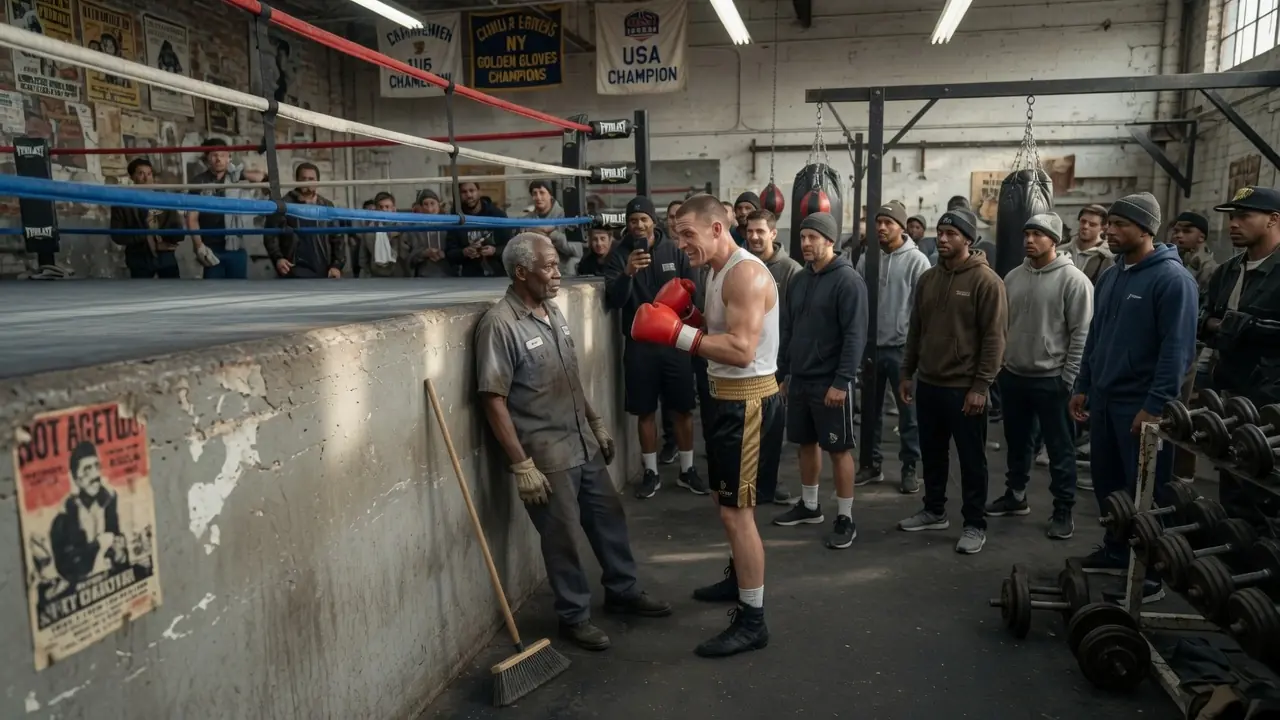
Marcus twisted.
His balance vanished.
The undefeated champion stumbled across the ring and crashed shoulder-first into the ropes.
The ropes threw him backward.
He fell onto the canvas.
No one laughed.
No one moved.
Marcus sat up, stunned.
Elijah stood exactly where he had finished the single step.
His hands were still open.
His breathing had not changed.
From outside the ring, Noah whispered, “What was that?”
Elijah looked at Marcus.
“A man falling over his own anger.”
The words cut more deeply than any punch.
Marcus scrambled to his feet.
His face had turned red.
“That wasn’t boxing.”
“No,” Elijah said. “It was balance.”
“You tripped me.”
“I touched you twice.”
“You cheated.”
“You said one punch. You threw one punch.”
Marcus ripped the gloves from his hands and tossed them toward the corner.
“I’m not finished.”
Elijah’s expression became colder.
“I am.”
He turned toward the ropes.
Marcus charged from behind.
No warning.
No gloves.
Just rage.
Noah shouted.
Elijah heard the canvas shift beneath Marcus’s feet.
He turned, lowered his center of gravity, and caught the champion’s wrist as a wild fist passed his shoulder. In one smooth motion, Elijah stepped across Marcus’s body and rotated his hips.
Marcus left the floor.
For a fraction of a second, the undefeated boxer was completely airborne.
Then he landed flat on his back.
The sound echoed through the building.
Heavy bags swayed in the silence.
Elijah kept hold of Marcus’s wrist but did not twist it. He placed one knee beside the champion’s shoulder, controlling him without pressing down.
Marcus stared up at the old custodian.
For the first time since anyone at Titan Forge had known him, he looked afraid.
Elijah leaned closer.
“Never attack a man from behind,” he said quietly. “Especially when you don’t know where he learned to stand.”
He released Marcus immediately and rose.
No celebration.
No raised fists.
No smile.
He simply stepped through the ropes, returned to the wall, picked up his work gloves, and placed them back on his hands.
The fighters watched him in disbelief.
Elijah lifted the broom.
Then he began cleaning the spilled water.
Marcus remained on the canvas.
Victor Hale hurried into the ring.
“Are you hurt?”
Marcus shoved him away and stood.
“Who is he?”
Victor looked toward Elijah.
The old custodian did not react.
Marcus climbed out of the ring, ignoring the hand offered by his coach.
“I asked you a question,” he said. “Who is he?”
Victor’s eyes moved around the room.
Every fighter was listening.
“He cleans the gym.”
Marcus grabbed Victor’s shirt.
“I know what he does here. Who is he?”
Victor pulled the champion’s hand away.
“You should go cool off.”
Marcus pointed toward Elijah.
“That old man just threw me across the ring.”
“You threw yourself.”
Marcus’s eyes narrowed.
Victor had repeated Elijah’s words.
That made the humiliation worse.
Darren Cole approached Marcus carefully.
“Forget it. Nobody recorded anything.”
Dozens of heads turned.
A young amateur near the speed bags slowly lowered his phone.
Marcus crossed the gym in three strides and snatched it away.
“You post that, and I’ll end your career.”
He deleted the video, then searched the room for other phones.
“Anyone else?”
Nobody answered.
Marcus pointed at Elijah.
“You’re fired.”
Elijah continued mopping.
Marcus looked at Victor.
“Fire him.”
Victor hesitated.
It was a small hesitation, but everyone noticed.
Marcus stepped closer.
“My sponsors keep this place open. My name sells your memberships. Either he goes, or I go.”
Victor’s face tightened.
He had owned Titan Forge for eleven years. For most of that time, the gym had struggled. The roof leaked. The heating failed every winter. Some months Victor had paid trainers with money borrowed against his house.
Then Marcus Kane began winning.
Membership tripled.
Sponsors arrived.
Television crews rented the building.
Victor finally replaced the roof, bought new equipment, and paid his debts.
Marcus knew exactly how much power that gave him.
Victor looked at Elijah.
“Brooks, come to my office.”
Elijah leaned the mop against his cart.
“No need.”
He untied the gray apron around his waist and folded it.
Victor lowered his voice.
“I didn’t say you were fired.”
“You were going to.”
“It’s complicated.”
“No,” Elijah replied. “It’s expensive. That’s different.”
Victor looked ashamed.
Elijah removed a ring of keys from his belt and placed it in Victor’s palm.
“I repaired the loose floorboard near bag six. The boiler still needs a new pressure valve. And the rear exit sticks when it rains.”
“Brooks—”
“The supply order comes Thursday.”
He turned toward Noah.
The teenager stood frozen beside the ring.
“Keep your feet under you,” Elijah said.
Then he walked toward the locker room to collect his coat.
Marcus watched him go.
“Good,” he muttered. “Now maybe we can train without the help acting like they own the place.”
An older trainer named Samuel Ortiz turned away in disgust.
Marcus noticed.
“You got something to say, Sam?”
Samuel had coached fighters for thirty-seven years. His face was lined, and his ears were thick with old scar tissue.
He looked from Marcus to the ring.
“Not yet.”
That evening, the gym was quieter than usual.
Marcus resumed training, but his punches lacked rhythm. Every time he threw his right hand, he remembered Elijah stepping outside his lead foot.
One step.
No panic.
No wasted movement.
Marcus hit the bag harder.
His coach called combinations.
Marcus ignored them.
Across the room, Noah practiced the same step repeatedly.
Left foot outside.
Turn.
Guide the arm.
Block the path.
Samuel watched him.
“You’ll hurt yourself doing something you don’t understand.”
Noah stopped.
“What did Mr. Brooks do?”
Samuel looked toward Victor’s office.
“I’m trying to remember.”
“You’ve seen it before?”
“Maybe.”
Samuel walked to an old cabinet near the rear wall. It contained damaged gloves, faded photographs, newspaper clippings, and programs from fights held decades earlier.
He searched through a stack of yellowing papers.
Noah followed.
“What are you looking for?”
“A ghost.”
Samuel found a photograph from 1982.
It showed six young men standing in front of a boxing ring at the Cleveland Municipal Athletic Center. Five wore gloves and satin robes.
The sixth stood behind them in a plain white shirt.
He was lean, serious, and unmistakable.
Noah pointed.
“That’s him.”
Samuel wiped dust from the photograph.
The name written on the back had faded, but several letters remained visible.
E. Brooks.
Samuel sat down slowly.
“I knew I’d seen those eyes.”
“Was he a boxer?”
Samuel did not answer.
He searched deeper in the cabinet and found an old tournament program.
The pages were brittle.
Inside was a black-and-white picture of a young fighter standing in a defensive posture. Beneath it were the words:
ELIJAH “QUIET” BROOKS
National Amateur Champion
156 Pounds
Noah read the line twice.
“He was a champion?”
Samuel turned the page.
There were more photographs.
Elijah holding a regional trophy.
Elijah beside Olympic hopefuls.
Elijah sparring with a heavyweight contender who later became world champion.
Then came a newspaper clipping with a darker headline.
PROMISING BOXER DISAPPEARS AFTER TRAINING TRAGEDY
Samuel read silently.
“What happened?” Noah asked.
Samuel’s expression changed.
“Another fighter died.”
The clipping described a private sparring session in February 1985. Elijah Brooks, then twenty-seven years old and considered one of the finest defensive fighters in the Midwest, had been preparing for his professional debut.
His sparring partner was Daniel Reed, Elijah’s closest friend.
During the sixth round, Daniel complained of a headache. The head trainer ordered the session to continue.
Minutes later, Daniel collapsed.
He never regained consciousness.
The gym denied responsibility.
Witnesses changed their statements.
The trainer blamed Elijah for striking too hard.
Though the investigation found no criminal wrongdoing, Elijah vanished from competition before his first professional fight.
Samuel folded the clipping.
“They made him carry it,” he said.
“Was it his fault?”
“No.”
“How do you know?”
“Because Daniel Reed was my cousin.”
Noah stared at him.
Samuel looked toward the empty cleaning cart.
“I was nineteen. Elijah stayed at the hospital all night. He paid for the funeral when the gym refused. After that, he wouldn’t throw another hard punch.”
“Where did he go?”
“Factories. Warehouses. Maintenance jobs. Anywhere nobody asked him to fight.”
Noah glanced toward Marcus.
The champion was sparring aggressively, punishing a younger boxer against the ropes.
“Does Victor know?”
Samuel closed the cabinet.
“He knows more than he pretends.”
The next morning, a video appeared online.
Someone had recorded the confrontation from the upstairs cardio room. The angle was distant, but clear enough to show Marcus shoving Elijah into the wall, issuing the challenge, missing his punch, and falling.
By noon, the video had been viewed two million times.
By evening, it had reached nine million.
Sports channels replayed the single step in slow motion.
Commentators debated whether it was judo, boxing footwork, wrestling, or simple physics.
The headline spread everywhere:
UNDEFEATED CHAMPION DROPPED BY ELDERLY CUSTODIAN
Marcus’s sponsors began calling.
His management team rushed to the gym.
Victor locked himself in his office.
Reporters gathered outside Titan Forge.
Marcus watched the video again and again.
Not because he wanted to understand Elijah’s movement.
Because he wanted to find a way to make it look accidental.
“It was a wet canvas,” he told his manager.
“The canvas was dry.”
“He grabbed my arm.”
“You challenged him.”
“He attacked me after the punch.”
“The video shows you charging him from behind.”
Marcus threw the phone against the wall.
His manager waited for the pieces to stop sliding.
“You need to apologize.”
“I’m not apologizing to a janitor.”
“You may lose three sponsorships by Friday.”
“I’ll knock out Raymond Price next month, and they’ll come back.”
“Not if the commission suspends you for assaulting an elderly employee.”
Marcus paced across the office.
“Find Brooks.”
“For what?”
“I’ll offer him money.”
“To stay quiet?”
“To say it was staged.”
His manager stared at him.
“You still don’t understand what people are angry about.”
“They’re jealous.”
“They watched a champion humiliate a man who was cleaning his floor.”
Marcus stepped closer.
“I made this gym.”
“No. You made yourself famous inside it.”
The distinction enraged him.
Outside the office, Noah sat on a bench beside Samuel.
“Do you know where Mr. Brooks lives?” he asked.
Samuel did.
Elijah rented a small apartment above an appliance repair shop three miles from the gym.
That evening, Noah rode his bicycle there through cold autumn rain. He carried the old tournament program inside his jacket.
Elijah answered the door wearing a plain sweater and dark trousers.
He looked at Noah’s soaked hair.
“You’re going to catch pneumonia.”
“Can I come in?”
Elijah stepped aside.
The apartment was modest and carefully kept. A small kitchen opened into a narrow living room. There were no trophies on the shelves. No championship photographs on the walls.
Only books, a wooden radio, and a framed picture of two young men standing outside an old boxing gym.
Noah recognized Elijah.
The other man had to be Daniel Reed.
Elijah handed him a towel.
“What happened at the gym?”
“Nothing.”
“Then why are you here?”
Noah placed the tournament program on the table.
Elijah looked at it but did not touch it.
“Coach Samuel found this.”
“I see.”
“You were a national champion.”
“A long time ago.”
“Why didn’t you tell anyone?”
“Nobody asked.”
“I asked if you boxed once.”
“You asked if I could show you how to wrap your hands.”
Noah sat down.
“The whole world is watching that video.”
“I don’t have a computer.”
“They’re calling you the one-step master.”
Elijah almost smiled.
“That sounds foolish.”
“Reporters want to interview you.”
“They’ll lose interest.”
“Marcus says you cheated.”
“That doesn’t interest me either.”
Noah leaned forward.
“He fired you.”
“Marcus didn’t employ me.”
“Victor let you leave.”
“That was Victor’s decision.”
“You should go back.”
Elijah’s eyes hardened slightly.
“No.”
“Why not?”
“Because a place that allows cruelty until it becomes embarrassing has not changed. It has only become embarrassed.”
Noah lowered his head.
Rain tapped against the window.
After a moment, he asked, “Did you stop boxing because Daniel Reed died?”
Elijah looked toward the framed photograph.
Samuel had probably expected anger.
Instead, Elijah appeared tired.
“He was twenty-five,” he said. “He had a daughter who had just learned to walk.”
“Was it your punch?”
“It was many things.”
Elijah sat opposite him.
“Daniel had headaches for weeks. The trainer knew. The doctor hired by the gym knew. I knew he looked wrong that afternoon, but Daniel told me he needed the rounds. We were young men in a sport that teaches you to treat pain like a weakness.”
“You didn’t know he would die.”
“No. But I knew he should have stopped.”
Elijah looked at his hands.
“I followed an order instead of my conscience. That was enough.”
“So you never fought again?”
“I promised his mother I would never use what I knew for pride.”
“But you used it on Marcus.”
“I prevented him from hitting me.”
“And when he attacked from behind?”
“I prevented him from hitting me again.”
Noah considered that.
“Could you teach me?”
Elijah shook his head.
“I already have.”
“A few tips aren’t the same.”
“They are the beginning.”
“I want to fight like you.”
Elijah looked directly at him.
“No, you don’t.”
“Yes, I do.”
“You want to move like me. That is different.”
Noah became quiet.
Elijah pointed toward the floor.
“Stand up.”
The teenager obeyed.
“Show me your stance.”
Noah raised his fists.
Elijah tapped his front knee.
“Too stiff.”
He nudged Noah’s rear heel.
“Too heavy.”
He touched the teenager’s shoulder.
“Too much fear hiding as tension.”
Noah lowered his hands.
“How can you tell?”
“Because I stood that way once.”
For the next hour, Elijah taught him no punches.
Only balance.
How to stand without locking the knees.
How to step without bringing the feet together.
How to turn the body without leaning.
How to breathe while someone approached.
Before Noah left, Elijah handed him an umbrella.
“Bring it back when the rain stops.”
“Will you come watch my amateur fight Saturday?”
“No.”
Noah tried to hide his disappointment.
Elijah continued, “But I may come watch you train tomorrow.”
The following afternoon, Elijah entered Titan Forge through the front door.
Reporters surrounded him immediately.
Microphones appeared near his face.
“Mr. Brooks, were you a professional fighter?”
“Did you intend to humiliate Marcus Kane?”
“Will you accept a rematch?”
“Are you suing the gym?”
Elijah continued walking.
Victor hurried from his office.
“Give him room!”
The reporters followed until Samuel and several trainers formed a barrier.
Marcus stood near the ring.
The gym had expected Elijah to return as a victim seeking compensation.
Instead, he wore the same gray uniform.
His work gloves were tucked into one pocket.
Victor approached him.
“I didn’t expect you.”
“I came for my final paycheck.”
Victor lowered his voice.
“I want to offer you your job back.”
Elijah looked around at the cameras.
“Because you need a custodian?”
Victor’s face flushed.
“Because I handled the situation badly.”
“You did nothing.”
“I know.”
“That was the situation.”
Victor swallowed.
“I’m sorry.”
Elijah studied him long enough to make the apology uncomfortable.
Then he nodded once.
“Thank you for saying it.”
Marcus crossed the gym.
His manager reached for his arm, but Marcus pulled free.
He stopped several feet from Elijah.
The cameras turned toward them.
“I want to clear something up,” Marcus announced.
Elijah waited.
Marcus forced a smile.
“What happened yesterday was a misunderstanding. Things got heated after training. Mr. Brooks and I were messing around.”
Elijah’s expression did not change.
Marcus continued.
“The video makes it look worse than it was.”
“You pushed me into a wall,” Elijah said.
The smile weakened.
“I apologized privately.”
“No, you didn’t.”
Marcus glanced at the cameras.
His manager closed his eyes.
Marcus lowered his voice.
“What do you want?”
“Nothing from you.”
“I can pay you.”
“For what?”
“To appear at the press conference. We shake hands. You say there are no hard feelings.”
“There are no hard feelings.”
Marcus relaxed.
Elijah continued.
“But I won’t lie.”
Marcus stepped closer.
“You think one lucky move makes you better than me?”
“No.”
“You think these people came here for you?”
“No.”
“You think you could last one round with me?”
Elijah looked toward the ring.
Then back at Marcus.
“At your age, with your strength, you should defeat me easily.”
Marcus smiled.
“But?”
“But strength is the smallest thing you are missing.”
The reporters erupted with questions.
Marcus’s face twisted with fury.
His manager moved between them.
“Enough.”
Elijah collected his paycheck from Victor and turned to leave.
Noah stood near bag six wearing headgear and amateur gloves.
Elijah stopped.
“You’re crossing your feet again.”
Noah corrected them immediately.
A few fighters laughed softly—not at Elijah, but with recognition.
Marcus heard it.
That small sound wounded him more than the viral video.
During the next several days, his behavior worsened.
He sparred too hard.
He dismissed his coach’s instructions.
He insulted younger fighters.
He spent hours arguing with strangers online.
Meanwhile, Elijah began visiting the gym in the evenings—not as an employee, but to help Noah prepare for his first amateur bout.
Other fighters watched from a distance.
Then one asked a question.
“How do I stop leaning when I slip?”
Another followed.
“Why do I lose balance after my left hook?”
Elijah answered briefly.
Soon six fighters were standing around him.
Then twelve.
Samuel gave him a pair of focus mitts.
Elijah refused them.
“I’m not coaching.”
Samuel smiled.
“Of course not.”
Elijah taught them without throwing a punch.
He placed strips of tape on the floor and made fighters move along them.
He balanced coins on their shoulders to expose unnecessary tension.
He had heavyweights practice stepping around empty chairs.
He made professionals spend entire rounds without striking, learning to control distance with their feet.
At first, they found it ridiculous.
Then they began landing more cleanly during sparring.
They stopped wasting energy.
They became harder to hit.
Noah improved fastest.
He was not powerful, but he learned patience. He stopped reacting to every feint. He waited until opponents committed, then moved just beyond reach.
On Saturday, Elijah attended Noah’s amateur fight.
Marcus was also there, seated ringside for publicity.
Noah’s opponent was stronger and more experienced. In the first round, he drove Noah backward with heavy combinations.
The crowd shouted for Noah to fight back.
Elijah sat silently.
Between rounds, Noah looked toward him.
Elijah touched one finger to his own chest.
Breathe.
Then he pointed toward the floor.
Keep your feet under you.
In the second round, Noah stopped retreating in straight lines.
He stepped outside.
Turned.
Let punches pass.
By the third round, the stronger boy was exhausted.
Noah won by decision.
The first person he approached after leaving the ring was Elijah.
“Did I cross my feet?”
“Twice.”
Noah laughed.
Marcus watched the embrace from several seats away.
The audience had cheered louder for the unknown teenager than they had when Marcus entered the building.
Afterward, a reporter asked Elijah whether he planned to train fighters professionally.
“No.”
“Why not?”
“I’m helping a boy.”
“Several professionals say you’ve improved their defense.”
“They were willing to listen.”
The quote spread online.
Marcus saw it before midnight.
They were willing to listen.
He interpreted every word Elijah spoke as an attack.
His title eliminator took place three weeks later.
Raymond Price was a disciplined contender from Philadelphia. He lacked Marcus’s knockout power, but he had excellent footwork and a patient jab.
Before the fight, Marcus promised a first-round knockout.
Instead, he spent the opening rounds chasing Raymond around the ring.
Every time Marcus loaded his right hand, Raymond stepped outside his lead foot.
One step.
Turn.
Disappear.
The same movement Elijah had used.
By the seventh round, Marcus was breathing through his mouth.
By the ninth, he was swinging wildly.
Raymond dropped him with a short counter left.
Marcus rose before the count of ten but lost by unanimous decision.
His undefeated record was gone.
In the locker room, he blamed everyone.
His coach.
The referee.
The judges.
The media.
Even Elijah.
“He put that move in Price’s head,” Marcus shouted.
His trainer stared at him.
“Every trained boxer knows that step.”
“Not like that.”
“You lost because you spent a month protecting your pride instead of correcting your feet.”
Marcus threw a stool across the room.
His trainer removed his credential badge and placed it on the table.
“I’m done.”
Within days, Marcus’s team began falling apart.
His sponsors reduced their offers.
Victor removed the giant Marcus Kane banner from the front of Titan Forge.
The gym did not close.
In fact, membership continued growing because fighters wanted to learn from the mysterious old custodian.
Elijah still refused the title of coach.
Then Victor made him a different offer.
“Director of fighter safety.”
Elijah raised an eyebrow.
Victor explained that the gym needed someone independent—someone who could stop sparring sessions, review medical clearances, and overrule trainers when fighters showed signs of injury.
“You want me to protect people from the mistake that killed Daniel,” Elijah said.
“Yes.”
“Why now?”
Victor did not hide behind business language.
“Because I watched Marcus shove you, and I chose money. I told myself I was protecting the gym. The truth is, I was protecting my comfort.”
Elijah remained silent.
Victor placed a set of keys on the desk.
“I can’t undo what I allowed. But I can make sure nobody here is treated as disposable again.”
Elijah looked at the keys.
Then through the office window at Noah practicing with Samuel.
“I want written authority to stop any session.”
“You’ll have it.”
“Medical records available before hard sparring.”
“Agreed.”
“No retaliation against fighters who report symptoms.”
“Agreed.”
“And the custodial staff receives health insurance.”
Victor blinked.
“All of them?”
“All three.”
Victor nodded.
“Agreed.”
Elijah picked up the keys.
Months passed.
Titan Forge changed.
The gym remained loud and competitive, but the cruelty that had once been excused as toughness began disappearing.
Elijah stopped sparring sessions when fighters became reckless.
He sent one promising amateur to the hospital after noticing delayed reactions and uneven pupils. Doctors found a brain bleed early enough to treat it.
He created rules limiting hard rounds.
He required coaches to record injuries.
He also continued sweeping floors whenever the evening custodian needed help.
When people told him the work was beneath his new position, he replied, “A clean floor keeps fighters standing.”
Marcus stayed away.
After his loss, he trained at several different gyms, but arguments followed him. Coaches tried to repair his technique. Marcus rejected them whenever criticism became uncomfortable.
Eight months later, he returned to Titan Forge.
It was after closing.
Rain fell against the front windows.
Elijah was alone near the ring, replacing frayed tape on a corner pad.
Marcus entered wearing a hooded sweatshirt.
He looked thinner.
The confidence that once filled every room had become something guarded and brittle.
Elijah continued working.
“We’re closed.”
“I know.”
Marcus stood beside the ring.
For nearly a minute, neither man spoke.
Then Marcus said, “I watched the Price fight thirty times.”
Elijah pulled the tape tight.
“That sounds unpleasant.”
“He used your step.”
“He used a basic angle.”
“I couldn’t stop it.”
“You could have.”
Marcus’s jaw tightened.
“How?”
“By seeing it.”
“I did see it.”
“You saw what it did to you. You didn’t see why you kept allowing it.”
Marcus looked away.
“I need a coach.”
“There are many good coaches.”
“They don’t understand.”
“They understand boxing.”
Marcus lowered his voice.
“I need someone who understands what happened to me.”
Elijah stopped taping the corner.
“What happened to you?”
Marcus appeared ready to blame someone.
Then, slowly, the fight left his face.
“I became afraid.”
Elijah waited.
Marcus continued.
“Before every fight, I was afraid people would discover I wasn’t special. So I trained harder than everyone. Then I started winning, and people told me I was special. After that, I became afraid of losing it.”
He looked around the gym.
“When that bottle spilled, I’d had a bad sparring session. Cameras were coming the next day. My shoulder hurt. Everyone was watching me.”
“So you chose someone you believed could not fight back.”
Marcus nodded.
The admission seemed to cost him more than any defeat.
“I’m sorry.”
Elijah said nothing.
Marcus looked at him.
“I know that doesn’t fix it.”
“No.”
“I know you don’t owe me anything.”
“No.”
“But I’m asking.”
“For training?”
“For help.”
Rain continued tapping against the glass.
Elijah climbed down from the ring apron.
“Take off your shoes.”
Marcus frowned.
“What?”
“Take them off.”
Marcus obeyed.
Elijah placed two strips of white tape on the floor, forming a narrow line.
“Stand there.”
Marcus stepped onto it.
“Raise your hands.”
Marcus took his familiar fighting stance.
Elijah tapped his shoulder.
“Too much tension.”
He nudged Marcus’s rear heel.
“Too heavy.”
Then he touched the center of Marcus’s chest.
“Too much fear hiding as anger.”
Marcus lowered his eyes.
“That’s what you told Noah.”
“Noah listened the first time.”
For the first time, Marcus smiled without arrogance.
“What do I do?”
“Stand correctly.”
“That’s all?”
“That is where everyone begins.”
For six months, Elijah did not allow Marcus to spar.
The former champion hated it.
He practiced footwork beside teenagers.
He cleaned equipment after sessions.
He apologized publicly to the gym staff and privately to Victor.
Several people refused to forgive him.
Elijah did not force them.
“An apology is not a purchase,” he told Marcus. “You don’t pay it and demand something back.”
Marcus learned to remain silent when criticism stung.
He learned to help beginners without making them feel small.
He learned that respect gained slowly felt different from fear gained quickly.
When he finally returned to competition, there was no giant entourage.
No cruel jokes.
No predictions of an easy knockout.
Before entering the ring, Marcus found Elijah near the locker room.
“Any advice?”
Elijah adjusted the tape around Marcus’s glove.
“Your opponent’s left hand drops after his jab.”
Marcus nodded.
“And Marcus?”
“Yes?”
“Whether you win or lose, you still have to wake up as yourself tomorrow.”
Marcus absorbed the words.
Then he entered the arena.
He did not win by knockout.
He won a difficult ten-round decision by staying patient, controlling distance, and refusing to chase his opponent’s insults.
After the final bell, Marcus did not climb the ropes.
He did not point at the cameras.
He crossed the ring and bowed to his opponent.
Later, reporters surrounded him.
They asked what had changed.
Marcus looked toward the back of the arena, where Elijah stood beside Noah and Samuel.
“I spent years believing power meant making people afraid of me,” Marcus said. “Then an old man moved one step, and I learned power is knowing exactly how much force not to use.”
The quote appeared in newspapers the next morning.
Elijah cut it out.
Not for himself.
He placed it inside the old tournament program and gave it to Noah, who was preparing to leave for college on a boxing scholarship.
Years later, visitors to Titan Forge would ask about the framed photograph hanging beside the main ring.
It showed an elderly man in a faded gray work uniform holding a broom. Around him stood champions, amateurs, trainers, and custodians.
There was no belt around Elijah’s waist.
No gloves on his hands.
Beneath the photograph was a small metal plate.
It did not mention his amateur titles.
It did not mention the viral video.
It did not call him a master, a legend, or a hero.
It contained only the sentence he had repeated to every fighter who entered the gym with more pride than balance:
Keep your feet under you.
Because the most important lesson Elijah Brooks ever taught was not how to defeat another person.
It was how to stand firmly enough that anger, fear, fame, and humiliation could not knock you away from the man you were supposed to become.