Everyone at the auction laughed when Walter Henley raised his hand.
The object sitting near the back fence of Ralston Industrial Salvage looked less like something worth buying and more like something the auction company had forgotten to throw away.
It was a rectangular steel box, nearly five feet long and three feet high, covered in reddish-brown rust. There were no hinges, handles, locks, or visible openings. Every edge had been welded shut beneath thick beads of metal.
The auctioneer struck the side with the wooden handle of his microphone.
“Lot eighty-seven. One sealed steel container of unknown purpose and unknown contents. Buyer assumes all responsibility for removal.”
A man in a clean work shirt called from the crowd.
“Does the rust come free?”
Laughter moved through the bidders.
The auctioneer smiled.
“We’re selling by the box, not by the pound. Who’ll give me one hundred dollars?”
No one moved.
“Fifty?”
A scrap dealer named Curtis Malloy examined the box from several feet away.
“Thirty, and only if your boys load it.”
The crowd laughed again.
Walter stood near the rear, wearing faded overalls beneath an old canvas jacket. At seventy-two, he was narrow through the shoulders, slightly stooped, and missing the tip of his left index finger.
Most people in Harlan County knew him as Walt.
For nearly fifty years, he had welded farm gates, repaired broken trailers, rebuilt hay balers, and patched machinery that younger technicians declared too old to save. He rarely attended auctions unless he needed a specific tool or piece of equipment.
That morning, he came looking for a used metal brake.
He had not expected to see the box.
The first time he walked past it, nothing seemed unusual.
The second time, he noticed the weld on the lower right corner.
He stopped.
Most welders developed habits they did not know they possessed. Some pulled their bead slightly left. Others paused too long at the edges. Certain men cleaned every pass. Others left slag buried where no customer would notice.
The weld on the box had been laid in a slow double crescent.
Forward.
Back.
Forward again.
Walt had not seen that pattern in thirty-eight years.
He moved closer.
The box sat on two rotting wooden beams. Heavy steel bands had been welded around its width at four separate points, reinforcing the walls from the outside.
That bothered him.
If someone wanted to keep thieves out, they would reinforce the corners and add a lock.
These bands were positioned to resist pressure pushing outward.
Walt crouched despite the pain in his left knee.
Near one end, he found a short piece of pipe no wider than his thumb. It had once served as a vent, but someone had crushed the end flat and sealed it with a final spot weld.
His mouth became dry.
The auctioneer lowered the opening price.
“Twenty dollars.”
Curtis raised two fingers.
“Twenty.”
The auctioneer pointed.
“I have twenty. Do I hear thirty?”
Walt lifted his hand.
“Thirty.”
Several people turned.
Curtis looked over his shoulder.
“You planning to build a submarine, Walt?”
“Maybe.”
The auctioneer continued.
“Forty?”
Curtis shrugged.
“Forty.”
Walt studied the lower weld.
Beneath the rust, faint but still visible, were two shallow hammer marks beside the bead.
One round.
One square.
His chest tightened.
“Sixty,” Walt said.
Curtis laughed.
“You can have it.”
The auctioneer looked around.
“Sixty dollars once. Sixty dollars twice.”
The gavel struck the podium.
“Sold to Walter Henley.”
A younger farmer slapped Walt lightly on the shoulder.
“You just paid sixty dollars for a coffin with no door.”
Walt kept looking at the box.
“That’s what worries me.”
Two forklift operators loaded it into the bed of his old Ford pickup. The truck’s suspension dropped several inches beneath the weight.
The auction clerk handed him the receipt.
“Any idea what’s inside?”
“No.”
“You want us to cut it open before you leave?”
Walt folded the receipt.
“No.”
“Could save you trouble.”
“I’d rather open it myself.”
He secured the box with two chains.
Then he drove away while the auction continued behind him.
Ralston Industrial Salvage occupied what remained of the old Vale Manufacturing complex outside Bell Ridge, Kentucky. For forty years, the company had built pressure tanks, mining equipment, and steel assemblies for factories across three states.
Walt had worked there from 1972 until 1986.
His younger brother, Thomas, had worked beside him.
Tommy Henley was twenty-eight when he disappeared.
The police concluded that he stole nearly eighteen thousand dollars from the company payroll office and fled the state.
The newspapers printed his photograph beneath the word THEFT.
Vale Manufacturing’s owner offered a reward for his arrest.
Walt never believed the story.
Tommy had been careless with money, quick-tempered, and too willing to argue with supervisors. But he was not a thief.
More importantly, he would not have abandoned his six-year-old daughter.
Tommy’s truck was found at the Cincinnati bus station. A ticket agent remembered selling a cash ticket to a man matching his description.
The trail ended there.
The family waited.
Tommy’s wife eventually moved to Tennessee. His daughter grew up believing her father had chosen to disappear.
Walt spent years checking telephone directories, police bulletins, and letters sent from strangers claiming they had seen him.
No answer ever came.
Then Vale Manufacturing closed.
The main buildings changed owners twice. A warehouse burned. Records disappeared. Machines were sold. People retired, died, or decided that old questions no longer mattered.
Walt kept asking anyway.
By the time he reached his property that afternoon, rain had begun striking the windshield.
His workshop stood behind a small white farmhouse on twelve wooded acres. The building was made from concrete block and corrugated metal, with a chimney near the rear and a wide sliding door facing the drive.
Walt backed the truck inside.
He lowered the door.
Then he locked it.
The workshop smelled of welding smoke, cutting oil, and old wood. Tools hung above a scarred workbench. Shelves contained coffee cans filled with bolts, fittings, springs, and pieces of metal he had saved because they might be useful someday.
Walt switched on the overhead lights.
The steel box rested in the truck bed like something dug from the earth.
He did not unload it immediately.
Instead, he made coffee.
His hands remained steady while he filled the kettle, but he forgot to add grounds to the machine. He noticed only after clear hot water began dripping into the pot.
Walt poured it out.
“Get hold of yourself,” he muttered.
He moved a hydraulic engine hoist beside the pickup and attached chains to the bands around the box. Slowly, the hoist lifted the container from the truck.
It weighed perhaps eight hundred pounds.
Too heavy to be empty.
Walt lowered it onto steel rollers and pushed it toward the center of the shop.
Rain drummed against the roof.
He spent the next hour cleaning sections of rust from the seams with a wire wheel.
The welds became clearer.
The side seams had been made by different hands.
One welder moved quickly and unevenly.
Another laid short, heavily reinforced passes.
But the final top weld used the double-crescent motion Walt remembered.
He had taught that movement to Tommy.
Their father, Earl Henley, used it when welding cracked farm equipment. He claimed the backward motion reduced undercut along dirty steel.
Walt had abandoned the technique years later after modern welding instructors criticized it.
Tommy never did.
Walt ran one finger above the bead.
“Did you do this?”
The workshop answered only with rain.
He inspected the external bands.
They had been added after the main box was sealed. Each band contained short vertical braces intended to prevent the side panels from bowing.
He struck the center wall lightly with a rubber mallet.
The sound was dull.
Something dense occupied most of the interior.
Near the vent tube, he found scratches in the steel.
Not random rust damage.
Parallel marks.
Four together.
Then another set beneath them.
Walt stepped back.
He did not want to imagine what could have made them.
The clock above the workbench showed 4:36.
He considered calling Sheriff Daniel Rowan.
Then he imagined explaining that a box purchased at a salvage auction reminded him of his missing brother because of the shape of a weld.
Daniel would come.
The sheriff had known Walt for thirty years.
But the box might contain nothing more than scrap steel, casting sand, or old machine parts.
Walt needed one fact before he called anyone.
He rolled the plasma cutter toward the box.
Before connecting it, he inspected the vent again.
Whoever sealed the container had left the vent open while completing the long welds. That was normal. Welding a completely closed container could cause heated air to expand and rupture the metal.
But the vent had been crushed and sealed only after the box cooled.
Whatever was inside had been intentionally isolated from the outside air.
Walt looked at the reinforcement bands.
“This wasn’t sealed to keep people out,” he said quietly.
He touched one of the braces.
“It was sealed to keep something in.”
The words sounded foolish once spoken.
Yet the box had been built like a crude containment vessel rather than a safe.
He opened both workshop windows and positioned a large exhaust fan near the door. If the box contained chemicals, pressure, or combustible vapor, one careless spark could kill him.
Walt drilled a tiny hole near the former vent.
The bit broke through.
He stepped back immediately.
No gas escaped.
No pressure hissed.
He held a combustible-gas detector near the hole.
The reading remained normal.
Next, he inserted a small inspection camera.
The lens passed through darkness.
At first, the screen showed only rust and black space.
Then it touched something soft.
Canvas.
Walt rotated the cable.
A pale curved object appeared briefly beneath the fabric.
He froze.
It could have been plastic.
A handle.
A pipe.
Bone.
He withdrew the camera.
The rain had become heavier.
Walt disconnected the plasma cutter and reached instead for a cold metal saw. It would take longer, but it would create fewer sparks and less heat.
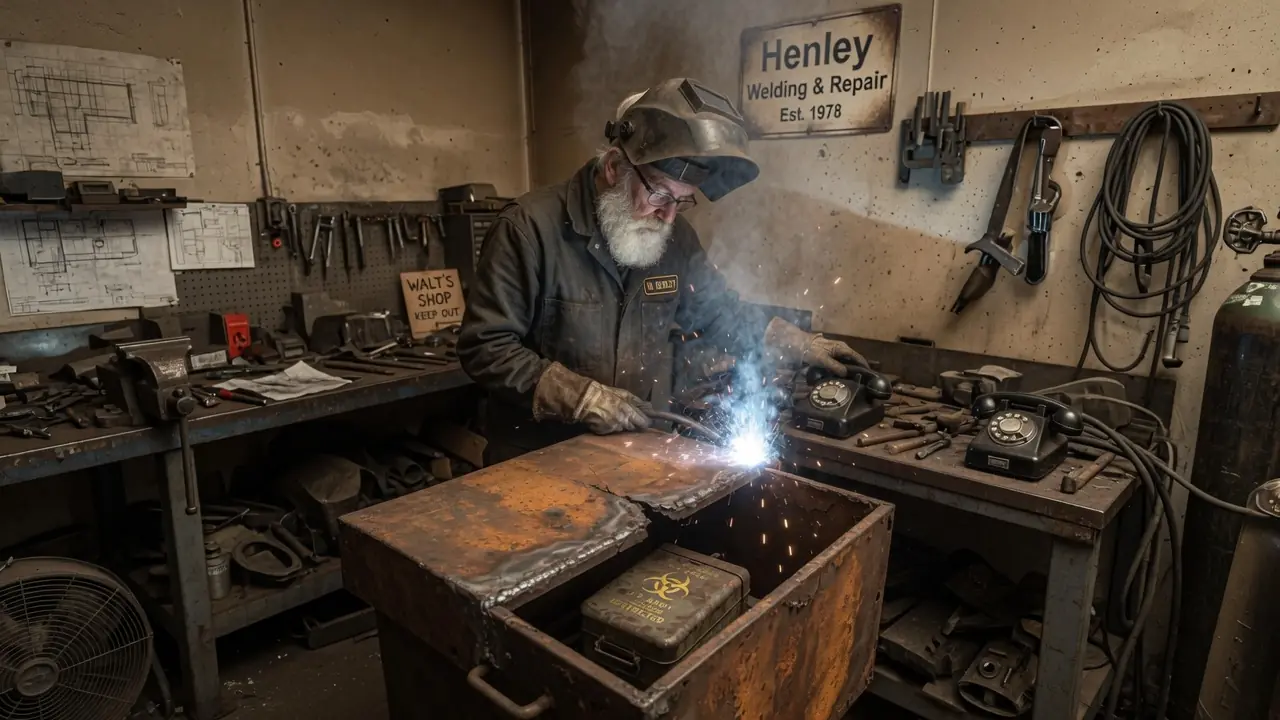
He marked a square near one end of the lid.
Then he began cutting.
The first side required twenty minutes.
The steel plate was three-eighths of an inch thick.
The second side took longer because his hands began to ache.
After the third cut, the section shifted slightly downward.
Something moved inside.
Not a mechanical click.
Not loose bolts rolling.
A heavy, soft movement.
Like a bundle settling after support beneath it had changed.
Walt switched off the saw.
The workshop became silent.
He listened.
Nothing moved again.
He completed the final cut.
The square of steel remained in place, supported by whatever rested beneath it.
Using a pry bar, he lifted one edge.
Air escaped from the opening.
It smelled stale, metallic, and faintly sweet.
Walt turned away and allowed the fan to clear it.
When he returned, he raised the plate another inch.
His flashlight beam entered the box.
The first thing he saw was red fabric.
Faded.
Covered in brown stains.
A work jacket.
On the chest was a white oval patch with blue stitched letters.
TOM
Walt dropped the pry bar.
The steel plate slammed shut.
He stood motionless, staring at the box.
His heart struck hard against his ribs.
The jacket meant nothing by itself.
Thousands of men were named Tom.
Vale Manufacturing had issued red work jackets to employees in the 1980s.
But Walt remembered stitching that patch onto his brother’s coat after the company laundry tore the original loose.
One side of the letter T had always leaned downward.
He had laughed about it.
Tommy had worn the jacket anyway.
Walt picked up the workshop phone.
His first attempt to dial failed because he pressed two numbers at once.
He hung up.
Then he called Sheriff Rowan.
“Daniel.”
“Walt?”
“I need you at my workshop.”
“What happened?”
“I bought something at the Vale auction.”
“What kind of something?”
“A welded steel box.”
There was a pause.
“Are you hurt?”
“No.”
“What’s inside?”
Walt looked toward the cut opening.
“I think my brother is.”
The sheriff arrived twelve minutes later with two deputies and an ambulance crew.
Daniel Rowan entered the workshop alone first.
He was sixty-one, heavy around the middle, and careful in the way of a man who had seen enough accidents to stop rushing toward things he did not understand.
He looked at Walt.
“Show me.”
Walt pointed toward the opening.
Daniel put on gloves and raised the steel section using the pry bar.
He shined a flashlight inside.
The red jacket appeared.
Beneath it was a human arm.
The skin was gone, but the bones remained inside the collapsed sleeve. A metal watch still encircled the wrist.
Daniel lowered the plate.
“Everyone out.”
The workshop became a crime scene.
State investigators arrived before dark. The county medical examiner came with a forensic anthropologist from Lexington. The fire department tested the box for hazardous substances before allowing anyone near it.
Walt sat inside the farmhouse while strangers photographed his workshop.
His daughter, Rebecca, drove from Bowling Green after Daniel called her.
She found him at the kitchen table with untouched coffee between his hands.
“Dad?”
Walt looked up.
Rebecca was forty-six, with her mother’s brown eyes and Tommy’s habit of rubbing one thumb against the side of her hand when nervous.
“They found a body,” Walt said.
“I know.”
“It may be Tommy.”
Rebecca sat beside him.
“You don’t know yet.”
“I know the jacket.”
“People had the same uniforms.”
“I sewed the patch.”
Rebecca covered his hand with hers.
For nearly forty years, the family had been forced to live between two possibilities.
Tommy had run away.
Or something prevented him from returning.
One answer carried shame.
The other carried grief.
Neither allowed peace.
Investigators worked until after midnight.
The top of the box was removed in sections. The remains inside belonged to an adult male lying on his right side. His wrists had been bound with steel wire.
Beside the body were a metal lunchbox, a portable cassette recorder, three accounting ledgers wrapped in plastic, and a canvas tool bag.
The lunchbox contained a wallet.
The driver’s license identified the man as Thomas Edward Henley.
The medical examiner still required dental and DNA confirmation.
Walt did not.
He recognized Tommy’s wedding ring, his watch, and the handmade leather belt their father had given him.
The tool bag contained something else Walt recognized.
A chipping hammer with a square head on one end and a rounded point on the other.
The same tool had created the marks beside the weld.
Tommy had left his signature on the outside of the box.
Or tried to leave a message.
The following morning, Sheriff Rowan sat across from Walt at the kitchen table.
“We need you to tell us everything you remember about the week Tommy disappeared.”
“I already told the police in 1986.”
“Tell me again.”
Walt looked toward the workshop.
State vehicles filled the yard.
“It was August.”
“Start with the last time you saw him.”
Walt closed his eyes.
Vale Manufacturing had been building large pressure vessels for a chemical company in Ohio. Each tank required radiographic inspection of critical welds before shipment.
Tommy worked in final assembly.
Walt supervised a repair crew.
For several weeks, Tommy complained that rejected welds were being ground, covered, and marked as approved without proper testing.
“He thought Vale was falsifying inspection records,” Walt said.
“Who was Vale?”
“Malcolm Vale. Owned the company.”
“Still alive?”
“Yes. Ninety-one, last I heard.”
Daniel made a note.
“Anyone else involved?”
“Plant manager named Russell Pike. Quality-control supervisor was Gerald Pruitt.”
“Both alive?”
“Pike died in 2003. Pruitt lives in Florida.”
“What did Tommy plan to do?”
“He said he copied the inspection books. He wanted to send them to the customer and the state.”
“Did you see the copies?”
“No.”
“Did you believe him?”
Walt stared into his coffee.
“Not enough.”
Daniel stopped writing.
“What does that mean?”
“I told him not to make accusations unless he had proof. He said he did.”
“What happened next?”
“The Friday before he disappeared, he fought with Pike near the loading bay. Tommy came home with a split lip.”
“Did he report it?”
“No.”
“The following Monday?”
“He worked day shift. I worked nights.”
Walt paused.
The memory had waited nearly four decades for someone to open the correct door.
“Pike called me into the fabrication bay around eleven.”
“What did he want?”
“He had a steel test container beside the furnace room. Said it contained chemical insulation waste from one of the pressure-vessel jobs.”
Daniel looked toward the workshop.
“The box?”
“I didn’t recognize it at the auction because it had rusted and the bands covered some of the seams.”
“What did Pike ask you to do?”
“Finish sealing the lid.”
The kitchen became silent.
Rebecca stood near the sink. She turned slowly.
“You welded it?”
Walt looked at his daughter.
“Part of it.”
His voice nearly failed.
“Pike said the morning crew had sealed three sides but the final seam leaked. He told me the waste had to be contained before an environmental inspector arrived.”
Daniel leaned forward.
“Did you look inside?”
“No.”
“Did you hear anything?”
Walt rubbed his left hand.
“I heard a shift when the crane set it down. Pike said the insulation rolls were settling.”
“Was the vent open?”
“Yes.”
“Who closed it?”
“Pike.”
“After you finished?”
Walt nodded.
“He crushed it with Tommy’s chipping hammer.”
Daniel stopped.
“You knew it was Tommy’s?”
“Not then. Half the tools in the plant looked alike.”
“What happened to the box?”
“Pike ordered a forklift driver to move it behind the old furnace building. He said a waste contractor would collect it.”
“And Tommy?”
“Didn’t come to work Tuesday.”
Walt’s face tightened.
“Pike told police Tommy stole payroll cash and ran. They found his truck in Cincinnati.”
“You believed the truck was planted?”
“I didn’t know what to believe.”
Rebecca’s eyes filled with tears.
“Uncle Tommy was inside while you welded it?”
Walt did not answer immediately.
The question had already begun consuming him.
“I don’t know whether he was alive.”
The medical examiner answered part of that question three days later.
Thomas Henley had suffered a severe blow to the left side of the skull. The injury was serious but not necessarily immediately fatal.
There were fractures on two fingers consistent with defensive wounds.
Most disturbing were the scratches found on the interior wall near the vent.
Microscopic examination showed they were made after the box had been sealed.
Tommy had been alive inside.
Perhaps for minutes.
Perhaps longer.
Walt received the news in Sheriff Rowan’s office.
He sat without moving.
Daniel spoke carefully.
“You did not know.”
“I welded the lid.”
“You were lied to.”
“I should have looked.”
“Pike was your supervisor. He gave you a plausible explanation.”
“A sealed steel box is never just a box.”
“You were thirty-four years old, working a night shift. You had a wife, two children, and a mortgage.”
Walt looked at him.
“Does that make the weld thinner?”
Daniel had no answer.
The cassette recorder found inside the box no longer worked, but the tape survived within its plastic case.
Forensic audio technicians cleaned the cassette and transferred the recording.
The sound was damaged.
Some sections contained only static and machinery noise.
Others were clear enough.
Tommy had hidden the recorder inside his jacket.
The first audible conversation took place in an office.
Malcolm Vale’s voice was identified through archived television interviews and family recordings.
“You copied company records,” Vale said.
“I copied inspection records,” Tommy answered.
“Those are company property.”
“They’re proof.”
“Proof of what?”
“You shipped bad tanks.”
A second voice belonged to Russell Pike.
“You don’t know what you’re talking about.”
“I welded two of those seams. I saw the rejection films.”
Vale’s voice became colder.
“You have a daughter, Thomas.”
“Don’t talk about my family.”
“You should think carefully about what happens to them if you destroy this company.”
The recording continued.
Tommy demanded that the defective tanks be recalled.
Vale refused.
Then came movement.
A chair struck the floor.
Someone shouted.
The audio became muffled.
The final clear sentence belonged to Tommy.
“You can hide the books, but you can’t hide every weld.”
A loud impact followed.
Then silence.
The cassette continued recording inside his jacket.
Several minutes later, voices returned.
Pike sounded frightened.
“He’s breathing.”
Vale answered.
“Then make sure he stops.”
Walt listened to the tape once.
He refused to hear it again.
The ledgers contained copies of weld-inspection results, shipping numbers, and handwritten changes. Several pressure vessels had failed initial tests but were sent to customers under falsified certificates.
One of those vessels ruptured at an Ohio chemical facility in 1988.
Two workers died.
The accident had been blamed on improper maintenance.
The new evidence suggested the tank was defective when it left Vale Manufacturing.
The case expanded beyond Tommy’s murder.
State police contacted federal investigators.
Attorneys reopened the Ohio accident file.
Reporters gathered outside Malcolm Vale’s assisted-living residence.
Vale had spent the last thirty years as a respected businessman and philanthropist. A technical-school building bore his name. He had donated money to hospitals, churches, and veterans’ programs.
His attorney issued a statement calling the recording unreliable and the allegations impossible to verify after so many years.
Then investigators found the forklift driver.
His name was Leonard Moss.
He was eighty-three and living in western Tennessee.
At first, Moss claimed he remembered nothing.
When detectives played part of the cassette, he began crying.
He admitted moving the box behind the furnace building.
“Pike told me it was waste,” he said.
“Did you believe him?”
“No.”
“Why did you move it?”
“I had four kids.”
“Did you hear anything?”
Moss covered his face.
“Three knocks.”
The interview room became quiet.
“From inside the box?”
“Yes.”
“What did you do?”
“I stopped the forklift.”
“What happened then?”
“Pike walked over. He looked at me and said if I wanted my family fed, I would keep driving.”
Moss obeyed.
The box remained behind the furnace building for several months. Later, company workers constructed a storage shed around that area, hiding the container behind equipment and obsolete dies.
When Vale Manufacturing closed, no one knew what it contained.
It entered the auction inventory as scrap.
Sixty dollars returned Tommy Henley to his family.
Malcolm Vale was arrested six weeks after the auction.
Because of his age and health, he appeared in court in a wheelchair. He wore a dark suit and oxygen tubes beneath his nose.
Walt attended the preliminary hearing.
Vale turned toward him once.
For a moment, they looked at each other across the courtroom.
Walt expected anger.
Instead, he felt something colder.
Recognition without respect.
Vale had forgotten Tommy’s body inside the box.
He had forgotten the brother he ordered to weld it.
He had forgotten because powerful men often assumed the things they buried stopped existing.
The court found sufficient evidence to proceed with charges including murder, kidnapping, obstruction, conspiracy, and falsification of safety records.
Gerald Pruitt, the former quality supervisor, agreed to testify in exchange for reduced charges.
He admitted altering inspection records under orders from Vale.
He also revealed that the payroll theft had been staged. Pike removed cash from the office while another employee drove Tommy’s truck to Cincinnati.
The ticket agent had not seen Tommy.
He had identified Pike’s nephew from a photograph that police later misplaced.
Every part of Tommy’s disappearance had been built from ordinary acts.
A false report.
A planted vehicle.
A frightened employee.
A supervisor who signed the wrong line.
A brother told not to ask what was inside a box.
Vale died before the murder trial began.
Some people called that an escape.
Walt did not.
The public record remained.
The recording remained.
Tommy’s name was cleared.
The county prosecutor issued a formal declaration stating that Thomas Henley had not stolen payroll funds and had been killed while attempting to expose dangerous industrial fraud.
The technical school removed Malcolm Vale’s name from its welding building.
After a community vote, it was renamed the Thomas Henley Center for Industrial Safety.
Tommy’s daughter, Grace, returned to Kentucky for the dedication.
She was forty-four, married, and the mother of two teenagers.
Walt had not seen her in six years.
She stood outside the building holding a photograph of her father.
“He didn’t leave us,” she said.
“No.”
“I spent most of my life angry at him.”
Walt looked down.
“He would understand.”
“How do you know?”
“Because he spent most of his life angry at somebody.”
Grace laughed through her tears.
Then she looked toward him.
“Did you really weld the box?”
Walt’s mouth tightened.
“Yes.”
She waited.
He forced himself to continue.
“I didn’t know he was inside. But I welded it.”
Grace looked at the old man’s hands.
“I read the investigators’ report.”
“That doesn’t change what I did.”
“You did what they told you.”
“I didn’t look.”
“Would you have expected to find your brother?”
“No.”
“Then stop judging the man you were using what you know now.”
Walt looked at her.
The words sounded similar to what Sheriff Rowan had said.
He had rejected them then.
From Grace, they carried a different weight.
She touched his arm.
“The man who sealed the box didn’t know.”
Her voice softened.
“The man who opened it brought my father home.”
Tommy was buried beside his parents in the Bell Ridge Cemetery.
The funeral took place thirty-eight years late.
Former employees from Vale Manufacturing attended. So did workers from the Ohio chemical plant and families affected by the defective equipment.
Walt stood beside Grace while a folded union flag was placed over the casket.
After the service, he remained when everyone else left.
Rain began lightly.
Walt looked at the new headstone.
THOMAS EDWARD HENLEY
1958–1986
HE SPOKE WHEN SILENCE WAS SAFER
“I’m sorry,” Walt said.
Wind moved through the maple trees.
He imagined Tommy answering in the impatient voice he remembered.
Then you better make it count.
Walt did.
He donated part of the civil settlement from the reopened industrial case to create a certification program for young welders.
The program taught more than technique.
Students studied inspection ethics, documentation, and the responsibility to stop work when something seemed unsafe.
On the first day of every class, Walt placed two pieces of steel on a table.
One contained a beautiful weld over a dirty joint.
The other contained an ugly but structurally sound repair.
He asked the students which one they trusted.
Most chose the beautiful bead.
Walt then cut both pieces open.
The attractive weld concealed a long internal crack.
“Steel does not care what the surface looks like,” he told them. “Neither does the truth.”
The rusted box remained evidence for almost two years.
After the cases concluded, the sheriff’s office asked whether Walt wanted it returned.
Rebecca expected him to refuse.
Instead, he said yes.
The county delivered the empty shell to his property on a flatbed.
The steel container looked smaller without its secret.
Walt placed it behind the workshop beneath a simple roof.
He did not restore it.
He did not remove the rust or grind away the welds.
Near the cut opening, he attached a small metal plate.
ASK BEFORE YOU SEAL IT.
People sometimes visited to see the box.
Reporters asked Walt how he knew it was important.
He told them about the weld pattern, the reinforcement bands, and the crushed vent.
They preferred the dramatic answer.
They wanted him to say he felt his brother calling from inside.
Walt never did.
Tommy had not called him from beyond the grave.
He left evidence.
Marks from a hammer.
A jacket patch.
A cassette.
Records protected in plastic.
The truth had survived because a welder understood that metal remembered what people tried to forget.
Years later, Walt finally stopped working full days.
His hands had begun trembling, and his eyesight made precision welding difficult. He continued teaching twice a week and repairing small equipment for neighbors who could not afford new machinery.
One autumn afternoon, a seventeen-year-old student named Aaron stayed after class.
“My boss told me to cover a cracked weld,” the boy said.
Walt looked up.
“Why?”
“He says there’s no time to grind it out.”
“What are you welding?”
“A trailer frame.”
“Who uses the trailer?”
“His landscaping crew.”
Walt removed his glasses.
“What did you tell him?”
“That I’d think about it.”
“No.”
Aaron shifted uneasily.
“No?”
“You don’t think about whether to hide a crack carrying someone else’s life.”
“I could lose the job.”
“Yes.”
“My mom needs the money.”
Walt looked toward the rusted box outside.
He understood the fear.
Fear of losing work.
Fear of disappointing a supervisor.
Fear that asking one more question would make life harder for everyone depending on you.
He had lived inside that fear since 1986.
“Tell your boss you won’t cover it,” Walt said. “If he fires you, come here tomorrow. I’ll find you work.”
Aaron nodded.
At the door, the boy looked back.
“Is that what your brother would have done?”
Walt considered the question.
“Tommy would have argued louder.”
Aaron smiled.
Walt looked through the window at the box.
“But yes.”
After the student left, Walt stepped outside.
The evening light settled across the rusted steel. Rainwater darkened the old welds, making the double-crescent pattern visible again.
Walt placed his hand against the metal.
For decades, he believed his brother’s story had ended at a bus station in Cincinnati.
Then he spent sixty dollars on something everyone else saw as scrap.
The auction crowd had laughed because the box appeared to have no opening and nothing useful inside.
They were wrong about both.
It had an opening.
Someone simply needed to understand where to cut.
And what rested inside was not treasure in the ordinary sense.
There was no gold.
No hidden cash.
No rare weapon or lost invention.
There was a murdered man.
There were records of crimes powerful people believed time had erased.
There was proof that Thomas Henley had not abandoned his family.
Most of all, there was a second chance for the living to tell the story correctly.
Walt never forgot the sound the contents made when the final cut loosened the lid.
That quiet shift inside the box had separated his life into two parts.
Before it, his brother was a question.
After it, Tommy became a man who had tried to protect strangers and paid for it with his life.
The box had not truly been built to keep a body in.
Bodies did not need steel walls after death.
It had been built to contain evidence, guilt, fear, and the truth of what had happened inside Vale Manufacturing.
For thirty-eight years, it succeeded.
Then an old welder recognized the hand behind one rusted bead.
He locked the workshop.
He cut through the steel.
And everything those men had buried finally came out.