Everyone at the Harlan County farm auction laughed when seventy-two-year-old Walt Henley raised his hand for the rusted steel box.
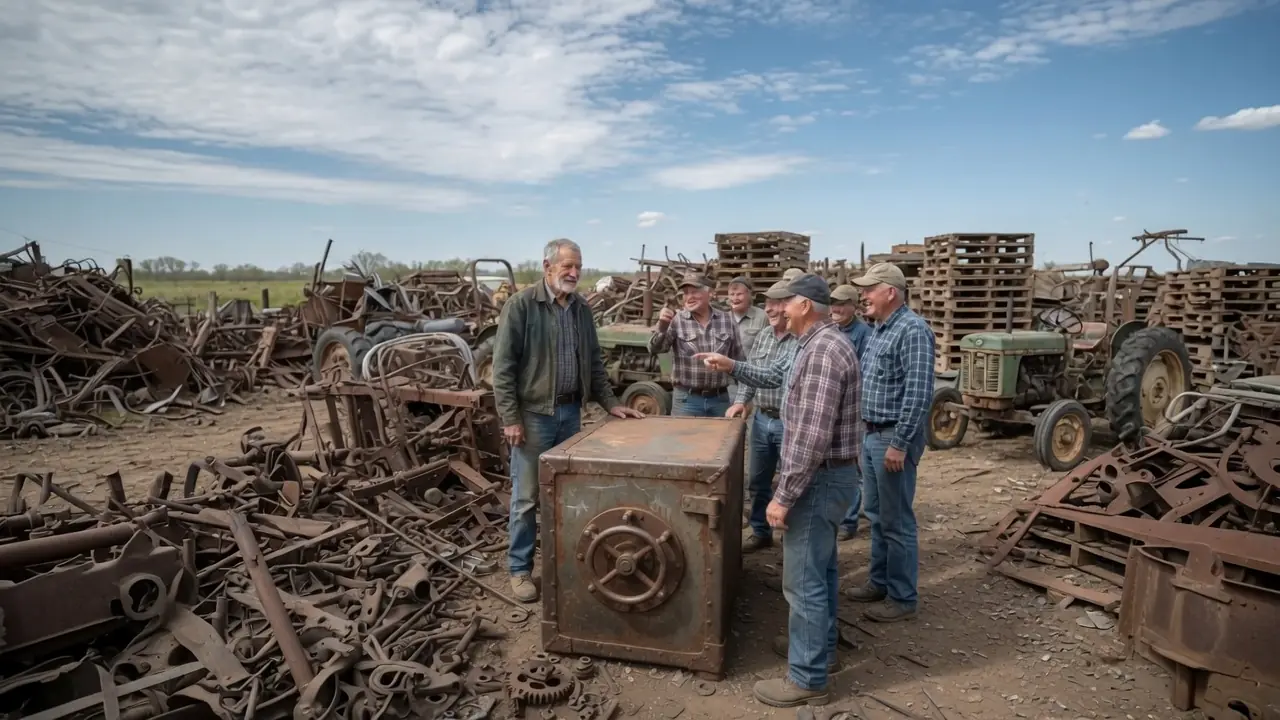
It sat near the edge of the auction yard between a cracked tractor hood, a stack of bent cultivator teeth, and three pallets of scrap chain. The box was about four feet wide, three feet tall, and heavy enough that two young men had cursed while dragging it off a flatbed that morning. Its sides were scarred with rust, old torch burns, and deep scratches. Every seam had been welded shut.
The auctioneer barely tried to sell it.
“All right, boys,” he called, tapping the side with his clipboard. “Anybody want this mystery coffin? Heavy steel, no key, no hinges worth saving, and welded tighter than a preacher’s Sunday shoes.”
The farmers laughed.
Walt stood near the front with his hands in the pockets of his faded jacket.
He had come to the auction looking for a used vise and maybe a box of welding rods if the price was right. He had not planned to buy anything strange. At his age, he had learned that strange things usually became work, and work had a way of finding old bones even when old bones did not go looking for it. But the moment he saw the rusted box, something in him stopped moving.
The welds were wrong.
Not bad.
Wrong.
Walt had spent fifty-three years welding steel in barns, machine shops, shipyards, grain elevators, and half-collapsed factories no sane man should have entered. He knew hurried welds, pretty welds, panic welds, repair welds, and government welds made by men who had been paid by the hour and warned not to ask questions. The welds on this box had not been done to fix damage. They had been laid down slowly, heavily, and deliberately by someone who wanted every possible opening sealed.
The auctioneer tried again.
“Five dollars?”
No one raised a hand.
A farmer named Bud Ransom laughed and pointed at Walt.
“Maybe Henley wants it. Old welders love dragging home useless iron.”
The men around him chuckled.
Walt ignored them.
He stepped closer to the box and crouched with a small groan in his knees.
The circular handle on the front had been welded over from the inside, or at least that was what the heat marks suggested. The corners were reinforced with overlapping plates. Someone had run beads across the seams, then run another layer over those beads, as if one pass had not been enough to quiet their fear.
Walt touched the metal with two fingers.
It was warm from the sun.
But beneath the rust, he could feel something else.
Weight.
Not just the weight of old steel.
The kind of weight that made a hollow box feel less than hollow.
“Ten dollars,” Walt said.
The yard went quiet for half a second.
Then laughter broke out harder than before.
Bud slapped his knee.
“Ten dollars? Walt, you buying rust by the pound now?”
The auctioneer grinned.
“I got ten from Mr. Henley. Anybody want to rescue him from himself?”
No one bid.
Walt stayed crouched, still studying the seams.
The auctioneer shrugged.
“Sold for ten.”
Walt stood slowly.
The auctioneer blinked.
“What’s that?”
“I’ll pay sixty if you help me load it.”
The laughter stopped for a different reason now.
Sixty dollars was not a fortune, but nobody in that yard wasted sixty dollars on metal that might not open. Bud leaned over the box, squinting at Walt like the old man had lost more than hearing. Another farmer, Earl Pike, shook his head and whistled softly.
“Walt,” Earl said, “that thing ain’t worth six.”
Walt pulled three twenties from his wallet.
“Then nobody else should mind.”
The auctioneer took the money.
“Sold again, I suppose.”
The farmers laughed all the way to Walt’s pickup.
Four men helped load the steel box into the bed using a tractor with forks and two lengths of chain. It settled with a groan that made the old truck sag on its springs. Rust flakes fell like dirty snow. The circular handle faced upward now, dull and stubborn in the daylight.
Bud climbed onto the tailgate and gave the box a kick.
“There, Walt, your sixty-dollar coffin is on the truck.”
Walt tightened a strap across the top.
“Careful with it.”
Bud laughed.
“Careful? With scrap?”
Walt pulled the strap until it creaked.
“Whoever sealed this didn’t do it for decoration.”
Another farmer snorted.
“You hear that, boys? Walt thinks scrap metal has secrets.”
Walt looked down at the welded seams.
“No,” he said quietly. “I think somebody worked real hard to make sure this secret stayed buried.”
The laughter followed him as he drove away.
Walt did not look back.
His workshop sat behind his farmhouse on twelve acres outside Wichita, Kansas, a low metal building with a concrete floor, two roll-up doors, and a roof patched so many times it looked like a quilt from above. His wife, Helen, used to joke that the shop was his second church. After she died five years earlier, it became something closer to a shelter. Walt spent most evenings there, repairing neighbors’ gates, sharpening mower blades, welding cracked implement frames, and pretending the empty house did not wait for him across the yard.
He backed the truck into the shop and shut the door behind him.
The sound echoed in the building.
For a moment, he just stood there beside the truck bed and listened.
No auction laughter.
No Bud Ransom.
No men calling him crazy.
Only the ticking of the cooling engine, the faint hum of the fluorescent lights, and the quiet weight of the box sitting behind him.
Walt pulled on leather gloves and climbed into the truck bed.
He brushed rust away from one seam.
The weld was old.
Maybe thirty years.
Maybe more.
The bead was thick and rough, but the hand behind it had known what it was doing. There were no gaps. No lazy starts. No weak spots left by accident. Walt followed the seam along one side and found a second layer beneath the first, older and darker under the scale.
“Whoever you were,” he muttered, “you were scared.”
He set up a chain hoist from the ceiling beam and lifted the box from the truck bed onto a heavy worktable.
The table complained under the weight.
Walt measured the box, marked the seams with chalk, and tapped the sides with a ball-peen hammer. The sound changed near the lower left corner. Not hollow. Not solid either. There was something packed inside, something wrapped or wedged tightly enough to deaden the ring of the metal.
He leaned close to the front seam.
There were initials scratched near the handle.
Not deep.
Almost hidden beneath rust.
E.M.
Walt frowned.
He knew those initials.
Or thought he did.
Back in 1981, when Walt was still welding full time at Dawson Grain Equipment, there had been a machinist named Elias Mercer. Quiet man. Careful hands. Never drank, never borrowed money, never talked politics. He had disappeared one winter without collecting his final check. People said he moved south. Others said he owed money. Walt remembered only one thing clearly: Elias Mercer could weld clean enough that his beads looked like script.
Walt stared at the initials again.
E.M.
His stomach tightened.
He went to the cabinet and took out his old grinder.
Then he stopped.
Something about the box made him reach for his notebook first.
He wrote the date, the auction location, the amount paid, and every visible marking. He sketched the box. He photographed it from each side with his old phone, though he had to hold the device at arm’s length because his eyes were not what they used to be. Helen would have laughed at that. She always said he treated scrap like crime evidence.
Maybe this time, he was right.
He started with the top seam.
The grinder screamed into the steel, sending sparks across the shop floor. Rust dust and old metal filled the air. Walt wore his face shield and respirator, but he could still taste age in the back of his throat. Whoever welded the box had used hard rod and more patience than kindness. It took nearly forty minutes just to cut the first twelve inches.
Walt shut off the grinder and listened.
Nothing.
He cut another stretch.
Then another.
By dusk, he had opened three sides of the top seam.
His back hurt.
His hands tingled.
He ate a cold sandwich standing at the workbench, eyes never leaving the box. After dark, rain began tapping against the workshop roof. Walt turned on the old radio but kept the volume low. The box seemed to dislike noise. That was foolish, of course. Steel had no preferences.
Still, he turned the radio off.
At 9:14 p.m., Walt cut through the final corner of the top seam.
The box made a sound.
Not loud.
A dull internal shift, like something heavy settling after years of being held in place.
Walt froze.
He lifted his face shield slowly.
The sound came again.
A small slide.
Then a thump.
Walt stepped back from the table.
For the first time that day, he felt something colder than curiosity.
He picked up a pry bar but did not use it.
Instead, he crouched and looked at the lower seam again. More heat marks. More reinforcement. Whoever sealed the box had done it after something had been placed inside. And now, after decades, whatever was inside had moved.
Walt whispered the words before he could stop himself.
“This wasn’t sealed to keep people out… it was sealed to keep something in.”
He did not sleep that night.
At dawn, he made coffee so strong it tasted burned and returned to the shop.
Rain had washed the dust from the yard, leaving puddles that reflected the gray sky. The box sat under the fluorescent lights like it had waited for him. Walt touched the top plate. Cool. Still. Innocent-looking, if rusted steel could pretend innocence.
He slid the pry bar under the loosened lid.
The metal resisted.
He pushed harder.
The top plate lifted a quarter inch with a long, ugly groan.
A smell came out.
Not rot.
Not fuel.
Old paper, dry leather, machine oil, and something faintly sweet, like cedar that had been trapped in darkness too long.
Walt opened the lid another inch and shone a flashlight inside.
The first thing he saw was a child’s shoe.
Tiny.
Brown leather.
Wrapped in brittle cloth.
Walt’s breath stopped.
He reached for the phone immediately.
Not another tool.
The phone.
He called Sheriff Nolan Briggs, who had once been a boy Walt coached in Little League.
“Nolan,” Walt said when the sheriff answered, “I need you at my shop.”
“What happened?”
“I opened something I bought at auction.”
A pause.
“What kind of something?”
“A welded steel box.”
Another pause.
“What’s inside?”
Walt looked into the crack again.
His voice dropped.
“Something that might belong to a missing child.”
The sheriff arrived in fourteen minutes.
He came with one deputy, a camera, gloves, and the expression of a man hoping an old welder had misunderstood what he had seen.
He had not.
Together, they opened the lid under careful light.
Inside the steel box was not a body.
Walt thanked God for that before his knees nearly gave.
The child’s shoe sat on top of a waxed canvas bundle. Beneath it were three sealed metal tins, an old leather satchel, a rusted revolver wrapped in oilcloth, and a stack of documents protected inside glass jars. There were also photographs, brittle but intact, tied together with twine. The top photograph showed a little girl with dark braids standing beside a man in work overalls.
On the back, written in faded pencil, were three words.
Annie Mercer, 1979.
Sheriff Briggs looked at Walt.
“Mercer?”
Walt nodded slowly.
“Elias Mercer.”
The sheriff’s face changed.
Everyone old enough in Harlan County remembered something about the Mercer girl.
Annie Mercer had vanished in 1980.
She was seven years old.
Her father, Elias, worked as a machinist and welder.
Her mother had died the year before. The story at the time was that Elias took Annie and left town after stealing from the grain equipment company. Some said he ran from debt. Some said he was unstable after his wife’s death. No one found him. No one found the girl. After a while, people stopped talking about it.
Walt had been thirty years old then.
Busy.
Married.
Working overtime.
He remembered the whispers, but not much more.
Now he stared at the box and felt shame crawl through him.
“What have we got here?” Sheriff Briggs murmured.
They photographed everything before touching it.
Then the sheriff opened the leather satchel.
Inside was a stack of handwritten pages.
The first page began with a sentence that made Walt sit down.
If this box is found, I did not run, and I did not harm my daughter.
The handwriting was careful, slanted, and controlled, the hand of a machinist used to precision.
Sheriff Briggs read aloud.
My name is Elias Mercer. My daughter, Annie, was taken from me on March 4, 1980, because I discovered what Dawson Grain Equipment was hiding in government seed storage contracts. I have sealed this evidence because the men involved have already killed once, and I believe they will try to make my daughter’s disappearance my crime.
Walt’s mouth went dry.
Dawson Grain Equipment.
His old employer.
The sheriff kept reading.
The letter named three men.
Harold Dawson, owner of the company.
Lester Pike, county commissioner.
And Bud Ransom’s older brother, Calvin Ransom, who had managed shipping records.
Walt felt the shop tilt around him.
Bud Ransom had been laughing at the auction yesterday.
His family name sat inside the box.
The documents explained the rest in chilling detail.
Dawson Grain had been contracted to fabricate storage bins and sealed containment units for state seed reserves and emergency agricultural supplies. According to Elias, the company had falsified steel thickness records, pocketed contract money, and supplied dangerously weak structures. When several bins failed in storms, ruining seed reserves, the damage was blamed on weather and poor maintenance.
Elias had found the altered records.
Then Annie disappeared.
The official story became that Elias stole company money and fled with his child.
But the sealed documents told another story.
Elias had hidden copies of invoices, altered blueprints, forged inspection signatures, photographs of failed welds, and letters proving he had contacted authorities before vanishing. The tins contained microfilm and a cassette tape labeled Commissioner Pike, Office, April 1980. In one jar was Annie’s shoe, a ribbon, and a note in a child’s handwriting.
Daddy, I hid like you said. I am scared.
Walt covered his face with both hands.
Sheriff Briggs swore under his breath.
The deputy stepped outside for air.
The old welder sat beside the box, hearing laughter from the auction in his memory.
Sixty-dollar coffin.
Rust with hinges.
Scrap metal has secrets.
Yes, Walt thought.
It did.
By noon, the workshop was full of law enforcement.
State investigators arrived first.
Then two older cold-case detectives from Wichita.
They sealed off the shop, cataloged the contents, and asked Walt to repeat every detail about the auction. Where the box had been placed. Who had laughed. Who had touched it. Who helped load it. Walt told them everything, including Bud Ransom’s comments. The detectives exchanged a look at that name.
One of them, Detective Marla Chase, had gray hair, sharp eyes, and the patience of someone who knew old cases resisted being forced.
“Mr. Henley,” she said, “do you know how this box ended up at auction?”
Walt shook his head.
“Came from the old Dawson storage property, I think. Auctioneer said they were clearing a farm lot after a tax seizure.”
“Dawson property?”
“Yes, ma’am.”
She wrote that down.
That afternoon, investigators searched the old storage lot.
They found records showing the steel box had sat inside a collapsed shed for decades, buried under implement parts, pallets, and broken machinery. Nobody had known what it was. When the lot was liquidated, workers dragged it out and sent it to auction as scrap. The box had been hidden in plain sight so long that the people who feared it were either dead, old, or convinced the past had rusted shut forever.
They were wrong.
The cassette tape was restored three days later.
Sheriff Briggs called Walt to the courthouse to hear it.
Walt did not want to go.
He went anyway.
The audio crackled with age, then cleared just enough to reveal voices.
Elias Mercer’s voice was low and tense.
Another voice, later confirmed to be Commissioner Lester Pike, told him to stop asking questions.
A third voice, believed to be Harold Dawson, said, “A man with a little girl ought to know when silence is safer.”
Then Elias said, “Where is Annie?”
The tape cut to static.
Walt stared at the recorder.
Detective Chase stopped the tape.
“It doesn’t prove everything,” she said carefully.
“No,” Walt replied. “But it proves he didn’t run.”
More evidence emerged over the next month.
An old farmhouse once owned by Calvin Ransom was searched after land records connected it to Dawson shipping storage. Beneath a rotted staircase, investigators found a rusted lunch pail containing a child’s hair ribbon, two buttons matching Annie’s coat from photographs, and a partial note written by Elias. The note said Annie had escaped custody briefly and hidden near the Ransom place before being moved again.
But the girl herself was not found.
That part stayed cruelly empty.
Elias Mercer’s fate emerged from another source.
A retired nurse from Harlan County, now ninety-one, came forward after the story appeared in the local paper. She remembered a badly injured man brought secretly to a rural clinic in 1980 under a false name. He had asked for a priest, then for paper. He died before dawn. She had always suspected something was wrong but had been young, afraid, and warned by powerful men to forget the night.
She had kept the paper.
For forty-four years, folded inside a Bible.
On it, in Elias Mercer’s handwriting, were the words:
Tell Annie I did not stop looking.
Walt read that sentence alone in his kitchen after Sheriff Briggs showed him a copy.
Then he walked out to the workshop and sat beside the steel box.
For the first time since Helen died, he cried hard enough that he did not try to stop it.
The case reopened publicly.
Harlan County changed overnight.
Names once painted on plaques and charity boards became poison. Harold Dawson was dead, but his company’s legacy was stripped apart. Lester Pike had died respected, but his family watched that respect collapse under the weight of old evidence. Calvin Ransom, still alive in a care facility, refused to speak at first. Then, when detectives played the restored tape, he began to tremble.
He confessed enough.
Not everything.
Enough.
Annie had not been killed at first, he said.
She had been hidden to force Elias to stop pushing the fraud evidence. But panic spread when Elias refused and began making copies. Men argued. The child was moved. Calvin claimed he did not know where she was taken after that. Detective Chase did not believe all of it, but old men near death often use gaps as their final hiding places.
The county searched three properties.
On the third, near a dried creek bed behind an abandoned tenant house, ground-penetrating radar found an old buried trunk.
Inside were remains.
A small locket with the initials A.M.
Annie Mercer finally came home.
There are moments when a town becomes quieter than it has any right to be.
Annie’s memorial was one of those moments.
Hundreds came, some out of grief, some out of guilt, some because they had once believed the lie and needed to stand near the truth when it was spoken aloud. Walt stood in the back, hat in his hands. He did not feel like a hero. He felt like a man who had paid sixty dollars for a box that had been screaming silently for forty-four years.
Sheriff Briggs spoke.
Detective Chase spoke.
A distant cousin of Annie’s read a psalm.
Then Walt was asked to say something.
He almost refused.
But he walked to the front, slow and stiff, and stood behind the microphone.
“I knew Elias Mercer,” Walt said. “Not well enough, and that’s the part I’ve been carrying.”
The church was still.
“He was quiet. Careful. A good hand with steel. When folks said he ran, I believed the gossip because believing gossip was easier than asking why a careful man would leave everything behind.”
His voice broke slightly.
“That box came to me because men laughed at it. They saw rust. They saw scrap. Elias saw danger coming and tried to preserve the truth in the only way he knew. He sealed steel around it.”
Walt looked toward Annie’s small photograph near the altar.
“I’m sorry it took us so long to open it.”
No one breathed for a moment.
Then someone sobbed.
After the memorial, Walt returned to his workshop and looked at the box.
Investigators had taken the contents, but the box itself had been returned after evidence processing. It sat empty now, lid removed, seams jagged where Walt had cut them. He ran his hand over the welds again. They were ugly in places, beautiful in others, desperate everywhere.
He could have scrapped it.
He did not.
Instead, Walt cleaned the rust carefully, preserving the scars. He built a stand from old steel beams and mounted the box upright in the county historical center, beside copies of the documents that cleared Elias Mercer’s name and told Annie’s story. A small plaque beneath it read:
The Mercer Box
Sealed in fear. Opened in truth.
Never call something worthless because you do not yet know what it carries.
Bud Ransom came to see it once.
He stood in front of the display with his cap in his hands, older and smaller than he had looked at the auction. Walt happened to be there that day, tightening a bracket on the stand. For a long while, neither man spoke.
Finally, Bud said, “I laughed.”
Walt did not look at him.
“Yes.”
“I didn’t know.”
“No.”
Bud swallowed.
“But my brother did.”
Walt tightened the bolt.
“Yes.”
Bud wiped his eyes with the back of one hand.
“I’m sorry, Walt.”
Walt stepped down from the stool.
“Don’t tell me.”
He nodded toward Annie’s photograph.
“Tell her.”
Bud stood there until closing.
Years passed, but the story did not fade.
School groups came to see the box.
Welders studied the seams.
Historians studied the documents.
Local farmers, who once joked about the old man wasting money, now told the story differently. They said Walt Henley had seen what others missed because old skill still mattered. They said he had bought truth for sixty dollars. They said rust hides more than metal.
Walt still corrected them when they made him sound too grand.
“I bought a box,” he would say. “Elias saved the truth. Annie waited for us to listen.”
At seventy-five, Walt began teaching a small welding class at the community college.
He started the first lesson the same way every time.
He placed a strip of welded steel on the table and told the students to study it.
Not just whether the weld was strong.
Not just whether the bead looked clean.
He wanted them to read it.
“What does this tell you?” he would ask.
Most students shrugged at first.
Then he taught them to see heat, pressure, speed, hesitation, fear, pride, care, laziness, patience, and panic in the metal.
“A weld is a sentence,” Walt told them. “Somebody’s hand wrote it. Learn to read.”
On the last day of every course, he took them to the historical center.
He stood before the Mercer Box and let them look.
Then he told them about an auction yard, laughing farmers, a rusted steel box, and a weld made not for machinery, but for memory. He told them how power can bury truth, how fear can seal it away, and how sometimes the smallest detail can crack open a lie that lasted decades.
He always ended with the same words.
“When you don’t understand why something was sealed, don’t assume it was empty.”
One autumn evening, Walt returned alone to the historical center after hours.
Sheriff Briggs had given him a key because the bracket on the display needed adjusting. Walt fixed it quickly, then stood in the quiet room with his hand resting lightly on the box. The lights were dim. The building smelled of dust, paper, and polished floors. Annie’s photograph watched from behind glass.
Walt closed his eyes.
He thought of Helen.
Of Elias.
Of Annie.
Of all the things people leave behind without knowing who will find them.
“I opened it,” he whispered.
The room gave no answer.
But outside, wind moved through the trees, and for a moment, the old welder felt something ease in his chest.
Not peace exactly.
Something closer to duty completed.
He locked the door behind him and stepped into the cool evening.
His pickup waited under the streetlight, rust along the wheel wells, tools behind the seat, straps still coiled in the bed from the day he brought the box home. Walt ran one hand along the truck rail and smiled faintly.
Sixty dollars.
That was what the truth had cost him.
That, and the willingness to see what everyone else laughed at.
And maybe that was the lesson.
The world is full of sealed things.
Old boxes.
Old stories.
Old lies.
Old grief.
People point, laugh, dismiss, and move on because looking closer might cost them comfort.
But sometimes an old man with tired hands, a welder’s eye, and enough silence in his life to hear metal speak can notice the seam everyone else ignores.
Sometimes he can bring the forgotten thing home.
Sometimes he can cut carefully.
And sometimes, when the final weld cracks open, the past finally gets enough air to speak.