The motorcycle came alive on the third kick.
For one violent second, the old engine coughed, shook, and sounded as though seventeen years of silence were fighting to keep their grip on it.
Then the 1978 Harley-Davidson Shovelhead found its rhythm.
The exhaust cracked through the repair shop like a rifle shot. Tools rattled against the workbenches. Dust drifted from the rafters, and the deep, uneven idle filled the building with a sound that seemed too large for the walls holding it.
No one inside Price & Sons Motorcycle Repair cheered immediately.
They simply stood and listened.
Daniel Price pressed one fist against his mouth. Jonah Reed lowered himself onto a stool as though his legs had stopped working. Luke Parker remained seated on the motorcycle with both boots planted on the concrete, feeling the rebuilt engine pulse beneath him.
Near the rear fender stood seventy-two-year-old Henry Briggs.
His right hand rested lightly against the metal.
There was no triumph in his face.
Only completion.
On a phone propped against the parts wall, a thin man lay inside a hospital bed two miles away.
Earl Maddox was seventy-one years old. Cancer had reduced the broad-shouldered rider to sharp bones beneath a white hospital gown, but his dark eyes remained clear.
He listened through the small speaker.
The phone could not reproduce the full weight of a Shovelhead engine. It could not carry the low vibration through the floor or the heat gathering around the pipes.
But it carried enough.
The rhythm reached Earl.
His eyes closed.
The monitor beside his bed continued its steady electronic pulse as his breathing slowed.
“There you are,” he whispered.
His nephew Caleb Monroe leaned closer to the screen.
“Uncle Earl?”
Earl did not answer.
He was no longer in the hospital.
He was twenty-four again, standing outside a motorcycle dealership after returning from Vietnam. A Purple Heart sat forgotten inside a drawer at home, and the desert road stretched north from Phoenix beneath a sky so wide it made survival feel possible.
He remembered throwing one leg over the black Harley for the first time.
He remembered the engine starting beneath him.
He remembered understanding that the road required no explanation.
For eleven minutes, the men in the shop allowed the motorcycle to run.
No one blipped the throttle for effect.
No one made a speech.
They let it idle exactly as Earl had asked, filling the hospital room with the sound of the life he had chosen.
Four days earlier, the same motorcycle had entered the shop as a rusted, silent monument to everything time could take away.
Caleb Monroe rolled it through the front bay on a Tuesday morning in July.
Phoenix heat pressed against the building like an open furnace. The thermometer near the gas station across Route 9 already showed 107 degrees, though it was not yet ten o’clock.
Inside Price & Sons, the air smelled of old oil, rubber, coffee, and metal.
The shop had operated on the same corner for thirty-one years.
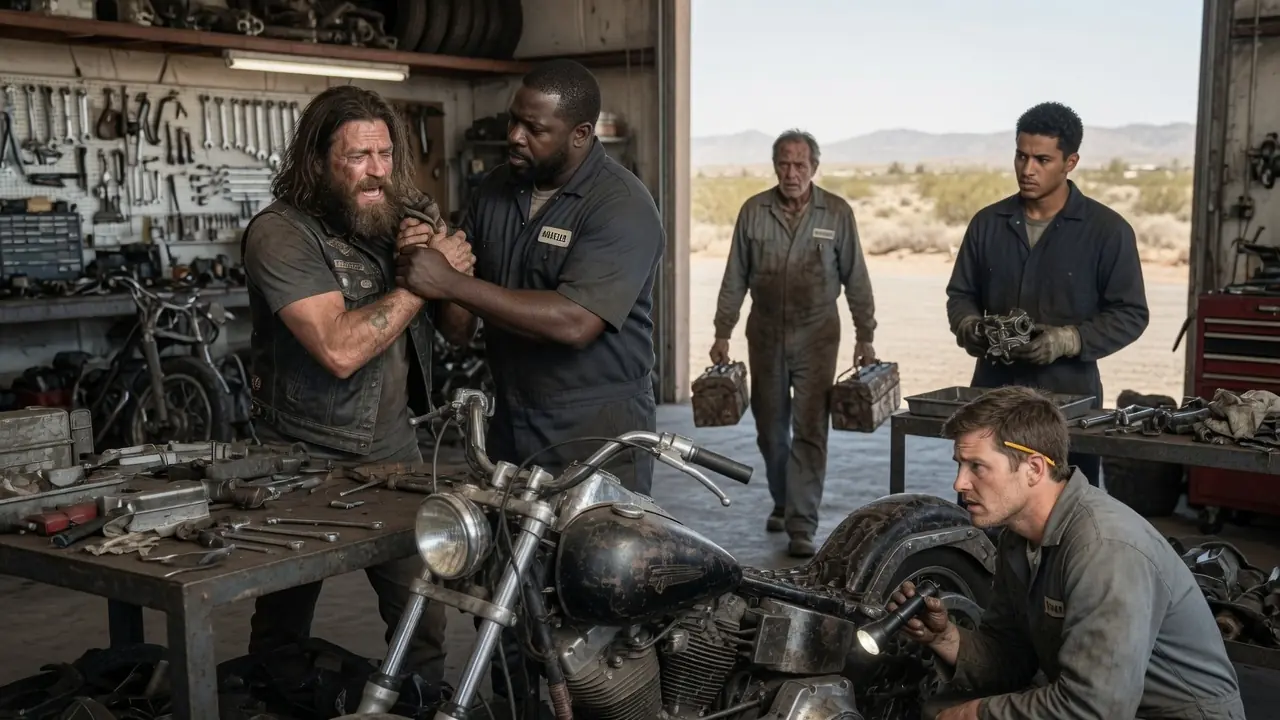
It was not polished enough to impress people who wanted designer showrooms. Three repair bays occupied the main floor. Shelves reached from concrete to ceiling, filled with parts labeled in Daniel’s tight handwriting.
The coffee machine had not been cleaned properly since 2019.
Customers came because Daniel Price fixed motorcycles other mechanics abandoned.
At forty-three, Daniel had been the shop’s head mechanic for eleven years. He had rebuilt carburetors older than some of his customers, sourced discontinued parts from three continents, and kept machines on the road long after manufacturers expected them to become scrap.
He did not panic when Caleb pushed the old Harley inside.
He walked around it once.
Then twice.
Daniel crouched beside the left engine case and stared at a dark line beneath the years of dried oil.
Jonah Reed joined him.
At twenty-six, Jonah was the youngest mechanic in the shop and the least skilled at hiding his reactions.
He whistled.
“What happened to this thing?”
“Time,” Daniel said.
“How much?”
“Fifteen years, at least.”
“Seventeen,” Caleb said from the doorway.
He was thirty-four, lean, exhausted, and carrying the kind of fatigue that did not come from missing sleep. His hands remained clenched at his sides.
Daniel looked toward him.
“Seventeen years since it ran?”
“Since my uncle rode it.”
“Who is your uncle?”
“Earl Maddox.”
The name changed the room.
Jonah straightened.
Luke Parker stopped sorting bolts at the rear bench.
Daniel looked back at the motorcycle.
Earl Maddox was known across the Arizona riding community.
He had served two tours in Vietnam with the Army’s 25th Infantry Division. He returned with a Purple Heart, bought the Shovelhead, and spent the next four decades riding across the Southwest.
The motorcycle clubs, independent riders, mechanics, and veterans who knew him told different stories.
Some remembered the man who organized fuel runs for stranded riders.
Others remembered him appearing outside county jails with bail money before anyone called.
One family remembered Earl riding six hours through a storm to attend the funeral of a rider he had met only twice.
He belonged to the Desert Sons Motorcycle Club, but people who respected him said the patch was not what made him important.
Earl showed up.
That was his reputation.
Caleb stepped closer to the motorcycle.
“He’s at Desert Springs Hospital.”
No one spoke.
“The doctors say three days. Maybe four.”
Jonah looked down.
Caleb pressed his lips together before continuing.
“I visited him this morning. He hasn’t had much strength, but he grabbed my hand and wouldn’t let go.”
His voice began to crack.
“He said he didn’t need anything. He wasn’t afraid. He’d had a good life.”
Caleb looked at the silent motorcycle.
“But he wanted to hear this engine one more time.”
Daniel rested one hand on the fuel tank.
The metal felt cold despite the heat outside.
Caleb continued.
“He said that sound was where he lived. Where he felt free.”
Daniel examined the cracked case again.
The carburetor was seized.
The wiring had been eaten by heat, corrosion, and rodents.
The primary chain appeared brittle enough to break under load. The ignition points were ruined. The oil pump would not move.
There were jobs that required time.
This machine required time they did not have.
“I don’t care what it costs,” Caleb said. “I don’t care how many mechanics tell me it’s dead.”
He stepped toward Daniel.
“My uncle is dying. The last thing he asked from me was to hear this motorcycle run.”
Daniel studied him.
“Leave it.”
Caleb’s eyes searched his face.
“Can you do it?”
“I didn’t say that.”
“I need an answer.”
“You need an honest answer.”
Daniel looked toward the bike.
“Give me today to understand what we’re dealing with.”
Caleb nodded.
He placed a business card on the workbench.
“That’s my cell.”
He started toward the door, then stopped.
“He thinks the bike is still in storage.”
“Why didn’t you tell him?”
“I didn’t want his final days spent waiting for something impossible.”
Daniel glanced again at the engine.
“Call him tonight.”
Caleb looked back.
“What should I tell him?”
“Tell him people started working.”
After Caleb left, Jonah crouched beside the engine.
“You saw the crack?”
“Yes.”
“The carburetor is completely frozen.”
“Yes.”
“The pump won’t move.”
“I know.”
Luke approached from the rear bench.
At thirty-one, he worked differently from Jonah.
Jonah attacked problems with energy.
Luke approached them like a surgeon.
He arranged parts in exact order, photographed assemblies before removing them, and believed that understanding how a machine came apart was the only honest way to know how it should return.
Luke examined the case.
“That crack may have reached the casting branch.”
Daniel pulled over a stool.
“What are we doing?” Jonah asked.
“We assess everything.”
“And after that?”
“We decide whether it can run.”
Jonah looked at the motorcycle.
“What if it can’t?”
Daniel switched on a flashlight and traced the dark line along the aluminum.
“We don’t decide that before we begin.”
The first day became an education.
A modern motorcycle spoke through diagnostic computers.
The old Shovelhead spoke through sound, smell, mechanical resistance, and the way a component felt beneath experienced fingers.
By noon, Daniel had the carburetor on the bench.
He lifted the float assembly toward the light.
“Fuel sat inside this bowl for seventeen years,” he explained. “It became varnish, then something closer to cement.”
Jonah leaned closer.
“Can we clean it?”
“We can try.”
Daniel pointed toward the needle seat.
“If that surface is scored, there is no replacement sitting on a shelf. We fabricate or we stop.”
“How do you know all this?”
Daniel lowered the component.
“When I was nineteen, a man named Gabriel Oakes let me work in his shop for free.”
“The Gabriel Oakes?”
“He was not ‘the Gabriel Oakes’ when I met him. He was an old man who told me I held a wrench wrong.”
Jonah smiled.
“He rebuilt these engines from the late sixties onward. There was no curriculum. He talked while he worked.”
Daniel placed the carburetor inside the parts washer.
“If you listened, you learned.”
“What happened to him?”
“He died in 2009.”
Daniel switched on the machine.
“But before he died, he made sure what he knew did not die with him.”
By evening, the list of problems covered two pages.
The carburetor needed a complete rebuild.
The oil pump required either rehabilitation or replacement.
The ignition points had corroded beyond use. The primary chain was unsafe. The battery was gone, and much of the electrical system would need to be traced and rebuilt by hand.
Then there was the case.
The crack measured a little more than two inches along the lower-left section.
Original 1978 engine cases were no longer manufactured.
Aftermarket replacements existed, but fitting one could require machining, alignment work, and modifications that might create new failures.
If the original case could be repaired, the motorcycle had a chance.
If not, the restoration might become a display project.
Daniel sent Caleb a message.
Assessment complete. Extensive damage. Building a plan. No promises yet.
Caleb replied several minutes later.
He had a difficult afternoon. Still asking about the bike. Thank you for trying.
Daniel read the message three times.
After Jonah and Luke left, he remained in the shop.
At nine seventeen, he called a number he had not dialed in nearly two years.
Henry Briggs answered on the second ring.
“Daniel Price.”
Henry’s voice sounded like gravel worn smooth by time.
“Don’t tell me you found a Shovelhead.”
“1978.”
A pause.
“Earl Maddox’s?”
Daniel looked toward the motorcycle.
“You know it?”
“I saw him ride that bike outside Tucson in 1983.”
Henry’s voice became quieter.
“I heard about Earl. Bad news travels quickly among old riders.”
Daniel described the condition.
Henry listened without interrupting.
When Daniel finished, silence held the line.
“The crack,” Henry finally said. “Where?”
“Lower-left case. Two inches. Old seepage. Not completely through yet.”
“Branching?”
“Not visibly.”
“I can come look.”
“You retired four years ago.”
“I remember.”
“You have bad knees.”
“I remember those too.”
Daniel rubbed one hand over his face.
“Henry—”
“Earl Maddox is dying.”
Henry’s voice remained calm.
“His final request is to hear an engine that half the state believes is dead.”
He paused.
“Do you honestly think this is the moment to worry about whether I am retired?”
Daniel looked at the silent motorcycle.
“What time?”
“Seven.”
“I’ll open early.”
“I’ll arrive before you.”
Henry reached the shop at 6:52 the next morning.
He was seventy-two years old, six feet tall, and still carried the shoulders of the Marine he had been between 1971 and 1975.
His hair was white and cut short.
His hands were thick, scarred, and permanently marked by fifty years of grease that no amount of washing could completely remove.
He carried a battered metal toolbox.
The box looked older than Jonah.
Henry placed it on the bench and walked directly to the Shovelhead.
He crouched beside the engine.
His fingers found the crack without a flashlight.
Then he closed his eyes.
For nearly a minute, he remained still.
Jonah watched from beside the coffee machine.
Luke stood near the parts wall.
Daniel said nothing.
Henry rose slowly, his knees protesting.
“It can be done.”
Jonah could not stop himself.
“The crack or the entire motorcycle?”
Henry looked at him.
“The entire motorcycle.”
Jonah stared.
“The crack is the hardest part. Everything else is work.”
Henry pointed toward the timing cover.
“This is warped.”
Luke moved closer.
He had not noticed.
“If that cover goes back on like this, it will never seal properly. Oil will reach the repaired case before the engine reaches temperature.”
Henry turned toward Daniel.
“How much time?”
“Three days, perhaps four.”
Henry opened his toolbox.
“Then stop describing the problem.”
He removed the first wrench.
“Start.”
For the next eighteen hours, Price & Sons became a different kind of shop.
To Luke, the work was technical.
He watched Henry explain not only what had failed, but why the original engineers designed each component as they did.
“This engine was built before anyone expected it to live for nearly fifty years,” Henry said while holding the timing cover toward the light.
“The people who designed it believed it would run hard for ten or twenty years, then be replaced.”
He looked toward the Shovelhead.
“Earl refused to replace it.”
Henry placed the part on the bench.
“Our job is to honor the care that kept it worth saving.”
To Jonah, the lesson was less mechanical.
He watched a seventy-two-year-old man spend hour after hour on a concrete floor without complaint.
Henry’s knees hurt.
His back stiffened.
He never mentioned either problem.
He had no contract, invoice, or promise of recognition.
He simply worked.
Near midnight, Jonah brought him coffee.
Henry drank half without looking up.
“Can I ask you something?”
“Asking is still free.”
“You never met Earl. Why does this matter so much?”
Henry set down the component in his hand.
“My best friend in the Marines was named Curtis Lane.”
Jonah leaned against the bench.
“Curtis returned home. Lived a good life. Died of a heart attack at sixty-eight.”
Henry looked toward the old motorcycle.
“A week before he died, he called me. Said his one regret was never returning to Birmingham to see the house where he grew up.”
“He couldn’t go?”
“He could have gone for forty years.”
Henry picked up the component again.
“He kept assuming there would be another summer.”
Jonah became quiet.
“I cannot change Curtis’s regret.”
Henry’s hands resumed their work.
“But if there is anything I can do about Earl’s, that man will hear this engine.”
Jonah returned to his bench.
He worked harder afterward.
Caleb called at nine that evening.
Daniel answered inside the office.
“How is he?”
“Awake. He slept most of the day, but he’s awake.”
Caleb’s voice carried the constant strain of a man refusing to fall apart.
“He asked about the motorcycle.”
“What did you tell him?”
“That a retired Marine named Henry Briggs came in with his own tools.”
Daniel looked through the office window.
Henry stood beneath a work light, bent over the engine.
“What did Earl say?”
“He became quiet.”
Caleb paused.
“Then he said, ‘That sounds like the right kind of man.’”
Daniel leaned against the wall.
“We are making progress.”
“Honestly?”
“Yes.”
“Do you think it will run?”
Daniel watched Henry work.
“Yes.”
He said it because he believed it.
He also said it because the alternative had not earned the right to enter the room yet.
The following morning, Luke arrived first.
He began tracing the electrical harness against an old schematic Henry had produced from his toolbox.
The document was a photocopy of a photocopy. The pages had softened with age and carried handwritten notes from several mechanics.
By eight, the carburetor had been cleaned.
The float needle seat could be saved with careful polishing. Henry located a replacement needle through two telephone calls.
The oil pump was disassembled on a clean cloth.
Two internal parts required replacement.
Henry called a retired Desert Sons rider in Albuquerque named Miguel Alvarez.
“He has a complete original pump,” Henry announced after ending the call.
“When can he ship it?” Jonah asked.
“He won’t.”
Jonah frowned.
“He’s driving it here.”
“From Albuquerque?”
“Four hours.”
Daniel stared at him.
“Why?”
“Because he rode beside Earl in the seventies.”
Caleb arrived at seven thirty and remained near the corner of the shop.
He watched quietly.
At 10:47, everything changed.
Henry was examining the crack again when his hand stopped.
The stillness caught everyone’s attention.
Daniel crossed the shop.
“What?”
Henry brought the light closer.
“The crack moved.”
Daniel crouched.
The line that had measured slightly more than two inches now stretched nearly three.
At the thinnest section of the casting, a hairline branch reached upward.
“The parts washer,” Henry said.
“Vibration?” Luke asked.
“The cleaning yesterday. We didn’t account for the case resting close enough to the surface.”
Daniel looked at the branch.
“Propagating fast.”
Caleb stood.
“What does that mean?”
Henry did not soften the answer.
“It means the weld became much more dangerous.”
“Can it still be repaired?”
“Yes.”
“What happens if the repair fails?”
“The case may split when the engine starts.”
The shop became silent.
Caleb sat again.
His hands rested flat on his knees.
“So that’s it.”
“No.”
Henry stood.
His joints protested as he straightened, but his eyes remained on the crack.
“It means our margin for error is gone.”
He turned toward Luke.
“You have welded aluminum.”
Luke nodded.
“Some.”
“What is the most difficult work you’ve done?”
“A frame from a 1937 Knucklehead. Original metal. Thin and badly fatigued.”
“Did it hold?”
“It has held for three years.”
Henry studied him.
Then he began arranging tools on the bench.
“I will guide you.”
Luke stared.
“You’re not welding it?”
Henry held out both hands.
The tremor was small.
Nearly invisible.
“My hands are steady enough for ordinary work.”
He looked toward the branch in the crack.
“This is not ordinary work.”
There was no embarrassment in his voice.
Only fact.
“Your hands will do it.”
Luke looked toward Daniel.
Daniel’s expression gave him nothing except confidence.
Henry stepped closer.
“If you keep your nerves, follow the heat, and listen carefully, that engine will run.”
Luke looked at Caleb.
Then at the motorcycle.
“I’m nervous.”
“Good,” Henry said.
Luke frowned.
“A man who is not nervous before work like this either does not understand it or does not care about the result.”
Henry pulled two stools toward the engine.
“Sit down. We prepare before we touch the torch.”
He explained that old aluminum was not simply new aluminum with more years behind it.
Decades of heat cycles had altered the grain structure. Expansion, contraction, vibration, and oil contamination had created invisible paths inside the casting.
“When you introduce heat,” Henry said, “it does not travel where your manual promises it will.”
He pointed toward the branching line.
“It travels where the metal allows.”
Luke listened.
“Preheat the entire case.”
“How long?”
“Fifty-five minutes.”
“Contact readings every five.”
“Yes.”
“Filler?”
“4043.”
Henry nodded.
“Do not let anyone persuade you to use 5356 because it sounds stronger. Hardness is not our friend in a casting this old.”
He leaned closer.
“Your arc length must remain consistent. When you reach the branch, your instinct will tell you to tighten because the material becomes thin.”
Luke nodded.
“Do not obey that instinct.”
“Understood.”
“What will the nerves do?”
“Slow me down.”
“Exactly.”
While the case preheated, the rest of the shop continued moving.
Daniel measured the primary chain against specifications written inside a forty-year-old manual.
Gabriel Oakes’s notes covered the margins.
Daniel recognized his teacher’s cramped handwriting.
He called a parts supplier in Nebraska named Paul Grady.
“I have two chains,” Paul said. “One new old stock. One low-mileage pull.”
“The new old stock.”
“For Earl Maddox’s motorcycle?”
Daniel paused.
“How do you know?”
“Miguel called somebody in El Paso. That man called me.”
Paul laughed quietly.
“Word travels.”
“What do you want for the chain?”
“Nothing. It will arrive tomorrow morning.”
Henry had been working his telephone before entering the shop each day.
He had called former mechanics, riders, suppliers, and men who kept rare parts in boxes because they believed someday the right reason would arrive.
Miguel Alvarez reached Phoenix at 2:47 in the afternoon.
He was sixty-eight, compact, gray-mustached, and carried the replacement oil pump inside a cigar box.
He entered the shop and stopped when he saw the Shovelhead.
For several seconds, he said nothing.
Then he walked toward it and placed one hand against the fuel tank.
“The last time I saw this machine was outside Tucson in 1983.”
Caleb rose from the corner.
“You’re Miguel?”
The older man looked at him.
“You must be Caleb.”
“How did you know?”
“You have Earl’s eyes.”
Miguel removed the oil pump from the cigar box.
The original packaging had yellowed, but remained sealed.
“He kept this for twenty years?” Jonah asked.
Miguel nodded.
“Waiting for a reason.”
He placed it on the workbench.
“That reason came.”
Henry entered from the rear bay.
The two older men recognized each other.
“Henry Briggs,” Miguel said.
“Miguel Alvarez.”
They shook hands longer than strangers normally did.
“You came four hours for a pump,” Henry said.
“Earl would have ridden to Alaska for me.”
Miguel released his hand.
“Four hours is nothing.”
The case reached temperature.
Luke sat with both hands resting on his knees.
He had mentally completed the weld more than a dozen times.
Daniel once taught him that the best work began before the tool touched metal.
“You should perform it three times in your head before your hands attempt it once.”
Luke stood.
He pulled on his gloves and lowered the welding helmet.
Henry positioned himself near his right shoulder.
“Begin at the base, not the tip.”
Luke held the torch.
“The base is older and fully opened. Establish the puddle there. Read the material before moving toward the branch.”
Luke struck the arc.
Blue-white light filled the bay.
No one spoke.
The first inch flowed correctly.
“Good,” Henry said.
Not praise.
Confirmation.
Luke continued.
His breathing remained slow.
The arc length held steady.
Then he reached the branch.
The geometry changed.
Heat moved differently.
Luke adjusted his wrist before Henry could speak.
He followed the line upward, feeding the rod in a smooth, controlled rhythm.
Then he killed the arc.
The shop remained completely silent.
Luke lifted his helmet.
Sweat ran along his face.
His hands were steady.
Henry inspected the weld with a flashlight.
Then a magnifying lens.
He moved from one end to the other.
Luke waited.
Caleb pressed one hand over his mouth.
Finally, Henry straightened.
“No voids.”
Daniel exhaled.
“No visible inclusion. Penetration is complete.”
Henry looked at Luke.
“That is a clean weld.”
Jonah released a sound and turned it into a cough.
Caleb lowered his head.
Miguel placed one hand on his shoulder.
Daniel crossed the shop and struck Luke once between the shoulder blades.
“Good work.”
Luke nodded.
His eyes were bright.
“What’s next?”
Everything.
The replacement oil pump went in that afternoon.
Henry taught Luke the torque sequence and pre-lubrication procedure, neither of which appeared inside any current manual.
Ignition points arrived from El Paso through a retired mechanic who drove them personally to a courier.
The primary chain continued across the country.
Jonah rebuilt the wiring.
He identified eleven failures inside the harness, including corroded connectors, cracked insulation, oxidized copper, and a main ground partially destroyed by old battery acid.
By evening, he had reconstructed most of the electrical system from raw wire, terminals, and hand-fabricated connectors.
“I’ve never traced an original harness this old,” he said.
“You have now,” Daniel replied.
Jonah looked over his work.
“I could draw it from memory.”
Henry continued working at the next bench.
“That is what difficult problems do.”
“What?”
“They make the answer part of you.”
Caleb left for the hospital at four and returned after eight.
Everyone looked at his face when he entered.
“He had a better afternoon.”
Daniel set down his wrench.
“He ate something. Stayed awake for three hours.”
Caleb looked toward the motorcycle.
“He asked if it was running.”
“What did you say?”
“That we were close.”
Caleb looked at Henry.
“Are we?”
Henry considered the question honestly.
“The weld should set for twenty-four hours before stress. The chain arrives tomorrow morning. Carburetor is ready. Wiring is almost complete.”
He paused.
“If everything goes correctly, we attempt a start tomorrow afternoon.”
Caleb did the calculation.
Tomorrow afternoon still fit inside the doctors’ estimate.
Barely.
Miguel poured two cups of coffee and handed one to him.
Caleb stared into it.
“My uncle always said a club was not the patch.”
Miguel nodded.
“He said it was the people who showed up.”
“He was right.”
“He still is.”
The chain arrived at 5:58 the following morning.
Daniel had slept on the cot inside the office.
He heard the delivery truck and carried the package inside before the driver reached the door.
The chain had never been installed.
It had been manufactured in the same era as the engine.
It belonged there.
Henry arrived at seven.
Luke examined the cooled weld beneath the morning light.
No discoloration suggested uncontrolled heat travel.
No movement had occurred overnight.
“It’s solid.”
Henry inspected it himself.
Then he nodded.
The carburetor went on at nine fifteen.
The primary case closed at ten.
Jonah completed the final wiring connection at ten forty.
Daniel inspected the motorcycle from front to rear.
Then he did it again.
“I think we’re ready.”
Henry stood beside the headlight.
“Not yet.”
He looked toward Caleb.
“Call Earl.”
Caleb’s hands shook as he dialed the hospital.
A nurse answered and said Earl had been waiting since eight that morning.
The tablet was already beside his bed.
“We’ll call in five minutes,” Caleb said.
He ended the call and looked toward Henry.
“He’s been waiting for hours.”
Henry nodded.
Caleb hesitated.
“Can I ask you something?”
“Go ahead.”
“Why didn’t you leave when the crack spread?”
Henry placed one hand on the tank.
“I have been on the other side of that question.”
Caleb waited.
“Three years ago, I became ill. Not dying, but sick enough that the future felt uncertain.”
Henry looked at the motorcycle.
“I remember wanting one more thing that proved my life had been real.”
“What thing?”
“I never decided.”
He turned toward Caleb.
“I recovered before I needed to.”
Henry’s hand remained on the tank.
“Earl did not get that luck. He has this.”
Caleb’s eyes filled.
“He has a nephew who refused to accept silence. He has riders driving parts across states. He has men working until their bodies hurt.”
Henry stepped away.
“That is more than many people receive.”
The video call connected.
Earl lay propped inside the hospital bed.
His face had become thin, but his eyes remained sharp.
“Caleb.”
“I’m here.”
Caleb turned the camera around.
Daniel nodded toward the screen.
Jonah lifted one hand.
Luke gave a small wave.
Then Miguel stepped forward.
Earl went still.
“Miguel?”
The older rider’s jaw tightened.
“Hello, brother.”
Earl released a rough laugh.
“You old dog. Where did you come from?”
“Albuquerque.”
“For this?”
“I brought the oil pump.”
Earl stared at him.
“You still had it?”
“Twenty years.”
“Why?”
Miguel smiled through tears.
“I was waiting for the right reason.”
Earl closed his eyes briefly.
“How is Rosa?”
“She says she still makes the best enchiladas in New Mexico.”
“She lies.”
“She saved you a plate.”
Earl smiled.
It transformed his face.
“Tell her I’m holding her to it.”
Caleb moved the camera toward Henry.
The two men studied one another.
They had never met.
It did not seem important.
“You’re Henry Briggs,” Earl said.
“Yes.”
“Marine?”
“First Battalion, Seventh Marines. Seventy-one to seventy-five.”
“Army. Twenty-Fifth Infantry. Two tours.”
The recognition between them required no further explanation.
“Caleb told me you arrived with your own tools.”
Henry almost smiled.
“I assumed permission was not the issue.”
Earl’s rough laugh came again.
“Thank you.”
He said it completely.
Henry nodded once.
“We are not finished.”
Earl looked beyond the camera.
“Is she there?”
Caleb turned the phone.
The 1978 Shovelhead stood fully assembled inside the bay.
Not polished into something new.
Not stripped of its scars.
Alive in every way except sound.
Earl stared.
“There she is.”
The words were barely audible.
Henry leaned toward the phone.
“We are going to start her.”
“She will start.”
“That confidence is useful.”
“I know the machine.”
Luke performed the final inspection.
Fuel.
Oil.
Battery.
Throttle.
Choke.
Ignition.
Primary chain.
Kill switch.
Every connection received one more check.
“Who kicks it?” Jonah asked.
“Luke,” Henry answered.
Luke looked at him.
“You made the weld that kept the original heart inside this motorcycle.”
Henry nodded toward the seat.
“You wake it.”
Luke straddled the Shovelhead.
The engine felt tight beneath the kickstarter.
Henry guided him through compression.
“Find top dead center. Move just beyond it.”
Luke adjusted.
“Now commit.”
The first kick turned the engine.
No fire.
But the sound of metal moving after seventeen years filled the bay.
“Again,” Henry said.
The second kick produced a sharp cough from the exhaust.
Earl’s voice came through the phone.
“She’s thinking.”
Henry looked toward the screen.
“She remembers.”
Luke kicked a third time.
The engine erupted.
The shop walls shook.
Earl closed his eyes.
“There you are.”
They let the motorcycle run for eleven minutes.
Daniel thought about Gabriel Oakes.
He thought about knowledge traveling through dead teachers into living hands.
Miguel called Rosa and held the phone toward the open bay so she could hear the engine from Albuquerque.
Jonah remembered his grandfather, a mechanic in Georgia who once told him that repairing machines was another way of caring for people.
Luke felt the engine pulse beneath him and understood why Henry trusted him with the weld.
Henry stood close to the rear fender.
For four years after retirement, he had wondered whether the most important part of him had been left behind inside another shop.
The Shovelhead answered.
Knowledge did not retire.
It waited for somewhere to go.
On the screen, Earl listened with his eyes closed.
After ten minutes, he opened them.
“Caleb.”
“I’m here.”
“Come tonight.”
“I’ll be there.”
Earl looked toward the men.
“Tell them.”
Caleb’s voice failed.
Henry stepped forward.
“We know.”
Earl met his eyes through the screen.
“Semper Fi.”
Henry straightened.
“Semper Fi.”
The call ended.
The motorcycle continued running for several more seconds.
Then Luke switched it off.
The silence carried physical weight.
No one spoke for nearly a minute.
Henry placed one hand on the tank.
Then he began returning tools to his box in the exact order he had carried them for half a century.
“What happens to the bike?” Luke asked.
Henry closed the latches.
“That belongs to Earl’s family.”
He looked at the machine.
“But whatever they decide, it runs.”
Caleb drove directly to the hospital.
Earl was sitting higher in the bed when he entered.
“Took you long enough,” the old man said.
“I drove the speed limit.”
“Since when?”
The rough laugh returned.
Caleb pulled a chair close.
Earl studied his face.
“You did that.”
“I had help.”
“Everybody who does something worthwhile has help.”
Earl settled against the pillow.
“But you started it.”
Caleb looked down.
“Is there anything you want me to know?”
“Before I die?”
The directness hurt.
“Yes.”
Earl looked toward the ceiling.
“I lived the life I wanted.”
He spoke slowly.
“Not the life people called safe. Not the life they called sensible when they meant small.”
Caleb listened.
“The road gave me brothers. Freedom. Mornings when the sun came over the desert and I was the only machine moving for fifty miles.”
Earl touched his chest.
“The club was never what outsiders thought. It was showing up.”
“I know.”
“You know it here.”
Earl tapped his temple.
“I need you to know it here.”
His hand moved lower.
“Miguel drove four hours. A man I never met spent four days on a concrete floor. Mechanics across the country sent parts.”
Earl’s voice weakened, but his eyes did not.
“That is what real commitments look like.”
Caleb nodded.
“You find people like that, you keep them.”
“I will.”
“Tell me everything.”
Caleb began at the beginning.
He told Earl about Daniel’s silent inspection.
About Henry arriving at 6:52 with his own tools.
About the spreading crack.
About Henry admitting his hands shook too much and trusting Luke instead.
He told him about Miguel’s cigar box, the chain from Nebraska, the points from El Paso, and Jonah rebuilding the entire harness.
Earl listened with his eyes closed.
When Caleb finished, he remained quiet.
“Gabriel Oakes taught Daniel?”
“Yes.”
“I knew Gabriel.”
Caleb leaned forward.
“Where?”
“Tucson rally. 1983.”
A faint smile appeared.
“He repaired that carburetor in the parking lot after it started running rich.”
Earl breathed carefully.
“It all connects.”
“What does?”
“People. Work. Promises.”
His eyes opened.
“You stare long enough, you see the line.”
Earl Maddox died three days later at 4:17 in the morning.
Caleb had been sleeping beside the bed.
The nurse woke him with one hand on his shoulder.
He knew before she spoke.
Caleb held his uncle’s hand while it remained warm.
He thought about the engine.
He imagined Earl inside the sound, riding north under a desert sunrise with his brothers surrounding him.
For eleven minutes, the road had returned.
That had to be enough.
And somehow, it was.
Caleb called Daniel at six.
“Earl passed.”
Daniel closed his eyes.
“I’m sorry.”
“He was peaceful.”
Caleb took a breath.
“He asked me to tell you something exactly.”
“I’m listening.”
“He said Gabriel Oakes would be proud.”
Daniel did not answer immediately.
When he did, his voice had changed.
“Thank you.”
“He also had a message for Henry.”
“What?”
“A Marine keeps his word. So does a brother.”
Daniel drove to Henry’s home rather than calling.
Henry opened the door wearing work clothes.
Grease marked one hand.
He saw Daniel’s face and understood.
“This morning?”
“4:17.”
Henry stepped aside.
They sat inside a careful, quiet kitchen.
Henry made coffee.
Daniel delivered Earl’s message.
The older man held the cup in both hands.
“A Marine keeps his word,” he repeated.
“So does a brother.”
Silence followed.
Daniel allowed it.
“I knew him for eleven minutes,” Henry finally said.
“Some people spend a lifetime together and never know each other that well.”
Henry looked up.
“He was the real thing.”
Daniel nodded.
“What happens to the motorcycle?”
“Caleb wants to keep it running. The Desert Sons are discussing a memorial ride.”
“A machine that runs should be ridden.”
“That’s what Caleb said.”
Daniel placed a legal pad on the table.
“What is that?” Henry asked.
“Everything you taught us.”
Pages of notes filled the pad.
Torque sequences.
Repair procedures.
Material choices.
The reasoning behind decisions no manual explained.
“I’m writing it down.”
Henry looked through several pages.
Daniel continued.
“I want to turn it into a restoration curriculum at the shop.”
“For Jonah and Luke?”
“For them. For whoever comes after them.”
Henry returned the pad.
“There are mistakes.”
“That’s why I need you.”
Henry looked at him.
“Two mornings a week.”
Daniel waited.
“You teach. Bring your own tools. Say exactly what you think.”
“Jonah may not enjoy that.”
“He can handle it.”
“We will see.”
The corner of Henry’s mouth moved.
“Tuesday and Thursday. Seven o’clock.”
“Agreed.”
“Do not be late.”
Earl’s memorial ride was announced three days later.
Caleb expected sixty motorcycles.
Two hundred forty-three arrived.
Riders came from Arizona, New Mexico, California, Nevada, Texas, Colorado, Utah, and Montana.
Some had known Earl in the seventies.
Others had never met him.
They had heard about the motorcycle and understood that something worth honoring had happened.
Caleb rode Earl’s Shovelhead at the front.
The engine started on the first kick.
Daniel laughed in disbelief.
Jonah shouted.
Luke stared at the repaired case as if the machine had personally answered him.
Henry nodded once.
“Take her out,” he said.
The route followed Highway 89 into the high desert.
Fifty miles north of Phoenix stood a roadside overlook riders called Earl’s Corner.
A weathered plaque marked the place.
The motorcycles gathered beneath the mountains.
Engines went silent.
Caleb sat on the Shovelhead and allowed himself to grieve without controlling the shape of it.
Then one rider rolled a throttle once.
A brief note of sound crossed the desert.
Another rider answered.
Then another.
The gesture moved through all two hundred forty-three motorcycles.
One engine at a time.
A wave of sound.
A final conversation in the language Earl understood best.
When it ended, a silver-haired rider placed one hand on Caleb’s shoulder.
Nothing more was required.
The twist came after they returned.
Caleb checked his phone and found eleven missed calls from a number in Tucson.
He called back.
A seventy-seven-year-old veteran named Robert Hayes answered from a VA hospital.
“I knew Earl.”
Something in the way he said it made Caleb sit down.
“Vietnam?”
“1969.”
Robert’s voice remained steady.
“I was trapped inside a drainage ditch outside Saigon for six hours. Wounded. Enemy movement on both sides.”
Caleb listened.
“Earl came back for me.”
The noise of the staging area faded.
“He did not have to. Nobody would have blamed him for leaving.”
Robert paused.
“He carried me out.”
Caleb pressed the phone closer.
“I lived fifty-seven more years because Earl Maddox returned.”
“How did you hear about the motorcycle?”
“My granddaughter saw the story online.”
Robert’s breathing became heavier.
“I could not attend the ride. My legs do not work properly now.”
He paused.
“But I need you to understand something.”
Caleb looked toward Henry, who stood forty feet away speaking with several riders.
“What?”
“What that old mechanic did for Earl was the same thing.”
Caleb became still.
“Earl put something into the world in 1969. He came back for someone who believed he was finished.”
Robert’s voice trembled.
“At the end of Earl’s road, the world came back for him.”
He asked to speak with Henry.
Caleb approached the old mechanic.
“There is someone on the phone.”
Henry looked at his face.
“Who?”
“A man Earl saved in Vietnam.”
Caleb told him the story.
Henry listened without moving.
Then he held out his hand.
“Give me the phone.”
“Robert Hayes?”
“Henry Briggs.”
“Vietnam, sixty-eight to seventy.”
“Marine Corps, seventy-one to seventy-five.”
The two old veterans became quiet.
Then Robert spoke.
“I spent fifty-seven years trying to be worthy of the life Earl returned to me.”
Henry looked toward the Shovelhead.
“When I heard what you did, I understood.”
“I only repaired a motorcycle.”
“No.”
Robert’s voice hardened.
“You returned for him.”
Henry’s face changed.
The composure he had carried through four days of impossible work finally cracked open.
“The world paid Earl back through your hands,” Robert said.
Henry looked away.
“Thank you.”
He said it completely.
Robert answered the same way.
Six weeks later, Henry entered Price & Sons at seven in the morning.
The coffee machine had been cleaned for the first time in years.
A 1974 Ironhead Sportster stood on the lift.
Its engine was seized. Rust covered the frame. Rodents had destroyed much of the wiring.
A note from the owner rested on the fuel tank.
I know it looks impossible. I’m trusting you.
Henry placed his toolbox on the bench.
He walked around the motorcycle.
Then he looked at Jonah and Luke.
“Who taught you Ironheads?”
“No one,” Luke said.
“Good.”
Henry opened the toolbox.
“Then you have not learned them incorrectly.”
He removed a wrench.
“Pay attention. I only enjoy repeating myself when someone is bleeding.”
Jonah smiled.
Daniel looked toward the legal pad near his bench.
The line continued.
Three months after Earl’s death, his Shovelhead received a permanent place inside the Desert Sons’ Phoenix garage.
Not behind glass.
Not as a decoration.
It sat where mechanics could reach it, where fuel could remain in the tank, and where the engine would be started every month.
A plaque hung beside it.
EARL MADDOX
VIETNAM VETERAN
ARIZONA ROADS FOREVER
HE CAME BACK FOR HIS BROTHERS.
HIS BROTHERS CAME BACK FOR HIM.
On Earl’s birthday, Caleb entered the garage alone.
He swung one leg over the motorcycle.
The four-page letter from Robert Hayes rested inside his jacket pocket.
Caleb found compression and kicked.
The engine started immediately.
Its deep, uneven rhythm filled the garage.
He held both grips and allowed the vibration to enter his chest.
He thought about Daniel preserving Gabriel Oakes’s knowledge.
About Henry teaching two mornings each week.
About Luke refusing a better-paying fabrication job because he was not finished learning.
About Jonah traveling to Georgia to stand beside his grandfather’s grave and finally understand what the old mechanic meant when he said repairing machines was a way of caring for people.
He thought about Miguel and Rosa, who now insisted he visit New Mexico for dinner because grief had somehow expanded the boundaries of family.
Then he thought about Earl.
Not the dying man inside the hospital.
The rider.
Twenty-four years old.
Alive beneath a desert sky.
The motorcycle ran because people had refused to let silence have the final word.
Henry Briggs had arrived with an old toolbox at 6:52 in the morning.
Luke Parker had made the weld that every other mechanic feared.
Jonah Reed had rebuilt a forgotten electrical language one wire at a time.
Daniel Price had known whom to call.
Riders across five states had opened dusty boxes and sent the parts they had been saving for the right reason.
None of them had done it for money.
They had done it because brotherhood was not a word printed on a vest.
It was work.
It was showing up before sunrise.
It was kneeling on concrete until old knees ached.
It was trusting younger hands when your own began to shake.
It was refusing to leave someone alone at the end of the road.
Caleb closed his eyes.
The Shovelhead continued to run beneath him.
Somewhere inside its voice, he heard his uncle again.
There you are.
And this time, Caleb understood.
Earl had not been speaking only to the motorcycle.
He had been speaking to the life he thought had disappeared.
To the young soldier who came home.
To the rider who found freedom.
To every brother who had shown up.
To himself.
The engine ran.
It would keep running.
Not because machines were immortal.
Because the right people had learned that nothing worth saving should be declared finished before someone was willing to return for it.