The telephone rang from inside the crate at 11:43 on a Sunday night.
Frank Dawson was standing at the workbench in his garage with a wire brush in one hand and a flashlight in the other when the sound began.
One sharp metallic ring.
Then another.
Frank did not move.
The old iron crate sat in the center of the concrete floor beneath two fluorescent lights. Rust covered its sides in dark red sheets. Thick steel plates reinforced every corner, and four welded locking pins sealed the lid so completely that no ordinary tool could open it.
There was no electrical cord.
No battery compartment.
No telephone line running into the garage.
Yet something inside the crate rang a third time.
Frank slowly set down the wire brush.
The sound stopped.
For several seconds, the garage became completely silent except for the ticking of the cooling furnace and rain tapping against the metal roof.
Then a man’s voice came from inside the crate.
Faint.
Distorted.
But unmistakably human.
“Station Twelve, confirm receipt.”
Frank stared at the rusted box.
The voice crackled again.
“Station Twelve, do you copy?”
Frank had spent forty-eight years repairing industrial machinery, machining aerospace components, and rebuilding engines other men declared impossible to save.
He understood gears.
Pressure.
Metal fatigue.
Electrical interference.
He did not believe in ghosts.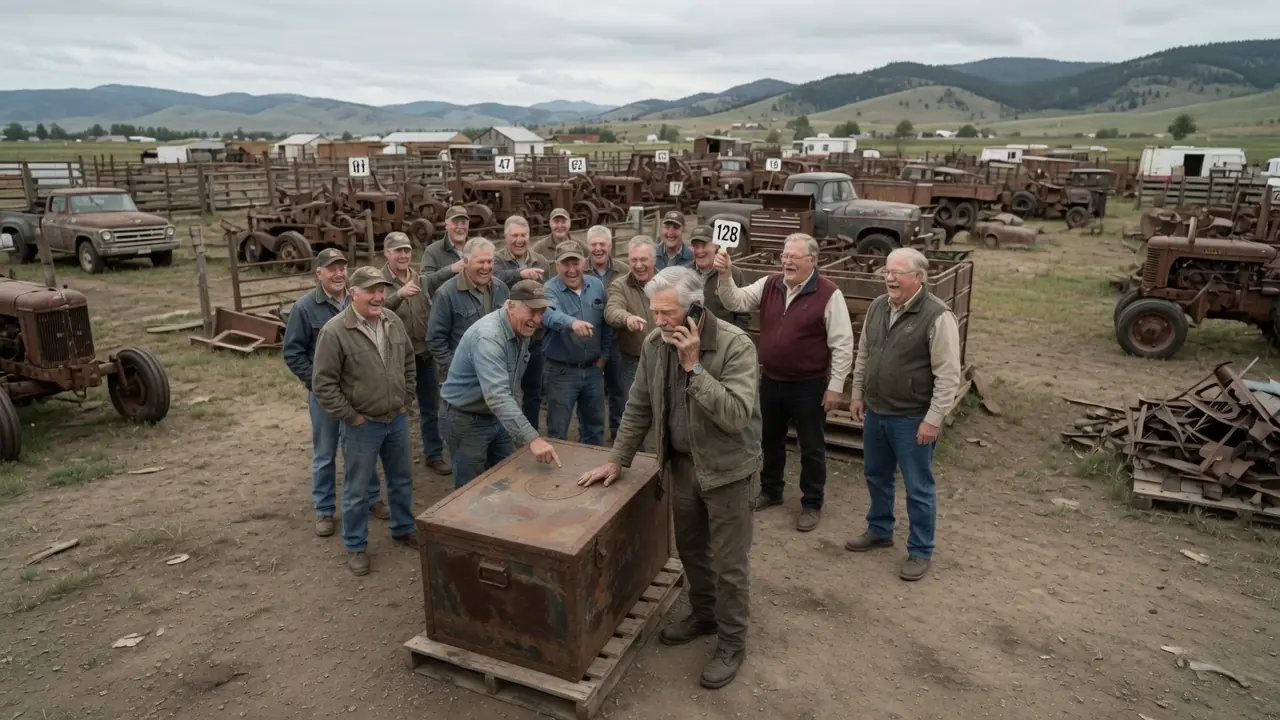
But the crate had no opening large enough for a radio signal to pass clearly, no visible antenna, and no reason to contain equipment that could still function after decades of neglect.
Frank stepped closer.
“Who is this?”
Static answered him.
Then the voice returned.
Older this time.
Weaker.
“Frank?”
His blood went cold.
No one had called him by that name inside the garage.
No one knew he had bought the crate.
And the voice sounded exactly like his brother.
Daniel Dawson had been dead for fifty-two years.
Frank backed away so quickly that his hip struck the workbench.
A row of sockets fell to the floor.
The noise broke whatever spell had held him.
He grabbed the garage door control and raised the overhead door.
Cold rain blew inside.
The crate remained still.
No more ringing came.
Frank stood beneath the open door until nearly midnight, watching the thing as if it might breathe.
The previous morning, he had bought it for seventy-five dollars at the Moultrie County surplus auction outside Bozeman, Montana.
Most people attended the auction for tractors, generators, welding equipment, and county trucks. Frank had gone looking for an old hydraulic press.
He found the crate behind a row of damaged snowplows.
It measured six feet long, four feet wide, and nearly four feet high. Rust covered every surface, but the corrosion was mostly superficial. Beneath it, the steel remained unusually thick.
No hinges.
No latch.
No manufacturer’s plate.
No shipping marks.
Only a faded yellow number stenciled on one side.
12-417-B.
The auctioneer described it as unidentified scrap recovered from an abandoned federal storage building.
“Probably empty,” he said.
Someone in the crowd laughed.
“Then why does it weigh eight hundred pounds?”
Another bidder kicked the side.
The crate answered with a dull, dense sound.
“Filled with rocks.”
“Or government paperwork.”
That drew more laughter.
Frank did not laugh.
He crouched beside the box and examined the corner welds.
The weld beads were narrow, even, and far more precise than ordinary storage-crate work from the era suggested by the rust.
Someone had not merely closed the container.
Someone had sealed it.
“Ten dollars,” the auctioneer called.
No one bid.
Frank raised his number.
A man in a camouflage cap turned toward him.
Frank ignored him.
Another bidder offered twenty-five.
Frank went to forty.
The other man stopped.
The auctioneer looked around.
“Forty dollars for the mystery box. Anyone else?”
A scrap dealer near the back shouted fifty.
Frank raised to seventy-five.
That ended it.
“Sold.”
The crowd applauded as if he had performed a trick.
Frank paid, loaded the crate onto his old flatbed truck with a forklift, and drove home alone.
He had not told his daughter.
Claire worried whenever he bought machinery heavier than he could safely move.
Frank lived by himself on six acres outside Bozeman. His wife, Helen, had died six years earlier. Retirement changed little about his routine.
He still woke before sunrise.
Still drank coffee from the same dented enamel mug.
Still spent most days in the garage repairing engines, antique farm equipment, and anything neighbors brought him.
Machines made sense.
People often did not.
The crate bothered him before it ever rang.
When he unloaded it with the chain hoist, he noticed the lifting eyes were positioned asymmetrically.
Not for balance.
For concealment.
The bottom plate also carried several threaded holes filled with lead plugs.
Something had once connected through the floor.
He spent Saturday afternoon removing rust.
Under one layer, he found a second number stamped into the steel.
D-19.
That was when the first memory returned.
Daniel’s military duffel bag.
The same marking had been written near the bottom in black paint.
D-19.
Frank had not thought about it in years.
He told himself it meant nothing.
D could stand for depot, division, department, or any number of other things.
Still, he worked more carefully after seeing it.
By Sunday evening, he had uncovered a narrow brass strip beneath the rust.
Most of the lettering had corroded away.
Only three words remained legible.
SIGNAL TEST UNIT.
Then the telephone rang.
Frank did not sleep that night.
He sat in the kitchen with the lights on, listening for the garage.
At 2:10, he called the county sheriff’s nonemergency number.
He hung up before anyone answered.
What would he say?
An old crate knew his name.
His daughter would take his car keys.
The sheriff would open the box with a cutting torch and laugh when they found an abandoned radio inside.
At 3:30, Frank returned to the garage carrying Daniel’s old military file.
It had been stored in the bottom drawer of a steel cabinet since 1971.
Daniel Dawson was twenty-four when he disappeared during a classified Air Force training operation in Nevada.
The official letter said his aircraft crashed during a navigation exercise.
No wreckage was recovered.
No body returned.
The family received a folded flag, a sealed explanation, and instructions not to contact the press because the mission involved sensitive equipment.
Frank had been nineteen.
He believed the government because adults around him did.
His father did not.
For the remaining fourteen years of his life, Walter Dawson insisted Daniel had not died in an aircraft.
“He called me,” Walter said repeatedly.
“After the date they claimed he crashed.”
Frank remembered the argument.
His father standing in the kitchen with the telephone receiver still in his hand.
Daniel’s mother crying at the table.
Walter saying Daniel had called from an underground station.
Frank told him grief was confusing him.
The official crash date had been June 17.
Walter claimed the call came June 19.
He said Daniel sounded frightened and whispered three things before the line failed.
Station Twelve.
The red field.
Do not trust Mercer.
No one named Mercer appeared in Daniel’s service records.
The family eventually stopped discussing the call.
After Walter died, Frank kept Daniel’s file but discarded most of his father’s notes.
Now, more than half a century later, a sealed federal crate marked 12-417-B had spoken from inside Frank’s garage.
At 4:05, he found a photograph tucked behind Daniel’s discharge paperwork.
It showed six young airmen standing beside a large truck-mounted electronic unit.
Daniel was second from the left.
Behind them stood an older officer.
The handwritten names on the back included:
Capt. Robert Mercer.
Frank sat down.
Rain continued against the roof.
At 4:17, the crate rang again.
He returned to the garage.
This time, he brought a portable tape recorder.
The ringing came from deep inside the steel.
Three times.
Then static.
Frank pressed record.
“Station Twelve,” the voice said. “Relay failure. Primary chamber compromised.”
Frank moved closer.
“Daniel?”
Silence.
Then:
“Frank, listen to me.”
The voice was clearer than before.
It was not a perfect match to Daniel as Frank remembered him. Too much distortion covered it.
But the rhythm was right.
Daniel always paused before saying Frank’s name when he was serious.
Frank’s hands trembled.
“What happened to you?”
The crate crackled.
“Find Mercer’s log.”
“Where?”
“Red field.”
“What does that mean?”
A deep electrical hum built inside the container.
Then another voice interrupted.
Cold.
Authoritative.
“Transmission unauthorized. Terminate channel.”
Daniel spoke quickly.
“Not a crash. They buried—”
The signal died.
The crate became silent.
Frank stood beside it until daylight.
At eight, he called Claire.
She arrived forty minutes later wearing jeans, a winter coat, and the expression of someone expecting to discover her father beneath a tractor.
Claire was forty-six, a civil engineer for the state transportation department, and far less patient with mysteries than Frank.
“You said not to panic.”
“I did.”
“That guarantees panic.”
Frank led her into the garage.
She stared at the crate.
“You bought this?”
“Yes.”
“For seventy-five dollars?”
“Yes.”
“Why?”
“The welds.”
Claire closed her eyes briefly.
“Of course.”
Frank played the recording.
She listened twice.
Then she looked at him.
“Where did you get this audio?”
“From the crate.”
“Dad.”
“I recorded it here.”
“There has to be a radio inside.”
“With power from what?”
“Battery.”
“After fifty years?”
“Maybe it isn’t fifty years old.”
“The steel is.”
“Someone could have modified it.”
“Why would they know Daniel’s name?”
Claire folded her arms.
“You said the voice sounded like Uncle Daniel. You haven’t heard him since you were nineteen.”
“I know how he spoke.”
“You want it to be him.”
Frank’s face hardened.
“I spent fifty-two years believing he died in a plane.”
“And now a box at a county auction tells you otherwise?”
“It mentioned Station Twelve.”
Claire stared.
Frank showed her the photograph.
Then told her about Walter’s call.
She had never heard the story.
Her skepticism weakened.
“Why didn’t Grandpa tell anyone else?”
“He did. They said he was unstable.”
“Was he?”
“He was grieving.”
“That isn’t an answer.”
“No.”
Frank walked toward the crate.
“But he knew Mercer’s name before we found this picture.”
Claire examined the brass strip.
SIGNAL TEST UNIT.
She crouched near the bottom.
“What are these?”
“Lead-filled ports.”
“Cable pass-throughs?”
“Probably.”
“Then this may have been part of a communications system.”
Frank nodded.
“We need to open it.”
Claire stood immediately.
“No cutting torch.”
“I wasn’t planning to use one.”
“You were absolutely planning to use one.”
“The heat could damage what’s inside.”
“That is the only reason?”
Frank ignored her.
They spent the morning examining the crate.
Each welded pin passed through a thick collar. Frank used an ultrasonic thickness gauge to map the metal. The pins were hollow.
Inside each was a smaller rod.
A mechanical locking system hidden beneath the welds.
“This was designed to be opened without cutting,” Claire said.
“From a specific sequence.”
“How do we find it?”
Frank studied the stenciled number.
12-417-B.
He traced the lifting eyes.
One near the front.
Two on the opposite side.
Four lead plugs underneath.
“One, two, four,” he said.
Claire looked at him.
“What?”
“The number may be an instruction.”
They tested the lifting eyes.
The first rotated one-quarter turn.
The second would not move.
The fourth lead plug concealed a recessed hex socket.
Frank inserted a wrench.
The internal mechanism shifted with a heavy click.
One locking pin loosened.
For the next three hours, they worked through the sequence.
One lifting eye.
Two side bolts.
Four bottom ports.
Then the brass plate marked B.
When Frank pressed it, all four internal rods retracted.
The lid rose less than an inch.
A rubber seal exhaled air that had been trapped for decades.
Claire stepped back.
“That pressure was still holding.”
Frank attached the chain hoist.
They lifted the lid slowly.
Inside the crate was not one device.
It was an entire communications console built into a steel frame.
Vacuum tubes.
Copper coils.
Relay banks.
A field telephone.
Two reel-to-reel tape units.
A faded map mounted beneath cracked glass.
And, at the center, a black handset resting in its cradle.
A small amber light glowed beside it.
Claire stared.
“That is impossible.”
Frank leaned closer.
The light weakened.
Then brightened.
He saw a cable descending through the false bottom.
“Power is coming from below.”
They raised the crate with the hoist.
Beneath it, one of the lead plugs had pierced a small metal contact plate embedded in the concrete floor.
Frank frowned.
“That wasn’t here yesterday.”
Claire crouched.
“It’s not part of the concrete.”
She pulled.
A thin wire slid from a crack between two slabs.
It ran toward the north wall.
They followed it behind a cabinet.
The wire entered an old conduit Frank had never used.
The conduit continued underground toward the abandoned pasture behind the garage.
Frank’s property had once belonged to the federal government.
He knew that.
The land was sold as surplus in 1984 after serving as a storage annex connected to an Air Force radar station.
But the real-estate documents mentioned no buried communications lines.
Claire called a utility-locating service.
By afternoon, technicians marked a narrow underground cable running from the garage to the western edge of the property.
Then beyond it.
Toward an abandoned military tract locals called the Red Meadow.
Frank felt his father’s words return.
The red field.
The land earned the name from iron-rich clay that stained boots and machinery. Nothing grew well there except dry grass and rabbitbrush.
At sunset, Frank and Claire followed the cable with a magnetic locator.
It ended at a collapsed concrete slab half hidden beneath sagebrush.
Stamped into the corner was the number 12.
Claire looked at her father.
“Station Twelve.”
The slab covered an underground entrance.
By nightfall, they had exposed a steel hatch.
It was locked.
Frank called the sheriff.
This time, he did not hang up.
Sheriff Linda Carver arrived with two deputies.
She listened to the recording, examined the open crate, and contacted the nearest Air Force office.
Within two hours, three black government vehicles entered Frank’s driveway.
The lead official introduced himself as Colonel Alan Reeves.
He was polite until he saw the console.
Then his expression changed.
“Where did you obtain this?”
“County auction.”
“That equipment is federal property.”
“I have a receipt.”
“This is not a joke, Mr. Dawson.”
“Neither was my brother’s death.”
Reeves looked at him.
Frank placed Daniel’s photograph on the workbench.
“Do you know Station Twelve?”
“No.”
The answer came too quickly.
Claire noticed.
“So why did you bring an explosive-ordnance team?” she asked.
Reeves glanced toward the vehicles.
“Standard precaution.”
“For a radio?”
“For unidentified military equipment.”
Frank stepped between Reeves and the crate.
“You are not taking it.”
Reeves’s voice cooled.
“You do not have authority to retain classified material.”
“You said you don’t know what it is.”
Silence followed.
Sheriff Carver moved closer.
“This is private property. Unless you have a warrant, nothing leaves tonight.”
Reeves looked at her.
Then at the underground hatch.
“We need to secure that entrance.”
“Why?” Frank asked.
“Because the facility may be unsafe.”
“Then you do know what it is.”
Reeves said nothing.
At 11:43, the telephone inside the console rang.
Everyone froze.
Frank lifted the handset.
Static filled the speaker.
Then Daniel’s voice came through.
“Frank?”
Reeves stepped forward.
“Put that down.”
Frank turned away.
“I’m here.”
“The chamber is failing.”
“Where are you?”
“Below Station Twelve.”
Colonel Reeves whispered something to one of his men.
The man ran toward the vehicles.
Frank tightened his grip on the handset.
“Daniel, what year is it?”
A long pause.
“1971.”
Claire covered her mouth.
Frank felt the room tilt around him.
“That was fifty-two years ago.”
“No.”
Daniel sounded frightened.
“No, the relay only failed for eleven minutes.”
Frank looked at the reels.
One was turning.
Slowly.
The machine was not communicating live.
It was playing a stored transmission.
A recording triggered by the cable connection.
Daniel’s voice had been waiting in the system for more than half a century.
“Listen,” the recording continued. “Mercer ordered the test after the containment readings failed. They knew the chamber was unstable.”
Frank closed his eyes.
“What chamber?”
“The temporal relay.”
Claire stared at him.
Reeves reached for the handset.
Sheriff Carver blocked him.
Daniel continued.
“They said it was signal compression. Sending voice across distance without delay. But Mercer knew it was more. The field was arriving before we transmitted it.”
Frank did not understand every word.
But the fear in Daniel’s voice needed no translation.
“He locked six of us below. Said no one could know. We tried to shut it down.”
A crash sounded on the recording.
Men shouting.
An alarm.
Then Daniel returned.
“If this reaches you, the storage unit made it out. Mercer keeps the master log in the red field control room.”
The voice weakened.
“Frank, Dad was right. It wasn’t a crash.”
The recording ended.
The reels stopped.
The amber light went dark.
No one spoke.
Colonel Reeves finally said, “That facility must be sealed.”
Frank placed the handset down.
“No.”
“It may contain hazardous material.”
“Then open it with us watching.”
“That will not happen.”
Sheriff Carver stepped beside Frank.
“It will if the county obtains a court order.”
Reeves looked furious.
Claire had already photographed every component, every label, and the underground hatch.
“If anything disappears,” she said, “copies go to three news organizations.”
Reeves’s expression changed.
“You do not understand what you’re dealing with.”
Frank looked at the silent console.
“Neither did my brother.”
The legal fight lasted eleven days.
The Air Force requested emergency control of the site.
The county demanded environmental records.
Claire contacted a journalist who specialized in Cold War military installations.
The number D-19 led to a declassified budget document from 1969.
Project Distant Signal.
Officially, it studied long-range communication through ionized atmospheric channels.
Unofficial memos referred to temporal echo.
The research team believed certain electromagnetic fields could cause a signal to be received fractions of a second before transmission.
At first, the effect lasted microseconds.
Then milliseconds.
By 1971, Station Twelve reportedly produced an eleven-minute displacement.
A message recorded inside one chamber could emerge from another before it was sent.
The military saw strategic value.
A warning received eleven minutes early could change a battle.
A missile launch detected before it happened could transform warfare.
But the field was unstable.
Test animals suffered neurological damage.
Electrical equipment aged rapidly.
One chamber experienced what technicians called time shear, where clocks inside and outside no longer agreed.
Daniel had not been a pilot.
He was an electronics specialist assigned to Station Twelve.
The aircraft crash story was fabricated after the facility accident.
Captain Robert Mercer supervised the project.
He died in 1988.
His official biography mentioned nothing about Montana.
The court allowed a joint federal and county team to open the underground station under independent observation.
Frank stood beside Claire when the steel hatch lifted.
Stale air escaped.
A concrete stairway descended into darkness.
The facility had partially collapsed, but the main corridor remained intact.
Red emergency lights flickered after engineers restored limited power.
Room numbers appeared along the wall.
Control.
Relay.
Recording.
Containment.
At the end of the corridor stood a steel door marked D-19.
Behind it, investigators found six military cots.
Three emergency oxygen tanks.
A broken control panel.
And human remains.
Six sets.
Daniel’s identification tags lay beside one of them.
Frank did not enter immediately.
He stood in the doorway with one hand against the concrete.
For fifty-two years, his family had lived with an empty grave.
Now the truth waited twelve feet underground.
Daniel had survived the initial accident.
The team became trapped when Mercer sealed the chamber to prevent information from escaping.
Emergency logs showed they lived at least four days.
They recorded messages into the signal system, hoping one would travel beyond the facility.
Most loops failed.
One entered the portable test unit sealed inside the crate.
The crate was moved to a storage annex before Station Twelve was buried.
No one realized the message remained encoded in its relay banks.
When Frank placed the crate above the old underground cable contact, the system completed a circuit.
Daniel’s final transmission began to play.
The master log was found inside a fireproof cabinet in the control room.
Mercer’s handwriting appeared throughout.
The entries proved he knew the test chamber was unstable.
He also knew personnel remained alive after the accident.
One line became the center of the investigation.
RECOVERY NOT AUTHORIZED. EXPOSURE RISK EXCEEDS PERSONNEL VALUE.
Frank read it once.
Then again.
His brother had not been lost.
He had been judged expendable.
The government issued a formal apology six months later.
Daniel and the other five men received posthumous honors.
Their remains were returned to their families.
A memorial service was held at the Red Meadow site.
Hundreds attended.
Frank stood beside Daniel’s casket holding the folded flag his mother had received in 1971.
Claire remained at his side.
After the ceremony, Colonel Reeves approached.
He no longer wore the guarded expression from the garage.
“My office did not know the full history,” he said.
Frank looked at him.
“But someone always knows enough to stay quiet.”
Reeves accepted that.
“The test unit belongs in the Air Force museum.”
“No.”
“It is historically significant.”
“It sat forgotten for fifty-two years.”
“We can preserve it properly.”
Frank looked toward the crate displayed beneath a temporary shelter.
Rust still marked its sides.
The welded pins remained.
The old telephone rested inside.
“My father died believing people thought he was crazy.”
Reeves said nothing.
“My mother died without knowing where her son was.”
Frank’s voice stayed calm.
“My brother’s voice waited inside that box longer than he was alive.”
He looked at the colonel.
“It stays with the families.”
A compromise was reached.
The crate and console became the central exhibit in a small museum built near the memorial.
Ownership belonged jointly to the six families.
The government provided preservation funding but no control over the history displayed.
The exhibit did not focus on strange science.
It focused on decisions.
Warnings ignored.
Records altered.
Lives weighed against secrecy.
Frank donated Daniel’s photograph, service papers, and his father’s handwritten notes.
He kept one thing.
The original field telephone handset.
It rested on the workbench in his garage.
Not connected.
Not powered.
Silent.
Two years after the discovery, Frank returned to the Moultrie County surplus auction.
The same auctioneer recognized him.
“You buying another mystery crate?”
“Not today.”
“You made that seventy-five dollars famous.”
Frank looked across the equipment yard.
Most objects appeared ordinary.
A bent harrow.
Two generators.
A stack of steel cabinets.
Things people stopped noticing because age had removed their labels.
The auctioneer lowered his voice.
“Did you really hear your dead brother call you?”
Frank considered the question.
“No.”
The man looked disappointed.
“I heard something he recorded when he was alive.”
“That’s different?”
“Yes.”
“How?”
Frank looked toward the mountains.
“A ghost asks you to believe the impossible.”
He paused.
“A recording asks why the truth was hidden.”
At eighty, Frank still opened the museum every Thursday.
School groups came.
Veterans came.
Engineers came to study the relay equipment.
Conspiracy theorists came hoping for proof that time travel existed.
Frank disappointed them.
“No person traveled through time,” he said. “Only a signal, and even that may have been stored in ways the original team misunderstood.”
“But Daniel’s message knew your name.”
“He recorded it for me.”
“How did the crate activate exactly when you bought it?”
“The old cable remained beneath my garage.”
“That seems impossible.”
“Unlikely is not impossible.”
Visitors often asked whether the telephone ever rang again.
It did not.
After the final recording played, the relay banks burned out.
Engineers could not reproduce the effect.
Some claimed the system had never displaced signals through time at all. They believed unusual electromagnetic storage created delayed playback.
Others argued the recorded timestamps proved the messages emerged before their original transmission.
Frank cared less about the answer as he grew older.
The great secret was not whether the military briefly bent time.
It was that six men were left to die because admitting failure threatened powerful careers.
That part required no advanced physics.
It had happened before.
It would happen again.
Only memory resisted it.
On the fiftieth anniversary of Daniel’s official death, Frank stood before the crate with a group of young mechanics.
They had come to study its construction.
One student examined the welds.
“Whoever built this didn’t want it opened.”
Frank shook his head.
“They wanted it opened by the right person.”
“How do you know?”
“Everything sealed by people has a method.”
The student pointed toward the hidden locking system.
“You figured it out from the number?”
“Partly.”
“Were you sure?”
“No.”
“What made you keep trying?”
Frank placed his hand on the rusted steel.
“Because the details were too deliberate to be meaningless.”
The student looked at the thick corner plates.
“Most people thought it was scrap.”
“I did too.”
“But you paid seventy-five dollars.”
Frank smiled.
“Scrap can still have good steel.”
After the group left, Claire found him sitting beside the exhibit.
She had become director of the memorial foundation.
“You tired?”
“A little.”
“You want me to close early?”
“No.”
She sat beside him.
For a while, they listened to the low hum of the climate-control system.
“Do you ever wish you hadn’t bought it?” Claire asked.
Frank looked at the crate.
The discovery had reopened wounds his family had buried for decades.
It exposed government wrongdoing.
It gave his brother a grave.
It also destroyed the last comforting idea that Daniel’s death had been fast.
“No,” Frank said.
“Even knowing how he died?”
“Especially then.”
Claire waited.
Frank touched the telephone handset inside the display case.
“We spent fifty-two years grieving a story someone invented for us.”
He looked at her.
“Pain does not become kindness because it arrives with a lie.”
That winter, Frank’s health began to fail.
His heart weakened.
He stopped lifting engines.
Then stopped driving at night.
By spring, Claire moved him into her home.
The garage remained exactly as he left it.
Tools arranged by size.
Coffee mug beside the vise.
Daniel’s handset on the workbench.
One evening, Frank asked Claire to take him there.
She drove him back to the property.
He walked slowly into the garage using a cane.
Dust had settled across the benches.
The concrete patch where the old cable contact emerged remained visible beneath the lights.
Frank sat in his wooden chair.
Claire opened the toolbox.
Inside was the seventy-five-dollar auction receipt.
“You kept this?”
“Proof I overpaid.”
She smiled.
“You could sell the story rights for more.”
“Then someone would add explosions.”
“They already want to.”
“Tell them no ghosts.”
“I have.”
“No time machine carrying Daniel into the present.”
“I know.”
“And no secret gold inside the crate.”
Claire laughed.
“That would be a different audience.”
Frank looked toward the workbench.
“Put the receipt in the museum.”
“Why?”
“People should know how ordinary the beginning was.”
An auction.
A rainy weekend.
An old mechanic noticing good welds.
History rarely announced itself.
Sometimes it sat behind snowplows while strangers made jokes.
Frank died that autumn at eighty-two.
His funeral was held near the Station Twelve memorial.
The six families attended.
So did Sheriff Carver, retired mechanics, veterans, students, and several engineers who had spent years studying the strange relay console.
Claire placed the auction receipt beside his photograph.
Seventy-five dollars.
The amount seemed absurdly small compared with everything the crate contained.
Not gold.
Not weapons.
Not treasure.
A voice.
A betrayal.
A grave.
A truth waiting for the right circuit to close.
Years later, visitors still stood before the rusted container and listened to Daniel Dawson’s restored recording.
The museum played only a short portion.
“Frank, listen to me.”
Then static.
Then:
“It wasn’t a crash.”
The remaining message was preserved for the families.
A brass plaque beside the exhibit read:
RECOVERED FROM COUNTY SURPLUS IN 2023.
PURCHASE PRICE: $75.
CONTENTS: CLASSIFIED SIGNAL EQUIPMENT AND THE FINAL TESTIMONY OF SIX MEN LOST AT STATION TWELVE IN 1971.
Below it appeared a sentence Frank had written shortly before his death:
OLD METAL DOES NOT KEEP SECRETS.
PEOPLE DO.
The crate never rang again.
It did not need to.
One call had been enough to reopen the ground, restore six names, and prove that some truths are not lost with time.
They remain sealed beneath rust and silence.
Waiting for someone who notices the welds.