The snow started falling before noon and turned cruel before sunset. By the time the last logging truck crawled past the blue neon sign of The North Star Grill, the whole road outside had vanished beneath a white, shifting wall, and the old building groaned like it remembered every winter it had survived. Frank Mallory stood behind the counter with a towel over one shoulder, watching the empty highway through the steamed front windows. He was seventy-one, narrow-shouldered but still upright, with silver hair combed back from a weathered face, hands scarred from forty years of fixing engines, patching roofs, and burying things he did not talk about. The radio above the pie case kept cutting in and out, warning people to stay home, but Frank had learned a long time ago that warnings never arrived in time for the people who needed them most.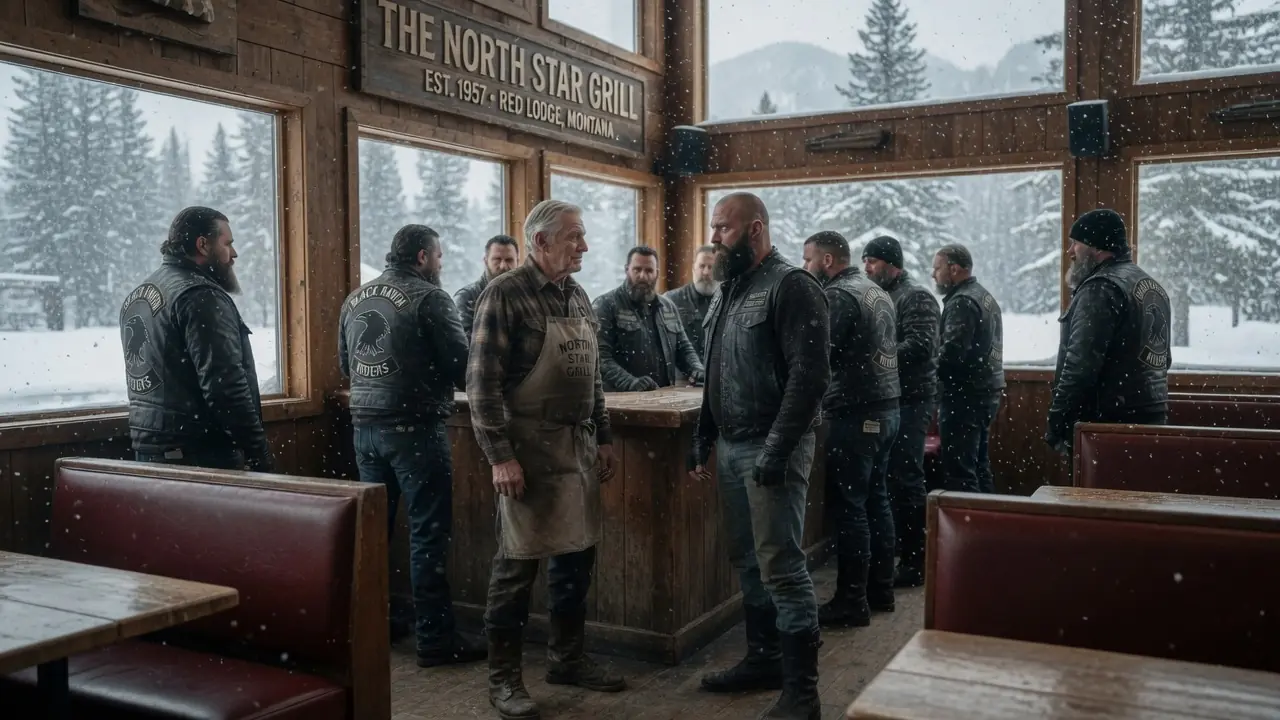
The North Star had once been a busy stop outside Red Lodge, Montana, where hunters, skiers, bikers, and truck drivers came in for coffee strong enough to wake the dead. Now it mostly served loneliness. The stools were cracked, the booths were taped at the corners, and the jukebox only played if Frank kicked it in the right spot with the heel of his boot. He kept the place open because his late wife, June, had painted the sign herself in bright blue letters, and because every Wednesday he still made her chicken stew from a grease-stained recipe card she had written the year they got married. The card sat in a plastic sleeve under the register, soft at the edges from his thumb brushing it whenever the nights got too quiet.
At six-thirty, Frank locked the front door but left the sign glowing. It was habit more than hope. A man who had run a roadside grill for half his life knew somebody always got stranded, lost, hungry, or proud enough to think they could outrun weather. He filled the old coffee urn, carried a pot of stew to the back warmer, and lowered himself onto the stool beside the counter. June’s framed photograph watched from the shelf above the register, her laughing face forever forty-eight, her red scarf caught in the wind at Glacier National Park. Frank touched two fingers to the frame and whispered, “One more bad night, June. Then I’ll close early tomorrow.”
The first thud came so softly he thought it was a branch hitting the side wall. The second came harder, followed by a dragging scrape against the front door. Frank stood without thinking, his right knee popping, his old dog Scout lifting his head from the rug behind the counter. The dog was almost blind and half deaf, but he growled toward the entrance with a low sound Frank had not heard from him in years. Frank grabbed the heavy flashlight beneath the sink and moved toward the door. Through the frosted glass, he saw a shape slumped against the frame, one gloved hand sliding slowly down the pane.
When he opened the door, the storm pushed in first, cold and wild, scattering napkins off the counter and rattling the hanging pans in the kitchen. Then the woman fell forward into his arms. She was maybe thirty-two, with snow packed into her black hair and lashes, her skin gray from cold, her mouth cracked and trembling. She wore a leather motorcycle jacket beneath a torn wool coat, and one side of her face was bruised, the swelling purple under her cheekbone. Around her neck hung a small silver locket, frozen to her skin, and in her left hand she clutched a child’s red mitten so tightly Frank had to pry her fingers open enough to see it.
“Please,” she breathed. Her voice was almost gone. “Don’t let them take her.”
Frank looked past her into the storm, but all he saw was spinning snow and the blue glow of his own sign. He pulled her inside, kicked the door shut with his boot, and dragged her toward the booth nearest the kitchen. She was lighter than she should have been, soaked to the bone, shivering so violently that her teeth clicked together. Frank had not worn a uniform in decades, but the old training in his hands woke up fast. He had been a volunteer rescue medic after the mill closed, back when Red Lodge still had enough people to fill a church basement, and he knew cold could steal a life without raising its voice.
He cut away the wet coat, wrapped her in two wool blankets from the storage room, and put warm towels around her neck and feet. Her leather jacket fell open, and Frank noticed the patch on the inside lining, not on the outside where any stranger could read it. A white raven stitched over a road, the words Black Raven Riders curved beneath it, and a smaller line sewn in silver thread: wife of Gabriel Vale. Frank knew the name in the loose way small towns know dangerous names. Gabe Vale ran a biker club out of Idaho, men who came through Montana in groups big enough to shake windows and polite enough to tip well, but never gentle enough to be mistaken for harmless.
The woman’s eyes opened when Frank pressed a warm mug against her hands. They were a pale green, unfocused but alert with terror. “My name is Lina,” she whispered. “I’m not running from Gabe.”
“I didn’t ask,” Frank said, keeping his voice quiet.
“They’ll think I am,” she said. “They’ll think you helped me hide.”
Frank pulled the mug away before she spilled it and checked the pulse at her throat. Fast, weak, wrong. “Who are they?”
Lina closed her eyes as if the answer hurt more than the cold. “His own men, maybe. Or my brother’s. I don’t know anymore.” She swallowed, and tears slipped sideways into her hair. “There was a truck. No headlights. They forced me off Route 212 near the creek bridge. I got out before the car slid down. My daughter was supposed to be with me, but she wasn’t in the back seat. Her mitten was there. Just the mitten.”
Frank felt the room tilt slightly, not from fear but from memory. A child missing in weather like this was not a problem; it was a clock. He looked at the red mitten on the table, damp and tiny, the kind sold in pairs at hardware stores beside snow shovels and salt. For a second, he saw another small hand, another winter, another thing he had failed to reach in time. Then he pushed the memory down where he kept it with all the other buried things. “How old?”
“Six,” Lina said. “Maddie. Brown curls. Pink snow boots. She was wearing a yellow coat.”
Frank’s eyes moved to the storm-dark windows. “If she was taken, we need people. If she wandered, we need them faster.”
“No police,” Lina said quickly, trying to sit up. Pain twisted her face and she grabbed the edge of the booth. “Please, Frank, no police.”
Her eyes filled with something like shame. “June did.”
For a moment the only sound was the wind beating the windows. Frank stared at the woman, at her bruised face, at the locket on her neck, at the red mitten between them. He had known June kept pieces of the town alive long after people left, writing letters to former waitresses, sending recipes to widowers, mailing Christmas cards to kids who once washed dishes in the back kitchen. But June had been dead nine years. Hearing her name from a stranger on a night like this felt like hearing a bell ring under water.
“My wife died in 2017,” he said.
“I know,” Lina whispered. “She wrote to me before that. When I was seventeen.” Her hand went to the locket. “She told me if I ever had nowhere safe to go in Montana, find the blue North Star sign. She said the man inside looked grumpy but never turned away a freezing soul.”
Frank looked toward June’s photograph and felt something open in his chest that had been locked for years. He wanted to ask a dozen questions, but outside, the storm pressed harder against the glass. Lina’s skin was still too cold, her breathing too shallow, and somewhere out in that whiteness a little girl might be alone or in the hands of men who thought a child could be used as a message. Frank took June’s recipe card from under the register and tucked it into his shirt pocket without knowing why. Then he lifted the old landline receiver and listened to nothing but dead air.
The storm had knocked the phone out. His cell had no service. The sheriff’s station was twelve miles away across a road that had probably disappeared. Frank moved to the cabinet under the coffee maker and pulled out the emergency radio he had not touched in three winters. Static spat through the speaker, then a weather alert, then more static. He adjusted the antenna, turned the dial, and found a local plow frequency that came and went like a voice through a wall. Before he could speak, Scout growled again.
Headlights appeared outside, blurred by blowing snow, then another pair behind them, then more. Engines crawled into the lot. Not trucks, not plows. Motorcycles would have been impossible in that storm, but the vehicles that arrived had the same feeling as a pack entering a room. Black pickups, a lifted van, two SUVs with light bars, all easing into the parking lot until the blue neon reflected off their windshields. Frank did not need to see the patches to know who had come.
Lina gripped his wrist. “Don’t tell them I’m here until Gabe is here.”
“Is Gabe the one I should trust?”
Her face tightened. “He’s the only one who loves Maddie more than he loves his club.”
That was not exactly an answer, but Frank had lived long enough to know the truth often came limping, not marching. He guided Lina toward the kitchen pantry, the only room with no windows, and settled her on folded tablecloths behind the flour sacks. He put Scout beside her, then handed her the radio. “Press this if you hear a child outside. Press it twice if you hear men inside.”
“What are you going to do?”
Frank looked back at the dining room, at the booths June had wiped, the counter she had leaned across, the photograph above the register. “Open my restaurant.”
The first man through the door was not Gabe Vale. He was younger, thick-necked, with a shaved head, a black beard full of ice, and eyes that moved too quickly. Three others came behind him, all broad-shouldered, leather cuts visible beneath winter gear, boots tracking dirty slush across the tile. The lead biker looked around the empty grill and saw only an old man standing behind the counter with a coffee pot in one hand. He did not see Lina. He did not see the red mitten Frank had slipped into his apron pocket. He did see the torn coat near the back booth, because Frank had left it there on purpose.
“We’re looking for a woman,” the biker said.
Frank poured coffee into a mug and slid it down the counter. “Most men are.”
The biker’s mouth tightened. “Don’t get cute with me, old-timer. Black hair. Green eyes. Wearing our patch under her coat. She came this way.”
“A lot of things came this way tonight,” Frank said. “Snow, wind, bad manners.”
One of the bikers laughed, but the lead man did not. His gaze fixed on the wet coat. He crossed the room, picked it up, and held it like evidence. “She was here.”
Frank set the coffee pot down. “A woman knocked. Half-frozen. Bruised. Talking about a missing child.”
The room changed. The laugh died first. Then the men looked at each other, and Frank saw what he needed to see. Not surprise. Not enough of it. The lead biker recovered quickly, but he had given himself away in the quarter second before his face hardened. “Where is she?”
“Gone,” Frank said.
The biker stepped close enough for Frank to smell wet leather and chewing tobacco. “You lying for her?”
“I lie better than that.”
The blow came fast, a backhand across the side of Frank’s face that sent him into the pie case hard enough to crack the glass. Pain flashed white behind his eyes, and the room swayed. He tasted blood along his gumline. The biker leaned over him, breathing hard, while his men spread through the diner, kicking open the kitchen door, yanking aside curtains, opening cabinets, and knocking pans onto the floor. Frank heard the pantry latch rattle once, then stop. Lina had locked it from inside.
“Search everything,” the lead biker snapped. “If she’s here, drag her out.”
Frank pushed himself upright, wiping his mouth with the back of his hand. “You boys always this rough with women and old men?”
The biker grabbed him by the collar and shoved him against the counter. “I’m being polite.”
“Then your mother quit early.”
The second hit landed in Frank’s stomach and took the air from him. He folded but did not fall. In the pantry, no sound came. Good girl, he thought, though he did not know if he meant Lina or the missing child or the memory that kept climbing up from the locked place in his mind. The men tore through the storage closet, dumped sugar bags, opened the freezer, slammed the bathroom door so hard the mirror cracked. One ripped June’s photograph from the shelf and knocked it to the floor.
Frank moved before he thought. “Don’t touch that.”
The lead biker looked down at the broken frame, then at Frank’s face. A slow, ugly smile spread beneath his beard. “That your wife?”
Frank said nothing.
The biker lifted his boot and pressed the heel against the glass over June’s picture. “Tell me where Lina is.”
Frank’s hands curled at his sides. The old grief in him rose sharp and hot, begging for violence, but violence would open the pantry and end any chance of finding Maddie. He looked at June’s smiling face under the cracked glass and remembered her saying every person has one job in a storm: keep the next person alive. He forced his voice flat. “You got a name?”
“Doyle.”
“Well, Doyle,” Frank said, “your coffee’s getting cold.”
Doyle shoved him backward, and two men moved toward the kitchen pantry again. One kicked the lower panel. Lina must have pressed herself into the flour sacks, because Frank heard only the wood groan. He needed to pull them away. He reached into his apron pocket, closed his fingers around the red mitten, and made sure Doyle saw it when he pulled it halfway out.
Doyle’s eyes sharpened. “Where did you get that?”
“Found it.”
“Where?”
Frank tucked it away again. “Not here.”
Doyle signaled with two fingers, and the men stopped searching. Now the whole room was focused on Frank, which was exactly what he wanted and exactly what terrified him. Doyle grabbed Frank’s coat from the hook by the door and threw it into his chest. “You’re taking us.”
“Road’s closed.”
“Then we walk.”
Frank let them drag him outside because refusing would only restart the search. The cold hit his bruised face like broken glass. Snow blew sideways across the lot, covering the tire tracks almost as quickly as they formed, and the blue neon sign flickered above them like a dying star. Doyle’s men spread out with flashlights, following Frank behind the grill toward the old service lane that led to the creek bridge. Frank walked slowly, pretending age made him uncertain, while his mind mapped every ditch, fence post, cattle gate, and drainage culvert he had known since before Doyle had teeth.
He had seen the skid marks when he stepped out earlier, faint black curves near the far edge of the lot. A vehicle had cut across the service lane and turned toward the creek, not away from it. If Lina was telling the truth, whoever took Maddie knew the old road. If Doyle had known about the mitten before Frank showed it, he was not looking for Lina. He was cleaning up a mistake.
The storm swallowed sound in strange ways. Sometimes a man ten feet away sounded like he was behind a door; sometimes the groan of a tree half a mile off came close enough to touch. Frank led them past the broken cattle gate, down through waist-high snow, and toward the abandoned warming shed where skiers used to stop years ago before the county gave up maintaining the lower trail. He had not been there since June died. The place sat near the creek line, half-collapsed, but the roof still held, and a child could survive there if someone had left her with blankets.
Doyle shoved him from behind. “You better not be wasting my time.”
Frank stumbled, caught himself on a fence post, and looked at the white world ahead. “Funny. I was thinking the same about you.”
One of the men cursed and raised his flashlight. Through the snow, faint and thin, came a sound that made Frank’s bones tighten. A bell. Not a church bell, not a cowbell, but the tiny uneven jingle of something tied to a child’s zipper. Lina had said yellow coat. Frank remembered seeing kids come through the diner with little bells on winter jackets so parents could hear them in stores. The sound came once, then vanished.
Doyle heard it too. His face changed, not with relief but with anger. He pushed ahead of Frank, signaling the others to fan out. That told Frank enough. He veered left, away from the shed, toward the line of junipers where the old drainage culvert ran beneath the access road. A child hiding from adults would not stay in an open shed. A child hiding from men who scared her might crawl into the smallest dark place she could find.
“Maddie,” Frank called, keeping his voice gentle. “My name is Frank. Your mama is warm and safe. I have stew, and I have an old dog who snores louder than a tractor.”
Doyle rounded on him. “Shut up.”
A tiny sob answered from the culvert.
Frank moved fast for an old man. He dropped to his knees in the snow, ignoring the lightning pain in both legs, and shone his flashlight under the road. At first he saw only ice, weeds, and darkness. Then two brown eyes reflected back at him. The little girl was curled deep inside the pipe, her yellow coat torn, one boot missing, curls stuck damply to her cheeks. A strip of silver duct tape hung from one sleeve where someone had bound her wrists and she had worked herself loose.
“Hi, Maddie,” Frank said softly. “Your mom sent me.”
“My mom fell,” she whispered.
“She got back up,” Frank said. “Strong women do that.”
Doyle stepped behind him. “Grab her.”
Maddie screamed and scrambled deeper into the culvert. Frank stood so sharply Doyle took half a step back. For the first time that night, the old man let his full height show, not much but enough, and the grief in his eyes hardened into something Doyle did not understand. “You touch that child and you’ll be walking out of these woods without the hand you use.”
Doyle laughed, but uneasily. “You think you can stop us?”
“No,” Frank said. “But I think you’re scared of who’s behind you.”
Engines growled somewhere beyond the storm.
Not close yet. Not clear. But deep, numerous, rising under the wind like a mountain waking. Doyle’s men turned toward the road. Their flashlights jerked in the snow. Frank smiled despite the blood drying at his lip, because he knew that sound now. It was not the pickups in the lot. It was not police. It was the Black Raven Riders arriving the hard way, through weather nobody sane would challenge, and whoever led them knew the roads well enough to make the storm look small.
Doyle grabbed Frank by the jacket and spun him around. “What did you do?”
Frank pointed to the sky, where a faint red blink moved beyond the tree line. “Your men missed the emergency beacon in Lina’s locket.”
Doyle’s face drained. “That was dead.”
“It was,” Frank said. “Until I warmed it against the coffee urn and taped it to the weather antenna.”
The first headlight broke through the snow like an eye opening. Then another appeared, and another, not motorcycles this time but snowcats, plow trucks, utility rigs, and four-wheel drives fitted with chains. They came down the closed highway in formation, yellow roof lights turning the storm red and gold. At the front was a black plow truck with a raven painted across the hood. It stopped twenty yards from the culvert, and the driver’s door opened before the engine died.
Gabriel Vale stepped out into the blizzard.
He was not as big as Doyle, but the space around him changed when he moved. He was forty, lean, with a close black beard, snow collecting on his shoulders, and eyes so pale they seemed almost colorless in the headlights. He wore a leather cut beneath a heavy parka, the Black Raven patch visible over his heart. Men poured out behind him, dozens of them, maybe more hidden in the white, each one silent in a way that frightened Frank more than shouting would have. They did not rush. They did not wave weapons. They simply formed a wide half circle around Doyle’s crew and waited for Gabe to speak.
Gabe looked at Frank first, then at the culvert, then at the red mitten hanging from Frank’s apron pocket. His face almost broke. “Maddie?”
“Daddy?” the little girl cried from the pipe.
Gabe’s knees hit the snow. All the danger in him fell away at the sound of his child’s voice, leaving only a father with both hands reaching into the cold. Maddie crawled toward him, sobbing so hard she could barely breathe, and Frank guided her out carefully, wrapping his coat around her shoulders. Gabe pulled her against his chest and held her as if he could put warmth back into her by force. For a moment nobody moved, not even Doyle.
Then Gabe saw the duct tape on Maddie’s sleeve.
The father disappeared. The president remained.
His eyes lifted to Doyle. “Why was my daughter tied up in a culvert?”
Doyle raised his hands. “Gabe, listen. I found her like that. We were tracking Lina, same as you.”
Frank coughed a laugh, and every biker looked at him. He was bent slightly from the cold, face bruised, jacket open, June’s recipe card tucked crookedly in his shirt pocket. “He knew where the mitten came from before I told him. He knew the beacon was supposed to be dead. He searched my place like he was trying to find Lina before you did, not save her.”
Doyle’s jaw worked. “Old man’s confused.”
Gabe looked at Frank’s split lip, then at Doyle’s clean gloves, then at the men behind Doyle who suddenly seemed very interested in the snow. “Did he put hands on you?”
Frank shrugged. “A little. Your people are hard on pie cases.”
One of Gabe’s riders, a broad woman with gray braids and a Raven patch on her sleeve, stepped forward carrying a tablet wrapped in plastic. “Beacon log came through,” she said. “Lina’s signal pinged at the diner, then on the roof antenna. I also got a partial dashcam upload from her car before it died. The truck that forced her off Route 212 had a club plate. Doyle’s plate.”
The storm seemed to stop breathing.
Doyle moved first, lunging toward Maddie as if the child could become a shield. He made it two steps before three Ravens took him down into the snow so hard the sound carried across the trees. His men tried to scatter and found every path blocked. No one fired. No one needed to. Gabe handed Maddie to the gray-braided woman and walked to Doyle, who was face-down, cursing into the snow.
“You used my wife and child to start a war inside my own club,” Gabe said.
Doyle spat blood. “You got soft. Everybody sees it. You married a woman who hates the life, raised a kid like we’re some church picnic. Men were ready for new leadership.”
Gabe stared down at him with a stillness that made even Frank cold. “So you planned to make it look like Lina ran to some old man for help. Then you’d find her dead, blame me for not protecting my family, and take the chair while everyone was grieving.”
Doyle said nothing.
Frank looked away from the men in the snow and focused on Maddie, who was shivering under his coat. “Your mama’s waiting,” he told her. “She’s scared too.”
Gabe heard that and turned sharply. “Lina’s alive?”
Frank frowned. “You came here without knowing?”
“The beacon gave coordinates,” Gabe said, voice suddenly thin. “Then Doyle’s men hit the channel first and said they found blood at the old grill. He told us you had her. He told us you wouldn’t open the door.”
“Well,” Frank said, “I did open the door. That was my first mistake.”
They got Maddie into the plow truck and drove back to The North Star with Gabe sitting in the rear seat, one arm around his daughter, his other hand pressed against his mouth as if holding himself together. Frank rode up front beside the gray-braided woman, whose name was Ruth Calder, and said nothing while the wipers fought the snow. His face hurt. His ribs hurt. His hands ached from cold and age and memory. In his shirt pocket, June’s recipe card had softened from melted snow, and he kept one palm over it as if it were a pulse.
When they reached the grill, the parking lot was full of vehicles and the front door hung crooked where Doyle’s men had forced it too wide. The inside looked worse under brighter headlights. Flour dust coated the kitchen floor, drawers were overturned, chairs tipped, the cracked pie case glittered with broken glass, and June’s photograph lay face-down near the register. Gabe stepped inside slowly, carrying Maddie, and Frank saw the exact moment the biker understood what his people had done to the place that had sheltered his family.
Scout barked once from behind the pantry door.
Frank hurried across the mess and knocked softly. “Lina, it’s me. He’s here.”
The lock clicked. Lina came out wrapped in a tablecloth and an old diner sweater, barefoot, pale, and shaking, but alive. Her eyes went first to Maddie. The sound she made was not a word. Gabe set the child down, and Maddie ran into her mother’s arms so hard both of them sank to the floor. Lina held her daughter’s face between her hands, kissing her forehead, cheeks, hair, and the little red mark left by the duct tape. Gabe knelt around them and folded both into his chest.
Frank stood beside the counter, suddenly aware that he did not belong inside that circle. He turned away to pick up June’s photograph, brushing glass from the frame with careful fingers. The photo had a crack across June’s smile. Not through her face, thank God, just across the blue sky behind her. He set it on the counter and looked at the broken dining room, the torn booths, the spilled sugar, the dirty boot prints across tile June had once scrubbed every night because she said a clean floor made hungry people feel respected.
“I’m sorry,” Gabe said behind him.
Frank did not turn. “For which part?”
“All of it.”
“That’s a crowded apology.”
Gabe came to stand beside him, his daughter asleep now against Lina’s lap, his wife wrapped in blankets near the stove while Ruth checked her bruises. Up close, Gabe looked younger than Frank expected and older than any forty-year-old should. There was road dust in the lines around his eyes, and grief hanging off him though everyone he loved had survived. “Doyle was my vice president. I put him close because I thought loyalty meant history. I was wrong.”
“People confuse those all the time,” Frank said.
Gabe looked at the cracked photograph. “Your wife?”
“June.”
“She knew Lina?”
Frank’s throat tightened. “Apparently better than I did.”
Lina heard and lifted her head. “She answered letters at the shelter in Spokane,” she said softly. “I was seventeen and pregnant with Maddie, though I lost that baby. I wasn’t with Gabe yet. I wrote to a women’s advice column in an old church newsletter because I had nowhere to sleep. June mailed me twenty dollars, a recipe for chicken stew, and a note that said, ‘A person who feeds you without asking what you can repay is showing you what home is supposed to feel like.’ I kept that note for years.”
Frank closed his eyes. Of course June had done that. Of course she had sent money they barely had to a girl she would never meet. June had always carried strangers like candles, protecting small flames in both hands while Frank worried about bills, repairs, weather, and whether kindness could keep the lights on. He had loved her for it and feared it and, near the end, resented that she still had enough heart left for the world when cancer had taken so much of hers.
Lina reached into her locket and removed a folded strip of paper, soft and worn nearly transparent. “I brought it because I was going to leave Maddie here for one night,” she said. “Not because I didn’t love Gabe. Because Doyle had been watching us, and I thought if I could get Maddie somewhere nobody connected to the club knew, she’d be safe while I warned Gabe. I didn’t know Doyle already knew about June’s place. I think he found the letter in my bag weeks ago.”
Frank took the paper with trembling fingers. The handwriting was June’s, rounded and steady, the same hand that had written the recipe card in his pocket. At the bottom she had drawn a tiny blue star. Frank pressed the note to his lips before he could stop himself. For nine years he had thought June’s kindness ended when her heart did. Now he understood it had been moving in the world without him, reaching this woman, this child, this night.
Ruth finished checking Lina and looked at Gabe. “She needs a clinic. Not tomorrow. Tonight.”
“The pass is closed,” one of the riders said.
Frank wiped his eyes with his sleeve and pointed toward the kitchen. “Old county map in the drawer by the stove. There’s a service road behind the grain elevator, runs along the creek to the clinic in Absarokee. County stopped plowing it in 2011, but if those rigs are half as tough as they look, you can make it.”
Gabe turned to his men. “Clear it.”
No one argued. Within minutes the parking lot became motion. Ravens moved through the snow with shovels, chains, tow straps, and emergency lights. Ruth organized Lina’s transport. Maddie refused to let go of Frank’s coat until he promised she could keep it until morning. Gabe stayed behind just long enough to help Frank lift the broken pie case panel away from the walkway. It was a strange, quiet task after so much violence, two men from different worlds carrying glass like pallbearers.
“I owe you more than I can say,” Gabe said.
“You owe me a door, a window, a pie case, three chairs, two sacks of flour, and a new frame for June’s picture.”
Gabe looked at him, startled, then laughed once, rough and almost painful. “Done.”
Frank’s face stayed serious. “And you owe your wife a life where she doesn’t have to hide letters in lockets and plan escape routes for her daughter.”
The laugh died. Gabe looked toward Lina, who was being helped into the heated van with Maddie wrapped beside her. Snow stuck to his beard and melted slowly. “I know.”
“No,” Frank said. “You heard me. That’s different from knowing.”
Gabe took the words without defending himself, which told Frank more than an apology would have. Then he walked out into the storm and climbed into the lead truck. The convoy left in staggered lines, plows first, van second, riders behind, their lights disappearing into the white. Doyle and his loyal men were gone too, bound for consequences Frank did not ask about and did not want described. By three in the morning, The North Star was quiet again except for Scout snoring behind the counter and snow tapping the windows like fingers.
Frank should have cleaned, but he did not. He sat in the booth where Lina had first collapsed and laid June’s note beside June’s recipe card. The two pieces of paper looked like they belonged together, one offering food, one offering refuge. He thought about the daughter he and June had lost before she was born, a tiny life that had made them parents for six months and mourners for the rest of their marriage. They never had another child. June had poured her mothering into waitresses, runaways, hungry teenagers, truckers with sad eyes, and apparently a seventeen-year-old girl in Spokane who needed a reason to survive one more week.
Frank had mistaken quiet for emptiness. He had thought the grill was a museum of what he lost. But tonight a woman had followed a blue sign through a blizzard because June’s kindness still pointed north. Tonight a little girl had crawled out of a frozen culvert and into her father’s arms because an old recipe card reminded Frank that feeding people was only one kind of rescue. He bowed his head over both pieces of paper and let himself cry, not loudly and not for long, but enough to thaw something that had been frozen far longer than the storm.
By morning, the snow stopped. The highway remained buried, the sky washed pale and clean, and The North Star looked like it had survived a bar fight with a mountain. Frank was sweeping glass when the first Raven returned, a young rider with shy eyes and a truck bed full of lumber. Behind him came two more with tools, then Ruth with coffee, then a van from the clinic carrying Gabe, Lina, and Maddie wrapped in blankets. Lina’s bruises looked worse in daylight, but her smile was steady. Maddie ran to Frank still wearing his coat, dragging it behind her like a royal cape.
“You said your dog snores,” she announced.
“He lied,” Lina said. “The dog sounds like a broken chainsaw.”
Scout wagged his tail as if proud.
Gabe stood in the doorway, taking in the damage under daylight. His face tightened again. “We fix all of it.”
Frank leaned on the broom. “You break more while fixing it, you buy lunch.”
“We buy lunch either way.”
For the next two days, the grill filled with men and women who looked like they belonged on wanted posters and worked like church volunteers. They replaced the door, repaired the pantry latch, patched the booth seats, installed storm shutters, and built a new frame for June’s photograph out of reclaimed pine from the old warming shed. Nobody smoked inside because Maddie declared the place smelled like cinnamon and dogs, and she wanted it to stay that way. Frank cooked stew from June’s recipe card in the biggest pot he owned, and every time he turned around another bowl had vanished into rough hands with tattooed knuckles.
On the second evening, Gabe brought Frank a small box. Inside was not a weapon, not a club patch, not a stack of money. It was a new blue neon tube shaped like a star, custom made and wired to survive Montana winters. Beneath it, on a brushed metal plate, were engraved the words June’s North Star Room. Frank stared at it a long time, unable to speak.
“Lina told me what your wife did,” Gabe said. “I thought the sign should say what it always meant.”
Frank ran a thumb over the engraving. “She would’ve said it was too fancy.”
“Would she have let us hang it?”
Frank looked at June’s photograph, now in its new frame, her cracked sky replaced but her smile unchanged. “She would’ve made you eat first.”
Months passed, and winter loosened its grip. Doyle’s betrayal fractured the Black Raven Riders for a while, but Gabe did what Frank told him to do. He cut loose the men who wanted fear more than family. He moved Lina and Maddie into a house near town with locks, neighbors, and a school bus stop. He still rode, still wore the patch, still carried the weight of his world, but he came to The North Star every Sunday for breakfast and sat in the booth closest to the kitchen like a man learning how to stay.
Frank did not become soft. He still complained about boot prints, burnt coffee, bad tips, and men who leaned too far back in chairs. But the grill no longer felt like a closed hand. Ruth organized a winter fund from the back table, sending food, blankets, and generator fuel to stranded families across the county. Lina started a small shelf near the register called June’s Shelf, where anyone could take diapers, gloves, canned soup, bus vouchers, or envelopes with twenty dollars inside and no questions asked. Maddie drew blue stars on every envelope.
One spring afternoon, a teenage boy came in soaked from rain, not snow, with a split lip and a backpack held together by tape. He stood just inside the door, ready to run if anyone looked at him wrong. Frank saw the old fear in his eyes, the kind that expects kindness to have a hook in it. He reached under the register and touched June’s recipe card, then June’s note, now kept together in the same plastic sleeve. The boy stared at the bikers in the corner and took a step backward.
Frank pointed to a booth. “Sit down.”
“I don’t have money,” the boy said.
“Didn’t ask.”
Gabe looked up from his coffee, understood at once, and quietly moved his jacket off the booth so the boy could sit. Lina brought stew. Maddie, now seven and missing one front tooth, placed a blue-star envelope beside the bowl with great seriousness. The boy stared at all of them as if he had wandered into the wrong ending to a story he thought he knew.
Frank watched him take the first bite and felt June beside him as clearly as if she had come through the kitchen door humming. The storm that brought Lina to him had broken windows, cracked glass, and dragged old pain out of the dark. It had also brought a child home, exposed a traitor, and turned a dying roadside grill into a place people followed when they had nowhere else to go. Frank had thought his life was narrowing down to memory, coffee, and snow. Instead, it had widened into something messy, loud, dangerous, and alive.
That night, after the last customer left and the blue North Star glowed against the clean Montana sky, Frank stood outside with Scout leaning against his leg. The road was quiet. The mountains held the last pink edge of sunset, and from inside came the sound of Maddie laughing while Gabe tried to fix the jukebox and failed. Frank pulled June’s recipe card from his pocket, the ink faded but still readable, and held it gently between both hands.
“You were right,” he whispered. “One more bad night can still turn into home.”
Then he went back inside, where the stew was warm, the floor was clean enough, and the people who had once arrived as danger now stayed as family.