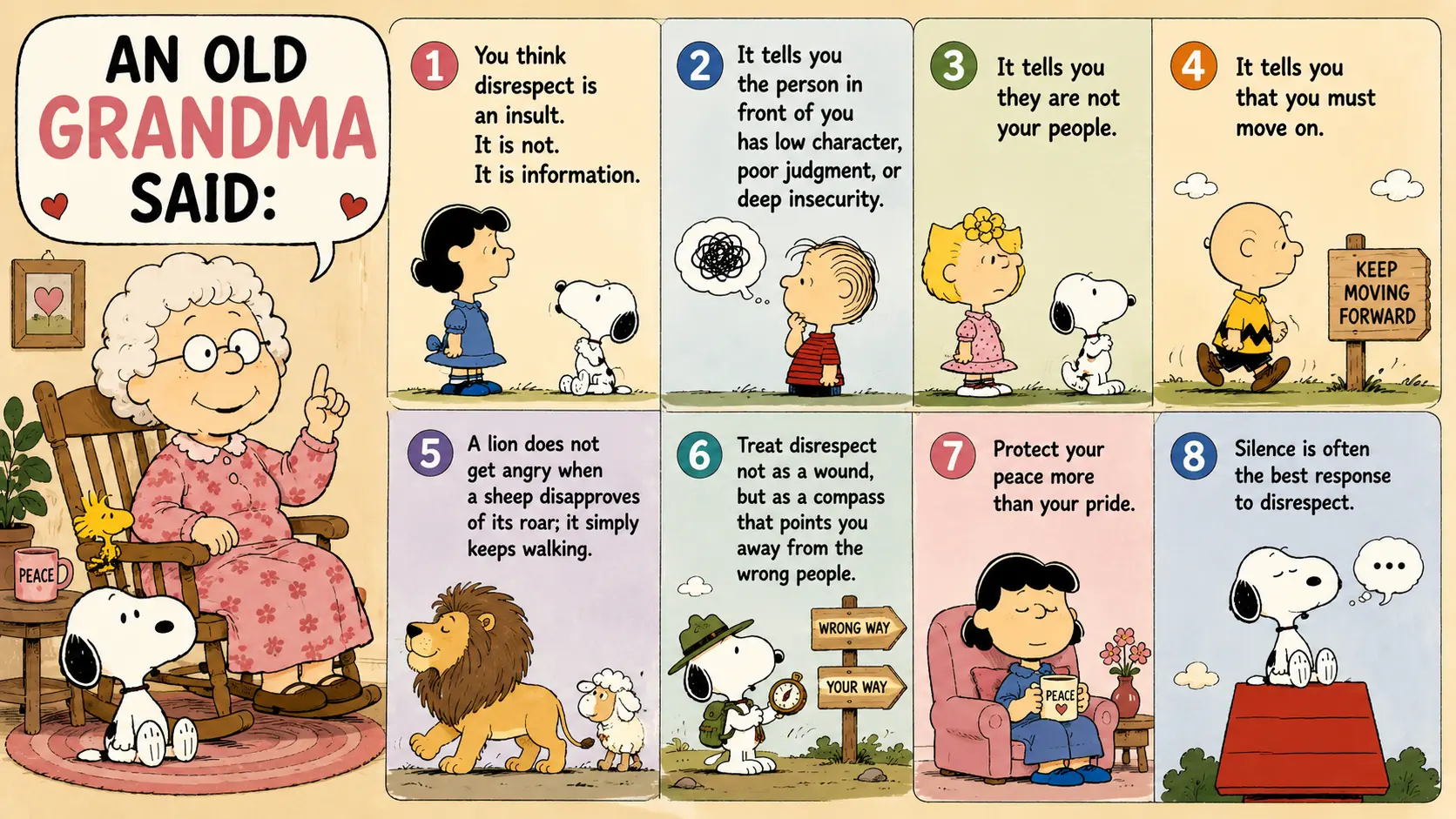
1. Disrespect often tells you more about the situation than about your worth.
When someone speaks disrespectfully, it's natural to take it personally. However, psychologists encourage a strategy known as cognitive reappraisal—looking at a situation from a different perspective before reacting emotionally.
Instead of immediately assuming, "Something must be wrong with me," it can be healthier to ask:
-
Is this person's behavior typical?
-
Are they under unusual stress?
-
Is this part of a repeated pattern?
-
Could there be another explanation?
Disrespect can provide useful information about the interaction, but it should not automatically become evidence that you are less valuable.
The healthiest mindset is to separate another person's behavior from your own self-worth.
2. Repeated disrespect may reveal emotional struggles—but one moment doesn't define a person.
The original quote suggests that disrespect reflects low character or insecurity.
Sometimes it does.
Repeated disrespect can stem from poor emotional regulation, chronic stress, low empathy, insecurity, narcissistic traits, or unhealthy communication habits learned over many years.
However, psychology also reminds us that no one should be judged based on a single interaction.
Even emotionally healthy people occasionally say things they regret when they are exhausted, overwhelmed, grieving, or frightened.
What matters most is not one mistake, but the overall pattern.
Ask yourself:
-
Is the behavior frequent?
-
Is it intentional?
-
Does the person take responsibility afterward?
-
Do they sincerely try to repair the relationship?
Patterns reveal far more than isolated moments.
3. Healthy relationships are defined by respect—not perfection.
One quote says that disrespect means "they are not your people."
That may be true in some situations, but healthy relationships are rarely free of conflict.
Every close relationship experiences misunderstandings, disagreements, and moments of frustration.
What separates healthy relationships from unhealthy ones is what happens afterward.
Healthy people apologize.
Healthy people listen.
Healthy people grow.
Healthy people repair damage.
If someone repeatedly humiliates you, ignores your boundaries, manipulates your emotions, or dismisses your concerns despite honest conversations, the relationship may no longer be emotionally healthy.
But one disagreement alone does not necessarily mean someone has no place in your life.
4. Sometimes moving on is healthy—but it shouldn't be automatic.
Walking away can be one of the healthiest decisions a person makes, especially in relationships involving emotional abuse, manipulation, repeated humiliation, psychological control, or chronic boundary violations.
However, psychology does not encourage abandoning every difficult relationship.
Many relationships become stronger through:
-
Honest conversations
-
Clear boundaries
-
Mutual accountability
-
Genuine efforts to change
Emotional maturity includes knowing the difference between a relationship that needs repair and one that repeatedly causes harm.
Moving on becomes appropriate when respectful communication consistently fails and unhealthy behavior continues despite repeated efforts to improve the situation.
5. Not every opinion deserves your emotional energy.
One of the most memorable metaphors says:
"A lion does not get angry when a sheep disapproves of its roar."
Although symbolic, the psychological lesson is valuable.
People with stable self-esteem are generally less affected by criticism from individuals whose opinions carry little meaning in their lives.
This does not mean ignoring every criticism.
Constructive feedback from trusted friends, family members, mentors, or colleagues can help us grow.
But random criticism from people who neither know nor respect us deserves far less emotional weight.
Emotional intelligence involves learning which voices are worth listening to.
6. Repeated disrespect can become an important guide.
Rather than viewing disrespect only as an emotional wound, it can sometimes serve as useful information about relationship quality.
Consistent behaviors such as:
-
Belittling
-
Mockery
-
Manipulation
-
Contempt
-
Refusal to accept responsibility
often signal unhealthy relationship dynamics.
Recognizing these patterns allows us to establish healthier boundaries before greater emotional harm occurs.
At the same time, occasional mistakes followed by sincere apologies and lasting behavioral change remain part of normal human relationships.
No one is perfect.
The key difference is whether someone repeatedly chooses disrespect or consistently chooses growth.
7. Protecting your peace is not the same as avoiding conflict.
Modern psychological research strongly supports emotional regulation, resilience, and healthy boundary setting.
Many unnecessary conflicts continue because people become more focused on winning than on protecting their emotional well-being.
Before responding, it can help to ask:
-
Is this argument worth my energy?
-
Will my response improve the situation?
-
What outcome am I actually hoping to achieve?
Protecting your peace does not mean staying silent about abuse or allowing people to mistreat you.
Instead, it means choosing thoughtful responses rather than impulsive reactions.
Sometimes the healthiest decision is setting a boundary.
Sometimes it is saying no.
Sometimes it is simply refusing to participate in unnecessary conflict.
8. Silence can be powerful—but it isn't always the answer.
The final quote suggests that silence is often the best response to disrespect.
In many situations, that is true.
Silence prevents emotional escalation and avoids rewarding people who seek attention through provocation.
It can be particularly helpful when dealing with internet trolls, manipulative arguments, or individuals attempting to provoke an emotional reaction.
However, silence should never become avoidance.
In healthy relationships, respectful communication is often far more effective than emotional withdrawal.
If someone important repeatedly crosses your boundaries, calmly expressing your feelings may strengthen the relationship far more than saying nothing.
Wisdom lies in knowing when silence protects your peace and when honest conversation protects your relationships.
The bigger psychological lesson
The greatest lesson behind these quotes is not that every disrespectful person should be removed from your life.
Instead, it is that emotional maturity begins with responding thoughtfully rather than reacting automatically.
When you experience disrespect:
-
Pause before reacting emotionally.
-
Consider whether the behavior is an isolated mistake or a repeated pattern.
-
Set clear, respectful boundaries.
-
Protect your emotional well-being without assuming the worst about everyone.
-
Invest your time and energy in relationships where kindness, accountability, and mutual respect are consistently present.
Ultimately, emotional strength is not measured by how fiercely you respond to disrespect. It is measured by your ability to regulate your emotions, recognize healthy and unhealthy relationship patterns, and make decisions that protect both your peace and your well-being.