The lower field on Hargrove Farm had been wet since September, though there had not been enough rain to explain it. Most people would have walked across that hollow, seen damp soil, and blamed poor drainage or a stubborn low spot. Eli Hargrove saw something else. He saw a message from the ground, the kind his grandfather had taught him to read before he was old enough to drive a tractor.
Eli was sixteen years old, and the farm was his in every way that mattered, even if the court papers had not finished saying so. His father had died two winters earlier in a tractor accident, quiet and terrible, leaving behind land, equipment, debt, and a boy who had to grow into a man before anyone had the decency to ask if he was ready. The Hargrove farm had been in the family for three generations, tucked along the Sulfur Creek corridor where the river valley ran wide and shallow. His grandfather, seventy-eight and stubborn as fence wire, drove out from town twice a week to help, but everyone in the county knew the truth. Eli carried the place now.
He had been reading that land since he could walk. Not reading it like a textbook, where someone else had already organized the answers and given them chapter names. He read it the way a farmer reads weather, slowly and repeatedly, checking one season against another, remembering what changed and what stayed wrong. His grandfather called it paying attention. Eli called it the only way to survive.
Behind the seat of the farm truck, he kept a spiral-bound notebook stuffed with hand-drawn maps. There were drainage paths, soil color sketches, water table notes, and records of where the cattle refused to drink after storms. He wrote down where barn swallows built their nests and whether they nested high or low. He recorded the pale gray soil that showed up after dry summers and the dark rust band that appeared eighteen inches down only on the east side of the second pasture. None of it looked professional, but all of it meant something.
That fall, the swallows left six weeks before the first frost. Eli had watched that species for years, long enough to know that low nests usually meant a rising water table. It was not folklore to him. It was observation, checked and rechecked across seasons. That October, every nest along the south fence line sat less than four feet off the ground. Eli wrote it down.
The creek behind the south fence also ran slower than any October he could remember. Its color was just a little off, not polluted, but carrying a faint mineral trace that clung to the stones. Across the boundary line, on land that would soon belong to someone else, the grass had stopped growing in a dead brown circle thirty feet across. The center was dry even while everything around it stayed damp. Eli pressed his fingers into the soil on his own side of the fence and felt the difference immediately.
The ground felt almost hollow underfoot. Not empty, exactly, but wrong beneath the surface, like pressure was moving where no one could see it. Eli did not tell anyone yet. He only took out his notebook, marked the location, drew the shape of the dead circle, and wrote down the date. That was November.
By February, Crestfield Energy Group arrived.
They were not a small operation, and they did not arrive like men who expected to be questioned. They had purchased eight thousand acres bordering Hargrove Farm and three other properties along the Sulfur Creek corridor. The geology was promising, the land was cheap, and the company came prepared with clean trucks, polished boots, engineers with tablets, drone equipment, satellite data, and a temporary office built inside a converted construction trailer. By every visible measure, they looked organized. They looked like people who knew exactly what they were doing.
The lead project engineer was a man named Whitfield. He was in his mid-forties, confident without needing to be loud, the kind of man whose calm came from years of solving difficult problems in difficult places. He had worked oil fields in three countries and understood subsurface geology in systems, procedures, and data sets. He had read Crestfield’s geological report on the acreage twice. It was two hundred and fourteen pages long and built from soil core samples, seismic imaging, and comparative data from similar formations two hundred miles east.
What it did not include was one conversation with anyone who had actually farmed that ground.
Eli met Whitfield at the fence line in early March. He had ridden the property line on his quad and stopped when he saw orange survey flags marching across the hollow in clean lines spaced fifty feet apart. The flags cut straight through the lower run where the old creek had once flowed before shifting above ground around 1962. Eli knew that story because his grandfather had told it, and because the land still behaved as if the creek had never really left.
“Those stakes are going through the lower run,” Eli said.
“That ground has been saturated since September,” Eli replied. “It is not surface water. It is coming up from below.”
Whitfield paused. “Where are you getting that from?”
“From watching it.”
The answer did not impress him.
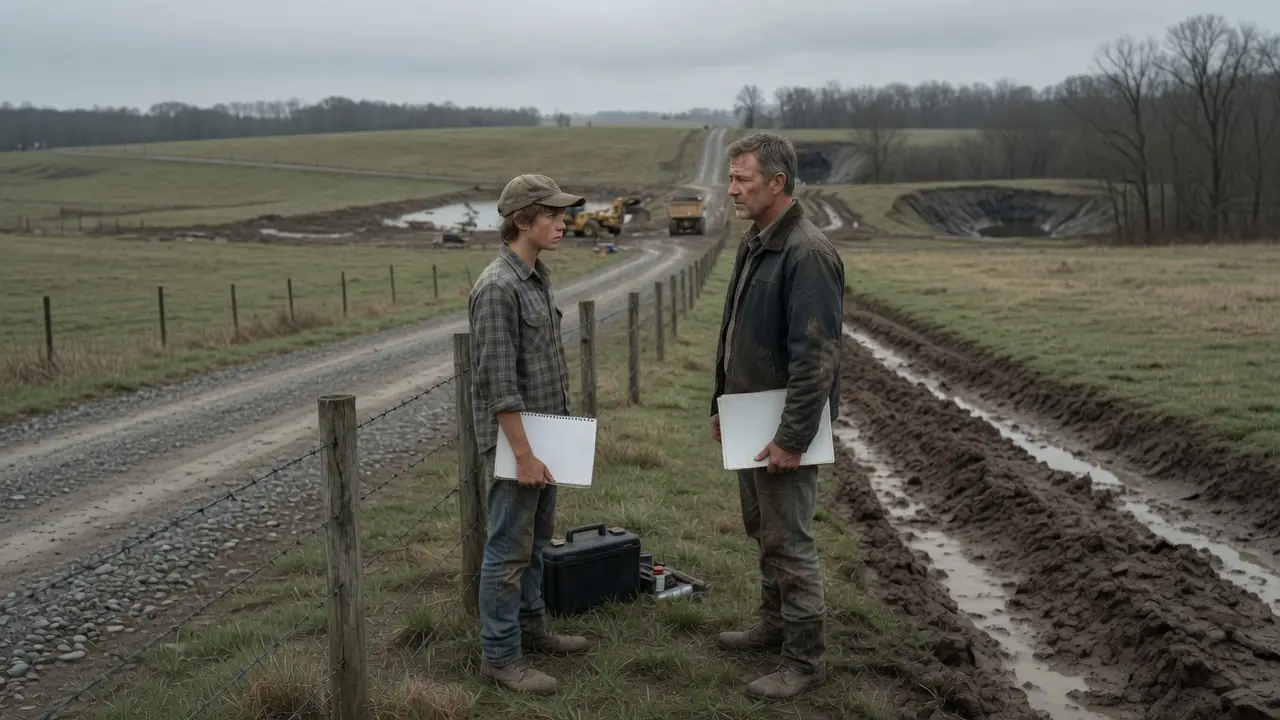
Whitfield looked toward the hollow, then back at his tablet. “Our subsurface imaging did not indicate a significant aquifer event in that section. There is some moisture retention, but it is within normal parameters for this soil type.”
Eli looked at the survey flags and felt the first flicker of frustration. “The old creek channel runs under that whole section,” he said. “It shifted above ground decades ago, but the underground path is still active. Those stakes are going to give you trouble.”
“We will keep an eye on it,” Whitfield said.
It was polite. It was professional. It was also dismissal dressed in clean language. Eli had been underestimated before by men who saw his age before his records, his muddy boots before his knowledge, and his farm cap before his mind. He did not argue. He only wrote down the conversation when he got back to the truck.
By the following Monday, heavy equipment began moving in.
Crestfield’s project was not a simple wellhead operation. The plan involved three extraction wells along the eastern ridge, a pipeline corridor running southwest toward a processing facility eight miles out, and a retention pond designed to hold produced water. The retention pond was planned directly over the hollow. The same hollow with the dead grass circle. The same hollow that had been wet since September. The same hollow Eli had warned them about at the fence.
Groundwater is not simple, though people like to pretend it is. Most imagine aquifers as underground lakes, still and contained, waiting neatly beneath the soil. In reality, shallow groundwater moves through buried channels, fractured layers, old creek beds, and gradients of permeability. It responds to pressure and seeks weakness. It also carries history that machines can miss, because imaging reads density, not memory.
The buried channel beneath the hollow was not on Crestfield’s survey because it had never caused enough trouble to become official. It had carried water quietly, season after season, through clay, gravel, and old silt left behind from the valley’s deeper past. It had no name on modern maps. It existed anyway. Farmers know that many things exist long before paperwork admits them.
The trouble began when Crestfield’s earthmovers compacted the hollow to create the retention pond foundation. They did not block the underground channel completely. They narrowed it. They sealed part of the old path and forced pressure into a route that had never been meant to carry that much force. Water does not stop moving when its path narrows. It finds another way.
The first sign appeared six weeks into construction. A drainage ditch on the Hargrove property, forty yards north of the construction fence, began running with water it should not have had. February had been dry. March had been dry. There was no rainwater or surface source to explain it. Eli walked the ditch, pressed his fingers into the bank, and smelled the faint mineral tang before he even tested it.
He used a simple livestock water kit his grandfather kept in the barn. The mineral content had shifted. It matched what came up in the hollow after wet seasons. Eli wrote down the readings, noted the weather, marked the ditch flow, and returned to the fence line. This time, he asked to speak with Whitfield again.
Whitfield did not come. A site supervisor named Greer came instead, younger and less patient.
“There is water coming up in my north ditch,” Eli told him. “It started when you began compacting the hollow. The underground channel you did not survey is being pressurized.”
Greer looked at the ditch. Then he looked at the dry sky as if the answer might be floating above him. “Could be a lot of things,” he said. “Spring thaw. Water table fluctuation.”
“The mineral content changed,” Eli said. “It is the same source as the hollow.”
Greer gave him a tight smile. “We do not have authority to stop operations based on a ditch reading.”
Eli looked him straight in the eye. “You have a retention pond going in above an active underground channel. When that pond starts filling, the pressure differential is going to push water sideways. It will come up where the ground is weakest.”
Greer sighed. “And where is that, according to you?”
“Under your access road.”
Greer thanked him and went back to the site, though the way he said it made clear he was not thankful.
Six weeks later, the access road sank.
It began as a soft spot near the northwestern section of the road. Machinery weighing tens of thousands of pounds started settling unevenly when it crossed. Engineers drove stakes into the roadbed and monitored movement. The stakes shifted, not from equipment vibration, but from subsurface movement below the compacted layer. Crestfield brought in more compaction equipment and laid crushed stone.
The soft spot migrated twenty feet west.
Then the retention pond liner began showing stress. The geomembrane liner was designed to prevent produced water from seeping into surrounding soil, and it could handle pressure from above if the substrate beneath stayed stable. But when the ground below moved laterally, the liner began experiencing differential stress. Small seam problems developed. Nothing catastrophic yet, but enough to make engineers stop smiling.
In April, a water quality test from a monitoring well on the Hargrove property came back with elevated conductivity levels. Conductivity measured dissolved minerals, and while the number was still technically within safe limits, it had risen. Eli’s grandfather read the report, drove to the county extension office, and called a lawyer before lunchtime. Eli did not need him to say why. The farm had already lost one man to something quiet and terrible. They were not going to lose the water too.
At Crestfield’s site, Whitfield now had three engineering problems on his hands. The access road was unstable. The pond liner showed stress. The drainage pattern had shifted around the pond, causing water that should have moved east to pool west and push toward the Hargrove property line. An internal engineering review was ordered. Crestfield brought in a hydrologist named Dr. Callaway from an environmental consulting firm in the city.
Dr. Callaway spent two days on the site and one afternoon walking the fence line with instruments. On the third morning, she asked who had been reporting the issues from the neighboring farm. Greer brought her to the fence, where Eli stood with his spiral notebook in hand. Unlike the others, Dr. Callaway did not look at the notebook as if it were a child’s drawing. She opened it, read the dated entries, studied the hand-drawn maps, and stayed quiet for a long time.
“When did you first notice the moisture anomaly in the hollow?” she asked.
“September,” Eli said. “But I have records showing irregular drainage there going back to when I was twelve. It gets worse every three or four years. Follows the wet cycle.”
She looked at her tablet, then back at his notebook.
“Your survey missed it because the channel runs north-south through a clay lens,” Eli said. “The imaging would have read it as dense subsoil. It looks like a non-permeable layer, but it is actually a confined pathway. It only activates under pressure.”
Dr. Callaway looked at him differently then. Not like a boy at a fence. Like a witness.
“How do you know what subsurface imaging reads?” she asked.
“I looked it up,” Eli said.
That evening, she asked for copies of his records. Eli went home and photocopied the relevant pages: water table logs, drainage maps, mineral test results, swallow nest height records, soil sketches, dates, and weather notes. He kept the originals. His grandfather stood beside the kitchen table while the copies stacked up, arms crossed and eyes quiet.
“You did right keeping everything,” the old man said.
Eli shrugged. “I did not know if anyone would ever care.”
“Land cares,” his grandfather said. “People catch up late.”
The next morning, Eli handed Dr. Callaway a full copy at the fence.
Three days later, her report landed on Whitfield’s desk.
It confirmed a buried relict stream channel beneath the clay layer at approximately eleven feet, running north-south through the hollow. It confirmed that compaction of the retention pond foundation had increased hydraulic pressure in the confined channel. It confirmed lateral movement toward the lowest surface gradient, which pushed water toward the Hargrove northern fence line and then under the construction access road. It confirmed differential settlement along the western edge of the retention pond liner.
The corrective work would cost more than two million dollars.
The delay would run four to six months.
Whitfield read the report twice.
Then he told Greer to set up a meeting at the fence.
They met where it had started, but everything about the meeting had changed. This time, Whitfield came himself. Dr. Callaway came with him, carrying her field kit. Eli stood on his side of the fence with his notebook in one hand. His grandfather stood beside him, arms crossed, saying nothing and giving nothing away.
“You identified a buried channel about four months before we started work,” Whitfield said.
It was not a question.
“Yes,” Eli said.
“And you warned Greer about the pressure risk before the access road failed.”
“Yes.”
Whitfield looked across the hollow. The wind moved through the fence grass. A swallow cut low over the damp field, banking hard south without landing. It passed between them like a living footnote to every page Eli had written.
Whitfield looked back at Eli. “I would like Dr. Callaway’s firm to do a full resurvey of the corridor before we do further construction,” he said. “And I would like to ask if you would be willing to walk that corridor with her and show her what you have observed.”
Eli glanced at his grandfather.
The old man only watched.
Eli looked back at Whitfield. “That hollow needs a bypass channel,” he said. “Not a retention pond. The water has to go somewhere. If you move the pond site fifty yards east, you are out of the confined layer entirely.”
Whitfield turned to Dr. Callaway.
She nodded. “That is consistent with what I found.”
Whitfield was quiet for a moment. Then he said the words he should have said in March.
“We should have listened.”
It was not a grand apology. It was not a speech. It was simply the truth, spoken plainly by a man who had built his career on models, data, and reports, now standing in front of a sixteen-year-old with muddy boots and a spiral notebook. Eli did not smile. He did not celebrate. Being right had already cost the land too much trouble.
“The land was speaking before March,” Eli said. “You just did not think a farm boy could translate it.”
Whitfield accepted that without defending himself.
“I can walk it with you Thursday,” Eli added.
By summer, the retention pond had been relocated. The access road was rebuilt with a proper drainage corridor. The buried creek channel was mapped, documented, and included in the final environmental survey, the first time it had ever officially existed on paper, though it had existed in fact for thousands of years. Crestfield Energy paid millions to fix what could have been avoided with one serious conversation at a fence line. Their timeline slipped, their budget bled, and their report got rewritten by the land itself.
Hargrove Farm did not flood that autumn the way it might have if the original plan had gone forward. The north ditch ran clear again. The cattle drank from it without hesitation. Eli kept testing the water every week, then every two weeks, then every month. He recorded every number.
He also started a second notebook.
Whitfield came by once in late September after the major construction changes were done. He parked near the fence instead of sending Greer. Eli was checking a gate hinge when the engineer walked up with his boots already muddy, which Eli noticed. Whitfield looked across the lower field, then at the notebook tucked under Eli’s arm.
“I added a local knowledge review to the project procedure,” Whitfield said. “Every future site assessment has to include interviews with landowners, farmers, ranchers, whoever has been watching the ground.”
Eli tightened the hinge bolt. “That sounds useful.”
“It should have been there already.”
“Yes,” Eli said.
Whitfield smiled faintly, not offended this time. “You do not make things easy.”
“The land does not make things easy,” Eli said. “I just learned from it.”
Whitfield looked at him for a long second and nodded.
That winter, Eli’s grandfather grew weaker. He still came out twice a week when weather allowed, but he sat more often than he worked. Sometimes he sat in the truck and watched Eli cross the fields, notebook in pocket, checking the places where water moved under the surface. One afternoon, he asked Eli to drive him down to the lower hollow. They parked near the fence where the first survey stakes had gone in.
The old man looked across the field for a long time.
“You know,” he said, “your father would have liked seeing them come back and ask you.”
Eli kept his eyes on the hollow. “He would have told me not to get proud.”
“He would have told you to stay useful,” his grandfather said. “That is better than proud.”
Eli smiled a little.
The old man tapped the dashboard. “The soil is the great connector of lives. Links the dead, the living, and the ones not yet born.”
“You still will not tell me who said that.”
His grandfather looked at him. “Maybe I did.”
Eli laughed then, which surprised them both.
The story traveled beyond the county because stories like that always do. Some people told it as a tale about a big oil company humbled by a farm kid. Some told it as a warning about environmental oversight. Some made Whitfield into a villain, though Eli never did. Whitfield had been wrong, but he had not been stupid. His tools had limits. His report had assumptions. His mistake was believing the report was complete because it was long.
Eli understood the difference.
There was value in science, models, engineering, and expertise. Dr. Callaway had used all of those things to prove what the land had already warned. Whitfield’s team had tools Eli did not have and knowledge he still wanted to learn. But Eli had years of presence. He had stood in that hollow in every season, watched swallows nest low, watched water change color, watched cattle refuse certain puddles, watched grass die in a circle where no one else thought to ask why.
That kind of knowledge cannot be collected in a week.
It has to be lived.
The most dangerous gap is not always between intelligence and ignorance. Sometimes it is between knowing about a place and knowing it. Between the report and the field. Between the model and the ground. Between someone passing through with equipment and someone who has buried family nearby and cannot afford to stop watching.
Eli was not smarter than all the engineers.
He had simply been paying attention longer.
The following spring, the swallows returned. Eli walked the south fence line and recorded nest heights like he always did. Most were higher than the year before. The water table had eased. The north ditch moved clear and slow, with no strange mineral trace along the stones. Across the boundary, Crestfield’s relocated pond sat on firmer ground, east of the hollow where it should have been from the beginning.
Eli stood there for a while with his notebook open and his pencil still.
He thought of his father, his grandfather, the old creek, the clay lens beneath the soil, the report that missed it, and the swallow banking low the day Whitfield finally listened. Then he wrote down the date, the weather, the ditch level, the nest height, and one sentence in the margin.
Nature leaves warnings before it leaves consequences.
Then he closed the notebook, climbed back onto the quad, and rode the fence line home.