The first thing twelve-year-old Caleb Turner heard was not the water. It was the latch on the side gate.
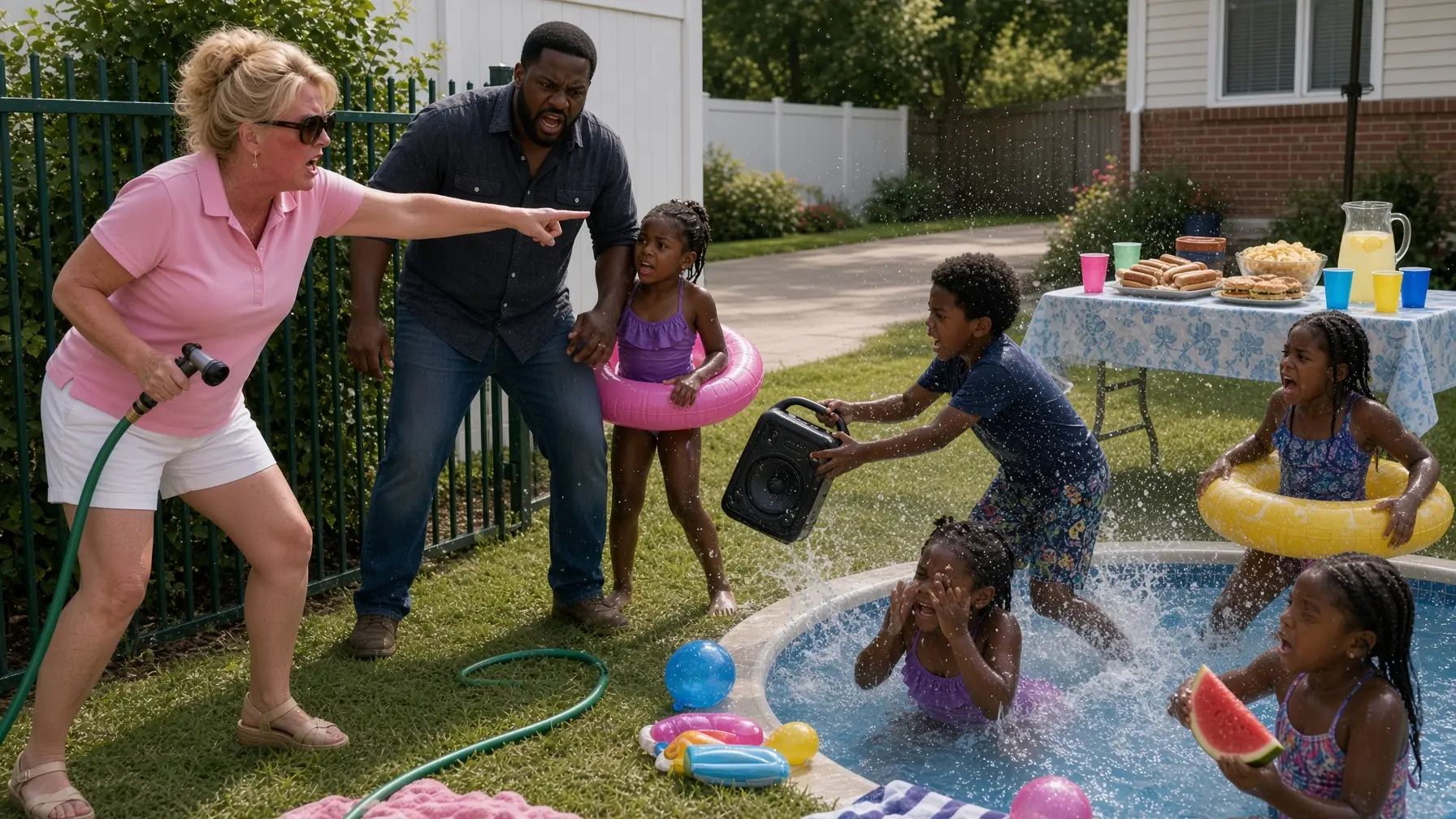
He was standing beside the swimming pool with seven friends, all of them still laughing about a relay race they had invented using foam noodles, plastic cups, and rules nobody seemed able to explain twice the same way. Music played quietly from a small speaker on the patio. Two pizzas sat beneath foil on the outdoor table, a chocolate cake waited beneath a plastic cover, and blue-and-gold balloons moved lazily beneath the pergola. It was the last Saturday before school resumed, and Caleb’s father had promised him one afternoon when the backyard belonged entirely to the kids. No adults hovering, no organized games, no photographs every three minutes. Just swimming, pizza, cake, and the freedom to be loud enough to sound twelve without being loud enough to become somebody else’s problem.
Then the gate opened.
Patricia Whitmore walked into the yard carrying a clipboard.
Caleb knew her immediately. Everybody in Briarwood Lakes knew Patricia. She had been president of the homeowners association for six years and wore the position as though the county had appointed her sheriff of grass height, driveway color, and garbage-can morality. She was fifty-nine, pale, perfectly dressed even in August heat, with blond hair fixed into a rigid bob and sunglasses large enough to hide half her face. Caleb had seen her argue with his father about a basketball hoop, a trash bin, and once about whether the Turner family’s Christmas lights remained illuminated eleven minutes past the neighborhood’s suggested time.
Caleb stepped away from the pool.
“Mrs. Whitmore?”
Patricia looked over the yard.
“Where are your parents?”
“My dad went to pick up my sister.”
“And he left all of you here?”
“My cousin’s inside.”
Caleb pointed toward the kitchen, where nineteen-year-old Maya Turner was preparing another pitcher of lemonade.
Patricia barely looked.
“This gathering needs to end.”
The children became quiet.
Caleb frowned. “Why?”
“Because I’ve received complaints.”
“What complaints?”
“Noise. Running. Screaming. Excessive use of the pool.”
One of Caleb’s friends, Jamal, whispered, “How do you excessively use a pool?”
A few children laughed.
Patricia heard.
Her mouth tightened.
“This is not funny.”
Caleb tried to remember what his father always told him when adults became unreasonable.
Don’t match somebody else’s volume.
Ask what they mean.
“Is there a rule saying we can’t have friends over?”
“There are community standards.”
“Which rule?”
That was the wrong question.
Or perhaps it was exactly the right one.
Patricia’s face changed.
Caleb had inherited the question from his father, Darius Turner, a forty-one-year-old Black electrician who had built his small contracting company by treating every confusing problem as though somewhere, beneath enough bad assumptions, there was a wire connected to the wrong thing. Darius read contracts before signing them. He measured twice. He saved receipts. When Patricia once claimed HOA rules prohibited portable basketball hoops, Darius asked for the page number. Three days later she quietly withdrew the violation because the rule applied only to permanent structures visible above front-yard fences.
Caleb had watched.
Now he repeated the family habit.
“Which rule?”
Patricia stepped toward him.
“You do not speak to me like that.”
“I’m just asking.”
“You’re a child.”
“Yes.”
“Then behave like one.”
Something in her tone made Jamal stop smiling.
Caleb looked toward the kitchen.
“Maya!”
His cousin appeared at the sliding door, drying her hands.
She saw Patricia.
Her expression hardened.
“Why are you inside our yard?”
“I am conducting an HOA inspection.”
“You can inspect from outside the gate.”
Patricia laughed.
“No, I can enter common-interest property when there is an active nuisance.”
Maya stepped onto the patio.
“This is private property.”
“You clearly don’t understand how an HOA works.”
“I understand closed gates.”
The children moved closer together.
Nobody was afraid yet.
Mostly confused.
Then Patricia walked to the speaker and switched it off.
Caleb stared.
“Hey.”
“That’s enough.”
“It wasn’t loud.”
“I could hear it from the sidewalk.”
Caleb looked toward the sidewalk thirty yards away.
“That’s because music makes sound.”
Jamal covered his mouth.
Patricia spun toward him.
“You think you’re clever?”
Caleb stepped between them.
“Leave him alone.”
Patricia looked at eight Black children standing around the pool, wet from swimming, some barefoot, some still holding plastic cups, and her expression became something colder than irritation. “This neighborhood has standards,” she said. “Your father has been told repeatedly that people cannot simply turn their homes into recreation centers whenever they feel like it.”
Caleb’s chest tightened.
“This is our pool.”
“Exactly. And what you do affects everyone around you.”
Maya pulled out her phone.
“I’m calling Uncle Darius.”
Patricia noticed.
“Put that away.”
“No.”
“I said put it away.”
Maya began recording instead.
That changed the afternoon.
Patricia walked toward the balloon arch beside the table.
“What are you doing?” Caleb asked.
“Ending the event.”
She grabbed one support pole and pulled.
The balloons collapsed sideways.
Two popped.
The children shouted.
One of the younger boys, nine-year-old Isaiah, stepped backward and knocked over a cup.
Maya said, “Mrs. Whitmore, stop touching our things.”
Patricia ignored her.
She swept a stack of paper plates from the table.
They scattered across the patio.
Then she picked up a tray of cupcakes.
Caleb moved closer.
“Put those down.”
“Stay back.”
“They’re ours.”
“Stay back.”
Patricia carried the tray to the edge of the pool.
Caleb realized what she was about to do.
“Don’t.”
She tipped it.
Cupcakes fell into the water.
Blue frosting spread across the surface.
For perhaps two seconds, nobody spoke.
Then Jamal said quietly, “Lady, what is wrong with you?”
Patricia turned.
“You want to find out?”
She crossed toward the hose reel attached to the house.
Maya’s voice sharpened.
“Do not touch that.”
Patricia pulled the hose free.
The nozzle clicked in her hand.
Caleb stepped forward.
“This is my dad’s house.”
Patricia opened the valve.
Water burst across the patio.
The first spray hit the table, sending napkins and plastic cups flying.
Children screamed and scattered.
Patricia swung the nozzle.
The stream hit Caleb across the chest.
He stumbled backward.
Then Jamal.
Then Isaiah.
A ten-year-old girl named Tiana tried to protect the cake with both arms.
Patricia sprayed her too.
“Stop!” Maya screamed.
Patricia kept going.
“You want to behave like animals, you can cool off like animals.”
The words hung in the air.
Maya’s recording caught them clearly.
Several children froze.
The water kept striking them.
Caleb felt something different now.
Not embarrassment.
Not even anger.
The sudden knowledge that an adult standing in his father’s backyard believed she could do this because nobody old enough to stop her was there.
He moved toward the hose.
Patricia aimed directly at his face.
Caleb raised both hands.
“Stop spraying us!”
“Then go inside.”
“This is our house!”
“Go inside!”
Maya ran to the outdoor faucet and reached for the shutoff.
Patricia moved toward her.
“You touch that and—”
A truck door slammed beyond the fence.
Everyone turned.
The side gate opened again.
Darius Turner stood there.
His nine-year-old daughter Layla was beside him holding a grocery bag.
For one second, Darius did not understand what he was seeing.
His son was soaked despite having a towel around his waist.
Jamal stood behind a patio chair wiping water from his eyes.
Tiana’s white summer dress had become translucent enough that Maya had wrapped a pool towel around her shoulders.
Cupcakes floated in the pool.
Balloons lay across the patio.
The cake had been pushed halfway off the table.
And Patricia Whitmore stood in the middle of it holding Darius’s garden hose like she had every right in the world.
The water was still running.
Darius put the grocery bag down.
“Patricia.”
She released the trigger.
Silence settled over the yard.
Darius handed his keys to Layla.
“Go inside.”
“But Dad—”
“Inside, baby.”
Something in his voice sent her immediately.
Then he looked at Caleb.
“You hurt?”
“No.”
“Anybody hurt?”
The children shook their heads.