The patrol cruiser rolled to a stop in front of our house at 9:14 on a Saturday morning. My wife, Renee, was kneeling beside the front walkway in an old gray sweatshirt, pulling dandelions from the flower bed with green gardening gloves while Helen Trowbridge stood six feet away holding an orange HOA notice like a warrant. “You need to leave this property immediately,” Helen said. “The board has already made its decision.”
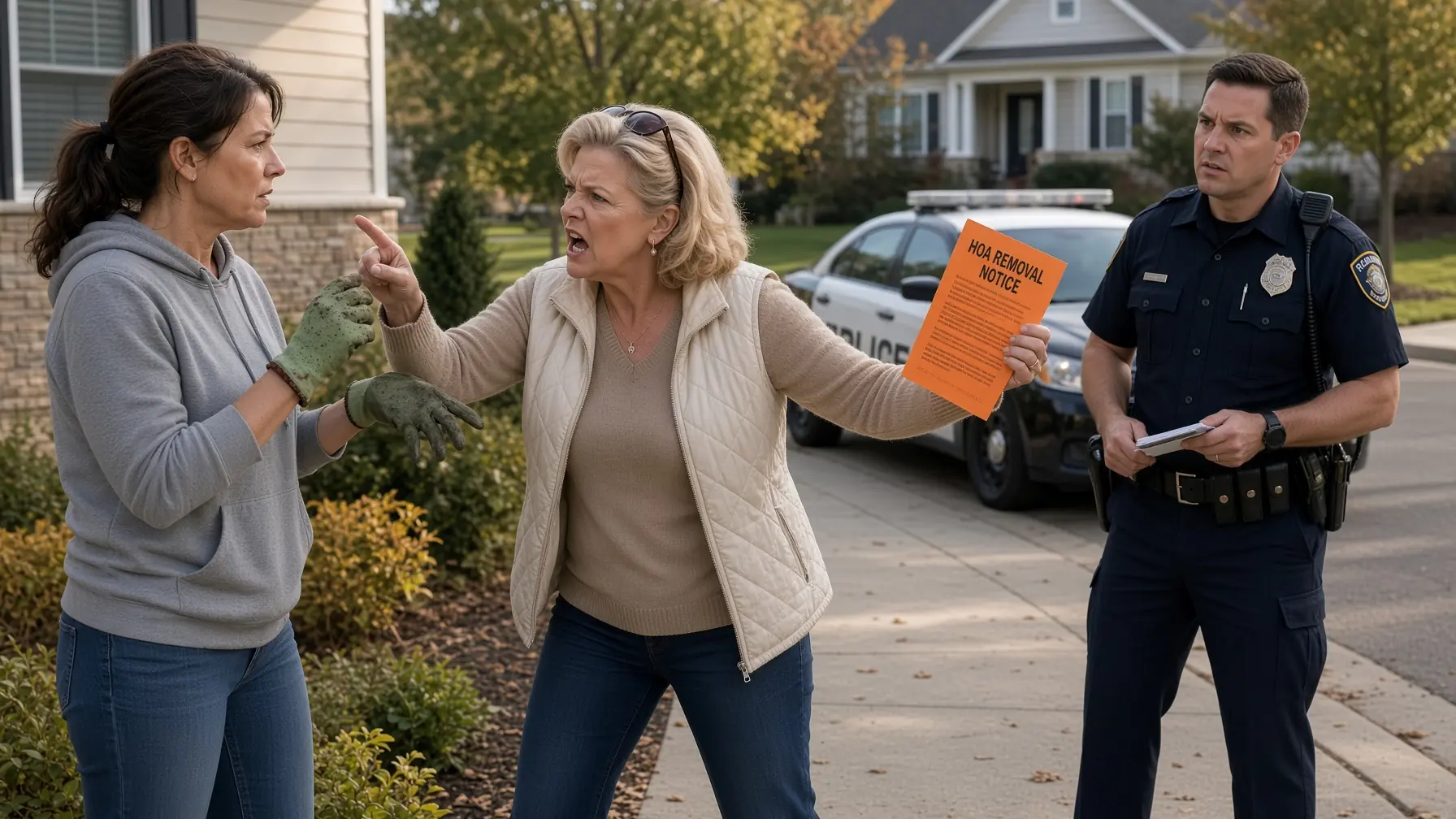
That was the first sentence I heard when I opened the front door. Helen was ordering a woman off property whose name appeared beside mine on the deed, mortgage, tax records, insurance policy, and every other document that established ownership in the ordinary world. Helen’s name appeared on none of those things. What she possessed was a title on a homeowners association board and eight years of experience convincing people that the title meant considerably more than it did.
The officer stepped out of the cruiser with a notepad already in his hand. He looked to be in his early thirties, and his expression carried the weary neutrality of someone expecting another neighborhood dispute about parking, barking dogs, or a fence three inches too high. Helen immediately turned toward him and began talking. “Officer, thank you for coming. That woman has repeatedly refused HOA directives, and I need her removed from the property.”
He walked three steps toward the driveway. Then he looked at Renee and stopped completely. His hand lowered from the notepad, his posture changed, and for perhaps three seconds nobody said anything except Helen, who had not yet realized the entire situation had just rearranged itself around her.
Renee stood and brushed soil from one knee. She was forty-eight, Black, five foot seven, and on weekends she looked like almost any other homeowner trying to rescue neglected flower beds from weeds. There was nothing in the gray sweatshirt, faded jeans, or gardening gloves that announced she was Colonel Renee Langley, commander of Patrol Operations for the Riverton County Police Department. The officer knew anyway.
“Colonel Langley,” he said.
Helen stopped talking.
The officer straightened almost unconsciously, then caught himself and returned to a more ordinary posture. Renee gave him a small nod and said, “Morning, Officer Bennett,” in the calm voice she used when she wanted rank to matter as little as possible. Helen looked from the officer to Renee and back again. The orange paper in her hand lowered several inches.
I could have enjoyed that moment more than I did. After seven months of fines, threats, legal letters, and police calls, part of me wanted Helen to understand immediately how badly she had miscalculated. Renee had taught me something during those seven months, though: if your case depends on someone important finally being recognized, you have built the wrong case. So I stayed quiet and let the facts catch up.
To understand why an HOA president was standing on my lawn trying to remove my wife from her own house, you have to go back to February. Renee and I had spent almost a year searching for a home closer to her headquarters but far enough from downtown that our evenings did not sound like traffic reports. Meadowbrook Heights looked ordinary in the best possible way: ninety-six houses, mature trees, children on bicycles, matched mailboxes, and a small community center beside a retention pond.
The house at 14 Crestfield Drive was not dramatic. It had four bedrooms, a narrow porch, a backyard Renee immediately loved, and garden beds somebody had once cared for before apparently surrendering to dandelions. We closed on a Thursday with both names on every relevant document and moved in that weekend. On Monday afternoon, the first orange notice appeared on our front door.
The alleged violation was an unapproved commercial vehicle in a residential driveway. The vehicle was Renee’s county-issued SUV, parked entirely on our property, and neither the recorded covenants nor the community rules prohibited government vehicles. I checked before responding because I had already learned that assumptions were expensive whenever paperwork became involved. I sent a polite email with the relevant section attached.
Four days later, a second violation arrived. This one accused us of failing to respond appropriately to HOA communication. I read it twice because my first assumption was that somebody had attached the wrong letter to our address. Then I realized the response they considered inappropriate was the one in which I had politely shown that the first violation had no basis.
That was my introduction to Helen Trowbridge.
Helen was sixty-one, wore expensive reading glasses on a chain around her neck, and had served as Meadowbrook Heights HOA president for eight consecutive years. She liked procedure the way some people like weapons, especially procedures obscure enough that nobody could immediately tell whether she was using them correctly. Her great talent was not inventing rules; it was creating enough inconvenience around existing ones that ordinary people eventually chose surrender.
I started asking neighbors about her. Ted Myers across the street had lived there eleven years and told me that two homeowners who challenged Helen in previous elections withdrew shortly after receiving clusters of violation notices. He did not claim the notices were fabricated, because he could not prove that. He simply noted that the timing had been remarkable.
Other stories followed. A family named Walker disputed lawn fines, received a lien notice months later, spent more than a year fighting, then sold when the stress and attorney costs became greater than their attachment to the neighborhood. Another family moved after repeated police calls over gatherings that officers repeatedly found lawful. An elderly couple sold after a dispute over a wheelchair ramp became so bitter that their daughter said staying no longer felt worth it.
None of those events proved a conspiracy. That mattered to Renee. “Do not turn a pattern you suspect into a fact you cannot prove,” she told me the first time I tried to connect everything too confidently. “Document what happened. Let the pattern earn its own name.”
Six weeks after we moved in, Helen came to our front door accompanied by HOA treasurer Curtis Webb and a younger board member named Mason Price. Renee was working late, which Helen appeared to know. She carried a clipboard and announced that the board had received concerns about “the woman occupying the residence.” I remember the phrase because I wrote it down afterward.
“My wife owns the house with me,” I said.
Helen smiled without warmth. “That may be reflected in county records, but the association has an internal residency verification process.”
I opened the county property record on my phone. Both our names appeared beside the parcel number and transfer date. “There is nothing to verify regarding ownership,” I said. “She is not a tenant.”
Helen looked at the screen and then deliberately looked away. “County ownership and community compliance are separate matters.”
They were, technically. That did not make her next sentence true.
She handed me a yellow notice imposing a five-hundred-dollar fine for unauthorized occupancy. The document claimed the issue had remained unresolved after prior communications, although neither previous notice had concerned occupancy at all. I signed only to acknowledge receipt, scanned the document the moment they left, and recorded the time, date, witnesses, and exact language.
Before walking away, Helen stopped on the porch. “Mr. Langley, I have had residents leave this community before when they were unwilling to meet its standards.” Mason Price looked uncomfortable when she said it. “I hope you do not make this harder than it needs to be.”
That evening Renee came home shortly after ten. She read the notice standing beside the kitchen counter, set it down, and said, “Make two copies.” There was no outrage in her voice and no discussion of using her position, because Renee had spent twenty-six years in law enforcement learning that official power becomes dangerous the moment you use it to settle private irritation.
So we built a file.
Ted gave us a written statement about what he had personally observed. Sarah Bennett three houses down provided copies of two old police reports involving her teenage son, both originating from complaints that officers found baseless. I downloaded meeting minutes, election records, enforcement policies, and every version of the community rules available on the HOA portal.
Renee added her own notes. She had recorded the dates when board members photographed her county vehicle from the street, copies of every envelope, and details from encounters I had not even known occurred. She did not embellish any of it. A record becomes weaker, she reminded me, every time anger convinces you to add more than you actually know.
By the end of the ninth week, my spreadsheet had twenty-three documented events. Then a certified letter arrived from the association’s law firm. Meadowbrook Heights had recorded a lien against our property based on twenty-eight hundred dollars in allegedly unpaid violations.
Three violations were familiar. Five were not.
The new violations appeared in the lien packet with dates and descriptions but no evidence that we had ever been properly notified or given the appeal opportunities described in the HOA’s own enforcement policy. One alleged unauthorized landscaping during a week when Renee and I had been out of state. Another cited repeated parking misconduct despite security-camera footage showing no vehicle in the alleged location.
That afternoon I called attorney Joanna Pierce.
Joanna specialized in property and association disputes and had the deeply reassuring habit of being unimpressed by intimidating letterhead. I sent her everything: deed, covenants, notices, responses, police reports, board minutes, lien filing, security footage, and the spreadsheet. She called the next morning.
“The lien has procedural weaknesses,” she said. “That does not mean you ignore it.”
“I don’t intend to.”
“Good, because bad liens are still expensive until somebody forces them to become former liens.”
Joanna first sent a formal dispute and preservation letter to the association and its counsel. She demanded the complete enforcement history for our property, proof of service for every alleged violation, meeting records relating to our address, and preservation of board communications. She also demanded that Helen take no part in any enforcement matter concerning us while the conflict was reviewed. The association did not immediately agree.
Four days later, Helen made the first police call involving Renee personally.
I was at work when it happened. Renee was watering the front garden shortly after seven in the morning when two Riverton County officers arrived in response to a complaint about a suspicious woman possibly occupying the house without authorization. Renee had not spoken to Helen that morning.
The officers explained the complaint. Renee provided identification, although she was not legally required to prove ownership simply because a neighbor disliked her presence. The officers confirmed the address, saw no offense, and ended the contact.
One of them recognized her only after checking the name. Renee specifically asked him not to treat the incident differently because of her rank. Their report stated that a resident had been identified at her own address and that no police action was required.
That evening she sat at the kitchen table with tea between both hands. “She is going to keep using systems until one of them gives her the answer she wants,” Renee said. I turned the laptop toward her and showed her the expanding spreadsheet.
“Joanna has everything.”
Renee nodded. “Good.”
Then she said, “Make sure the police report is requested through the same process any resident would use.”
That sentence explained my wife better than any title ever could.
The association scheduled an emergency board meeting six days after Joanna’s preservation letter. Thirty-one homeowners attended a room designed for forty, including fourteen people Ted said had never attended an HOA meeting before. Helen arrived with printed slides, a laser pointer, and a presentation describing our house as an escalating compliance matter.
She cited “repeated police involvement” without mentioning that she had initiated the calls. She characterized our written disputes as refusals to cooperate and presented the lien as evidence of unresolved misconduct even though the lien itself was being formally challenged. Then she asked the board to approve what she called a final enforcement and removal demand.
Joanna had already explained what that phrase meant legally. The HOA could pursue certain remedies authorized by its governing documents and state law, but it could not simply vote a deeded homeowner out of her residence and send police to execute the decision. The document was a demand, not an eviction order, and calling it something grander did not create authority.
The board voted four to one. Mason Price voted no. Helen signed the document publicly and slid it across the table toward me.
Renee took it, folded it once, and placed it inside her jacket. She did not argue. That unsettled Helen more than anger would have.
By the time we reached home, Joanna had a scanned copy.
She responded the following morning with a letter addressed not only to Helen but to the full board, association counsel, and the HOA’s liability insurer. She challenged the lien, the notice procedure, the apparent conflict of interest, and the use of law enforcement as a substitute for civil enforcement. She also informed them that multiple homeowners had begun providing statements regarding selective enforcement.
Helen interpreted that letter as proof she needed to move faster.
Three days later she called police again.
That was the Saturday morning when Renee was pulling weeds.
Helen had come to our driveway shortly after nine carrying the board’s orange enforcement demand. According to the 911 recording we later obtained, she told dispatch that an unauthorized woman was refusing to vacate HOA-controlled property and requested officers to remove her. The dispatcher asked whether anyone was being threatened, and Helen said no.
Officer Caleb Bennett arrived with Officer Monica Reyes.
Bennett was the officer who stopped when he recognized Renee. He worked in the patrol division Renee commanded, although several management layers separated them. His surprise was understandable; officers did not usually expect to find their colonel wearing gardening gloves in the middle of what had been dispatched as an unauthorized-occupant complaint.
Helen finally recovered from hearing Renee’s title. “I have a board order,” she said, holding the orange page toward him. “Her position is irrelevant.”
Renee spoke before Bennett answered. “It should be irrelevant.”
Helen stared at her.
Renee removed one gardening glove. “Officer Bennett, handle this exactly as you would if you had never met me.”
Bennett nodded.
That mattered more than the recognition.
Officer Reyes pulled up the address through normal department resources. She confirmed that Renee and I were associated with the residence and that there was no court-issued eviction order, writ of possession, protection order, trespass notice against Renee, or other judicial document authorizing police removal. Bennett asked Helen whether she had anything issued by a court.
Helen handed him the HOA demand.
He read it.
“This is a homeowners association document.”
“It is a formal removal order.”
“No, ma’am.”
Helen’s face tightened.
“The board voted.”
“I understand.”
“So enforce it.”
Bennett handed the page back. “Police do not remove deeded homeowners from their residences because an association voted on an internal enforcement demand.”
Helen looked toward Renee. “She has refused every compliance order we’ve issued.”
Renee remained quiet.
Officer Reyes asked, “Is there a court case involving possession of this property?”
“No.”
“Has a judge ordered her to leave?”
“No, but—”
“Then this is a civil dispute.”
Helen’s voice rose. “You do not understand HOA authority.”
Bennett said, “I understand what police authority is.”
That ended the useful part of Helen’s argument.
Renee then asked for something simple. “Please document that this is the third police contact associated with complaints from Ms. Trowbridge concerning my right to be at my own residence.” Bennett wrote it down.
She continued, “Please include that no judicial removal order was presented today.”
He nodded.
“And please route any question regarding possible misuse of police services through a supervisor outside my command review.”
Bennett looked at her. “Understood.”
Helen finally seemed to grasp the deeper problem. The woman she had spent seven months treating as somebody who did not understand procedure had just protected the procedure from herself.
Bennett did not threaten Helen with immediate arrest. There was no dramatic handcuffing on our lawn, because a false or abusive call required more than an officer deciding the caller was unpleasant. Instead, he explained that future complaints had to accurately describe the situation and that repeated misuse of police resources could be reviewed.
“Would you like to make any criminal complaint against Ms. Langley today?” he asked Helen.
Helen looked at the orange notice.
Then at Renee.
Then at Officer Reyes’s screen.
“No.”
She walked home.
Ted had watched from across the street. Sarah was standing near her mailbox, and several other neighbors had appeared on porches after seeing the patrol cruiser. Nobody cheered when Helen left.
That silence was better.
I handed Bennett a folder containing copies of the previous call reports, the HOA demand, our ownership record, and Joanna’s contact information. He accepted it for attachment to the incident report but made clear that the broader civil dispute belonged with attorneys and the association. That was exactly where we wanted it.
Before leaving, he looked toward Renee. “Colonel, anything else?”
She pulled her glove back on.
“No.”
Then she crouched beside the garden again.
Bennett almost smiled.
The cruiser drove away.
That afternoon, the incident report went into a supervisory review queue outside Renee’s chain of command. The department’s professional standards office later referred the question of repeated non-emergency complaints to a county attorney liaison for evaluation, not because Renee was a colonel but because three documented calls concerned the same alleged occupancy problem after ownership had repeatedly been confirmed. No one promised charges.
The legal consequences moved faster.
The association’s liability insurer appointed independent counsel after receiving Joanna’s letter and the newest police report. Independent counsel immediately asked the board to suspend disputed enforcement against us while the records were reviewed. Helen objected.
For the first time in eight years, the board continued without her agreement.
Mason Price became important then. He had kept emails.
Lots of them.
He provided the association’s independent counsel with board communications showing that Helen had repeatedly pushed for enforcement against our address after being shown county records confirming Renee’s ownership. Other messages showed her asking whether police contact might “encourage compliance” after ordinary notices failed.
None of that proved every allegation neighbors had made over eight years. It proved enough about our case.
The association attorney who had recorded the lien withdrew from representing the HOA in the dispute after the insurer-appointed counsel began reviewing the file. The lien was released shortly afterward by board vote, without any admission that it had been intentionally false. The association also withdrew every outstanding violation connected to alleged unauthorized occupancy.
Joanna did not stop there.
She sought reimbursement of our documented legal expenses and requested an independent review of enforcement procedures. The insurer had reasons to prefer settlement over a lawsuit involving questionable notices, a challenged lien, repeated police calls, and a board president participating directly in a personal dispute. We eventually reached a confidential settlement covering most of our out-of-pocket legal costs.
Renee received none of the money personally beyond our shared expenses being reimbursed.
She wanted it that way.
The board called another emergency meeting.
This time there was no laser pointer.
Mason chaired it.
Fourteen homeowners submitted written statements describing their own experiences with enforcement. Some involved Helen; some involved board practices more generally; several turned out to be ordinary disputes in which the HOA had probably acted within its authority.
That distinction mattered.
If you investigate a pattern only to prove the conclusion you already want, you are not investigating anything.
Ted read his statement aloud.
He described watching the Walker family leave after fourteen months of escalating conflict, seeing Helen observe the moving truck from her driveway, and deciding afterward that staying quiet had been easier than becoming the next target. He did not accuse Helen of crimes. He described what he personally saw.
Sarah submitted copies of the two old police reports involving her son. Another homeowner produced emails showing inconsistent grace periods between residents. A retired teacher brought three years of violation letters and said she had never understood why neighbors received verbal warnings for the same issues that generated immediate fines at her house.
Independent counsel listened.
Then the board voted to remove Helen as president under the association’s bylaws.
The vote was four to zero, with Helen abstaining after counsel advised her not to participate in a vote concerning her own office. Removing her as president did not automatically remove her from the board; that required a different membership process. Two weeks later, facing a recall petition with enough signatures to trigger a community vote, Helen resigned her remaining board seat.
There was no applause when the resignation was announced.
Renee did not attend that meeting.
She was working.
Months later, the independent review produced an uglier and more ordinary explanation than some neighbors expected. There had been no massive embezzlement scheme, secret property acquisition plan, or organized criminal conspiracy.
There had been weak governance.
Helen had accumulated influence because other board members deferred difficult conversations to her. Enforcement records were inconsistent, conflicts of interest were poorly managed, appeal procedures were vague, and the board had often accepted the president’s summary of a dispute without independently reviewing the underlying documents.
Some homeowners had absolutely violated rules.
Some fines were justified.
Others were reduced or refunded because the file did not support how they had been escalated.
The neighborhood adopted changes that would have bored anyone expecting revenge. Enforcement notices required citation to the exact covenant provision. Residents received documented appeal deadlines, conflicts required recusal, liens needed independent legal review, and no board member could contact police to enforce a purely civil HOA matter unless an actual safety or criminal concern existed.
Meeting minutes became detailed enough to matter.
The association also created a homeowner records portal.
The police department handled its side separately. Because Renee was connected to the complaint, she had no role in reviewing Helen’s calls. The county attorney ultimately declined criminal prosecution after concluding the record did not clearly establish the level of intentional deception required for the available offenses.
Some neighbors were angry.
They wanted Helen arrested.
Renee did not.
“Criminal law is not a customer-service department for people who behaved badly,” she told me.
That sentence disappointed several people when I repeated it.
It also happened to be true.
The calls remained documented, and police dispatch added an internal note requiring supervisory review if future complaints from Helen involved alleged residency at our address. That was not punishment. It was risk management.
Helen stopped calling.
For the first several weeks after her resignation, I saw her only through the window of her house.
Then one Saturday morning she appeared at the mailbox while Renee and I were walking back from the neighborhood pond. We would have passed without speaking, but Helen looked directly at Renee.
“I didn’t know who you were,” she said.
Renee stopped.
Helen seemed to expect the sentence to carry more weight.
Renee asked, “Would it have changed anything?”
Helen hesitated.
“Yes.”
Renee nodded.
“That’s the problem.”
Helen looked away.
“I mean I would not have involved police if I knew you commanded them.”
“You shouldn’t have involved police because you had already been shown I owned the house.”
Helen’s mouth tightened.
Renee continued before the conversation became an argument. “My rank did not put my name on the deed.”
Helen had no answer.
Neither did I.
We walked home.
That exchange became my favorite part of the entire story because it corrected the version neighbors preferred telling. People said Helen had called police on the wrong woman.
She had not.
There was no right woman.
If Renee had been a nurse, teacher, grocery clerk, receptionist, retiree, unemployed mother, or stranger nobody in uniform recognized, ownership would have remained ownership. A person’s right to stand in her own garden did not become stronger because an officer knew her title.
Recognition merely exposed how ridiculous the situation already was.
That autumn, Meadowbrook Heights became noticeably quieter. Not lawless, not chaotic, and certainly not free from HOA disagreements. People still argued about fences, trash cans, landscaping, parking, and holiday decorations because ninety-six households will always find something to disagree about.
The difference was that disagreement became less personal.
Notices cited rules.
Appeals produced answers.
Board members disagreed publicly.
Nobody treated dissent like infection.
Mason Price ran for president the following year.
He almost lost.
Renee liked that.
“Competitive elections are healthy,” she said when he complained jokingly about having to campaign.
He won by seven votes and spent the first meeting reminding residents that he was president of a homeowners association, not mayor, sheriff, judge, or landlord.
Ted nearly applauded.
The Walker family never moved back. Neither did the elderly couple who had sold after the wheelchair-ramp dispute. Some damage arrives after the point where reform can repair it.
Joanna contacted several former homeowners after obtaining permission to do so, and some chose to have old files reviewed.
Others wanted nothing to do with Meadowbrook Heights again.
That choice deserved respect too.
Renee and I stayed.
For a while, I wondered whether remaining in the neighborhood would make every ordinary interaction feel contaminated by what happened. It did not.
People are adaptable in ways institutions often are not.
Soon we were discussing sprinkler schedules with Ted again.
Sarah’s son graduated high school.
The couple on the corner had a baby.
Life became embarrassingly normal.
The county SUV remained in our driveway when Renee brought it home.
Nobody taped an orange notice to it.
One year after the Saturday police call, Officer Bennett came through Meadowbrook Heights on patrol.
Renee happened to be outside.
This time she was planting tulip bulbs.
He slowed the cruiser and lowered the window.
“Morning, Colonel.”
Renee looked up.
“Morning, Bennett.”
He nodded toward the garden.
“Still fighting those weeds?”
“Losing with dignity.”
He laughed and drove away.
No one saluted.
No neighbors panicked.
No hidden identity needed revealing.
That was better.
The old HOA bulletin board at the entrance changed too. During Helen’s presidency it had usually carried rows of orange notices, compliance reminders, deadlines, and rule updates written in language that seemed determined to sound like consequences.
After the governance review, somebody cleared it.
The first new item was an index card containing only the date and time of the next community meeting.
All homeowners welcome.
No threat beneath it.
No fine schedule.
No line about failure to comply.
Just a date.
I drove past that board one morning and remembered Renee standing in our kitchen seven months earlier holding the first ridiculous violation notice. I had expected outrage.
Instead she said, “Make a copy.”
At the time, I thought she was merely being calm.
I eventually understood she was doing something much more important.
She was refusing to let Helen choose the battlefield.
Helen operated through intimidation, ambiguity, and the assumption that ordinary people would eventually become too exhausted to demand that paperwork mean what it claimed to mean. Renee answered with records.
Dates.
Copies.
Witnesses.
Appeals.
Outside review.
A lawyer who asked inconvenient questions.
Neighbors who finally realized their separate experiences were worth documenting.
And, eventually, board members willing to admit that surrendering responsibility to one confident person had been easier than governing.
The officer recognizing Renee in our driveway made a satisfying moment.
I will not pretend otherwise.
For three seconds, Helen Holden saw the social hierarchy she trusted suddenly point the other direction, and after seven months of watching her use presumed authority against my wife, that felt good.
But it was not what defeated her.
If Officer Bennett had never met Renee before, he still should have checked the property record.
If Renee had held no rank, the HOA document still would not have been a court order.
If we had never hired Joanna Pierce, our names still would have been on the deed.
Facts do not wait for important people before becoming true.
That was the lesson Helen had spent eight years refusing to learn.
Power had convinced her that if she repeated something often enough on official-looking paper, eventually reality would have to reorganize itself around her.
For a long time, people did.
Then one family kept copies.
One neighbor wrote a statement.
Another saved police reports.
One young board member kept emails.
One attorney opened the file instead of being intimidated by its thickness.
And one Saturday morning, in front of a flower bed full of dandelions, a piece of orange paper finally met a system that asked the simplest possible question:
What authority does this actually have?
The answer was almost none.
Renee went back to pulling weeds after the cruiser left that morning.
She finished the flower bed before lunch.
By spring, tulips were growing there.
And every time I walked past them, I thought about how strange it was that Helen had spent seven months trying to prove my wife did not belong in that yard.
The flowers never had any trouble figuring it out.