The first orange survey stake appeared in Ethan Brooks’s hayfield three days before the rain.
It stood near the eastern fence line, driven deep into soil his family had worked for more than sixty years. A strip of fluorescent ribbon fluttered from the top, bright enough to be seen from the seat of the old Massey Ferguson 135.
Ethan noticed it while carrying a twelve-hundred-pound round bale toward the barn.
He eased off the throttle.
The Perkins diesel dropped into a slow, even rhythm. The loader remained steady, holding the bale several feet above the ground without drifting or shaking.
Ethan stopped beside the marker.
The stake stood almost forty feet inside his fence.
A second marker was visible farther north.
Then a third.
Caleb Brooks came across the field on foot, wiping dust from his face with one sleeve.
“What are those?”
“Survey stakes.”
“Ours?”
Ethan lowered the bale gently onto the grass.
“No.”
Caleb pulled one marker from the ground and examined the writing.
HAWTHORNE RIDGE — PHASE II
Hawthorne Ridge was the new residential development east of the Brooks farm.
Two years earlier, the land had been cattle pasture owned by an elderly widower named Edwin Shaw. After Shaw died, his children sold the eastern parcel to a company from Lexington.
The developer cleared trees, paved roads, and built thirty-six large houses overlooking the Brooks hayfields.
The advertisements promised peaceful country living.
Families were shown photographs of green fields, red barns, and cattle beneath clear Kentucky skies.
Nobody mentioned that fields stayed green because farmers cut them.
Nobody explained that hay balers ran late when rain approached.
Nobody warned buyers that cattle made noise, manure had a smell, and old tractors did not disappear because the view had been sold to someone new.
Caleb looked toward the houses beyond the fence.
“They’re claiming our field?”
“Looks that way.”
“That fence has been there since Grandpa was a boy.”
“Fences can be wrong.”
“Ours isn’t.”
Ethan climbed down from the tractor.
He crouched beside the hole left by the stake and pressed one hand against the soil.
The eastern field was twenty-three acres.
It contained some of the farm’s best grass because the slope drained quickly after spring rain. Ethan’s father had reseeded it with orchard grass and clover in 1978.
Losing forty feet along the boundary would take nearly three acres.
It would also give Hawthorne Ridge control of the only level route connecting the hayfield to the county road.
Without that strip, Ethan would have to move equipment across a steep creek crossing that became nearly impassable after rain.
Caleb looked toward the dark clouds gathering in the west.
“We have forty-seven bales left.”
“I know.”
“Forecast says rain Friday.”
“I know.”
“And they’re planting stakes across the access lane.”
Ethan lifted the marker from Caleb’s hand.
“Put it back.”
Caleb stared at him.
“Why?”
“Because whoever placed it wants us to remove it.”
“That doesn’t make sense.”
“It gives them a photograph of us disturbing survey markers.”
Caleb looked toward Hawthorne Ridge.
“So we just leave them?”
“For now.”
The old Massey Ferguson continued idling beside them.
Its faded red hood carried scratches from years of work. One fender had been dented during a winter storm, and the loader arms showed bare metal beneath worn paint.
But the tractor worked.
It had lifted every bale Ethan asked it to lift that summer.
The problem in the field was not mechanical.
It was legal.
At seven the following morning, a white Cadillac entered the Brooks driveway.
A woman stepped out wearing a pale yellow suit and shoes too clean for farm gravel. Her blonde hair was pulled tightly behind her head, and a leather folder rested beneath one arm.
Three people followed in a station wagon.
They carried cameras, clipboards, and rolled maps.
Ethan met them beside the barn.
“I’m Vivian Hartwell,” the woman said. “President of the Hawthorne Ridge Homeowners Association.”
Ethan nodded.
“I know who you are.”
“Then you know we’re conducting a boundary correction.”
“I saw the stakes.”
Vivian smiled.
“Good. That saves time.”
“Who authorized it?”
“The association retained Pritchard Land Services after discovering inconsistencies in the original Shaw property survey.”
“What inconsistencies?”
Vivian opened the folder.
“The eastern portion of your hayfield appears to fall within Hawthorne Ridge’s legal description.”
Ethan looked at the papers but did not take them.
“Our deed says otherwise.”
“Old deeds are often imprecise.”
“This one isn’t.”
Vivian glanced toward the Massey Ferguson.
“Old farmers tend to believe anything used long enough becomes permanent.”
“I’m thirty-four.”
“You inherited old assumptions.”
Caleb appeared in the barn doorway.
Vivian’s attention moved toward him.
“We also need to discuss unauthorized agricultural use on association property.”
Ethan’s expression remained still.
“What use?”
“Hay production, heavy machinery traffic, and commercial storage.”
“That field belongs to us.”
“That is under review.”
“No. You planted stakes and decided to call it a review.”
One of the board members raised his camera.
Ethan noticed.
Vivian noticed him noticing.
Her smile sharpened.
“You should remain calm, Mr. Brooks.”
“I am calm.”
“You are operating heavy equipment in an active boundary-dispute area. That creates serious concerns.”
“The equipment is on my land.”
“That has not been established.”
“It was established in 1926.”
Vivian removed a typed notice from the folder.
“Until the dispute is resolved, the association is ordering all agricultural activity to stop within the marked section.”
Ethan read the first paragraph.
The HOA claimed the disputed strip formed part of a community greenbelt established during the development’s final approval.
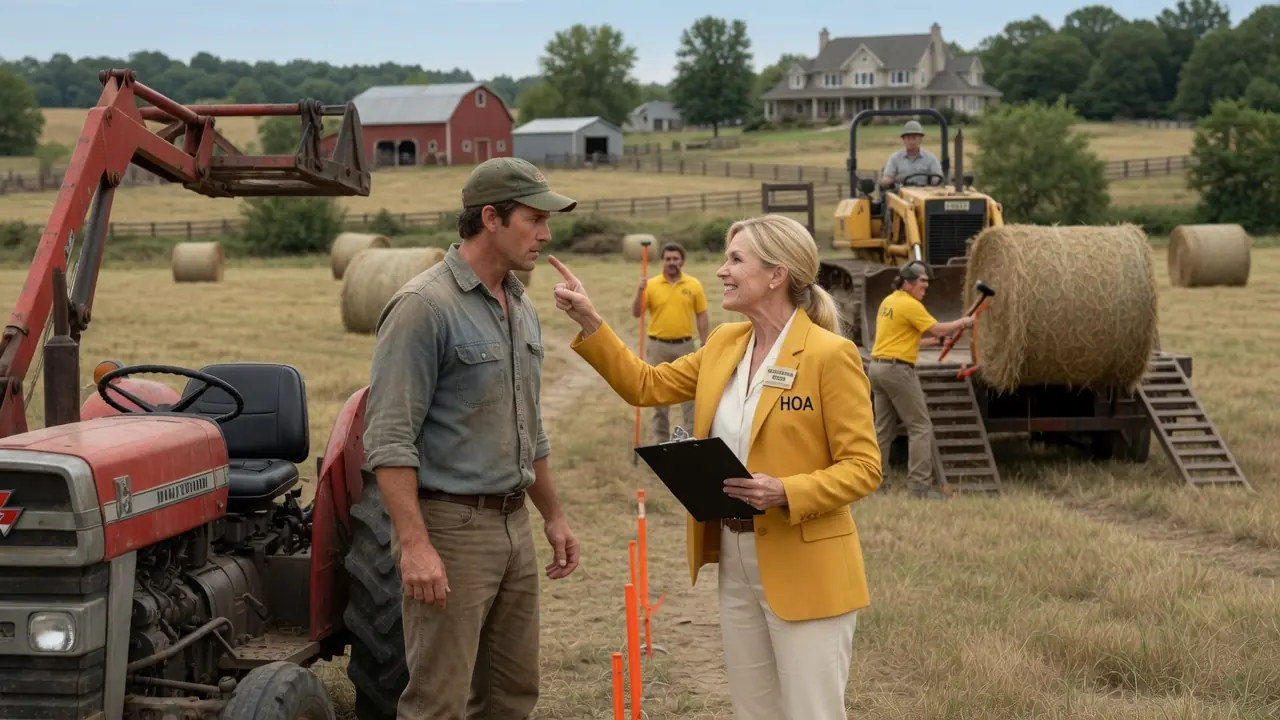
The notice prohibited tractors, balers, livestock, fuel storage, and commercial harvesting.
Violations would result in fines of five hundred dollars per day.
Ethan handed the notice back.
“I’m not a member of your HOA.”
“The land may be.”
“Land doesn’t join homeowners associations by itself.”
One of the board members laughed quietly.
Vivian turned toward the field.
“That machine of yours has already caused enough damage.”
“The tractor?”
“The soil is deeply compacted. There are ruts near the proposed walking trail.”
“There is no walking trail.”
“There will be.”
Ethan followed her gaze.
The orange stakes formed a line across the access road and continued toward Sarah Creek.
Hawthorne Ridge did not merely want three acres.
It wanted a corridor.
A walking trail through the hayfield would connect the subdivision to a planned recreation area near the creek. That amenity had appeared in the newest sales brochures, even though the land did not belong to the developer.
“You’ve already advertised this,” Ethan said.
Vivian did not answer.
“That’s why you’re moving so quickly.”
“We are protecting community assets.”
“You’re trying to create one.”
Caleb stepped forward.
“You can protect it from your side of the fence.”
Vivian looked at him.
“Young man, shouting will not strengthen your family’s claim.”
“I’m not shouting.”
“You’re being aggressive.”
Ethan placed one hand against Caleb’s shoulder.
“Go check the baler.”
Caleb understood.
He walked toward the equipment shed without another word.
Vivian gave Ethan the notice.
“You have forty-eight hours to cease operations in the disputed area.”
“Rain is coming.”
“That is not the HOA’s responsibility.”
“Those bales are winter feed.”
“You should have considered the legal uncertainty before cutting.”
Ethan watched her return to the Cadillac.
She paused beside the old Massey Ferguson.
“Frankly, equipment like this is one reason the board believes the boundary correction is necessary.”
“What does my tractor have to do with your survey?”
“It represents a type of land use no longer compatible with the direction of this community.”
She looked over the faded paint.
“This valley is changing, Mr. Brooks. You cannot preserve every obsolete thing simply because it belonged to your father.”
Ethan glanced toward the tractor.
Then toward the field beyond her.
“The tractor works.”
Vivian laughed.
“So did horse-drawn plows.”
She entered the Cadillac and drove away.
By noon, the HOA’s notice had been copied onto the Hawthorne Ridge community board.
Someone added a handwritten warning:
DANGEROUS FARM EQUIPMENT OPERATING NEAR CHILDREN
No child lived within half a mile of the eastern hayfield.
That afternoon, Ethan began searching the farm records.
The Brooks property had passed through three generations.
His grandfather, Samuel, purchased the first eighty acres in 1926. He added the eastern pasture in 1941 after a neighboring dairy failed.
Ethan’s father, Robert, expanded the farm to one hundred and sixty acres and placed nearly every document inside gray filing cabinets in the farmhouse office.
Nothing had been organized by year.
Old seed receipts sat beside mortgage papers.
Veterinary invoices shared folders with deeds.
Caleb opened boxes from the attic.
Their mother, Ruth, searched a cedar chest containing Robert’s personal papers.
By midnight, the kitchen table had disappeared beneath documents.
“We have the 1941 deed,” Caleb said.
Ethan took it.
The description began at a limestone marker near the county road, followed the old Shaw fence north, turned east near a black walnut tree, and continued toward Sarah Creek.
“Black walnut tree,” Caleb said. “That’s useful.”
“It died twenty years ago.”
“What about the limestone marker?”
“Could still be there.”
Ruth placed a cup of coffee beside Ethan.
“Your father said the corner was marked by a stone his grandfather buried.”
“Where?”
“Near the south access lane.”
“We’ve plowed and driven through there for years.”
“He said it was below ground.”
Caleb frowned.
“Why bury a boundary marker?”
“So equipment wouldn’t move it.”
Ethan read the deed again.
The description referred to a separate survey completed by Thomas Weller in 1941.
The survey was not in the cabinet.
At eight the following morning, Ethan visited the county courthouse.
The clerk searched the archive.
The Weller survey appeared in the index.
The physical file was missing.
“When was it last used?” Ethan asked.
The clerk examined the checkout card.
“Three months ago.”
“By whom?”
She hesitated.
“Pritchard Land Services.”
The company hired by Hawthorne Ridge.
“Was it returned?”
“It says it was.”
“Then where is it?”
The clerk opened the folder again.
Inside was a modern photocopy of the 1941 deed.
No original survey.
No field notes.
No corner coordinates.
Ethan looked toward the clerk.
“Did Pritchard make copies?”
“I don’t know.”
“Who requested the file?”
She read the signature.
“Vivian Hartwell.”
By the time Ethan returned to the farm, another vehicle was parked beside the eastern field.
Two men in work clothes were measuring between the orange stakes.
A small bulldozer sat on a trailer near the road.
Vivian stood with them.
Ethan approached in the Massey Ferguson.
A round bale hung securely from the loader.
He stopped on his side of the fence.
“What’s the bulldozer for?”
Vivian looked up.
“Preliminary trail preparation.”
“You cannot build on disputed land.”
“Our attorney believes the HOA holds presumptive ownership.”
“Your attorney is wrong.”
“Then prove it.”
The bulldozer operator began lowering the trailer ramps.
Ethan kept the tractor in place.
The old diesel idled steadily.
Vivian pointed toward him.
“Move that machine.”
“No.”
“You are obstructing authorized work.”
“You are trespassing.”
“We are within the corrected boundary.”
“The correction is based on a survey file your company checked out before the original disappeared.”
For the first time, Vivian’s face changed.
Only slightly.
Enough.
“I don’t know what you’re implying.”
“Yes, you do.”
She turned toward the camera held by one of the board members.
“Record this. Mr. Brooks is threatening contractors with heavy machinery.”
Ethan lowered the bale slowly onto the road.
The loader descended smoothly.
No sudden movements.
No threat.
Then he shut off the engine.
“I’m preserving evidence.”
Vivian folded her arms.
“You think that old tractor gives you authority?”
“No.”
Ethan climbed down.
“The deed does.”
“You do not have the survey.”
“Neither do you.”
“We have a modern correction.”
“Based on what?”
Vivian did not answer.
Sheriff Tom Reynolds arrived twenty minutes later.
He listened to both sides.
The HOA presented the new survey.
Ethan presented the 1941 deed, the archive index, and the record showing Vivian had requested the missing file.
Reynolds looked toward the bulldozer.
“No one moves dirt today.”
Vivian objected.
“The association has invested significant money in this project.”
“That makes it more important to wait.”
She pointed toward the Massey Ferguson.
“He used the tractor to intimidate our workers.”
Reynolds looked at the bale resting beside the road.
“Did he cross the fence?”
“No.”
“Did he threaten anyone?”
“Not verbally.”
“Did he raise the loader toward anyone?”
“No.”
“Then he parked a tractor on his claimed property.”
Vivian’s jaw tightened.
Reynolds turned toward Ethan.
“Do not remove the stakes.”
“I won’t.”
“Do not cross the new survey line until the court reviews it.”
“That includes my access road.”
“I know.”
Rain was now expected in two days.
Forty-seven bales remained in the field.
If Ethan could not use the access road, the hay would stay exposed.
Caleb watched the sheriff leave.
“She planned that.”
“Yes.”
“She knew closing the road would hurt us before court.”
“Yes.”
“So what do we do?”
Ethan looked toward the creek.
“We find the old boundary.”
They began near the county road.
The 1941 deed described a limestone marker buried twenty inches below grade and twelve feet west of the Shaw fence corner.
The original fence had been replaced twice, but one cedar post from the 1950s still stood beside the lane.
Ethan measured twelve feet west.
Then he used the Massey Ferguson’s loader to scrape away the topsoil.
The bucket moved carefully.
Two inches.
Four.
Six.
Caleb watched from beside the hole.
“Nothing.”
Ethan removed another thin layer.
At eleven inches, the bucket struck stone.
Not violently.
A dull scrape.
Ethan stopped immediately.
They cleared the soil by hand.
A flat limestone slab emerged.
A cross had been chiseled into the center.
Caleb sat back.
“Grandpa was right.”
The marker stood thirty-eight feet east of Vivian’s new survey line.
Exactly where the old fence had always been.
But one marker did not prove the entire boundary.
They needed the northern corner.
The deed referred to the black walnut tree, long dead, and a line running toward Sarah Creek.
Walter Hayes arrived that afternoon.
At eighty, Walter was known as a retired cattle farmer and mechanic. He had repaired tractors throughout the county before returning to his own land.
More importantly, he had known Ethan’s grandfather.
Walter climbed from a cream-colored pickup carrying a folding ruler, an old notebook, and a metal detector borrowed from his grandson.
“I heard Hawthorne Ridge discovered three acres nobody knew were missing,” he said.
Caleb pointed toward the orange stakes.
“They found them inside our field.”
Walter examined the limestone marker.
“Samuel buried this in ’41.”
“You were there?” Ethan asked.
“I was fifteen.”
Walter looked north.
“Thomas Weller ran the line to a walnut tree near the creek bend. Your grandfather made us carry chains all day.”
“The tree is gone.”
“The stump may not be.”
They walked the old fence line.
Walter stopped repeatedly.
He ignored the orange markers.
He studied the slope.
The remains of drainage ditches.
The way the grass changed color near old post holes.
At one point, he crouched and pushed his fingers into the soil.
“The old fence turned here.”
“How can you tell?” Caleb asked.
“Cattle walked this corner for thirty years. Soil’s still harder.”
“That was decades ago.”
“Ground remembers pressure longer than people remember promises.”
They continued toward the creek.
Near a shallow bend, Walter stopped.
“This is where the walnut stood.”
There was no visible stump.
Only grass and a slight depression.
They used the metal detector.
The machine remained silent at first.
Then it sounded near the center.
Ethan brought the Massey Ferguson forward.
He attached a narrow digging tooth to the loader and removed the soil carefully.
At eighteen inches, they found rusted iron.
A survey pin.
Beside it lay pieces of dark wood preserved in wet clay.
The walnut stump.
The northern marker stood forty-one feet east of Vivian’s line.
The same difference as the southern corner.
Walter opened his notebook.
Inside was a hand-drawn map dated August 1941.
Ethan stared at it.
“You kept this?”
“Your grandfather gave it to my father after the survey.”
“Why?”
“Our cattle shared the north fence. He wanted both families to know where it belonged.”
The drawing was not an official survey.
But it showed the limestone marker, walnut tree, creek bend, distances, and bearing measurements.
Every detail matched the physical evidence they had uncovered.
Walter looked toward the orange stakes.
“They didn’t make a mistake.”
Caleb nodded.
“They moved the whole line.”
“Forty feet,” Ethan said.
The emergency hearing took place the following morning.
Vivian arrived with two attorneys, the HOA board, and photographs of the Massey Ferguson parked near the contractors.
Their first argument focused on safety.
Their second focused on the new survey.
Their third claimed the old physical markers could have been moved.
Ethan’s attorney presented the archive index, Walter’s notebook, the buried limestone slab, the original iron pin, and the distances recorded in the 1941 deed.
Judge Margaret Holloway examined the photographs.
“The limestone marker was buried?”
“Yes,” Ethan said.
“Had the soil above it been recently disturbed?”
“No.”
“The iron pin?”
“Found beneath remnants of the original walnut stump.”
The judge looked toward Vivian’s surveyor.
“What source did you use to establish the corrected line?”
The surveyor adjusted his glasses.
“Modern measurements based on the subdivision plat.”
“Was the subdivision plat based on the 1941 Weller survey?”
“Partly.”
“Did you review that survey?”
“I reviewed available records.”
“That was not my question.”
He looked toward Vivian.
She remained still.
The surveyor answered quietly.
“Yes.”
“Where is it now?”
“I returned it to the archive.”
“The archive does not have it.”
“I cannot explain that.”
Judge Holloway turned to Vivian.
“Did you possess a copy?”
“No.”
Ethan’s attorney placed a photograph on the evidence table.
It had been taken during a Hawthorne Ridge planning meeting and later provided by a concerned resident.
A large map stood behind Vivian.
In the lower corner was the title:
THOMAS WELLER SURVEY — BROOKS/SHAW BOUNDARY — 1941
Vivian’s face went pale.
The photograph showed that the HOA had copied the missing survey.
It also showed the original line.
The same line marked by the buried limestone and iron pin.
The proposed walking trail had been drawn west of it, inside the Brooks hayfield.
Judge Holloway removed her glasses.
“Mrs. Hartwell, your association possessed a map showing this land belonged to the Brooks family.”
Vivian looked toward her attorney.
He did not move.
“The planning image may have been preliminary.”
“The original boundary is visible.”
“We believed a modern correction superseded it.”
“Based on what evidence?”
Silence.
The judge continued.
“The court finds a substantial likelihood that Hawthorne Ridge knowingly advanced an unsupported boundary claim to acquire land for a recreational trail.”
She issued an immediate injunction.
The HOA could not enter the field.
Could not move soil.
Could not restrict agricultural use.
Could not block the access lane.
The orange stakes had to be removed under county supervision.
The bulldozer was forbidden from returning.
Ethan had his road back.
The problem was time.
Rain had already begun falling lightly when he returned to the farm.
The hay remained dry enough to move, but only barely.
Caleb started the second tractor.
Neighbors arrived with wagons.
Walter stood near the barn directing traffic.
Ethan climbed onto the Massey Ferguson.
Vivian and several board members watched from behind the eastern fence while a deputy removed the first orange marker.
Vivian called across the field.
“That old machine won’t save you from the next lawsuit.”
Ethan started the engine.
The Perkins diesel settled into its familiar rhythm.
He guided the spear into a full bale and pulled the hydraulic lever.
The loader lifted twelve hundred pounds smoothly.
One foot.
Two.
Then high enough to clear the wagon.
No hesitation.
No shudder.
The tractor carried the bale across the strip Vivian had attempted to claim.
Caleb positioned the wagon.
Ethan lowered the bale into place.
Vivian had mocked the Massey Ferguson because its paint was faded and its design belonged to another era.
But the tractor did exactly what it had been built to do.
It lifted the work of the land and carried it home.
By noon, fourteen bales were under cover.
By four, thirty-two.
The rain strengthened after sunset.
The final wagon entered the barn at 7:18.
All forty-seven bales were safe.
The permanent trial took place three months later.
County investigators recovered the missing Weller survey from a locked cabinet inside the Hawthorne Ridge management office.
The HOA’s attorney claimed it had been stored there accidentally.
Meeting minutes suggested otherwise.
Vivian had discussed the original boundary before commissioning the new survey.
She knew the walking trail crossed Brooks property.
She also knew the subdivision developer had promised the trail to buyers before securing ownership.
The three disputed acres were worth less than the reputational damage Hawthorne Ridge would suffer if residents learned an advertised amenity did not exist.
So Vivian attempted to create the land on paper.
The court confirmed the Brooks boundary.
The HOA was ordered to pay legal fees, restoration costs, and damages for delaying the hay harvest.
It also had to file a corrected subdivision map acknowledging that the eastern field, access lane, and creek bank belonged entirely to the Brooks family.
The surveyor lost his license after the state board determined he had ignored known physical markers and altered measurements to satisfy the client.
Vivian was removed as HOA president.
Several residents who had supported her claimed they never knew the trail crossed private property.
Some were telling the truth.
Others had simply preferred not to ask.
The new HOA president was a teacher named Robert Lane.
He met Ethan beside the fence in early spring.
No cameras.
No attorney.
No yellow suit.
“We owe you an apology,” Robert said.
“The board does.”
“The residents too.”
“Not all of them were involved.”
“No. But enough of us accepted the promise of that trail without asking who owned the ground.”
Ethan looked toward the creek.
Children could be heard playing in Hawthorne Ridge.
Robert held a folder.
“We would like to propose an arrangement.”
Ethan’s expression tightened.
“Another trail?”
“A legal one.”
The HOA offered to lease a narrow route along the outer fence, staying completely east of the Brooks boundary.
Residents would pay for construction and maintenance.
The agreement would prohibit entry into the hayfield, protect farm traffic, and close the path during harvest.
Ethan reviewed the proposal carefully.
Then he added several conditions.
No photographs of the farm used in advertising without permission.
No claims that the Brooks land belonged to Hawthorne Ridge.
Signs warning visitors that they were beside an active agricultural operation.
The HOA accepted.
The path opened the following year.
It remained on the correct side of the fence.
Children watched Ethan cut hay from a distance.
Some waved.
Others asked questions when he stopped near the gate.
One boy pointed toward the Massey Ferguson.
“Is that the tractor Mrs. Hartwell said was dangerous?”
Ethan looked at the faded machine.
“She said many things.”
“My dad says it found the boundary.”
“The tractor helped uncover the markers.”
“How?”
“It moved the dirt carefully.”
The boy studied the loader.
“So the old machine proved the new map was wrong?”
“Something like that.”
Walter Hayes stood nearby and smiled.
“Machines don’t prove much by themselves,” he said. “People have to know where to look.”
The boy glanced toward the field.
“How did you know?”
Walter pointed toward the ground.
“Old land leaves clues.”
Years passed.
The Massey Ferguson continued working.
It loaded hay.
Moved feed.
Cleared fallen branches.
Lifted fence posts.
Its paint faded further, but its hydraulics remained strong.
The buried limestone marker was covered again after the county recorded its coordinates.
Ethan placed a small steel post nearby, painted red so future generations could find the location without digging.
At the northern corner, he protected the iron pin with a concrete collar.
Inside the farmhouse, the recovered Weller survey was placed in a fireproof cabinet.
Copies went to the county, the bank, and Ethan’s attorney.
Walter’s hand-drawn map was framed beside it.
Caleb later asked why Ethan kept the original orange HOA stake.
It leaned in a corner of the office, its fluorescent ribbon faded almost white.
“To remember what?” Caleb asked. “That they tried to steal three acres?”
Ethan shook his head.
“To remember how easy it was.”
Vivian had not arrived with armed men.
She arrived with maps.
Notices.
Professional language.
A surveyor willing to move a line.
A community willing to believe a promised walking trail mattered more than the farmer who already owned the ground.
The attempt looked official because every piece of paper had a logo, stamp, or signature.
If Ethan had accepted the new markers, the false boundary would eventually have become ordinary.
Future buyers would see the trail.
County maps would show the corrected line.
Children would grow up believing the hayfield had always belonged to the subdivision.
The theft would disappear inside familiarity.
That was why Ethan kept the orange stake.
Not as a symbol of victory.
As a warning.
Years later, his daughter stood with him near the eastern field while the Massey Ferguson carried another round bale toward the barn.
She had recently returned from college with a degree in agricultural business and plans to take over part of the operation.
“Dad,” she asked, “why didn’t you sell them the land after the case?”
“They offered enough.”
“They offered more than the three acres were worth as hay ground.”
Ethan nodded.
“Then why keep it?”
He looked toward the access lane.
“Because they were not buying only soil.”
“What were they buying?”
“The ability to decide what this place used to be.”
The houses of Hawthorne Ridge stood beyond the fence.
The legal walking path curved along its proper boundary.
The hayfield remained open and productive.
The old Massey Ferguson moved steadily across it.
Ethan watched the loader hold the bale without drifting.
The tractor’s strength had never disappeared.
Neither had the boundary.
Both had been there from the beginning.
The problem was that a group of people looked at something old and assumed it could be replaced by whatever version of the future they preferred.
They were wrong.
A new subdivision did not erase an old deed.
A promised amenity did not become ownership.
A polished survey did not outweigh buried stone, iron, memory, and recorded truth.
Vivian Hartwell believed Ethan Brooks was only a young farmer with an aging tractor and no money for a prolonged legal fight.
She expected him to become frightened by official letters.
She expected the rain to force him into surrender.
She expected the old boundary to vanish because the paper describing it had disappeared.
Instead, Ethan climbed onto the machine she mocked.
He lowered the loader into soil his grandfather had protected.
And beneath the ground, exactly where the original deed said it would be, the farm answered for itself.