“Which direction did he drive in from?”
Nobody answered Elden Croft.
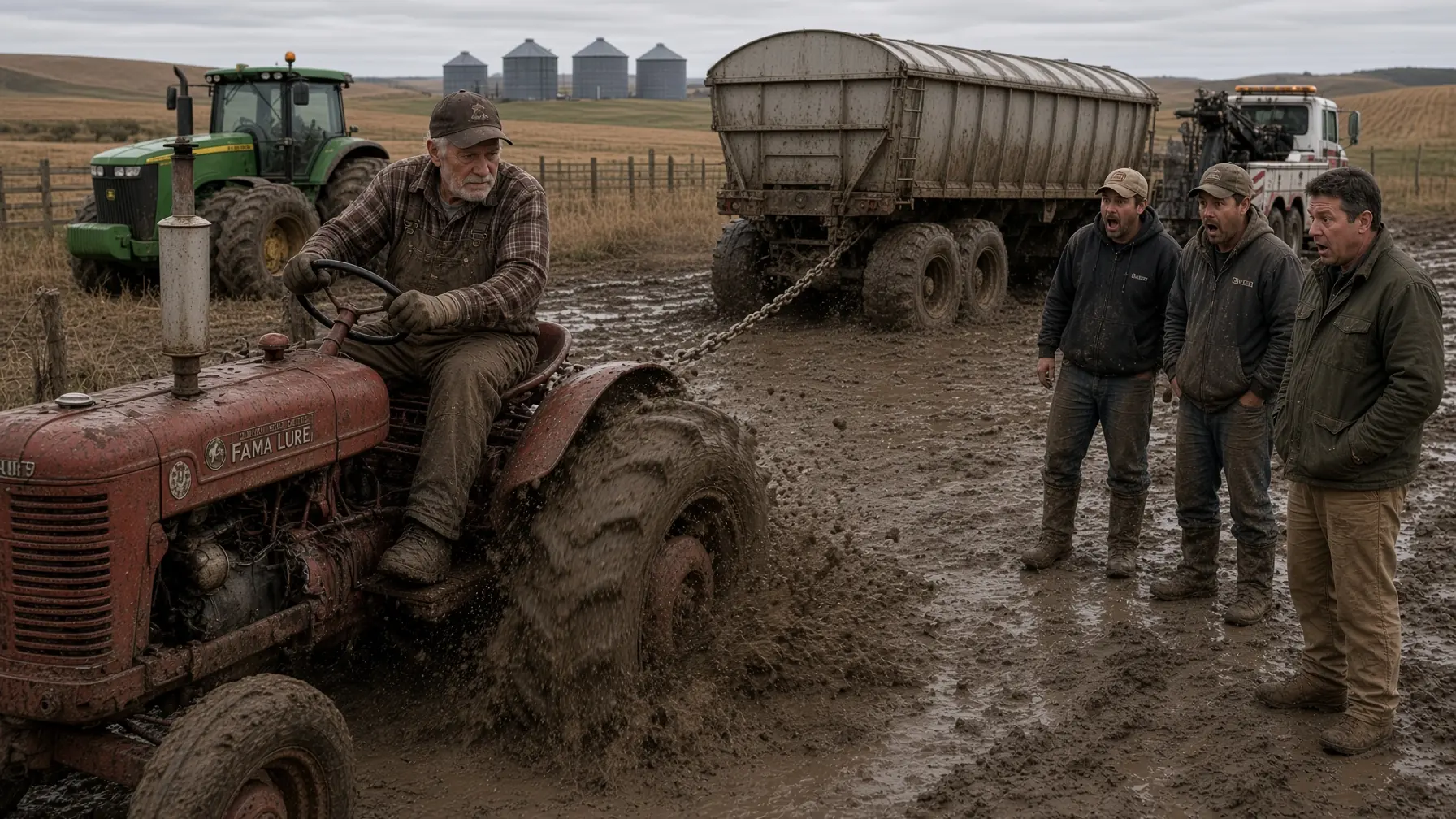
Twelve men stood around the buried grain semi as if the answer might be hiding somewhere among them. A 340-horsepower John Deere sat twenty yards away with both duals packed in red Missouri mud. Beyond it, a heavy wrecker leaned awkwardly on its outriggers, steel pads buried almost to their edges. A crawler dozer waited on slightly firmer ground, its operator refusing to move another foot until someone gave him a plan that did not involve sacrificing a second machine to the field.
Elden asked again.
“Which way did the truck come in?”
The crew chief looked down at his clipboard.
Garrett Doyle, regional project manager for Cresthaven Energy, glanced toward the stuck semi, then toward the old man who had just driven across the neighboring pasture on a 1948 Farmall H.
The tractor’s red paint had faded to rust and pink. Its hood carried two dents. One rear tire was newer than the other, though “newer” meant perhaps fifteen years old instead of twenty. Compared with the equipment already scattered around the field, it looked less like a recovery machine than something brought out for a county-fair parade.
One of the younger workers laughed.
Not cruelly.
Almost involuntarily.
Elden heard him.
He did not look over.
Finally the truck driver pointed toward the north end of the field.
“Came from there.”
Elden turned.
He followed the twin ruts with his eyes.
“How far?”
“Quarter mile, maybe.”
“Same tracks all the way?”
“Mostly.”
“You stop before it sank?”
The driver hesitated.
“No.”
“What did you do?”
“Kept throttle in it.”
“How long?”
“Not long.”
“That’s not a measurement.”
“Maybe fifteen seconds.”
Elden nodded.
Then he walked away from everyone.
Garrett Doyle watched him.
“Where’s he going?”
Nobody knew.
Elden crouched beside the first shallow wheel marks fifty yards north of the semi. Then he moved farther. He scraped mud aside with the heel of his boot. Walked another thirty yards. Crouched again.
Garrett checked his watch.
“We have a pipeline survey team sitting idle, a loaded truck immobilized for two days, and we’re watching a neighbor study tire tracks.”
The crew chief said nothing.
The man had already watched one tractor bury itself and one wrecker nearly pull its own rear wheels off the ground. He was beginning to appreciate activities that did not immediately make the situation worse.
Elden reached the eastern side of the field and kicked through an inch of dark soil.
Gray stone appeared.
He kicked again.
More stone.
Then he looked back toward the semi.
There it was.
The thing nobody else had noticed.
A strip perhaps nine feet wide running beneath the grass, almost completely swallowed by forty years of soil and weeds.
An old limestone farm lane.
Elden knew it because he had helped spread the rock when he was fourteen.
His father had built it for hay wagons.
Nobody had used it since the mid-1970s.
But limestone did not disappear because people forgot where they put it.
Elden returned to the group.
“Don’t hook my tractor to that truck.”
The young worker who had laughed looked surprised.
Garrett frowned.
“I thought that was why you brought it.”
“No.”
“Then what exactly are you doing here?”
Elden pointed toward the buried lane.
“Giving your wrecker somewhere solid to work from.”
That was the first moment nobody laughed.
Two days earlier, none of them had expected Elden Croft to matter.
On Tuesday morning, a convoy belonging to Cresthaven Energy had entered the northern section of the Croft property while Elden was repairing a cattle-water valve behind the barn.
The first pickup carried survey equipment.
The second pulled a small trailer loaded with stakes.
Behind them came a utility truck.
Then the semi.
Eighty thousand pounds gross weight, loaded with steel drilling pipe and equipment intended for preliminary geotechnical work along a proposed natural-gas pipeline corridor.
Elden heard them before he saw them.
By the time he reached the north field, orange survey flags had already appeared along his fence line.
A young surveyor was driving another stake into the ground.
Elden stopped twenty feet away.
“Who gave you permission?”
The surveyor straightened.
“Cresthaven Energy.”
“That isn’t who owns the field.”
The young man glanced toward the convoy.
“We’ve got right-of-way authorization.”
“Show me.”
“I don’t have the easement documents with me.”
“Then stop.”
The surveyor looked uncomfortable.
“We were told access had been cleared.”
“By who?”
“Our regional office.”
Elden nodded.
“Call them.”
The young man did.
That was when Garrett Doyle first entered Elden Croft’s life.
The regional manager arrived forty minutes later in a black pickup that had never hauled livestock, feed, fencing wire, or anything else likely to scratch its paint.
Garrett was forty-three, educated, competent, and under enormous pressure.
That mattered.
He was not a cartoon villain.
He had a project deadline.
Permitting delays upstream had already cost Cresthaven months. Construction contracts were tied to winter schedules. Environmental windows restricted work around two sensitive stream crossings. One property owner farther west had demanded changes to the route.
Then there was Elden Croft.
On Garrett’s digital right-of-way map, a corridor crossed the northern quarter of the Croft farm.
It appeared clean.
An existing historical easement.
Acquired decades earlier by Northgate Timber Company.
Cresthaven had purchased a bundle of Northgate-related property interests during a regional acquisition in 2003.
The mapping database treated the Croft corridor as one of them.
Garrett had no reason—yet—to believe otherwise.
He stepped from his truck.
“Mr. Croft?”
“Yes.”
“Garrett Doyle, Cresthaven Energy.”
“You tell these men they could drive across my field?”
“We hold an access right through this section.”
“You hold paper?”
“Our land department does.”
“I asked if you had it.”
Garrett controlled his irritation.
“Not physically.”
“Then you don’t have anything I can read.”
“We can get you a copy.”
“Do that.”
Garrett looked toward the survey crew.
“We have a work schedule.”
Elden looked toward the same men.
“They can schedule lunch.”
“Mr. Croft—”
“Bring the document.”
Garrett stared at him.
Neither raised his voice.
That almost made the argument worse.
Eventually Garrett called the regional office.
A summary was emailed to his phone.
Historic access corridor established in 1961.
Northgate Timber Company.
Forty-foot width.
Successor-interest notation.
Garrett showed Elden the screen.
Elden read it.
“That isn’t the document.”
“It summarizes the recorded interest.”
“Then get the recorded interest.”
Garrett exhaled slowly.
“We are not trying to take your farm.”
“You’re standing on it.”
“We have a legitimate project.”
“Maybe.”
“We have rights.”
“Maybe.”
Garrett looked toward the old farmer.
Most landowners he dealt with responded one of two ways.
Anger.
Or fear.
Elden gave him neither.
That made him harder to read.
Garrett said, “We’ll send the full easement.”
“Good.”
“Meanwhile, the survey crew needs to proceed.”
“No.”
“Mr. Croft.”
“No.”
Garrett’s jaw tightened.
“Fine.”
He turned.
“Pull out.”
The convoy began leaving.
That should have ended Tuesday’s confrontation.
Instead the semi driver made one mistake.
Rather than returning along the graveled approach the pickups had used, he followed a flagged line south across what appeared to be open grass.
The driver saw tire tracks from lighter vehicles.
He saw dry grass.
He did not see what Elden knew.
The north field lay over a shallow clay pan.
Three days of rain the previous week had saturated the soil beneath a dry-looking crust.
A pickup could cross.
An eighty-thousand-pound semi could not.
The truck traveled perhaps two hundred yards before the rear tandem began sinking.
The driver felt drag.
He added throttle.
That was the worst thing he could have done.
The tires spun.
The surface crust broke.
The first axle dropped.
Then the second.
By the time he released the throttle, mud had climbed almost halfway to the hubs.
The front wheels remained higher, but the loaded trailer sat axle-deep.
Elden watched from the fence.
Garrett walked toward him.
“We’ll remove it.”
Elden nodded.
“You’ll repair the field too.”