Rain had been falling over Manhattan since early morning, washing the sidewalks in silver and turning every passing taxi into a blur of headlights and wet pavement.
By late afternoon, the storm had grown heavier.
Guests hurried beneath umbrellas toward the revolving doors of the Grand Meridian Hotel, one of the most expensive five-star properties in the city. Bellmen in spotless uniforms opened car doors for wealthy travelers, while attendants carried designer luggage beneath the enormous glass canopy.
Inside, the lobby seemed untouched by the weather.
Crystal chandeliers glowed above polished marble floors. Fresh white flowers filled tall arrangements beside the reception desk. A pianist played softly near the lounge while elegantly dressed guests moved between private elevators, velvet chairs, and the hotel’s celebrated restaurant.
At 4:37 p.m., the revolving door turned again.
An elderly woman stepped inside.
Her name was Evelyn Harrison.
She was eighty-one years old, slender, and slightly stooped from age. Rainwater clung to her silver hair and darkened the shoulders of her weathered gray coat. In one hand, she carried a faded brown suitcase with scratched brass corners. In the other, she held a simple black umbrella that had been repaired with tape near the handle.
No chauffeur followed her.
No assistant rushed forward.
No designer labels appeared on her luggage or clothing.
She paused just inside the entrance, allowing the revolving door to close behind her.
Water dripped quietly from the edge of her coat onto the marble floor.
A bellman noticed her.
He looked toward the street, apparently expecting someone else to enter.
When no one did, he gave Evelyn a quick glance and returned his attention to a young couple arriving in a luxury sedan.
Evelyn tightened her grip on the suitcase and walked toward the reception desk.
Several employees watched her approach.
A young receptionist named Chloe Bennett stood behind the counter. She was twenty-seven, sharply dressed, and known among the staff for recognizing wealthy guests before they introduced themselves.
She noticed watches.
Shoes.
Handbags.
Jewelry.
The subtle details that revealed whether someone belonged in a hotel where even the least expensive room cost more than many people earned in a week.
Evelyn’s old shoes, repaired suitcase, and rain-soaked coat told Chloe everything she believed she needed to know.
“Good afternoon,” Evelyn said.
Chloe offered a thin professional smile.
“May I help you?”
“I need a room for three nights.”
Chloe glanced toward the suitcase.
“Do you have a reservation?”
“No.”
“I see.”
Evelyn looked toward the golden lettering behind the desk.
“The Presidential Suite, please.”
For a moment, Chloe thought she had misunderstood.
“I’m sorry?”
“The Presidential Suite. For three nights.”
A second receptionist looked up from her computer.
Two guests waiting nearby turned slightly toward the conversation.
Chloe kept her smile in place.
“Madam, the Presidential Suite is our most exclusive accommodation.”
“Yes.”
“The nightly rate begins at twelve thousand dollars.”
“I understand.”
Chloe waited for the elderly woman to laugh or admit she had made a mistake.
Evelyn simply stood there.
Rainwater continued dripping from the hem of her coat.
The receptionist leaned forward slightly.
“There are several affordable hotels farther downtown. One of them offers weekly rates and may be more suitable.”
Evelyn’s expression remained calm.
“I did not ask for another hotel.”
A man standing nearby gave a quiet laugh.
His wife whispered something to him, and both looked toward Evelyn’s worn suitcase.
The second receptionist covered a smile by lowering her face toward the keyboard.
Chloe’s tone became more direct.
“Perhaps you are unfamiliar with our pricing.”
“I am familiar with it.”
“The suite must be paid in advance.”
“That will not be a problem.”
The front desk manager, Martin Caldwell, had been standing a few feet away reviewing the evening arrivals.
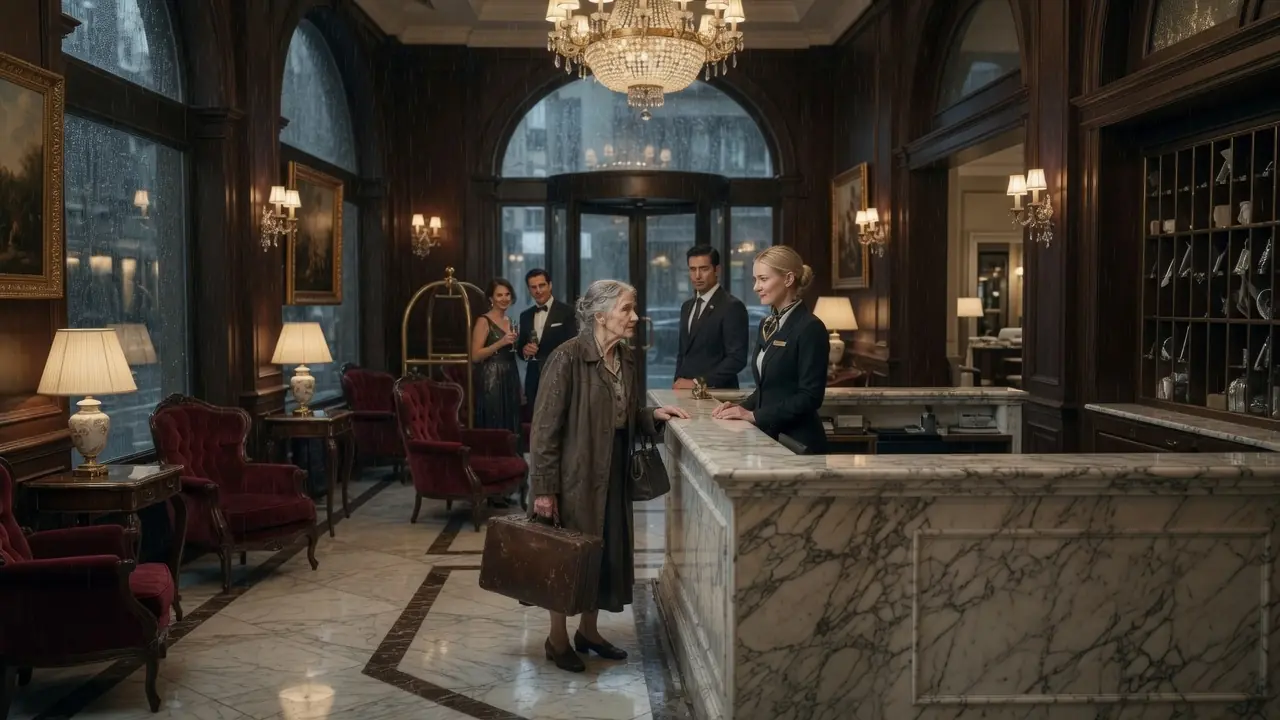
He heard the conversation.
He looked at Evelyn from head to toe.
Then he looked at Chloe and gave a small shrug, as though the matter was not worth his time.
Chloe interpreted his silence as permission to continue.
“Madam, we are trying to avoid an embarrassing situation.”
Evelyn tilted her head.
“For whom?”
The question made the second receptionist stop smiling.
Chloe’s face tightened.
“For everyone involved.”
Evelyn rested both hands on the handle of her suitcase.
“I have requested a room.”
“And I have explained the cost.”
“Yes.”
“Then perhaps you should reconsider.”
Evelyn reached slowly into the inside pocket of her coat.
One of the nearby security officers shifted his attention toward her.
She removed a dark leather wallet.
From it, she took a black payment card and placed it on the counter.
“I will not reconsider.”
Chloe stared at the card.
It was an American Express Centurion Card.
She had handled several before. Many of the hotel’s wealthiest guests carried them.
Still, she remained convinced there had to be some mistake.
Perhaps the card belonged to someone else.
Perhaps it had expired.
Perhaps the elderly woman did not understand how much would be charged.
Chloe picked it up.
“Three nights?”
“Three.”
“With the private dining service?”
“Yes.”
“Airport transportation?”
“That will not be necessary.”
Chloe entered the total.
Taxes, service fees, and the required deposit brought the charge to more than forty-three thousand dollars.
She turned the terminal toward Evelyn.
The elderly woman entered the security code.
Chloe pressed the final key.
The machine processed the transaction.
Everyone near the desk waited.
Approved.
The word appeared across the screen.
Chloe stared at it.
She tried the authorization again, convinced she had entered something incorrectly.
Approved.
The payment went through a second time without hesitation.
The laughter near the desk stopped.
Martin Caldwell finally moved closer.
Chloe handed the card back.
Her voice had lost some of its confidence.
“I will need a passport or government-issued identification.”
Evelyn removed a dark blue passport from her handbag and placed it beside the card.
Chloe opened it.
At first, she checked only the photograph.
Then her eyes dropped toward the name.
Evelyn Margaret Harrison.
Chloe froze.
She read it again.
Then she looked at the elderly woman.
Back at the passport.
Then toward Martin.
Her fingers began trembling.
“Mr. Caldwell?”
The manager frowned.
“What is it?”
Chloe did not answer.
She handed him the passport.
Martin took it impatiently.
The moment he read the name, the color disappeared from his face.
His posture changed immediately.
The folder he had been holding slipped slightly in his hand.
He looked at Evelyn with sudden disbelief.
“Mrs. Harrison?”
Evelyn nodded.
The manager’s mouth opened, but no words came.
The guests nearby noticed his reaction.
The employees behind the desk stopped working.
Even the pianist seemed to lower the volume of the music.
Martin looked again at the passport, as if the name might change if he stared long enough.
It did not.
Evelyn Margaret Harrison.
Founder and majority owner of Harrison International Hotels.
The company that owned the Grand Meridian.
Martin stepped around the desk.
“Mrs. Harrison, I had no idea you were arriving.”
“That was intentional.”
His eyes moved toward Chloe.
Then toward the bellmen near the entrance.
“I sincerely apologize.”
Evelyn studied him.
“For what?”
Martin hesitated.
“For the misunderstanding.”
“There was no misunderstanding.”
The manager’s face tightened.
Evelyn continued.
“Your staff saw an elderly woman in wet clothing carrying an old suitcase. They understood perfectly what they were doing.”
Chloe lowered her eyes.
Martin attempted a nervous smile.
“I assure you, our employees are trained to maintain certain standards.”
“Whose standards?”
“The hotel’s.”
Evelyn looked around the lobby.
At the marble.
The chandeliers.
The carefully arranged flowers.
Then she looked back at him.
“This hotel was built on my standards.”
Martin said nothing.
Evelyn slowly removed her wet coat.
A bellman hurried forward, but she held up one hand.
He stopped.
Beneath the coat, she wore a plain navy dress and a small pearl brooch.
Nothing extravagant.
Nothing that would have changed how the staff judged her.
She placed the coat over the suitcase.
“I founded my first hotel fifty-two years ago,” she said. “It had eighteen rooms, leaking pipes, and a front desk made from an old church table.”
The lobby remained silent.
“I could not afford staff, so I cleaned rooms in the morning, carried luggage in the afternoon, and worked reception at night.”
Her eyes moved toward Chloe.
“Do you know who my first paying guest was?”
Chloe shook her head.
“A widow traveling to her son’s funeral.”
Evelyn’s voice softened.
“She arrived wearing a torn coat and carrying a cardboard box instead of a suitcase. Every other hotel in town had turned her away because they believed she could not pay.”
No one interrupted.
“She had enough money for one night. I gave her three.”
Evelyn looked toward Martin.
“That woman later introduced me to the banker who financed my second hotel.”
Martin swallowed.
“I understand.”
“No,” Evelyn replied. “You understand my name. That is different.”
The sentence struck the room harder than any shout could have.
A few guests looked away.
The man who had laughed earlier lowered his head.
Evelyn turned toward Chloe.
“When I entered, did you greet me?”
Chloe’s voice was barely audible.
“Not properly.”
“Did anyone offer to take my suitcase?”
“No.”
“Did you ask what kind of assistance I needed?”
“No.”
“You suggested I leave before checking whether I could pay.”
“Yes.”
Evelyn paused.
“Why?”
Chloe struggled for an answer.
Her eyes filled with embarrassment.
“Because of how you looked.”
The honesty surprised everyone.
Evelyn nodded.
“Thank you for telling the truth.”
Martin stepped forward.
“Mrs. Harrison, I will handle the disciplinary process personally.”
Evelyn looked at him.
“You stood here.”
The manager became still.
“You heard the conversation.”
“Yes.”
“You saw how she was treated.”
“Yes.”
“And you said nothing.”
Martin’s face reddened.
“I believed Chloe could manage the situation.”
“You believed I did not matter.”
He could not deny it.
Evelyn reclaimed her passport.
“I did not come here looking for people to fire.”
Several employees exhaled quietly.
“I came because the hotel’s guest satisfaction reports were excellent, but employee complaints and anonymous reviews told a different story.”
Martin looked alarmed.
“You were conducting an inspection?”
“I was visiting a hotel my late husband helped me open thirty-four years ago.”
She looked around the lobby again.
“This was his favorite property.”
Evelyn’s husband, Charles Harrison, had died eight months earlier after fifty-nine years of marriage.
Together, they had built a small roadside hotel into an international hospitality company. Charles had loved the Grand Meridian because it had been their first truly luxurious property.
He had chosen the lobby marble himself.
He had personally hired the first doorman.
And every Christmas morning, he had stood near the entrance greeting employees by name.
Before his death, he had asked Evelyn to visit the hotel anonymously.
“Beautiful buildings can hide ugly habits,” he had told her. “Go in looking like nobody important. See who remembers what we built.”
For months, Evelyn had postponed the trip.
The grief was still too heavy.
That morning, however, she had taken the train into the city, walked several blocks through the rain, and entered carrying the same suitcase she and Charles had used on their honeymoon.
The worn case was not a disguise.
It was a memory.
Martin looked toward the suitcase.
Recognition slowly appeared in his eyes.
A framed photograph of Charles and Evelyn standing beside it hung inside the executive conference room.
He had passed that photograph hundreds of times.
He had never really looked at it.
“I should have recognized you,” he said.
Evelyn shook her head.
“That would have ruined the test.”
The private elevator doors opened.
A senior concierge rushed into the lobby, having finally received word that the owner had arrived.
Evelyn ignored him.
She looked toward Chloe again.
“How long have you worked here?”
“Two years.”
“Why did you choose hospitality?”
Chloe hesitated.
“My mother worked in hotels.”
“Did she teach you to judge guests by their coats?”
“No.”
“What did she teach you?”
Chloe’s voice trembled.
“To make people feel safe when they are far from home.”
Evelyn’s expression softened slightly.
“Then you have forgotten the most important part of your training.”
Chloe wiped one tear from the corner of her eye.
“Yes, ma’am.”
Evelyn turned to Martin.
“Gather every department manager in the ballroom at seven this evening.”
“Yes, ma’am.”
“Include the night staff.”
“Of course.”
“And do not prepare a presentation.”
Martin looked confused.
“What should we prepare?”
“Honest answers.”
At seven o’clock, nearly two hundred employees gathered inside the Grand Meridian’s main ballroom.
Housekeepers sat beside executives.
Bellmen stood near chefs.
Maintenance workers, servers, security guards, receptionists, and department heads filled the chairs beneath enormous chandeliers.
No one knew who would lose a job.
Rumors had spread through the hotel.
Some said Evelyn planned to replace the entire management team.
Others believed she intended to sell the property.
Evelyn walked onto the stage carrying the old suitcase.
She placed it on a small table.
“This case is sixty years old,” she began.
The room became silent.
“My husband and I bought it before our honeymoon. It traveled with us when we had very little money and again after we could afford anything we wanted.”
She rested one hand on the worn leather.
“I brought it here today because Charles asked me to.”
Several longtime employees lowered their heads at the mention of his name.
“He believed hospitality was easiest to measure when the person entering the door appeared to offer nothing in return.”
Evelyn told them what had happened in the lobby.
She did not exaggerate.
She did not name Chloe publicly.
She described the laughter, the silence, the suggestion that she find a cheaper hotel, and the manager who watched without intervening.
Then she asked a question.
“How many guests have entered this building without a famous name and received the same treatment?”
No one answered.
“That is the problem,” she said. “We will never know.”
Evelyn explained that no employee would be dismissed that evening.
But changes would begin immediately.
Every manager would spend one full week working alongside housekeepers, bell staff, kitchen workers, and reception teams.
Anonymous guest evaluations would be expanded.
Complaints about discrimination, humiliation, or disrespect would no longer disappear inside management reports.
The hotel would create an emergency-room fund for travelers experiencing illness, bereavement, theft, or unexpected hardship.
And every employee, including executives, would undergo new service training based on one principle.
A guest’s dignity would never depend on appearance.
Martin Caldwell was removed as general manager, though he was not fired. Evelyn reassigned him to a six-month training role at one of the company’s smaller roadside properties.
“You need to remember how hospitality begins,” she told him.
Chloe expected to be dismissed.
Instead, Evelyn asked her to join the guest-relations training team after completing a probationary period.
“Why would you give me another chance?” Chloe asked privately.
“Because you admitted the truth.”
“That does not erase what I did.”
“No.”
Evelyn looked toward the lobby.
“But people are not improved by pretending their failures never happened. They improve by being required to face them every day.”
Three months later, Chloe was working differently.
She greeted every guest before noticing their luggage.
She learned to kneel beside elderly travelers who struggled to hear across the counter.
She carried umbrellas to taxis.
She kept sandwiches and bottled water available for stranded guests.
One rainy evening, a tired man entered wearing construction clothes and asked whether he could sit in the lobby while waiting for a bus.
The old Chloe would have directed him outside.
Instead, she brought him coffee.
No one important appeared afterward.
No lawyer arrived.
No hidden owner revealed himself.
That was how Evelyn knew the lesson had finally been learned.
During her original three-night stay, Evelyn slept in the Presidential Suite but spent little time there.
She ate breakfast with the kitchen staff.
She visited the laundry room.
She spoke with housekeepers who had worked at the property longer than most executives.
She asked the doormen about their families and the maintenance crew about equipment the budget had ignored.
On her final morning, she stood beside the revolving doors with the old suitcase in her hand.
Chloe approached her.
“May I carry that for you?”
Evelyn smiled.
“Yes.”
Outside, the rain had stopped.
A company car waited at the curb, but Evelyn asked the driver to remain where he was.
She walked slowly beneath the glass canopy and looked back at the hotel.
The building remained beautiful.
But beauty, she knew, was never enough.
Charles had understood that.
A hotel could offer silk sheets, marble bathrooms, crystal chandeliers, and views across the city.
Still, none of those things could make a person feel welcome.
Only another person could do that.
Before getting into the car, Evelyn looked at Chloe.
“What is the first rule of hospitality?”
Chloe answered without hesitation.
“Never decide what a guest deserves before hearing what they need.”
Evelyn nodded.
“Good.”
The car pulled away.
Years later, new employees at the Grand Meridian still heard the story during orientation.
They were shown the old suitcase, now displayed behind glass in the training room.
Beside it was a small plaque containing words Evelyn had spoken in the lobby that rainy afternoon.
YOU DID NOT FAIL BECAUSE YOU FAILED TO RECOGNIZE THE OWNER.
YOU FAILED BECAUSE YOU DID NOT RECOGNIZE A GUEST.
Most visitors who saw the display assumed the story was about a wealthy woman teaching arrogant employees a lesson.
It was not.
Evelyn had never cared whether anyone knew how much money she possessed.
She cared that an unknown elderly woman in wet clothes had been treated as though age, poverty, and an old suitcase made her less worthy of kindness.
Her passport revealed her name.
Her payment card revealed her wealth.
But neither revealed her value.
That had been present from the moment she walked through the door.
The hotel staff had simply failed to see it.