Sheriff Raymond Cole snapped the handcuff around Daniel Carter’s right wrist before the single father had taken more than one bite of breakfast.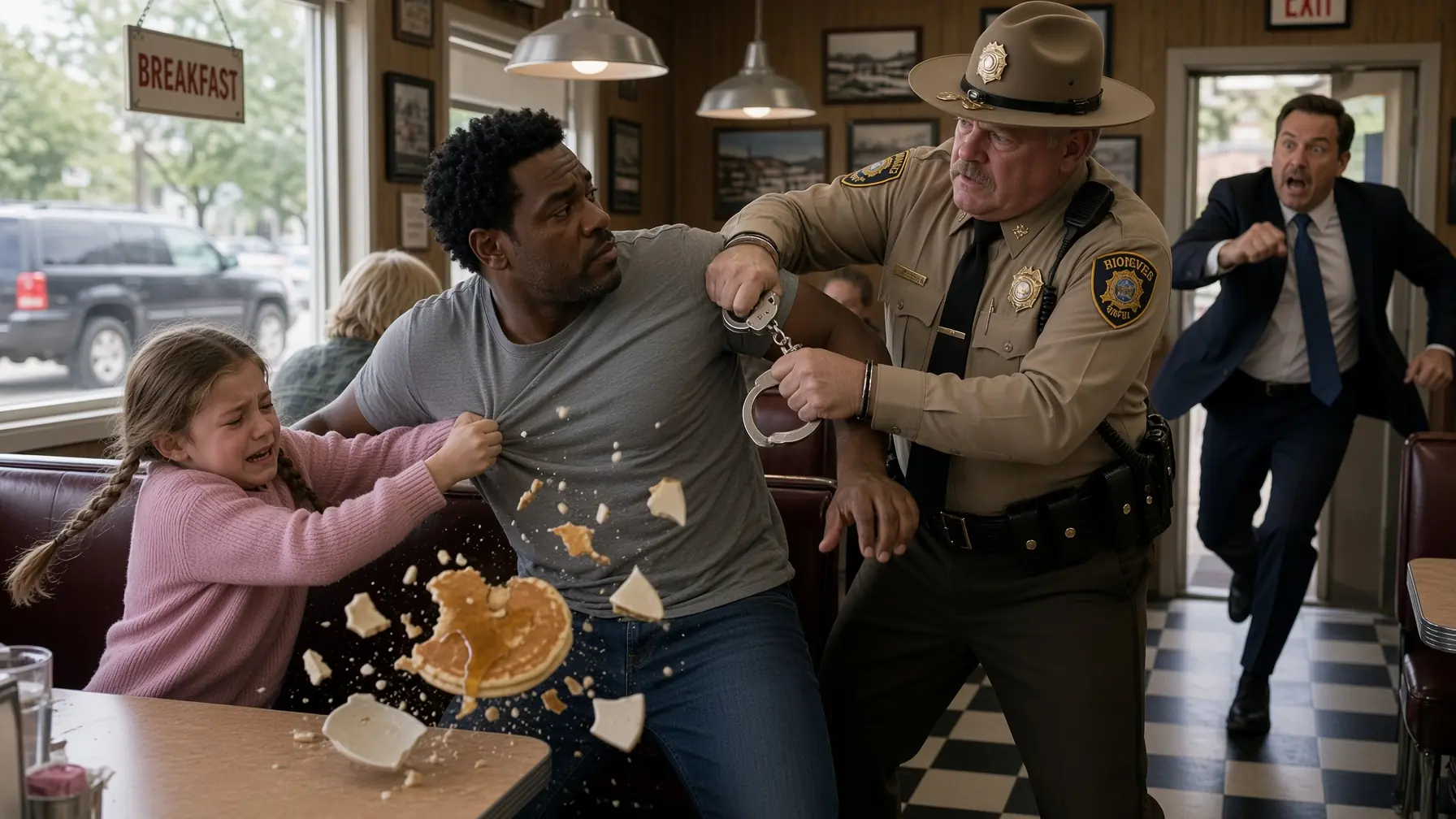
The metallic click seemed louder than it should have been inside Millie’s Diner.
Daniel’s fork stopped halfway between his plate and his mouth. Across from him, his eight-year-old daughter Lily froze with a piece of pancake balanced on the end of her fork. Maple syrup dripped onto the white plate while every conversation in the diner died at once.
“Daddy?”
Daniel turned toward her.
The fear in Lily’s face hit him harder than the steel around his wrists.
“It’s okay, sweetheart.”
Cole pulled Daniel’s other arm behind him.
Lily pushed away from the table.
“No! Don’t hurt him!”
Daniel immediately shook his head.
“Lily, look at me.”
She did.
Not the sheriff.
Not the deputies.
Her father.
Daniel kept his voice low.
“I’m not fighting anybody. You don’t fight anybody either. Understand?”
Tears filled her eyes.
“But why are they taking you?”
Daniel wished he had an answer a child could understand.
He had one for lawyers.
One for supervisors.
One for an FBI operations report.
None for an eight-year-old girl who had already lost one parent and was suddenly watching uniformed men take the other.
“I’m coming back.”
Sheriff Cole laughed behind him.
“That depends on whether Daddy finally decides to cooperate.”
Daniel’s expression changed almost imperceptibly.
Cole noticed.
He mistook restraint for fear.
“Something funny?”
“No.”
“Good.”
The sheriff tightened his grip on Daniel’s arm.
“Because trespassing around a restricted warehouse in the middle of the night isn’t funny.”
Daniel looked toward Lily again.
Then toward the deputy standing several feet away.
Deputy Noah Grant was twenty-eight, three years into the Pine County Sheriff’s Department, and had been visibly uncomfortable since walking into the diner.
Daniel said:
“My daughter needs someone she knows.”
Cole scoffed.
“She’ll be fine.”
Daniel ignored him.
“Millie?”
The waitress standing behind the counter immediately came forward.
Millie Harper was sixty-two and had been serving breakfast in that room since before Lily was born.
“I’ve got her.”
Daniel nodded.
“Her school starts at eight fifteen. Her aunt Rebecca’s number is under favorites.”
Millie swallowed.
“I know.”
Lily was crying openly now.
“Daddy, don’t go.”
Daniel crouched as far as Cole’s hold allowed.
“Remember what I told you after Mom died?”
Lily wiped her cheek.
“That you always come back.”
“Yes.”
Daniel’s throat tightened.
“I keep my promises.”
Sheriff Raymond Cole rolled his eyes.
“Touching. Let’s go.”
He pulled Daniel toward the door.
Daniel did not resist.
He could have ended the scene in seconds.
Inside the leather wallet hidden beneath his jacket was a credential that would have made Cole’s expression change instantly.
FEDERAL BUREAU OF INVESTIGATION.
Special Agent Daniel Carter.
Public Corruption and Organized Crime Task Force.
Fourteen years federal service.
Former Army Criminal Investigation Division.
Current undercover assignment: Pine County evidence diversion investigation.
But Daniel did not reach for it.
Because the person the FBI had spent four months trying to identify might have been standing somewhere inside the Pine County Sheriff’s Department.
And revealing himself in a crowded diner could destroy an investigation involving stolen firearms, missing narcotics, falsified evidence logs, and at least three criminal prosecutions that federal agents now believed had been deliberately manipulated.
So Daniel allowed Cole to march him through the diner.
Past the coffee cups.
Past the silent customers.
Past his daughter.
And out into the morning.
What Sheriff Raymond Cole did not understand was that arresting Daniel Carter would not protect the corruption inside his department.
It would force every hidden part of it into the light.
Six months earlier, Daniel had buried his wife.
Laura Carter had been thirty-nine.
Healthy until she wasn’t.
A headache became a scan.
The scan became surgery.
The surgery became three months of treatment.
Then one November morning, Daniel sat beside a hospital bed holding her hand while she asked him the only question she cared about.
“Lily?”
“She’s with Rebecca.”
“No.”
Laura’s voice was weak.
“After.”
Daniel understood.
“I’ll take care of her.”
“Don’t disappear into work.”
“I won’t.”
“You do that.”
“I know.”
Laura smiled faintly.
“You’re very good at saving strangers.”
Daniel lowered his head.
“Save enough of yourself for her.”
Those were nearly her last words.
Grief did not arrive as one giant collapse after Laura died.
It arrived as dozens of small failures.
Daniel burned toast.
Forgot picture day.
Bought the wrong shampoo.
Discovered that an eight-year-old girl’s hair contained engineering principles apparently omitted from FBI training.
The first morning he tried to braid it, Lily looked in the mirror and burst out laughing.
“What?”
“Dad.”
“What?”
“One side is higher.”
“It’s tactical.”
“What does that mean?”
“Nothing.”
She laughed again.
That became a victory.
Daniel learned.
Lunches packed the night before.
Permission forms beside his keys.
Hair ties in the top kitchen drawer.
Tuesday gymnastics.
Thursday library.
Friday pizza.
Bedtime story even if his phone vibrated.
Especially if his phone vibrated.
Then came Pine County.
The investigation had begun with a discrepancy nobody outside law enforcement would have found interesting.
A pistol seized during a narcotics arrest in Pine County appeared in the evidence system at 11:42 p.m.
Three months later, the same serial number surfaced during a federal gun-trafficking investigation sixty miles away.
Impossible.
The weapon should have remained locked inside county evidence storage.
Auditors checked.
The evidence record said the pistol had been destroyed.
No destruction certificate existed.
Then another gun appeared.
Then a third.
Then cocaine seized during a highway stop weighed nearly four pounds less when transferred for laboratory testing than it had at booking.
The official explanation was packaging error.
Federal prosecutors were not convinced.
Soon the investigation widened.
Search-warrant affidavits contained strange similarities.
Evidence transfers happened after midnight.
Body-camera files went missing.
One confidential informant had apparently been paid eleven times in six months despite nobody being able to identify a single productive case connected to him.
Someone inside Pine County was stealing from cases.
Possibly more than one person.
And whoever it was understood police systems well enough to make discrepancies look like clerical mistakes.
Daniel was assigned because he had worked public corruption cases before.
His cover identity was deliberately boring.
Daniel Carter.
Widowed father.
Independent commercial electrical consultant working temporary contracts throughout the county.
That part required very little invention.
His father had been an electrician.
Daniel had grown up around conduit, service panels, transformers, and job sites. He knew enough to discuss electrical systems without sounding like someone who had memorized vocabulary the night before.
The FBI created legitimate business records for the cover.
Insurance.
Invoices.
Contract email.
A white Ford pickup with magnetic CARTER ELECTRICAL CONSULTING signs.
Daniel rented a small office.
Then he waited.
Four months produced more patience than excitement.
He met contractors.
Visited warehouses.
Drank bad coffee with county employees.
Listened.
Eventually one name appeared too often.
Lieutenant Carl Voss.
Sheriff Cole’s closest operational commander.
Evidence access.
Drug-task-force oversight.
Armory authority.
After-hours access to a county warehouse supposedly used for seized vehicles and obsolete equipment.
Daniel’s team suspected Voss was moving stolen evidence through that warehouse.
But suspicion was not enough.
Federal agents needed records.
Witnesses.
Transfers.
Money.
Preferably a transaction.
Daniel entered the warehouse property the night before his arrest under his electrical-consultant cover.
Not illegally.
A cooperating county maintenance employee had arranged a legitimate inspection of an exterior service panel because Voss used contractors as an excuse to explain irregular traffic near the site.
Daniel was supposed to observe.
Nothing more.
At 11:18 p.m., he photographed a county SUV arriving.
11:23.
Lieutenant Voss exited.
11:31.
A second vehicle arrived.
Civilian pickup.
Daniel could not see the driver.
11:37.
Two hard cases were transferred from the county SUV to the pickup.
Daniel recorded the plates.
Then left.
He did not know a security camera mounted across the road had also captured part of his presence.
By seven the next morning, somebody had reported a “suspicious man” near the warehouse.
Sheriff Cole received the description.
White male.
Early forties.
Dark jacket.
White commercial pickup.
Cole knew Daniel’s truck.
Not because he knew Daniel was FBI.
Because Daniel had asked too many boring questions over the previous month.
Questions about electrical invoices.
Access records.
Maintenance vendors.
Nothing illegal.
Nothing overtly threatening.
But enough to irritate a man who disliked curiosity around his department.
Cole drove to Millie’s Diner.
And found Daniel eating breakfast with his daughter.
At 7:36 a.m., Deputy Noah Grant followed Cole outside.
Daniel stood beside the sheriff’s cruiser with his hands cuffed behind him.
Cole opened the rear door.
Daniel stopped.
“Before I get in, I’d like you to state the basis for the arrest.”
Cole laughed.
“You don’t dictate procedure.”
“I’m asking.”
“You were trespassing at the county warehouse last night.”
“No.”
“You admitting you were there?”
Daniel looked at Noah.
Then back at Cole.
“I was on an authorized contractor visit.”
“Authorized by who?”
“The county maintenance department.”
“Name.”
Daniel gave it.
“Evan Rhodes.”
Cole’s face changed slightly.
“Never heard of him.”
“He’s deputy facilities manager.”
“Convenient.”
“Call him.”
Cole stared.
Daniel continued.
“He can verify the work order.”
Cole leaned closer.
“You think I need permission from some maintenance clerk to investigate somebody sneaking around my warehouse?”
“I think if your allegation is trespass, whether I had permission matters.”
Noah lowered his eyes.
Cole noticed.
“Noah.”
“Yes, Sheriff?”
“You got something to say?”
“No.”
Daniel looked at the deputy.
He could almost see the thought forming.
Check.
One call.
One work order.
One question.
Instead, Noah said nothing.
Cole pushed Daniel into the cruiser.
Then turned toward Millie’s window.
Lily stood inside with both palms against the glass.
Daniel looked at her.
She lifted one hand.
He lifted his cuffed hands as far as he could.
Then the cruiser pulled away.
Millie’s Diner returned to noise only after Daniel disappeared.
Not normal noise.
Whispers.
Lily sat in the booth staring at her father’s untouched plate.
Millie brought her another pancake.
She did not touch it.
“Your dad’s going to be okay.”
Lily looked up.
“How do you know?”
Millie hesitated.
Adults lied too easily to children when frightened.
“I don’t know.”
Lily’s eyes filled again.
“Then why’d you say it?”
“Because I believe it.”
“That’s different.”
Millie nodded.
“You’re right.”
Lily looked toward the door.
“My dad never gets arrested.”
Millie almost smiled.
“I imagine not.”
“He works on buildings.”
That was what Daniel had told Lily about his current assignment.
Not a complete lie.
He had also explained that parts of his job could not be discussed.
Lily had grown up around that.
Her mother used to tease:
“Your father works for the government, which means his answer to every interesting question is ‘I can’t talk about it.’”
Lily looked at Millie.
“Can I call Aunt Rebecca?”
“Yes.”
Before Millie could hand her the phone, Noah Grant came back through the diner door.