The ICU hallway was never truly quiet, but that afternoon it became still in a way Nadia Osayi had never heard before. Monitors kept their steady rhythm behind glass doors, IV pumps blinked green and blue, and nurses moved between rooms with charts pressed against their chests. The air smelled of antiseptic, clean linen, and the kind of fear families tried to hide when doctors stepped out of patient rooms. Nadia stood near the restricted corridor with one hand close to the wall phone and the other resting gently against the curve of her seven-month pregnancy.
She had worked that floor for six years. At thirty-one, she was the nurse younger staff called when a patient’s pressure dropped, when a family member panicked, or when a resident looked too overwhelmed to admit it. Her feet hurt almost every shift now, and by hour eight, a dull ache always settled into her back. Still, she came in, tied her hair neatly, clipped on her badge, and became the calmest person in the room because that was what the job required.
Nobody on the floor knew much about her private life. They knew she was kind but guarded, skilled but humble, and stubborn when patient safety was involved. They did not know that the quiet nurse in navy scrubs had grown up beside a man named Kai Moro, a foster brother who had built a life very far from hospital hallways. Nadia had spent years asking Kai to let her live normally, without power, fear, or protection following her name like a shadow.
Kai had honored that promise. He never came to her workplace unless she invited him. He never sent cars, never interfered, and never used his influence to make her life easier. He respected her request because Nadia had earned her life shift by shift, patient by patient, and she wanted that life to belong to her.
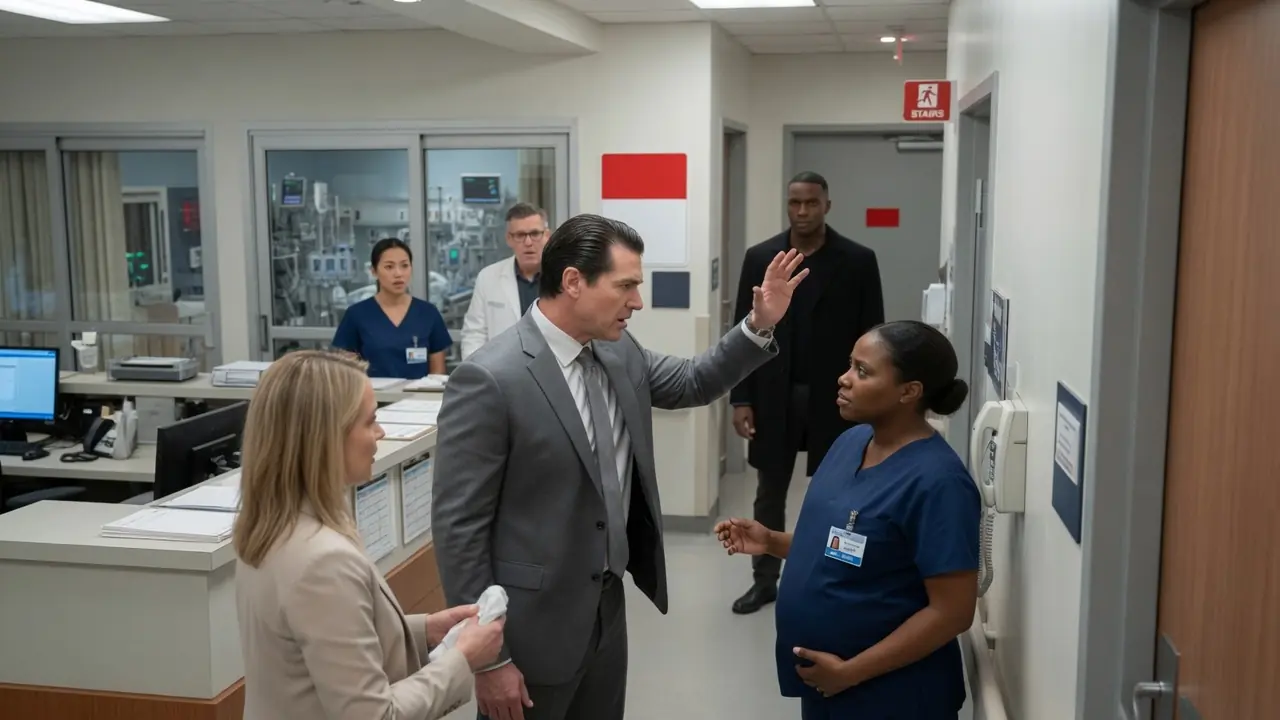
At 2:14 p.m., the double doors at the end of the ICU hallway slammed open. Every head turned. A tall man in a steel-gray designer suit strode in like he owned the building, followed by a nervous assistant holding a white cloth around a small cut on his hand. The man was Bryce Fontaine, a billionaire tech founder, hospital donor, and the kind of person who had mistaken wealth for permission so many times that he no longer noticed the difference.
“I need a doctor,” Bryce snapped. “Now. Not a resident, not a student, not someone guessing their way through medical school.” His voice cut through the corridor hard enough to make Priya, the young nurse at the station, freeze with a pen in her hand. Dr. Trevor Hill stepped forward, trying to keep his tone professional. “Sir, this is the ICU. The emergency department is two floors down, and your assistant’s injury appears minor.”
Bryce looked at Trevor as if the young doctor had spoken in another language. “I did not ask for directions,” he said. “I asked for care.” He pushed past Trevor’s outstretched hand and started down the restricted corridor toward rooms filled with patients who could not simply be moved because a rich man disliked waiting. Nadia stepped into his path before anyone else found the courage to do it.
She did not rush. She did not shout. She simply placed herself between Bryce and the patient rooms, shoulders squared, badge visible, expression calm. “Sir, you cannot enter this hallway,” she said. “These are critical-care rooms, and your assistant needs to be evaluated in the emergency department.”
Bryce stopped so close that Nadia could see the faint shine on his expensive shoes. His eyes moved from her face to her badge, then briefly to her pregnant belly, and something ugly passed across his expression. “Do you know who I am?” he asked. “I donated four million dollars to this hospital.”
Nadia held his gaze. “That may be true,” she said. “But you are still not coming through this hallway.” Behind Bryce, his assistant looked like he wished he could disappear through the floor. Behind Nadia, Priya’s hand moved toward the phone and stopped, waiting to see whether security needed to be called.
Bryce gave a short, cold laugh. “You are a nurse.” He said the word like it was a stain. “You do not decide where I go.” Nadia’s voice remained steady. “On this floor, I help protect patients who cannot protect themselves. That includes keeping you out of rooms where you do not belong.”
The hallway drew tighter around them. Dr. Trevor looked at the security guard near the elevator, but the guard did not move. The hospital had a donor wall near the lobby, and Bryce Fontaine’s name was carved into it in letters large enough to make some employees forget their own authority. Nadia had seen that happen before.
Bryce reached into his jacket and pulled out a leather card holder. He flipped it open and held it toward Trevor. “Write a number,” he said. “Move one of these patients to another floor. I do not care which one. I need a bed, and I am done explaining myself.”
Trevor’s mouth opened, but no sound came out. Nadia spoke before silence became permission. “Put that away,” she said. “Money does not decide which patients are stable enough to move. The man in room four had heart surgery this morning, and the woman in room six cannot breathe without support. Neither of them is losing a bed for a hand cut.”
Bryce turned back to her slowly. His face had gone pale with anger, but his voice lowered, which made it worse. “You think you can embarrass me in front of staff?” he asked. “I will have your badge pulled before your shift ends.”
“That is your choice to try,” Nadia answered. “My choice is to call security if you take one more step.” She reached toward the wall phone without looking away from him. The movement was small, but it changed everything.
Bryce stepped in front of her hand. His jaw tightened, and his right arm rose sharply between them, palm open, suspended in the air inches from her face. The entire hallway froze. It was not a completed strike, not a touch, not an impact, but the threat of it hung so clearly in the white hospital light that nobody could pretend they did not understand.
Nadia did not step back. Her left hand moved to her belly, steady and protective, while her right hand stayed lifted near the phone. Her face showed fear only for a second, and then something stronger replaced it. “Lower your hand,” she said. “This is a hospital.”
Bryce’s assistant whispered, “Mr. Fontaine, please.” Priya stood near the nurses’ station with both hands over her mouth. Dr. Trevor was pressed back against the wall, stunned and ashamed, while the security guard finally lifted his radio but still had not found the courage to speak. Every person in that hallway knew they were watching a man cross a line even before contact happened.
Near the exit stairwell, a tall man in a black coat stood completely still. He had arrived minutes earlier, quietly, without announcement, and nobody had noticed him because all attention belonged to Bryce. His name was Kai Moro, and he had come to the hospital to drop off legal documents Nadia had forgotten at home. He had not planned to interfere.
He saw Bryce’s raised hand. He saw Nadia’s hand move to her belly. He saw the staff freeze, not because they did not know right from wrong, but because Bryce Fontaine’s money had filled the hallway before his body did. Kai’s face did not change, but something in his eyes went colder than the polished floor beneath his shoes.
“That hand goes any closer,” Kai said from the stairwell, calm and low, “and your money will not be enough to save your reputation.” The words did not boom. They did not need to. They moved through the hallway with the quiet weight of someone who did not speak unless every word had already been decided.
Bryce turned his head, annoyed more than frightened at first. “Who are you?” he demanded. Kai stepped into the open light. The small wolf-eye tattoo on the side of his neck became visible as he moved. Nadia’s eyes flicked toward him, and for one painful second, her calm almost broke.
“Kai,” she said softly. It was not a call for help. It was a warning, a plea, and an old promise all at once. Kai understood every layer of it.
He stopped several feet away, hands visible, voice controlled. “Lower your hand, Mr. Fontaine.” Bryce looked from Kai to Nadia. “This is ridiculous,” he snapped, but the confidence in his voice had cracked. He dropped his hand slowly, not because he suddenly respected Nadia, but because the hallway had shifted against him.
Nadia reached the wall phone and called security herself. Her voice was professional as she reported an attempted assault threat, donor interference, and unauthorized entry into a restricted ICU area. Bryce barked that she was exaggerating. Kai watched him without blinking.
Dr. Holt, the chief of medicine, arrived three minutes later with two administrators behind him. He took in the scene quickly: Bryce angry, Nadia standing firm, staff shaken, Kai near the stairwell, and security gathering uncertainly by the elevator. For a moment, Nadia saw the old hospital calculation cross Holt’s face. Donor first, nurse later.
“Mr. Fontaine,” Holt began smoothly, “I am sure this has been a misunderstanding.” Nadia’s jaw tightened. Kai finally looked away from Bryce and toward the chief of medicine. That look stopped Holt mid-sentence.
“No,” Kai said. “It was recorded.” He lifted his phone. “From the moment Mr. Fontaine entered the hallway.” The silence changed again, this time from fear to exposure. Priya took a breath as if someone had opened a window.
Bryce’s expression hardened. “You have no right to record me.” Kai’s voice remained flat. “In a public hospital corridor where my pregnant sister was threatened? I will let the attorneys discuss that.” The word sister landed like a dropped instrument tray. Everyone turned toward Nadia, then back toward Bryce.
Nadia closed her eyes for one brief moment. She had spent years keeping Kai separate from her work, separate from the life she built carefully and honestly. Now the two worlds stood in the same hallway, and she could feel the weight of every gaze. But for the first time that afternoon, she did not feel alone.
Dr. Holt cleared his throat. “Nadia, perhaps you should step into my office while we review this.” Kai’s head turned slowly. “She is not being removed from the floor like the problem is hers.” Holt looked offended, but he did not argue immediately. Bryce did.
“I want her fired,” Bryce said. “I want her badge pulled today.” Nadia faced him fully. “And I want you escorted to the emergency department like every other visitor with a minor injury. If you refuse care there, that is your choice.”
Bryce stared at her as if he could not believe she was still speaking. “You will regret this,” he said. Nadia’s voice lowered, not with fear, but exhaustion. “No, Mr. Fontaine. I think this is the first correct thing that has happened since you walked in.”
Security finally moved. Two guards stepped beside Bryce and guided him toward the elevator. He did not resist, but he kept talking, threatening lawsuits, donors, board members, careers, and reputations. The threats echoed down the hall until the elevator doors closed on him. When the doors shut, the whole ICU seemed to breathe again.
Priya walked to Nadia first. “Are you okay?” she asked. Nadia nodded automatically, then stopped because lying took too much strength. “I need to sit down,” she said. Kai moved instantly, but she held up one hand. “Not here. Not like that.”
He stopped. The old promise still mattered. He would not take over her life just because danger had touched it.
Dr. Trevor brought a chair. Priya brought water. Another nurse checked Nadia’s pulse and asked if she had any pain. Nadia answered carefully, one hand still resting near her belly while the baby shifted beneath her palm like a small reminder that she had something stronger than fear inside her.
Kai stood a few feet away, silent. He wanted to do a hundred things, and Nadia knew it. She could see restraint in every line of his body. That restraint, more than any threat he could make, reminded her that he loved her enough to wait for her permission.
Dr. Holt tried again. “We will review the incident internally.” Kai looked at him. “No. It will be reviewed externally.” Holt’s face tightened. “Hospital procedure—” “Failed when your staff froze because a donor was angry,” Kai interrupted. “Procedure needs witnesses, footage, and accountability.”
Nadia looked up. “Kai.” He stopped immediately. Her voice softened but stayed firm. “Let me handle my part.”
He nodded once. “Then I will handle mine.” That answer was not defiance. It was partnership. She could hear the difference.
By evening, the hospital board had received the footage. By midnight, every administrator who had tried to minimize the threat had been contacted by legal counsel. By morning, Bryce Fontaine’s public relations team was already trying to bury the story, but they discovered that money could slow truth only when everyone involved wanted to be bought. Nadia did not.
She gave her statement in a conference room with her attorney present, Kai outside the door, and Priya sitting beside her as a witness. She spoke clearly about the restricted hallway, the patient safety issue, the raised hand, the threats, and the staff’s hesitation. Her voice shook once when she described protecting her belly. Then it steadied again.
The attorney asked if she wanted to pursue a formal complaint. Nadia looked down at her badge on the table. For six years, that badge had represented the life she chose for herself. She thought of every patient whose room she had guarded, every family she had comforted, every long shift where she had kept moving because people needed her.
“Yes,” she said. “I do.” Kai did not smile when she told him afterward. He simply looked relieved in a way only she would recognize. “Good,” he said. “That is your voice.”
Bryce Fontaine’s version collapsed within forty-eight hours. At first, he claimed Nadia had been aggressive. Then the footage showed her standing still while he crowded her space. He claimed she blocked care. Then records showed his assistant’s injury had already been triaged as minor and redirected properly to the emergency department.
The hospital issued a public apology without using Nadia’s name at first. Kai’s attorneys rejected it within an hour. The second apology named her, acknowledged the attempted intimidation, praised her professionalism, and announced an independent review of donor influence in clinical areas. Nadia read it at home with tea cooling beside her and did not know whether to laugh or cry.
The hardest part was returning to work. Two days later, Nadia walked into the ICU with her badge clipped back onto her scrubs and her head held higher than she felt. Conversations stopped for a moment, then Priya began clapping. Trevor joined, then another nurse, then a respiratory therapist near room four. Soon the whole station was standing.
Nadia almost turned around. She was not used to being seen that openly. But Priya came forward and hugged her carefully. “You stood there when we didn’t,” Priya whispered. Nadia hugged her back. “Next time, we all stand sooner.”
That sentence became something of a quiet rule on the floor. Staff meetings changed. Security response changed. Donor access rules changed. The ICU hallway received a new sign that made the policy plain: clinical decisions are made by medical staff only. Nadia passed it every day and felt a small measure of peace.
Bryce tried to fight. He threatened lawsuits, public statements, and donation withdrawals. But the footage had stripped the situation clean. A billionaire had demanded special treatment, threatened a pregnant nurse, raised his hand in front of witnesses, and been stopped before the final disgrace could happen.
His board distanced itself. His companies issued careful statements. His name disappeared from two charity events and one hospital gala. For a man who had built power through image, image became the first thing to leave him.
Kai did less than people imagined and more than they would ever know. He did not storm buildings or shout threats. He connected Nadia with the best attorney, ensured the footage was preserved, and used legitimate pressure where institutions preferred silence. For Nadia’s sake, he kept everything clean.
One evening, after her shift ended, Nadia found him waiting outside the hospital under the covered entrance. He wore the same black coat, but his face was softer than it had been in the hallway. “You ate today?” he asked. Nadia stared at him, then laughed because of all the things he could have said, that was the most brotherly and the most familiar.
“Yes,” she said. “Priya watched me like a guard dog until I finished soup.” Kai nodded. “Good.” They stood together beneath the lights while rain tapped the pavement beyond the awning.
“You scared me,” Nadia said finally. Kai looked at her. “He scared me first.” She sighed. “I mean it. I do not want my life swallowed by yours.” His expression shifted, not wounded, but careful. “I know.”
“I need to be Nadia Osayi, ICU nurse,” she said. “Not Kai Moro’s sister who everyone is afraid to cross.” Kai looked through the rain toward the parking lot. “You are Nadia Osayi,” he said. “And you were that before I stepped into the hallway.”
She believed him because he had stopped when she told him to stop. That mattered more than anything. Power without restraint was Bryce Fontaine. Power with restraint was Kai standing in a hospital hallway, waiting for her voice before using his own.
Months later, Nadia’s daughter was born in the same hospital. The room was quiet, filled with flowers, soft blankets, and the tiny breath of a newborn sleeping against her chest. Priya visited with a pink knit cap. Dr. Trevor cried and pretended he had allergies. Kai stood near the door with his hands folded, looking at his niece like she was the first gentle thing the world had ever made.
Nadia looked at him and smiled tiredly. “You can come closer,” she said. Kai approached the bed as if it were holy ground. He looked down at the baby, and all the coldness that had lived in his face during the Bryce incident disappeared. “She is small,” he said.
“She is new,” Nadia corrected. He nodded solemnly, accepting the distinction. The baby stretched one tiny hand, and Kai looked startled when her fingers brushed his. Nadia laughed, real and soft.
Outside the room, the ICU hallway continued as it always had. Monitors beeped, nurses moved quickly, families waited, and life balanced itself between fear and hope. But something had changed. The quietest people in that hallway had learned that silence could protect the wrong person if courage arrived too late.
Nadia still worked the ICU after maternity leave. She still wore navy scrubs, still tied her hair back, still carried herself with calm strength. But now, when wealthy visitors raised their voices or tried to turn money into access, staff stood sooner. Security moved faster. Administrators remembered that donor names did not outrank patient safety.
As for Bryce Fontaine, his reputation never fully recovered. His companies survived without him, which may have been the final insult. The hospital removed his framed donor photo during renovations and replaced it with a wall honoring clinical staff. Nadia pretended not to notice her name among them, but Priya caught her looking once and smiled.
Nadia did not celebrate Bryce’s fall. She had never wanted revenge. She had wanted safety, dignity, and the right to do her job without being threatened by a man who thought money turned people into doors he could kick open. The world called that strength, but to Nadia it was simpler.
She had stood where she was supposed to stand.
She had refused to move.
And when Bryce Fontaine raised his hand, he did not understand the truth waiting in that bright ICU hallway.
Nadia Osayi was not alone, not weak, and not for sale.
And the brother watching from the stairwell was only one part of the power she already carried within herself.