The city was barely awake when Ronda Rousey pulled into the upper parking deck at Los Angeles International Airport.
Morning haze clung to the skyline, blurring the buildings beyond the freeway. The clock on her dashboard read 6:12 a.m., and every minute seemed to disappear faster than the last.
Traffic on the interstate had been nearly motionless. A river of brake lights stretched for miles while drivers leaned on their horns as though noise could somehow move the cars ahead of them.
Now the parking structure felt just as heavy.
Exhaust lingered beneath the concrete ceiling. Tires squealed around corners. Travelers hurried toward the elevators, dragging suitcases behind them.
Ronda cut the engine, pulled her duffel bag from the passenger seat, and began walking toward the terminal.
She did not run.
Years of martial arts training had taught her that panic wasted energy. Even when time was against her, she moved with purpose rather than fear.
Inside, the terminal carried the restless hum of early travel.
Boarding announcements echoed through the wide glass hall. Gate changes flashed across overhead screens. The wheels of hundreds of suitcases clicked against the polished floor.
A child cried near the ticket counters.
A businessman shouted into his phone.
Somewhere nearby, the bitter smell of airport coffee mixed with disinfectant and perfume.
Ronda adjusted her jacket and approached a check-in kiosk. Her identification was already in her hand.
She was flying to New York for a veterans’ charity event. The work mattered to her far more than the cameras and reporters that would probably be waiting when she arrived.
The kiosk refused to scan her passport.
She tried again.
Nothing.
Ronda closed her eyes briefly and forced herself to remain patient.
A young airline attendant approached.
“Let me help you.”
The woman entered the confirmation code manually. As soon as she looked at the passenger information, her eyes widened.
“Oh my God,” she whispered. “You’re Ronda Rousey.”
Ronda gave her a tired but genuine smile.
“That’s what the passport says.”
“I watched all your fights. You were incredible.”
“Thank you.”
The boarding pass printed with a soft mechanical click.
Ronda slipped it into her jacket.
“I’m just trying to get to New York in one piece today.”
The attendant laughed nervously.
“You should be all set.”
One obstacle was gone.
Then Ronda saw the security line.
It twisted across the terminal in a slow-moving maze of bodies. Travelers removed belts and shoes while officers shouted instructions nobody seemed able to follow correctly.
The overhead clock read 6:26.
Her flight would begin boarding in fifty minutes.
Ronda joined the line.
She kept her breathing steady and resisted looking at the clock again. Losing her temper would not make the line move faster. It would only make people stare.
Two men several places ahead turned toward her.
The taller one nudged his friend.
“Isn’t that Ronda Rousey?”
The second man glanced over his shoulder.
“Didn’t think she still did anything.”
They laughed.
“Guess she flies coach like everybody else.”
Ronda heard every word.
Her jaw tightened, but she did not respond.
She had learned years earlier that silence often said more than confrontation. People who wanted a reaction became frustrated when they did not receive one.
The line moved forward.
When she reached the conveyor belt, Ronda removed her shoes and jacket. She placed her duffel bag, phone, and other belongings into a plastic tray.
Her movements were efficient and familiar.
She stepped through the metal detector.
A sharp tone sounded.
A red light appeared.
The officer watching the monitor raised his head.
He was broad-shouldered, with a neatly trimmed beard and a name tag that read R. KENNER. His expression carried a strange mixture of boredom and superiority.
“Ma’am, step aside.”
Ronda frowned.
“Is there a problem?”
“Metal-detection alert.”
He looked her up and down.
“Could be jewelry. Could be an underwire in your…”
He paused, allowing his gaze to drift downward.
“Garments.”
Ronda noticed the deliberate hesitation.
“I’m not wearing any metal.”
“Then this should be quick.”
Kenner gestured toward a glass partition.
Behind her, the line slowed. Travelers turned their heads to watch.
Several people recognized her.
Whispers spread.
“The UFC woman got stopped.”
“I wonder what she has.”
Ronda exhaled through her nose and stepped where Kenner directed.
He passed a handheld scanner along her arms, shoulders, waist, and legs.
The device remained silent.
He ran it over her again.
Nothing.
Kenner looked at the screen as though he had expected a different result.
“Unusual.”
“It was a false alarm,” Ronda said. “Can I go?”
“Might be a calibration issue.”
He lifted his radio.
“Control, we have a code-six discrepancy at Lane Four. Requesting authorization for secondary screening.”
Ronda folded her arms.
“That isn’t necessary.”
“Regulations, ma’am.”
His tone had become colder.
“You’ll need to come with me.”
A younger security officer standing nearby glanced toward the scanner.
“Sir, it was probably just a false—”
Kenner cut him off with a look.
The younger man fell silent.
Kenner returned his attention to Ronda.
“This will only take a moment. You can cooperate here, or we can make it official.”
The phrase was carefully chosen.
Make it official.
It did not sound like a security procedure. It sounded like a threat.
Ronda had dealt with men like him before.
Men who hid insecurity behind authority.
Men who enjoyed small acts of humiliation because the uniform protected them from consequences.
She considered demanding a supervisor.
But her flight was boarding soon, and escalating the argument could delay her for hours.
Ronda unclenched her jaw.
“Lead the way.”
Kenner smiled.
“This way, Miss Rousey.”
The way he said her name carried no admiration.
It sounded as though he were pleased to have control over someone other people considered powerful.
They passed through a door marked AUTHORIZED PERSONNEL ONLY.
The noise of the terminal faded behind them.
A sterile hallway stretched ahead beneath flickering fluorescent lights. Their footsteps echoed against gray walls.
Kenner led her into a small waiting area containing plastic chairs and a table stacked with forms.
Another officer stood near the doorway.
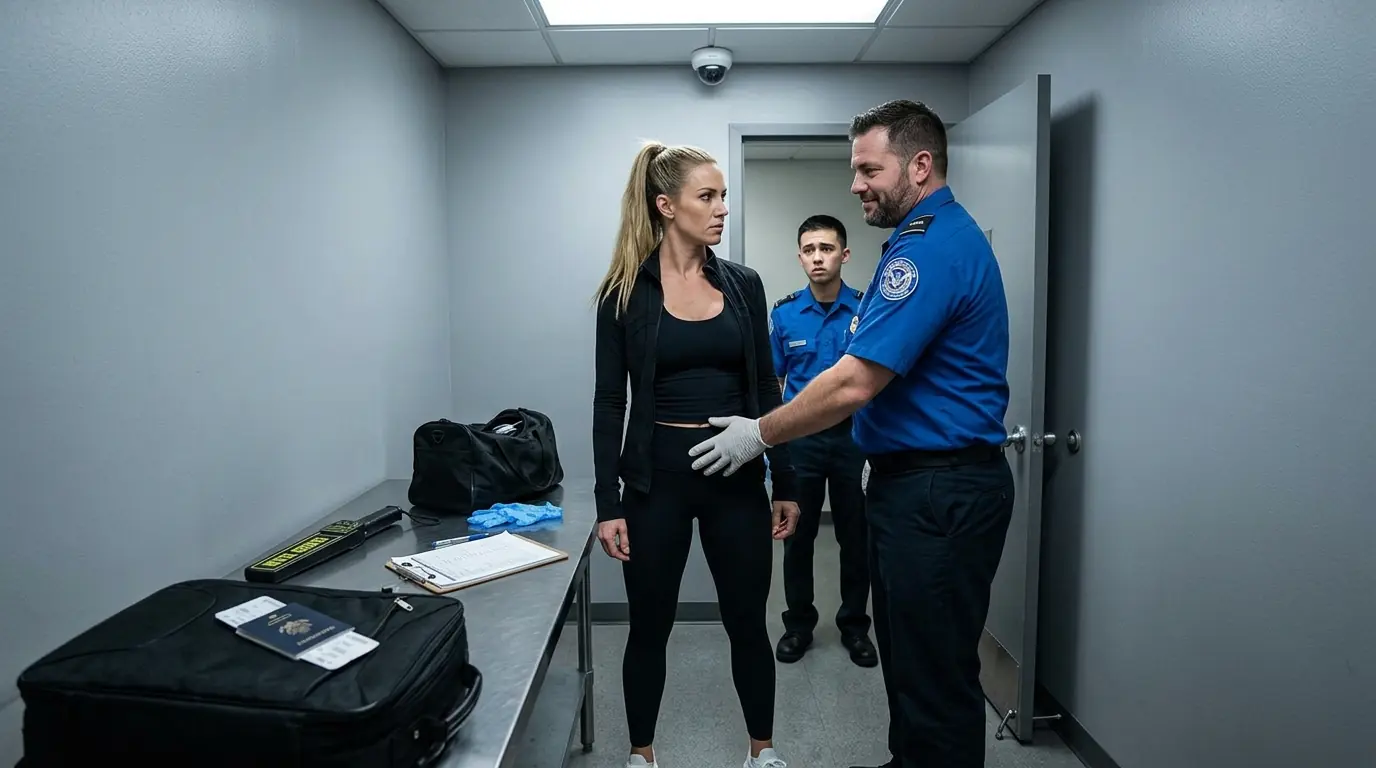
He appeared uncomfortable before either of them spoke.
Kenner waved him away.
“I’ll handle this one.”
Ronda stopped.
“You said this would be quick.”
“It will be.”
He opened another door.
“I just need to follow the full procedure.”
She looked at him for several seconds.
“Fine. Let’s finish it.”
“Of course.”
His voice had become almost intimate.
Ronda entered the inspection room.
The door closed behind her with a soft click.
The room was colder than the hallway. Stainless-steel surfaces reflected the fluorescent light. A single plastic chair stood beside an inspection table.
Kenner reached for a box of gloves.
The latex snapped against his wrists.
Ronda watched him carefully.
Something inside her had begun to sharpen.
This was no longer about a defective metal detector.
It was about power.
And Kenner wanted her to understand that he believed all of it belonged to him.
“This will only take a minute,” he said. “Standard procedure for scanner anomalies.”
“I travel constantly. This has never happened before.”
Kenner smiled faintly.
“Maybe today is special.”
Ronda did not answer.
She was trying to prevent the situation from escalating.
Her flight was boarding in less than forty minutes. If she caused a public confrontation, clips would be online before she reached the gate.
The headlines would not discuss misconduct.
They would say Ronda Rousey lost her temper again.
She had spent years trying to escape that image.
She reminded herself that she was no longer the angry young fighter people expected to explode when provoked.
Kenner stepped closer.
“Raise your arms.”
Ronda obeyed.
He moved the handheld scanner slowly along her sides and torso.
No alert sounded.
He frowned and inspected the device.
“Sometimes these miss small objects.”
“You already scanned me twice.”
“I’ll need to perform a physical check.”
Ronda stared at him.
“You need to call a female officer.”
Kenner gave a soft chuckle.
“All the female screeners are occupied.”
“Then I’ll wait.”
“I’m qualified to conduct the inspection.”
His eyes remained on her.
“Don’t worry. I’ll be professional.”
The words were contradicted by his expression.
Ronda kept her arms raised.
“Then keep it professional.”
“Always.”
Kenner began the pat-down.
His hands moved along her arms and sides.
At first, his actions stayed close enough to procedure that she could not openly accuse him of anything.
Then his fingers lingered along her ribs.
He leaned closer.
“You keep yourself in good shape.”
Ronda stepped back.
“I think we’re done.”
Kenner straightened.
“Not quite.”
“There was no alert from the handheld scanner.”
“The original screen still showed one.”
“I saw the monitor. The alert cleared.”
He ignored her.
“It might be something near the belt line. I’ll need to confirm manually.”
Ronda’s pulse struck once, hard.
“Call a female officer.”
“I already told you, none are available.”
“You are about to cross a line you cannot walk back from.”
The younger officer remained in the doorway.
“Sir, maybe we should wait for—”
Kenner turned sharply.
“I said I have it.”
The young man froze.
Ronda could feel the room changing.
Her body automatically began calculating distance, balance, and leverage.
She did not want the encounter to become physical.
Kenner wanted exactly that.
He was stripping away control one small piece at a time, waiting for her to react so he could claim she was the danger.
He stepped forward again.
His gloved hand moved slowly along her hip, lingering where no legitimate inspection required it to remain.
“You never know what people are hiding,” he murmured.
Ronda caught his wrist.
The movement was fast but controlled.
She applied only enough pressure to stop him.
Kenner’s smirk vanished.
For one second, shock appeared on his face.
Then anger replaced it.
“Remove your hand,” Ronda said.
“You are interfering with a federal inspection.”
“I said remove your hand from me.”
He yanked his wrist free.
“You are becoming uncooperative, Miss Rousey.”
“You are abusing your authority.”
“I can escalate this.”
“You already have.”
The room became silent except for the fluorescent hum.
Kenner lifted his radio again.
“We’re moving to private extended screening.”
Ronda looked around.
“This is already a private screening room.”
“The next one is more thorough.”
The younger officer’s face became pale.
Kenner opened the door.
“Please follow me.”
Ronda studied him.
She could refuse.
She could demand help.
But she wanted witnesses, cameras, and a clear record of every step he took.
She followed him into another corridor.
As they walked, she noted every doorway and surveillance camera. One overhead camera showed no operating light.
They reached a narrow metal door controlled by a keypad.
Kenner entered a code.
The room beyond was smaller.
No windows.
No visible working camera.
Only gray walls, a metal table, and a plastic chair.
Ronda stopped at the threshold.
“You are going too far.”
Kenner turned.
“I’m doing my job.”
“No. You’re enjoying it.”
He tilted his head.
“You think too highly of yourself.”
“You’re about to find out exactly what I think.”
Kenner’s smile weakened.
He gestured toward the table.
“Put your bag down.”
Ronda did not move.
Her bag was still at the original checkpoint.
Kenner realized his mistake and covered it with another smirk.
“Relax. Nobody is trying to hurt you.”
“I know.”
Her voice was soft.
“Because I wouldn’t allow it.”
For the first time, uncertainty flickered in his eyes.
Kenner closed the door.
He leaned against the table.
“I used to watch your fights.”
Ronda remained silent.
“You had anger back then. Fire.”
He studied her.
“Everybody loved watching it.”
Ronda’s expression did not change.
“Shame to see it disappear.”
She glanced at the clock.
Twenty minutes until boarding.
Kenner continued.
“I always wondered what it would take to bring that side of you back.”
Ronda understood then that he was no longer pretending this was about security.
He wanted dominance.
Not protection.
Not procedure.
The same energy she had felt from opponents who entered the cage wanting to hurt someone simply to prove that they could.
The difference was that the cage had rules.
This room did not.
“Do your inspection,” she said.
Kenner stepped closer.
“Don’t worry. I know what I’m doing.”
“So do I.”
He snapped on another pair of gloves.
Then he began asking unnecessary questions from a blank form.
“Destination?”
“New York.”
“Purpose?”
“Charity work.”
“Occupation?”
“You already know.”
He looked up.
“Remind me.”
“Retired professional fighter.”
His mouth curved.
“Right. The tough one.”
He placed the clipboard on the table.
“Let’s see how tough you are without cameras.”
Ronda’s body became still.
Kenner moved behind her with the scanner.
It remained silent.
He ran it over her a second time.
Nothing.
“Turn around,” he ordered.
“No.”
The single word hung in the room.
Kenner’s politeness vanished.
“You do not make the rules here.”
He reached for her shoulder.
Ronda caught his wrist before he touched her.
The movement was effortless.
“I said don’t touch me.”
“Let go.”
“You’ve had every opportunity to stop.”
Kenner tried to pull free.
Ronda tightened her grip slightly.
Pain moved across his face.
“You’re assaulting a federal officer.”
“No.”
She looked directly into his eyes.
“You assaulted me.”
Kenner lunged.
It was not a trained attack.
It was an angry attempt to regain control.
Ronda moved to the side, redirected his momentum, and turned his arm.
His body struck the edge of the metal table.
The clipboard fell.
Loose pages scattered across the floor.
Before he could recover, Ronda secured his arm and pressed his shoulder against the table.
She did not strike him.
She did not break anything.
She used only the force required to prevent another attack.
“Stay down.”
“Let me go!”
“Not until you understand what restraint means.”
Kenner tried to rise.
Ronda shifted her weight.
He stopped moving.
“You think you can do this and walk away?” he hissed. “You’re finished.”
“Maybe.”
Her breathing remained steady.
“But not today.”
The door opened.
The younger officer stood in the doorway.
His eyes widened.
Kenner was pinned against the table.
Ronda stood above him, calm and controlled.
“Call your supervisor,” she said.
The young officer hesitated.
“Now.”
He reached for his radio.
His voice shook as he requested assistance.
Footsteps began echoing through the hallway.
Ronda released Kenner and stepped back.
She raised both hands where they could be seen.
Kenner pushed himself upright and grabbed his wrist.
His face was red with humiliation.
“You’re going to regret this.”
“I doubt it.”
He stepped toward her.
Approaching footsteps made him stop.
Two officers entered with their hands near their weapons.
“She attacked me!” Kenner shouted. “She resisted screening and assaulted a federal officer.”
One officer looked toward Ronda.
“Is that true?”
“The corridor cameras will show how he brought me here.”
She pointed toward the dark camera above the door.
“The camera in this room appears not to work. Convenient, isn’t it?”
The officers looked up.
No operating light.
The younger officer swallowed.
“She asked for a female screener,” he said.
Kenner turned on him.
“Shut your mouth.”
“He refused to call one,” the young man continued. “The scanner did not detect anything, but he kept extending the search.”
“That’s enough,” one of the senior officers said. “Everyone out.”
Kenner continued glaring at Ronda.
She looked toward the nearest officer.
“My belongings are still at the checkpoint. You may search them again. I am not hiding anything.”
She paused.
“But I will not allow anyone to touch me like that again.”
The officer nodded.
“Understood.”
They escorted her into the corridor.
The terminal beyond seemed strangely bright after the locked gray room.
Travelers walked past without knowing what had happened only a few hundred feet away.
Children laughed.
A barista called out an order.
A family hurried toward a gate.
Life continued.
Behind Ronda, angry voices rose as officers questioned Kenner.
She did not look back.
A supervisor arrived several minutes later.
He was an older man with gray at his temples and the neutral expression of someone accustomed to administrative crises.
“Miss Rousey, please wait in the observation area while we review the incident.”
“Fine.”
She sat near the corridor.
Through the glass panel, she saw Kenner gesturing wildly while explaining himself.
The younger officer stood near the wall.
At first, he appeared uncertain.
Then the supervisor asked another question.
The young man began speaking.
He described the original false alarm.
The clear handheld scan.
Ronda’s request for a female screener.
Kenner’s refusal.
The unnecessary physical contact.
The move into a room without a working camera.
Each statement removed another layer of protection from Kenner’s story.
Ronda watched without satisfaction.
She did not need revenge.
She needed the truth recorded accurately.
The supervisor emerged ten minutes later.
“We need a brief statement.”
“And Kenner?”
“That is being handled internally.”
“Review every camera you have.”
“We will.”
A female officer escorted Ronda into an office and began typing her account.
Ronda spoke plainly.
She did not exaggerate.
She described every instruction, each warning, and the exact moment Kenner attempted to force her around.
She explained that she used only enough physical control to stop him.
When the statement was complete, she signed it.
“I want a copy.”
“Of course.”
The officer printed one.
“You are cleared to board. We are very sorry.”
Ronda accepted the document.
“Do not apologize to me.”
She looked toward the screening area.
“Make sure it doesn’t happen to someone else.”
Back inside the terminal, everything remained painfully ordinary.
Coffee.
Perfume.
Rolling luggage.
Announcements.
A mother knelt to adjust her daughter’s backpack.
A businessman argued about a missed connection.
None of them knew how quickly a routine inspection had become an abuse of power.
At the gate, the monitor showed that boarding had begun.
Ronda joined the line.
The gate agent recognized her immediately.
“Oh my God. You’re—”
“I’m just a passenger.”
The woman blinked.
“Right. Of course.”
She scanned the boarding pass.
“Have a good flight.”
Ronda entered the jet bridge.
Before she reached the aircraft door, someone called her name.
“Miss Rousey!”
The security supervisor hurried toward her.
He held a small envelope.
“We found your phone in the inspection area.”
Ronda took it.
“Thank you.”
He hesitated.
“For what it’s worth, you did the right thing.”
She met his eyes.
“Then make sure your system does too.”
He nodded.
Ronda boarded the plane and found her seat beside the window.
The aircraft smelled of recycled air and citrus disinfectant. Passengers placed bags into overhead compartments while flight attendants repeated instructions.
Ronda looked toward the runway.
The sun had begun rising above the terminal.
For the first time since entering security, she allowed herself to feel the exhaustion beneath her control.
The snapping gloves.
Kenner’s voice.
His hand remaining where it did not belong.
The metallic sound of his body striking the table.
She had handled the situation.
But another thought stayed with her.
Someone else might not have been able to.
Someone without training.
Someone afraid of authority.
Someone who would remain silent because the person abusing them wore a uniform and used the word procedure.
The flight attendant offered water.
Ronda accepted it.
“Thank you.”
The plane began taxiing.
Through the window, she saw several officers near the security wing.
Their radios moved.
Their postures were tense.
The investigation had already begun.
When the aircraft lifted from the runway, Los Angeles fell away beneath the clouds.
Ronda rested her head against the seat.
She had protected herself.
For that moment, it was enough.
By the time the plane reached New York, the story was already spreading.
As soon as her phone connected to the network, notifications flooded the screen.
Missed calls.
Messages from her manager.
Social-media alerts.
News headlines.
RONDA ROUSEY INVOLVED IN AIRPORT ALTERCATION
FORMER UFC CHAMPION ACCUSED OF ATTACKING SECURITY OFFICER
LAX SCREENING INCIDENT UNDER INVESTIGATION
Some reports described a misunderstanding.
Others claimed she lost control.
Most had almost no verified information.
Her name had once again become attached to violence.
Ronda locked the screen.
Near baggage claim, a uniformed airport-security representative approached.
“Ms. Rousey, do you have a moment?”
“If this concerns Los Angeles, I already submitted a statement.”
“The Department of Transportation’s internal-affairs division would like to verify your contact details.”
Ronda gave the information.
“Anything else?”
The woman hesitated.
“For what it’s worth, I’m sorry.”
“Make sure it doesn’t happen again.”
Ronda picked up her bag.
“That is apology enough.”
Outside, New York was loud and bright.
A car from the veterans’ charity waited near the curb.
The driver opened the rear door.
“Ms. Rousey. Pleasure to meet you. Heard you had a rough morning.”
She paused.
“Already?”
He smiled apologetically.
“News travels fast.”
Ronda entered without responding.
The city passed outside in flashing pieces—bridges, billboards, taxis, glass towers and crowds moving along sidewalks.
At the hotel, her phone rang again.
Unknown number.
She answered.
“Ms. Rousey, this is Captain Drew Walters with Airport Division Internal Affairs.”
“I have already filed a report.”
“Yes, ma’am. We have reviewed it. We also recovered corridor footage supporting your account.”
Ronda sat on the edge of the hotel bed.
“We need to clarify several details. Off the record, Officer Kenner has been suspended pending investigation.”
“Good.”
“There is something else. Your restraint is being noted in the official record. That will matter.”
“I did not show restraint for your report.”
Her voice remained calm.
“I did it because it was the right thing to do.”
There was a pause.
“Understood.”
After the call, Ronda sat alone.
The city hummed beyond the windows.
Her hands trembled slightly as she opened her bag.
It was not fear.
It was the physical aftermath of holding herself together for hours.
She showered and changed before attending the scheduled charity event.
The hall was already crowded when she arrived.
Cameras flashed.
Reporters whispered from the back of the room.
Ronda shook hands with volunteers and veterans. She smiled for photographs. Each polite gesture felt like armor.
Few journalists asked about the organization’s work.
They wanted the airport story.
One followed her after she stepped away from the stage.
“Ms. Rousey, can you comment on the incident at LAX?”
“No.”
“There are claims that you used excessive force.”
Ronda stopped.
She turned toward him.
“If defending myself from harassment is excessive, perhaps that is the problem you should report.”
The journalist lowered his pen.
Ronda walked away.
That night, her manager called.
“Social media is a disaster. Half the people are defending you. The other half are calling it assault.”
“Then half the people finally noticed what the other half has been ignoring.”
“Should I prepare a public statement?”
“No.”
“The news outlets are requesting one.”
“The truth doesn’t need me to decorate it.”
Her manager became quiet.
“Are you okay?”
“I’ve been worse.”
After ending the call, Ronda stood near the hotel window.
New York glittered below.
She imagined Kenner inside an interview room, repeating words such as procedure, security, and noncompliance.
She imagined the corridor footage playing.
The younger officer giving his statement.
The broken camera being examined.
It did not feel like victory.
It felt like justice attempting to move through bureaucracy one slow inch at a time.
The next morning, Ronda received an official email from the airport.
We extend our formal apology for the misconduct you experienced. Measures are being taken to ensure accountability and prevent recurrence.
She read it once.
Then deleted it.
By evening, the news cycle had already begun moving toward other stories.
Public outrage rarely remained in one place for long.
But something inside Ronda had changed.
For years, she had carried a quiet guilt about being strong.
People had often treated her ability to defend herself as evidence that she could not be hurt.
If she reacted, she was aggressive.
If she remained silent, they assumed nothing happened.
In the airport room, she had refused both versions.
She protected herself without surrendering control.
When she looked into the mirror that night, she did not see the angry fighter the headlines wanted to resurrect.
She saw a woman who refused to surrender her dignity simply because someone in authority expected obedience.
Two days later, Captain Walters called again.
“The investigation is complete.”
Ronda stood beside the hotel window with a cup of coffee.
“And?”
“Officer Kenner has been terminated. There will also be disciplinary hearings concerning supervisory failures.”
She said nothing.
“The report concludes that you acted in lawful self-defense after repeated misconduct and provocation. The footage and witness testimony support your statement.”
“I see.”
“We will issue a public announcement today.”
Walters paused.
“I believed you deserved to hear it before the media.”
“Thank you.”
“Your actions are being described as restraint under pressure.”
“I was not trying to be remarkable.”
“What were you trying to be?”
“Right.”
The silence that followed the call felt different.
Clean.
Not exactly closure.
But balance.
Later that day, Ronda attended the veterans’ charity event.
Families and volunteers filled the hall. Children sat in the front rows. Many of them had no idea what she had endured during the previous days.
They had come to hear her speak about perseverance.
For once, her words did not feel rehearsed.
Ronda stepped toward the microphone.
“Sometimes strength is not about what you can do in a fight.”
The room became quiet.
“Sometimes it is about what you refuse to let another person take from you.”
She looked across the audience.
“Dignity is not something authority gives you. It is something you guard every day, no matter who tries to convince you that you do not deserve it.”
The applause that followed was not wild or theatrical.
It was steady.
Real.
After the event, Ronda left the building alone.
The afternoon air was cold.
New York moved around her—horns, sirens, laughter, footsteps, conversations spilling from restaurants.
She walked without direction until she reached Central Park.
Bare trees stretched against the gray sky.
Ronda sat on a bench near the lake.
Years earlier, she had trained nearby while believing every important battle occurred in a ring.
She understood differently now.
Some of the hardest fights happened in quiet rooms without witnesses, where the person hurting you was protected by a badge, a title, or the expectation that you would remain polite.
A familiar voice interrupted her thoughts.
“Didn’t expect to find you here.”
Ronda looked up.
Derek, an old friend from her training years, stood nearby carrying two coffees. He now worked in law enforcement.
He offered one.
“Heard what happened.”
Ronda accepted it.
“I’m fine.”
Derek sat beside her.
“That word is doing a lot of work.”
They watched joggers pass.
After a while, Derek spoke again.
“You could have made this much louder.”
“It was already loud.”
“You could sue. Hold a press conference. Tell everyone exactly what happened.”
Ronda stared toward the water.
“I don’t want revenge.”
“What do you want?”
“I want it to stop.”
Derek nodded.
“You made it stop for this officer.”
“I hope the system stops the next one before someone has to pin him against a table.”
They spoke about training, the city, and the strange experience of being treated like a symbol instead of a human being.
When Derek left, daylight had begun fading.
Ronda remained on the bench.
Her thoughts returned to the people inside the airport.
Kenner, whose arrogance ended his career.
The young officer who found the courage to speak.
The supervisor who chose evidence over loyalty.
Each one had made a decision.
Those decisions had determined whether the truth remained trapped inside the locked room.
Ronda stood and began walking.
City lights flickered on one by one.
Somewhere, another person was being underestimated.
Somewhere, someone with authority was testing how much humiliation another human being would tolerate.
Somewhere, another line was being crossed in silence.
Ronda slipped her hands into her coat pockets.
She was no longer angry.
She was awake.
Aware.
Unshaken.
Back in the hotel room, she placed her phone facedown on the desk and opened the window.
Cold air moved inside.
The city stretched below her in a grid of white and red lights.
For years, the world had insisted on seeing her as the fighter.
The champion.
The angry woman.
The headline.
But none of those descriptions explained what happened inside the airport room.
She had not won because she was famous.
She had not won because she could overpower Kenner.
She had won because she recognized the moment procedure became violation and refused to let his authority erase her right to protect herself.
The fighter had never truly disappeared.
She had simply learned that real discipline was not the absence of power.
It was knowing exactly when to use it.
Ronda leaned against the window frame and looked over the city.
For the first time in years, she did not feel like a public figure being watched.
She felt like herself.
Not the fighter.
Not the controversy.
Not someone else’s story.
Just Ronda.
And after everything that happened inside that locked airport room, reclaiming that simple truth felt like the greatest victory of all.