The general stopped three feet in front of the handcuffed woman and raised his right hand.
His salute was sharp.
Formal.
Unmistakable.
For several seconds, nobody inside the Los Angeles international terminal moved.
Travelers stood beneath departure screens with phones still raised. Airport employees stared from behind their counters. Tactical officers who had arrived expecting an armed threat now held their rifles pointed toward the floor.
At the center of them all stood Naomi Reed.
She wore a faded gray hoodie, worn jeans, and inexpensive shoes. A scuffed backpack hung from one shoulder. Her cheap suitcase rested several yards away with one damaged wheel turned sideways.
Red marks circled her wrists where the handcuffs had been tightened.
A bruise had begun forming along the back of her left leg.
Less than forty minutes earlier, a young police officer had kicked that leg from beneath her and driven her onto the terminal floor in front of hundreds of witnesses.
Now Lieutenant General Adrian Mercer stood before her as though she outranked every person in the building.
Naomi looked at him.
For one brief moment, something passed between them that no civilian in the terminal could understand.
Recognition.
Shared history.
And a warning that the years they had buried were now being dragged into public view.
Mercer lowered his hand.
“Remove the restraints.”
His voice was quiet.
The nearest officer fumbled for the key.
Officer Caleb Morrow stood several steps away.
His face had lost all color.
He had been the one to accuse Naomi of stealing a wallet.
The one who refused to review the terminal cameras.
The one who pushed her into a support pillar, kicked her leg, pressed a knee against her shoulder, and called her violent when she prevented him from swinging a baton toward her head.
Caleb looked from the general to Naomi.
Then toward the federal vehicles visible through the terminal windows.
Black SUVs blocked the emergency access lane. Plainclothes personnel stood at every approach. An airport tactical commander had just received an order from Washington that no weapon was to be pointed at Naomi under any circumstances.
Caleb’s lips moved.
No words came.
The cuffs opened.
Naomi brought her hands forward and rubbed one wrist slowly.
General Mercer’s expression hardened when he saw the marks.
“Are you injured?”
“I’ll be fine.”
“You were struck?”
Naomi glanced toward Caleb.
“Everything is on camera.”
Mercer looked around the terminal.
Dozens of passengers continued recording.
“Yes,” he said. “It appears to be.”
The airport security supervisor, Denise Harper, stood near the information desk with both hands folded tightly in front of her.
She had watched the encounter unfold from the beginning.
She had told Caleb to slow down.
Told him the woman was cooperating.
Told him to review the cameras.
He had ignored her.
Now Denise understood why Naomi’s stillness had disturbed her.
It had not been helplessness.
It had been restraint.
Caleb finally found his voice.
“She attacked me.”
Naomi turned toward him.
Her expression contained no anger.
That frightened him more than fury would have.
“You raised a baton while I was handcuffed.”
“I was controlling a suspect.”
“You were swinging a weapon.”
“I thought you stole the wallet.”
“You never searched for it.”
Caleb’s jaw tightened.
“I saw you near where it disappeared.”
“Being near an object is not evidence of touching it.”
General Mercer looked toward the airport operations director.
“Pull every camera covering this concourse.”
“They’re already being secured, General.”
“Display them.”
Within minutes, footage from six angles appeared on a large monitor above the information desk.
The terminal watched the truth play back.
A businessman rushing toward a departure gate bumped another traveler.
His wallet slipped from his coat pocket.
It slid across the floor and stopped beside a support pillar.
Naomi never looked at it.
She stood twenty feet away, reading a flight board.
Caleb noticed the wallet.
Then noticed Naomi.
He did not examine the floor between them.
He did not ask who had dropped it.
He simply began walking toward her.
The screen showed him entering her path.
Naomi stopping.
Caleb speaking first.
Her hands remaining visible.
The video had no sound from that camera, but several passenger recordings provided audio.
“My name is Naomi Reed,” she had said. “I did not touch anyone’s property.”
Caleb demanded her bag.
Naomi offered to open it.
Instead, he grabbed her upper arm.
The footage showed her body turning slightly with the force.
Then Caleb pushed her toward the pillar.
Several travelers moved closer.
Naomi repeated that she was not resisting.
Caleb swept his boot behind her leg.
Her knees struck the tile.
A gasp moved through the terminal again as people watched the recorded impact.
The next angle showed Caleb pressing his knee against her shoulder.
Naomi remained controlled.
The footage continued.
Caleb stood.
Reached for his baton.
Raised it.
Naomi moved.
Even in slow motion, the action was difficult to follow.
Her cuffed hands intercepted his wrist.
She rotated beneath the arm, redirected his balance, and brought him to the floor.
No strike.
No kick.
No retaliation.
She controlled his shoulder for less than three seconds.
Then released him, stepped backward, and raised her cuffed hands.
General Mercer watched without blinking.
When the footage ended, the terminal remained silent.
The businessman whose wallet had fallen pushed through the crowd.
“That’s mine.”
He pointed toward the pillar.
An airport employee retrieved it from the exact place where it had landed.
The wallet was unopened.
Every card remained inside.
The businessman looked toward Naomi.
“I’m sorry.”
“You didn’t accuse me.”
“No, but—”
“You dropped something in a crowded airport. That is all you did.”
Her answer offered him no convenient way to absorb guilt that did not belong to him.
The real responsibility stood several yards away in uniform.
Caleb looked toward his fellow officers.
None met his eyes.
The story that had brought a general into the terminal began nearly two hours earlier with a woman trying to disappear into ordinary life.
Naomi Reed arrived at Los Angeles International Airport before sunrise.
She moved through the international terminal pulling a suitcase whose rear wheel squeaked every third rotation.
The sound annoyed her.
She had considered replacing the suitcase before the flight but decided against it. The case still closed. The handle worked. Spending money to eliminate a harmless noise felt unnecessary.
Naomi had spent most of her life distinguishing inconvenience from danger.
At forty-one, she appeared younger from a distance and older when someone looked closely at her eyes.
She wore no makeup or jewelry.
The gray hoodie had been washed enough times to lose its original shape. Her jeans were faded at the knees, and the backpack over her shoulder had once been black but had softened to charcoal.
Nobody looking at her would have imagined that the federal government had once erased her name from official personnel records.
Naomi preferred it that way.
She was flying to Washington to begin a civilian security position inside an agency most people had heard of but few understood.
The job was quiet.
Risk assessments.
Facility inspections.
Emergency planning.
A badge that opened controlled doors without attracting cameras.
After fourteen years in classified special operations, ordinary employment felt like a form of freedom.
Naomi had entered embassies during active sieges.
Extracted intelligence officers from cities where their capture would have triggered diplomatic crises.
Protected heads of state whose own security services had been compromised.
She had operated in countries omitted from her service record and completed missions summarized in official documents with sentences no longer than the paragraph describing her travel expenses.
Her unit had no public name.
Within restricted circles, it was known as Raven Section.
Naomi’s operational designation had been Gray Raven.
The name embarrassed her now.
People who created code names often attempted to make fear sound poetic.
The reality had involved long nights, infected wounds, ruined relationships, and memories that arrived at two in the morning without invitation.
She left after a mission in Eastern Europe.
The operation succeeded.
Everyone under her protection survived.
Two members of her team did not.
Naomi carried their names privately because no monument ever would.
Afterward, a military therapist asked what she wanted from civilian life.
“Days that do not require a briefing,” Naomi said.
The therapist smiled sadly.
“You may find normal life difficult.”
“I have found every life difficult.”
Normal life did not remove the training.
Naomi still counted exits.
Noticed unattended bags.
Identified reflective surfaces that could reveal movement behind her.
Listened for footsteps that broke the rhythm of a crowd.
She selected seats with walls behind them and avoided standing beneath overhead glass.
These habits did not feel dramatic.
They existed beneath thought, like breathing.
That morning, she reached the security area with more than two hours before her flight.
A toddler cried near a coffee kiosk.
A man argued quietly into a telephone.
Travelers shifted between lines while announcements echoed overhead.
Naomi checked her boarding pass.
Business-class aisle seat.
The agency had purchased the ticket because she was expected to report for work within hours of landing.
The expensive seat did not match her clothes or suitcase.
Naomi noticed several travelers noticing that.
She ignored them.
Officer Caleb Morrow did not.
Caleb had worked airport policing for eighteen months.
He was twenty-six, ambitious, and deeply frustrated that his career had not advanced faster.
He had joined the department expecting excitement.
Most days involved lost luggage, intoxicated passengers, traffic disputes, unattended bags, and arguments over parking.
Caleb wanted an arrest people discussed during briefings.
He wanted supervisors to describe him as sharp.
Proactive.
Instinctive.
His training officer, Sergeant Laura Fields, used different words.
Impulsive.
Defensive.
Too eager to turn uncertainty into confrontation.
Twice, she had warned him that suspicion was the beginning of police work, not its conclusion.
Caleb believed Laura had become cautious with age.
He considered hesitation a weakness disguised as professionalism.
That morning, he had been assigned near the premium departure corridor.
He saw Naomi reading the business-class flight board.
Her clothes appeared inexpensive.
Her luggage looked damaged.
She traveled alone.
Caleb noticed her skin before consciously acknowledging anything else.
A Black woman carrying a worn suitcase near a premium gate did not fit the picture he expected.
He told himself the discomfort was professional instinct.
He began watching her.
Naomi noticed immediately.
She did not change direction.
A person altering behavior after noticing surveillance often attracted more attention.
Instead, she continued toward the departure screen.
Several yards away, businessman Philip Garner hurried through the crowd.
His boarding group had already been called.
He struck another traveler’s shoulder while checking his phone.
Neither man noticed the wallet fall from Philip’s coat.
The leather case slid across the tile.
Caleb saw it.
He also saw Naomi standing near the support pillar.
The connection existed only in his assumption.
But once formed, it felt complete.
He did not call to Philip.
Did not check whether Naomi had bent down.
Did not review the nearby camera monitor.
He approached her.
“Stop.”
Naomi turned.
“Can I help you?”
“Where is the wallet?”
“What wallet?”
Caleb interpreted the question as performance.
“The one you just picked up.”
“I did not pick up a wallet.”
“You were standing right there.”
Naomi looked toward the floor.
The pillar partly blocked her view of the billfold.
“I have been reading the departure board.”
“Open your bag.”
She studied him.
“Am I being detained?”
The question irritated him.
People who knew the language of rights often appeared guilty to officers already seeking confirmation.
“I said open the bag.”
Naomi lowered the backpack carefully.
“I will open it voluntarily. I want it clear that I am not consenting to an accusation. I am trying to resolve this quickly.”
Nearby travelers slowed.
Caleb heard the careful wording and felt challenged.
He grabbed her upper arm.
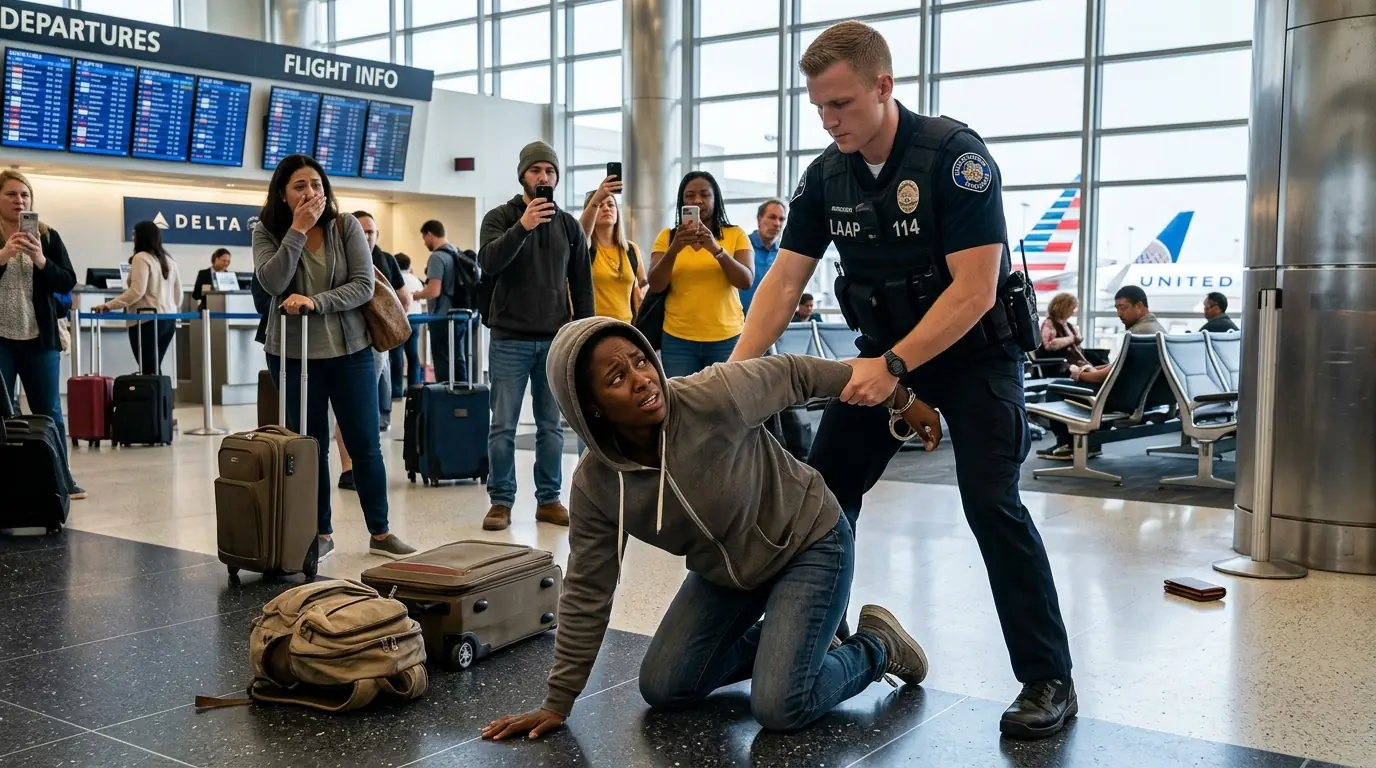
Naomi’s body tensed automatically.
Every part of her training demanded that she break the grip, move behind him, and control the weapon at his side.
She did none of those things.
“Release my arm.”
“Turn around.”
“I have offered cooperation.”
“You’re being detained for theft.”
“You have no evidence that a theft occurred.”
Caleb pushed her toward the pillar.
The backpack fell.
A water bottle rolled from an open side pocket.
Phones began rising.
Naomi placed both hands against the concrete to avoid striking her face.
“I am not resisting.”
“Hands behind your back.”
“You are holding one of them.”
“Stop arguing.”
Denise Harper heard the raised voices from the security podium.
She had supervised terminal security for thirteen years.
She crossed the concourse and found Caleb gripping Naomi against the pillar.
“What happened?”
Caleb answered without looking at her.
“She stole a passenger’s wallet.”
“Where is the victim?”
“He’s somewhere near the gates.”
“You spoke to him?”
“I saw what happened.”
Naomi turned her head.
“He saw a wallet fall and decided I took it.”
Caleb tightened his grip.
“Stop moving.”
Denise looked toward the cameras.
“We can review the footage in less than a minute.”
“I don’t need footage.”
The answer alarmed her.
“Officer Morrow, camera verification is standard for a terminal theft.”
“This is a police matter.”
“It became an airport-security matter the moment you accused someone based on activity covered by our system.”
Caleb heard only another person questioning him in public.
He swept his boot behind Naomi’s knee.
She fell.
Pain traveled sharply through both kneecaps.
Naomi caught herself with one hand.
The crowd gasped.
A man shouted, “She wasn’t doing anything.”
Caleb pulled Naomi’s right arm behind her.
The first cuff closed.
Naomi controlled her breathing.
The terminal dissolved into distances, exits, threat positions, and weapon access.
Four officers within visible range.
One armed airport security employee.
Glass behind the coffee kiosk.
Civilians too close.
No immediate lethal threat.
Her training produced a hundred possible responses.
She chose none.
“I am not resisting.”
Caleb forced the other wrist backward.
The second cuff tightened.
“I am not resisting.”
He pressed his knee against her shoulder.
“I am not resisting.”
Her repetition was deliberate.
Witnesses needed language clear enough to survive a false report.
Denise crouched nearby.
“Caleb, remove your knee. She is secured.”
“Back away.”
“This is excessive.”
“She’s resisting.”
Naomi looked toward Denise.
“No, I am not.”
The videos captured all of it.
Caleb stood.
Naomi shifted onto one knee because the angle of the cuffs made lying flat painful.
“Stay down.”
“You ordered me to kneel.”
“Don’t tell me what I ordered.”
“Check the cameras.”
“I know what I saw.”
“You saw me standing near a pillar.”
Caleb’s face flushed.
“Who do you think you are?”
Naomi said nothing.
It was not because she lacked an answer.
Her real service record was classified beyond his access.
Her new civilian credential remained inside a protected compartment in her backpack.
Explaining either would create more confusion than clarity.
She trusted the cameras.
Caleb interpreted her silence as contempt.
His hand moved toward the baton on his belt.
Denise saw it.
“Do not draw that.”
Caleb pulled it free.
“I have control.”
“No, you don’t.”
The words came from a passenger recording nearby.
More people began shouting.
Caleb raised the baton.
He intended to threaten Naomi into lowering herself.
But his arm accelerated too far.
The weapon moved toward the side of her head.
Naomi’s body responded.
Her cuffed wrists turned inward.
She rose beneath his arm, trapped the baton wrist, and rotated across his line of balance.
Caleb’s feet left their position.
He struck the floor on his back.
Naomi controlled his wrist and shoulder.
The baton rolled away.
She could have broken the joint.
Could have rendered him unconscious.
Could have taken the pistol before another officer understood what was happening.
Instead, she held him only long enough to stop the attack.
Then released him.
Naomi stepped backward with both cuffed hands raised.
“Do not reach for the baton again.”
The terminal became silent.
Caleb stared at her from the floor.
Humiliation overwhelmed judgment.
He grabbed his radio.
“Officer attacked. Suspect combative. Send tactical support.”
Denise stepped toward him.
“That is not what happened.”
“She took me down.”
“After you swung at her.”
“She assaulted an officer.”
“You escalated an unsupported detention.”
Caleb scrambled upright.
Two other officers approached.
Naomi remained motionless.
The safest choice was now complete stillness.
Additional units entered the concourse.
The first reports described an aggressive suspect who had disarmed an officer.
Several responding officers reached for weapons.
Naomi kept her hands visible.
“Review the cameras.”
Caleb shouted over her.
“She is highly trained. Treat her as dangerous.”
Tactical commander Elias Grant arrived moments later.
He was fifty, broad-shouldered, and carried himself with the economy of someone who no longer needed speed to demonstrate competence.
Elias looked past Caleb.
He studied Naomi’s stance.
Feet positioned beneath her center.
Shoulders relaxed.
Breathing controlled.
Eyes moving without turning the head.
He had seen that posture during a classified joint-operation briefing twelve years earlier.
The instructor had shown a blurred photograph of a female operative standing beside a damaged vehicle in North Africa.
Most of her face had been hidden.
But the body position remained in Elias’s memory.
He moved closer.
“Ma’am, state your name.”
“Naomi Reed.”
The name meant nothing publicly.
Something in his memory tightened.
“Any other name?”
Naomi looked at him.
“That question is above your clearance.”
Elias felt cold move through his chest.
Near the crowd stood federal agent Marcus Bell, who was traveling to Seattle on unrelated business.
He had heard the name Naomi Reed once, during a restricted counterterrorism briefing.
The real detail had been attached to a code name.
Gray Raven.
Marcus looked at her face.
Then at the control with which she stood while surrounded by armed officers.
He stepped away and called a protected number.
“I may have visual contact with Gray Raven at LAX.”
The person on the other end became silent.
“Confirm.”
“I cannot. She is in restraints after an airport-police confrontation.”
“Do not approach. Stand by.”
The call moved through several offices.
At the Pentagon, an operations officer opened a retired personnel file requiring two separate authorizations.
The photograph matched.
Lieutenant General Adrian Mercer received the alert during a meeting at a nearby defense facility.
He had commanded the task group attached to Raven Section during several operations.
Naomi had saved his life once.
She had also ignored an evacuation order to recover two wounded team members under fire.
Mercer read the message twice.
FORMER OPERATIVE NAOMI REED DETAINED AT LAX.
LOCAL OFFICER REPORTS ASSAULT.
TACTICAL RESPONSE ACTIVE.
He stood.
“Prepare the vehicle.”
At the airport, Elias’s radio received an instruction from a federal command channel.
“No weapons are to be pointed at Naomi Reed.”
He looked toward his team.
“Lower everything.”
Caleb stared.
“She attacked me.”
Elias’s expression hardened.
“I said lower them.”
Minutes later, emergency access doors opened.
Federal vehicles entered the restricted lane.
General Mercer crossed the terminal and saluted the woman in the faded hoodie.
That was the moment every person present understood Caleb had built the entire encounter around a lie.
Not a deliberate lie at first.
Something more common and dangerous.
An assumption he refused to test.
After the footage played, internal-affairs investigators separated the witnesses.
Denise gave a complete statement.
She described Naomi’s cooperation.
Caleb’s refusal to use the cameras.
The unnecessary takedown.
The baton.
Passenger videos supported every detail.
Philip Garner confirmed he had dropped the wallet.
No one had taken it.
Caleb’s body camera revealed that Naomi offered her bag before he touched her.
His audio captured her saying “I am not resisting” seven times.
It also captured Denise warning him repeatedly.
The airport police chief arrived.
He watched the footage without speaking.
Then approached Caleb.
“Your badge and weapon.”
Caleb looked stunned.
“Chief, she took me down.”
“After you raised a baton at a handcuffed woman.”
“She was a theft suspect.”
“The wallet was never stolen.”
“I believed—”
“That is the problem.”
The chief held out his hand.
“You acted on belief, rejected verification, and created facts after escalating.”
Caleb looked toward Naomi.
“She is some kind of military operative.”
“You did not know that when you kicked her.”
The sentence ended every remaining defense.
Caleb removed his badge.
His weapon followed.
Internal-affairs officers placed him in the same type of restraints he had used on Naomi.
The crowd watched him leave.
Naomi did not.
She was seated near the information desk while a medical technician examined her knee.
General Mercer stood nearby.
“You should go to a hospital.”
“It is bruised.”
“You said that after the embassy stairs.”
“The stairs were worse.”
Mercer almost smiled.
Then his expression became serious.
“You were supposed to remain anonymous.”
“I was trying.”
“A terminal full of cameras complicates that.”
Naomi looked toward the passengers.
“I noticed.”
“Washington can contain the classified details.”
“The public has already seen enough.”
“They know you have training.”
“They do not need to know where it came from.”
Mercer nodded.
That boundary would be respected.
News spread by afternoon.
Videos showed a Black woman cooperating while an officer forced her to the ground.
Other clips showed the same woman neutralizing him without throwing a strike.
The general’s salute became the most replayed moment.
Speculation grew.
Former intelligence officer.
Secret-service agent.
Military legend.
Naomi refused every interview.
She released only one statement through an attorney.
“I do not require public praise for surviving an encounter that should never have happened. I want institutions to stop treating verification as optional when prejudice has already supplied an answer.”
The airport department opened a broader review.
Caleb had received two earlier complaints.
One involved questioning a Latino airline employee after refusing to believe his access badge was valid.
Another involved detaining a Black passenger near a first-class lounge despite a matching boarding pass.
Supervisors had described both incidents as communication failures.
Neither resulted in serious discipline.
The pattern had been visible.
The department had chosen not to name it.
Caleb faced criminal charges for assault, falsifying a report, and violating Naomi’s civil rights under color of authority.
His attorney argued that Naomi’s unexpected skill made him reasonably fear for his safety.
The prosecutor played the footage in order.
The accusation.
Her offer to open the bag.
The push.
The kick.
The cuffs.
The baton.
Only then the defensive maneuver.
“Ms. Reed’s ability to defend herself did not travel backward in time and justify the attack that came first,” the prosecutor told the jury.
Caleb was convicted.
Before sentencing, he attempted an apology.
“I made a mistake.”
Naomi sat behind the prosecution table.
Caleb continued.
“I was trying to keep the airport safe, but she did not look like—”
He stopped.
The judge waited.
“Like what?” she asked.
Caleb had no answer he was willing to say aloud.
The judge spoke plainly.
“You saw a Black woman with inexpensive luggage near a premium gate and built suspicion from appearance. When evidence failed to support you, you escalated until resistance became inevitable.”
Caleb lowered his head.
“The defendant’s mistake was not failing to recognize a classified operative.”
The judge looked toward Naomi.
“His crime was refusing to recognize an ordinary citizen’s rights.”
The sentence included incarceration, supervised release, and permanent removal from law enforcement.
Civil litigation resulted in compensation and mandatory procedural reforms.
Airport police could no longer bypass camera review in property accusations when footage was immediately available.
Supervisors had to respond when officers rejected exculpatory evidence.
Use-of-force reports were automatically compared with terminal recordings.
Repeated credibility complaints triggered independent investigation.
Denise Harper joined the reform committee.
When reporters praised her for recognizing Naomi was unusual, she corrected them.
“I did not need to know she was unusual.”
Denise looked toward the camera.
“I needed to see that she was cooperating.”
Naomi eventually reached Washington eight hours later than planned.
Airport staff offered a private jet.
She declined.
They offered first-class accommodations.
She kept the original seat.
They offered new luggage.
She continued pulling the suitcase with the damaged wheel.
Before boarding, General Mercer walked beside her toward the gate.
“You could return to operations,” he said.
“No.”
“You would not need to deploy.”
“No.”
“Training, perhaps.”
Naomi stopped.
“You did not come to the airport to recruit me.”
“No.”
“You are still trying.”
Mercer smiled faintly.
“Old habits.”
“So are mine.”
She adjusted the backpack strap.
Mercer looked toward the bruise on her leg.
“How did you know exactly how much pressure to use?”
“The same way I always did.”
“And that was?”
Naomi looked back toward the terminal where Caleb had first approached her.
“By deciding the outcome before anger could decide it for me.”
She boarded the flight.
At cruising altitude, Los Angeles disappeared beneath clouds.
Naomi rested her head against the window.
Her knee ached.
Her wrists burned slightly.
The incident replayed in pieces.
Caleb’s hand on her arm.
The impact of the tile.
Denise telling him to stop.
The baton moving.
Mercer’s salute.
Naomi did not feel victorious.
Victory implied a contest she had wanted to enter.
She had wanted coffee, a quiet flight, and an ordinary first day at work.
Instead, strangers knew part of a history she had spent years concealing.
Still, something useful had survived the exposure.
The videos did not merely reveal what Naomi could do.
They revealed how long she had chosen not to do it.
For several minutes, she had possessed the ability to overpower Caleb.
She complied instead.
She offered evidence.
Requested camera review.
Repeated that she was not resisting.
Only when a baton moved toward her head did she act.
That was the part General Mercer later explained to a group of young protective-service recruits.
One asked how dangerous Gray Raven had truly been.
Mercer stood near the classroom window.
“The most dangerous person is not always the one who strikes first.”
The recruits waited.
“Naomi Reed could control a room before most people identified the threat.”
“Then why did she let the officer handcuff her?” one recruit asked.
“Because she understood that ability and authority are not the same thing.”
Mercer looked across the room.
“She possessed the ability to stop him from the beginning. She lacked the legal and moral reason to use that force until he raised the baton.”
Another recruit asked whether restraint made someone vulnerable.
“Sometimes.”
Mercer nodded.
“Restraint carries risk. So does force. Discipline is choosing the risk that protects the most people.”
He turned toward an image frozen on the screen.
Naomi kneeling on the terminal floor.
Hands cuffed.
Eyes calm.
“The frightening thing about her was never the number of people she could defeat.”
Mercer paused.
“It was the number of times she chose not to.”
Naomi’s new position involved reviewing security failures inside federal facilities.
During her first week, she received the LAX incident report.
The document described her as the affected civilian.
She read the phrase twice.
For most of her career, reports called her operative, asset, team leader, or protective element.
Affected civilian felt strangely meaningful.
That was what she had been in the terminal.
Not Gray Raven.
Not a legend.
Not someone whose identity required a general.
A citizen entitled to move through an airport without being kicked to the ground because an officer’s prejudice decided she looked guilty.
Naomi returned the report with several recommendations.
The first concerned evidence verification.
The second addressed supervisory intervention.
The third focused on the language used in threat assessments.
She removed phrases that treated clothing, ticket class, or economic appearance as independent indicators of criminal behavior.
The final recommendation was only one sentence.
A person should not require an extraordinary identity to receive ordinary dignity.
The sentence became part of the revised policy.
Years later, travelers still occasionally shared videos from that morning.
Most titles focused on the reveal.
GENERAL SALUTES MYSTERY WOMAN ARRESTED AT AIRPORT.
OFFICER ATTACKS THE WRONG PASSENGER.
SECRET OPERATIVE TAKES DOWN COP IN SECONDS.
Naomi disliked all of them.
They made the lesson depend on who she had once been.
The real story was simpler.
A wallet fell.
A woman stood nearby.
An officer chose assumption over evidence.
Then he rejected every opportunity to correct himself because admitting uncertainty felt more threatening than harming an innocent person.
Naomi’s training changed the final outcome.
It did not change the wrongness of what came before.
She kept the old suitcase for another four years.
The wheel continued squeaking.
Colleagues offered to replace it.
She always refused.
The sound reminded her of the ordinary journey she had intended to take.
One morning, while entering a federal training center, a young security officer recognized her from the airport footage.
He straightened immediately.
“Ma’am.”
Naomi stopped.
The officer appeared nervous.
“May I ask you something?”
“One question.”
“When General Mercer saluted you, what were you thinking?”
Naomi considered the answer.
“I was thinking that everyone had finally decided to look at the evidence.”
The officer seemed disappointed.
He expected something dramatic.
Naomi continued.
“The salute did not prove I was innocent.”
“No, ma’am.”
“The cameras did.”
She entered the building.
Behind her, the young officer stood quietly with the lesson.
Powerful people could force institutions to pay attention.
But truth had been present before power arrived.
It rested untouched beside a support pillar.
It appeared on six security cameras.
It spoke through a woman repeating that she was not resisting.
And it remained true even while the wrong person wore the handcuffs.
General Mercer’s salute shocked the terminal because it revealed Naomi Reed had once occupied rooms of extraordinary authority.
But the more important fact required no classified history.
She had been an innocent traveler.
That should have been enough.