The highway diner smelled of burnt coffee, old grease, and sun-baked asphalt.
When twenty motorcycles rolled into the gravel parking lot, every conversation inside stopped.
A long-haul trucker lowered his eyes toward his coffee.
A young couple moved closer together in their booth.
The waitress behind the counter tightened both hands around the glass pot she was holding.
Everyone watched the door.
Everyone except Martha Hayes.
She sat alone at the far end of the counter, sipping Earl Grey tea from a chipped white cup.
At eighty-two, Martha was small enough that her feet barely touched the floor from the diner stool. Her back had curved slightly with age, and her hands carried the fine tremor of someone who had spent too many years working on engines, waiting tables, and raising children without enough sleep.
The black leather jacket around her shoulders looked enormous.
Its sleeves had been rolled into thick cuffs so her hands could emerge. Its shoulders hung several inches beyond her own. The leather was cracked, faded, and worn almost gray at the elbows.
It did not look fashionable.
It looked old enough to remember things.
The motorcycles outside shut down one after another.
The silence following them was heavier than the noise.
Then the door opened.
Heat, dust, and the smell of gasoline entered with the riders.
They wore black vests over road-stained shirts, dark jeans, heavy boots, and the red-and-silver emblem of the Iron Wolves Motorcycle Brotherhood.
Some had long hair.
Some had shaved heads.
Most carried the hard, weathered appearance of men who had spent decades riding highways that punished both machines and bodies.
Their vice president entered first.
His name was Cole Mercer.
He was fifty-eight, broad across the chest, with a gray beard and a thick scar running through his left eyebrow.
Cole did not need to shout to control a room.
He moved slowly and looked carefully.
Behind him came Cody Briggs.
Cody was twenty-three and had received his full club patch only three months earlier.
He wore it like a crown.
His vest was still stiff. The red stitching remained bright and clean. He walked with his shoulders pushed back and his boots landing harder than necessary.
He was the youngest patched member on the ride, and he wanted everyone to know he belonged among men twice his age.
“Back booths,” Cole said.
The riders moved toward the rear of the diner.
The trucker placed several dollars beneath his cup and stood.
He kept his eyes down while walking toward the exit.
Two bikers stepped aside to let him pass, but the man still moved with the stiff caution of someone leaving a room occupied by dangerous animals.
Cole noticed.
His expression tightened.
The Iron Wolves had begun nearly fifty years earlier as a brotherhood of veterans, mechanics, truck drivers, and men who had returned from war unable to fit comfortably into ordinary life.
They had not been saints.
Cole knew better than to romanticize the past.
There had been fights, arrests, bad decisions, and years when several chapters treated recklessness as a virtue.
But there had also been rules.
You did not threaten children.
You did not harass working people.
You did not frighten someone merely because you could.
You helped a stranded rider before asking which patch he wore.
Lately, Cole worried the younger members remembered the power of the vest but none of the responsibility.
Cody slammed one hand against a table.
“Coffee,” he called toward the waitress. “Black. Keep it coming.”
The waitress flinched.
Cole looked at him.
“Dial it back.”
“We’ve been riding six hours.”
“That doesn’t make her responsible for your manners.”
Cody raised both hands.
“I was asking for coffee.”
“You were announcing yourself.”
Several older riders lowered their eyes, hiding faint smiles.
Cody leaned back in the booth.
He did not enjoy being corrected, especially in front of the men whose respect he wanted.
The waitress approached carefully.
Her name tag read Brenda.
“What can I get everyone?”
The orders came quickly.
Coffee.
Burgers.
Pie.
Water.
Cole spoke last.
“Whatever is easiest.”
Brenda nodded gratefully and returned to the counter.
That was when Cody noticed Martha.
She had not looked at them once.
She continued stirring her tea as though twenty leather-clad bikers entering the room were no more important than the ceiling fan turning above her.
Cody nudged the man beside him.
“Look at that jacket.”
The other biker, a quiet mechanic named Lewis, glanced toward Martha.
Then he looked away.
“Leave it.”
“It’s three sizes too big.”
Lewis reached for the sugar.
“So?”
Cody grinned.
“Maybe she stole it from a scarecrow.”
Several younger riders laughed.
Cole heard them but was speaking to another chapter officer about the road ahead.
Cody became louder.
“You think Grandma has a motorcycle outside?”
“Probably rides a shopping cart,” someone said.
More laughter.
Martha removed the spoon from her cup.
She placed it carefully on the saucer.
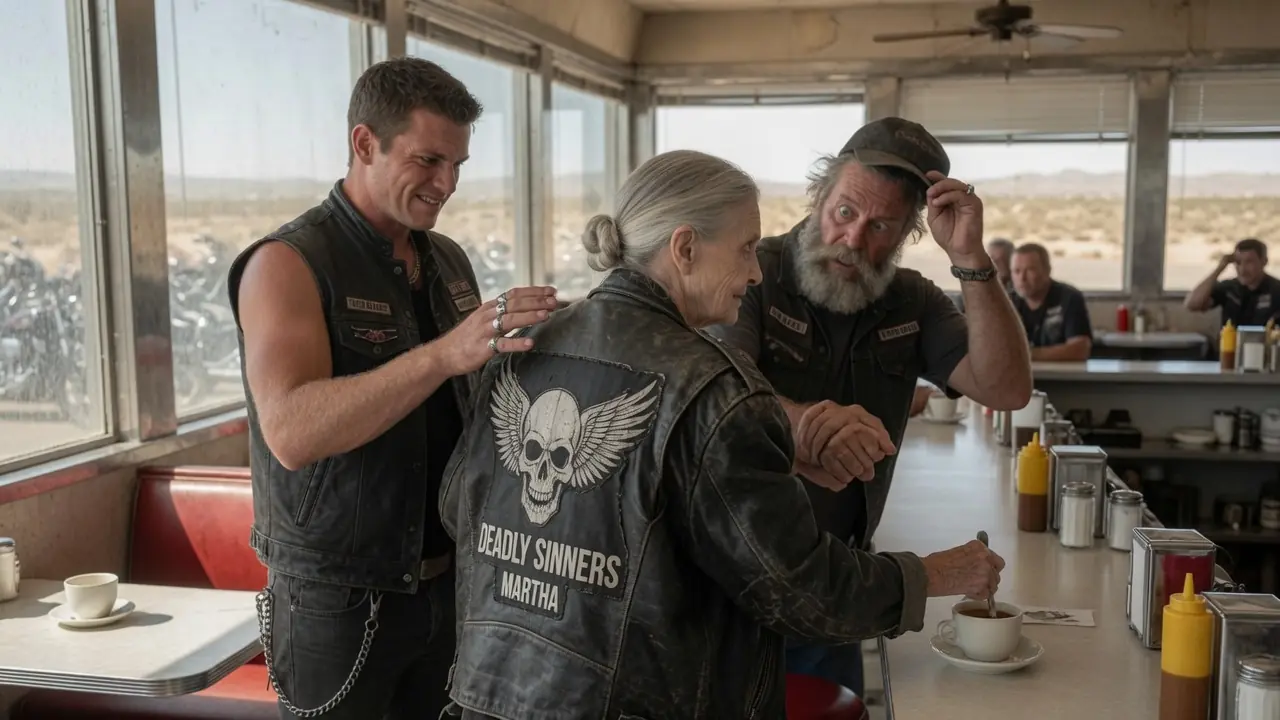
The small sound of metal against china somehow carried through the diner.
Cody stood.
Lewis caught his sleeve.
“Sit down.”
“I’m only talking to her.”
“She didn’t invite conversation.”
Cody pulled free.
“That’s why I’m going to introduce myself.”
Cole looked up.
“Cody.”
The younger man turned.
“Yes, VP?”
“Leave the woman alone.”
“I’m being friendly.”
“No, you’re looking for an audience.”
The words struck exactly where Cole intended.
Cody glanced at the men watching him.
Pride pushed him toward the counter.
He smiled.
“I’ll be respectful.”
Cole watched him cross the diner.
Every instinct told him to call the boy back.
But Cody had to learn that wearing a patch did not make every room his stage.
Cole hoped embarrassment might teach the lesson more effectively than another order.
Cody stopped beside Martha.
Up close, the contrast between them was almost ridiculous.
He stood more than six feet tall, muscular from gym training, with tattooed forearms and a silver chain hanging from his belt.
Martha looked fragile enough to be lifted by a strong wind.
“Nice jacket,” Cody said.
His tone made the words an insult.
Martha continued looking at her tea.
“It serves its purpose.”
“What purpose is that?”
“Keeping me warm.”
“It looks like it belongs to somebody else.”
“It did.”
The answer surprised him.
Cody leaned against the counter.
“Your husband?”
Martha said nothing.
“Must have been a big guy.”
“He was.”
“Did he ride?”
Martha turned her head slightly.
“More miles than you’ve been alive.”
A few riders heard her.
Someone coughed to conceal a laugh.
Cody’s smile tightened.
“You know, people who don’t ride shouldn’t wear club leather.”
Martha looked at his new vest.
“Is that what you believe?”
“It’s disrespectful.”
“To whom?”
“To the people who earned it.”
Martha lifted her cup.
“And you earned yours?”
Cody’s face changed.
“I put in my time.”
“How much?”
“That isn’t your business.”
“Then neither is my jacket.”
She took another sip.
Cody felt the room watching.
He had approached expecting an easy joke.
Instead, the old woman had spoken to him like a boy interrupting adults.
He moved closer.
“You should be careful wearing things you don’t understand.”
Martha set down the cup.
“You are standing in my light.”
Silence settled across the diner.
Brenda stopped beside the cash register.
The young couple stared.
Cole slowly rose from his booth.
Cody’s face flushed.
“Excuse me?”
“You heard me.”
“I’m trying to keep you out of trouble.”
“No. You’re trying to make yourself look large by standing over someone small.”
One of the older bikers whispered, “Damn.”
Cody turned angrily toward the group.
No one laughed now.
He faced Martha again.
“Listen, old lady—”
“Cody.”
Cole’s voice cut across the room.
The younger man ignored him.
He reached toward Martha’s shoulder.
“Maybe you should take it off before somebody mistakes it for club property.”
“Do not touch me,” Martha said.
The warning was quiet.
Absolute.
Cody’s hand continued forward.
Before his fingers closed around the leather, Cole seized his wrist.
The vice president had crossed the distance without Cody noticing.
Cole twisted the younger man’s arm away and stepped between them.
“I told you to leave her alone.”
“She’s wearing—”
“She’s drinking tea.”
“She insulted me.”
Cole’s grip tightened.
“No. She described you.”
He released Cody with a shove toward the nearest stool.
“Sit down.”
Cody stared at him.
Humiliation burned hotter than the desert outside.
Cole turned toward Martha.
“Ma’am, I apologize for—”
He stopped.
Martha had risen from the stool.
The movement took time.
She placed one hand against the counter and straightened her knees carefully. The jacket shifted around her narrow shoulders.
Then she turned.
The back of the leather came into view.
Cole forgot what he had been about to say.
The center patch had faded with age.
It showed the original Iron Wolves emblem, not the polished modern design stitched onto the riders’ current vests.
A silver wolf’s head faced an open highway beneath a red desert moon.
The thread had darkened.
The leather around it carried oil stains, scratches, and two repaired tears.
There were no modern chapter rockers.
Only a rectangular strip beneath the emblem.
ELIAS “IRON” HAYES
FOUNDING PRESIDENT
Below it was a smaller patch.
MOTHER OF THE ROAD
Cole took one step backward.
His hat was suddenly in his hand.
He had removed it without realizing.
Lewis stood.
So did three of the oldest riders.
They recognized the name.
Every Iron Wolves clubhouse contained a black-and-white photograph of Elias Hayes standing beside a 1958 Panhead outside an Arizona repair shop.
The stories about him had grown larger with every telling.
Some were probably exaggerated.
Some were not.
Elias had founded the first chapter after returning from Vietnam.
He took in veterans who could not sleep, mechanics who could not keep regular jobs, and men who needed brothers more than they needed rules.
He organized food runs to isolated desert families during floods.
He repaired motorcycles for riders who could not pay.
He also spent nights in jail, broke several bones in bar fights, and made choices that Martha later described as “the work of an idiot with a good heart.”
Elias died at thirty-seven.
Cole had been a young prospect when the news reached his chapter.
He remembered the older men removing their hats.
He remembered one of them saying that the Iron Wolves had lost the man who taught them why the road mattered.
Now his widow stood inside a diner wearing his jacket.
“Martha Hayes,” Cole whispered.
She studied him.
“You know my name.”
“Yes, ma’am.”
Cody looked from Cole to the old patch.
Confusion replaced anger.
“So what?”
Cole turned slowly.
Cody had never seen that expression on his vice president’s face.
It contained disbelief, shame, and barely controlled fury.
“What did you say?”
“I said I didn’t know who she was.”
“That is not what you said.”
Cody looked toward Martha.
“She’s wearing old colors. I thought—”
“You did not think.”
Cole stepped closer.
“You saw someone smaller than you and decided she existed for your entertainment.”
“I was only joking.”
“No one else was laughing.”
Some had been.
They now stared at the floor.
Cole faced the entire chapter.
“How many of you recognized that patch?”
Four men raised their hands.
“How many knew the name?”
More hands rose.
Cole looked toward the younger members.
“You wear a brotherhood on your backs without knowing who built it.”
No one answered.
Martha returned to the counter and picked up her purse.
The confrontation already seemed to bore her.
Cole turned back.
“Mrs. Hayes, I am deeply sorry.”
“The boy is young.”
“That does not excuse him.”
“No.”
She looked toward Cody.
“It explains why he mistakes noise for strength.”
Cody’s jaw tightened.
But he no longer challenged her.
Martha adjusted the heavy collar.
The leather creaked.
Cole noticed a repaired hole beneath the left shoulder blade.
The patch around it had darkened almost brown.
He remembered another story.
A roadside confrontation outside Needles in 1974.
Elias had been shot while covering two injured riders.
Some versions claimed three bullets.
Others claimed five.
Cole had always assumed the details grew with time.
Martha followed his gaze.
“That one went through him.”
Cole looked at her.
“The bullet hole?”
“Yes.”
“He was wearing this?”
“He came home in it.”
The diner became still.
Martha’s voice did not tremble.
“Elias believed he was unbreakable until life corrected him.”
Cody glanced at the repaired leather.
Martha continued.
“He liked being feared when he was young. Thought fear was respect.”
“What changed him?” Lewis asked.
“Consequences.”
She looked toward the window.
“His closest friend was killed because a roadside argument became more important than walking away. Elias carried that guilt for the rest of his life.”
Cole lowered his head.
“That isn’t in the stories.”
“Men leave out the parts that make their heroes look foolish.”
A faint smile touched the face of one older rider.
Martha saw it.
“Do not misunderstand me. My husband was brave. He was loyal. He was also stubborn, reckless, and occasionally too stupid to be allowed outdoors without supervision.”
A soft ripple of laughter moved through the older men.
This laughter held no cruelty.
Martha continued.
“He did not create your club so twenty men could frighten a waitress.”
Brenda looked down at her order pad.
Cole’s face tightened.
“He created it because the men around him were returning from war with nowhere to go. They could not sleep. Could not keep jobs. Could not explain what they had seen to their families.”
Martha rested one hand on the counter.
“They built motorcycles because engines made more sense than memories. They rode together because being alone was worse.”
Cody glanced toward the other members.
For the first time since entering, he seemed to notice Brenda’s shaking hands and the young couple pressed against the wall.
Martha looked directly at him.
“This jacket is not a costume.”
He remained silent.
“It is not proof that my husband was better than anyone else. It is proof that every choice leaves something behind.”
Her fingers touched the repaired bullet hole.
“When I wear it, I carry a dead man on my shoulders.”
The arrogance drained from Cody’s face.
Martha’s voice softened.
“You wear your vest because you want people to see you.”
She touched the front of his cut with one finger.
“One day, if you stay on this road long enough, you may wear it because of the people who are no longer there to see you.”
Cody swallowed.
“I didn’t know.”
“You did not need to know my name to behave decently.”
The sentence struck harder than anger would have.
Cole released a slow breath.
“That is the lesson.”
Martha turned toward her purse and opened a small coin compartment.
Her fingers struggled with the clasp.
Cole almost reached to help.
He stopped himself.
She removed three folded dollars and several coins, placing them beside her cup.
Brenda stepped forward.
“Miss Martha, your tea was already covered.”
“By whom?”
“Me.”
“I pay my own way.”
“It’s only tea.”
“So charge me only for tea.”
Brenda hesitated.
Then she nodded.
“Yes, ma’am.”
Martha closed her purse.
Cole moved toward the door.
“Allow us to escort you to your vehicle.”
“I have crossed that parking lot alone before.”
“The heat is dangerous.”
“It was hotter when I arrived.”
He realized arguing would accomplish nothing.
Instead, Cole looked toward his riders.
“Clear the path.”
The men left their booths.
Twenty bikers formed two lines from the counter to the entrance.
There was no command to do so.
The older members began it.
The younger ones followed.
Cody stood at the end nearest the counter.
He looked uncertain.
Martha approached him.
His jaw had reddened where Cole’s grip had forced him away earlier, but no one had struck him.
He lowered his eyes.
“I’m sorry.”
Martha stopped.
“For what?”
“For mocking you.”
“That is the smallest part.”
Cody looked up.
“I frightened everyone in here.”
“Yes.”
“I thought the vest meant I didn’t have to care.”
“No. The vest means you have more reason to care.”
He nodded.
Martha studied him.
“Do you still have a mother?”
“Yes.”
“Does she know how you behave?”
His face reddened again.
“No.”
“Then imagine explaining today to her.”
That seemed to frighten him more than Cole had.
Martha moved past.
As she walked between the two rows, the bikers removed hats and sunglasses.
Some bowed their heads.
Several addressed her quietly.
“Ma’am.”
“Mrs. Hayes.”
“Mother.”
She acknowledged none of it until reaching Cole.
“You boys make an awful lot of noise.”
“We do.”
“And your motorcycles leak.”
“Some of them.”
“All of them.”
A smile moved beneath Cole’s beard.
“Probably.”
He opened the door.
Desert heat pressed inside.
Martha paused at the threshold.
“Keep the rubber down.”
The answer came from twenty voices.
“Yes, ma’am.”
She stepped into the sun.
The riders watched her cross the gravel lot.
She walked past their polished motorcycles toward a faded green sedan parked beneath the narrow shade of a cottonwood tree.
The Ford was nearly thirty years old.
Its paint had dulled.
The rear bumper carried several dents.
Martha opened the driver’s door and placed her purse on the passenger seat.
Getting behind the wheel took effort because of the oversized jacket.
The engine turned over twice before starting with a rough cough.
Cole listened.
“Sounds like the fuel mixture is wrong.”
Lewis nodded.
“Maybe the pump.”
Martha backed out slowly.
The sedan rolled toward Route 66 and disappeared into the bright distance.
Only after it was gone did Cole close the diner door.
He turned toward the chapter.
The honor line dissolved.
No one spoke.
Cody stood near the counter, looking as though he wished the floor would open.
Cole approached him.
“You knew I told you to leave her alone.”
“Yes.”
“You ignored me.”
“Yes.”
“You reached for her after she warned you.”
Cody looked down.
“Yes.”
Cole gripped the front of the young man’s vest.
Not violently.
Firmly.
“This patch does not make you king of any room.”
“I understand.”
“No. You are beginning to understand.”
Cole released him.
“Remove it.”
Cody looked up.
“What?”
“Take off your cut.”
Fear entered his face.
“Are you taking my patch?”
“For today.”
Cody hesitated.
Then he removed the vest and handed it over.
Without it, he appeared younger.
Not harmless.
But less protected by the identity he had used as armor.
“You will ride at the back,” Cole said. “When we return, you will clean the clubhouse.”
“Yes.”
“You will also read the chapter history.”
“Yes.”
“And tomorrow morning, you are coming back here.”
Cody glanced toward Brenda.
“To apologize?”
“To work.”
Cole looked at the waitress.
“If the owner agrees.”
Brenda’s eyes widened.
“Work doing what?”
“Whatever needs doing.”
She looked at Cody.
The young man could not meet her eyes.
“The grease trap hasn’t been cleaned in months,” she said.
Cole almost smiled.
“He’ll start there.”
Cody looked horrified.
Cole leaned closer.
“Do you have an objection?”
“No.”
“Good.”
Cole turned toward the rest of the riders.
“We frightened everyone in this place.”
A few men looked toward the couple still sitting in the corner.
“We walked in behaving as though ordinary people should fear us.”
His voice grew harder.
“That is not respect. It is not brotherhood. It is cowardice performed in a group.”
No one moved.
“If any of you believe your patch gives you permission to make innocent people feel small, hand it to me now.”
No one did.
“Then behave like men worthy of wearing it.”
Cole walked to the counter.
He placed enough money beside the register to cover every meal ordered, the broken glass Cody had knocked aside, and a generous tip.
“For the food,” he told Brenda.
She looked at the bills.
“You haven’t eaten yet.”
“We’ll take it to go.”
“And the rest?”
“For the noise.”
She nodded.
The riders waited quietly while Brenda and the cook packed burgers, fries, and slices of pie into paper bags.
No one shouted.
No one complained about the delay.
Cody stood near the entrance without his vest.
The absence felt visible.
When the group left, their boots no longer struck the floor like a threat.
The motorcycles started outside.
The engines remained low.
No unnecessary revving.
Cole led them away from the diner, with Cody riding last.
The next morning, Cody returned at seven.
He came alone in an old pickup rather than on his motorcycle.
Brenda unlocked the diner and found him waiting with work gloves.
“You actually came.”
“Cole said I had to.”
“That isn’t an apology.”
Cody looked embarrassed.
“I’m sorry for frightening you.”
Brenda folded her arms.
“And?”
“For treating the diner like it belonged to us.”
“And?”
“For harassing Martha.”
Brenda waited.
Cody sighed.
“And for acting like a fool.”
“That one I believe.”
She handed him a bucket.
“The grease trap is behind the kitchen.”
For six hours, Cody cleaned.
The work was filthy.
The heat behind the kitchen was worse than outside.
He scraped grease from metal surfaces, carried trash, washed floor mats, and repaired a loose hinge on the rear door.
By lunchtime, Brenda stopped watching him as though he might steal something.
At two, an elderly man entered carrying a photograph.
He introduced himself as Samuel Hayes, Martha’s eldest son.
“My mother told me what happened.”
Cody set down the mop.
“Is she all right?”
“She is angry.”
Cody swallowed.
“At me?”
“At the price of tea.”
Samuel smiled slightly.
“My mother has survived worse than you.”
“I know.”
“No. You know what the jacket represents. That isn’t the same as knowing her.”
Samuel sat at the counter.
He told Cody about Martha’s life after Elias died.
She had been thirty-three with three children and nearly no money.
The repair shop carried debts.
Several men who claimed brotherhood disappeared once the funeral ended.
Others remained.
They repaired the roof.
Brought groceries.
Took turns driving the children to school.
For nearly a decade, Martha worked mornings at a diner and evenings handling accounts for a repair garage.
She refused charity but accepted work.
“She kept the original chapter from collapsing,” Samuel said. “Not by riding at the front. By making sure widows received money, injured members had food, and the books remained honest.”
Cody looked toward the floor.
“I treated her like a joke.”
“Yes.”
“I can’t change that.”
“No.”
Samuel placed the photograph on the counter.
It showed a young Elias beside a motorcycle. Martha stood next to him wearing the same oversized jacket, though it fitted Elias perfectly.
“You can decide what you do after.”
Cody completed his work.
Then he drove to Martha’s small house outside town.
He carried no flowers.
Brenda warned him Martha would consider them wasteful.
He brought a new fuel pump for the Ford.
Martha opened the door but did not invite him inside.
“What do you want?”
“I heard your car struggling.”
“It still runs.”
“For now.”
She looked toward the part in his hands.
“You know how to install that?”
“Yes.”
“You know the difference between a fuel pump and your own ego?”
“I’m starting to.”
Martha stepped aside.
“The garage is behind the house.”
Cody worked for nearly two hours.
Martha watched from a chair beneath the porch awning.
When he finished, the Ford started cleanly.
He wiped his hands.
“No charge.”
“I did not ask for free work.”
“It’s not payment.”
“Then what is it?”
Cody considered.
“Maintenance.”
Martha almost smiled.
The incident at Rusty’s Diner changed the Iron Wolves gradually.
Not because Martha possessed magical authority.
Not because every biker suddenly became gentle.
Change came through uncomfortable decisions repeated over time.
Cole required every new prospect to study the club’s history.
The chapter began publishing its financial records.
Older members told the complete stories, including failures and consequences rather than only fights and escapes.
The brotherhood established a roadside assistance fund in Elias Hayes’s name.
It provided fuel, towing, temporary lodging, and repairs for stranded travelers regardless of what they drove.
Cody became one of its most active volunteers.
He carried tools on every ride.
The first person he helped was an elderly woman whose minivan overheated outside Flagstaff.
She asked whether he was dangerous.
Cody looked at the patch on his vest.
“Not to you.”
Years passed.
Martha continued visiting Rusty’s every Tuesday.
She ordered tea.
Sat in the same place.
Wore Elias’s jacket when the weather allowed.
The Iron Wolves did not crowd her.
Sometimes one or two members stopped by.
They sat several stools away unless invited closer.
Cole always removed his hat.
Cody always asked before sitting.
Martha never became sentimental about them.
She corrected their grammar.
Criticized their motorcycles.
Refused to praise anyone for doing what decent people should have done without recognition.
When she turned eighty-six, the chapter offered to organize a celebration.
“No motorcycles on my lawn,” she said.
They arrived in trucks.
When Martha died two years later, the Iron Wolves gathered outside the small desert church.
The motorcycles remained silent until the service ended.
Her children displayed Elias’s jacket beside the casket.
Cody stood near the back.
He had become a road captain by then, though he still thought of himself as the young fool in the diner whenever pride began speaking too loudly.
Samuel read from a letter Martha had written to the chapter.
A patch cannot give you honor.
It can only remind you that honor is expected.
The road will eventually take every one of you.
Until then, try not to make it harder for the people sharing it.
After the funeral, the riders returned to Rusty’s.
Brenda poured coffee.
No one slammed the tables.
No one frightened the customers.
Cole raised his cup.
“To Martha.”
Twenty voices answered quietly.
“To Martha.”
The old leather jacket never returned to the highway.
Martha’s family donated it to the Iron Wolves’ historical room under one condition.
It would not be displayed as a trophy.
Beside it hung a simple card bearing Martha’s words:
This jacket is not proof that a man was fearless.
It is proof that somebody loved him enough to carry the weight after he was gone.
Cody often stopped before it.
The repaired bullet hole remained visible.
So did the faded patch.
Visitors usually noticed the emblem first.
Cody noticed the worn shoulders.
They showed where the jacket had rested on Elias for years.
Later, the same leather had rested on Martha, a small woman carrying something far heavier than its physical weight.
People repeated the diner story for years.
In some versions, Cole knocked Cody unconscious.
That never happened.
In others, every biker fell to one knee.
They did not.
The truth required no embellishment.
Twenty men entered a roadside diner expecting the room to bend around them.
An elderly woman refused.
She did not shout.
She did not threaten.
She simply wore the history they had forgotten and looked at them without fear.
The youngest among them believed respect came from making others uncomfortable.
Martha taught him that real respect could not be taken.
It arrived only after a person had behaved in a way that made others willing to give it.
The Iron Wolves had entered Rusty’s believing they were the most powerful people in the room.
They left understanding that the smallest person there had carried more loss, courage, and responsibility than all of them combined.
Martha never needed to demand silence.
Her presence created it.
And long after the motorcycle engines faded down Route 66, the lesson she left behind remained:
True strength does not need an audience.
True honor does not need fear.
And the heaviest things people carry are often invisible until they finally turn around.