On Thursday morning, January 15, 1998, Tom DelVecchio stood on the frozen bank of the Allegheny River and watched eighty tons of steel settle another inch into twelve feet of black water.
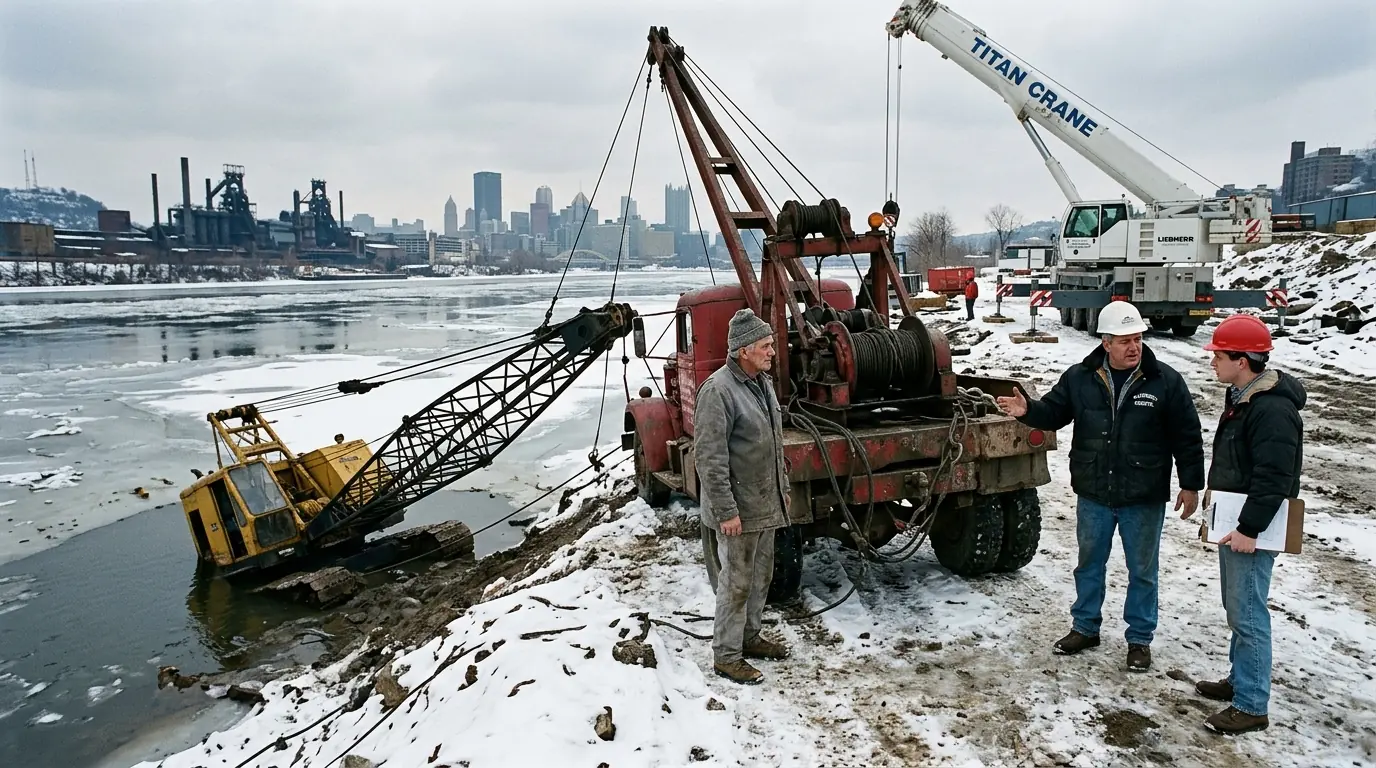
The crane had been in the river for four days.
Its cab was submerged. The lower half of the counterweight disappeared beneath the surface whenever passing barge traffic pushed a wake toward shore, then emerged again streaming water. The boom extended diagonally into the river, its lower section buried nearly four feet into mud. Ice had formed along cables, railings, and every exposed edge of the machine. Whenever the wind came down the river, those thin shells of ice cracked and fell into the water.
Tom had been a construction supervisor for twenty-three years. He had dealt with accidents, inspections, strikes, equipment failures, bad concrete, missed deliveries, and weather that seemed personally determined to bankrupt whatever company happened to be pouring foundations that week.
He had never dealt with anything like this.
Four days earlier, a crew had been positioning a sixty-foot steel bridge girder when the crane’s river-side support area suddenly failed. The site had been tested. Mats had been placed. The geotechnical consultant had approved the working platform.
None of that mattered once the earth beneath the crane began moving.
The ground near the river looked frozen from the surface, but beneath the top layer winter seepage had softened an old pocket of silty fill. The crane’s load shifted during the swing. One side settled, then settled again. The operator reacted correctly and released the suspended girder before the crane could carry it into the river with him. He escaped through the uphill side of the cab seconds before the machine rolled over the bank.
Nobody died.
Tom repeated that fact whenever he found himself thinking about money.
Nobody died.
Still, money had become impossible to ignore.
The bridge project was already behind schedule. The submerged crane was costing tens of thousands of dollars in lost productivity every day. Specialized divers had to be housed and paid. A recovery company out of Ohio had mobilized a two-hundred-ton hydraulic crane, only to discover that the same shoreline unable to hold the first crane could not safely support the second.
Every proposed solution created another problem.
Move the recovery crane closer and its outriggers began sinking.
Move it farther back and the lifting radius destroyed its usable capacity.
Build a new working platform and the project lost another week.
Drive piles for a recovery pad and the engineers wanted permits.
Bring in a barge crane and winter river conditions complicated both access and anchoring.
By Wednesday evening, the recovery contractor had proposed what Tom regarded as the most depressing plan yet: stabilize the riverbank, excavate around the submerged boom with divers and suction equipment, rig the crane underwater, then conduct a tandem lift using a floating support system.
Estimated duration: seven to ten days if everything went well.
Estimated cost: enough that Tom stopped asking.
The insurance adjuster was coming Monday.
Everybody knew what that meant.
If the crane was declared uneconomical to recover, the company would lose not only the equipment but perhaps the bridge contract as well.
Tom stood outside the heated site trailer that Thursday morning, coffee cooling in one hand, while a young project engineer named Brian Keller approached from behind.
“Divers are back down.”
Tom nodded.
“Anything?”
“They think they can clear another foot around the boom today.”
“And then?”
Brian looked toward the river.
“Then we still need a crane we can put somewhere.”
Tom threw the rest of his coffee into the snow.
His radio crackled.
“Tom, gate says there’s somebody here asking for you.”
“Who?”
“Old guy. Says his name is Kowalczyk.”
Tom frowned.
“Inspector?”
“Says he heard about the crane.”
“Everybody’s heard about the crane.”
“He brought a truck.”
Tom almost ignored it.
Then the guard added, “You should probably see this thing.”
Five minutes later, an engine came rumbling down the temporary access road.
Every worker within sight turned toward it.
The truck looked less like something arriving for a modern bridge project than something that had escaped from an industrial photograph fifty years earlier.
It was a 1948 Autocar DC-series heavy chassis, long hood faded from dark red toward brown, front fenders scarred and repaired, steel bumper carrying enough dents to tell its own history. Behind the cab rose a fixed recovery tower nearly twenty-four feet tall, fabricated from heavy structural steel. The welds were visible. So were reinforcement plates, gussets, old pulley housings, and a massive mechanical winch mounted behind the cab.
Nothing folded.
Nothing telescoped.
Nothing had a digital display.
There were no hydraulic stabilizers extending gracefully from the sides.
The machine looked brutally permanent, as though somebody had decided in 1950 that towing equipment needed only three qualities: weight, gearing, and enough steel to survive poor decisions.
A few workers laughed.
Brian stared.
“What is that?”
Tom narrowed his eyes.
“I’m guessing Mr. Kowalczyk.”
The Autocar stopped beside the site trailer.
Its engine idled with an uneven mechanical rhythm that made the aluminum siding vibrate.
The driver shut it down.
A seventy-three-year-old man climbed from the cab.
Ed Kowalczyk moved carefully, but not weakly. His shoulders had rounded with age and decades of labor. His hands were broad, knuckles enlarged, fingers permanently bent from years of heavy work. He wore insulated coveralls, an old canvas jacket, steel-toed boots, and a black wool cap pulled over gray hair.
Tom walked toward him.
“Mr. Kowalczyk?”
“Ed.”
“I’m Tom DelVecchio.”
Ed shook his hand.
His grip was dry, hard, and brief.
“Appreciate you letting me look.”
Tom glanced toward the wrecker.
“You drove that here?”
Ed followed his gaze.
“She still drives.”
“That wasn’t quite what I meant.”
Ed smiled faintly.
“I know.”
Brian joined them.
Ed looked toward the river.
“Mind if I walk the site?”
Tom shrugged.
“At this point, you can look at whatever you want. Stay behind the marked line unless somebody clears you.”
Ed nodded.
Then he walked away without another word.
Brian watched him.
“That’s the entire recovery consultant?”
“He’s not a consultant.”
“What is he?”
Tom looked at the old Autocar.
“I have no idea.”
Three hours earlier, Ed had been eating eggs in the kitchen of the house he had owned since 1961.
A police and fire scanner sat on a shelf near the refrigerator.
Most mornings it produced little more than traffic stops, ambulance dispatches, alarm calls, and occasional industrial incidents. Ed kept it running because old habits died slowly. He had spent more than four decades around Pittsburgh’s mills, where men learned quickly that knowing when something went wrong could matter even if the problem was half a mile away.
That morning he heard someone discussing a crane recovery on the Allegheny.
The voice sounded tired.
“The ground won’t hold us,” the man said. “We can’t get close enough to the bank.”
Ed stopped eating.
He turned the scanner louder.
Another voice answered.
Something about longer rigging.
Another about underwater suction around the boom.
Then:
“Insurance adjuster’s here Monday. If we don’t have a workable plan by then, they may write the unit off.”
Ed looked toward the detached garage behind his house.
The Autocar sat inside.
His father, Stefan Kowalczyk, had bought the bare military-surplus heavy-truck chassis in 1948.
Stefan worked maintenance at Jones and Laughlin Steel. He understood industrial machinery and possessed the particular postwar confidence of men who believed that if a machine did not yet exist for the job they needed done, that merely meant somebody had not welded it together yet.
He spent nearly two years building the wrecker.
The boom tower came from structural sections purchased cheaply through mill surplus.
The main winch had originally served industrial pulling duty.
Stefan fabricated frame reinforcements from heavy channel.
Mechanical power traveled through a power takeoff and reduction gearing to the winch drum. It was painfully slow compared with modern hydraulic recovery equipment.
That was intentional.
Stefan wanted control.
The truck was not designed to tow automobiles from grocery-store parking lots. It handled loaded dump trucks, mill tractors, machinery, overturned equipment, and whatever else local working men could not afford to have retrieved by larger commercial outfits.
Ed had learned beside his father.
At nineteen, he knew how to run blocks.
At twenty-two, he could calculate line load quickly enough to know when a cable was becoming dangerous.
At thirty, he had already spent hundreds of hours helping move heavy machinery inside steel plants where space was measured in inches and mistakes could remove fingers, legs, or lives.
When Stefan died in 1976, the Autocar became Ed’s.
By then modern wreckers were improving rapidly. Hydraulic booms were easier, faster, safer, and more versatile.
Ed used them too.
He was not sentimental enough to pretend old automatically meant better.
But the Autocar possessed one quality new equipment did not always provide.
Its tall fixed tower allowed pulling from far behind an obstacle while keeping a useful vertical component on the line.
And its mechanical winch could hold enormous tension at very low speed without caring whether a computer thought the recovery looked normal.
Ed had not used it professionally in years.
He started it twice annually.
Changed fluids.
Greased bearings.
Exercised the winch.
His wife used to call that “feeding the dinosaur.”
She had been gone seven years.
Ed still did it.
That Thursday morning he finished breakfast, carried his plate to the sink, and called North Allegheny Bridge Constructors.
When Tom DelVecchio came onto the phone, Ed said simply:
“I think you’re trying to solve your crane problem from too close.”
Tom had paused.
“What?”
“Your recovery machine keeps sinking because you’re trying to get next to the river.”
“Who is this?”
Ed introduced himself.
Then explained the Autocar.
Tom’s response was predictable.
“We already have a two-hundred-ton recovery crane.”
“I heard.”
“It can’t do it.”
“I heard that too.”
“So what exactly is a fifty-year-old tow truck going to do?”
“Stay where the ground holds.”
Silence.
Ed continued.
“You don’t need to lift that crane straight up.”
“Divers say the boom is buried.”
“Then you free the boom first.”
“We’re working on that.”
“Good.”
“Mr. Kowalczyk—”
“Ed.”
“Ed, I’m looking at close to a million dollars in recovery exposure and a bridge schedule falling apart. I don’t have time for somebody to come out and tell stories about what a truck did in 1963.”
Ed looked through the kitchen window toward the garage.
“Then don’t listen to stories.”
Another pause.
“Let me look at the machine. If I’m wrong, I’ll leave.”
Tom exhaled.
“I’m not paying a callout.”
“Didn’t ask.”
“And you don’t touch anything without my recovery contractor approving it.”
“Wouldn’t want it any other way.”