He was eleven years old, standing in the rain, and nobody had ever come back for him. Not the first family, not the second, not the seventh. He had stopped counting. Then a stranger's motorcycle died on a flooded road, and Eli walked across the parking lot anyway. Not because he expected anything, not because anyone told him to, because someone needed help.
He fixed the chain in 20 minutes. He went to bed that night thinking it was over. He woke up to a sound he'd never heard before. Something building, rolling, filling the whole valley like thunder that didn't stop. And when he looked out the window, he counted 3,500.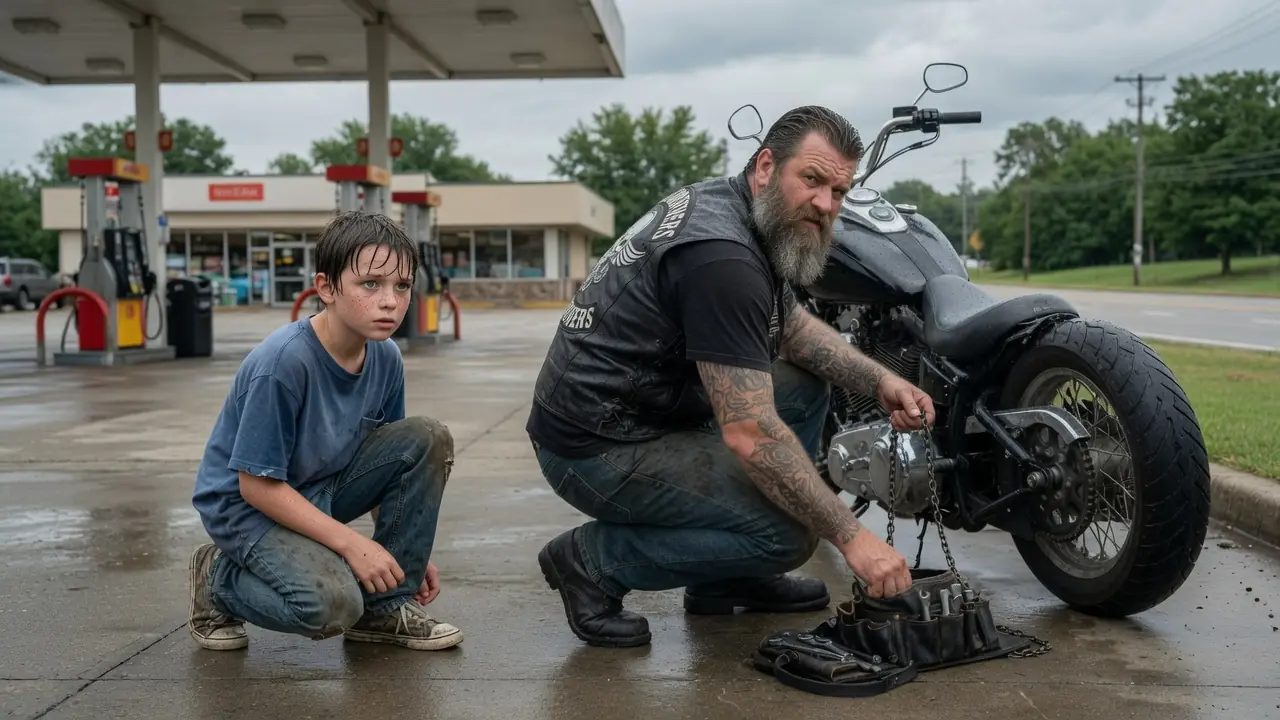
The rain came without warning, the way it always did in Millhaven in late October. One moment the sky above Cedar Hill Road was a dull, uniform gray, the kind of gray that settles over a small Tennessee town like a second skin in autumn. And the next, it cracked open completely, releasing a curtain of cold water that turned the asphalt dark within seconds. The oak trees along the roadside shook violently. Gutters flooded.
Puddles exploded into tiny crowns of water that vanished as quickly as they formed. Eli Carter stood at the edge of the Millhaven Children's Home parking lot, his sneakers already soaked through the worn rubber soles, watching the storm swallow the road ahead. He was supposed to be inside. Mrs. Sandra Pruitt had said so at least four times that afternoon. Her voice carrying the particular brand of tired authority that came from spending thirty years managing a building full of children who never quite listened.
But Eli had slipped out anyway, the way he often did, silently, without drawing attention, moving through spaces the way water moves through cracks. That was his talent, if you could call it that. Being invisible. At eleven years old, Eli had spent the last six years perfecting the art of disappearing in plain sight. He was small for his age with dark brown hair that hung slightly over his forehead, a face full of faint freckles that made him look younger than he was, and green eyes that had a habit of studying things, floors, walls, windows, people's shoes, rather than meeting them directly.
He wore a faded blue T-shirt that had been washed so many times the color had migrated somewhere between sky and memory, and a pair of jeans with a fraying knee. His voice, when he used it, was barely above a murmur. His laughter, when it came, was so rare and so quiet that most people around him didn't notice it at all. He had been at the Millhaven Children's Home since he was five. He didn't remember much about before.
A woman's perfume, a yellow curtain, the sound of a door closing. Nothing that assembled itself into anything as solid as a story. What he had instead was this, a bed in a room he shared with three other boys, a small wooden box under that bed where he kept a dog-eared paperback, a photograph he'd found on the ground outside a pharmacy, and a blue jay feather he'd picked up in the yard the previous spring. These were his things. These were the edges of his world.
He wasn't unhappy, exactly. That was what made his situation difficult to explain to the social workers who came and went, always with their clipboards and their careful smiles. He wasn't unhappy. He just existed in a kind of permanent quiet that the world around him seemed to neither notice nor disturb. June noticed, though.
June was ten with wild red hair that refused to be tamed by any braid Sandra Pruitt attempted, and the kind of fearless energy that existed in complete opposition to Eli's stillness. She had arrived at the home fourteen months ago, and had decided within her first week that Eli Carter was her best friend. A decision she made entirely on her own, and announced to him one Tuesday morning over breakfast, as if reading from a list. "You're my best friend now," she had said, stabbing a piece of toast. "You don't have to say anything. " He hadn't.
But he'd smiled just barely, and that had been enough for June. It was June who had noticed him slipping out the side door that afternoon, and it was June who had appeared at his elbow 1five minutes later, holding a broken umbrella that did approximately nothing against the rain. "She's going to lose her mind when she finds out you're out here," June said, squinting against the wind. "She won't notice," Eli said. "She always notices. " "She notices you," Eli said quietly.
"She never notices me. " June had no answer for that because it was true, and she knew it. She stood beside him in the rain, the useless umbrella tilted at an angle that managed to redirect water directly onto her left shoulder, and together they watched Cedar Hill Road disappear into the storm. That was when they heard it. The sound came first, a mechanical cough, a sputter, a deep grinding complaint that rose above the rain, and then died into silence. A moment later, a figure emerged from the curtain of water on the road, a large motorcycle, its engine dead, being pushed by hand toward the gravel shoulder, and behind it, pushing with both hands on the handlebars, a man.
He was enormous. That was the first thing Eli registered, not in a frightening way, but in the way that certain things simply occupied more space than expected. The way a draft horse standing in a field is bigger than your mind prepared for. The man was over six feet tall with shoulders that stretched his soaked dark t-shirt to its limits. Forearms covered in tattoos that the rain had made into dark rivers of color.
A dark leather vest, cut, the kind bikers wore, hung heavy with water. His gray-streaked beard was plastered against his jaw. His boots were enormous, steel-toed, sinking slightly into the soft gravel as he pushed. His name stitched in pale thread on the left breast of the vest read Garrett. He pushed the dead motorcycle to the shoulder and stopped, stood still for a moment, hands on the handlebars, head down, rain pouring off the back of his neck.
Eli didn't move. The man, Garrett, had crouched down beside the rear of the motorcycle, examining something near the wheel with the focused expression of someone who already knew the answer and didn't like it. He reached for something in the saddlebag, came up empty, tried another pouch, and swore quietly under his breath. He sat back on his heels, looked up at the gray sky as if conducting a brief negotiation with it. Then he pulled out a phone, looked at the screen, and his expression changed.
Something between frustration and a deeper kind of tired that had nothing to do with the rain. No signal. Cedar Hill Road was a dead zone. Everyone in Millhaven knew that. Eli took a step forward.
"Eli. " June hissed. He walked across the wet parking lot and onto the gravel shoulder. His sneakers made small sucking sounds in the mud. He stopped a few feet from the motorcycle, close enough that the man heard him and looked up. For a moment, Garrett Holloway simply stared.
His blue eyes were sharp and direct, the kind of eyes that had spent a long time looking at things that needed to be assessed quickly. He looked at the boy, small, soaked, freckled, with that quiet green gaze, and said nothing. Eli said nothing either. He looked at the rear tire. The chain had snapped.
It lay in a loose pile near the rear sprocket, disconnected, useless. The tire itself was fine. The problem was entirely mechanical, entirely fixable, entirely dependent on having the right tools. "Chain? " Eli said. Garrett blinked.
"Yeah," he said. His voice was deep, like something produced in a barrel. "Chain. " Eli looked up at the building behind him, then back at the motorcycle, then at the man. "We have a toolbox. " He said. "In the maintenance closet.
Mr. Alderman, he fixes things. He has chain tools. " Garrett looked at the boy for a long moment, then at the building, the faded sign above the entrance, Millhaven Children's Home. His expression shifted. Something moved behind his eyes, something that reorganized itself carefully before it reached his face. "That's an orphanage," he said.
"Yes. " Eli said. Another pause. The rain hammered the gravel between them. "You live there? " Garrett asked. "Yes. " "How old are you, kid? " "Eleven. " Garrett nodded slowly.
He looked at the chain. He looked at the boy. He seemed to be conducting some internal calculation that took several seconds to complete. "You sure about the tools? " he finally said. "Mr. Alderman has everything. " Eli said.
"He fixed Mrs. Pruitt's lawn mower last spring, and the boiler, and the Okay. " Garrett said. A small sound that might have been the beginning of a smile moved across his face and then stopped. "Lead the way. " Eli turned and walked back across the parking lot. Garrett followed, pushing the heavy motorcycle one-handed through the gravel, moving it with a kind of practiced ease that suggested the machine weighed less to him than it did to physics. June stood at the edge of the lot with her broken umbrella, watching the approach of this enormous man with the tattoos and the wet leather vest, her eyes wide.
"It's fine. " Eli said quietly as he passed her. "He's really big. " June whispered. "He needs help. " Eli said. And that, for Eli Carter, was the entire calculation. Sandra Pruitt found out about the motorcycle approximately four minutes after Eli brought it through the side gate, which was about three minutes and fifty seconds after she'd been hoping to sit down with a cup of tea and not solve any new problems for the remainder of the afternoon.
She appeared in the doorway of the maintenance area, a wide, cluttered room that smelled of motor oil, sawdust, and decades of accumulated repairs, and stopped. The motorcycle sat on the concrete floor, its wet tires leaving dark imprints. Eli was crouched beside the rear wheel with a chain breaker tool he'd retrieved from the top shelf of Mr. Alderman's carefully organized cabinet. And standing against the far wall, arms crossed, watching the boy work with an unreadable expression, was the largest man Sandra had seen in recent memory. She assessed the situation in approximately two seconds, the way you learn to after thirty years.
The man's vest, the patches, the worn leather, the tattoos climbing his forearms, the gray beard, the sheer physical weight of his presence in a room full of children's bicycles and broken lawnmower parts. Everything about Garrett Holloway announced itself loudly in a language Sandra Pruitt understood immediately and immediately braced against. "Can I help you? " she said, and her voice carried every syllable of its intention. Garrett looked at her. He recognized the tone.
He'd been hearing it his entire adult life in grocery stores, at parent-teacher conferences he'd attended for his niece, at hospital waiting rooms and roadside diners and every other location where his appearance preceded his character by about thirty seconds. He didn't bristle. He'd stopped bristling years ago. "Your boy there offered to help with a chain repair," he said evenly. "I appreciate it.
I'll be out of your way soon as it's done. " "He's not my boy," Sandra said, then immediately heard how that sounded. "I mean, he's a child in my care. He shouldn't be "He knew what he was doing," Garrett said, nodding toward Eli. "More than most adults I know. " Sandra looked at Eli, who was working the chain tool with quiet concentration, his tongue slightly between his teeth in the way it went when he was focused. She looked back at Garrett.
"You're with a motorcycle club," she said, not a question. "I am," he said. "Which one? " A pause. "Does it matter? " Sandra held his gaze. "To me it does. " Something shifted in Garrett's expression, not defensiveness, exactly, but something that had learned to live next to defensiveness without becoming it.
"Iron Brothers," he said, "out of Nashville. " Sandra said nothing. She kept her face neutral, the way she'd learned to when gathering information. "Iron Brothers. " She'd heard the name associated with charity rides, toy drives, veteran support, not a criminal organization. Not dangerous, but Sandra Pruitt had also learned, across thirty years of protecting children, that appearances told stories both ways. Men who looked harmless could be anything, and men who looked frightening could be the gentlest people in a room.
She watched Garrett Holloway watch Eli work. Watch the way his eyes tracked the boy's hands, not with anything predatory or calculating, but with something closer to quiet surprise. The kind of surprise that comes from expecting nothing and receiving something that defies expectations. There was something almost careful about his attention, like a man who had decided to be very still near something fragile. "He's good with his hands," Garrett said, almost to himself.
"He always has been," Sandra said, and her voice had lost one layer of its armor without her entirely meaning it to. Eli looked up then, briefly, registered Sandra's presence without alarm, and went back to the chain. "How long has he been here? " Garrett asked. "Six years," Sandra said. Garrett absorbed that.
Six years. He did the math without asking for it. The boy was 11, which meant he'd arrived at five. He said nothing, but something in his jaw tightened almost imperceptibly, and then released. "He's good," Garrett said again.
Then, after a pause, "Quiet. " "He is," Sandra agreed. "Quiet's not a bad thing. " "No," Sandra said, "it's not. " They stood in an odd, temporary truce, the woman who'd spent her life building walls around children and the man who'd spent his life walking through rooms where walls went up at the sight of him while Eli Carter worked in silence between them. It took him twenty minutes. The chain breaker tool, a spare master link from the cabinet's third drawer, and a patience that didn't seem to belong to an 11-year-old. When he was done, he sat back, wiped his hands on a rag, and looked up at Garrett.
"Try it now," he said. Garrett crouched beside the wheel, tested the chain by hand, smooth, properly tensioned, seated on the sprocket correctly. He looked at the boy. "Where'd you learn to do that? " he said. Eli shrugged.
"YouTube and Mr. Alderman showed me some things. " "YouTube? " Garrett repeated. Something that was fully a smile this time moved across his face, brief, genuine, unexpected. "How about that? " He stood, reached into the inner pocket of his vest, and pulled out his wallet. "No," Sandra said immediately, stepping forward. Garrett looked at her.
"He doesn't need money," she said. "He helped because he wanted to. " Garrett looked at Eli. Eli looked at the floor. "She's right," Eli said quietly. "It's fine. " Garrett put his wallet away.
He looked at the boy for a long moment, this small, soaked, freckled kid who had walked across a parking lot in the rain to help a stranger because the stranger needed help without calculating what he might get in return, without fear, without anything except a simple and direct assessment of a problem that needed solving. "What's your name? " Garrett said. "Eli. " "Eli. " Garrett nodded slowly. He extended his hand, a large hand scarred at the knuckles, tattooed to the wrist. "I'm Garrett. " Eli shook it.
His small hand disappeared into Garrett's entirely. "Thank you, Eli," Garrett said. And his voice, for a moment, carried something underneath the words, something that had the texture of old pain and quiet recognition. The sound of a man who had been on the wrong side of a first impression enough times to know exactly what it cost and exactly what it meant when someone didn't care about the impression and just saw the problem instead. He wheeled the motorcycle out through the side gate.
Eli and Sandra stood in the maintenance room doorway and watched him go. The rain had thinned to a drizzle. The motorcycle's engine turned over on the second try, settling into its deep, even rumble. Garrett paused at the gate, looked back once. He didn't wave.
He just looked. Then he was gone, and Cedar Hill Road swallowed the sound of his engine in about 30 seconds. And Eli Carter stood in the doorway of the Millhaven Children's Home maintenance room, watching the empty road the way he watched most things, quietly, carefully, without expectation. "Inside," Sandra said softly, "dry clothes. Dinner in twenty minutes. " Eli nodded and turned to go.
"Eli," she said. He stopped. "That was a good thing you did. " He didn't answer. But as he walked down the hallway toward the stairs, his steps were slightly less careful than usual, slightly less practiced in the art of taking up no space. June was waiting at the top of the stairs with a towel, which she dropped over his head without ceremony.
"So? " she said. "So what? " came his muffled voice. Was he scary? Eli pulled the towel off, considered, "No," he said. "He just needed help. " June studied him.
You think he'll come back? Eli started down the hall toward their rooms. "No," he said simply. People don't usually come back. He said it without bitterness, just the plain factual weight of a truth that had organized itself around him so completely, he no longer noticed its edges.
The next morning arrived the way mornings do in Millhaven in late October, gray at the edges, cold enough to see your breath inside the bathroom, the kind of light that makes everything look slightly less permanent than it was the day before. Eli was up before 6:00, which was not unusual. He had always been an early riser. The home was quieter in those first hours before the other children began to fill it with their noise and movement, before the day assembled itself into its obligations. He sat on the window sill of the third floor hallway, the one that looked out over Cedar Hill Road and the long flat stretch of Tennessee countryside beyond it, and read his paperback, or tried to.
Mostly, he looked at the road. By seven, the other children were awake and the home filled with its usual morning sounds, Mrs. Pruitt's voice from the kitchen, the thunder of feet on the stairs, June demanding that someone return her left sneaker which had gone missing in circumstances she described as suspicious. Eli came down for breakfast, ate his toast, answered the questions directed at him in monosyllables, and performed the morning the way he always did, present, quiet, unobtrusive. At 8:15, Carol Bains arrived. Carol was the home's assigned social worker from the county office, a woman with kind eyes behind thick-framed glasses, dark hair threaded with silver, and the particular combination of warmth and professional fatigue that came from caring deeply about a system that often didn't.
She visited every other week, filed her reports, met with the children individually, advocated where she could. She and Sandra had an understanding built over years of the same frustrations and the same small victories. She found Sandra in the office and closed the door behind her, which meant the news was something that required a closed door. Eli was in the hallway when Carol arrived on his way to retrieve his jacket from the coat closet near the front entrance. He stopped when he heard the door close.
He wasn't trying to eavesdrop. It simply happened the way things happened to Eli, quietly, without effort or intent. Through the door, Carol's voice, careful and measured, "The Hendersons withdrew their application. " Sandra's silence was the loudest thing in the hallway. They said, "Sandra, I'm sorry. They said they were looking for a younger child, and they specifically said they mentioned that Eli is" a pause "that he's very quiet, that they found him difficult to connect with during the visit. " More silence.
"He's 11 now," Carol continued, and her voice had the texture of something she'd said before, something that didn't get easier with repetition. "The window for" "I know the window," Sandra said. Her voice was very controlled. Eli stood in the hallway. His jacket was three feet away in the closet.
He didn't move toward it. He had known about the Hendersons distantly, the way you know about things adults think they're keeping from you, through fragments, through changed subjects, through the particular way Sandra looked at him sometimes, like she was simultaneously hoping for something and preparing for its absence. He had not known they had actually visited, or that they had made a decision, or that the decision had anything to do with how quiet he was. He stood very still for approximately thirty seconds. Then he got his jacket from the closet, walked back down the hallway, and went outside to the parking lot.
The morning air was sharp. The oak trees along Cedar Hill Road held their last stubborn leaves, dark red and orange, rattling against a thin wind. Eli sat on the low concrete wall at the edge of the parking lot and looked at the road. He wasn't crying. He considered the idea, turned it over, put it back down.
There was something in his chest that was too dense and too practiced to dissolve into something as simple as tears. It was more like a stone that had been there so long it had become structural, something load-bearing, part of the architecture of how he stood. He had been looked at by seven families in six years. Seven times adults had come to the home with that particular expression, cautiously hopeful, slightly assessing, performing warmth in the way that people perform warmth when they're also conducting an interview. Seven times Eli had sat across from them and answered their questions and showed them the things they asked to see and been as much as he knew how to be the version of himself most likely to be chosen.
Seven times the door had closed. Different reasons. Different language. The same result. He understood in the abstract that he was difficult to reach.
He understood it the way you understand a fact about geography or weather. Intellectually, without quite grasping what it would feel like if things were different. He didn't know how to be louder or brighter or more immediately appealing. He had been this way since before he could remember, and he had stopped believing it was something that could be fixed. He sat on the wall for a long time.
The road was empty. A crow landed briefly on the parking lot surface, studied him with one bright eye, and departed. He was still sitting there 30 minutes later when he heard it. It was distant at first, so faint that he initially dismissed it as wind or a truck on the highway two miles north, but it grew, and it kept growing, building from a murmur into something larger, something with texture and depth and a rhythmic layered quality that his brain didn't immediately have a category for because he had never heard anything quite like it. The sound of engines, many engines.
Not the random scatter of ordinary traffic, but something organized, something moving in formation, something that built and built until it seemed to come from everywhere and nowhere, bouncing off the hills and filling the valley that cradled Millhaven like water fills a bowl. Eli stood up from the wall. He looked north down Cedar Hill Road in the direction the sound was coming from. They appeared around the bend slowly, the way a river appears when you're standing on a bridge, the front of it arriving before you can conceive of its full length. The first riders came into view, and Eli counted them automatically.
1 2 5 10. They filled the lane completely, then spilled into two lanes, riding in a formation so precise it seemed choreographed. Dark leather, chrome glinting in the pale morning light, flags and banners he couldn't yet read. The thunder of their engines rolled through his chest like weather. More came around the bend, more still.
The line of motorcycles extended back around the curve and out of sight, and still more came until Cedar Hill Road was nothing but a river of steel and leather and sound, moving slowly, deliberately, directly toward the Millhaven Children's Home. Eli stood at the edge of the parking lot and watched them come. Behind him, the front door of the home banged open. Eli! Sandra's voice sharp with something between alarm and disbelief.
Eli, get inside. There are— She stopped when she saw what he was seeing. June materialized at his left elbow, having apparently teleported from inside the building in the way June often did. She grabbed his arm, said nothing, just stood there with her mouth slightly open, watching the motorcycles fill the road. At the front of the formation, a single rider pulled ahead and turned into the parking lot entrance.
He stopped the motorcycle twenty feet from where Eli stood, killed the engine, and swung off the bike with the ease of a man who'd performed the motion 10,000 times. It was Garrett. He was wearing the same leather vest, dry now, the same boots. He walked across the parking lot with the unhurried, deliberate movement of a man who had somewhere to be and had already arrived. He stopped in front of Eli Carter and looked down at him.
Behind him, the motorcycles were pulling off the road, parking along the shoulder in a line that stretched as far as Eli could see in both directions. Their engines cut off one by one, and the silence that accumulated in their wake was enormous. A held breath, a full auditorium going quiet. Garrett looked at Eli. "You fixed my chain," he said.
Eli looked past him at the road, at the hundreds, hundreds of motorcycles lining Cedar Hill Road, their riders dismounting, standing, turning to face the parking lot. "Yes," Eli said. His voice was very small. "Nobody had to do that," Garrett said. "You just did it. " Eli said nothing.
"I told some people about you. " Garrett said. "About what you did. " "They wanted to come. " Eli looked at him. "How many? " He said. Garrett turned and looked at the road, at the line of bikes that disappeared around the bend in both directions. He turned back.
"3,500," he said. Sandra Pruitt had, in thirty years of running the Mill Haven Children's Home, managed thunderstorms that flooded the basement, a kitchen fire that destroyed two walls, three separate incidents involving children on the roof for reasons she preferred not to revisit, and a county budget review that nearly closed the home entirely. She had handled each of these events with the particular competence of someone who had long ago stopped being surprised by catastrophe, and started being annoyed by it. She had not handled 3,500 motorcycles on Cedar Hill Road. She stood on the front steps of the home for approximately 45 seconds, watching the riders dismount and the line of machines extend further than her eyes could follow, and performed a rapid calculation of every possible thing this could be, and every possible thing she should do about it.
Then she took a breath, squared her shoulders, and walked across the parking lot to where Garrett Holloway was standing with Eli. "Mr. Holloway," she said. "Mrs. Pruitt. " He said without surprise. He'd apparently remembered her name. You want to tell me what's happening?
I told some of my people about your boy, Garrett said, about what he did. They wanted to show up. 3,500 people, Sandra said, give or take, Garrett said. Sandra looked at the road. She looked at the riders, men and women, young and old, every shape and size, in leather and denim and colors she didn't recognize.
Some with gray beards longer than Garrett's, some barely older than her eldest kids. They were standing quietly along the road, talking in small groups, some sitting on their bikes, all of them oriented toward the home with an attention that felt, she searched for the word, respectful. They're not coming in, she said. Not quite a question. We're not here to come in, Garrett said.
We're here because Eli helped a stranger in the rain and didn't ask for anything back. And that matters. Some of us know what it's like when it doesn't happen. Sandra looked at him. The sentence landed somewhere specific.
I'd like to have some things delivered, Garrett continued. He reached into his vest and produced a folded sheet of paper, which he handed to Sandra. If that's all right. Sandra unfolded the paper. It was a list, a long one.
She read it, then she read it again. Groceries, six months of supplies, branded and itemized. Winter coats and boots for every child in the home, sizes requested in advance from county records, which someone had clearly obtained through channels Sandra preferred not to question. Books, art supplies, a complete set of tools for the maintenance room, a new boiler donated and scheduled for professional installation the following week, a college savings fund, contributions from sixty-eight individual riders totaling Sandra stopped at the number and read it twice. $47,000. A letter from a Nashville law firm pro bono offering to handle adoption paperwork for any child in the home whose case was stalled in the county system.
And at the bottom of the list in Garrett's handwriting three words, for Eli specifically. She looked up. What does that last part mean? We have a donor, Garrett said. Anonymous.
He runs a youth trades program in Nashville, carpentry, mechanical work, that kind of thing. He wants to fund a full scholarship for Eli. Training, materials, everything. Starting whenever the kid is ready. Sandra stared at him.
He saw a video, Garrett said, of Eli fixing the chain. I took it without thinking. I'm sorry. I should have asked. But I posted it last night and people responded.
Sandra was quiet for a moment. Then, you posted a video of a child in my care without permission. I know, Garrett said. He didn't flinch from it. I apologize.
I'll take it down if you want. But I can't take back what it started. Sandra looked at Eli who had not moved from his spot, who was standing with his hands in the pockets of his jacket looking at the road full of motorcycles with the same quiet, careful attention he gave to everything. Eli, she said. He looked at her.
Are you all right? He considered the question with the seriousness he gave to most things. I don't know what this is, he said. Neither do I, Sandra said honestly. But I think it's good.
She turned back to Garrett. The deliveries are welcome, she said. The fund, the law firm, I'll need to review everything through proper channels, but yes, thank you. She paused. The scholarship.
That's Eli's decision, not mine. Garrett nodded. He looked at Eli. What do you think? He said.
Eli looked at the road. 3,500 motorcycles. 3,500 people who had ridden, some of them hundreds of miles, he would learn later, to a small town in Tennessee on a cold October morning because a boy had fixed a chain. Why? Eli said.
Not an ungrateful question, a genuine one. Garrett crouched down so he was at eye level with the boy. It was a significant maneuver for a man of his size. Because most people didn't, he said. When they saw me coming, they crossed the street.
Locked their doors, decided what I was before I opened my mouth. He paused. You just saw a problem. And you helped. He looked at Eli steadily.
Do you know how rare that is? Eli was quiet. You gave me something yesterday, Garrett said. We're just trying to give something back. Eli looked at the line of riders.
Some of them had begun quietly to set up folding tables along the road. Food appearing, coffee thermoses. Others were unloading trucks that had pulled up behind the motorcycles. A woman with silver hair and a cut that read sergeant-at-arms was directing the organization of what appeared to be an enormous quantity of winter coats with military precision. Two men in their 60s were carrying a wrapped pallet of books toward the parking lot.
A teenage girl, rider's daughter maybe or younger member, was distributing cups of hot chocolate to the home's children who had now all gathered at the front windows and were pressing their faces to the glass. June had abandoned all pretense of restraint and was standing on the low wall with her arms out, describing what she was seeing to anyone within earshot. "There's a woman with a patch that says road captain, and she is very organized. " Eli watched all of it. He watched it the way he watched most things, carefully, quietly, from a slight distance, but something in his posture was different. Something in the way he was standing had changed.
Some load-bearing tension in his shoulders that had been so familiar for so long that its absence was almost disorienting. "Doug! " Garrett called out. A heavy-set man with a short beard and an Iron Brothers patch across his back turned from where he was directing traffic on the road and walked over. He had the easy manner of someone who had been solving logistical problems for decades and found it mildly entertaining. "Doug Mercer," Garrett said to Eli.
"He organizes our charity rides. He's the one who made the calls last night. " Doug looked at Eli. His expression was warm and direct without condescension. "Good morning, young man," he said. "Morning," Eli said.
"You caused quite a thing," Doug said, with what appeared to be genuine appreciation. "I just fixed a chain," Eli said. "That's true," Doug agreed, "and sometimes that's all it takes. " He looked at Garrett. "We've got everything staged. The boiler team is scheduled for Monday.
The law firm rep is here. She drove up from Nashville this morning. And the" He glanced at Eli and lowered his voice by a fraction. "The other thing is in the truck. " Garrett looked at Eli. "There's something we want to show you," he said.
"If you want. " Eli looked at Sandra. Sandra, who had been listening to all of this with the expression of a woman furiously updating every assumption she'd arrived at that morning, gave a small nod. "Okay," Eli said. The truck was parked at the edge of the lot, a large light-colored pickup, unremarkable except for what was in the bed of it, covered by a canvas tarp secured with bungee cords. Doug pulled the cords loose and folded back the tarp.
Underneath was a motorcycle, not a full-sized one, a small, well-maintained learner bike, a Honda Trail model in matte charcoal with simple chrome details. Beside it, in a padded case, was a set of basic mechanics tools, real ones, professional grade, not the toy set sold in hobby stores. And taped to the handlebars, in a sealed envelope, a card. Eli stood at the edge of the truck bed and looked at it. He said nothing for a long time.
"You don't have to take it," Garrett said. He was standing slightly back, giving the boy the space that he'd noticed the previous day Eli seemed to function best within. "It's not a transaction. There's no debt here. " Eli reached out and touched the handlebars. His hand was small against the chrome.
He looked at the tools. "I can't ride," he said. "Not yet," Garrett said, "but you can learn. And while you're learning," he nodded at the tools, "you can keep fixing things. " Eli was quiet. "The scholarship is real," Garrett said.
"The donor's name is Raymond Park. He built a trade school in Nashville 15 years ago because nobody taught him anything useful when he was your age, and he figured somebody should start. He saw the video and called me at 6:00 this morning. " A pause. "He said, and I'm quoting him directly here, because he said, 'That kid has hands. Don't let the world waste them.'" Eli looked at the motorcycle, at the tools, at the card.
"Can I open it? " he said. "It's yours," Garrett said. Eli opened the envelope. Inside was a card, plain light-colored with a short handwritten note in careful block letters. "I didn't have anyone either.
I built something anyway. I think you can, too. RP. " Eli read it twice, folded it carefully along its original crease, put it in the front pocket of his jacket. He looked up at Garrett. "People are going to be scared of them. " Eli said.
He meant the riders, the 3,000-plus people now spread along Cedar Hill Road in their leather and their chrome, their patches, and their road-worn faces. "People are going to see them and think "They always do," Garrett said. "That's wrong," Eli said, simply, directly, without heat. "Yes. " Garrett said. "It is. " "You knew I wasn't scared of you. " Eli said.
"Yesterday. " Garrett considered this. "I hoped," he said. "I wasn't. " Eli said. "I just saw someone who needed help. " Garrett said. "That's why we're here. " Sandra Pruitt had been standing at a respectful distance during this exchange, near the front of the truck, arms crossed against the cold.
She had spent the morning revising several years of carefully maintained assumptions, and she was doing it with the grim efficiency of a woman who respected evidence. She had watched Garrett Holloway manage 3,500 people with a combination of authority and restraint she associated with leaders of a particular kind, the kind who'd learned leadership through consequence rather than appointment. She had watched Doug Mercer coordinate deliveries, legal consultations, and hot chocolate distribution simultaneously and with considerable grace. She had watched rider after rider interact with her children, her children who had a calibrated and hard-won suspicion of strangers, with patience and humor and an absence of pressure that was, in her experience, genuinely unusual. She had also watched Eli.
She'd been watching Eli for six years. She knew his silences the way you know the silences in a house you've lived in, each one different, each one legible if you paid attention. She knew the silence of his loneliness and the silence of his contentment and the silence of his thinking and the silence of his hurt. She had heard all of them so many times she could distinguish them the way a musician distinguishes notes. What she was hearing now was new.
It wasn't the absence of sound. It was the absence of a particular weight, the specific load-bearing structural quiet of a boy who has spent years taking up as little space as possible because he has learned, in the accumulated way that children learn the most devastating lessons, that space is finite and that no one is saving any for him. He was still quiet. He would probably always be quiet, but the weight inside the quiet was different. Carol Bains appeared at Sandra's shoulder.
She had arrived at 8:15 for a routine visit and had instead walked into something she was still processing. "Sandra," she said, her voice low. "The law firm. " Sandra looked at her. "Their rep is here. Rebecca Walsh, family law.
She's reviewed Eli's file. " Carol paused. "There's a family in Nashville. They've been in the system for two years. Pre-approved, fully vetted, a couple in their 40s, two dogs, house near the park. They specifically requested an older child, eight to thirteen.
Another pause. They read about Eli this morning. Sandra was very still. "They called the firm at 7:30," Carol said. "Rebecca says they were" She stopped, tried again.
"Rebecca says they asked if they could make him" Sandra closed her eyes briefly, opened them. "That's Eli's decision," she said, "not mine. " "I know," Carol said. "But Sandra, it's a good family. I know them. I've seen the file. " Sandra looked across the parking lot at Eli, who was still standing at the tailgate of the truck, looking at the motorcycle with his hand resting lightly on the handlebar.
Garrett was beside him, saying something Sandra couldn't hear from this distance. And whatever it was made Eli look up and briefly, faintly, in the way that Eli's smiles always operated, like light through a very narrow window, smile. Sandra pressed her lips together. Something in her chest pulled tight and then released. "Give me a moment," she said.
She walked across the parking lot, stopped beside Eli. "Can I tell you something? " she said. He looked at her, waited. "There's someone who wants to meet you, a family in Nashville. " She said it straight, the way he preferred. No softening, no performance.
He could always tell the difference, and he preferred the straight version. "You don't have to do anything. You don't have to be anything. You can say no, but I wanted you to know. " Eli was quiet for a moment. "What are they like? " he said.
"Carol knows them," Sandra said. "She says they're good. " Eli looked at the road, at the riders, at the strange, enormous, improbable fact of 3,500 people who had come to Cedar Hill Road on a cold morning because one of them needed a chain fixed, and a boy had just fixed it. "I helped him because I could," Eli said, not explaining himself, just noting something out loud carefully, the way he did. "I know," Sandra said. "I wasn't trying to get anything. " "I know that, too," Sandra said.
"That's not how it works. You know that. " Eli was quiet again. Then, "Can June come to Nashville when I go? " Sandra felt the catch in her throat and managed, through the considerable practice of thirty years, not to show it. "Yes," she said. "June can come. " June, who had apparently relocated from the wall to a position approximately 6 ft behind Eli at some point in the last five minutes, said, "Obviously, I'm coming. " Eli didn't turn around, but the corner of his mouth moved.
Garrett was watching all of this from a careful distance, close enough to be present, far enough not to intrude. He caught Sandra's eye briefly. She gave him a small nod. He returned it. Doug Mercer materialized at Garrett's elbow.
"Everything's staged," he said quietly. "Law firm rep has the paperwork, food set up, the boiler team confirms Monday. " "Good," Garrett said. "How long do you want to stay? " Garrett looked at Eli, at the boy standing in the parking lot of the Millhaven Children's Home with his hand on a motorcycle he didn't yet know how to ride and a card in his pocket from a man he'd never met, surrounded by more people than had ever paid him any attention in his 11 years, all of them there because of a chain and twenty minutes in the rain. "As long as it means something," Garrett said. It meant something for the rest of the day.
The riders stayed until late afternoon. They ate together. Enormous quantities of food materialized from coolers and trucks and the particular logistical magic of organized people with a shared purpose. The children of the Millhaven Children's Home, who had started the morning with their faces pressed to glass, ended it sitting on motorcycles for photographs, learning how patches worked, asking questions of grizzled riders who answered them with the patient, detailed generosity of people who are used to explaining things to young people, and find it genuinely worthwhile. June collected seventeen new facts about motorcycle engines, four stories about road trips she immediately began planning hypothetically, and the personal cell number of the woman with the road captain patch, who told her she was welcome to call if she ever needed advice, and meant it.
Eli spent most of the afternoon with Garrett and Doug talking, or rather listening, in the way that Eli listened, which was with his whole attention, which was more than most people gave with their whole body. He learned about the Iron Brothers, that they ran two food banks in Nashville, that their annual toy drive had distributed eleven thousand gifts the previous December, that half their membership included veterans, former foster kids, and people who had built their lives out of the wreckage of what they'd been handed, that they had a saying, "You ride with us, you're family. " That it meant what it said. At four in the afternoon, the riders began to leave. Engines turning over one by one, the sound building again the way it had in the morning, but different now, warmer somehow, or maybe Eli's relationship to the sound had changed. They pulled out of the shoulder onto Cedar Hill Road in formation, slowly, and headed back toward the highway.
Garrett was one of the last to leave. He shook Sandra's hand. He shook Carol's hand. He nodded to June, who said, "I'll be in touch. " With the authority of someone who absolutely would be. He looked at Eli.
"You have my number," he said. He had given it to Eli earlier, written on the back of an Iron Brothers card. "You need anything, a question, a problem, a chain that needs fixing, you call. " Eli nodded. "And Eli," Garrett said. He paused.
Something in his face was very direct, very unperformed. "You were never invisible. Some people were just not looking. " Eli was quiet. "I was looking," Garrett said. "That's all. " He walked to his motorcycle, swung on, started the engine.
The deep, even rumble settled into the cold air like something that belonged there. He pulled out of the lot onto the road and was gone. Eli stood in the parking lot of the Millhaven Children's Home and watched Cedar Hill Road go quiet for the second time in two days. The supply trucks were still there, being unloaded with the help of three volunteers who would be back Monday with the boiler installation team. The tables were being folded.
The last few stragglers from the ride were finishing their coffee and heading out. The road was almost empty now. The light was going gold and low. The particular late October afternoon light that made everything in Millhaven look slightly more permanent than it was. The oak trees had stopped shaking.
A crow landed on the parking lot wall and sat there. June came up beside Eli. She didn't say anything for once, just stood there, her wild red hair doing its own thing in the breeze, looking at the road. After a while, Eli reached into his jacket pocket and pulled out the card from Raymond Park, unfolded it, read it again. "I didn't have anyone either.
I built something anyway. I think you can, too. R. P. He folded it back up, put it back in his pocket.
"Eli," June said. "Yeah, you think the Nashville family has a yard? " Eli considered this. Probably. With the two dogs. Yeah.
"That's good," June said. "You need a yard and dogs are" She searched for the word. "Dogs are constant. " Eli looked at her. "Constant? They don't change their mind about you," she said.
"Dogs, I mean. Once they decide you're theirs, that's it. " Eli looked back at the road. At the space where 3,500 motorcycles had been, where now there was just asphalt and October light, and the beginning of a quiet that was different from all the other quiets he had known. Not the quiet of being unnoticed, not the quiet of waiting, but something else.
The quiet of a held breath finally released, of a story that had been building for a long time finally, carefully turning a page. He didn't know what was on the next page. He had never known. That had always been the part that frightened him, not the present, which he could navigate, but the blank space of what came next, which had never offered him any reliable evidence of its intentions.
But a man had needed a chain fixed, and he'd fixed it. And 3,500 people had come to tell him that the world was not as small as the room he'd been standing in. And somewhere in Nashville, a couple with two dogs and a yard had read something about him this morning and decided, before meeting him, before knowing the sound of his voice or the color of his eyes or the weight of his particular silence, that they wanted to. He was eleven years old.
He had a motorcycle he didn't know how to ride, a box of professional tools, a card from a man who'd built something from nothing, a scholarship to a trade school, and a best friend who was already planning a hypothetical road trip. He had, it turned out, considerably more than he'd thought. The crow on the wall watched him for a moment, then spread its wings and lifted into the golden gray Tennessee sky. Eli Carter watched it go, then he turned around and went inside.