The summer Clara Whitaker turned eleven, she began collecting things other farmers had already decided were useless.
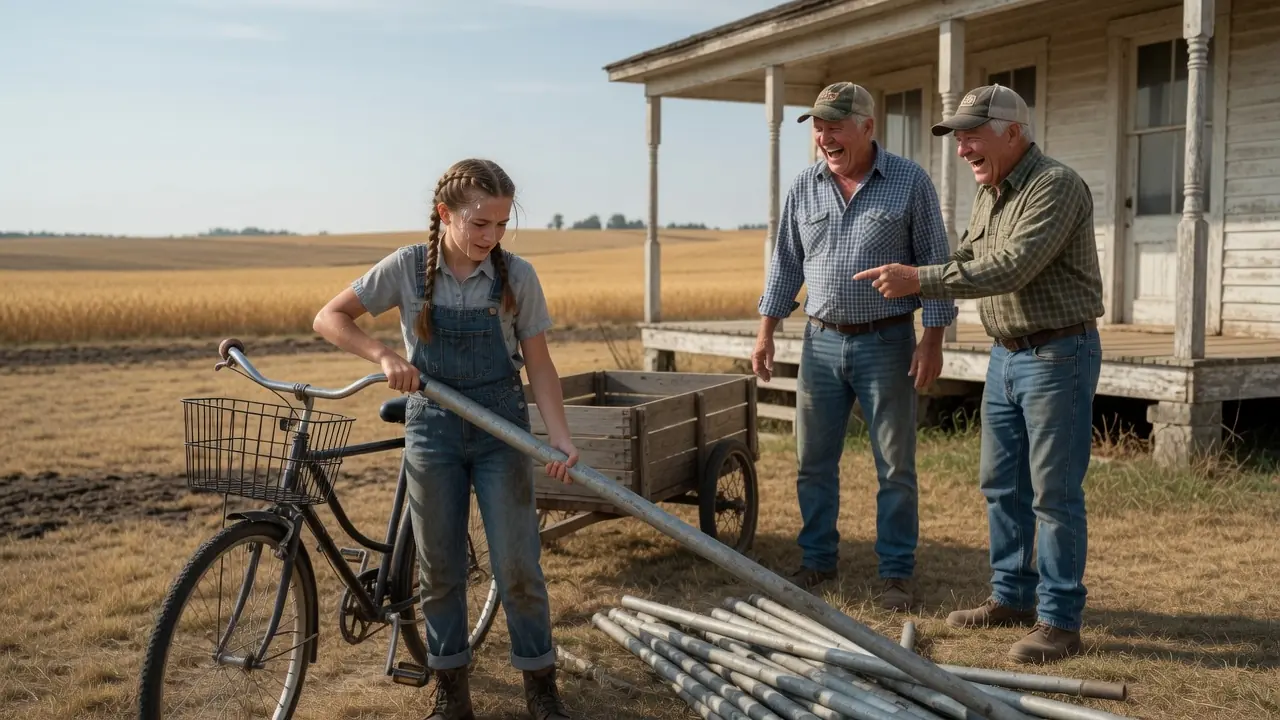
Every Saturday morning, just after the heat began lifting from the fields, Clara hitched a homemade wooden trailer to the back of her bicycle and pedaled down the dirt roads of Calloway County, Kentucky.
She stopped wherever old farm equipment sat abandoned in tall grass.
Bent aluminum irrigation pipes.
Cracked PVC fittings.
Discarded valves.
Lengths of hose stiffened by years beneath the sun.
She was not gathering scrap metal to sell.
She was not building a fort.
She had one quiet purpose, and she refused to explain it.
Clara knocked on farmhouse doors and asked the same question.
“Would you mind if I took some of that old pipe?”
Most farmers stared at her for a moment before looking toward the rusted equipment beside their barns.
“That junk?”
“Yes, sir.”
“What are you going to do with it?”
“I’m still working that out.”
That answer usually made them laugh.
Not cruelly.
It was the gentle, confused laughter adults used when a child appeared completely serious about something they did not understand.
“Help yourself, honey.”
Then they leaned against porch railings and watched Clara drag pipes twice her height through weeds and load them into the little trailer her father had built from old wagon boards and bicycle wheels.
Some pieces were so long that they extended several feet behind her. She tied red cloth to the ends so drivers could see them on the road.
By the time August arrived, Clara had collected enough irrigation pipe to supply a small vegetable farm.
She stacked it behind the Whitaker barn in rows according to size.
Her older brother, Luke, called it Clara’s junkyard.
Her younger sister, Annie, called it the silver forest.
Her father said almost nothing.
Samuel Whitaker believed that children revealed themselves most clearly when adults gave them enough room to work.
So he watched.
Calloway County sat in the western corner of Kentucky, where the land rolled toward the Tennessee River in long green folds.
Families there measured time by planting seasons, school calendars, and the arrival of summer storms.
The Whitakers had farmed the same forty-two acres for four generations.
Samuel grew corn, soybeans, and a small tobacco crop when market prices made the work worthwhile. He was a patient man with broad hands and a deliberate way of speaking.
He rarely wasted words.
His wife, Ellen, kept a vegetable garden behind the farmhouse that seemed too ambitious for its size. Tomatoes climbed wooden frames. Pole beans twisted around cedar stakes. Squash leaves spread across the paths until people had to step over them.
Ellen had first placed seeds in Clara’s hand when the girl was three.
“Don’t bury them too deep,” she had said. “Small things need a chance to reach the light.”
Clara had remembered.
She remembered most things connected to soil.
The Whitaker household also included Samuel’s mother, Ruth, who lived in a room beside the kitchen.
At eighty-one, Ruth still woke before sunrise and drank black coffee at the table while reading agricultural-extension pamphlets she had saved since the 1960s.
The pamphlets filled three wooden crates.
Some discussed crop rotation.
Others explained erosion control, soil chemistry, water conservation, livestock disease, and farming methods that had gone out of fashion before Clara was born.
Ruth read them the way other people read novels.
She made notes in the margins and argued with advice written by men who had probably never repaired a fence during a thunderstorm.
It was Ruth who first noticed that Clara watched fields differently from other children.
Most children looked at crops.
Clara watched water.
After rain, she walked the property and studied where puddles formed.
She noticed where water rushed downhill too quickly, carrying soil with it.
She knew which part of the garden dried first and which remained damp for days.
She pressed her fingers into the ground and compared its texture from one field to another.
One spring morning, Ruth found her crouched beside a drainage ditch.
“What are you doing?”
“Watching.”
“Watching what?”
“The water decide where it wants to go.”
Ruth lowered herself carefully onto a stump.
“And where does it want to go?”
“Down.”
“That is usually its preference.”
Clara looked toward the upper soybean field.
“But that’s not where we need it.”
The summer Clara turned eleven was the third consecutive year of below-average rainfall in the county.
By June, the ponds had begun shrinking.
Pastures turned pale.
Creeks that normally ran through August became strings of shallow pools separated by cracked stone.
The upper field on the Whitaker farm suffered first.
Its soil contained more sand than the lower ground. Rain passed through quickly, leaving little moisture near the surface.
The soybean plants emerged well enough in spring.
Then the summer heat arrived.
By early July, their leaves had begun curling inward.
The color faded from deep green to dusty yellow.
Samuel drove the tractor slowly through the rows, studying the plants with an expression Clara recognized.
He looked the same way when opening an unexpected bill.
County extension agent Walter Grady visited twice.
Walter was a steady, practical man who had spent twenty years advising farmers through droughts, floods, insects, disease, and market crashes.
He examined the soil, pulled several plants, and studied their roots.
“The upper section needs more consistent irrigation,” he said.
Samuel removed his cap and wiped his forehead.
“I know.”
“Smaller applications more frequently.”
“That means running the pump almost every day.”
Walter nodded.
“The diesel cost won’t be pleasant.”
“The pressure drops before the water reaches the final rows.”
“I noticed.”
Clara stood nearby holding a bucket.
Adults often forgot she was listening.
“If the pressure drops while the pipe is going uphill,” she asked, “what happens to the water that doesn’t reach the top?”
Walter turned toward her.
“It slows down.”
“Does it stay inside the pipe?”
“Some of it.”
“So the pump is moving water that never reaches the plants?”
“In a manner of speaking.”
Clara nodded slowly.
It was the way she nodded when one final piece had fitted into a problem she had already been turning over in her mind.
Walter looked toward Samuel.
“How old is she?”
“Eleven.”
“I know engineers who ask worse questions.”
That conversation took place in May.
Clara began collecting pipes in June.
What she understood was simple enough to describe but difficult to build.
Water did not care about the price of diesel.
It did not care whether a farmer could afford another pump.
It responded to gravity, pressure, resistance, and the path made available to it.
The spring-fed pond at the bottom of the Whitaker property never went dry, but it sat fourteen feet below the upper soybean field.
Water could not flow uphill without mechanical help.
The adults considered that the end of the discussion.
Clara did not.
At the northern edge of the farm was a shallow natural draw where storm water gathered after heavy rain.
It looked unimpressive most of the year—just a low section of ground bordered by weeds and scrub trees.
After storms, however, it held thousands of gallons.
The water often remained for several days before soaking into the soil or evaporating.
More importantly, the draw sat approximately nine feet above the struggling soybean field.
Clara had measured the elevation using string, stakes, a carpenter’s level, and patient help from Annie, who did not always understand the project but enjoyed carrying tools.
Nine feet was not much.
But according to one of Ruth’s old pamphlets, it might be enough.
The pamphlet described gravity-fed irrigation systems used before electric pumps became common. Water stored at a higher elevation moved through a main pipe and into narrower distribution lines.
Another pamphlet explained drip irrigation.
Instead of spraying water across the soil, narrow lines delivered slow drops near plant roots. Less water evaporated in the air. Less ran down the slope. Fewer weeds grew between rows.
Clara spread the pamphlets across Ruth’s kitchen table.
“You planning to read all of those?” Ruth asked.
“I already did.”
“Then what are you planning?”
Clara pointed toward a diagram.
“If I collect the storm water in the north draw, I don’t have to move it uphill.”
“No.”
“It’s already above the field.”
“It is.”
“If I use a big pipe first, then smaller ones near the rows, gravity should make enough pressure.”
Ruth studied her granddaughter.
“Should?”
Clara looked down at the drawing.
“I haven’t built it yet.”
“That does make testing difficult.”
“I need pipe.”
Ruth glanced toward the growing collection behind the barn.
“I suspected as much.”
Clara used money earned from selling eggs to buy one roll of drip tape at the farm-supply store in town.
The clerk placed the roll on the counter.
“What is your father building?”
“He isn’t.”
The clerk looked at her.
“What are you building?”
“I’ll tell you if it works.”
Her first system was not impressive.
It looked like something assembled after a storm from pieces washed into the same ditch.
Clara used sections of aluminum irrigation pipe her father had replaced years earlier. She connected them with mismatched PVC fittings, rubber sleeves, wire clamps, and plumber’s tape.
She dug shallow trenches from the draw toward the upper field.
On the first Saturday, Samuel watched from the barn.
Clara worked for nearly an hour with a shovel almost as tall as she was.
The July soil had hardened beneath the sun.
Each cut into the ground produced only a thin layer of dust and clay.
Samuel eventually walked toward her carrying another shovel.
Clara looked up.
“Are you going to ask what I’m doing?”
“No.”
“Why not?”
“You’ll tell me when you’re ready.”
He began digging beside her.
That was Samuel’s way.
Luke joined them only after their mother threatened to assign him kitchen work instead.
“This is a waste of summer,” he complained.
Clara kept digging.
“You said that about the chicken coop.”
“The chicken coop was a waste of spring.”
“You eat the eggs.”
“That is unrelated.”
Annie followed behind them, dropping fittings into the trench until Clara explained that the pieces had to remain clean.
By evening, the first section reached the edge of the field.
Clara built a small collection basin in the natural draw using boards, stones, and a piece of pond liner salvaged from a neighbor’s renovation.
A screened inlet kept leaves and insects from entering the pipe.
The first rain arrived three days later.
Not a storm.
Just enough water to fill the basin several inches.
Clara opened the valve.
Water entered the main line.
She ran downhill beside it, listening to the faint movement inside the pipe.
At the first connection, water appeared.
Then at the second.
At the third joint, a stream burst sideways.
Another leak opened several feet farther down.
Before the water had traveled ten yards, most of it was running across the ground.
Luke leaned against a fence post.
“Successful?”
Clara closed the valve.
“No.”
“Was that the purpose?”
“No.”
Samuel gave Luke a look.
The boy returned to the barn.
Clara knelt beside the leaking joint.
Her hands were muddy.
The first failure did not surprise her.
It disappointed her, but disappointment was information.
She removed every connection.
For two days, she cleaned threads, replaced worn seals, added plumber’s tape, and cut rubber sleeves from an old tractor inner tube.
The second test occurred after Samuel carried several barrels of pond water to the draw so Clara would not have to wait for rain.
This time, the main line held.
Water reached the upper field.
Clara attached the drip tape.
At first, nothing happened.
Then one emitter released a weak drop.
Another began dripping several feet away.
The first row received some water.
The remaining lines stayed nearly dry.
Clara walked the full length of the system.
The water pressure had disappeared before reaching most of the plants.
That evening, she sat at Ruth’s kitchen table without eating supper.
The pamphlets surrounded her.
Ellen placed a plate beside her.
“Food helps thinking.”
“I used too much narrow pipe.”
“Food may still help.”
Clara opened a pamphlet explaining flow rates.
Pipe diameter affected more than the amount of water moving through a line. Narrow pipe created greater friction. Pressure losses accumulated across long distances and multiple fittings.
The main line she had built was too small.
She needed a larger pipe near the collection basin, then gradually smaller pipes closer to the plants.
She also needed fewer sharp turns.
The next Saturday, Clara rode six miles to the farm of Franklin Hayes.
Franklin had operated a commercial vegetable farm before retiring in 2010. His main barn remained filled with old irrigation equipment.
He opened the door when Clara knocked.
She explained what she needed.
“Two-inch aluminum main line,” she said. “The longer sections if you still have them.”
Franklin scratched his chin.
“What do you have to trade?”
Clara showed him several smaller pipes on the trailer.
He inspected them.
“These aren’t worth much.”
“They don’t have to be worth much. They only have to be useful to you.”
Franklin looked at the girl, then toward the barn.
“What are you doing with the larger pipe?”
“Trying to water our upper field without running a pump.”
He laughed once.
Then he saw she was serious.
“That field is uphill from the pond.”
“I’m not using the pond.”
“What are you using?”
“The north draw.”
Franklin’s expression changed.
“That doesn’t hold water long.”
“It doesn’t need to if I move the water while it’s there.”
He leaned against the doorframe.
“And you think nine feet of drop gives you enough pressure?”
“I think it might.”
“Might?”
“The first two systems didn’t work.”
Franklin stared at her for several seconds.
Then he opened the barn.
“I’ll trade.”
He selected six lengths of larger pipe, two valves, and several fittings.
Clara began unloading her smaller pieces.
Franklin stopped her.
“Keep yours.”
“But that isn’t a trade.”
“It is.”
“For what?”
He smiled.
“Your stubbornness.”
She frowned.
“You can’t use stubbornness on a farm.”
Franklin laughed.
“Give it time.”
The third version took two weeks.
Samuel helped Clara lift the large sections into position.
Luke repaired the wooden supports after one collapsed.
Annie carried bolts and asked questions no one could answer.
Ruth sat beneath a shade tree with the pamphlets open on her lap and called out measurements when Clara forgot them.
They raised the collection basin slightly, straightened the main line, and reduced the pipe diameter gradually near the field.
Clara added a simple filter made from mesh and gravel.
She installed valves so each group of rows could be controlled separately.
Then they waited for rain.
The storm arrived on an August afternoon.
Clouds gathered above the county, darkening the sky until the fields looked almost silver.
Rain fell hard for forty minutes.
The north draw filled rapidly.
Water spread across the basin and pressed against the inlet screen.
Clara stood beneath a raincoat far too large for her.
Samuel waited beside her.
“You ready?”
“No.”
He looked down.
“That ever stopped you before?”
Clara opened the main valve.
Water entered the two-inch pipe.
The line trembled slightly.
They followed it downhill.
The first joint held.
So did the second.
At the edge of the field, water entered the narrower distribution pipe.
Clara opened the row valves.
For several seconds, nothing happened.
Then the first emitter darkened the soil beneath a soybean plant.
Another followed.
Then another.
Drops appeared along the full length of the row.
Clara ran toward the far end.
The final emitter released a slow, steady pulse of water.
She stared at it.
Rain moved across her face.
Samuel stood several yards away.
“Well?” he asked.
Clara touched the wet soil.
“It reached the end.”
“Looks that way.”
“It worked.”
Samuel smiled.
It was not a large smile.
He was not a man given to large displays.
But Clara would remember it for the rest of her life.
The system did not solve every problem immediately.
The draw depended on rainfall, so Clara and Samuel expanded the basin and added barrels to capture runoff from the barn roof.
They covered part of the storage area to reduce evaporation.
Clara adjusted emitters almost every day.
Some clogged.
Some released too much water.
One connection failed during the night and drained half the storage basin before morning.
She repaired each weakness.
By mid-August, the upper soybean field had changed.
Samuel noticed first.
He walked the rows before sunrise and stopped where Clara’s drip lines ended.
On one side, the plants stood upright with wide, deep-green leaves.
On the other, the same variety remained pale and curled from heat stress.
He knelt and pressed his fingers into the ground beneath an emitter.
The soil was cool and moist.
Between the rows, it remained mostly dry.
Water was reaching the roots instead of feeding weeds or evaporating from the entire surface.
He walked the field twice.
Then he found Clara lying in the dirt beside a row, adjusting a damaged line.
“How much water is this using?” he asked.
Clara sat up.
She showed him a notebook.
She had measured the storage barrels, estimated flow through the main line, and recorded how long each valve remained open.
Samuel studied the numbers.
“This can’t be right.”
“I checked twice.”
“You’re using less than half the water.”
“A little over forty percent of the normal system.”
Samuel looked toward the plants.
“And no diesel.”
“No.”
He remained silent for a long time.
Then he handed back the notebook.
“You want to extend it to the east field?”
Clara wiped dirt from her cheek.
“Yes.”
“Thought you might.”
County extension agent Walter Grady returned in September.
This time, his visit was official.
Samuel had telephoned him and said only that his daughter had built something worth seeing.
Walter arrived carrying a clipboard.
Clara walked him through the entire system.
She explained the collection basin, the elevation drop, the step-down pipe design, and the emitter lines.
Walter asked questions.
Clara answered most of them.
When she did not know, she said so.
That impressed him as much as the system itself.
“How much did this cost?”
“Twenty-three dollars for the drip tape and fourteen for fittings.”
“What about the pipe?”
“People gave it to me.”
“Labor?”
“My family.”
Walter looked across the field.
The difference between irrigated and unirrigated rows was visible from the road.
“I have seen gravity-fed drip systems,” he said. “I have seen systems built from salvaged materials.”
He looked at Clara.
“I have never seen both put together this effectively by an eleven-year-old.”
Clara shifted uncomfortably.
“It leaked a lot at first.”
“Most useful things do.”
Walter asked permission to bring an agricultural-engineering student from Murray State the following spring.
Clara agreed, provided the student helped dig.
A reporter from the county newspaper arrived the next week.
Her article appeared below the fold on the front page.
The headline called Clara a young agricultural innovator.
Clara thought the word sounded embarrassing.
Luke clipped the article and taped it above her bedroom door.
She removed it.
He replaced it.
By October, word had traveled across the county.
The farmers who had given Clara their pipes began arriving at the Whitaker farm.
Some came alone.
Others brought wives, children, or neighbors.
They had watched Clara load their discarded equipment and laughed from their porches.
Now they came expecting to be polite.
They were not prepared for what they saw.
The upper field was a different color from nearly every other soybean field in the county.
Across the surrounding farms, plants stood thin and yellow after the long dry summer.
Clara’s rows were dense and green.
The canopy nearly concealed the soil.
Pods hung heavily from the stems.
One farmer named Henry Lawson entered the field and pulled a pod from a plant.
He split it open with his thumbnail.
The beans inside were full.
He looked toward Clara standing near the collection valve with mud on her boots.
“What did you do differently?”
Clara showed them.
She led the group uphill toward the north draw.
She explained how storm water that once pooled and disappeared was now collected and released slowly.
She pointed out the wide main pipe and the smaller distribution lines.
She lifted the drip tape and showed the emitters beneath it.
“Water goes near the roots,” she said. “It doesn’t have to wet everything.”
The farmers walked the network quietly.
They recognized sections of pipe from their own fields.
A valve from Lawson’s old tobacco system.
An aluminum length from the Morrison farm.
Couplings Franklin Hayes had stored for more than a decade.
What they had considered waste had become part of something none of them had imagined.
The laughter was gone.
In its place was something quieter.
Respect often arrived later than laughter.
But when genuine, it stayed much longer.
Henry Lawson removed his cap.
“Would you help me build one before spring?”
Clara looked toward Samuel.
Her father nodded.
“Yes,” she said.
Another farmer asked.
Then another.
Through winter, the Whitaker kitchen became an unofficial planning office.
Farm maps covered the table.
Ruth’s old pamphlets remained open beside new extension manuals.
Clara helped neighbors identify natural slopes, collection areas, and possible pipe routes.
She never pretended one design would work everywhere.
Some farms lacked enough elevation.
Others needed pumps for part of the system.
Several had soil too heavy for the same emitter spacing.
Clara learned that solving one problem did not make her an expert on every field.
She listened.
She measured.
She asked questions.
Franklin Hayes helped her calculate pressure losses over longer runs.
Walter Grady arranged for soil and water testing.
Samuel taught her how to estimate labor realistically.
Luke stopped calling the pipes junk.
Annie continued calling them the silver forest.
The following spring, three neighboring farms installed small gravity-fed drip systems using salvaged material.
None looked exactly like Clara’s.
That was the point.
Each system matched the land it served.
The drought did not disappear.
But the farms wasted less water.
Diesel costs fell.
Several families produced stronger yields in the upper sections of their properties.
The success attracted more attention.
State agricultural officials visited.
A university researcher interviewed Clara.
Someone invited her to speak at a regional farming conference.
She refused at first.
“I don’t want to stand on a stage.”
Ruth looked up from her coffee.
“You were willing to stand in a field while grown men laughed.”
“That was different.”
“Yes. It was harder.”
Clara eventually agreed.
She stood behind a wooden lectern before nearly two hundred farmers and explained the system without dramatic language.
She did not call it revolutionary.
She did not describe herself as a genius.
She showed photographs of failed joints, clogged emitters, and pipes that had burst under pressure.
“The first one didn’t work,” she said.
A few people smiled.
“The second one didn’t work very well either.”
More smiles.
“The third one worked because I knew what was wrong with the first two.”
That sentence became the part people remembered.
Not the headline.
Not her age.
The failures.
Clara understood something many adults struggled to accept.
A failed attempt was not always proof that an idea was bad.
Sometimes it was simply a measurement.
A year after she began collecting pipe, the east field had its own expanded system.
Franklin helped with the calculations.
Samuel built a larger storage basin.
Luke installed supports without complaining much.
Annie painted small numbers on each valve so no one would open the wrong section.
Ruth continued reading pamphlets.
She remained the only person who never seemed surprised by what Clara had done.
One evening, Clara asked her why.
“You never laughed.”
Ruth turned a page.
“I have lived too long to laugh at a person who pays attention.”
“But you didn’t know it would work.”
“No.”
“You could have thought it was foolish.”
“Most useful ideas look foolish before they become familiar.”
Clara considered that.
Outside the kitchen window, sunlight reflected from the salvaged aluminum lines.
The pipes no longer sat rusting at the edges of forgotten fields.
They carried water.
They protected roots.
They connected farms and families that had once viewed them as worthless.
Years later, people would remember the summer of the pipes as the beginning of Clara Whitaker’s work.
She studied agricultural engineering.
She returned to western Kentucky after college and helped design low-cost irrigation and water-capture systems for small farms throughout the region.
Her projects used modern tools, but she never lost her interest in overlooked materials and simple forces.
Gravity.
Pressure.
Shade.
Soil.
Rain.
She often told farmers that expensive equipment could make work easier, but it could not replace observation.
The most important part of any system remained the person willing to study the land closely enough to understand what it was already trying to do.
Samuel farmed well into old age.
Luke eventually took over much of the operation.
Annie became a teacher and used Clara’s first irrigation diagram in her science classroom.
Ruth’s pamphlets were donated to the county agricultural library, except for one.
Clara kept the gravity-irrigation pamphlet that had started everything.
The paper became soft at the folds.
Her grandmother’s handwriting remained in the margin beside a diagram of a hillside reservoir.
Water does not need to be forced when it can be shown where to go.
Clara framed the sentence above her desk.
But the deepest harvest from that summer could not be measured in soybeans, water savings, or newspaper articles.
It was found in the habits that formed around the work.
A child watched where adults had stopped looking.
She asked for things people considered worthless.
She accepted help without surrendering ownership of the idea.
She failed twice and returned to the field.
Her father trusted her enough not to demand an explanation before offering a shovel.
Her grandmother gave her old knowledge without treating it as outdated.
Her neighbors learned that experience did not always make them the first to notice a solution.
That October, when the farmers stood in the green upper field, they were not merely looking at healthier soybeans.
They were seeing their own discarded materials transformed by attention, patience, and imagination.
They were also seeing the eleven-year-old girl differently.
Not because she had demanded their respect.
Because she had built something that made laughter impossible.
On the final warm afternoon of that year, Clara walked alone through the upper rows.
Most of the crop had already been harvested.
Dry leaves moved across the ground.
The drip lines lay empty beneath the stubble, waiting for winter storage.
She stopped beside one of the original aluminum pipes.
A faded red cloth still hung from its end—the same cloth she had tied there while hauling it home behind her bicycle.
Samuel approached from the barn.
“You keeping that piece?”
“Yes.”
“It leaks.”
“I know.”
“It’s too bent for the new system.”
“I know.”
He looked at her.
“Then why keep it?”
Clara ran one hand across the scratched aluminum.
“Because it was part of the first one.”
“The one that failed?”
She nodded.
Samuel smiled.
“That seems worth remembering.”
Together, they carried the bent pipe toward the barn.
The field behind them had turned brown beneath the late-autumn sky.
But below the surface, the soil still held moisture.
And stacked beneath the roof were the pieces of a system that had begun with an eleven-year-old girl riding down Kentucky dirt roads, asking farmers for the things they no longer believed had value.