The command came while Caleb Rowan still held one shoe in his hand. “Step aside, sir, we need to move quickly,” the security officer said, shifting half a step until his body blocked the path leading from the screening lane into the concourse. Caleb glanced toward the metal detector he had just passed through, then toward his briefcase emerging untouched from the X-ray conveyor. No alarm had sounded, no light had flashed, and nobody had called for a hand search until he was almost finished putting himself back together.
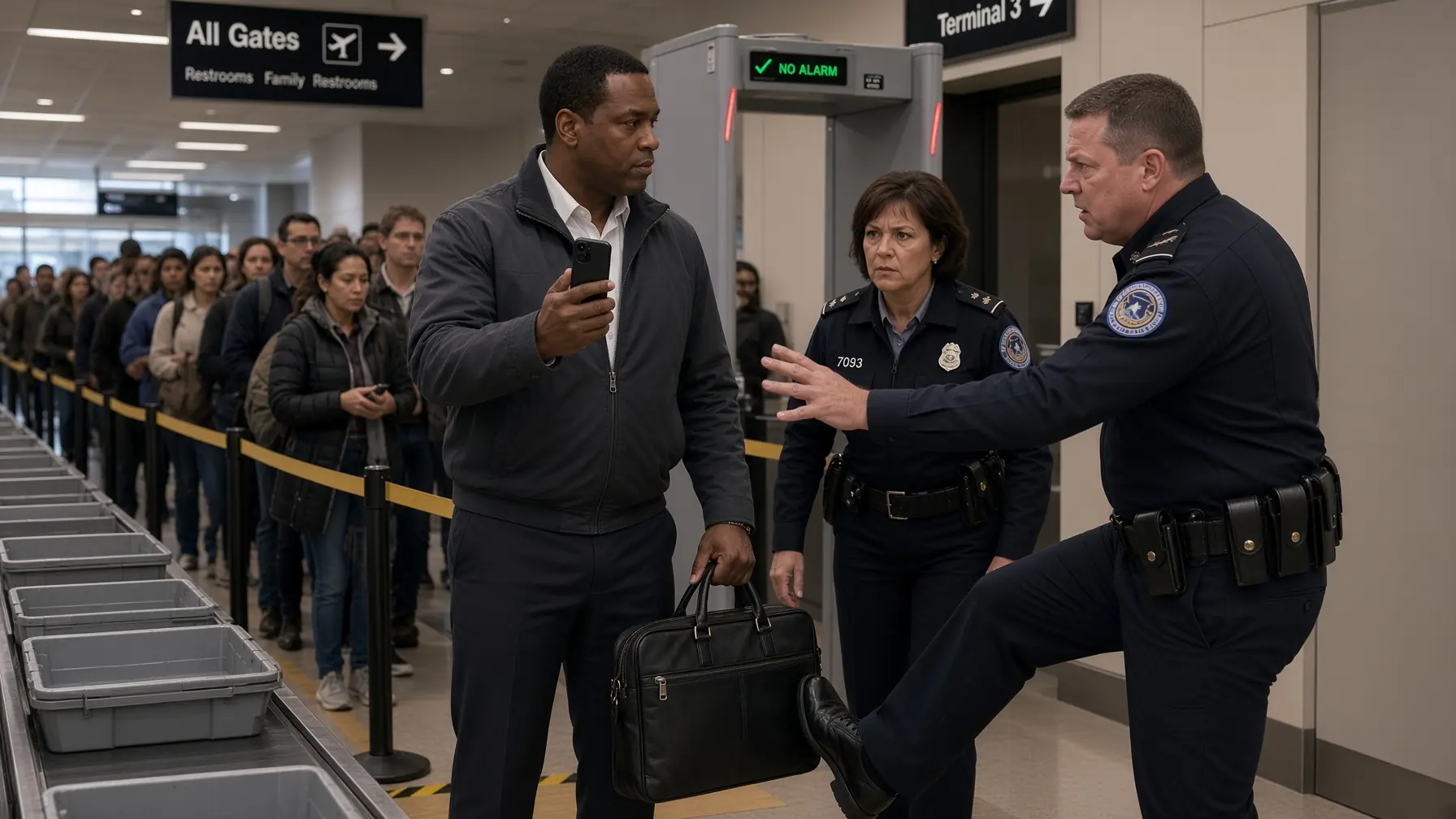
Caleb lowered the shoe to the floor and slipped it on slowly. “Is there a problem with my screening?” he asked, keeping his voice level enough that the passengers behind him would not mistake the question for an argument. The officer’s badge read GRANT HOLLIS, though Caleb had to angle his head slightly to see it beneath the fluorescent glare. Hollis did not answer the question and simply repeated, “Additional screening, step aside.”
Caleb was fifty-seven years old and had been traveling through American airports for more than three decades. He had been selected for additional screening before, had his bag opened, his hands tested, his shoes rescanned, and once waited forty-five minutes while security tried to identify a piece of specialized measuring equipment inside a carry-on. He did not believe being selected automatically meant discrimination, incompetence, or abuse. What bothered him was Hollis’s expression before Caleb had asked anything, a look less concerned with determining whether screening was complete than with establishing which one of them controlled the next thirty seconds.
“I cleared the detector,” Caleb said. “I’m asking what triggered the additional screening.” Hollis kept his shoulders square and answered with one word. “Random.” Caleb nodded once, then asked, “Computer selection or officer discretion?”
The line behind him continued moving until a plastic bin touched the heel of Caleb’s shoe. Another screening officer, a younger white man named Travis Boone, approached from the adjacent station with both hands resting high on his duty belt. “Sir, don’t make this difficult,” Boone said, glancing past Caleb toward passengers retrieving bags. “We’ve got people trying to get through.”
“I understand,” Caleb answered. “I’m cooperating, and I’m asking what the basis is.” Boone exhaled through his nose and replied, “You were told it’s random.” Caleb looked toward the display attached to the lane because he knew enough about screening systems to understand that many random selections produced an electronic notation. Nobody else looked at the display.
A woman behind Caleb reached for her roller suitcase and hurried away. A middle-aged man in a gray business suit slowed instead, watching the exchange while pretending to organize his laptop bag. Hollis used the side of his shoe to push Caleb’s briefcase farther from the walking lane and said, “Move your stuff, you’re holding everybody up.” Caleb bent down, pulled the briefcase upright, and kept one hand around the handle.
“I haven’t refused anything,” Caleb said. “I just want the selection documented correctly.” Boone replied, “We don’t have to explain our security procedures to you.” That was the first answer Caleb considered important enough to remember word for word.
He reached carefully into his jacket and removed his phone. Hollis immediately said, “No recording here.” Caleb unlocked the screen, pointed the camera toward his own chest rather than the screening equipment, and replied, “I’m documenting my interaction without obstructing the lane.” Boone told him recording was prohibited, though the airport’s posted rules contained no blanket ban in that public portion of the terminal.
Caleb knew because he had checked six months earlier after another traveler’s phone was taken during a dispute at the same airport. His consulting work involved internal controls, regulatory compliance, and investigations for transportation companies, so policies were the sort of documents he read even when they did not directly concern him. He also knew that being technically right about a rule did not make confrontation strategically intelligent. His objective was not to win an argument beside a metal detector.
“It is 6:02 a.m. at Easton International Airport, Terminal Three,” Caleb said into the phone. “I cleared primary screening without an alarm and have been directed to additional screening after being told the selection was random.” He added, “I have asked whether the random selection was generated by the system or by officer discretion, and I have not been given that information.”
“Put the phone away,” Hollis said. Caleb asked whether the order was a condition of being screened. Hollis looked at Boone, and Boone raised his radio.
“Supervisor needed at exit lane,” Boone said. Caleb lowered the phone slightly but did not stop recording his own voice. He could hear passengers behind him beginning to whisper.
The man in the gray suit remained several yards away. He lifted his phone chest-high and pointed it toward the floor as though reading a message, though Caleb could see from the reflection in the glass beside the lane that the camera faced outward. Hollis saw him too and called, “Sir, move along.” The man answered, “I’m not in the lane.”
Footsteps approached from the side corridor. A woman in a dark-blue supervisor’s uniform entered the area, took one look at the stopped flow of passengers, then at the two phones and the security staff surrounding Caleb. Her nameplate read IRENE WALSH, and unlike Hollis, she did not begin by issuing an order. She asked, “What’s the issue?”
“Random secondary,” Hollis answered. “Subject refusing to comply and recording the checkpoint.” Caleb looked directly at Walsh and said, “I have not refused screening.” Walsh turned toward him.
“What are you refusing?” she asked. Caleb replied, “Nothing.” He explained that he had passed primary screening without an alert, was told the additional screening was random, and asked whether a random-selection flag had actually been generated. Walsh’s gaze shifted toward Hollis.
“What indicator?” she asked. Hollis hesitated. Caleb watched the hesitation rather than the officer.
“Behavioral,” Hollis finally said. Walsh’s forehead tightened. “You said random.”
Hollis glanced toward Boone. “It started random, and then his behavior became an issue.” Caleb said, “My only behavior before the secondary request was putting my shoe on.” Walsh did not respond to him immediately.
Instead, she stepped toward the screening console. She asked the operator to pull the lane record for Caleb’s passage. The operator touched several controls, studied the display, and said something quietly that Caleb could not hear.
Walsh turned around. “Mr. Rowan, you are free to proceed.” Caleb asked, “Was there a random-selection flag?” She paused.
“No system-generated flag is showing on this record.” Hollis shifted his stance. Caleb felt something inside him become very still.
He did not say, I knew it. He did not accuse Hollis of racism, profiling, or lying even though all three possibilities had moved higher on his list. Instead he asked for Walsh’s name, employee number, the corresponding identifiers for Hollis and Boone, and a complaint form. Walsh provided all of them without argument.
Hollis muttered, “This didn’t need to become a thing.” Caleb slid his shoe completely on and closed his briefcase. “I agree,” he said.
Walsh returned with a folded complaint sheet. Caleb checked the top of the form before placing it inside his briefcase, then asked whether he was required to remain in the screening area. Walsh answered no.
Caleb nodded. “Then I’ll move out of the checkpoint and finish my documentation somewhere I’m not obstructing traffic.” He turned toward the concourse.
Hollis called after him, “Proceed to your gate.” Caleb stopped long enough to look back.
“I am.” Then he kept walking.
He reached a wide pillar approximately fifty feet beyond the checkpoint, where passengers waited for coffee and adjusted luggage without blocking the flow. Caleb stood beside the wall, brought the phone back up, and recorded the time as 6:07. He described the lane number, the names he had been given, the difference between Hollis’s first explanation and his later reference to behavior, and Supervisor Walsh’s statement that no random-selection flag appeared in the system.
The man in the gray suit approached carefully. “I recorded some of it,” he said. Caleb stopped his own recording and looked at him.
“My name’s Howard Bell,” the man continued. “I saw them pull you over after you cleared.” Caleb thanked him.
Howard offered to send the video. Caleb opened a new contact entry and handed him the phone. Howard typed his name, number, and email, then added, “For what it’s worth, I fly every Monday, and I’ve watched that guy stop people before.”
Caleb looked toward the checkpoint. “What people?” Howard hesitated.
“Mostly Black men.” Caleb waited.
Howard added, “Could be coincidence.” Caleb nodded. “Could be.”
That was the first moment the morning changed for him. Until then, Caleb had been thinking about one undocumented screening decision and one officer who disliked being questioned. Howard’s observation introduced the possibility of repetition.
Possibility was not proof. Caleb had spent thirty years telling companies that investigations became unreliable the moment investigators started treating suspicions as conclusions. He thanked Howard again and asked whether he would be willing to speak with investigators if a formal complaint reached that point. Howard said yes.
Caleb boarded Flight 817 to Minneapolis eleven minutes before the door closed. He chose the aisle seat he had booked weeks earlier, placed his briefcase beneath the seat in front of him, and turned his phone off before takeoff. Around him, passengers settled into ordinary travel irritation, arguing with overhead bins and trying to fit coats around luggage. Nothing in the cabin suggested that six minutes at an airport checkpoint would become more than an unpleasant story Caleb told his wife over dinner.
The trip itself mattered more than the airport incident. Caleb’s seventy-nine-year-old mother, Lucille Rowan, was scheduled for a cardiac procedure at University Hospital the following morning. His older sister Patrice had been handling appointments for weeks, but she called three days earlier and admitted she was frightened enough to want Caleb there. Caleb booked the first flight he could find.
That was why he refused to let Hollis’s behavior turn into an arrest, missed departure, or confrontation. His mother had spent forty years reminding him that being right did not automatically make every fight worth having at every moment. “Choose the outcome before you choose the argument,” Lucille used to say when Caleb and Patrice fought as children. He had heard the sentence in his head while standing beside the detector.
The seatbelt sign switched off twenty minutes after takeoff. Caleb retrieved his phone, connected to the onboard network, and saved the recording to encrypted cloud storage. He emailed the original file to himself with the plain subject line Terminal 3 Morning, then created a second message containing Howard Bell’s contact information.
Next he unfolded the complaint form. He wrote the flight number at the top because he wanted the timeline to show why he had left rather than continued arguing at the checkpoint. He recorded the names exactly as they appeared on the badges and avoided adjectives.
He did not write hostile. He wrote Officer Hollis stated the screening was random, then later described the basis as behavioral after Supervisor Walsh asked for the system indicator. He did not write racist because racism was a conclusion his evidence did not yet establish.
Across the aisle, a woman glanced at the form and then away. Caleb wrote for nearly forty minutes. When he finished, the complaint sounded less dramatic than the interaction had felt.
That pleased him. Accurate documents were often emotionally disappointing. He considered that a strength.
Caleb had built a career around that idea. After earning an engineering degree in his twenties, he spent fifteen years in commercial aviation quality assurance before moving into compliance investigations, where he examined maintenance errors, vendor fraud, procurement failures, and regulatory breakdowns. His job rarely involved discovering cartoon villains. Most serious failures emerged from small shortcuts tolerated long enough to become normal.
He had seen mechanics falsify inspections because supervisors rewarded departure times more aggressively than documentation. He had seen managers ignore complaints because the employee causing them produced strong numbers. He had watched companies write perfect policies and then create incentives that made following those policies professionally inconvenient. Experience had made him suspicious of explanations that depended on one bad person.
Hollis might be one bad person. Caleb hoped he was. One individual could be disciplined more easily than a system could be repaired.
The plane landed at 9:11. Caleb waited until the crowd thinned because his briefcase was already under the seat and there was no reason to join seventy people competing for the same aisle. When he reached the terminal, a message from Howard Bell was waiting.
Video attached. I started recording after the phone dispute, but you can hear the supervisor asking what indicator was generated. Let me know if anyone contacts me. Caleb downloaded the file and saved two copies.
Patrice picked him up outside arrivals. She hugged him, pulled back, and immediately asked why he looked annoyed. Caleb said, “Airport.”
She groaned. “Delayed?”
“No.”
“Bag lost?”
“No.”
She stared. “Then why are we discussing the airport?”
Caleb placed his briefcase in the trunk. “I got selected for additional screening after I cleared.”
Patrice shut the trunk. “That happens.”
“I know.”
She waited.
Caleb added, “The supervisor checked the system and there was no random selection.”
Patrice stopped walking. “What?”
He gave her the condensed version during the drive to the hospital. She became angry faster than he had and asked why he had not demanded airport police, a written incident report, and the immediate removal of Hollis.
“Because Mom’s surgery is tomorrow.” Caleb looked out the window.
Patrice said, “So?”
“So I got on the plane.”
She shook her head. “You are maddening.”
“I learned from you.”
“You did not.”
They reached the hospital before lunch. Lucille was more irritated by the bland food than worried about the procedure. She listened while Patrice told the airport story with enough dramatic additions that Caleb interrupted twice to correct her.
Lucille looked at him. “Did they touch you?”
“No.”
“Take anything?”
“No.”
“Make you miss the plane?”
“No.”
“Did you write it down?”
“Yes.”
She nodded. “Then handle it after they fix my heart.”
Patrice threw both hands up. “This family is impossible.”
Lucille smiled. “That’s why you keep coming back.”
The procedure went well. Caleb spent most of the next day in a waiting room beside Patrice while their mother recovered. The airport complaint remained inside his briefcase.
That evening he finally completed it online. He uploaded his recording, Howard’s recording, photographs of the paper form, his boarding pass, and a concise chronology. The last question asked what resolution he sought.
Caleb thought about it longer than any other field. He did not ask for money. He wrote, Confirm the legitimate basis, if any, for the additional screening; determine whether the selection was properly documented; preserve lane data and relevant communications; and review whether similar undocumented discretionary selections have occurred.
Patrice read the paragraph over his shoulder. “That sounds like homework.”
“It’s a complaint.”
“You don’t want them to apologize?”
“Not yet.”
She stared. “You are the only person I know who wants an audit more than an apology.”
“Apologies don’t leave metadata.”
Patrice laughed despite herself.
The first reply arrived the next morning. It was automated, assigned a reference number, and stated that his complaint had been received. Caleb expected nothing more for weeks.
Two days later, another message arrived from a human investigator named Claire Donovan. She asked for permission to retain the original recording, contact Howard Bell, and request relevant airport surveillance. Caleb replied, You have my consent.
The speed surprised him. He wondered whether complaints involving screening documentation were treated more seriously than he had assumed. Another possibility occurred to him.
They might already know the name Grant Hollis.
Claire called three days later. Her voice carried the careful neutrality of someone trained not to validate a complainant’s theory before reviewing evidence.
“You cleared primary screening?” she asked. Caleb said yes.
“No audible or visual alarm that you observed?”
“None.”
“You were told the secondary screening was random?”
“Yes.”
“You asked whether the selection was system-generated?”
“Yes.”
“What happened after that?”
Caleb described the rest.
Claire asked whether Hollis used racial language. Caleb said no.
“Did Officer Boone?”
“No.”
“Did either officer make a statement referencing your race?”
“No.”
“Then why did you request review of similar selections?”
Caleb gave Howard’s observation and immediately qualified it. “He may be wrong.”
Claire was silent for a second. “Understood.”
She asked whether Caleb believed he had been discriminated against. He answered, “I believe I was selected without the reason I was initially given, and I believe the officer changed his explanation after the supervisor checked the system.”
“That wasn’t my question.”
“I know.”
Claire waited.
Caleb finally said, “I’m concerned race may have played a role.”
“Thank you.”
The call lasted twenty-seven minutes. Caleb wrote the duration beside the case number.
From that point forward, the investigation moved mostly through documents. Claire requested screenshots, clarified times, and asked Caleb to verify the exact location where he stood after leaving the checkpoint.
Howard was interviewed separately. Supervisor Irene Walsh was interviewed within the agency.
Caleb learned little about those conversations. That was normal.
Three weeks passed. His mother returned home and resumed complaining about everyone treating her like glass. Caleb went back to Virginia and returned to work.
The airport incident became background noise until a certified letter arrived from the Transportation Screening Review Office, an independent oversight unit within the fictional federal agency responsible for Easton International’s checkpoints. The notice stated that his complaint had been referred for expanded administrative review because preliminary evidence raised questions about compliance with random-selection documentation procedures. It cautioned that the referral did not constitute a finding of discrimination or misconduct.
Caleb appreciated the caution. He placed the letter inside a folder.
Then he called Patrice. “It’s expanded.”
She answered, “See, you should have demanded an apology.”
“That is not how those two things connect.”
“I still like my version.”
The next request was larger. Investigators asked Caleb to consent to review of travel records showing how often he had passed through Easton during the preceding two years. The records might help determine whether he had encountered the same personnel before.
He agreed. Caleb traveled frequently enough that he had used Terminal Three seventeen times.
He remembered Hollis from none of the previous trips. That did not surprise him.
Security officers saw thousands of people. Travelers rarely remembered them unless something went wrong.
A month after the encounter, Claire requested another virtual meeting. This time two additional people appeared on screen: civil-rights attorney Daniel Price and data analyst Meera Shah.
Daniel explained that Caleb’s individual complaint remained active, but analysts had compared manual secondary referrals at Terminal Three against system-generated selections. They had identified statistical anomalies associated with several personnel and time periods.
Caleb leaned back. “How significant?”
Meera shared a chart.
It covered eleven months. The chart did not identify passenger names, but it separated selections by recorded basis, lane, shift, and demographic information derived only from lawful aggregate data.
One lane stood out. Early morning manual referrals occurred at more than twice the terminal average.
A second chart narrowed the data to shifts where Hollis served at the exit position. The difference became larger.
Caleb did not speak.
Meera changed the screen again. “This is not, by itself, a finding of discriminatory intent.”
“I understand.”
Daniel continued. “But your recording gave us an event where the stated reason changed after a supervisor verified that the original reason wasn’t supported by the system record.”
Caleb looked at the chart. “Anchor point.”
Meera nodded. “Exactly.”
That phrase stayed with him.
His experience was not the entire case. It was a verified incident positioned in the middle of data nobody had previously interpreted as a pattern.
Daniel said investigators were expanding the review. Caleb asked whether findings would be documented.
“Yes.”
“Will corrective action be documented too?”
“To the extent law and personnel rules permit.”
Caleb nodded.
He asked one final question. “Are you notifying other affected passengers?”
Daniel said not yet. “We’re still determining who may have experienced improper discretionary referrals as opposed to legitimate screening decisions.”
Caleb thanked them and ended the call.
For the first time since the airport, he felt angry.
Not because the charts proved everything. They did not.
He was angry because numbers showing abnormal manual referrals had existed before he arrived at the checkpoint. Nobody had asked why.
That evening Teresa, Caleb’s wife of twenty-nine years, found him sitting at the dining-room table with his laptop open and no work happening. She had been in Arizona helping their daughter with a newborn during the original incident and knew the story only from phone calls. She sat across from him and asked what the investigators found.
Caleb showed her the charts from memory rather than sharing confidential documents. Teresa listened without interrupting.
“So Howard may have been right.”
“Maybe.”
She shook her head. “You still won’t just say it.”
“Say what?”
“That they were stopping Black men.”
Caleb folded his hands. “The pattern suggests Black men were being manually referred at a higher rate on that shift.”
Teresa stared at him. “You’ve been married to a lawyer too long.”
“You’re an accountant.”
“Exactly, and even I find that sentence annoying.”
He smiled.
Teresa became serious. “What happens now?”
“I don’t know.”
That answer bothered her. It bothered him too.
The next development did not come through the agency. It came from a local television report.
A twenty-nine-year-old software technician named Andre Mercer told Channel Eight he had been repeatedly sent to additional screening at Easton International during early morning travel despite never seeing an alert. He said he filed two complaints over eighteen months and received generic responses stating that security procedures could include random screening.
Caleb watched the interview twice.
Andre described Hollis.
He did not know Caleb.
The reporter had discovered his complaints through a broader records request after rumors circulated that the terminal was under review. A second traveler appeared later in the report, a fifty-one-year-old teacher named Malcolm Reyes.
Malcolm was Latino. He described Boone telling him, “People who ask too many questions give us more reasons to look.”
No recording existed.
His complaint had been closed six months earlier for insufficient evidence.
Caleb called Claire the next morning.
“I saw the news.”
“We did too.”
“Are those cases part of your review?”
“I can’t discuss individual complainants.”
“Understood.”
Claire paused. “Mr. Rowan, if other passengers contact you, please don’t coordinate statements.”
“I wouldn’t.”
“I know.”
“Then why say it?”
“Because you’re becoming visible.”
Caleb had not considered that.
The Channel Eight reporter called him before lunch. He declined an interview.
The reporter said, “Your complaint is why the review expanded.”
Caleb replied, “That is not something I can confirm.”
“We have sources.”
“Then use them.”
The reporter laughed. “You really don’t want to be on television.”
“No.”
“Why?”
“Because television likes conclusions faster than investigations do.”
The reporter used that line without his permission but attributed it accurately.
Teresa thought it was funny. Patrice said it made him sound insufferable.
The public attention changed the agency’s response. Easton International announced it was cooperating with an independent review of screening practices and had temporarily reassigned several personnel pending completion.
No names appeared in the statement.
Hollis disappeared from the lane.
Boone was moved to administrative duties.
Walsh remained in supervision because early evidence showed she checked the system, corrected the immediate problem, documented the incident, and later reported discrepancies she discovered during internal review.
That surprised Caleb. He had initially assumed Walsh’s role would become part of the problem.
Instead, investigators learned she had filed an internal note the same morning stating that Hollis’s explanation did not match the lane record. Her note had been submitted before Caleb’s online complaint reached the agency.
Caleb called Teresa after reading the public summary.
“I was wrong about Walsh.”
Teresa asked, “You thought she was involved?”
“I thought she might be protecting them.”
“And?”
“She documented it.”
Teresa smiled. “You sound pleased to be wrong.”
“I usually am when the alternative is worse.”
That became one of the investigation’s more important lessons. A system could contain failure and correction simultaneously.
Hollis’s behavior mattered. Walsh’s response mattered too.
So did the employees who had seen patterns before and done nothing.
That group became harder to evaluate.
Investigators interviewed dozens of screeners who worked Terminal Three. Several said Hollis had a reputation for selecting “difficult-looking” passengers.
When asked what that meant, definitions changed.
One officer said travelers who stared at staff too intensely.
Another said passengers who appeared nervous.
A third said people who did not follow instructions quickly.
None of those explanations directly referenced race.
Then investigators compared whom Hollis described in shift messages.
An internal chat system preserved short operational exchanges. Most were ordinary: staffing changes, broken equipment, requests for breaks, missing bins.
Several were not.
Watch the east exit, blue hoodie has attitude.
Pull the tall one if he comes through.
Gray suit okay, let him run.
Black jacket questioning everything, secondary him.
Those messages did not identify race.
But camera review showed who the descriptions referred to.
The “gray suit” allowed through without manual referral was white.
The “black jacket questioning everything” passenger was Black.
Investigators widened the sample.
A statistical pattern strengthened.