The airport security officer opened the older man’s suitcase at 6:18 on a Monday morning.
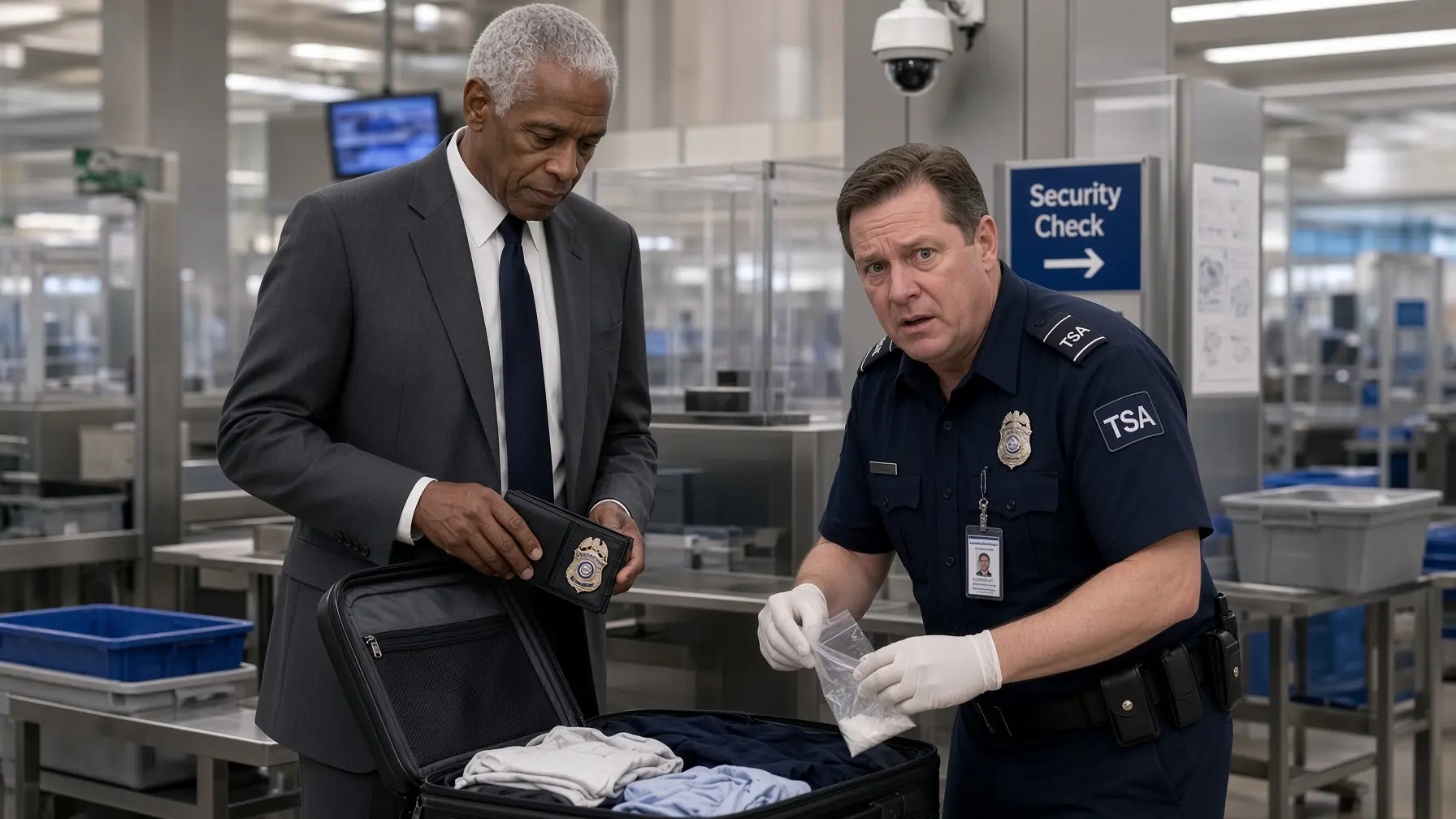
“Step back, sir.”
The traveler obeyed.
No complaint. No nervous laugh. No attempt to watch over the officer’s shoulder.
He simply moved behind the yellow line, straightened the sleeve of his dark charcoal suit, and waited while Officer Nolan Briggs pulled folded clothes from the case one piece at a time.
White shirt.
Blue shirt.
Socks.
A paperback novel.
Shaving kit.
Nothing remarkable.
Nothing illegal.
Nothing that should have taken more than two minutes to inspect.
But Briggs was not looking for anything.
He was waiting.
The checkpoint at Hawthorne International Airport was beginning to fill with the first business travelers of the morning. Plastic trays rolled along the belt. Shoes slapped against tile. Children complained. Announcements echoed from the concourse.
Almost nobody was watching Lane Four.
That was when Briggs’s right hand moved toward his own trouser pocket.
The motion lasted less than a second.
A small plastic packet disappeared beneath one of the shirts.
Briggs continued searching.
He opened the shaving kit.
Closed it.
Checked the suitcase lining.
Then reached beneath the shirt he had just moved.
“Well, well.”
He raised the plastic bag between two fingers.
Several white tablets rested inside.
The older man looked at it.
His expression did not change.
That bothered Briggs.
Most people reacted immediately.
Confusion.
Fear.
Anger.
Denial.
This man only watched.
Briggs smiled.
“You don’t look surprised.”
The traveler’s eyes shifted from the bag to Briggs.
Then toward the ceiling.
A small black camera sat above the inspection station.
Briggs glanced up but saw nothing unusual.
Security cameras were everywhere.
The older man returned his gaze to him.
“What happens now?” he asked.
Briggs had expected another kind of question.
That isn’t mine.
Where did you get that?
What are you doing?
Instead:
“What happens now?”
Briggs’s smile weakened slightly.
“Airport police.”
“Of course.”
“You carrying a prescription?”
“No.”
“Then you’ve got a problem.”
The older man nodded once.
“Maybe.”
Briggs reached for his radio.
The traveler spoke before he pressed the button.
“You should think very carefully about the next thirty seconds.”
Briggs turned.
“Is that a threat?”
“No.”
The man’s voice was almost gentle.
“It’s advice.”
Briggs stared at him.
Then keyed his radio.
“Checkpoint Four. I need airport police for suspected controlled substances.”
The traveler looked toward the camera again.
And waited.
His name, according to the boarding pass, was Thomas Avery.
Sixty-four years old.
Washington, D.C.
Destination: Seattle.
Seat 4C.
One carry-on suitcase.
One leather briefcase.
Nothing about him looked important.
That was deliberate.
Three hours earlier, in a hotel room overlooking Hawthorne Airport, Thomas Avery had stood in front of a mirror deciding which watch to wear.
He chose the cheap one.
Then removed a government-issued phone from its protective case and replaced it with an ordinary black smartphone.
His partner, Agent Maya Chen, sat at the small desk behind him studying a live feed on a laptop.
“You look like an insurance executive.”
“That’s the idea.”
“You look like an insurance executive who denies claims.”
Thomas adjusted his tie.
“Better.”
Maya looked up.
“You nervous?”
“No.”
“You always say that.”
“I’m sixty-four.”
“Age doesn’t make people honest.”
“It makes lying more tiring.”
Maya closed the laptop halfway.
“Last chance.”
Thomas turned.
“For what?”
“We can use somebody younger.”
“He’s been targeting older passengers.”
“Not exclusively.”
“Three of the six complainants were over sixty.”
“Thomas.”
He smiled.
“You’re worried.”
“I’m paid to worry.”
“So am I.”
The humor disappeared.
Maya stood.
“If Briggs does what we think he does, you do not confront him.”
“I know.”
“You do not identify yourself unless the operation commander gives the signal.”
“I know.”
“If airport police become involved—”
“I follow the plan.”
“And if Hollis shows up?”
Thomas’s expression changed slightly.
That name mattered.
Officer Nolan Briggs was only one piece of the investigation.
Airport Police Sergeant Martin Hollis was another.
For eleven weeks, the Department of Homeland Security Office of Inspector General had been examining a series of complaints from passengers traveling through Hawthorne International.
The complaints looked unrelated at first.
One passenger claimed a small packet of prescription pills appeared in his luggage during secondary screening.
Another said a security officer discovered a bag containing powder she had never seen before.
A third traveler insisted the item recovered from his backpack had been planted.
The cases had gone nowhere.
Each traveler was frightened.
None had clean video of the screening table.
Two eventually accepted civil citations for lesser violations rather than spend months fighting.
One missed an international flight.
Another lost a consulting contract because he was detained long enough to miss an important meeting.
One elderly man paid $1,800 in cash to what he believed was an airport “administrative resolution service.”
That payment was what finally attracted federal investigators.
No such service existed.
The receipt was fake.
Then investigators found camera gaps.
Not cameras turned off.
Angles.
Specific inspection stations had blind spots where an officer’s hands could disappear for a second beneath a pile of clothing.
The same four names appeared repeatedly in staffing records.
Nolan Briggs.
Caleb Wynn.
Marissa Holt.
Evan Pierce.
Different shifts.
Same secondary-screening area.
And in four of the six suspicious incidents, Sergeant Martin Hollis from airport police arrived within minutes.
That could have been coincidence.
Then investigators reviewed radio traffic.
Hollis was sometimes summoned directly before dispatch formally assigned him.
That was not coincidence.
Three weeks earlier, undercover investigators caught Caleb Wynn planting a prohibited item.
He confessed within six hours.