Sarah Mitchell bought the farm on a cold April afternoon because it was the only thing left in the world that did not ask her to prove she deserved it. The lawyer had handed her a settlement check for thirty-eight thousand dollars after twenty years of marriage, twenty years of grocery lists, dental appointments, late dinners, quiet apologies, and rooms where her own voice had slowly disappeared. Her half of everything fit inside one envelope, and the man who had once promised forever walked away with the calm confidence of someone who believed she would never know what to do without him. Sarah had sat in her car outside the lawyer’s office for nearly an hour, staring at the check, feeling less like a woman starting over and more like a woman being handed a receipt for the life she had lost.
For a week, she lived in a motel off the highway, the kind with thin towels, buzzing lights, and curtains that never fully closed. She looked at apartments she could not afford, filled out forms asking for income she no longer had, and watched her settlement shrink in her mind before she had even spent it. Every place demanded first month, last month, deposit, proof of work, and the kind of future she no longer trusted herself to explain. Then one night, while searching listings with a paper cup of motel coffee going cold beside her, she saw the farm.
Eighty acres, foreclosure auction, two hours north, minimum bid twenty-five thousand dollars. The photos showed a farmhouse with a roof that sagged like an exhausted back, a barn leaning into weeds, fields overgrown with bramble, and a machine shed that looked one storm away from giving up. In the last photo, barely visible beneath dust and bird droppings, sat a 1955 Allis-Chalmers WD tractor with flat tires and a faded orange hood. The bank description said it had not run in five years, which to Sarah should have sounded like a warning, but instead felt strangely familiar.
Her daughter Emily thought she had lost her mind. At nineteen, Emily was old enough to understand practical danger and young enough to still expect her mother to choose safety. She walked through the farm beside Sarah with her arms crossed, looking at the cracked porch steps, the broken pump, the collapsing barn door, and the mouse droppings near the kitchen wall. Sarah saw all of it too, but she also saw sky, space, soil, and silence that belonged to no one but whoever was brave enough to stay.
At the auction, no one bid against her. The bank agent read the terms, glanced around the small crowd, and looked almost embarrassed when Sarah raised her hand. Twenty-five thousand dollars bought her a failing farm, a broken house, a machine shed full of rust, and the old tractor no one thought was worth hauling away. When the papers were signed, Emily cried in the parking lot, not from happiness, but from fear that the divorce had broken her mother so badly she could no longer recognize a disaster.
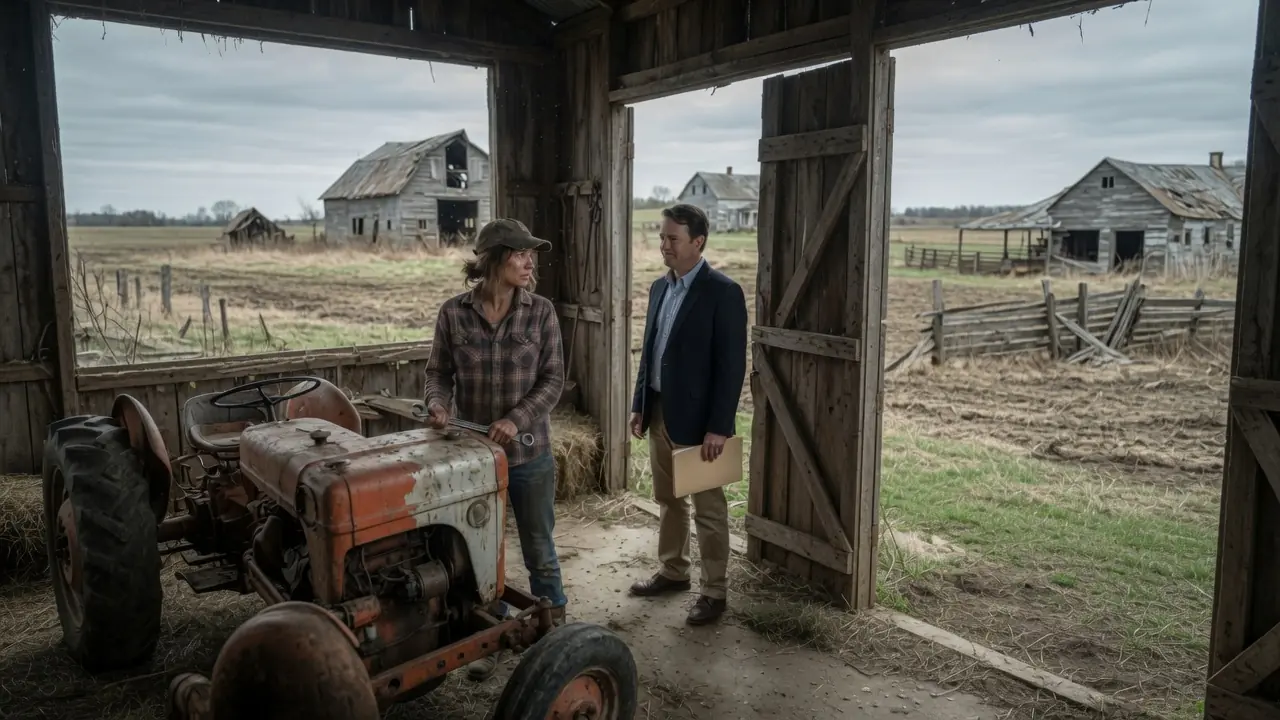
Two days after Sarah moved in, David came. He did not call first, because in twenty years of marriage he had never quite learned the difference between concern and control. His truck rolled into the yard while Sarah was inside the machine shed, standing beside the Allis-Chalmers with grease on her hands and a wrench pressed against the tractor hood. Dust floated in the cold daylight, old hay bales sat stacked against one wall, and the broken barn door creaked behind her like the whole place was listening.
“This isn’t a farm, Sarah. It’s a graveyard with a roof leak.”
The words hit harder than she expected. She had told herself his opinion no longer mattered, but the body remembers old damage before the mind can argue it away. For two decades, David had never needed to shout to make her feel small; he only had to speak like the facts were on his side and she was too emotional to see them. Standing there in the shed, Sarah felt the old version of herself rise up, the woman who would have apologized, explained, defended, and then surrendered.
But the wrench in her hand was heavy. The tractor beside her was broken, silent, and covered in grime, but it was hers. The fields outside looked wild and impossible, but they were hers too. For the first time in twenty years, every ruin around her belonged to her more honestly than the polished house she had once cleaned for a man who made her feel like a guest in her own life.
“Funny, David, because it still feels more alive than the marriage I just crawled out of.”
David’s face changed. He had expected tears, shame, maybe a plea for advice. He had not expected Sarah to stand in muddy boots with grease on her hands and answer him like a woman who had finally found the edge of her own voice. He stepped farther into the shed, careful to avoid a dark patch of oil on the concrete, and held up the divorce settlement folder as if it still gave him authority.
He told her the farm was not freedom, but humiliation. He told her the bank had wanted only twenty-five thousand because no sane person would carry the burden for free. He told her she had no farming experience, no savings to waste, no machinery that worked, and no plan beyond stubbornness. Sarah listened because every cruel sentence named a fear she had already met alone in the dark.
“Sell it before this place takes the last piece of you.”
That sentence nearly did what the others could not. Sarah looked at the Allis-Chalmers and saw what he saw for one awful second: flat tires, cracked hoses, rusted bolts, a dead battery, a machine that had failed before she even touched it. She looked through the shed doorway at the house where one room was livable, the barn that might fall before winter, and the fields that had not been cared for in years. Every number was against her, and David knew numbers had always frightened her because he had spent years using them like walls.
Then she remembered the motel room. She remembered sitting beside a vending machine eating crackers for dinner because she was afraid to spend money. She remembered apartment managers asking for proof that her life was stable, as if stability had not just been signed away in black ink. Most of all, she remembered waking up in her farmhouse for the first time and hearing nothing but birds, wind, and the strange terrifying sound of a life that was finally hers.
David stepped closer and reached for the folder, ready to gather the papers, ready to organize her fear into a decision he could manage. Sarah moved first. She pulled the folder from his hand, threw it onto the tractor seat, and planted herself between him and the old Allis-Chalmers like she was defending something alive. Her hands shook, but this time they shook from force, not surrender.
“No. This broken farm is mine, and so is the woman I’m about to become.”
The shed fell silent after that. David stared at her as if the woman in front of him had taken off a mask and revealed someone he did not know. Maybe he never had known her, not really. Maybe he had only known the version of Sarah who softened her sentences, swallowed her disappointment, and let him explain the world until her own instincts sounded foolish.
He left without another word. His truck threw gravel at the end of the driveway, then disappeared past the mailbox with the old Peterson name still painted on its side. Sarah stood in the machine shed until the sound faded completely. Then she turned to the tractor, placed both hands on the dusty hood, and broke down crying.
The next week was not inspiring. It was hard, dirty, lonely work with no music behind it and no guarantee of a beautiful ending. Sarah patched the roof with more determination than skill, hauled water from town in plastic containers, slept in the one room with an intact ceiling, and learned how to cook on a wood stove that smoked whenever the wind came from the wrong direction. At night, she lay under blankets in the cold and wondered whether courage and foolishness felt exactly the same until results arrived.
Emily came on weekends, bringing groceries, worry, and her boyfriend Marcus. Marcus was twenty-one, quiet, patient, and mechanically curious in a way Sarah immediately appreciated. Unlike David, he did not explain things as though Sarah’s ignorance was a character flaw. He explained them as though knowledge was simply something passed from one pair of hands to another.
Together, they opened the tractor hood and found five years of neglect waiting inside. Old fuel had varnished in the carburetor, the plugs were fouled, the battery was dead, and the oil looked like something dragged from the bottom of a ditch. Sarah learned the names of parts she had never cared about before: distributor cap, points, fuel bowl, sediment screen, pressure switch, grease fittings. Each name felt like a small light turning on in a room she had been told was not for her.
The day the Allis-Chalmers started, Sarah cried harder than she had cried at the divorce hearing. The engine cranked once, coughed, failed, then caught on the second try with a rough smoking roar that filled the machine shed like a resurrection. Birds burst from the rafters, Emily shouted, and Marcus slapped the hood with a grin that made him look twelve years old. Sarah stood beside the tractor with both hands over her mouth, understanding that broken things could make noise again.
Her neighbor Tom Henderson arrived a few days later, drawn by rumor or engine smoke or the natural instinct of old farmers to inspect trouble. He was seventy-three, lean as fence wire, with weathered hands and eyes that missed nothing. He found Sarah trying to attach a disc harrow backward and laughed in a way that did not make her feel humiliated. There was a difference, she realized, between being laughed at and being invited to learn.
Tom taught her how to set the disc depth, how to smooth a field, how to watch weather, and how to stop thinking of soil as dirt. He told her hay was forgiving, that clover and timothy would be kinder than corn for a first year, and that forty acres was enough to make mistakes without making ruin. Sarah listened with the hunger of someone who had spent years being corrected and was finally being taught. Her hands blistered, her shoulders burned, and her sleep became heavy instead of restless.
By June, she had seeded forty acres. The Allis-Chalmers ran rough but steady, pulling the seeder across the field while Sarah gripped the wheel like a woman steering a ship through unknown water. The rows were not perfect, but they were hers. When the last strip was planted, she climbed down, pressed her palm into the soil, and felt something close to gratitude.
Money became the next enemy. The settlement dropped from thirty-eight thousand to twelve, then lower, each repair and supply purchase biting into her safety. The farm did not care that she was newly divorced or afraid; it needed fuel, seed, parts, taxes, lumber, food, and more hours than her body seemed built to give. Sarah started a roadside stand with vegetables from a garden she had planted almost as an afterthought. On the first day, she made forty-three dollars and pinned the bills to the kitchen wall for an hour before putting them in a jar.
The stand grew slowly. Customers stopped for tomatoes, cucumbers, beans, and squash, then returned because the produce tasted better than grocery store vegetables and because people were curious about the divorced woman farming the old Peterson place. Some came to encourage her, some to gossip, some to see whether failure had arrived yet. Sarah smiled at all of them and sold what she had grown.
By August, the hay was ready. Tom brought equipment too expensive for Sarah to own, and she worked beside him until her arms shook. They cut, raked, baled, and stacked 320 bales in the barn Sarah had once feared would collapse. When Tom bought one hundred bales at market rate and handed her a check for six hundred dollars, Sarah drove to town, deposited it, and sat in the truck outside the bank with tears sliding down her face.
It was not enough money to save her. It was not even enough to make the farm secure. But it was income from her land, her work, her tractor, and her decision. Six hundred dollars had never looked so much like proof.
Emily noticed the change before Sarah did. By late summer, her daughter no longer walked the farm as if waiting for an emergency. She helped paint the roadside stand, brought friends to buy vegetables, and started talking about Sarah’s farm instead of the old Peterson place. The first time Emily said the name, Sarah turned away so no one would see how deeply it landed.
Autumn brought firewood. Tom taught Sarah chainsaw safety, and she learned with the same terrified determination she had brought to tractors. She cut dead standing timber, split it with a borrowed splitter, stacked cords under a tarp, and sold them to families preparing for winter. The work was brutal, but each swing, cut, and stack carved strength into her body.
Winter nearly broke her anyway. The house leaked cold through every crack, the stove ate wood faster than she could spare it, and the bank account dropped low enough that Sarah checked it with dread. Tom brought insulation and pretended it was leftover from a project. Sarah knew better, but she accepted it because pride did not keep a person warm.
Thanksgiving was the first day the house felt like more than shelter. Emily and Marcus came, Tom brought wine, and Sarah cooked vegetables she had grown herself. The table was mismatched, the plates were chipped, and the kitchen window still needed replacing, but there was laughter in the room. Sarah looked around and realized family could be built from whoever showed up with honest hands.
By spring of 2024, the Allis-Chalmers started on the first try. Sarah stood in the shed listening to the engine settle into a smoother rhythm and thought of the woman who had stood there a year earlier while David mocked everything she had bought. That woman had been grieving, frightened, and almost out of strength. This woman knew how to change spark plugs, seed hay, sell firewood, read weather, and make a failing farm last one more season.
Year two expanded because Sarah had learned that fear shrinks when work becomes familiar. She planted more hay, added oats, doubled the vegetable garden, and bought chickens for eggs. Marcus spent more time at the farm, learning alongside her and helping repair things that once would have seemed impossible. Emily used the farm as a business case study for school and proved with spreadsheets what Sarah could feel in her bones: the place was still struggling, but it was no longer dying.
David called in March 2025. His voice sounded smaller over the phone than it ever had in the marriage. He had heard about the farm from someone in town, heard she was still there, heard it was somehow working. Sarah stood on the porch while he talked, watching chickens move through the yard and the Allis-Chalmers sit ready near the shed.
He asked if she was happy. Sarah did not answer quickly, because happiness had become too honest a word to spend carelessly. She looked at the fields, the patched barn, the roadstand sign, the smoke from the chimney, and the hands that were now rougher, stronger, and more hers than they had ever been. Then she said yes, not to hurt him, but because it was true.
By the end of the third year, Sarah’s farm had become something no one could laugh at without looking foolish. The hay sold before harvest ended, eggs had a waiting list, the vegetables sold out every week, and the barn that once leaned like a warning stood repaired and painted. Tom began arranging to sell her his neighboring land through seller financing, trusting her to keep it farmland instead of letting developers cut it into lots. Sarah, who once could not afford an apartment deposit without panic, was preparing to steward 240 acres.
On April 3rd, 2026, three years after the divorce, Sarah stood inside the same machine shed where David had called the place a graveyard. The Allis-Chalmers had been fully restored over winter, though she had insisted Marcus keep the dent in the hood from the wrench she dropped during her first repair attempt. Some scars deserved to stay. They were not proof of failure; they were proof of survival.
The machine shed no longer felt like a place of ruin. Tools hung in order, hay was stacked dry, parts were labeled, and sunlight came through the open doors onto concrete Sarah had swept herself. Outside, the farmhouse roof was tight, the barn stood strong, and the fields waited for another season. Everything still required work, but work no longer frightened her.
Sarah placed one hand on the tractor hood and smiled. David had thought he was watching his ex-wife fall apart that first day, but he had been wrong. He had been standing at the edge of her beginning. The broken farm had not taken the last piece of her; it had given her back every piece she thought she had lost.
She was no longer the woman with an envelope and nowhere to go. She was Sarah Mitchell, farmer, builder, survivor, business owner, mother, neighbor, and steward of land no one else wanted. The old Allis-Chalmers had not saved her by magic. It had simply refused to be finished, and in learning how to bring it back to life, Sarah had learned the same thing about herself.
Broken did not mean useless. Old did not mean over. Failing did not mean failed. Sometimes it only meant no one had cared enough to repair what still had power left inside.
That was the truth Sarah carried into every new season. A divorce had ended one life, but the farm had begun another. It began with thirty-eight thousand dollars, one desperate bid, eighty unwanted acres, and an old tractor that coughed back to life when she needed a sign. And three years later, under the wide open sky, Sarah understood that she had not bought a failing farm at all; she had bought the place where she would finally rise.