Let her go. The four words cut through the screaming like a blade through silk. Madison Blake felt Travis's fingers tighten around her throat, cutting off her air, her vision blurring at the edges. The food court had gone silent, except for her sister's sobbing. Three hundred people stood frozen, phones raised, recording her death. 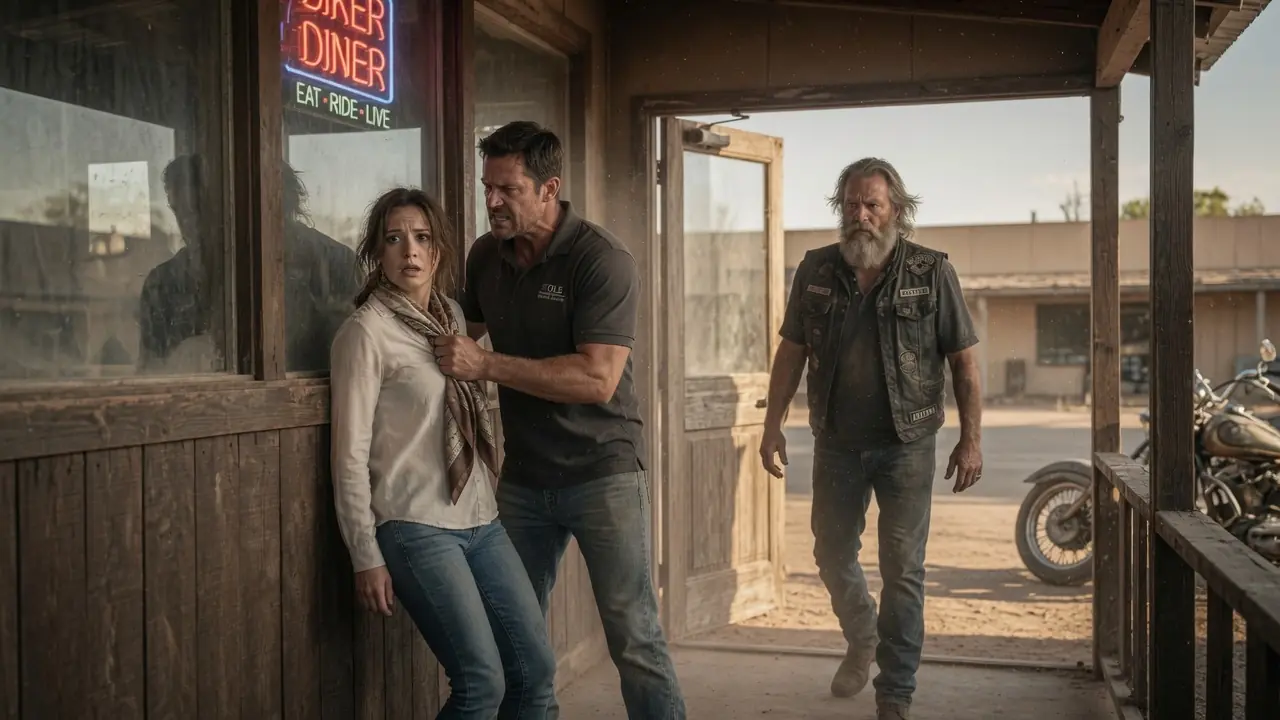
Then she heard the scrape of heavy boots on tile. Four men in leather moved with terrifying purpose. Travis snarled against her ear. She belongs to me. Not anymore, the gray-bearded one said quietly. Madison Blake had been holding her breath for seven years. Not literally, though there were nights when Travis's hands made that literally true. But in the way a person learns to exist in the smallest possible space. The way you stop laughing too loud, stop having opinions, stop taking up room in your own life. She was twenty-nine years old and felt ancient. That Thursday afternoon in October, she stood in Scottsdale Fashion Square with her younger sister, Haley, pretending to be normal, pretending she was just another woman shopping. Just another divorced mom trying to find a birthday present for her son. You okay, Bow? Haley asked, watching her sister's hands tremble around a coffee cup. Fine, Madison lied. She'd gotten good at lying. The scarf around her neck, silk and expensive looking, the kind of thing women wore to look sophisticated, hid fingerprint bruises that were three days old. The sunglasses perched on her head weren't for style. They covered the place where her left eyebrow had split open two weeks ago. Madison had left Travis six months earlier, six months, two weeks, and four days to be exact. She counted every one. The divorce had been finalized for thirty-seven days, but Travis didn't believe in divorce. I'm just tired, Madison said, forcing a smile. Noah kept me up last night. Bad dreams. Haley didn't look convinced, but she didn't push. They wandered through the mall. Two sisters who used to tell each other everything now communicated in careful half-truths. Madison picked up a toy car, put it down, picked up a puzzle. She couldn't remember if Noah already had it. Her phone buzzed. Unknown number. Her heart stopped. Don't answer it, Haley said immediately. But Madison's thumb was already moving. Years of conditioning, years of learning that ignoring Travis only made things worse. The text was short. I saw you. Madison's coffee cup slipped from her fingers. It didn't break. The carpet caught it, but coffee spread in a dark stain across pale fabric. Madison, Haley grabbed her arm. We're leaving right now. He knows I'm here. Then we call the police and tell them what. Madison's voice cracked. That my ex-husband sent me a text that I'm scared. They'll take a report and tell me to call if anything concrete happens. You know what concrete means to them. Haley, it means he has to actually hurt me first. There's a restraining order. A piece of paper. Madison's voice rose, drawing looks from nearby shoppers. She lowered it to a harsh whisper. It's a piece of paper that means nothing to him. He violated it twice last month. Both times the police gave him a warning. A warning, Haley. Like he's a dog that peed on the carpet. Haley's face went hard. Then we leave Arizona tonight. I'll help you pack. We'll drive to California. You can stay with. I can't keep running. Yes, you can. You run until he gets tired of chasing. Men like Travis don't get tired. Madison straightened her shoulders, forced her breathing to steady. I have a life here. Noah has school friends. I have a. I can't let him take all of that from me, too. But her hands wouldn't stop shaking. They kept shopping. What else could they do? Madison moved through the stores like a ghost, picking up items without seeing them, nodding at Haley's suggestions without hearing them. The mall was crowded Thursday afternoon, the calm before the weekend rush, families, teenagers, elderly couples walking for exercise. The food court smelled like pretzels and Chinese food, and someone had spilled something sweet near the smoothie bar. Normal. Everything was aggressively, painfully normal. I need to sit, Madison said. Just for a minute. They found chairs near the food court railing, second floor, overlooking the fountain below. Madison sat with her back to the shops facing the open air. Haley went to get water. That's when Madison saw them. Four men at a table twenty feet away. Leather vests, silver rings, the kind of men polite people pretended not to notice. Hell's Angels. She recognized the patches. The biggest one, a wall of muscle with a shaved head, was laughing at something one of the others said. The one with the gray beard and tired eyes sat quietly, not eating, just watching the crowd with the alertness of someone who'd learned to see trouble before it arrived. Madison looked away quickly. Her mother's voice in her head. Don't stare at men like that. Don't draw attention. But the gray-bearded one, his gaze had already found her and held. Not in a threatening way. Not in the way Travis looked at her like she was property. Just seeing, actually seeing. Madison's throat closed up. She stood abruptly. I can't do this. I can't breathe in here. I need. That's when she heard it. Her name not spoken, roared. Madison. The food court shifted. People turned. Madison turned and there he was. Travis Cole, six foot two and two hundred pounds of rage wrapped in fading good looks in a construction company polo shirt. His face was red, jaw clenched, hands balled into fists. He'd always been handsome. That was part of the trap. When they'd met eight years ago, she'd thought he looked like a movie star, strong jaw, bright smile, the kind of man who opened doors and paid for dinner and made you feel safe right up until the first time he didn't. Travis. Her voice came out strangled. You can't be here. The restraining order. Restraining order. He laughed, moving closer. People were backing away, forming a circle. You think a piece of paper stops me from talking to my wife? Ex-wife? Wrong thing to say. His hand shot out and grabbed her wrist, yanking her close. Don't you ever let go of me. Madison tried to pull free, but his grip was iron. Haley. Haley. Her sister appeared from the water fountain line, saw what was happening, and started running. Get away from her. But Travis didn't even look at Haley. His eyes were locked on Madison. And in them, she saw everything she'd spent six months running from. The rage, the obsession, the absolute certainty that she belonged to him. You embarrassed me, he hissed, walking out like that, filing papers, making me look like the bad guy. Do you know what people say about me now? Do you know what your lies cost me? They're not lies. His other hand came up and wrapped around her throat. The food court erupted in screams. Madison clawed at his fingers, but they were immovable. Her vision sparked. Someone was shouting for security. Haley was screaming. Travis's face filled her entire world. His voice a roar in her ears. You're mine. You'll always be mine. If I can't have you. Then suddenly his eyes shifted, looked past her, went wide. Let her go. The voice came from behind Madison. Deep, calm, absolutely certain. Travis's grip loosened just enough for Madison to gasp air. She tried to turn, but Travis held her in place, his face now showing something she'd never seen before. Fear. This is private, Travis said, but his voice had lost its edge. Between me and my wife. Ex-wife, the deep voice corrected. And no, it's not private anymore. Madison managed to twist enough to see him. The gray-bearded biker stood ten feet away. Up close, he was bigger than she'd thought, not tall, but solid, built like someone who'd spent decades doing hard work. His face was weathered, scarred. His eyes were the coldest thing Madison had ever seen. But he wasn't looking at her. He was looking at Travis like a butcher eyeing meat. Walk away, the biker said quietly. Right now, while you still can. Travis's hand tightened on Madison's throat again. You don't know who you're messing with, old man. Yeah, the biker tilted his head slightly. I do. That's when Madison noticed the other three. They'd moved without her seeing. One stood behind Travis, blocking his exit. Another had positioned himself between Travis and the crowd, protecting civilians, she realized with shock. The third, the huge bald one, stood perfectly still near the railing, watching everything with the alertness of a trained fighter. They'd surrounded him. No rush, no threats. Just four men cutting off every escape route with terrifying efficiency. Last chance, the gray-bearded one said. Let her go. Travis's breathing changed. Got faster. Panicked. Madison knew that breathing. It was what he did right before he lost control completely. She belongs to me, Travis screamed. And suddenly, there was something in his other hand, something that caught the light. A knife. The food court went from chaos to dead silence in one second. Travis yanked Madison against his chest, knife to her throat. She felt the blade cold and sharp, pressing into her skin. One move. That's all it would take. One move and she'd be dead. Back off! Travis was shouting now, spinning, trying to watch all four bikers at once. Back off or I swear to God you're not walking out of here, the gray-bearded biker said. His voice hadn't changed. Still calm, still certain. So you have two choices. You let her go, we hold you for the police, you face assault charges, or, he paused. The pause was worse than any threat. Or, Travis demanded. The biker reached up slowly and removed a silver ring from his right hand, set it on a nearby table with a soft clink. Or we remove you from her ourselves. One of the other bikers, the one behind Travis, removed his ring, then the huge bald one, then the fourth. Four silver rings on a table. Travis laughed high and hysterical. You think I'm scared of you? You think rings mean anything? I'll cut her throat before you take three steps. Those rings, the gray-bearded biker interrupted, weigh about four ounces each. Sterling silver. When you hit someone wearing them, the metal concentrates the force into a small area, breaks bones, shatters teeth, causes massive internal bleeding. He stepped closer. We took them off because if we hit you wearing them, you'll die, and we want you alive. Madison felt Travis's entire body go rigid. Alive to face trial, another biker added. The one with the shaved head, voice like grinding gears. Alive to hear her testify. Alive, the gray-bearded one finished, to lose everything the way you tried to make her lose everything. Time stopped. Madison could hear her own heartbeat. Could feel Travis's pulse hammering against her back. The knife pressed harder. A drop of blood ran down her throat. Everybody get back, Travis screamed, spinning again, dragging Madison with him. I'll do it. I swear I'll. The biker behind him moved. Madison didn't see exactly what happened. It was too fast. One second the knife was at her throat. The next there was a crack like a gunshot. And Travis was screaming, his hand empty, the knife clattering across the floor. Then everything happened at once. The huge bald biker grabbed Madison and pulled her away with surprising gentleness. The gray-bearded one moved in one brutal strike to Travis's throat. Not enough to kill, but enough to drop him, choking to his knees. Travis tried to get up, couldn't. Tried to speak, couldn't. He knelt on the tile, gasping, defeated, while four men he'd underestimated stood over him in silence. Mall security finally arrived, shouting, hands on tasers. He had a knife, the gray-bearded biker said calmly, pointing. Threatened her. We disarmed him. He's all yours. The security guards looked at Travis, at Madison, at the four bikers. One of them spoke into his radio. We need police now. Multiple witnesses, assault with a weapon. Madison couldn't stop shaking. Haley wrapped her in a hug, but Madison barely felt it. She was staring at Travis on the ground, still gasping, and feeling something she hadn't felt in seven years. Safe. Actually, genuinely safe. Ma'am. One of the bikers, the younger one with dark hair and sharp eyes, crouched beside her. You hurt. He cut you. Madison touched her throat. Blood came away on her fingers, but just a scratch. Surface wound. I'm okay, she whispered. No, the biker said gently. You're not, but you will be. Police arrived in minutes. The food court became a crime scene. Witnesses gave statements. Someone handed Madison a bottle of water she couldn't open because her hands wouldn't stop shaking. Travis was arrested, handcuffed, read his rights. As they walked him past Madison, he looked at her with such hatred that she flinched. This isn't over, he said. The gray-bearded biker stepped between them, blocking Travis's view. Yeah, he said quietly. It is. They took Travis away. Madison sat on a bench with a blanket around her shoulders, giving her statement to a detective who looked tired and sad and like he'd seen this exact scene a hundred times before. Do you feel safe at home? the detective asked. Madison almost laughed. Feel safe? She couldn't remember what safe felt like. I don't know, she said honestly. There are shelters, resources. I can give you numbers. I tried shelters. They're full. Three-month waiting list. The detective's expression said he knew. He pulled out a card anyway. Call them again. Tell them Detective Morris sent you. They'll find space. Madison took the card. Knew she wouldn't call. Shelters were for women with nowhere else to go. She had a home, a mom, a son. She couldn't let Travis destroy those, too. Haley drove her home in silence. Madison stared out the window, watching Phoenix scroll past. Strip malls, fast food restaurants, the ordinary landscape of her life. You're staying with me, Haley said. It wasn't a question. I can't. Noah needs his routine, his own bed. Madison, he's in jail, Haley. Travis is in jail for assault with a deadly weapon. They said he won't get bail. They said. Madison closed her eyes. I can't keep running. I can't keep disrupting Noah's life because his father is a monster. At some point, I have to. I have to live. Living means staying alive. I know, but she did not really. She'd spent so long in survival mode that she'd forgotten what living actually meant. At home, Noah was waiting with the babysitter, six years old, all knees and elbows and bright curious eyes. When he saw Madison's neck, she tried to hide it, but a kid could see everything. His face crumpled. Mama, you're hurt. Just a scratch, baby. I'm okay. Did daddy do it? The question gutted her. Madison knelt down, hugged her son close. Daddy made some bad choices. But he can't hurt us anymore. I promise. Noah pulled back, studied her face with those too-old eyes. You said that before. He had her there. The babysitter left. Haley made dinner that nobody ate. Noah went to bed early, curled against Madison's side, needing the contact. After he fell asleep, Madison lay in the dark and tried to process what had happened. Four strangers had saved her life. Not security, not police, not the hundreds of bystanders with phones. Four bikers who owed her nothing and risked everything. She thought about the rings, the way they'd removed them with such ceremony. The gray-bearded one's voice, We want you alive. They'd known exactly what they were doing, known the line between defense and murder, and stayed on the right side of it for her. Her phone buzzed. Madison almost didn't look, but curiosity won. Unknown number, but this time the text was different. You're stronger than you know. Keep fighting. Grim. Madison stared at the message for a long time. She didn't know anyone named Grim, had no idea how he got her number, but somehow she knew, knew with absolute certainty it was the gray-bearded biker. She typed back, How did you know? The response came quickly. Recognize the look. My mother had the same one. Three dots appeared, disappeared, appeared again. She didn't make it out. I'm glad you will. Madison's vision blurred. She wiped her eyes, typed, Thank you for everything. Don't thank me. Just live. Live loud. Live free. Show your son what strength looks like. The next morning, Madison woke to news vans outside her house. Somehow, though she'd find out later that seventeen witnesses had uploaded video. The mall incident had gone viral. Hell's Angel saves woman from abusive ex-husband was trending on every platform. Her phone rang constantly. News stations, podcasts, morning shows, everyone wanted her story. Madison turned them all down. This wasn't a story. It was her life, her trauma, her survival. But then a reporter knocked on her door. A woman in her fifties with kind eyes and a business card for a domestic violence nonprofit. I survived too, the woman said quietly. Fifteen years ago. I know you don't want attention, but your story could help others. My story, Madison said, is that I was almost murdered in a mall full of people who did nothing. Exactly. That's what people need to hear. They need to hear that freezing isn't helping, that silence isn't neutral, that four men with criminal records did more to help you than three hundred good citizens with clean records and cameras. Madison thought about that. About one interview, the reporter said. You control the questions. You approve the footage, and I promise to handle it with respect. Madison looked back at her house where Noah was having breakfast, where Haley was pretending everything was normal. Okay, she said. One interview. The interview aired two days later. Madison told the truth. All of it. The years of abuse, the escalation, the time she called police and was told it's a domestic situation, the restraining order that meant nothing, the fear that followed her everywhere. And the moment four strangers stepped in and saved her life. People ask why I didn't just leave, Madison said to the camera, her voice steady. As if leaving is simple, as if leaving doesn't sometimes get you killed. I did leave. I filed for divorce. I got a restraining order. I did everything right, and he still came for me. She paused. I survived because four men understood something everyone else missed. That violence doesn't end when you file paperwork. It ends when someone makes it end. The response was massive. Thousands of women reached out with similar stories. Stories of men who didn't respect restraining orders, stories of being attacked in parking lots, grocery stores, their own homes, stories of systems that failed them. And then donations started arriving for what Madison didn't know at first. Then a lawyer contacted her, a domestic violence specialist who worked pro bono. There are people who want to help, the lawyer said. People who saw your interview and want to do something. There's talk of starting a shelter, a safe house specifically for women fleeing violent partners. Would you be interested in being involved? Madison thought about the shelter waiting lists, the women with nowhere to go, the three-month delays that could mean life or death. Yes, she said. Yes, I would. But the case against Travis moved slowly. His lawyer, expensive, slick, the kind who wore watches worth more than Madison's car, argued that Travis had been provoked, that Madison had led him on by agreeing to meet him, that the knife was for self-defense against the bikers. None of it was true, but truth, Madison was learning, mattered less than performance in court. The preliminary hearing was a nightmare. Travis sat there in a suit looking remorseful while his lawyer painted Madison as vindictive, a woman scorned, someone who'd exaggerated the abuse for sympathy. Madison sat in the witness box and felt seven years old again, small, powerless, unbelieved. Then the prosecutor stood up. Miss Blake, how many times did Travis Cole hit you during your marriage? Madison's throat closed. I, I don't know. I stopped counting. Approximately hundreds. A murmur through the courtroom. And how many times did you report it to police? Four times. What happened those four times? They took reports, told us to work it out. Once they arrested him, but charges were dropped when I, when I asked them to. Why did you ask them to drop the charges? Because he said he'd kill me if I didn't. The courtroom went silent. Travis's lawyer stood. Objection, hearsay. It's her testimony about her own experience, the prosecutor cut in. She can testify to what she was told. The judge allowed it. Madison continued, told the story she'd kept buried. The time Travis broke her ribs and told the ER she'd fallen downstairs. The time he held her head underwater in the bathtub while Noah cried in the next room. The time he strangled her unconscious and she woke up on the kitchen floor with no memory of how long she'd been out. By the end, two jurors were crying. Travis's lawyer did his best. Tried to paint Travis as a man struggling with anger issues. Someone who needed therapy, not prison. He loves her, the lawyer said. He just doesn't know how to show it appropriately. Madison wanted to scream, but then the prosecutor showed the mall footage, all seventeen videos from different angles, showed Travis's face, the rage, the hatred, showed his hand around Madison's throat, showed the knife. This, the prosecutor said, is not love. This is attempted murder. The judge set bail at five hundred thousand dollars. Travis couldn't pay it. He stayed in jail. Madison went home and cried for six hours straight, not from sadness, from relief, from rage, from the weight of finally, finally being believed. That night, another text from Grim. Heard about the hearing. You did good. Madison typed, I fell apart on the stand. No, you told the truth. That's harder than people think. Madison stared at her phone. Why are you still checking on me? The response took a while. Because nobody checked on my mother. And I can't change that, but maybe I can change this. Madison's vision blurred again. She typed, Thank you. Stop thanking me. Start living. So she did. She went to therapy, real therapy, with a trauma specialist who didn't tell her to move on or let go, but instead helped her understand that healing wasn't linear, that some days she'd feel strong and others she'd break down in the grocery store because someone grabbed their partner's arm too hard. She started the shelter planning committee, met with other survivors, listened to their stories, and realized hers wasn't unique. It was universal. The patterns, the excuses, the systems that failed them all. And slowly, very slowly, Madison started to feel like a person again. Not the person she was before Travis. That girl was gone forever. But someone new, someone harder, someone who'd looked at death and survived. The trial was set for three months later. Three months of waiting, of jumping at shadows, of Noah asking if daddy would come back. No baby, Madison said every time. Okay. Daddy made choices that have consequences. She didn't tell him that Travis sent letters from jail. Dozens of them. Some threatening, some pleading, all obsessive. She burned them without reading past the first line. She didn't tell him about the nightmares. The way she still couldn't sleep without checking every lock twice. The way her hand shook whenever someone raised their voice. She was learning that surviving wasn't the same as being okay. But she was also learning that not being okay was okay. That healing looked different for everyone. And that strength wasn't about never falling apart. It was about putting yourself back together every single day and choosing to keep going. Even when every cell in your body wanted to hide, even when the fear felt bigger than you, even when the world felt too heavy to face, Madison kept going because four strangers had believed she was worth saving. And she was starting to believe it, too. The first threat arrived on a Tuesday. Madison found it tucked under her windshield wiper in the grocery store parking lot. Just a folded piece of notebook paper with six words scrawled in handwriting she didn't recognize. He has friends. You don't run. Her hands went numb. The grocery bags slipped from her fingers. Eggs cracking against asphalt. Mama. Noah was still buckled in the back seat, watching through the window. You dropped the food. Madison forced her fingers to move, crumpled the note, shoved it in her pocket. It's okay, baby. Mama's just clumsy today. But her eyes scanned the parking lot. Every truck, every man standing too still, every shadow that moved wrong. Nobody there. Nobody visible anyway. She drove home ten miles over the speed limit, checking the rearview mirror every thirty seconds. Called Detective Morris the moment Noah was inside. I can send a patrol car by your house, Morris said, sounding tired. But Madison, threats on paper aren't actionable unless they're specific. Run isn't a direct threat of violence. It's intimidation. I know. I'm sorry. The best I can do is document it and increase patrols in your area. Madison hung up and stared at the note spread on her kitchen counter. Travis was in jail, but Travis had brothers, cousins, friends from the construction crews who'd listened to his version of events and believed every word. She'd taken their boy down, made him look weak, put him in a cage. Men like that didn't forgive. The second note came three days later, slipped through her mail slot at two in the morning. Madison woke to the sound of footsteps on her porch, ran to the window in time to see taillights disappearing down her street. This note was worse. Drop the charges or we drop you. Madison called Morris again. I'm sending officers right now, he said. Don't touch anything. I mean it, Madison. This crosses the line. The police came, took photos, dusted for prints that wouldn't matter because whoever delivered it had worn gloves. One officer, young, earnest, probably three years out of the academy, tried to be reassuring. We'll catch whoever's doing this, ma'am. These guys always slip up. Before or after I'm dead? Madison asked. He didn't have an answer. Haley showed up at dawn, still in pajamas, furious. That's it. You're staying with me. Pack a bag. Get Noah. We're leaving. I can't. Yes, you can. Haley's voice cracked. Madison, they're threatening to kill you. This isn't about being strong anymore. This is about being alive. Madison looked at her sister, twenty-six years old, art teacher, never hurt anyone in her life, and saw the terror there. The kind of terror that came from watching someone you love walk toward danger and being powerless to stop it. Okay, Madison whispered. Okay. They packed in twenty minutes. Madison threw clothes in garbage bags because she couldn't find her suitcase. Grabbed Noah's favorite toys, his blanket, the photo of them at the beach from last summer. Noah cried the whole time. I don't want to leave. This is our house. It's just for a little while, baby. You said daddy couldn't hurt us anymore. Madison knelt down, grabbed his small shoulders, maybe too hard. He can't. I promise you he can't. But some people are being mean right now, and we need to be smart. Being smart means staying somewhere safe until the police catch the mean people. Okay. Noah's lip trembled. I'm scared. Me too, Madison said honestly. But we're going to be okay. I promise. She'd made too many promises lately. Promises she didn't know if she could keep. At Haley's apartment, small, cluttered, safe, Madison finally let herself break down, sat on the bathroom floor, and sobbed into a towel so Noah wouldn't hear. Her phone buzzed. Grim heard about the notes. You reported them. Madison stared at the text. How did he know? Was he tracking her? Was this another threat disguised as concern? She typed, How do you know about the notes? I have friends in the department. Are you safe for now? Staying with my sister. Good. Stay there. And Madison, don't drop the charges. That's what they want. They want to kill me. They want you scared. There's a difference. Madison's hand shook. What if scared is smart? The response came immediately. Smart is testifying. Scared is what they're counting on. Then you're not alone in this. Remember that. Madison wanted to believe him. Wanted to believe she had invisible protectors watching from the shadows. But the rational part of her brain, the part that had learned to trust nothing and no one, whispered that she was on her own. She'd always been on her own. The prosecutor called that afternoon. We need to talk about your testimony. Madison's stomach dropped. I'm still testifying. I know, but there's been complications. The prosecutor's name was Sandra Reeves, forty-three years old, with the exhausted determination of someone who had spent two decades fighting battles she couldn't win. She arrived at Haley's apartment an hour later with a briefcase and a laptop and bad news written all over her face. Travis's defense team is bringing in a psychologist, Sandra said without preamble. Dr. Raymond Keller, very expensive, very good at making abusers look sympathetic. Sympathetic? Madison's voice went flat. He tried to kill me in front of three hundred people. I know. But Keller specializes in something called reactive abuse. The theory that victims of emotional abuse sometimes become abusers themselves in response to prolonged psychological trauma. Madison stared. You're saying they'll argue Travis was the victim. They'll argue you drove him to it. That your leaving triggered an emotional breakdown. That his actions, while wrong, were the result of you systematically destroying his mental health over seven years. The room tilted. Haley grabbed Madison's hand. That's insane. That's literally insane. It's effective, Sandra said grimly. I've seen it work. Juries eat it up, especially if the defendant is remorseful enough. And Travis's lawyer knows exactly what he's doing. Madison felt something cold settle in her chest. So what do I do? You tell the truth. Every incident, every injury, every police report. We build a timeline that shows escalation, not reaction. We prove he was violent from the beginning, not just at the end. And if the jury believes him instead, Sandra's silence was answer enough. That night, Madison couldn't sleep. She lay in Haley's guest room, really just a converted office with a futon, and stared at the ceiling while Noah snored softly beside her. Seven years of abuse. Seven years of hiding bruises and making excuses and learning to exist in the spaces between his rages. And now a lawyer would stand in front of twelve strangers and argue she deserved it. Her phone lit up. Another text from Grim. You still awake? Can't sleep. Me neither. Want to talk? Madison hesitated. Then why are you doing this? You don't know me. I know enough. You know what you saw for five minutes in a mall. I know you're fighting when most people would have given up. I know you're protecting your kid. I know you're scared, but you're doing it anyway. That's all I need to know. Madison's eyes burned. I don't feel brave. Nobody does. Brave is what other people call you after you survive. What if I don't survive this? The three dots appeared, disappeared, appeared again. Then I'll make sure Travis doesn't either. Madison's breath caught. That's not funny. Wasn't a joke. She should have been horrified, should have reported the text, should have cut contact with this stranger who kept appearing in her life like a guardian angel with a criminal record. Instead, she typed, Thank you. Stop thanking me. Start preparing. This trial is going to be hell. You need to be ready. How do I get ready for people calling me a liar? By knowing you're not one. By remembering that truth doesn't need to be loud. It just needs to be consistent. Madison read the message three times before she understood. The trial was three weeks away. Three weeks to prepare. Three weeks to build her case. Three weeks for Travis's lawyer to dismantle everything she'd survived. Sandra called daily with questions. What year did the abuse start? Could Madison be specific about dates? Did she have medical records, photos, witnesses? Madison had some, not enough. Seven years of hiding meant seven years without evidence. She'd covered bruises with makeup, explained away injuries with lies, and convinced everyone, including herself sometimes, that it wasn't that bad. I need you to make a list, Sandra said during one of their prep sessions. Every incident you remember, date if possible, but even just month and year helps. Description of what happened, any witnesses, any evidence. Madison started writing. The list grew to four pages, then seven, then twelve. Seeing it all laid out like that, seeing the pattern, the escalation, the pure volume of violence, Madison felt something crack open inside her chest. She'd survived this. All of it. Every hit, every threat, every night wondering if she'd wake up. She'd survived. This is good, Sandra said when Madison handed over the list. This is really good. The jury needs to see this pattern. Will they believe it? Sandra's pause was too long. Some will. That's all we need. Some will. But Madison knew the truth. The jury wouldn't be twelve neutral parties weighing evidence. They'd be twelve people with their own histories, their own biases, their own ideas about what abuse looked like. And Travis looked like someone's son, someone's friend, someone who made a mistake. Madison looked like someone asking for attention. The preliminary motions started a week before trial. Legal maneuvering that Madison barely understood. Travis's lawyer trying to exclude evidence. Sandra fighting to include it. The mall video was admissible, thank God. But some of Madison's medical records were deemed prejudicial. A broken wrist from three years ago couldn't be definitively linked to Travis because Madison had told the ER she'd fallen. Why did you lie to them? Sandra asked, not unkindly. Because Travis was sitting right there in the waiting room, Madison said. Because if I told the truth, he'd hurt me worse when we got home. Because I was trying to survive. Sandra nodded. Tell the jury exactly that. The week before trial, Madison got a call from an unknown number. She almost didn't answer, but something made her pick up. Madison Blake, a woman's voice, professional, careful. Yes. My name is Dr. Sarah Chen. I'm a psychiatrist specializing in domestic violence trauma. I've been following your case, and I'd like to offer my services as an expert witness for the prosecution. Madison's heart jumped. We can't afford. Pro bono. I don't want payment. I want to help. Why? Dr. Chen's voice softened. Because I survived too, twenty years ago. And the psychologist testifying for your ex-husband is the same one who helped my abuser walk free. I'm not letting that happen again. Madison started crying. Couldn't help it. Thank you. God, thank you. Don't thank me yet. I'm going to ask you questions you won't want to answer. I need to evaluate you properly, understand the full scope of trauma. It won't be easy. Nothing about this is easy. No, Dr. Chen agreed. But you're still here. That counts for something. They met the next day. Dr. Chen was younger than Madison expected, maybe forty, with kind eyes and a notebook she filled with precise handwriting. As Madison talked and talked and talked, four hours, Madison told her everything. The progression of abuse, the isolation tactics, the financial control, the sexual violence she'd never told anyone about because shame was a cage stronger than any lock. Dr. Chen listened without judgment, asked clarifying questions, made notes. At the end, she closed her notebook and looked at Madison directly. You have severe PTSD, anxiety, depression, and all consistent with prolonged intimate partner violence. I'll testify to that, but I also need to tell you something else. Madison braced herself. You're one of the strongest people I've ever evaluated. The fact that you're sitting here preparing to face your abuser in court, protecting your child, trying to help other women, that's extraordinary. Most people couldn't do what you're doing. I don't feel strong. Nobody does, Dr. Chen said, echoing Grim's words. Strength looks like fear and determination having a fist fight. You're in that fight right now and you're winning. Madison didn't feel like she was winning. She felt like she was drowning in slow motion, but she nodded. Okay, thank you. One more thing, Dr. Chen hesitated. The defense psychologist, Dr. Keller. He's going to try to paint you as unstable, overly emotional, possibly mentally ill. I need you to stay calm on the stand no matter what he says. Can you do that? Madison thought about Travis's hands around her throat. About the knife. About seven years of staying calm while her world burned. Yes, she said. I can do that. The night before trial, Madison couldn't eat. Haley made dinner, pasta, Madison's favorite, and she pushed it around her plate until it got cold. Noah was anxious too. He'd started wetting the bed again, something he hadn't done since he was three. Madison changed sheets without comment, held him when he cried, and lied that everything would be okay. Will I have to see daddy? Noah asked. No, baby. You're staying with Aunt Haley. You won't be anywhere near the courthouse. What if he gets out? Madison's throat closed. He won't, I promise. But she'd learned that promises meant nothing against a system designed to give men second chances. Her phone buzzed. Grim, tomorrow's the day. You already know. Good. Only fools feel ready for war. Madison smiled despite everything. Is that what this is? War always has been. You're just finally fighting back. She thought about that, about seven years of surrendering, of trying to make herself smaller, quieter, less threatening, of believing that if she could just be perfect enough, he'd stop hurting her. I'm scared I'll fall apart on the stand. Then fall apart. Show them what he did to you. Let them see the damage. The defense will say I'm being dramatic. Let them. The jury will see the truth in your fear. Fear doesn't lie. Madison wanted to believe him, wanted to believe that truth mattered more than performance. But she'd seen too many women lose in court. Too many abusers walk free with custody, with clean records, with their reputations intact. What if we lose? She typed. Grim's response was immediate. Then we make sure he knows losing isn't an option. One way or another, Madison, you are going to be safe. I promise you that. The message should have scared her, the implied threat, the suggestion of violence outside the legal system. Instead, it was the most comforted she'd felt in months. Someone believed her. Someone was willing to fight for her. Someone thought she was worth protecting. Even if that someone was a biker with a criminal record and a past he'd never fully explained, Madison set her phone down and looked at herself in Haley's bathroom mirror. Twenty-nine years old. Bruises fading but still visible. Eyes shadowed with exhaustion. Hair she'd stopped coloring because Travis always complained when she changed it. This was the face that would testify tomorrow. This was the face twelve strangers would judge. This was the face that had to convince them she was telling the truth. Madison took a deep breath. Then another. Then another. You can do this, she whispered to her reflection. You survived him. You can survive this. Her reflection didn't look convinced, but she got ready for bed anyway. Laid out her clothes for tomorrow. Conservative dress, low heels, minimal makeup. Sandra's instructions. Look like a victim, but not too much like a victim. Sympathetic, but credible. Hurt, but not hysterical. The tightrope women always walked. Madison climbed into bed next to Noah and stared at the ceiling for hours. Somewhere across town, Travis was doing the same, probably. Or maybe he was sleeping soundly, confident his lawyer would save him, confident the system would protect him the way it always had. Men like Travis always slept well. It was their victims who lay awake counting scars. At three in the morning, Madison gave up on sleep. She went to the kitchen, made coffee, sat in the dark with her list of incidents spread across the table. Twelve pages. Twelve years if you counted the dating period, forty-seven documented incidents. God knew how many undocumented ones. Injuries ranging from bruises to broken bones, three ER visits, four police reports, one hospitalization, and Travis would stand up tomorrow and say she'd driven him to it. Madison's hand shook. She gripped her coffee mug harder, felt the heat seep into her palms. Pain, real, grounding. She'd survived Travis. She'd survived this. She had to because if she didn't, if she fell apart on the stand, if the jury did not believe her, if Travis walked free, what message did that send to Noah? That violence wins, that fighting back is pointless, that some men are allowed to hurt women without consequence. No. Madison set her mug down with a sharp click that echoed in the silent kitchen. No, she'd survived too much to lose now. She'd come too far, fought too hard. Tomorrow she'd walk into that courtroom and tell her truth. And whatever happened after, whatever verdict came down, whatever consequences followed, at least she'd know she fought. At least she'd know she didn't stay silent. At least she'd know that for once in her life she chose herself over his comfort. Madison finished her coffee and watched the sun rise through Haley's kitchen window. Dawn came slowly, pink and gold bleeding across gray. A new day, the day everything changed. Madison took a shower, did her makeup, put on the conservative dress that made her look smaller than she was, looked at herself one more time in the mirror. You can do this, she whispered. And somewhere across town in a holding cell, waiting for transport to the courthouse, Travis Cole put on his suit and told himself the same thing. The courthouse steps felt like climbing toward execution. Madison's legs moved, but she couldn't feel them. Haley gripped her elbow, steering her through a crowd of reporters, shouting questions she couldn't hear over the roaring in her ears. Madison, how do you feel about facing your ex-husband? Are you afraid he'll be acquitted? Did the Hell's Angels contact you after the incident? Sandra appeared like a shield, pushing cameras back. No comment. My client will speak in court. Inside, the fluorescent lights were too bright. Everything smelled like floor cleaner and old coffee. Madison's heels clicked against linoleum, each step echoing like gunshots. Then she saw him. Travis sat at the defense table in a navy suit that probably cost more than her rent. His hair was freshly cut, clean shaven. He looked like someone's youth pastor, not someone who tried to slit her throat in a mall. Their eyes met. He smiled. Not a big smile, just a small upturn of his lips that said, I'm going to win this. Madison's knees buckled. Haley caught her. Don't look at him. Eyes on me. Just me. But Madison couldn't look away. Seven years she'd spent trying to avoid that look. The one that said she belonged to him. That everything she was existed only in relation to him. Ms. Blake. Sandra touched her shoulder. We need to go over a few last things before we start. They huddled in a conference room. Sandra's assistant spread papers across the table. Evidence, photos, medical records. Madison stared at a picture of herself from three years ago, left eye swollen shut, and barely recognized the woman staring back. They're going to come at you hard, Sandra said. Especially Dr. Keller. He'll try to make you angry, make you cry, make you look unstable. Whatever he does, stay calm. Answer the question and nothing more. Don't elaborate. Don't defend. Just answer. What if I can't? Then we take a break. Judge Morrison is sympathetic to DV cases. She'll give us time if you need it. Madison nodded, but didn't believe it. Judges had been sympathetic before, right up until they weren't. The bailiff knocked. Five minutes. Sandra squeezed Madison's hand. Remember, you're not on trial here. He is. You're the witness, not the defendant. But Madison knew better. In cases like this, the victim was always on trial. The courtroom was smaller than she'd expected. Twenty rows of benches, half full of strangers who'd come to watch her trauma like it was entertainment. Madison spotted Detective Morris in the back. A few women she recognized from the DV support group Sandra had recommended. And in the third row, wearing street clothes instead of leather, sat Grim. Their eyes met. He nodded once. A promise without words. I'm here. Madison's breathing steadied fractionally. Barely, but enough. All rise. The Honorable Judge Patricia Morrison presiding. Everyone stood. The judge entered, sixty-some, steel gray hair, expression that gave nothing away. She settled into her chair and looked at the courtroom like she'd seen this exact case a thousand times before, because she probably had. Be seated. We're here for the case of Arizona versus Travis Michael Cole. Are both parties ready to proceed? Sandra stood. The prosecution is ready, your honor. Travis's lawyer, Richard Brennan, fifty-five, expensive watch, smiled like a shark, stood. Defense is ready, your honor. Then let's begin. Ms. Reeves, your opening statement. Sandra approached the jury. Twelve faces, seven women, five men, ages ranging from mid-twenties to seventies. Madison tried to read them and couldn't. Members of the jury, Sandra began, over the next few days, you're going to hear a story about a woman named Madison Blake who spent seven years married to a man who beat her regularly, controlled every aspect of her life, and ultimately tried to murder her in a crowded shopping mall when she finally found the courage to leave. She paused. The defense is going to tell you a different story. They're going to say Madison was difficult, that she provoked him, that Travis Cole was driven to violence by years of emotional abuse from his wife. They're going to try to make you believe that the real victim in this case is the man who wrapped his hands around her throat and pulled a knife. Sandra's voice hardened. Don't let them. The evidence will show that Travis Cole is a violent man with a history of escalating abuse. The evidence will show that Madison Blake lived in constant fear. And the evidence will show that on October fifteenth, in front of hundreds of witnesses, Travis Cole attempted to end Madison's life because she dared to leave him. She returned to her seat. Brennan stood. He moved with the confidence of someone who'd never lost. Ladies and gentlemen, my client isn't perfect. He'll be the first to tell you that he has anger issues. He's said things he regrets. He's done things he wishes he could take back. He paused for effect, but attempted murder? No. What you're going to see is a man who was systematically emotionally destroyed by a woman who played the victim while she was actually the aggressor. You'll hear testimony from a clinical psychologist about reactive abuse. What happens when someone who's been psychologically tortured for years finally snaps? Madison's hands clenched. Was my client's behavior at the mall appropriate? No. Was it criminal? Absolutely. But was it attempted murder? Or was it the desperate action of a broken man who'd reached his breaking point? Brennan looked at the jury like they were all on the same team. I ask you to keep an open mind. Listen to all the evidence and ask yourselves who was really the abuser in this relationship. He sat down. Madison wanted to scream, wanted to stand up and shout that everything he just said was a lie. But Sandra had warned her. Opening statements weren't evidence. They were just stories. The evidence came next. Ms. Reeves, call your first witness. The prosecution calls Detective James Morris. Morris took the stand, was sworn in, answered questions about the mall incident with professional detachment. Yes, he'd responded to the scene. Yes, Travis Cole had a weapon. Yes, Madison Blake had visible injuries consistent with strangulation. Brennan's cross-examination was brief. Detective Morris, in your investigation, did you interview Ms. Blake about her treatment of Mr. Cole during the marriage? That's not relevant to the assault. Please answer yes or no. Morris's jaw tightened. No. So you didn't investigate whether she might have provoked the incident. Provocation doesn't justify attempted murder. That's for the jury to decide. No further questions. Three more witnesses. Mall security who'd responded too slowly. A bystander who'd filmed the attack. An ER doctor who'd treated Madison's throat injury. Then Sandra stood. The prosecution calls Madison Blake. Time stopped. Madison's legs barely held her as she walked to the witness stand. The bailiff held out a Bible. She placed her hand on it, couldn't feel the leather under her palm. Do you swear to tell the truth, the whole truth, and nothing but the truth? I do. Her voice came out stronger than she expected. Sandra approached with a gentle smile. Miss Blake, can you tell us how you met Travis Cole? Madison took a breath. At a bar eight years ago. He was charming, funny. He made me feel special. When did the abuse start? Six months after we started dating. He got angry because I was laughing with a male coworker at a company party. He grabbed my arm hard enough to bruise. Then he cried and apologized and said he was just scared of losing me. Did you believe him? Yes. I thought it was romantic that he loved me that much. Brennan stood. Objection, speculation. It's her testimony about her own state of mind, Sandra countered. Overruled. Continue. Madison continued, told the story she'd told herself a thousand times. The progression, the isolation. The first time he hit her, a slap that left her ear ringing. The apology, the promises to change. Did he change? Sandra asked. No, it got worse. Can you describe worse? Madison looked at the jury. Seven women, five men. Some were taking notes. Others just watched. One older woman had tears in her eyes. He broke my ribs when I was six months pregnant. Told the hospital I'd fallen downstairs. He held my head under water in the bathtub until I passed out. He punched me in the stomach so hard I couldn't stand up for two days. He. Objection, Brennan said, beyond the scope. Your honor, this establishes pattern of behavior. I'll allow it. Continue, Miss Blake. Madison continued. Each incident felt like ripping open an old wound. The jury's faces shifted from shock to horror to something that looked like pity. She didn't want pity. She wanted belief. Why didn't you leave sooner? Sandra asked. Because he said he'd kill me if I did. Because I had nowhere to go. Because I thought it was my fault. Because I loved him and kept hoping he'd change. Because leaving is the most dangerous time for abuse victims. Statistically, that's when we're most likely to be killed. But you did eventually leave. Yes. Six months ago, I filed for divorce and got a restraining order. And what happened on October fifteenth? Madison's throat closed. She took a sip of water, hands shaking. I was shopping with my sister. Travis appeared. He grabbed me, put his hands around my throat, pulled a knife. What did you think was going to happen? I thought I was going to die. The courtroom was silent. What stopped him? Four men, bikers, Hell's Angels. They intervened. Sandra showed the mall footage. All seventeen angles. The jury watched Travis's face contort with rage, watched his hand tighten around Madison's throat, watched the knife appear. One juror looked away. No further questions, Sandra said. Brennan stood. He smiled at Madison like they were old friends. Ms. Blake, you've painted quite a picture of my client as a monster. I've told the truth. Have you? Let's talk about truth. Isn't it true that you frequently belittled Travis in front of his friends and family? Madison blinked. No. Isn't it true that you controlled all the finances and gave him an allowance? He spent our rent money on poker. Yes or no, please. Yes, I managed the money after he gambled us into debt. Isn't it true that you threatened to keep his son from him if he didn't do what you wanted? That's not yes or no. Madison's pulse raced. I told him if he kept hurting me, I'd have to protect Noah. That's not a threat. That's being a mother. So you admit you used his child as leverage. Objection. Sandra was on her feet. Counsel is twisting the witness's testimony. Sustained. Mr. Brennan, rephrase. But the damage was done. Madison could see it in some jurors' faces, doubt creeping in. Brennan continued for an hour, picking apart every statement, making her seven years of survival sound like seven years of manipulation. By the time he finished, Madison felt like she'd been torn apart and reassembled wrong. No further questions. Madison returned to her seat. Sandra leaned close. You did great. But Madison didn't feel great. She felt like she'd just lost. The prosecution rested. Brennan called his first witness, Travis's mother, who cried on the stand about what a good boy her son was. How Madison had changed him, made him angry, driven him to desperate acts. Madison wanted to vomit. Then came Dr. Raymond Keller, fifty-eight, wire-rimmed glasses, voice like a college professor. Dr. Keller, can you explain reactive abuse? Certainly. It's a phenomenon where someone who's been subjected to long-term psychological abuse eventually responds with violence. They're not the abuser. They're reacting to abuse. And in your professional opinion, does Travis Cole fit this pattern? Yes. Based on my interviews with Mr. Cole and review of the case materials, I believe he was systematically emotionally abused by Miss Blake. Her controlling behavior, her threats regarding custody, her public humiliation of him. All of these are classic psychological abuse tactics. Madison's vision blurred with rage. And the incident at the mall, a trauma response. When someone's been pushed to their psychological breaking point, they can experience what's called an amygdala hijack. The rational brain shuts down. The survival brain takes over. Mr. Cole wasn't trying to murder Miss Blake. He was having a psychological break triggered by her rejection. Sandra's cross-examination was sharp. Dr. Keller, have you reviewed Miss Blake's medical records? I've reviewed what was provided. So you're aware of three visits, two broken ribs, a fractured wrist, and multiple contusions over seven years. Those injuries could have been self-inflicted or accidental. The courtroom gasped. Are you seriously suggesting she broke her own ribs? I'm suggesting that without contemporaneous documentation attributing those injuries to Mr. Cole, we can't assume causation. Miss Blake testified under oath that Mr. Cole caused those injuries. Ms. Blake has a vested interest in portraying herself as a victim. Sandra's face went hard. You testified that reactive abuse occurs after long-term psychological abuse. Correct. And Ms. Blake's documented injuries span seven years. Correct. According to her testimony. So by your own logic, even if we accept your reactive abuse theory, Ms. Blake's injuries represent the long-term abuse that would justify a reactive response. Meaning she, not Mr. Cole, would be the reactive abuse victim. Keller's face flushed. That's not. That's twisting my testimony. No, doctor. I'm applying your own logic. No further questions. But Madison knew the jury had heard enough. Some faces showed doubt. Others showed confusion. A few looked angry, though at whom Madison couldn't tell. The trial stretched into day three. Character witnesses for both sides. Travis's co-workers who said he was a great guy. Madison's therapist who testified about PTSD. Dr. Chen, who explained complex trauma in terms even Madison barely understood. Then Brennan did something no one expected. He called Travis to the stand. Travis took the oath, sat down, looked directly at the jury with wet eyes. Mr. Cole, Brennan said gently. Did you love your wife? I loved her more than anything, Travis's voice broke. I still do. Did you hit her? Yes, he wiped his eyes. God help me. Yes. And I'll regret it for the rest of my life. Madison's hands clenched until her nails drew blood. Why did you hit her? Because I was broken. Because she made me feel worthless. Because every day she'd find new ways to tell me I wasn't enough, wasn't man enough, wasn't father enough, wasn't anything enough. And I know that's not an excuse. I know I should have walked away. But I was trapped in this cycle where she'd tear me down and I'd lash out and then hate myself and try to be better and she'd tear me down again. Several jurors were nodding. And at the mall I just wanted to talk to her, to apologize, to beg her to give me another chance, but she started screaming and everyone was staring and I just, I snapped. I grabbed her and then there was a knife in my hand and I don't even remember pulling it out. It's like I wasn't in control of my own body. Do you regret it? Every second of every day. Travis looked directly at Madison. I'm so sorry. I know you'll never forgive me. I don't deserve forgiveness, but I hope someday you can understand that I was sick, that I needed help, that I loved you so much it made me crazy. Madison stood up, couldn't help it. You tried to kill me. Miss Blake. Judge Morrison's gavel cracked. Sit down or I'll hold you in contempt. Sandra pulled Madison back to her seat. The damage was done. Madison looked hysterical. Travis looked remorseful. Sandra's cross-examination tried to punch holes in his testimony, but Travis stuck to his script. The broken man, the victim of psychological abuse, the person who just needed help. Mr. Cole, you testified you don't remember pulling the knife, but you do remember texting Mrs. Blake earlier that day saying, I saw you. Correct. I was trying to reach out, ma'am. Yes or no, ma'am? And you violated your restraining order to do so. I was desperate. You were stalking her. Objection. Argumentative. Sustained. But Sandra pressed on. Mr. Cole, in seven years of marriage, how many times did Ms. Blake send you to the emergency room? She didn't hit me if that's what you're asking. How many times did she break your bones? Emotional abuse doesn't leave visible scars. How many times did she threaten your life? Travis's face hardened just for a second, just long enough for the mask to slip. She threatened to take my son. Did you break her ribs while she was pregnant with him? Yes or no? The courtroom held its breath. Yes, Travis finally said. No further questions. The defense rested. Closing arguments came next. Brennan painted Travis as tragic, a man driven to the edge by a manipulative woman who played victim perfectly. He talked about reasonable doubt, about the complexities of abusive relationships, about how easy it was to believe the person crying loudest. Sandra's closing was fire. Ladies and gentlemen, the defense wants you to believe that Madison Blake is a master manipulator who spent seven years breaking her own bones and documenting fake injuries just so she could one day accuse Travis Cole of abuse. They want you to believe that a woman who weighs one hundred twenty pounds was the real threat to a man who weighs two hundred pounds and has six inches on her. She pulled up the mall footage one more time. Look at his face. Look at his hands around her throat. Look at the knife. This is not a man having a psychological break. This is a man attempting murder because he lost control over his property, because that's what Madison was to him. Property. Sandra's voice rose. And you know how I know that? Because he said it. At the mall before he pulled the knife, four witnesses heard him say, She belongs to me. Not I love her. Not I need help, but she belongs to me. She paused. Madison Blake belongs to no one. She is a human being with the right to leave a violent relationship without being murdered for it. She is a mother trying to protect her child. She is a survivor who did everything right, reported to police, got a restraining order, left, filed for divorce, and still almost died. Sandra looked at each juror in turn. Don't let her abuser convince you she deserved it because no one deserves what Travis Cole did. No one. The jury deliberated for six hours. Six hours of Madison pacing the courthouse hallway. Six hours of Sandra making phone calls and pretending to be confident. Six hours of Haley holding her hand and Detective Morris bringing coffee no one drank. Grim appeared at hour four, just walked up, said nothing, stood against the wall like a sentinel. You shouldn't be here, Madison said. Lot of things I shouldn't do, he replied. Still do them. At hour five, Madison's phone rang. Unknown number. She answered without thinking. Heavy breathing. Then whatever happens in there, you're still mine. Travis's voice. From jail somehow. Madison's hand shook so hard she dropped the phone. Grim caught it, listened, his face going stone cold. Listen carefully, he said into the phone. You come near her again in any way, through any method, I will find you. And what I do to you will make that mall look like mercy. We clear. He hung up, handed the phone back to Madison. He can't hurt you anymore, Grim said quietly. I promise you that. You can't promise that. Yes, Grim said. I can. At hour six, the bailiff appeared. Jury's reached a verdict. Madison's legs went numb. Sandra gripped her elbow, guided her back to the courtroom. Travis was already seated. He didn't look at her. The jury filed in. Madison tried to read their faces, couldn't. Has the jury reached a verdict? Judge Morrison asked. The foreman stood. We have, your honor. What say you? In the matter of attempted murder, we find the defendant guilty. The courtroom erupted. Madison couldn't breathe. Couldn't think. Couldn't process what she just heard. Guilty. He was guilty. Order. Judge Morrison's gavel cracked. Order in this courtroom. In the matter of assault with a deadly weapon, we find the defendant guilty. Travis's face went white. In the matter of violating a restraining order, we find the defendant guilty. Three counts, three convictions. Brennan was on his feet already filing appeals. Travis was shouting something Madison couldn't hear over the roaring in her ears. Then Travis turned, looked directly at her, mouthed two words. Not over. But it was finally, impossibly, it was. Sentencing was set for three weeks later. Travis was denied bail, considered a flight risk and a danger to Madison. He was led away in handcuffs, still shouting. Sandra hugged Madison. We did it. We actually did it. Madison nodded, but couldn't speak. Couldn't feel relief yet. Couldn't let herself believe it was real. Outside, reporters swarmed again. This time Madison stopped. I want to say something, she told Sandra. The cameras focused. Madison looked directly into the nearest lens. If you're in an abusive relationship, I want you to know three things. One, it's not your fault. Two, leaving is possible. And three, even if the system fails you, even if police don't believe you, even if restraining orders don't work, even if you think no one cares, some people will fight for you. Four strangers fought for me. Let someone fight for you, please. Her voice broke. You deserve to be safe. You deserve to live. Don't let anyone tell you different. The interview went viral within hours. By the next morning, Madison's phone was flooded with messages from women sharing their stories, women thanking her, women asking for help. And Madison, for the first time in seven years, felt like she'd done something that mattered. But Travis's words echoed, Not over. And deep in her gut, Madison knew he was right. The death threat arrived three days after the verdict. Not a note this time. A package. Madison found it on Haley's doorstep when she went out for morning coffee. Plain brown box. No return address. Her name written in block letters that made her stomach turn over. She should have called the police. Should have left it alone. Should have done anything except what she did. She opened it. Inside, wrapped in newspaper, was a dead rat. Its throat had been slit. Around its neck was a tiny collar made of wire with a tag that read snitch. Madison dropped the box. Coffee splashed across the concrete. She backed away, hands shaking, and pulled out her phone. Detective Morris answered on the second ring. Madison, what's wrong? There's a. He sent me a. She couldn't finish the sentence. I'm sending a unit right now. Don't touch anything. Is anyone with you? Haley's inside with Noah. I'm outside. Morris, he's going to kill me. Even from jail, he's going to kill me. We're going to protect you. I promise. Just stay put. But Madison knew what police promises were worth. She'd collected them like scars. The squad car arrived in minutes. Two officers, both young, both looking at the box like it was exactly what they'd expected. They took photos, bagged the evidence, asked questions Madison couldn't answer. Any idea who might have delivered this? Travis has friends, family, people who think I'm the villain. We'll increase patrols in the area. Maybe you should consider moving until sentencing. I've been moving for six months. How much further am I supposed to run? The officer didn't have an answer. Inside, Haley was making breakfast while Noah watched cartoons. Madison stood in the doorway watching them.Let her go. The four words cut through the screaming like a blade through silk. Madison Blake felt Travis's fingers tighten around her throat, cutting off her air, her vision blurring at the edges. The food court had gone silent, except for her sister's sobbing. Three hundred people stood frozen, phones raised, recording her death.
Then she heard the scrape of heavy boots on tile. Four men in leather moved with terrifying purpose. Travis snarled against her ear. She belongs to me. Not anymore, the gray-bearded one said quietly.
Madison Blake had been holding her breath for seven years. Not literally, though there were nights when Travis's hands made that literally true. But in the way a person learns to exist in the smallest possible space. The way you stop laughing too loud, stop having opinions, stop taking up room in your own life. She was twenty-nine years old and felt ancient.
That Thursday afternoon in October, she stood in Scottsdale Fashion Square with her younger sister, Haley, pretending to be normal, pretending she was just another woman shopping. Just another divorced mom trying to find a birthday present for her son. You okay, Bow? Haley asked, watching her sister's hands tremble around a coffee cup. Fine, Madison lied.
She'd gotten good at lying. The scarf around her neck, silk and expensive looking, the kind of thing women wore to look sophisticated, hid fingerprint bruises that were three days old. The sunglasses perched on her head weren't for style. They covered the place where her left eyebrow had split open two weeks ago. Madison had left Travis six months earlier, six months, two weeks, and four days to be exact.
She counted every one. The divorce had been finalized for thirty-seven days, but Travis didn't believe in divorce. I'm just tired, Madison said, forcing a smile. Noah kept me up last night. Bad dreams. Haley didn't look convinced, but she didn't push.
They wandered through the mall. Two sisters who used to tell each other everything now communicated in careful half-truths. Madison picked up a toy car, put it down, picked up a puzzle. She couldn't remember if Noah already had it. Her phone buzzed. Unknown number. Her heart stopped.
Don't answer it, Haley said immediately. But Madison's thumb was already moving. Years of conditioning, years of learning that ignoring Travis only made things worse. The text was short. I saw you. Madison's coffee cup slipped from her fingers.
It didn't break. The carpet caught it, but coffee spread in a dark stain across pale fabric. Madison, Haley grabbed her arm. We're leaving right now. He knows I'm here. Then we call the police and tell them what.
Madison's voice cracked. That my ex-husband sent me a text that I'm scared. They'll take a report and tell me to call if anything concrete happens. You know what concrete means to them. Haley, it means he has to actually hurt me first.
There's a restraining order. A piece of paper. Madison's voice rose, drawing looks from nearby shoppers. She lowered it to a harsh whisper. It's a piece of paper that means nothing to him. He violated it twice last month.
Both times the police gave him a warning. A warning, Haley. Like he's a dog that peed on the carpet. Haley's face went hard. Then we leave Arizona tonight. I'll help you pack.
We'll drive to California. You can stay with. I can't keep running. Yes, you can. You run until he gets tired of chasing. Men like Travis don't get tired.
Madison straightened her shoulders, forced her breathing to steady. I have a life here. Noah has school friends. I have a. I can't let him take all of that from me, too. But her hands wouldn't stop shaking.
They kept shopping. What else could they do? Madison moved through the stores like a ghost, picking up items without seeing them, nodding at Haley's suggestions without hearing them. The mall was crowded Thursday afternoon, the calm before the weekend rush, families, teenagers, elderly couples walking for exercise. The food court smelled like pretzels and Chinese food, and someone had spilled something sweet near the smoothie bar.
Normal. Everything was aggressively, painfully normal. I need to sit, Madison said. Just for a minute. They found chairs near the food court railing, second floor, overlooking the fountain below. Madison sat with her back to the shops facing the open air.
Haley went to get water. That's when Madison saw them. Four men at a table twenty feet away. Leather vests, silver rings, the kind of men polite people pretended not to notice. Hell's Angels.
She recognized the patches. The biggest one, a wall of muscle with a shaved head, was laughing at something one of the others said. The one with the gray beard and tired eyes sat quietly, not eating, just watching the crowd with the alertness of someone who'd learned to see trouble before it arrived. Madison looked away quickly.
Her mother's voice in her head. Don't stare at men like that. Don't draw attention. But the gray-bearded one, his gaze had already found her and held. Not in a threatening way.
Not in the way Travis looked at her like she was property. Just seeing, actually seeing. Madison's throat closed up. She stood abruptly. I can't do this.
I can't breathe in here. I need. That's when she heard it. Her name not spoken, roared. Madison.
The food court shifted. People turned. Madison turned and there he was. Travis Cole, six foot two and two hundred pounds of rage wrapped in fading good looks in a construction company polo shirt. His face was red, jaw clenched, hands balled into fists.
He'd always been handsome. That was part of the trap. When they'd met eight years ago, she'd thought he looked like a movie star, strong jaw, bright smile, the kind of man who opened doors and paid for dinner and made you feel safe right up until the first time he didn't. Travis. Her voice came out strangled.
You can't be here. The restraining order. Restraining order. He laughed, moving closer. People were backing away, forming a circle.
You think a piece of paper stops me from talking to my wife? Ex-wife? Wrong thing to say. His hand shot out and grabbed her wrist, yanking her close. Don't you ever let go of me. Madison tried to pull free, but his grip was iron.
Haley. Haley. Her sister appeared from the water fountain line, saw what was happening, and started running. Get away from her. But Travis didn't even look at Haley.
His eyes were locked on Madison. And in them, she saw everything she'd spent six months running from. The rage, the obsession, the absolute certainty that she belonged to him. You embarrassed me, he hissed, walking out like that, filing papers, making me look like the bad guy.
Do you know what people say about me now? Do you know what your lies cost me? They're not lies. His other hand came up and wrapped around her throat. The food court erupted in screams.
Madison clawed at his fingers, but they were immovable. Her vision sparked. Someone was shouting for security. Haley was screaming. Travis's face filled her entire world.
His voice a roar in her ears. You're mine. You'll always be mine. If I can't have you.
Then suddenly his eyes shifted, looked past her, went wide. Let her go. The voice came from behind Madison. Deep, calm, absolutely certain. Travis's grip loosened just enough for Madison to gasp air.
She tried to turn, but Travis held her in place, his face now showing something she'd never seen before. Fear. This is private, Travis said, but his voice had lost its edge. Between me and my wife. Ex-wife, the deep voice corrected.
And no, it's not private anymore. Madison managed to twist enough to see him. The gray-bearded biker stood ten feet away. Up close, he was bigger than she'd thought, not tall, but solid, built like someone who'd spent decades doing hard work. His face was weathered, scarred.
His eyes were the coldest thing Madison had ever seen. But he wasn't looking at her. He was looking at Travis like a butcher eyeing meat. Walk away, the biker said quietly.
Right now, while you still can. Travis's hand tightened on Madison's throat again. You don't know who you're messing with, old man. Yeah, the biker tilted his head slightly.
The third, the huge bald one, stood perfectly still near the railing, watching everything with the alertness of a trained fighter. They'd surrounded him. No rush, no threats. Just four men cutting off every escape route with terrifying efficiency. Last chance, the gray-bearded one said.
Let her go. Travis's breathing changed. Got faster. Panicked.
Madison knew that breathing. It was what he did right before he lost control completely. She belongs to me, Travis screamed. And suddenly, there was something in his other hand, something that caught the light.
A knife. The food court went from chaos to dead silence in one second. Travis yanked Madison against his chest, knife to her throat. She felt the blade cold and sharp, pressing into her skin. One move.
That's all it would take. One move and she'd be dead. Back off! Travis was shouting now, spinning, trying to watch all four bikers at once. Back off or I swear to God you're not walking out of here, the gray-bearded biker said.
His voice hadn't changed. Still calm, still certain. So you have two choices. You let her go, we hold you for the police, you face assault charges, or, he paused. The pause was worse than any threat.
Or, Travis demanded. The biker reached up slowly and removed a silver ring from his right hand, set it on a nearby table with a soft clink. Or we remove you from her ourselves. One of the other bikers, the one behind Travis, removed his ring, then the huge bald one, then the fourth.
Four silver rings on a table. Travis laughed high and hysterical. You think I'm scared of you? You think rings mean anything? I'll cut her throat before you take three steps.
Those rings, the gray-bearded biker interrupted, weigh about four ounces each. Sterling silver. When you hit someone wearing them, the metal concentrates the force into a small area, breaks bones, shatters teeth, causes massive internal bleeding. He stepped closer.
We took them off because if we hit you wearing them, you'll die, and we want you alive. Madison felt Travis's entire body go rigid. Alive to face trial, another biker added. The one with the shaved head, voice like grinding gears.
Alive to hear her testify. Alive, the gray-bearded one finished, to lose everything the way you tried to make her lose everything. Time stopped. Madison could hear her own heartbeat.
Could feel Travis's pulse hammering against her back. The knife pressed harder. A drop of blood ran down her throat. Everybody get back, Travis screamed, spinning again, dragging Madison with him.
I'll do it. I swear I'll. The biker behind him moved. Madison didn't see exactly what happened. It was too fast.
One second the knife was at her throat. The next there was a crack like a gunshot. And Travis was screaming, his hand empty, the knife clattering across the floor. Then everything happened at once.
The huge bald biker grabbed Madison and pulled her away with surprising gentleness. The gray-bearded one moved in one brutal strike to Travis's throat. Not enough to kill, but enough to drop him, choking to his knees. Travis tried to get up, couldn't.
Tried to speak, couldn't. He knelt on the tile, gasping, defeated, while four men he'd underestimated stood over him in silence. Mall security finally arrived, shouting, hands on tasers. He had a knife, the gray-bearded biker said calmly, pointing.
Threatened her. We disarmed him. He's all yours. The security guards looked at Travis, at Madison, at the four bikers.
One of them spoke into his radio. We need police now. Multiple witnesses, assault with a weapon. Madison couldn't stop shaking.
Haley wrapped her in a hug, but Madison barely felt it. She was staring at Travis on the ground, still gasping, and feeling something she hadn't felt in seven years. Safe. Actually, genuinely safe.
Ma'am. One of the bikers, the younger one with dark hair and sharp eyes, crouched beside her. You hurt. He cut you. Madison touched her throat.
Blood came away on her fingers, but just a scratch. Surface wound. I'm okay, she whispered. No, the biker said gently.
You're not, but you will be. Police arrived in minutes. The food court became a crime scene. Witnesses gave statements. Someone handed Madison a bottle of water she couldn't open because her hands wouldn't stop shaking.
Travis was arrested, handcuffed, read his rights. As they walked him past Madison, he looked at her with such hatred that she flinched. This isn't over, he said. The gray-bearded biker stepped between them, blocking Travis's view.
Yeah, he said quietly. It is. They took Travis away. Madison sat on a bench with a blanket around her shoulders, giving her statement to a detective who looked tired and sad and like he'd seen this exact scene a hundred times before.
Do you feel safe at home? the detective asked. Madison almost laughed. Feel safe? She couldn't remember what safe felt like. I don't know, she said honestly.
There are shelters, resources. I can give you numbers. I tried shelters. They're full.
Three-month waiting list. The detective's expression said he knew. He pulled out a card anyway. Call them again.
Tell them Detective Morris sent you. They'll find space. Madison took the card. Knew she wouldn't call.
Shelters were for women with nowhere else to go. She had a home, a mom, a son. She couldn't let Travis destroy those, too. Haley drove her home in silence.
Madison stared out the window, watching Phoenix scroll past. Strip malls, fast food restaurants, the ordinary landscape of her life. You're staying with me, Haley said. It wasn't a question.
I can't. Noah needs his routine, his own bed. Madison, he's in jail, Haley. Travis is in jail for assault with a deadly weapon.
They said he won't get bail. They said. Madison closed her eyes. I can't keep running.
I can't keep disrupting Noah's life because his father is a monster. At some point, I have to. I have to live. Living means staying alive.
I know, but she did not really. She'd spent so long in survival mode that she'd forgotten what living actually meant. At home, Noah was waiting with the babysitter, six years old, all knees and elbows and bright curious eyes. When he saw Madison's neck, she tried to hide it, but a kid could see everything.
His face crumpled. Mama, you're hurt. Just a scratch, baby. I'm okay.
Did daddy do it? The question gutted her. Madison knelt down, hugged her son close. Daddy made some bad choices. But he can't hurt us anymore.
I promise. Noah pulled back, studied her face with those too-old eyes. You said that before. He had her there.
The babysitter left. Haley made dinner that nobody ate. Noah went to bed early, curled against Madison's side, needing the contact. After he fell asleep, Madison lay in the dark and tried to process what had happened.
Four strangers had saved her life. Not security, not police, not the hundreds of bystanders with phones. Four bikers who owed her nothing and risked everything. She thought about the rings, the way they'd removed them with such ceremony.
The gray-bearded one's voice, We want you alive. They'd known exactly what they were doing, known the line between defense and murder, and stayed on the right side of it for her. Her phone buzzed. Madison almost didn't look, but curiosity won.
Unknown number, but this time the text was different. You're stronger than you know. Keep fighting. Grim.
Madison stared at the message for a long time. She didn't know anyone named Grim, had no idea how he got her number, but somehow she knew, knew with absolute certainty it was the gray-bearded biker. She typed back, How did you know? The response came quickly. Recognize the look.
My mother had the same one. Three dots appeared, disappeared, appeared again. She didn't make it out. I'm glad you will.
Madison's vision blurred. She wiped her eyes, typed, Thank you for everything. Don't thank me. Just live.
Live loud. Live free. Show your son what strength looks like. The next morning, Madison woke to news vans outside her house.
Somehow, though she'd find out later that seventeen witnesses had uploaded video. The mall incident had gone viral. Hell's Angel saves woman from abusive ex-husband was trending on every platform. Her phone rang constantly.
News stations, podcasts, morning shows, everyone wanted her story. Madison turned them all down. This wasn't a story. It was her life, her trauma, her survival.
But then a reporter knocked on her door. A woman in her fifties with kind eyes and a business card for a domestic violence nonprofit. I survived too, the woman said quietly. Fifteen years ago.
I know you don't want attention, but your story could help others. My story, Madison said, is that I was almost murdered in a mall full of people who did nothing. Exactly. That's what people need to hear.
They need to hear that freezing isn't helping, that silence isn't neutral, that four men with criminal records did more to help you than three hundred good citizens with clean records and cameras. Madison thought about that. About one interview, the reporter said. You control the questions.
You approve the footage, and I promise to handle it with respect. Madison looked back at her house where Noah was having breakfast, where Haley was pretending everything was normal. Okay, she said. One interview.
The interview aired two days later. Madison told the truth. All of it. The years of abuse, the escalation, the time she called police and was told it's a domestic situation, the restraining order that meant nothing, the fear that followed her everywhere.
And the moment four strangers stepped in and saved her life. People ask why I didn't just leave, Madison said to the camera, her voice steady. As if leaving is simple, as if leaving doesn't sometimes get you killed. I did leave.
I filed for divorce. I got a restraining order. I did everything right, and he still came for me. She paused.
I survived because four men understood something everyone else missed. That violence doesn't end when you file paperwork. It ends when someone makes it end. The response was massive.
Thousands of women reached out with similar stories. Stories of men who didn't respect restraining orders, stories of being attacked in parking lots, grocery stores, their own homes, stories of systems that failed them. And then donations started arriving for what Madison didn't know at first. Then a lawyer contacted her, a domestic violence specialist who worked pro bono.
There are people who want to help, the lawyer said. People who saw your interview and want to do something. There's talk of starting a shelter, a safe house specifically for women fleeing violent partners. Would you be interested in being involved?
Madison thought about the shelter waiting lists, the women with nowhere to go, the three-month delays that could mean life or death. Yes, she said. Yes, I would. But the case against Travis moved slowly.
His lawyer, expensive, slick, the kind who wore watches worth more than Madison's car, argued that Travis had been provoked, that Madison had led him on by agreeing to meet him, that the knife was for self-defense against the bikers. None of it was true, but truth, Madison was learning, mattered less than performance in court. The preliminary hearing was a nightmare. Travis sat there in a suit looking remorseful while his lawyer painted Madison as vindictive, a woman scorned, someone who'd exaggerated the abuse for sympathy.
Madison sat in the witness box and felt seven years old again, small, powerless, unbelieved. Then the prosecutor stood up. Miss Blake, how many times did Travis Cole hit you during your marriage? Madison's throat closed.
I, I don't know. I stopped counting. Approximately hundreds. A murmur through the courtroom.
And how many times did you report it to police? Four times. What happened those four times? They took reports, told us to work it out.
Once they arrested him, but charges were dropped when I, when I asked them to. Why did you ask them to drop the charges? Because he said he'd kill me if I didn't. The courtroom went silent.
Travis's lawyer stood. Objection, hearsay. It's her testimony about her own experience, the prosecutor cut in. She can testify to what she was told.
The judge allowed it. Madison continued, told the story she'd kept buried. The time Travis broke her ribs and told the ER she'd fallen downstairs. The time he held her head underwater in the bathtub while Noah cried in the next room.
The time he strangled her unconscious and she woke up on the kitchen floor with no memory of how long she'd been out. By the end, two jurors were crying. Travis's lawyer did his best. Tried to paint Travis as a man struggling with anger issues.
Someone who needed therapy, not prison. He loves her, the lawyer said. He just doesn't know how to show it appropriately. Madison wanted to scream, but then the prosecutor showed the mall footage, all seventeen videos from different angles, showed Travis's face, the rage, the hatred, showed his hand around Madison's throat, showed the knife.
This, the prosecutor said, is not love. This is attempted murder. The judge set bail at five hundred thousand dollars. Travis couldn't pay it.
He stayed in jail. Madison went home and cried for six hours straight, not from sadness, from relief, from rage, from the weight of finally, finally being believed. That night, another text from Grim. Heard about the hearing.
You did good. Madison typed, I fell apart on the stand. No, you told the truth. That's harder than people think.
Madison stared at her phone. Why are you still checking on me? The response took a while. Because nobody checked on my mother.
And I can't change that, but maybe I can change this. Madison's vision blurred again. She typed, Thank you. Stop thanking me.
Start living. So she did. She went to therapy, real therapy, with a trauma specialist who didn't tell her to move on or let go, but instead helped her understand that healing wasn't linear, that some days she'd feel strong and others she'd break down in the grocery store because someone grabbed their partner's arm too hard. She started the shelter planning committee, met with other survivors, listened to their stories, and realized hers wasn't unique.
It was universal. The patterns, the excuses, the systems that failed them all. And slowly, very slowly, Madison started to feel like a person again. Not the person she was before Travis.
That girl was gone forever. But someone new, someone harder, someone who'd looked at death and survived. The trial was set for three months later. Three months of waiting, of jumping at shadows, of Noah asking if daddy would come back.
No baby, Madison said every time. Okay. Daddy made choices that have consequences. She didn't tell him that Travis sent letters from jail.
Dozens of them. Some threatening, some pleading, all obsessive. She burned them without reading past the first line. She didn't tell him about the nightmares.
The way she still couldn't sleep without checking every lock twice. The way her hand shook whenever someone raised their voice. She was learning that surviving wasn't the same as being okay. But she was also learning that not being okay was okay.
That healing looked different for everyone. And that strength wasn't about never falling apart. It was about putting yourself back together every single day and choosing to keep going. Even when every cell in your body wanted to hide, even when the fear felt bigger than you, even when the world felt too heavy to face, Madison kept going because four strangers had believed she was worth saving.
And she was starting to believe it, too. The first threat arrived on a Tuesday. Madison found it tucked under her windshield wiper in the grocery store parking lot. Just a folded piece of notebook paper with six words scrawled in handwriting she didn't recognize.
He has friends. You don't run. Her hands went numb. The grocery bags slipped from her fingers.
Eggs cracking against asphalt. Mama. Noah was still buckled in the back seat, watching through the window. You dropped the food.
Madison forced her fingers to move, crumpled the note, shoved it in her pocket. It's okay, baby. Mama's just clumsy today. But her eyes scanned the parking lot.
Every truck, every man standing too still, every shadow that moved wrong. Nobody there. Nobody visible anyway. She drove home ten miles over the speed limit, checking the rearview mirror every thirty seconds.
Called Detective Morris the moment Noah was inside. I can send a patrol car by your house, Morris said, sounding tired. But Madison, threats on paper aren't actionable unless they're specific. Run isn't a direct threat of violence.
It's intimidation. I know. I'm sorry. The best I can do is document it and increase patrols in your area.
Madison hung up and stared at the note spread on her kitchen counter. Travis was in jail, but Travis had brothers, cousins, friends from the construction crews who'd listened to his version of events and believed every word. She'd taken their boy down, made him look weak, put him in a cage. Men like that didn't forgive.
The second note came three days later, slipped through her mail slot at two in the morning. Madison woke to the sound of footsteps on her porch, ran to the window in time to see taillights disappearing down her street. This note was worse. Drop the charges or we drop you.
Madison called Morris again. I'm sending officers right now, he said. Don't touch anything. I mean it, Madison.
This crosses the line. The police came, took photos, dusted for prints that wouldn't matter because whoever delivered it had worn gloves. One officer, young, earnest, probably three years out of the academy, tried to be reassuring. We'll catch whoever's doing this, ma'am.
These guys always slip up. Before or after I'm dead? Madison asked. He didn't have an answer. Haley showed up at dawn, still in pajamas, furious.
That's it. You're staying with me. Pack a bag. Get Noah.
We're leaving. I can't. Yes, you can. Haley's voice cracked.
Madison, they're threatening to kill you. This isn't about being strong anymore. This is about being alive. Madison looked at her sister, twenty-six years old, art teacher, never hurt anyone in her life, and saw the terror there.
The kind of terror that came from watching someone you love walk toward danger and being powerless to stop it. Okay, Madison whispered. Okay. They packed in twenty minutes.
Madison threw clothes in garbage bags because she couldn't find her suitcase. Grabbed Noah's favorite toys, his blanket, the photo of them at the beach from last summer. Noah cried the whole time. I don't want to leave.
This is our house. It's just for a little while, baby. You said daddy couldn't hurt us anymore. Madison knelt down, grabbed his small shoulders, maybe too hard.
He can't. I promise you he can't. But some people are being mean right now, and we need to be smart. Being smart means staying somewhere safe until the police catch the mean people.
Okay. Noah's lip trembled. I'm scared. Me too, Madison said honestly.
But we're going to be okay. I promise. She'd made too many promises lately. Promises she didn't know if she could keep.
At Haley's apartment, small, cluttered, safe, Madison finally let herself break down, sat on the bathroom floor, and sobbed into a towel so Noah wouldn't hear. Her phone buzzed. Grim heard about the notes.
You reported them. Madison stared at the text. How did he know? Was he tracking her? Was this another threat disguised as concern? She typed, How do you know about the notes?
I have friends in the department. Are you safe for now? Staying with my sister. Good.
Stay there. And Madison, don't drop the charges. That's what they want. They want to kill me.
They want you scared. There's a difference. Madison's hand shook. What if scared is smart?
The response came immediately. Smart is testifying. Scared is what they're counting on. Then you're not alone in this.
Remember that. Madison wanted to believe him. Wanted to believe she had invisible protectors watching from the shadows. But the rational part of her brain, the part that had learned to trust nothing and no one, whispered that she was on her own.
She'd always been on her own. The prosecutor called that afternoon. We need to talk about your testimony. Madison's stomach dropped.
I'm still testifying. I know, but there's been complications. The prosecutor's name was Sandra Reeves, forty-three years old, with the exhausted determination of someone who had spent two decades fighting battles she couldn't win. She arrived at Haley's apartment an hour later with a briefcase and a laptop and bad news written all over her face.
Travis's defense team is bringing in a psychologist, Sandra said without preamble. Dr. Raymond Keller, very expensive, very good at making abusers look sympathetic. Sympathetic? Madison's voice went flat.
He tried to kill me in front of three hundred people. I know. But Keller specializes in something called reactive abuse. The theory that victims of emotional abuse sometimes become abusers themselves in response to prolonged psychological trauma.
Madison stared. You're saying they'll argue Travis was the victim. They'll argue you drove him to it. That your leaving triggered an emotional breakdown.
That his actions, while wrong, were the result of you systematically destroying his mental health over seven years. The room tilted. Haley grabbed Madison's hand. That's insane.
That's literally insane. It's effective, Sandra said grimly. I've seen it work. Juries eat it up, especially if the defendant is remorseful enough.
And Travis's lawyer knows exactly what he's doing. Madison felt something cold settle in her chest. So what do I do? You tell the truth.
Every incident, every injury, every police report. We build a timeline that shows escalation, not reaction. We prove he was violent from the beginning, not just at the end. And if the jury believes him instead, Sandra's silence was answer enough.
That night, Madison couldn't sleep. She lay in Haley's guest room, really just a converted office with a futon, and stared at the ceiling while Noah snored softly beside her. Seven years of abuse. Seven years of hiding bruises and making excuses and learning to exist in the spaces between his rages.
And now a lawyer would stand in front of twelve strangers and argue she deserved it. Her phone lit up. Another text from Grim. You still awake?
Can't sleep. Me neither. Want to talk? Madison hesitated.
Then why are you doing this? You don't know me. I know enough. You know what you saw for five minutes in a mall.
I know you're fighting when most people would have given up. I know you're protecting your kid. I know you're scared, but you're doing it anyway. That's all I need to know.
Madison's eyes burned. I don't feel brave. Nobody does. Brave is what other people call you after you survive.
What if I don't survive this? The three dots appeared, disappeared, appeared again. Then I'll make sure Travis doesn't either. Madison's breath caught.
That's not funny. Wasn't a joke. She should have been horrified, should have reported the text, should have cut contact with this stranger who kept appearing in her life like a guardian angel with a criminal record. Instead, she typed, Thank you.
Stop thanking me. Start preparing. This trial is going to be hell. You need to be ready.
How do I get ready for people calling me a liar? By knowing you're not one. By remembering that truth doesn't need to be loud. It just needs to be consistent.
Madison read the message three times before she understood. The trial was three weeks away. Three weeks to prepare. Three weeks to build her case.
Three weeks for Travis's lawyer to dismantle everything she'd survived. Sandra called daily with questions. What year did the abuse start? Could Madison be specific about dates?
Did she have medical records, photos, witnesses? Madison had some, not enough. Seven years of hiding meant seven years without evidence. She'd covered bruises with makeup, explained away injuries with lies, and convinced everyone, including herself sometimes, that it wasn't that bad.
I need you to make a list, Sandra said during one of their prep sessions. Every incident you remember, date if possible, but even just month and year helps. Description of what happened, any witnesses, any evidence. Madison started writing.
The list grew to four pages, then seven, then twelve. Seeing it all laid out like that, seeing the pattern, the escalation, the pure volume of violence, Madison felt something crack open inside her chest. She'd survived this. All of it.
Every hit, every threat, every night wondering if she'd wake up. She'd survived. This is good, Sandra said when Madison handed over the list. This is really good.
The jury needs to see this pattern. Will they believe it? Sandra's pause was too long. Some will.
That's all we need. Some will. But Madison knew the truth. The jury wouldn't be twelve neutral parties weighing evidence.
They'd be twelve people with their own histories, their own biases, their own ideas about what abuse looked like. And Travis looked like someone's son, someone's friend, someone who made a mistake. Madison looked like someone asking for attention. The preliminary motions started a week before trial.
Legal maneuvering that Madison barely understood. Travis's lawyer trying to exclude evidence. Sandra fighting to include it. The mall video was admissible, thank God.
But some of Madison's medical records were deemed prejudicial. A broken wrist from three years ago couldn't be definitively linked to Travis because Madison had told the ER she'd fallen. Why did you lie to them? Sandra asked, not unkindly.
Because Travis was sitting right there in the waiting room, Madison said. Because if I told the truth, he'd hurt me worse when we got home. Because I was trying to survive. Sandra nodded.
Tell the jury exactly that. The week before trial, Madison got a call from an unknown number. She almost didn't answer, but something made her pick up. Madison Blake, a woman's voice, professional, careful.
Yes. My name is Dr. Sarah Chen. I'm a psychiatrist specializing in domestic violence trauma. I've been following your case, and I'd like to offer my services as an expert witness for the prosecution.
Madison's heart jumped. We can't afford. Pro bono. I don't want payment.
I want to help. Why? Dr. Chen's voice softened. Because I survived too, twenty years ago.
And the psychologist testifying for your ex-husband is the same one who helped my abuser walk free. I'm not letting that happen again. Madison started crying. Couldn't help it.
Thank you. God, thank you. Don't thank me yet. I'm going to ask you questions you won't want to answer.
I need to evaluate you properly, understand the full scope of trauma. It won't be easy. Nothing about this is easy. No, Dr. Chen agreed.
But you're still here. That counts for something. They met the next day. Dr. Chen was younger than Madison expected, maybe forty, with kind eyes and a notebook she filled with precise handwriting.
As Madison talked and talked and talked, four hours, Madison told her everything. The progression of abuse, the isolation tactics, the financial control, the sexual violence she'd never told anyone about because shame was a cage stronger than any lock. Dr. Chen listened without judgment, asked clarifying questions, made notes. At the end, she closed her notebook and looked at Madison directly.
You have severe PTSD, anxiety, depression, and all consistent with prolonged intimate partner violence. I'll testify to that, but I also need to tell you something else. Madison braced herself. You're one of the strongest people I've ever evaluated.
The fact that you're sitting here preparing to face your abuser in court, protecting your child, trying to help other women, that's extraordinary. Most people couldn't do what you're doing. I don't feel strong. Nobody does, Dr. Chen said, echoing Grim's words.
Strength looks like fear and determination having a fist fight. You're in that fight right now and you're winning. Madison didn't feel like she was winning. She felt like she was drowning in slow motion, but she nodded.
Okay, thank you. One more thing, Dr. Chen hesitated. The defense psychologist, Dr. Keller. He's going to try to paint you as unstable, overly emotional, possibly mentally ill.
I need you to stay calm on the stand no matter what he says. Can you do that? Madison thought about Travis's hands around her throat. About the knife. About seven years of staying calm while her world burned.
Yes, she said. I can do that. The night before trial, Madison couldn't eat. Haley made dinner, pasta, Madison's favorite, and she pushed it around her plate until it got cold.
Noah was anxious too. He'd started wetting the bed again, something he hadn't done since he was three. Madison changed sheets without comment, held him when he cried, and lied that everything would be okay. Will I have to see daddy?
Noah asked. No, baby. You're staying with Aunt Haley. You won't be anywhere near the courthouse.
What if he gets out? Madison's throat closed. He won't, I promise. But she'd learned that promises meant nothing against a system designed to give men second chances.
Her phone buzzed. Grim, tomorrow's the day. You already know. Good.
Only fools feel ready for war. Madison smiled despite everything. Is that what this is? War always has been.
You're just finally fighting back. She thought about that, about seven years of surrendering, of trying to make herself smaller, quieter, less threatening, of believing that if she could just be perfect enough, he'd stop hurting her. I'm scared I'll fall apart on the stand. Then fall apart.
Show them what he did to you. Let them see the damage. The defense will say I'm being dramatic. Let them.
The jury will see the truth in your fear. Fear doesn't lie. Madison wanted to believe him, wanted to believe that truth mattered more than performance. But she'd seen too many women lose in court.
Too many abusers walk free with custody, with clean records, with their reputations intact. What if we lose? She typed. Grim's response was immediate.
Then we make sure he knows losing isn't an option. One way or another, Madison, you are going to be safe. I promise you that. The message should have scared her, the implied threat, the suggestion of violence outside the legal system.
Instead, it was the most comforted she'd felt in months. Someone believed her. Someone was willing to fight for her. Someone thought she was worth protecting.
Even if that someone was a biker with a criminal record and a past he'd never fully explained, Madison set her phone down and looked at herself in Haley's bathroom mirror. Twenty-nine years old. Bruises fading but still visible. Eyes shadowed with exhaustion.
Hair she'd stopped coloring because Travis always complained when she changed it. This was the face that would testify tomorrow. This was the face twelve strangers would judge. This was the face that had to convince them she was telling the truth.
Madison took a deep breath. Then another. Then another. You can do this, she whispered to her reflection.
You survived him. You can survive this. Her reflection didn't look convinced, but she got ready for bed anyway. Laid out her clothes for tomorrow.
Conservative dress, low heels, minimal makeup. Sandra's instructions. Look like a victim, but not too much like a victim. Sympathetic, but credible.
Hurt, but not hysterical. The tightrope women always walked. Madison climbed into bed next to Noah and stared at the ceiling for hours. Somewhere across town, Travis was doing the same, probably.
Or maybe he was sleeping soundly, confident his lawyer would save him, confident the system would protect him the way it always had. Men like Travis always slept well. It was their victims who lay awake counting scars. At three in the morning, Madison gave up on sleep.
She went to the kitchen, made coffee, sat in the dark with her list of incidents spread across the table. Twelve pages. Twelve years if you counted the dating period, forty-seven documented incidents. God knew how many undocumented ones.
Injuries ranging from bruises to broken bones, three ER visits, four police reports, one hospitalization, and Travis would stand up tomorrow and say she'd driven him to it. Madison's hand shook. She gripped her coffee mug harder, felt the heat seep into her palms. Pain, real, grounding.
She'd survived Travis. She'd survived this. She had to because if she didn't, if she fell apart on the stand, if the jury did not believe her, if Travis walked free, what message did that send to Noah? That violence wins, that fighting back is pointless, that some men are allowed to hurt women without consequence. No.
Madison set her mug down with a sharp click that echoed in the silent kitchen. No, she'd survived too much to lose now. She'd come too far, fought too hard. Tomorrow she'd walk into that courtroom and tell her truth.
And whatever happened after, whatever verdict came down, whatever consequences followed, at least she'd know she fought. At least she'd know she didn't stay silent. At least she'd know that for once in her life she chose herself over his comfort. Madison finished her coffee and watched the sun rise through Haley's kitchen window.
Dawn came slowly, pink and gold bleeding across gray. A new day, the day everything changed. Madison took a shower, did her makeup, put on the conservative dress that made her look smaller than she was, looked at herself one more time in the mirror. You can do this, she whispered.
And somewhere across town in a holding cell, waiting for transport to the courthouse, Travis Cole put on his suit and told himself the same thing. The courthouse steps felt like climbing toward execution. Madison's legs moved, but she couldn't feel them. Haley gripped her elbow, steering her through a crowd of reporters, shouting questions she couldn't hear over the roaring in her ears.
Madison, how do you feel about facing your ex-husband? Are you afraid he'll be acquitted? Did the Hell's Angels contact you after the incident? Sandra appeared like a shield, pushing cameras back. No comment.
My client will speak in court. Inside, the fluorescent lights were too bright. Everything smelled like floor cleaner and old coffee. Madison's heels clicked against linoleum, each step echoing like gunshots.
Then she saw him. Travis sat at the defense table in a navy suit that probably cost more than her rent. His hair was freshly cut, clean shaven. He looked like someone's youth pastor, not someone who tried to slit her throat in a mall.
Their eyes met. He smiled. Not a big smile, just a small upturn of his lips that said, I'm going to win this. Madison's knees buckled.
Haley caught her. Don't look at him. Eyes on me. Just me.
But Madison couldn't look away. Seven years she'd spent trying to avoid that look. The one that said she belonged to him. That everything she was existed only in relation to him.
Ms. Blake. Sandra touched her shoulder. We need to go over a few last things before we start. They huddled in a conference room.
Sandra's assistant spread papers across the table. Evidence, photos, medical records. Madison stared at a picture of herself from three years ago, left eye swollen shut, and barely recognized the woman staring back. They're going to come at you hard, Sandra said.
Especially Dr. Keller. He'll try to make you angry, make you cry, make you look unstable. Whatever he does, stay calm. Answer the question and nothing more.
Don't elaborate. Don't defend. Just answer. What if I can't?
Then we take a break. Judge Morrison is sympathetic to DV cases. She'll give us time if you need it. Madison nodded, but didn't believe it.
Judges had been sympathetic before, right up until they weren't. The bailiff knocked. Five minutes. Sandra squeezed Madison's hand.
Remember, you're not on trial here. He is. You're the witness, not the defendant. But Madison knew better.
In cases like this, the victim was always on trial. The courtroom was smaller than she'd expected. Twenty rows of benches, half full of strangers who'd come to watch her trauma like it was entertainment. Madison spotted Detective Morris in the back.
A few women she recognized from the DV support group Sandra had recommended. And in the third row, wearing street clothes instead of leather, sat Grim. Their eyes met. He nodded once.
A promise without words. I'm here. Madison's breathing steadied fractionally. Barely, but enough.
All rise. The Honorable Judge Patricia Morrison presiding. Everyone stood. The judge entered, sixty-some, steel gray hair, expression that gave nothing away.
She settled into her chair and looked at the courtroom like she'd seen this exact case a thousand times before, because she probably had. Be seated. We're here for the case of Arizona versus Travis Michael Cole. Are both parties ready to proceed?
Sandra stood. The prosecution is ready, your honor. Travis's lawyer, Richard Brennan, fifty-five, expensive watch, smiled like a shark, stood. Defense is ready, your honor.
Then let's begin. Ms. Reeves, your opening statement. Sandra approached the jury. Twelve faces, seven women, five men, ages ranging from mid-twenties to seventies.
Madison tried to read them and couldn't. Members of the jury, Sandra began, over the next few days, you're going to hear a story about a woman named Madison Blake who spent seven years married to a man who beat her regularly, controlled every aspect of her life, and ultimately tried to murder her in a crowded shopping mall when she finally found the courage to leave. She paused.
The defense is going to tell you a different story. They're going to say Madison was difficult, that she provoked him, that Travis Cole was driven to violence by years of emotional abuse from his wife. They're going to try to make you believe that the real victim in this case is the man who wrapped his hands around her throat and pulled a knife. Sandra's voice hardened.
Don't let them. The evidence will show that Travis Cole is a violent man with a history of escalating abuse. The evidence will show that Madison Blake lived in constant fear. And the evidence will show that on October fifteenth, in front of hundreds of witnesses, Travis Cole attempted to end Madison's life because she dared to leave him.
She returned to her seat. Brennan stood. He moved with the confidence of someone who'd never lost. Ladies and gentlemen, my client isn't perfect.
He'll be the first to tell you that he has anger issues. He's said things he regrets. He's done things he wishes he could take back. He paused for effect, but attempted murder?
No. What you're going to see is a man who was systematically emotionally destroyed by a woman who played the victim while she was actually the aggressor. You'll hear testimony from a clinical psychologist about reactive abuse. What happens when someone who's been psychologically tortured for years finally snaps?
Madison's hands clenched. Was my client's behavior at the mall appropriate? No. Was it criminal?
Absolutely. But was it attempted murder? Or was it the desperate action of a broken man who'd reached his breaking point? Brennan looked at the jury like they were all on the same team.
I ask you to keep an open mind. Listen to all the evidence and ask yourselves who was really the abuser in this relationship. He sat down. Madison wanted to scream, wanted to stand up and shout that everything he just said was a lie.
But Sandra had warned her. Opening statements weren't evidence. They were just stories. The evidence came next.
Ms. Reeves, call your first witness. The prosecution calls Detective James Morris. Morris took the stand, was sworn in, answered questions about the mall incident with professional detachment. Yes, he'd responded to the scene.
Yes, Travis Cole had a weapon. Yes, Madison Blake had visible injuries consistent with strangulation. Brennan's cross-examination was brief. Detective Morris, in your investigation, did you interview Ms. Blake about her treatment of Mr. Cole during the marriage?
That's not relevant to the assault. Please answer yes or no. Morris's jaw tightened. No.
So you didn't investigate whether she might have provoked the incident. Provocation doesn't justify attempted murder. That's for the jury to decide. No further questions.
Three more witnesses. Mall security who'd responded too slowly. A bystander who'd filmed the attack. An ER doctor who'd treated Madison's throat injury.
Then Sandra stood. The prosecution calls Madison Blake. Time stopped. Madison's legs barely held her as she walked to the witness stand.
The bailiff held out a Bible. She placed her hand on it, couldn't feel the leather under her palm. Do you swear to tell the truth, the whole truth, and nothing but the truth? I do.
Her voice came out stronger than she expected. Sandra approached with a gentle smile. Miss Blake, can you tell us how you met Travis Cole? Madison took a breath.
At a bar eight years ago. He was charming, funny. He made me feel special. When did the abuse start?
Six months after we started dating. He got angry because I was laughing with a male coworker at a company party. He grabbed my arm hard enough to bruise. Then he cried and apologized and said he was just scared of losing me.
Did you believe him? Yes. I thought it was romantic that he loved me that much. Brennan stood. Objection, speculation.
It's her testimony about her own state of mind, Sandra countered. Overruled. Continue. Madison continued, told the story she'd told herself a thousand times.
The progression, the isolation. The first time he hit her, a slap that left her ear ringing. The apology, the promises to change. Did he change?
Sandra asked. No, it got worse. Can you describe worse? Madison looked at the jury.
Seven women, five men. Some were taking notes. Others just watched. One older woman had tears in her eyes.
He broke my ribs when I was six months pregnant. Told the hospital I'd fallen downstairs. He held my head under water in the bathtub until I passed out. He punched me in the stomach so hard I couldn't stand up for two days.
He. Objection, Brennan said, beyond the scope. Your honor, this establishes pattern of behavior. I'll allow it.
Continue, Miss Blake. Madison continued. Each incident felt like ripping open an old wound. The jury's faces shifted from shock to horror to something that looked like pity.
She didn't want pity. She wanted belief. Why didn't you leave sooner? Sandra asked.
Because he said he'd kill me if I did. Because I had nowhere to go. Because I thought it was my fault. Because I loved him and kept hoping he'd change.
Because leaving is the most dangerous time for abuse victims. Statistically, that's when we're most likely to be killed. But you did eventually leave. Yes.
Six months ago, I filed for divorce and got a restraining order. And what happened on October fifteenth? Madison's throat closed. She took a sip of water, hands shaking.
I was shopping with my sister. Travis appeared. He grabbed me, put his hands around my throat, pulled a knife. What did you think was going to happen?
I thought I was going to die. The courtroom was silent. What stopped him? Four men, bikers, Hell's Angels.
They intervened. Sandra showed the mall footage. All seventeen angles. The jury watched Travis's face contort with rage, watched his hand tighten around Madison's throat, watched the knife appear.
One juror looked away. No further questions, Sandra said. Brennan stood. He smiled at Madison like they were old friends.
Ms. Blake, you've painted quite a picture of my client as a monster. I've told the truth. Have you? Let's talk about truth.
Isn't it true that you frequently belittled Travis in front of his friends and family? Madison blinked. No. Isn't it true that you controlled all the finances and gave him an allowance?
He spent our rent money on poker. Yes or no, please. Yes, I managed the money after he gambled us into debt. Isn't it true that you threatened to keep his son from him if he didn't do what you wanted?
That's not yes or no. Madison's pulse raced. I told him if he kept hurting me, I'd have to protect Noah. That's not a threat.
That's being a mother. So you admit you used his child as leverage. Objection.
Sandra was on her feet. Counsel is twisting the witness's testimony. Sustained. Mr. Brennan, rephrase.
But the damage was done. Madison could see it in some jurors' faces, doubt creeping in. Brennan continued for an hour, picking apart every statement, making her seven years of survival sound like seven years of manipulation. By the time he finished, Madison felt like she'd been torn apart and reassembled wrong.
No further questions. Madison returned to her seat. Sandra leaned close. You did great.
But Madison didn't feel great. She felt like she'd just lost. The prosecution rested. Brennan called his first witness, Travis's mother, who cried on the stand about what a good boy her son was.
How Madison had changed him, made him angry, driven him to desperate acts. Madison wanted to vomit. Then came Dr. Raymond Keller, fifty-eight, wire-rimmed glasses, voice like a college professor. Dr. Keller, can you explain reactive abuse?
Certainly. It's a phenomenon where someone who's been subjected to long-term psychological abuse eventually responds with violence. They're not the abuser. They're reacting to abuse.
And in your professional opinion, does Travis Cole fit this pattern? Yes. Based on my interviews with Mr. Cole and review of the case materials, I believe he was systematically emotionally abused by Miss Blake. Her controlling behavior, her threats regarding custody, her public humiliation of him.
All of these are classic psychological abuse tactics. Madison's vision blurred with rage. And the incident at the mall, a trauma response. When someone's been pushed to their psychological breaking point, they can experience what's called an amygdala hijack.
The rational brain shuts down. The survival brain takes over. Mr. Cole wasn't trying to murder Miss Blake. He was having a psychological break triggered by her rejection.
Sandra's cross-examination was sharp. Dr. Keller, have you reviewed Miss Blake's medical records? I've reviewed what was provided. So you're aware of three visits, two broken ribs, a fractured wrist, and multiple contusions over seven years.
Those injuries could have been self-inflicted or accidental. The courtroom gasped. Are you seriously suggesting she broke her own ribs? I'm suggesting that without contemporaneous documentation attributing those injuries to Mr. Cole, we can't assume causation.
Miss Blake testified under oath that Mr. Cole caused those injuries. Ms. Blake has a vested interest in portraying herself as a victim. Sandra's face went hard.
You testified that reactive abuse occurs after long-term psychological abuse. Correct. And Ms. Blake's documented injuries span seven years. Correct.
According to her testimony. So by your own logic, even if we accept your reactive abuse theory, Ms. Blake's injuries represent the long-term abuse that would justify a reactive response. Meaning she, not Mr. Cole, would be the reactive abuse victim. Keller's face flushed.
That's not. That's twisting my testimony. No, doctor. I'm applying your own logic.
No further questions. But Madison knew the jury had heard enough. Some faces showed doubt. Others showed confusion.
A few looked angry, though at whom Madison couldn't tell. The trial stretched into day three. Character witnesses for both sides. Travis's co-workers who said he was a great guy.
Madison's therapist who testified about PTSD. Dr. Chen, who explained complex trauma in terms even Madison barely understood. Then Brennan did something no one expected.
He called Travis to the stand. Travis took the oath, sat down, looked directly at the jury with wet eyes. Mr. Cole, Brennan said gently. Did you love your wife?
I loved her more than anything, Travis's voice broke. I still do. Did you hit her? Yes, he wiped his eyes.
God help me. Yes. And I'll regret it for the rest of my life. Madison's hands clenched until her nails drew blood.
Why did you hit her? Because I was broken. Because she made me feel worthless. Because every day she'd find new ways to tell me I wasn't enough, wasn't man enough, wasn't father enough, wasn't anything enough.
And I know that's not an excuse. I know I should have walked away. But I was trapped in this cycle where she'd tear me down and I'd lash out and then hate myself and try to be better and she'd tear me down again. Several jurors were nodding.
And at the mall I just wanted to talk to her, to apologize, to beg her to give me another chance, but she started screaming and everyone was staring and I just, I snapped. I grabbed her and then there was a knife in my hand and I don't even remember pulling it out. It's like I wasn't in control of my own body. Do you regret it?
Every second of every day. Travis looked directly at Madison. I'm so sorry. I know you'll never forgive me.
I don't deserve forgiveness, but I hope someday you can understand that I was sick, that I needed help, that I loved you so much it made me crazy. Madison stood up, couldn't help it. You tried to kill me. Miss Blake.
Judge Morrison's gavel cracked. Sit down or I'll hold you in contempt. Sandra pulled Madison back to her seat. The damage was done.
Madison looked hysterical. Travis looked remorseful. Sandra's cross-examination tried to punch holes in his testimony, but Travis stuck to his script. The broken man, the victim of psychological abuse, the person who just needed help.
Mr. Cole, you testified you don't remember pulling the knife, but you do remember texting Mrs. Blake earlier that day saying, I saw you. Correct. I was trying to reach out, ma'am. Yes or no, ma'am?
And you violated your restraining order to do so. I was desperate. You were stalking her. Objection.
Argumentative. Sustained. But Sandra pressed on. Mr. Cole, in seven years of marriage, how many times did Ms. Blake send you to the emergency room?
She didn't hit me if that's what you're asking. How many times did she break your bones? Emotional abuse doesn't leave visible scars. How many times did she threaten your life?
Travis's face hardened just for a second, just long enough for the mask to slip. She threatened to take my son. Did you break her ribs while she was pregnant with him? Yes or no?
The courtroom held its breath. Yes, Travis finally said. No further questions. The defense rested.
Closing arguments came next. Brennan painted Travis as tragic, a man driven to the edge by a manipulative woman who played victim perfectly. He talked about reasonable doubt, about the complexities of abusive relationships, about how easy it was to believe the person crying loudest. Sandra's closing was fire.
Ladies and gentlemen, the defense wants you to believe that Madison Blake is a master manipulator who spent seven years breaking her own bones and documenting fake injuries just so she could one day accuse Travis Cole of abuse. They want you to believe that a woman who weighs one hundred twenty pounds was the real threat to a man who weighs two hundred pounds and has six inches on her. She pulled up the mall footage one more time.
Look at his face. Look at his hands around her throat. Look at the knife. This is not a man having a psychological break.
This is a man attempting murder because he lost control over his property, because that's what Madison was to him. Property. Sandra's voice rose. And you know how I know that?
Because he said it. At the mall before he pulled the knife, four witnesses heard him say, She belongs to me. Not I love her. Not I need help, but she belongs to me.
She paused. Madison Blake belongs to no one. She is a human being with the right to leave a violent relationship without being murdered for it. She is a mother trying to protect her child.
She is a survivor who did everything right, reported to police, got a restraining order, left, filed for divorce, and still almost died. Sandra looked at each juror in turn. Don't let her abuser convince you she deserved it because no one deserves what Travis Cole did.
No one. The jury deliberated for six hours. Six hours of Madison pacing the courthouse hallway. Six hours of Sandra making phone calls and pretending to be confident.
Six hours of Haley holding her hand and Detective Morris bringing coffee no one drank. Grim appeared at hour four, just walked up, said nothing, stood against the wall like a sentinel. You shouldn't be here, Madison said.
Lot of things I shouldn't do, he replied. Still do them. At hour five, Madison's phone rang.
Unknown number. She answered without thinking. Heavy breathing. Then whatever happens in there, you're still mine.
Travis's voice. From jail somehow. Madison's hand shook so hard she dropped the phone. Grim caught it, listened, his face going stone cold.
Listen carefully, he said into the phone. You come near her again in any way, through any method, I will find you. And what I do to you will make that mall look like mercy. We clear.
He hung up, handed the phone back to Madison. He can't hurt you anymore, Grim said quietly. I promise you that. You can't promise that.
Yes, Grim said. I can. At hour six, the bailiff appeared. Jury's reached a verdict.
Madison's legs went numb. Sandra gripped her elbow, guided her back to the courtroom. Travis was already seated. He didn't look at her.
The jury filed in. Madison tried to read their faces, couldn't. Has the jury reached a verdict? Judge Morrison asked.
The foreman stood. We have, your honor. What say you? In the matter of attempted murder, we find the defendant guilty.
The courtroom erupted. Madison couldn't breathe. Couldn't think. Couldn't process what she just heard.
Guilty. He was guilty. Order. Judge Morrison's gavel cracked.
Order in this courtroom. In the matter of assault with a deadly weapon, we find the defendant guilty. Travis's face went white. In the matter of violating a restraining order, we find the defendant guilty.
Three counts, three convictions. Brennan was on his feet already filing appeals. Travis was shouting something Madison couldn't hear over the roaring in her ears. Then Travis turned, looked directly at her, mouthed two words.
Not over. But it was finally, impossibly, it was. Sentencing was set for three weeks later. Travis was denied bail, considered a flight risk and a danger to Madison.
He was led away in handcuffs, still shouting. Sandra hugged Madison. We did it. We actually did it.
Madison nodded, but couldn't speak. Couldn't feel relief yet. Couldn't let herself believe it was real. Outside, reporters swarmed again.
This time Madison stopped. I want to say something, she told Sandra. The cameras focused. Madison looked directly into the nearest lens.
If you're in an abusive relationship, I want you to know three things. One, it's not your fault. Two, leaving is possible. And three, even if the system fails you, even if police don't believe you, even if restraining orders don't work, even if you think no one cares, some people will fight for you.
Four strangers fought for me. Let someone fight for you, please. Her voice broke. You deserve to be safe.
You deserve to live. Don't let anyone tell you different. The interview went viral within hours.
By the next morning, Madison's phone was flooded with messages from women sharing their stories, women thanking her, women asking for help. And Madison, for the first time in seven years, felt like she'd done something that mattered. But Travis's words echoed, Not over. And deep in her gut, Madison knew he was right.
The death threat arrived three days after the verdict. Not a note this time. A package. Madison found it on Haley's doorstep when she went out for morning coffee.
Plain brown box. No return address. Her name written in block letters that made her stomach turn over. She should have called the police.
Should have left it alone. Should have done anything except what she did. She opened it. Inside, wrapped in newspaper, was a dead rat.
Its throat had been slit. Around its neck was a tiny collar made of wire with a tag that read snitch. Madison dropped the box. Coffee splashed across the concrete.
She backed away, hands shaking, and pulled out her phone. Detective Morris answered on the second ring. Madison, what's wrong? There's a.
He sent me a. She couldn't finish the sentence. I'm sending a unit right now.
Don't touch anything. Is anyone with you? Haley's inside with Noah. I'm outside.
Morris, he's going to kill me. Even from jail, he's going to kill me. We're going to protect you. I promise.
Just stay put. But Madison knew what police promises were worth. She'd collected them like scars. The squad car arrived in minutes.
Two officers, both young, both looking at the box like it was exactly what they'd expected. They took photos, bagged the evidence, asked questions Madison couldn't answer. Any idea who might have delivered this?
Travis has friends, family, people who think I'm the villain. We'll increase patrols in the area. Maybe you should consider moving until sentencing. I've been moving for six months.
How much further am I supposed to run? The officer didn't have an answer. Inside, Haley was making breakfast while Noah watched cartoons. Madison stood in the doorway watching them.