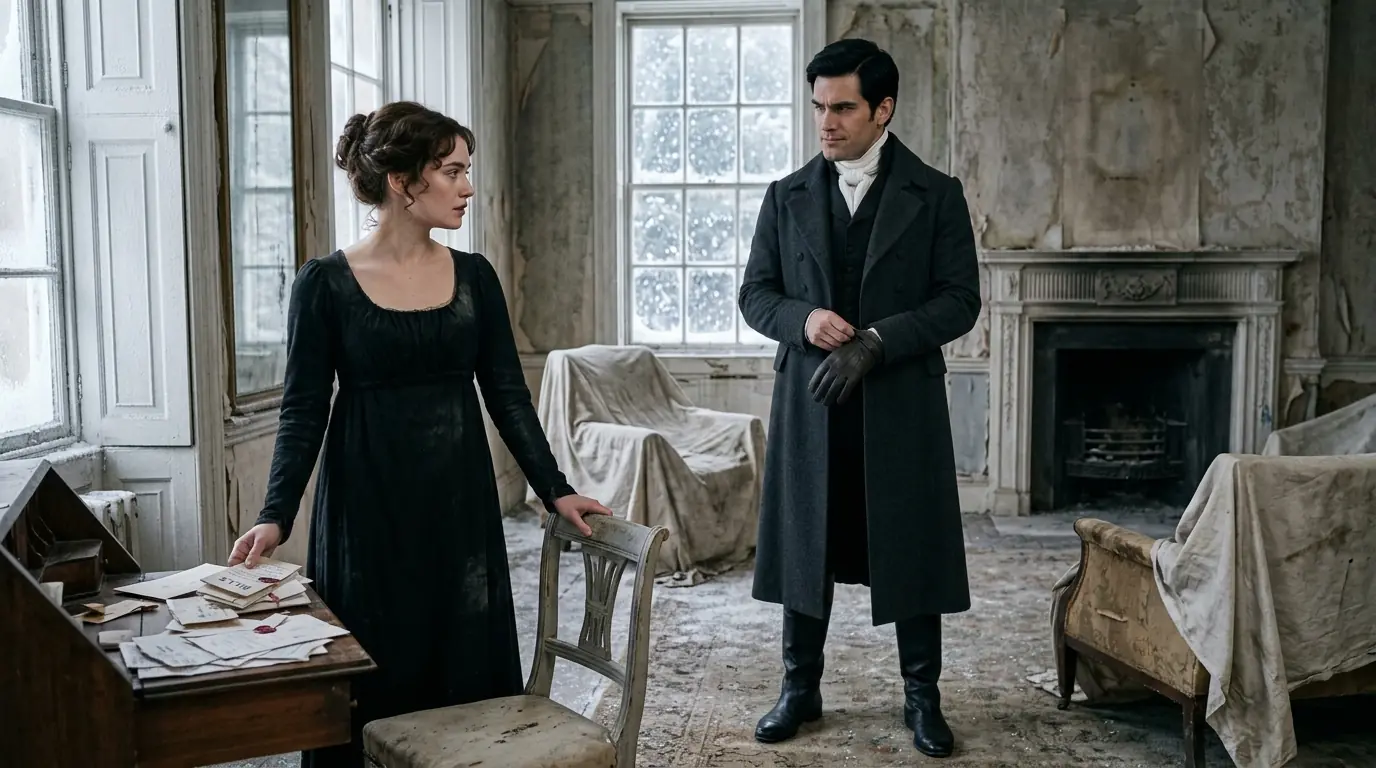
The Duke of Thornmere did not bow when he entered the ruined house. Instead, he looked at Diana Carey as if she were a decision already made. "Miss Carey," he said quietly, removing his gloves one finger at a time, "I have come to ask you to marry me." The word marry echoed in the cold drawing room like a pistol shot.
Diana stared at him. Outside snow pressed against the windows of the once proud merchant house. Inside, the hearth was dead. The air bitter enough to sting the lungs.
Three days earlier the servants had gone. Two days earlier the newspapers had published the truth about her father's debts. And that morning her fiance had abandoned her. Yet somehow the most impossible moment of all had arrived now.
"Your Grace," she said slowly, "I believe you are mistaken." Miles Garrett, Duke of Thornmere, did not look mistaken. Tall, composed, dressed in dark wool that belonged in a ballroom rather than a frozen house, he stood in the center of the room like a man accustomed to possession. "I am rarely mistaken," he replied.
Diana's fingers tightened around the back of the chair beside her. Only an hour earlier she had been rereading the short letter that ended her future. Given the recent circumstances involving your family, I consider our engagement at an end. Eight months of promises dismissed in three lines. Lord Philip Harcourt had not even come himself.
Now the most feared Duke in London stood before her offering marriage. It felt like a cruel joke played by fate. "I have no dowry," Diana said. "My father's estate is drowning in debt." She forced herself to meet his eyes.
"And society considers my family a scandal." Miles Garrett's gaze remained calm. "Yes." Silence spread between them. Diana felt suddenly aware of everything.
The threadbare carpet, the thin black dress she had worn since the funeral, the ache of hunger twisting low in her stomach. He noticed it. She saw the moment he noticed, but he said nothing about it. Instead, he walked slowly toward the window, glancing at the silent street where snow swallowed the sound of passing carriages. “You will lose this house within weeks,” he said without turning.
“Creditors are already preparing to claim it.” Her jaw tightened. “I am aware.” You will seek employment, he continued calmly, perhaps as a governess. His voice held no cruelty, only precision.
But your father's scandal will follow you. Diana's nails dug into her palm. “And what concern is that of yours?” Now he turned. His eyes were dark and unreadable.
“Because,” he said quietly, “I require a wife.” The words were spoken with the same tone another man might use when discussing the purchase of land. Diana almost laughed. Your Grace, she said, disbelief sharpening her voice. You are a duke.
London is filled with women eager to marry you. Yes. Then why, she demanded, would you choose a ruined merchant's daughter? For the first time something flickered across his face, interest. Because ruined women, he said evenly, have fewer illusions.
Her breath caught. The insult was subtle but unmistakable. You mean, she said slowly, that I would make fewer demands? “Precisely.” Snow tapped against the window.
The cold seemed deeper now. Diana took a step closer. “Do you believe I am desperate enough to sell myself?” Miles Garrett studied her with unsettling patience. “I believe,” he said, “that you are practical.”
His gaze moved briefly toward the empty hearth, then back to her. You are alone, without money, without allies. The words landed like stones. In three weeks, he continued, you will be forced to leave this house. Diana hated that he was correct.
I am offering you protection, he said. And what do you gain? She demanded. That was when he smiled. It was not a warm smile.
It was the smile of a man who had already calculated the answer. “A wife without expectations,” he said softly. “No interfering relatives. No romantic illusions.” Only then did Diana fully understand this was not kindness, it was strategy.
“You want obedience,” she said. “No,” he corrected. “I want honesty.” He stepped closer, not threatening, but close enough that the air between them tightened. I will protect you from every creditor in London, he said.
You will never be cold or hungry again. His voice dropped slightly. In return, you will become my Duchess. Diana's heart beat painfully in her chest. A Duchess.
The word felt absurd in this freezing room. “And love?” she asked quietly. Something in his expression hardened. “That,” Miles Garrett said, “is not part of the arrangement.”
The answer should have made refusal easy, but then she remembered Philip's letter, the unpaid funeral bill, Mrs. Albright's tired face in the kitchen that morning, and the hollow ache of hunger. “How long,” she asked carefully, “do I have to decide?” “Until tomorrow.” He moved toward the door, placing his gloves back on. “At noon,” he said, “a carriage will arrive.”
He opened the door. Winter air swept through the hall. “If you are inside it,” he finished, “I will take that as your acceptance.” Then he stepped out into the snow. The door closed behind him, and Diana Carey stood alone in the frozen drawing room, staring at the place where the most dangerous man in London had just offered her salvation or ruin.
Diana Carey did not sleep that night. The house was too quiet, too empty. Every clock seemed louder, every gust of wind against the windows more accusing. The fire had long since died, and the cold crept through the rooms like an unwelcome guest that had no intention of leaving. She sat at the writing desk with Philip's letter still lying open before her.
Three lines. Three lines that had erased a future she had once believed secure. “Given the recent circumstances involving your family...” Coward. Diana folded the paper slowly and placed it back on the desk.
Not with anger. Anger required strength, and she had very little left. Outside snow continued to fall over London. Inside the truth pressed harder with every passing hour. She had no money, no allies, and by noon tomorrow she would either be the Duchess of Thornmere or a woman without a home.
Across the city, Miles Garrett sat alone in his Mayfair library. A single lamp illuminated the desk where a stack of legal papers lay neatly arranged. The marriage contract. Richard Thornberry, his solicitor, stood across the room adjusting his spectacles. "Your Grace," the man said carefully, "may I ask a personal question?"
Miles did not look up from the document he was reviewing. "You may ask. Whether I answer is another matter." Thornberry cleared his throat. "Miss Carey is an unusual choice."
Miles dipped his pen into the ink. "That is precisely why she is suitable." The solicitor hesitated. "She has no fortune, no family influence, and society has already begun discussing her father's debts." Miles signed his name with a smooth, decisive stroke.
"Exactly." Thornberry frowned slightly. "You are aware this marriage will cause comment?" Miles set the pen down and leaned back in the chair. "I am the Duke of Thornmere."
His tone remained calm. "Society comments on everything I do." A pause stretched between them. Finally, Thornberry said quietly, "Forgive my concern, Your Grace, but most men in your position would choose differently." Miles rose from the desk and walked toward the tall window overlooking the snowy square.
Carriages moved slowly through the winter streets. London looked deceptively peaceful beneath its blanket of white. "Most men," Miles said, "want affection in their marriages." His reflection stared back at him in the glass. "I do not."
Thornberry watched him carefully. "Then why marry at all?" Miles did not hesitate. “Because a duke without a wife invites speculation, and speculation invites opportunists.” His voice hardened slightly.
He turned back toward the desk. “My distant cousins already circle like vultures around the estate, and an heir would silence them.” “Precisely.” The solicitor nodded slowly. “And Miss Carey?”
Miles's expression did not change. “She requires protection.” “And you require a duchess.” “Yes.” Thornberry sighed.
“A practical arrangement.” Miles gave the faintest smile. “The only kind that works.” Late the next morning, a black carriage rolled quietly through the snow-covered streets toward the Carey house. Inside it, Miles Garrett sat perfectly still.
He did not doubt her decision, not because he believed himself irresistible, but because he understood desperation. He had seen it in her eyes. Pride had hidden it well, but it was there, sharp and bright beneath the surface. A woman who had lost everything, a woman who would rather endure humiliation than beg. Those were the kind who survived, and survival was the only thing he was offering.
The carriage slowed. Through the frost-touched window, Miles saw the narrow street where the Carey house stood silent among its neighbors. The driver turned slightly. “We've arrived, Your Grace.” Miles glanced once more at the folded marriage contract resting beside him.
Then he stepped down from the carriage. Snow crunched beneath his boots. The front door of the house opened slowly, and Diana Carey appeared in the doorway. She wore the same black dress. Her face was pale, but composed.
For a moment, neither of them spoke. Then she stepped forward. "I assume," she said quietly, "your carriage is waiting." Miles studied her carefully. "Yes."
A long silence followed. Diana looked once over her shoulder at the house behind her. The house where she had grown up, where her father had laughed loudly at dinner, where the illusion of security had once felt permanent. Now the windows were dark, the rooms cold, and the future uncertain. She turned back to Miles Garrett.
Her chin lifted slightly. "I accept your proposal, “Your Grace.” " Miles inclined his head once. No triumph, no relief, only acknowledgement. "Very well."
He extended his hand toward the carriage. "Then we should not keep the reverend waiting." Diana hesitated only a moment before placing her gloved fingers in his. And with that simple gesture, the most feared duke in London escorted his future duchess into the carriage that would carry them toward a marriage built not on love, but necessity. The chapel was smaller than Diana had expected.
Tucked behind the Duke of Thornmere's Mayfair residence, it was an old family chapel built of pale stone and dim candlelight. The ceiling arched low above them, and the air carried the faint scent of incense and polished wood. No flowers decorated the altar, no music played. There were no guests, only the reverend, the duke, and the woman he had chosen as his duchess. Diana stood at the end of the narrow aisle, her gloved hands clasped together so tightly the fabric creased.
Mrs. Albright stood quietly behind her as a witness, the loyal housekeeper having insisted on accompanying her. On the other side of the chapel, Miles Garrett's butler, Hastings, waited with the same still dignity that seemed to exist in every corner of the duke's household. That was all. No family, no friends, no celebration. Diana had never imagined her wedding would feel like the signing of a treaty.
Miles stood near the altar, already waiting. He wore a dark formal coat and immaculate gloves, the sharp lines of his figure illuminated by candlelight. He looked exactly as he always did, composed, controlled, untouched by emotion, as though marriage were merely another responsibility in a long list of duties. When Diana stepped forward, the faint rustle of her ivory gown echoed through the chapel. The dress had been chosen by Mrs. Drummond that morning.
It fit perfectly. It did not feel like hers. Miles watched her approach without moving. Only when she reached him did he extend his arm. “Miss Carey,” he said quietly.
“Your Grace.” The reverend cleared his throat gently and began the ceremony. The familiar words floated through the quiet chapel like something ancient and distant. “Dearly beloved, we are gathered here today.” Diana tried to listen, tried to focus, but her thoughts drifted to the absurdity of it all.
Only yesterday she had been a ruined merchant's daughter facing eviction. Today she was marrying one of the most powerful men in England, a man who had made it very clear that affection had no place in their union. Your Grace, the reverend prompted softly. Miles turned toward her. “I, Miles Edward Garrett,” he said evenly, “take thee, Diana Margaret Carey, to be my lawful wife.”
His voice did not waver. Diana forced herself to meet his eyes. They were dark and unreadable. Miss Carey, the reverend said. Her turn.
Diana inhaled slowly. “I, Diana Margaret Carey,” she began, her voice softer but steady. “Take thee, Miles Edward Garrett, to be my lawful husband.” The words felt strange on her tongue, unreal. To have and to hold.
From this day forward. Promises neither of them expected to fulfill in the traditional sense. The reverend continued the ritual with quiet efficiency. When the moment came for the ring, Miles removed a simple gold band from his pocket. No jewels, no extravagance.
He took her hand. His fingers were warm despite the winter air. Diana felt the faintest tension in his grip as he slid the ring onto her finger. “Diana,” he said quietly. The reverend smiled faintly.
“You may kiss the bride.” The chapel seemed to hold its breath. Miles hesitated, only for a moment. Then he leaned forward. The kiss was brief, polite, almost ceremonial.
His lips brushed hers with the restraint of a man who had no intention of making the gesture mean anything. But something unexpected happened. For the briefest instant, Miles Garrett paused. As though he had noticed something he had not anticipated, something human. Then it was gone.
He stepped back immediately. "It is done," the reverend said warmly. "I present His Grace and Her Grace, the Duke and Duchess of Thornmere." Diana lowered her gaze to the ring on her hand. A duchess.
The title felt heavy. Miles signed the marriage register first. His handwriting was precise and controlled. Diana took the pen next. Her fingers trembled slightly as she wrote her new name for the first time, Diana Garrett.
When she finished, Miles glanced at the page. "Efficient," he murmured. She looked up sharply. Was efficiency part of the contract as well? A flicker of something, amusement perhaps, passed through his eyes.
"Among other things." Outside, the carriage was already waiting. Snow still drifted through the London streets as the newly married couple stepped out of the chapel. Miles offered his arm again. Diana accepted it, not because she trusted him, but because she had chosen this path.
As they reached the carriage, she glanced up at him. "“Your Grace.” " "Yes." She hesitated before speaking. "Now that we are married, what happens next?"
Miles helped her into the carriage before answering. Then he stepped in beside her and closed the door. The carriage began to move. "You become the Duchess of Thornmere," he said calmly. "And I?"
He looked at her for a long moment. "I learn," Miles Garrett said quietly, "whether marrying you was a mistake." The carriage rolled through the snowy streets of London, and for the first time since the ceremony, Diana wondered the same thing. The Duke's London residence did not feel like a home. It felt like a monument.
Marble floors reflected the light of enormous chandeliers. Tall portraits of Garrett ancestors stared down from the walls with quiet authority. Every piece of furniture stood in perfect order, untouched by the careless warmth of daily life. Diana felt like an intruder walking a museum. Hastings, the Duke's butler, led her up the sweeping staircase with silent efficiency.
Your rooms, your grace, he said, opening a double door. Rooms, plural. The suite contained a sitting room, a dressing chamber, and a bedchamber larger than the entire upper floor of her father's house. A fire burned warmly in the hearth. For the first time in days, Diana felt heat in her bones.
You will dine with his grace at seven o'clock, Hastings continued politely. And until then? The household is entirely at your disposal. He bowed slightly and withdrew. The door closed.
Diana stood alone. She walked slowly toward the tall windows overlooking Mayfair. Carriages rolled through the street below. Ladies in velvet cloaks hurried past shops glowing with lamplight. London carried on as if nothing had changed.
Yet her entire life had turned on a single decision. A knock sounded softly. The door opened before she could answer. A woman in her forties entered, brisk and composed. Mrs. Drummond, she introduced herself.
Housekeeper to his grace. Her gaze swept over Diana with professional efficiency. We must prepare your wardrobe immediately. My wardrobe? You cannot appear in society dressed in mourning forever.
Mrs. Drummond replied matter-of-factly. Diana almost laughed. Society. Only three days earlier society had been whispering about her father's debts. Now those same drawing rooms would bow to her.
The transformation felt unreal. Dinner that evening was served in a smaller dining room lit by dozens of candles. Miles Garrett stood by the fireplace when she entered. He turned when he heard her footsteps. For a moment he said nothing.
His gaze moved over her dark green dress. One of the new gowns Mrs. Drummond had insisted she wear. “Appropriate,” he said at last. Diana took her seat at the long table. “That is not quite a compliment.”
“It is not meant to be.” Servants appeared silently with the first course. For several minutes they ate in complete silence. Diana could not bear it. "Your Grace," she said finally, "may I ask you something?"
Miles glanced up from his plate. "You may." "You chose me because I had no expectations." "Yes." "And because I was convenient."
"Yes." The bluntness still stung, but there was something else, she continued, "wasn't there?" Miles did not answer immediately. Instead, he poured wine slowly into his glass. "What makes you believe that?"
"Because," Diana said quietly, "a man like you does nothing without a reason." The candlelight flickered between them. At last, he spoke. "My sister once told me something," he said. Diana waited.
Miles looked toward the far wall. A portrait hung there, a young woman with soft golden hair and gentle eyes. "She said loneliness can destroy a person faster than poverty." Diana followed his gaze. "Your sister?"
"Philippa Garrett." His voice carried a subtle change. "She died three years ago." Diana felt something tighten in her chest. "I'm sorry."
Miles shrugged slightly. "Fever." But his eyes lingered on the portrait longer than necessary. "She hated this house," he added quietly. "Why?"
"Because it was empty." The words seemed to surprise even him. Diana studied him carefully. "You brought me here to fill it." Miles met her eyes again.
"No." His answer was immediate. "I brought you here because it was practical." A lie, Diana could feel it, but she did not press further. Instead, she asked softly, "then why do you keep her portrait in the dining room?"
Miles leaned back in his chair. "For the same reason I married you." "And what reason is that?" His gaze sharpened slightly. "To remind myself," he said quietly, "what happens when I allow sentiment to influence my decisions."
The words were cold, but Diana noticed something else. His hand had tightened around the wine glass, as though the memory still hurt. And for the first time since their marriage, she wondered whether the feared Duke of Thornmere was not heartless after all, but merely a man who had buried something very human. Three days after the wedding, the snow began to melt. London streets turned gray and wet beneath carriage wheels, and the air carried the promise of rain instead of frost.
Inside the Thornmere townhouse, however, nothing seemed to change. Miles Garrett left the house early each morning. He returned late, and though he always joined Diana for dinner, their conversations remained brief, polite, and carefully distant. Exactly as the arrangement had been designed. Yet, Diana felt the silence pressing harder with each passing day.
That evening, the candles burned low in the dining room when Miles finally arrived. He removed his gloves slowly before taking his seat. "You dined late tonight," Diana observed. "Business in Parliament," he replied simply. The servants poured wine.
Diana watched him across the long table. "You work constantly." "It is expected of me." "And what is expected of me?" She asked quietly.
Miles looked up. "You manage the household." "I have done that." "You attend the dress fittings." "I have done that as well."
She folded her hands carefully in her lap. "And beyond that?" Miles frowned slightly. "What do you mean?" "I mean," Diana said softly, "what is my purpose here?"
The question lingered between them. Miles set his fork down. "You are the Duchess of Thornmere." "That is a title," she replied, "not an answer." A faint crease appeared between his brows.
"You wish security," he said. "I have given it." "Yes," she said. Her voice remained calm, but the words carried weight. "You have given me food, warmth, clothing, and a house larger than any I have ever known."
She looked directly at him, "but you have not given me a life." Miles was silent. Diana stood slowly from the table and walked toward the window. Rain had begun to fall softly against the glass. "When you proposed," she continued quietly, you said I would never be cold or hungry again.
Yes. You kept that promise. She turned toward him, but you never said anything about loneliness. Miles stiffened. I assumed, he said carefully, you understood the nature of our agreement.
I did. Then why does it trouble you now? Diana hesitated because the truth felt far more dangerous than silence. Because, she said finally, I did not expect you to be quite so absent. Miles studied her I dine with you every evening.
Yes. But you are never truly here. The words landed harder than she intended. For a moment Miles did not respond. Then he rose from his chair.
You want honesty, he said quietly. I will give it. He walked toward the fireplace staring into the flames. I married you because it was necessary. I know.
I do not pretend affection where none exists. I know that as well. His jaw tightened. Then what exactly are you asking from me? Diana swallowed.
She had not planned to say it aloud, yet the words escaped anyway. Attention. Miles turned sharply. She held his gaze. Not love, she said, not devotion.
Simply an acknowledgement that I exist beyond this arrangement. For a long moment the room remained silent except for the soft crackle of fire. Then Miles spoke quietly. You exist. That is not the same as being seen.
Her words struck deeper than she realized because something flickered across his expression, a brief hesitation, almost regret. He walked slowly back toward the table. When he spoke again his voice was lower. I am not skilled at companionship. That much is evident, Diana said dryly.
To her surprise, Miles almost smiled. It was faint, barely visible, but it was the first time she had seen anything resembling warmth in his face. You are remarkably bold for a Duchess who has been married less than a week, he said. And you are remarkably distant for a husband. Their eyes met across the candlelight.
Something shifted, small, fragile, but undeniable. And though neither of them spoke of it, Diana sensed the first tiny fracture forming in the armor the Duke of Thornmere had spent years building. Two days later, Diana discovered something she was never meant to see. It happened by accident. The morning had been gray and quiet, the kind of London morning where the sky seemed permanently undecided between rain and fog.
Diana wandered through the Thornmere library, a vast room lined with dark shelves and rolling ladders. It was the only place in the house that felt alive. Books at least did not pretend indifference. She was searching for something to occupy the long afternoon when she noticed a leather-bound journal lying half open on the desk, Miles's desk. She should not have looked.
She knew that. But one line had already caught her eye. I should have stayed with her. Diana froze. Slowly, almost guiltily, she read the next sentence.
Philippa asked me to remain that winter. I told her I had work in London. When the letter arrived saying she had fallen ill, I was already too late. The room seemed to grow colder. Diana closed the journal immediately.
So, that was the truth. Not simply a sister lost to illness, but a guilt that had followed him for years. Footsteps sounded behind her. Diana turned sharply. Miles stood in the doorway.
His gaze moved from her face to the journal and back again. For a moment, neither of them spoke. I did not mean to pry, Diana said quietly. Miles crossed the room slowly. You already have.
His voice was calm, too calm. Diana braced herself for anger, but it did not come. Instead, Miles picked up the journal and closed it carefully. You know now, he said. Yes.
Silence stretched between them. I suppose, Diana said gently, that explains why you keep the house so quiet. Miles laughed softly. It was not a pleasant sound. Quiet houses do not demand affection.
And affection frightens you. Yes. The honesty stunned her. Miles walked toward the tall window staring out at the gray garden. For years, he said quietly, I believed that caring for someone meant risking their loss.
His hand rested against the cold glass. So, I stopped caring. Diana stepped closer. But, that did not prevent loss. No.
His voice tightened. It only prevented life. The admission hung heavily in the room. Diana studied him carefully. You think if you allow yourself to care again, something terrible will happen.
Miles turned toward her. I know it will. You cannot know that. I watched it happen once already. His eyes were darker now, not cold, wounded.
Diana took another step forward. And yet, you married me. Yes. Why? The question was quiet, but relentless.
Miles hesitated. For the first time since she had known him, the Duke of Thornmere seemed uncertain. I told you, he said slowly, you were practical. That was not the real reason. No.
Silence again. Then, he said something unexpected. You reminded me of her. Diana blinked. Your sister?
Yes. Miles looked away. She was stubborn. She refused to let the house swallow her. He paused.
You looked the same way that day in the cold drawing room. The admission surprised them both. Diana felt her chest tighten. So, you married me, she said softly, to prove you could save someone this time? Miles did not answer immediately, because the truth was uncomfortable.
Yes, he said at last. The words landed between them like fragile glass. Diana nodded slowly. That is a heavy burden to place on a marriage. It was never meant to be a marriage.
It became one the moment you said the vows. Miles looked at her again. The fire had faded from the hearth, leaving the room dim and shadowed. You are asking for something I do not know how to give, he said quietly. Humanity, Diana replied.
Miles gave a faint bitter smile. Yes. She held his gaze steadily. “Then learn.” The word surprised him.
Learn? He repeated. Yes. Diana's voice softened. You are not a statue carved from ice.
You are a man who is afraid. Miles stared at her. No one had ever said it so plainly. And if I fail, he asked. Diana did not look away.
Then we will fail honestly, she said. But at least we will not live as strangers. The room fell silent again. Miles studied her for a long moment. Then slowly he nodded.
“I will try.” It was not a promise, but it was the first step he had taken toward another human being in years. And Diana understood something important in that moment. The feared Duke of Thornmere was not heartless. He was simply a man who had forgotten how to live.
The night after their conversation in the library, London hosted the Harrington winter ball. Under normal circumstances, the Duke of Thornmere would have ignored such an invitation. But this time he did not. Because that morning the newspapers had begun whispering again. The ruined merchant's daughter who trapped a Duke.
Diana read the line only once before folding the paper. She said nothing. But Miles saw the quiet way she placed it aside, and something cold settled in his chest. That evening, the Harrington ballroom glittered with chandeliers and silk gowns. Laughter floated through the hall, accompanied by the gentle music of a string quartet.
When the Duke of Thornmere entered, the room shifted. Whispers followed immediately. But the whispers grew louder when Diana stepped beside him. Her gown was deep emerald silk, elegant but restrained. Her hair was arranged simply, a few delicate pins catching the light.
She looked every inch a Duchess, even if society refused to accept it yet. Miles offered his arm. Diana took it. “Stay near me,” he murmured. “That sounds almost protective,” she replied quietly.
“It is.” The answer surprised them both. As they crossed the ballroom floor, conversations paused. Eyes followed them. Then the inevitable moment arrived.
Lord Philip Harcourt approached, Diana's former fiance. His smile was strained, his bow exaggerated. Your Grace, he said to Miles. Then he turned toward Diana. Mrs. Garrett, he added deliberately, not Duchess.
Miles's gaze sharpened. Philip continued smoothly. I trust you are enjoying your unexpected elevation. Diana felt the humiliation rise like heat in her throat. Before she could respond, Miles spoke.
My wife, he said calmly, is the Duchess of Thornmere. The words were quiet, but they carried across the nearby crowd. Philip's smile faltered. Miles stepped slightly closer to Diana, possessive, unmistakable. And anyone who forgets that, Miles added softly, will find themselves unwelcome in my presence.
The silence around them deepened. Philip flushed. Of course, “Your Grace.” He bowed quickly and retreated into the crowd. Diana stared at Miles.
You did not have to do that. Yes, he said simply. I did. She searched his expression. Why?
Miles hesitated. For once, the answer was not easy, because something had changed. Slowly, quietly, dangerously. I told you I would try, he said at last. The music shifted into a waltz.
Miles extended his hand. “Dance with me.” Diana raised an eyebrow. You do realize this will cause even more gossip. “Let them gossip.”
She placed her hand in his. He drew her into the center of the ballroom. The waltz began. For a moment, they moved in silence. Then Diana spoke softly.
This is the first time you have danced with me. Miles's hand rested carefully at her waist. I am learning. She studied him as they turned beneath the chandeliers. You are doing surprisingly well.
He almost smiled. The music slowed. Their steps slowed with it, and for a brief moment, the world seemed to narrow to the space between them. “Diana,” he said quietly. Yes?
I made you a promise when I proposed. You made several. That you would never be cold. Her breath caught slightly. Yes.
I intend to keep that promise. His voice softened. In every sense. Something in his tone was different. Not calculated.
Not distant. Honest. Diana's heart fluttered unexpectedly. Is that a confession, Your Grace? Miles looked down at her.
Perhaps it was. Not yet, he said quietly. But it is the beginning. The music ended. The ballroom erupted into applause.
Yet neither of them moved immediately because in that moment Diana understood something that frightened her almost as much as it thrilled her. The man she had married out of desperation was no longer simply a protector. And the feared Duke of Thornmere was no longer entirely made of ice. He was changing. And if she was not careful, she might truly fall in love with him.