The county auctioneer held up the deed as though it were a joke someone had forgotten to finish.
“Eighty acres outside Red Hollow,” he announced. “One ruined barn, one condemned pump house, no working electricity, no verified well, and an environmental warning attached to the eastern field.”
A few farmers in the back of the room laughed.
Mason Cole sat alone in the second row, grease still dark beneath his fingernails from the transmission he had rebuilt that morning.
The auction took place inside the Red Hollow municipal hall, where the ceiling fans turned too slowly to disturb the August heat. Folding chairs faced a wooden table covered with tax-sale documents, unpaid liens, and properties no sensible person wanted.
The land outside town had failed to sell three times.
Its former owner had disappeared.
The county had spent more money posting warnings and cutting weeds than the property was worth.
The auctioneer looked around.
“Minimum bid is one dollar.”
Silence.
Someone behind Mason whispered, “You’d have to pay me more than that.”
Another man said, “The ground’s poisoned.”
A third replied, “Nothing grows out there but debt.”
Mason raised his hand.
“One dollar.”
The laughter grew louder.
The auctioneer looked almost disappointed.
“Any competing bids?”
No one answered.
The wooden gavel came down.
“Sold.”
Mason Cole became the owner of eighty acres for less than the cost of a cup of coffee.
He had no idea that before the week ended, someone would attempt to burn the old pump house.
He did not know the contamination report attached to the property had been falsified.
And he certainly did not know that beneath the dead grass lay one of the largest clean-water reserves in the county.
All Mason knew was that he finally owned something no landlord could take from him.
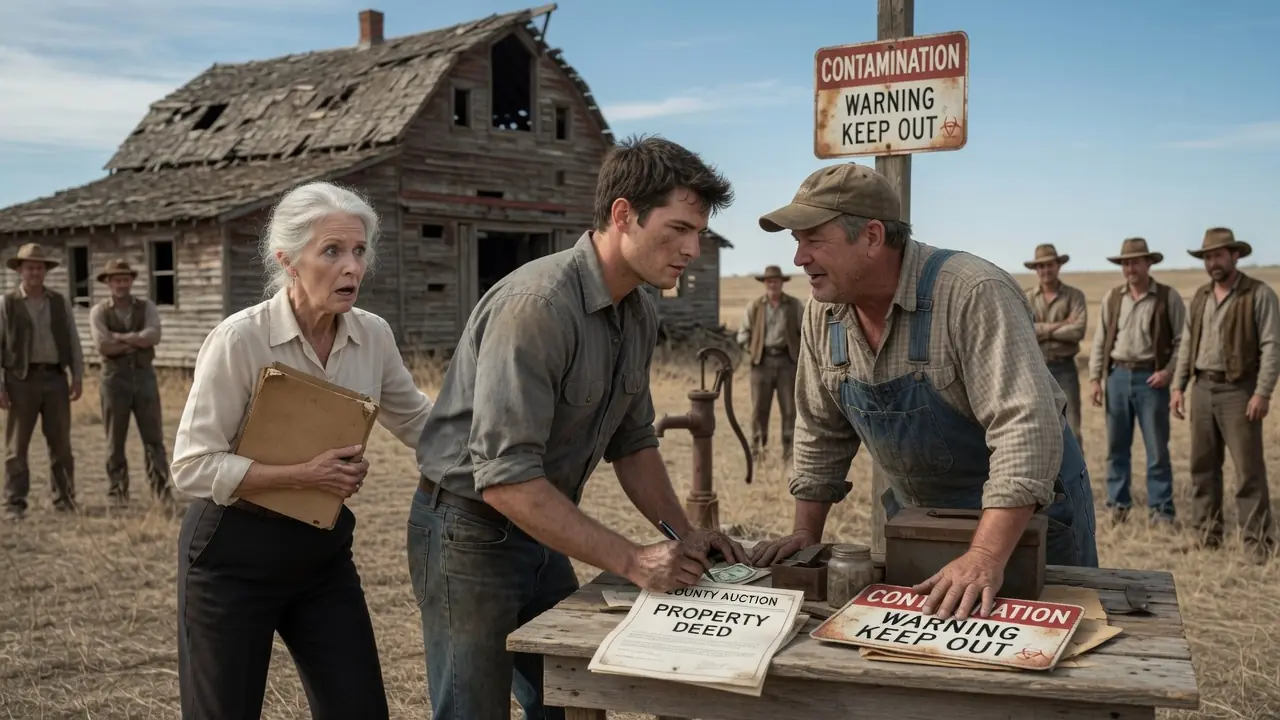
At twenty-four, he had spent most of his life repairing what other people had decided was finished.
Engines.
Farm equipment.
Air compressors.
Old generators whose owners insisted they had already been examined by better mechanics.
Mason liked machines because they rarely lied.
A broken gear did not accuse the bearing.
A cracked hose did not hide behind paperwork.
If a machine failed, it left evidence.
Metal shavings.
Heat marks.
Uneven wear.
You only had to look long enough.
People were different.
Mason had learned that from his father.
Caleb Cole had been a mechanic too, though not a careful one. He could rebuild a carburetor but could not keep money in the bank. After Mason’s mother died, Caleb moved from job to job, borrowing from relatives until every conversation began with an apology.
He died when Mason was nineteen, leaving behind a rented trailer, six thousand dollars in medical debt, and an old photograph of a farmhouse Mason had never seen.
On the back, someone had written:
Cole land, 1958. Before they took it.
Mason kept the photograph inside his toolbox.
He never knew who “they” were.
His grandfather, Henry Cole, had died before Mason was born. Family stories described him as stubborn, difficult, and unwilling to leave the farm even after the soil went bad.
Caleb refused to discuss him.
“Some land is better forgotten,” he once told Mason.
But Mason never forgot the photograph.
A white farmhouse.
A windmill.
A line of cottonwoods.
And beneath them, an irrigation pipe large enough to supply a serious farm.
When the county listed the abandoned eighty acres outside Red Hollow, Mason recognized the shape of the barn immediately.
The roof had collapsed.
The farmhouse was gone.
The cottonwoods had mostly died.
But the barn doors carried the same diagonal brace visible in the photograph.
Cole land.
The county record did not mention Henry Cole.
It listed three corporations, two foreclosures, and a final owner named Hollow Creek Agricultural Holdings.
The property taxes had gone unpaid for eleven years.
Mason had eleven hundred dollars in savings and a room above the repair shop where he worked.
Buying the land made no financial sense.
That was why he did it.
The next morning, Mason drove his faded pickup beyond the edge of town.
Red Hollow ended where the pavement broke into gravel.
The land lay another seven miles west, past wheat fields damaged by drought and cattle ponds reduced to cracked mud.
A rusted sign stood beside the entrance.
DANGER — POSSIBLE INDUSTRIAL CONTAMINATION
ENTRY AT OWNER’S RISK
Someone had added beneath it in black spray paint:
IDIOT LAND
Mason climbed through a broken section of fence.
The property looked worse from inside.
Dead grass covered most of the fields.
The barn leaned toward the south as if exhausted.
An old grain silo stood open to the sky.
Near the eastern boundary, orange warning stakes formed a rough square around bare soil.
The pump house sat near the center of the land.
It was a low concrete structure with a steel door welded shut.
Mason walked around it twice.
The building had no windows.
Three pipes emerged from the foundation and disappeared underground.
A fourth pipe had been cut cleanly and capped.
He crouched beside it.
The metal was thick industrial steel, far larger than anything needed for an ordinary livestock well.
He wiped away rust and found a stamped manufacturer’s plate.
HARTLEY DEEP-WELL SYSTEMS
MODEL 4000
MAXIMUM DEPTH: 680 FEET
Mason sat back.
No farmer installed a pump rated for nearly seven hundred feet unless he knew something was beneath him.
He returned to the barn and spent the afternoon clearing a section of roof before it collapsed completely.
Near sunset, a black sedan appeared on the gravel road.
It stopped outside the gate.
A silver-haired woman stepped out.
She wore a pale linen jacket despite the heat and carried an old brown folder against her chest.
Mason walked toward her.
“Can I help you?”
The woman looked beyond him at the barn.
Her eyes filled before she answered.
“You bought it.”
Mason glanced toward the county sign.
“That seems to be everyone’s favorite bad news.”
She looked at him carefully.
“You’re Caleb’s son.”
The words stopped him.
“Did you know my father?”
“I knew your grandfather.”
Mason’s posture changed.
The woman held out her hand.
“My name is Evelyn Shaw.”
He did not take it immediately.
“Why are you here?”
“Because I saw the auction notice yesterday.”
“You waited until after I bought it.”
“I waited until someone with the right name owned it again.”
Mason looked at the folder.
“What’s in there?”
“The reason this land was never worth one dollar.”
He unlocked the chain and allowed her through.
They sat inside the least damaged section of the barn.
Evelyn placed the folder on an overturned crate.
Its edges were soft with age. Several pages inside carried county seals and handwritten notes.
She removed a black-and-white photograph.
A younger Evelyn stood beside a man with heavy eyebrows, rolled sleeves, and dirt on his boots.
Mason recognized the farmhouse behind them.
“Henry Cole,” she said.
“My grandfather.”
“Yes.”
“You worked for him?”
“I was seventeen when he hired me to help with his books. My father had died, and my mother cleaned houses in town. Henry paid me the same hourly wage he paid the men.”
Mason looked at the photograph.
“What happened here?”
Evelyn opened the folder.
“Your grandfather discovered water.”
Mason almost laughed.
“There’s no water for miles.”
“There is beneath us.”
She removed an engineering survey dated 1957.
A blue line crossed the property at a depth of approximately five hundred and forty feet.
The notes described a confined aquifer beneath a layer of shale.
Estimated yield:
1,800–2,400 gallons per minute.
Mason read the number twice.
“That’s impossible.”
“It was unusual. Not impossible.”
“Why isn’t anyone using it?”
“Because Henry refused to surrender control.”
Evelyn explained.
In the late 1950s, Red Hollow’s shallow wells began declining. Three powerful families controlled most of the county’s farmland: the Barrows, the Mertons, and the Vales.
They formed a private irrigation company and purchased water rights wherever they could.
Henry Cole discovered the deeper aquifer while drilling for a livestock well.
Under the permits issued at the time, his claim carried an early priority date—older than nearly every major irrigation claim filed afterward.
“He had senior rights,” Evelyn said. “If the county suffered shortages, his lawful use would be protected before later claims.”
Mason turned another page.
It contained a water permit bearing Henry Cole’s name.
The seal had faded, but the registration number remained visible.
“What does this mean now?”
“It means anyone controlling this land may still possess a powerful claim, depending on what was preserved and how later transfers were recorded.”
“You said someone took it.”
Evelyn’s expression hardened.
“They tried to buy him first.”
The irrigation company offered Henry far more than the farm’s market value.
He refused.
They offered him a partnership.
He refused again.
Then cattle began dying near one of his surface ponds.
A county inspector reported petroleum contamination in the eastern field.
The bank called his loans.
Merchants stopped extending credit.
Neighbors were warned that Henry’s water could poison surrounding farms.
“He said the report was false,” Evelyn continued. “No machinery had ever been stored in that field. No fuel tank had leaked.”
“Did he test it himself?”
“He hired a laboratory in Wichita.”
Evelyn removed a yellowed page.
The results showed no petroleum contamination.
No industrial solvents.
No dangerous heavy metals.
Mason looked toward the orange stakes in the eastern field.
“The county report says the opposite.”
“Yes.”
“What happened to his test?”
“It disappeared from the official file.”
“And this copy?”
“I typed the original invoice.”
Evelyn touched the paper.
“I kept everything.”
Mason leaned back against the barn wall.
“Why?”
“Because Henry told me evidence matters most when powerful people say it doesn’t.”
The false contamination report destroyed the farm’s value.
Henry missed two loan payments.
Red Hollow Community Bank foreclosed.
The property passed to a company controlled by the same families who had tried to purchase his water rights.
Henry fought for years.
He lost the farm.
His wife left the county with their son, Caleb.
Henry remained in a rented room near the rail yard until his death.
“He died believing everyone thought he poisoned his own land,” Evelyn said.
Mason’s throat tightened.
“My father never told me.”
“Caleb was thirteen when they lost the farm. He watched men carry his mother’s furniture out of the house.”
Evelyn looked toward him.
“Shame changes family stories. People stop describing what was done to them and begin describing themselves as failures.”
Mason stared at the documents.
“Why didn’t you come forward?”
“I did.”
She removed several letters.
One had been sent to the county commission.
Another to the state water office.
A third to a federal agricultural agency.
Most received no answer.
One letter had been returned.
Another was acknowledged and closed because Evelyn lacked legal standing.
“I was nineteen,” she said. “My mother became ill. I left Kansas and spent most of my life teaching school in Colorado.”
“You kept this for sixty years.”
“I kept waiting for someone who could use it.”
Mason looked around the ruined barn.
“You think that’s me?”
“I think you bought eighty acres everyone else was afraid to touch.”
“That may prove I’m stupid.”
“It may.”
For the first time, Evelyn smiled.
“But stupidity and courage occasionally wear the same coat.”
Before leaving, she gave Mason the folder.
He did not accept it.
“This belongs to you.”
“No.”
She placed it inside his toolbox.
“It belongs to the land.”
That night, someone called Mason from an unlisted number.
“Sell the property.”
Mason sat on the edge of his bed above the repair shop.
“Who is this?”
“You paid one dollar. Take ten thousand and walk away.”
“That’s a generous return.”
“Twenty thousand.”
Mason looked toward the old photograph taped above his desk.
“Why?”
“The county needs the land for a future conservation project.”
“Then the county can contact me.”
“This offer will not remain open.”
“Good.”
Mason ended the call.
The next morning, his employer asked to speak privately.
Frank Delaney had owned the repair shop for thirty years. He was honest when honesty did not cost him business.
“I heard you bought the Cole place.”
“I did.”
“You should sell it.”
“That advice seems popular.”
Frank lowered his voice.
“Barrow Agricultural Services owns half the equipment contracts in this county. They called this morning.”
“What does my land have to do with transmissions?”
“They suggested I reconsider who works here.”
Mason understood.
“You’re firing me.”
“I’m trying not to.”
“Then don’t.”
Frank looked toward the service bays.
“I have eight men with families.”
“So do what you have to do.”
“Mason—”
“You already did.”
He removed his name patch from the uniform shirt and placed it on the desk.
By noon, Mason had lost his job over land worth one dollar.
He spent the afternoon at the pump house.
The welded steel door had been sealed from the outside, but the welds were shallow and uneven.
Someone had wanted the building closed quickly, not permanently.
Mason cut through them using a borrowed grinder.
Inside, the air smelled of dust, rust, and old oil.
The room contained a massive vertical pump motor, pressure tanks, and a mechanical control panel built decades before digital systems.
Most wiring had been removed.
The motor appeared ruined.
Yet as Mason examined it, he noticed something.
The bearings had been greased before shutdown.
The intake valves were closed properly.
The drive shaft had been secured against movement.
This pump had not failed.
Someone had preserved it.
He removed the motor housing.
Inside, wrapped in oilcloth, he found a small notebook.
The first page carried Henry Cole’s handwriting.
If Caleb ever comes back, tell him the well was clean.
Mason sat on the concrete floor.
The notebook contained maintenance records, pumping volumes, and dates.
The final entry had been written three days before foreclosure.
System shut down by order of county. Water clear. Pump operational. Main intake locked below grade. Secondary valve sealed beneath east manifold.
Mason read it repeatedly.
A mechanic had left him instructions.
Not directly.
Not intentionally.
But clearly enough.
Over the next two weeks, Mason repaired the pump.
He slept in the barn.
He washed at a gas station and ate sandwiches from a cooler.
Evelyn visited every afternoon, bringing food and more stories about Henry.
A retired electrician named Walter Price volunteered after hearing what Mason was doing.
Then came eighteen-year-old Zoe Ramirez, whose family’s shallow well had failed the previous summer.
She had grown up helping her father repair irrigation equipment and understood control systems better than Mason expected.
“You cannot pay me,” she said.
“I was not going to.”
“Good. I don’t want charity.”
“Neither do I.”
Together, they rebuilt the panel using modern breakers while preserving the old motor controls.
The underground intake remained the hardest problem.
Henry’s notes described a secondary valve below the eastern manifold.
Mason excavated beside the pump house and uncovered a buried steel cover.
Beneath it was a vertical shaft with a ladder descending twenty feet.
At the bottom, a horizontal pipe disappeared toward the eastern field.
The valve wheel would not move.
Mason spent six hours removing corrosion.
When it finally turned, something shifted deep beneath the ground.
A low metallic groan traveled through the pipe.
Then came pressure.
Water struck the sealed line hard enough to shake dirt from the shaft walls.
Mason climbed out.
Zoe stared at the gauge.
“Eighty pounds.”
“That line has been closed for sixty years.”
“Pressure doesn’t care.”
They activated the pump at low speed.
The motor resisted.
Then began turning.
The sound grew from a scrape to a steady mechanical hum.
Water entered the first holding tank.
Clear.
Cold.
Mason opened the sample valve.
A stream poured into his hands.
He tasted it before anyone could stop him.
Evelyn slapped the cup away.
“Have you lost your mind?”
“Probably.”
They sent samples to three independent laboratories under separate names.
All reported the same result.
The deep water was clean.
No petroleum.
No solvents.
No contamination.
High mineral content, but suitable for treatment and agricultural use.
The eastern soil samples were clean too.
The county warning had been wrong for more than six decades.
Mason did not announce the discovery.
He photographed every part.
Recorded the gauges.
Copied Henry’s notebook.
Registered the samples.
Then he found the second secret.
While tracing the buried pipe, Zoe noticed that the line did not end at the eastern field.
It continued beneath the county road toward land owned by Barrow Agricultural Services.
“That can’t be right,” she said.
Mason followed the route using a metal detector and old survey stakes.
The pipeline crossed the boundary through a buried access tunnel.
On the Barrow side, it connected to a newer pumping station.
Someone had been drawing water from Henry Cole’s well system for years.
The old pump house had been abandoned above ground.
The aquifer had not.
A modern submersible pump had been installed inside the original bore from an access point beyond Mason’s property.
Barrow Agricultural was extracting water under a newer permit tied to a different well location.
The coordinates on the permit were false.
Mason understood the entire scheme.
The powerful families did not merely want Henry’s land.
They wanted his priority date erased so they could claim the aquifer under their own names.
The foreclosure placed the property inside their control.
Later, when regulations tightened, the land was transferred through shell companies and allowed to fall into tax default.
The public saw worthless contaminated acreage.
Meanwhile, water traveled underground to thousands of acres of profitable farmland.
Mason brought the evidence to Sheriff Lena Brooks.
She listened without interrupting.
Then she closed her office door.
“Do not return to that property alone.”
“That sounds like advice people give before saying they can’t help.”
“I can help.”
She looked at the laboratory reports and pipeline photographs.
“But if this is what you believe it is, the men involved have lawyers, county connections, and enough money to turn theft into a paperwork disagreement.”
“What do we do?”
“Preserve everything outside the county.”
Sheriff Brooks contacted the state water authority and attorney general’s office.
Before investigators could arrive, the pump house burned.
Mason woke inside the barn shortly after midnight and smelled smoke.
Flames climbed the roof of the concrete building.
Someone had poured fuel around the doorway and control panel.
He called the fire department, then ran toward the pump house with an extinguisher.
A vehicle moved beyond the north fence.
Mason could not see the driver.
The rebuilt panel was destroyed.
The old notebook had been inside his truck.
The laboratory reports were stored elsewhere.
The fire damaged the upper motor but did not destroy the well.
At dawn, Sheriff Brooks found fresh tire tracks near the fence.
“Now they’ve given us arson,” she said.
Mason looked at the blackened pump.
“They think this stops me.”
“Does it?”
“No.”
Evelyn arrived while firefighters were leaving.
She stood beside the ruins without speaking.
Mason expected her to cry.
Instead, she opened the old folder.
“There is one more page.”
She removed a sealed envelope bearing Henry Cole’s signature.
“Why didn’t you show me this?”
“Because I promised Henry I would open it only if someone tried to destroy the evidence again.”
Inside was a sworn statement.
Henry described the false contamination report, the pressure to sell, and a meeting with County Commissioner Lawrence Barrow and banker Thomas Vale.
He wrote that both men admitted the aquifer could make the county rich if controlled privately.
The statement included the original water-right registration number and the location of a metal survey tube buried beneath the farmhouse foundation.
The farmhouse no longer existed.
But the foundation stones remained beneath weeds fifty yards north of the barn.
Mason, Evelyn, Zoe, and Sheriff Brooks dug there that afternoon.
They found the metal tube beneath the northwest corner.
Inside were original permits, laboratory reports, correspondence, and a small reel of magnetic recording tape.
Evelyn covered her mouth.
“I forgot about the recorder.”
“What recorder?” Mason asked.
“Henry bought one after the first threats.”
A state laboratory restored the audio.
The voices were damaged but identifiable.
Lawrence Barrow spoke first.
You are standing in the way of an entire county.
Henry answered.
I offered to sell water at a fair rate. You want the land and the right.
Thomas Vale said:
A poisoned farm has no water right worth defending.
Henry replied:
The field isn’t poisoned.
Then Barrow:
It will be when the report is filed.
The recording changed everything.
The men on the tape were dead.
Their sons and grandsons were not automatically guilty.
But the corporations built from the scheme still controlled the water.
The state opened an emergency investigation.
Barrow Agricultural denied wrongdoing.
Its president, Charles Barrow, claimed the hidden connection to Mason’s well had been installed by previous owners.
He described the audio as unreliable.
He argued that any historic claim had been abandoned.
Then investigators examined the modern pump.
Its maintenance records stretched back twenty-seven years.
The company had knowingly extracted water through coordinates that did not match its permit.
Invoices showed payments to county inspectors.
Digital files contained maps labeling Mason’s property:
LEGACY SOURCE — DO NOT DISCLOSE
A public hearing was scheduled in Red Hollow.
The municipal hall filled beyond capacity.
Farmers stood along the walls.
Some depended on Barrow Agricultural for water.
Others feared losing access if the company collapsed.
Mason sat beside Evelyn and Sheriff Brooks.
Charles Barrow arrived with four attorneys.
He looked across the room.
“You’re destroying this county over an old family grievance,” he told Mason.
Mason placed Henry’s notebook on the table.
“My family grievance was buried with my grandfather.”
“Then take a settlement.”
“How much?”
Charles leaned closer.
“Two million dollars. You transfer the property and withdraw your claims.”
The amount stunned Mason.
Two million dollars could change his life.
He could open his own repair shop.
Buy a home.
Never sleep in a barn again.
Evelyn said nothing.
She left the decision to him.
Mason looked toward the farmers filling the hall.
“What happens to the water?”
“We continue operations.”
“Under your control.”
“Under experienced management.”
“And when the drought gets worse?”
“We set rates according to the market.”
Mason understood.
Two million dollars was not payment for eighty acres.
It was payment for silence.
“No.”
Charles’s face hardened.
“You think these people will thank you when their irrigation stops?”
“I don’t want it stopped.”
“You can’t run a regional water system.”
“No.”
Mason looked toward Zoe, Walter, and the farmers whose wells had failed.
“But neither should one family own it in secret.”
At the hearing, the state presented its findings.
The contamination warning was withdrawn.
Barrow Agricultural’s extraction permit was suspended.
The historic Cole registration had never been legally canceled. It had been omitted from later indexes, but the original record remained valid.
Mason possessed a senior claim.
Legally, he could have shut the pipeline and demanded enormous fees.
Instead, he proposed a cooperative.
The aquifer would be managed by a board representing small farmers, the town, agricultural users, and environmental specialists.
Mason would contribute access through his land under a long-term agreement.
Rates would cover treatment, maintenance, and conservation.
No private company could sell the aquifer or hide extraction records.
Zoe’s father asked the question everyone was thinking.
“What do you get?”
Mason looked at the one-dollar deed.
“A seat on the board. Fair payment for the easement. And ownership of my land.”
“That’s all?”
“That’s enough.”
The cooperative passed after weeks of argument.
Not everyone supported it.
Some farmers accused Mason of endangering their livelihoods.
Others distrusted government involvement.
Barrow Agricultural fought the decision in court.
But evidence carried weight.
The company paid penalties, restitution, and the cost of repairing the damaged pumping infrastructure.
Charles Barrow was later charged with conspiracy, falsifying regulatory records, and obstruction related to the fire investigation.
His employees testified that he had ordered the pump house destroyed after learning about the laboratory tests.
Mason rebuilt it again.
This time, he used steel framing, fire-resistant walls, and a modern monitoring system.
He hired Walter as electrical supervisor.
Zoe became the cooperative’s first apprentice and later studied water engineering.
Evelyn received no official title because she refused every one Mason suggested.
“I am retired,” she said.
“You spent sixty years protecting these documents.”
“And I would like to spend what remains of my life criticizing everyone without a job description.”
She did accept a small house on the property.
Not as a gift.
She paid rent of one dollar per year.
The farmhouse was rebuilt near the original foundation.
Mason used salvaged barn wood for the kitchen table.
He placed Henry’s photograph on the wall beside the first clean-water report.
The contamination stakes were removed.
Grass returned gradually to the eastern field.
Not through a miracle.
The land needed treatment, careful irrigation, and time.
Mason planted cottonwoods along the stream channel described in his grandfather’s notes.
During the first winter, only half survived.
He replanted the rest.
Three years after the auction, the cooperative supplied farms across the county during the worst drought in decades.
Usage limits applied to everyone.
Large farms did not receive priority simply because they could pay more.
Small household wells were protected.
Extraction volumes were posted publicly each month.
The system was imperfect.
Meetings lasted too long.
Farmers argued.
Equipment failed.
Mason spent more nights repairing pumps than he had ever spent rebuilding engines.
But every valve, gauge, and ledger could be inspected.
Nothing important remained hidden beneath a false map.
One spring morning, a group of students visited the pump house.
Their teacher asked Mason how he discovered the aquifer.
“I didn’t.”
The children looked disappointed.
“My grandfather discovered it.”
“Then how did you find it?”
“I listened to the machine he left behind.”
A boy raised his hand.
“Machines can’t talk.”
“They can.”
Mason pointed toward the restored pump.
“They talk through wear, pressure, repairs, and the things someone tried to disconnect.”
Evelyn stood at the back of the group.
“What about folders?” she asked.
The children turned.
Mason smiled.
“Old folders talk even louder.”
After the students left, Evelyn and Mason walked toward the farmhouse.
She moved more slowly now and carried a cane.
The cottonwoods along the field had grown taller than both of them.
“Henry would have liked this,” she said.
“The cooperative?”
“The arguments.”
Mason laughed.
“He enjoyed arguments?”
“He enjoyed refusing men who thought money ended them.”
They stopped near the original foundation.
A small stone marker carried Henry Cole’s name.
Not as a hero.
Not as the discoverer of the county’s water.
Only:
HENRY COLE
FARMER
HE TOLD THE TRUTH BEFORE IT WAS PROFITABLE TO BELIEVE HIM
Mason looked across the eighty acres.
People still told the story as though he had become rich by purchasing valuable land for one dollar.
That was not true.
The land had made him responsible before it made him comfortable.
The aquifer required protection.
The cooperative required compromise.
The truth required evidence strong enough to survive the people who benefited from denying it.
Mason had not uncovered buried treasure.
He had uncovered a buried obligation.
His grandfather had found water and tried to share it without surrendering control to men who would exploit it.
Those men destroyed his reputation.
They took the farm.
They taught his son to feel ashamed of the Cole name.
For sixty years, their version of events survived because it sat inside official reports.
Then a young mechanic bought the land no one wanted.
He opened a welded door.
He repaired a pump that had never truly been broken.
And an old woman brought him the folder everyone else expected time to erase.
The county had sold him eighty acres for one dollar because it believed the property held nothing of value.
In one sense, the county was right.
The most valuable thing beneath that soil could not belong to one person.
It belonged to every family whose future depended on someone refusing to let the truth—or the water—be owned in secret.