On a Saturday morning in August of 1976, Ray Kowalski stood at the back of the Lackawanna County Surplus Auction yard in Scranton, Pennsylvania, staring at a truck everyone else had already buried with laughter.
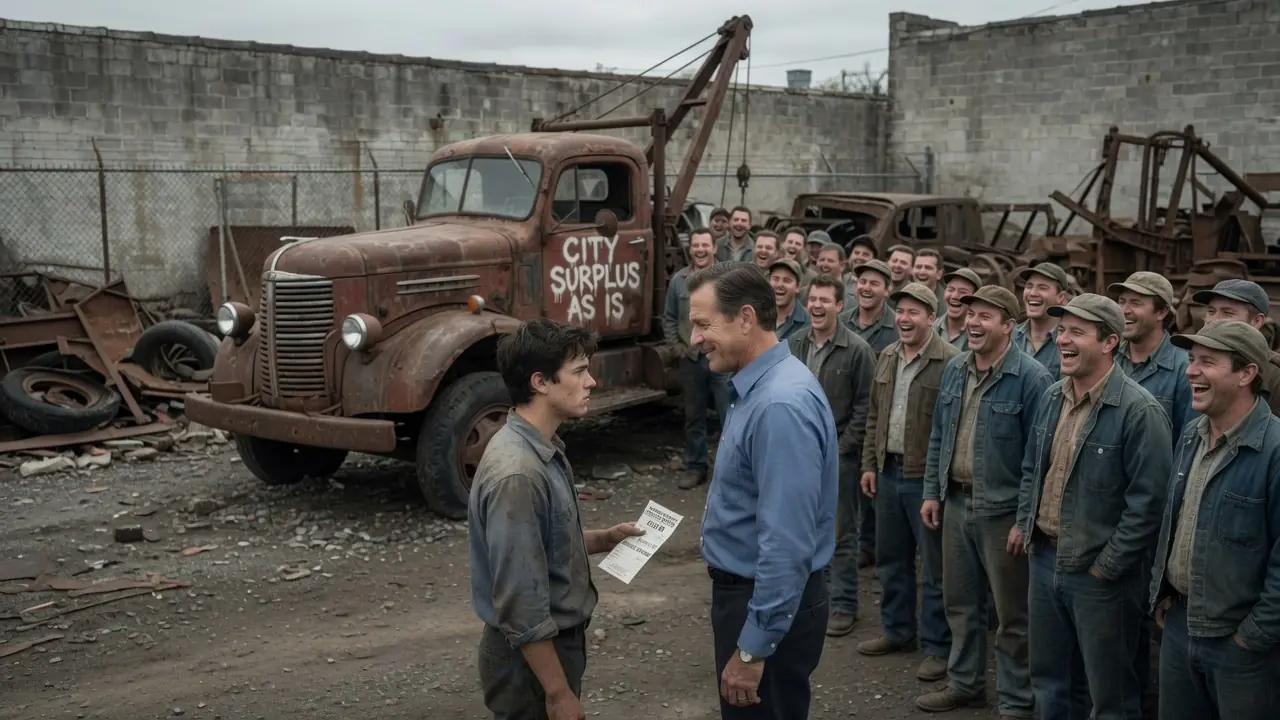
It was a 1952 Holmes 440 wrecker, retired from city service, forgotten under seven years of dirt, rain, snow, and rust. The paint had once been red, but now it looked like an old bruise, faded and rough, with orange rust crawling along the doors. Three tires were flat, the windshield was cracked from corner to corner, and the boom cable hung loose like a broken arm. Someone had spray-painted “city surplus as is” across the driver’s door, as if warning any fool with money to stay away.
Ray did not stay away.
He was twenty-six years old, lean, quiet, and working at a Texaco station on Music Street. He had grease under his fingernails, a few hundred dollars saved in a coffee can, and a dream bigger than his paycheck. He wanted to own one tow truck, just one, and work for himself. Not for a big company, not under someone else’s name, not with payments choking him every month before he even turned the key.
The auctioneer barely tried to sell the wrecker.
“Last item,” the man called, sounding tired already. “1952 Holmes wrecker, retired from city service in 1969. Been sitting since then. Sold as is, no warranty, probably needs everything.”
Nobody bid.
The crowd shifted, smoked cigarettes, laughed under their breath, and waited for lunch.
“Do I hear two hundred dollars?”
Silence.
“One hundred?”
More laughter.
“Fifty bucks for a piece of Scranton history?”
Ray raised his hand.
“Two hundred.”
The auctioneer blinked like he had misheard.
The men around Ray turned to look.
At the edge of the crowd, Mike Brennan, owner of Brennan’s Heavy Recovery, tilted his head and smiled. Mike was forty-five, thick through the shoulders, clean-handed, and proud of the dark blue Chevrolet wreckers he owned on payment plans. His company was the biggest tow operation in Lackawanna County, and he carried himself like every broken-down vehicle on every road already owed him money.
“Two hundred,” the auctioneer said slowly. “Do I hear two-fifty?”
No one answered.
Ray’s throat tightened.
“Three hundred.”
Now the laughter got louder.
“Sir,” the auctioneer said, half-smiling, “you don’t need to bid against yourself.”
“Three fifty,” Ray said.
The yard erupted.
Real laughter.
Men slapped each other’s shoulders, shook their heads, and looked at Ray like they were watching a man throw money into a storm drain.
“Sold,” the auctioneer said quickly, “to the young man in the back for three hundred fifty dollars.”
Ray walked to the payment table and counted out eighteen twenty-dollar bills, almost everything he had saved over six months of working late shifts, oil changes, brake jobs, and weekend repairs. The money left his hand slowly. Each bill felt like a piece of his future, and for one second, even he wondered if the crowd was right. Then he folded the receipt, put it in his pocket, and walked toward the wrecker.
That was when Mike Brennan stepped in front of him.
Mike’s blue work shirt was pressed, his boots were clean, and his smile looked friendly only from a distance.
“Ray Kowalski,” Mike said loud enough for everyone nearby to hear. “Did you just spend three hundred fifty dollars on that pile of rust?”
Ray looked at him.
“Yes, sir.”
Mike laughed.
“Kid, do you know what three hundred fifty could buy you?”
Ray said nothing.
“That’s three months of payments on a real wrecker,” Mike said, gesturing toward his shiny truck in the parking lot. “Something from this decade. Something that starts when you turn the key. I’ve got a 1974 Chevy C60 I could put you in. Two hundred a month, and you’d be in business tomorrow.”
Ray looked past Mike at the rusted Holmes.
“I can fix this one.”
Mike’s smile widened.
“No, you can’t.”
The words came out sharp enough to quiet the men closest to them.
Mike stepped closer, lowering his voice but not enough to keep others from hearing.
“Listen, kid. I know your father was a good mechanic. But you’re twenty-six, you work at a gas station, and you just spent your savings on a wrecker worth maybe a hundred bucks in scrap. That thing hasn’t run since Nixon was president.”
Ray’s jaw tightened.
Mike pointed toward the dead truck.
“The engine’s probably seized. The hydraulics are shot. The brakes are gone. You’ll need two grand in parts before that thing even coughs. You just bought yourself a monument to bad judgment.”
The crowd laughed again.
Ray looked at Mike’s clean hands.
Then he looked at his own dirty ones.
“My old man taught me something,” Ray said. “He said the worst mistake you can make is paying someone else to own your tools.”
Mike’s smile twitched.
Ray stepped around him.
Behind him, Mike called out, “You’ll be begging to sell it for scrap before winter.”
Ray did not turn around.
He placed one hand on the faded hood of the Holmes and felt the sun-warmed metal under his palm. The truck did not look like much. It looked tired, forgotten, and punished by time. But Ray had worked on enough machines to know the difference between dead and waiting.
The first week nearly broke him.
Ray borrowed a tow dolly and dragged the Holmes to his father’s garage in South Scranton. It took three men to push it inside because the brakes were frozen and the wheels barely wanted to move. Once the truck sat under the garage lights, the full truth showed itself. Mike Brennan had not been wrong about the damage.
The engine was seized.
The pistons had stuck to the cylinder walls after years of sitting. The hydraulic system was full of rust-colored sludge. The wiring looked like a nest of brittle snakes. The brake lines were rotted through, the floor was soft in places, and the old cab smelled like oil, dust, and abandonment.
Ray sat on a wooden crate that first night, staring at it.
The receipt was still in his shirt pocket.
Three hundred fifty dollars.
Almost everything he had.
For the first time, shame entered him.
Then his father walked in.
Stanisław Kowalski had hands like old tools and a back bent from thirty years at the Lackawanna Steel Mill. He had come to America with a suitcase, a Polish accent, and the belief that a man who could fix things would never be fully helpless. When the mill closed, he fixed cars in his garage to keep food on the table. Ray had learned mechanics beside him before he learned how to shave.
Stanisław looked at the wrecker for a long time.
Then he looked at Ray.
“You know what this is?” he asked.
Ray exhaled.
“A piece of junk.”
His father shook his head.
“No. This is a 1952 Holmes built in Chattanooga. We had two at the mill. Simple. Strong. No computers. No nonsense.”
He placed his hand on the faded hood.
“This truck will run another fifty years if you treat it right.”
Ray looked at him.
“How do I fix it?”
Stanisław smiled faintly.
“The same way I fixed everything at the mill. One piece at a time.”
So that was what Ray did.
After every shift at the Texaco, he came home and worked on the Holmes. He pulled the engine, tore it down, cleaned every piece, freed the pistons, bored the cylinders, and ground the valves. His father helped with machine work using tools he had carried from the steel mill like relics from another life. They rebuilt not just an engine, but a belief.
The hydraulics took months.
Ray flushed the system again and again until the fluid ran clean. He replaced every seal he could afford, rebuilt the pump, and cleaned the boom assembly by hand. The mechanical winch was old but honest; as long as the gears were good and the cable was right, it would do the job. Ray liked that about it.
All winter, Mike Brennan’s voice echoed in his head.
“You can’t fix this.”
Sometimes Ray answered out loud while turning a wrench.
“Watch me.”
By August of 1977, one year after the auction, the Holmes was ready.
Ray sat in the driver’s seat with his father standing in the garage doorway. His hand trembled slightly when he turned the key. The engine coughed once. Then again. Then it caught, shaking the whole truck before settling into a deep, steady rumble that filled the garage like a working man clearing his throat.
Stanisław crossed his arms and smiled.
“Now you are in business.”
Ray painted KOWALSKI RECOVERY on the doors by hand.
The letters were not perfect, but they were his.
He got his tow license, printed business cards, and started taking small calls nobody else wanted. Dead batteries. Flat tires. Cars stuck in muddy yards. Breakdowns on back roads. The Holmes moved slowly, but it always arrived.
Mike Brennan saw him around town.
“Still driving that antique, Ray?”
Ray would wipe his hands on a rag.
“Truck runs fine.”
“Ready for a real one yet?”
“Already got one.”
The jokes continued for years.
But so did the work.
While Brennan bought newer trucks and made monthly payments, Ray kept the Holmes running with grease, patience, and no debt. While Brennan charged seventy-five dollars a tow, Ray charged thirty-five and still made money because the truck was paid for. People in South Scranton began calling him first because he came when he said he would, charged what he said he would, and treated their trouble like it mattered.
By 1985, Kowalski Recovery was no longer just a dream.
Ray hired a young helper named Tony and bought a second wrecker, a 1965 International, with cash. The Holmes still worked daily, its faded red paint becoming a familiar sight around town. Kids waved when it passed. Old men nodded from porches. Mechanics at corner garages knew the sound of its engine before they saw it turn the block.
Mike Brennan’s company grew too.
He had ten trucks now, highway contracts, a new building, and his name painted in gold on everything he owned. But behind the shine were payments, loans, fuel bills, payroll, insurance, and debt stacked so high even success seemed to strain under it. Mike still smiled in public, still made comments when Ray pulled into a job, still acted like the biggest truck in the yard meant the strongest business. But sometimes Ray saw worry behind his eyes.
By 1995, Ray had owned the Holmes for nineteen years.
The truck had nearly 280,000 miles on it and more stories than paint. Its cab rattled over railroad crossings. Its seat had split on the driver’s side. The floor had begun to feel soft under Ray’s boots after years of Pennsylvania winters, salt, snow, and hard service. One afternoon, Ray finally decided to replace the floor pan.
He parked the Holmes inside the garage, pulled the seat, removed the old floor, and started measuring.
That was when he noticed something wrong.
The cab did not make sense.
Outside, it measured sixty-six inches across.
Inside, from door to door, it measured only fifty-eight.
Eight inches had disappeared.
Ray frowned, wiped sweat from his forehead, and measured again.
Same result.
He leaned into the cab and tapped the wall behind the driver’s seat. One section sounded solid. Another sounded hollow. The panel looked thicker than it should have, and the welds did not match the factory seams. Someone had built a false wall inside the cab.
Ray’s heartbeat changed.
He got his angle grinder and carefully cut along the bottom edge.
The sparks flew against the old metal.
The garage filled with the smell of hot steel.
When the panel finally loosened, Ray pulled it forward and saw darkness behind it.
Something wrapped in oilcloth sat inside the hidden space.
He reached in slowly.
His hands closed around a canvas bag.
Inside was a metal cash box.
Ray set it on the garage floor.
For a long moment, he just stared.
Then he opened it.
Old bills filled the box.
Fives.
Tens.
Twenties.
Nothing newer than 1968.
Ray counted it once, then again, then a third time because he did not trust his own eyes.
Four thousand eight hundred dollars.
Under the money was a small notebook, a city towing logbook dated from 1950 to 1969. Every job had been written by hand. Vehicle recovered, location, fee paid. Page after page. Three thousand two hundred forty-seven entries.
Under the logbook was a letter.
Ray sat down on the cold garage floor and unfolded it.
The handwriting was careful, the paper yellowed with age.
My name is Frank Gelinski.
If you’re reading this, I’m probably dead, and you found what I hid.
Ray’s throat tightened.
He kept reading.
Frank had driven the wrecker for the Scranton Department of Public Works for nineteen years. He wrote that it was the best job he ever had, because every day someone needed help and he was there. The city paid him three dollars per tow call, and with his supervisor’s approval, he kept one dollar from each call as a little bonus. Over nineteen years, he had saved $4,800.
He had planned to buy a corner garage on Pittston Avenue.
He wanted to start his own tow business when he retired.
Serve the neighborhood.
Keep helping people.
But the doctor told him his lungs were failing. Exhaust fumes, mill dust, years of hard air, and no time left. The garage he wanted had sold to someone else. He would never get to use the money. So he hid it inside the truck, hoping someday someone would find it and finish what he could not.
Ray read the last line twice.
This truck saved a lot of people. Let it keep saving.
For several minutes, Ray could not move.
The old Holmes sat beside him, silent but somehow alive in a new way. It had not just carried cars, chains, tools, and broken machines. It had carried a man’s hope through twenty-six years of darkness behind a cab wall. It had waited through Frank’s death, through city storage, through the auction yard laughter, through Mike Brennan’s insults, through every long night Ray spent rebuilding it.
Then Ray heard a truck pull up outside.
He turned.
Mike Brennan stood at the open garage door.
He was older now, heavier, his face lined, his once-perfect work shirt wrinkled from a long day. He had stopped by to ask about a subcontract job, something Ray sometimes helped with when Brennan’s company had too many calls. But when Mike saw the open cab, the false wall, the cash box, and the old bills spread on the floor, he forgot what he had come to say.
“What the hell is all that?” Mike asked.
Ray slowly stood, holding Frank’s letter in his hand.
“Something that was hidden in the Holmes.”
Mike stepped closer, his eyes fixed on the money.
“That was inside that worthless truck?”
The word hit Ray like a match.
Worthless.
Nineteen years after the auction, after every mile, every rescue, every storm call, every customer who had trusted that old wrecker, Mike still reached for the same insult.
Ray lifted the letter.
“Worthless?” he said, voice low. “This truck carried a man’s whole dream while you were laughing at it.”
Mike’s face changed.
He looked from the money to the logbook, then to Ray.
“I didn’t know what was inside.”
Ray stepped closer.
“No, Mike. You never looked past the rust long enough to know anything.”
The garage went silent.
Mike swallowed.
For the first time in all the years Ray had known him, Mike Brennan had no clever answer ready.
Ray looked down at the bills again.
“This belonged to Frank Gelinski,” he said. “He drove this truck before me. Saved one dollar at a time for nineteen years. Wanted to start a tow business.”
Mike’s expression tightened.
“A tow business?”
Ray nodded.
“Same dream I had. Same kind of neighborhood. Same kind of work.”
Mike rubbed the back of his neck.
“Well,” he said quietly, “that’s some story.”
Ray looked at him hard.
“No, Mike. It’s not just a story. It’s proof.”
“Proof of what?”
Ray’s eyes burned.
“That some men build something quiet while other men stand around laughing because they only understand shine.”
Mike looked away.
The words landed where nineteen years of pride had lived.
Ray did not say more.
He did not need to.
Two days later, Ray found Frank Gelinski’s daughter, Barbara, living in Wilkes-Barre. He called her and explained everything: the hidden wall, the cash box, the logbook, and the letter her father had left behind. At first, Barbara did not speak. Then Ray heard her crying softly through the phone.
“We thought he died with nothing,” she said. “My mother buried him in the cheapest casket we could afford. He never told us he was saving anything.”
Ray looked at the cash box on his desk.
“I’m bringing you half.”
“But you found it,” Barbara said. “You own the truck.”
“Your father earned it helping people,” Ray replied. “You’re his people.”
When Ray drove to Wilkes-Barre, he brought $2,400 in an envelope and Frank’s letter in a protective sleeve. Barbara held the paper with both hands like it was her father’s voice returned from the grave. She cried when she read it. Then she hugged Ray so tightly he felt, for a moment, that Frank himself had reached through time and thanked him.
Ray used the other half to formally register and expand his business.
He changed the name on the truck door.
GELINSKI-KOWALSKI RECOVERY.
Under it, he painted a smaller line.
In memory of Frank Gelinski, 1911–1969, who started this without knowing it.
The story spread through Scranton faster than any advertisement Ray could have bought.
People came by the garage just to see the wrecker. Old city workers remembered Frank and told stories about him pulling buses from snowbanks, rescuing families during winter storms, and working late even when he was sick. The Holmes became more than a truck. It became a piece of the town’s memory.
Mike Brennan heard the story too.
Everyone in the tow business heard it.
But Mike never joked about the Holmes again.
By 1996, Brennan’s Heavy Recovery filed for bankruptcy. Too many loans. Too many new trucks. Too many promises built on payments that never stopped coming. The highway contracts slowed, the bills piled up, and the company that once looked untouchable folded under its own weight.
Ray’s business survived.
It was smaller, older, less impressive from the road.
But it was paid for.
The Holmes kept running.
The International kept running.
Ray’s customers kept calling.
Years passed.
Ray grew older, slower, and quieter, but the lesson of the Holmes only grew louder in him. He eventually turned the business over to his son Eddie. Barbara Gelinski’s grandson came to work for the company too, driving the same truck that had once carried his grandfather’s secret dream inside its hidden wall. Every time he climbed into the cab, Ray felt something settle right in the world.
The 1952 Holmes still ran.
Not perfectly.
Not prettily.
But faithfully.
Sometimes young tow operators came by and asked Ray why he never bought flashy equipment when he could finally afford it. Ray would look toward the old wrecker, its paint faded, its door lettering touched up by hand, Frank’s name still visible beneath his own. Then he would smile.
“Don’t buy the flashiest truck,” he would say. “Buy the one that’ll still be working when the payments on the flashy one are overdue.”
Then he would add the part that mattered most.
“And remember, sometimes the treasure isn’t money. Sometimes it’s knowing you finished what someone else started.”
Ray never forgot the auction yard.
He never forgot the laughter.
He never forgot Mike Brennan’s clean hands, pressed shirt, and cruel smile as he called the Holmes scrap wearing tires.
But he also never forgot his father’s voice in that garage.
One piece at a time.
That was how you fixed a truck.
That was how you built a business.
That was how you carried another man’s dream forward when the world had buried it behind rust, dust, and disbelief.
Ray paid $350 for a wrecker everyone called junk.
He spent nineteen years driving it, fixing it, trusting it, and proving it still had work left to do.
Then one hidden cab wall opened, and the old truck gave back more than money.
It gave him Frank Gelinski.
It gave him a purpose deeper than profit.
And it proved that the things people laugh at from a distance are sometimes carrying the most valuable dreams of all.