The Bank Came to Take the Old Farmer’s $1 Property — Then a Fifty-Year-Old Envelope Changed Everything
The black SUV arrived at 9:14 on a Tuesday morning in October.
Robert Callahan was standing beside the old wooden fence near the eastern field when he heard tires crunching across the gravel driveway.
He looked up.
For nearly fifty years, Robert had known every vehicle that entered his property.
The mail truck came shortly before noon.
The fertilizer supplier drove a rust-red Ford with a rattling exhaust.
His neighbor Frank Wallace arrived in an old Chevrolet that leaned slightly to the left.
His daughter Emily and her children visited most weekends in a blue minivan covered in soccer stickers.
This vehicle was different.
The black SUV was clean, expensive, and completely unfamiliar.
It passed beneath the maple trees lining the driveway and stopped beside the farmhouse. A man in a dark suit stepped out carrying a leather folder.
Robert immediately felt something tighten in his chest.
At seventy-three, he had learned that people rarely drove that far into the Missouri countryside wearing polished shoes and carrying paperwork unless they wanted something.
The man glanced toward the white farmhouse, the restored red barn, and the rolling green fields beyond them.
Then he walked toward Robert.
“Mr. Callahan?”
Robert wiped both hands against his work jeans.
“Yes.”
“My name is Daniel Whitmore. I represent Heritage Valley Bank.”
Robert’s attention moved to the embossed name on the folder.
Heritage Valley.
He had not heard anyone speak that name directly to him in almost five decades.
“Heritage Valley?” he repeated.
“Yes, sir.”
Robert looked across the eastern field.
The soil there had once been so compacted that rainwater sat for days after every storm. He had spent years laying drainage channels by hand, planting cover crops, and hauling compost in an old truck that stalled whenever the engine became hot.
Now rows of winter wheat moved gently beneath the wind.
“What does the bank want with me?”
Daniel opened the folder.
“I’m here regarding the title to this property.”
Robert’s expression changed.
“What about it?”
The younger man hesitated.
That hesitation troubled Robert more than the answer.
“There appears to be an issue with the original transfer documents from 1973.”
The wind moved through the dry grass beside the fence.
Robert stared at him.
“An issue?”
“A discrepancy.”
“After fifty years?”
“Yes.”
Robert laughed once.
There was no humor in it.
“You’re telling me that after I paid the taxes, rebuilt the house, restored the fields, planted those trees, repaired the creek bank, and raised a family here, someone found a paperwork problem?”
Daniel lowered his eyes.
“I understand how this sounds.”
“No.”
Robert stepped toward him.
“You understand how it looks. You don’t understand how it sounds to the man who built everything behind you.”
Daniel glanced toward the barn.
“I’m not here to make a final determination.”
“Then why are you here?”
“To deliver formal notice that ownership is being reviewed.”
Robert’s hands became still.
“Reviewed by whom?”
“Bank counsel and representatives of an affiliated land-management company.”
Robert caught the final phrase.
“What land-management company?”
Daniel turned one page inside the folder.
“Armitage Development Holdings.”
Robert had seen that name recently.
A real-estate company had been purchasing farms and woodland across three counties. Rumors said it planned to build a distribution center and luxury housing near the new interstate connector.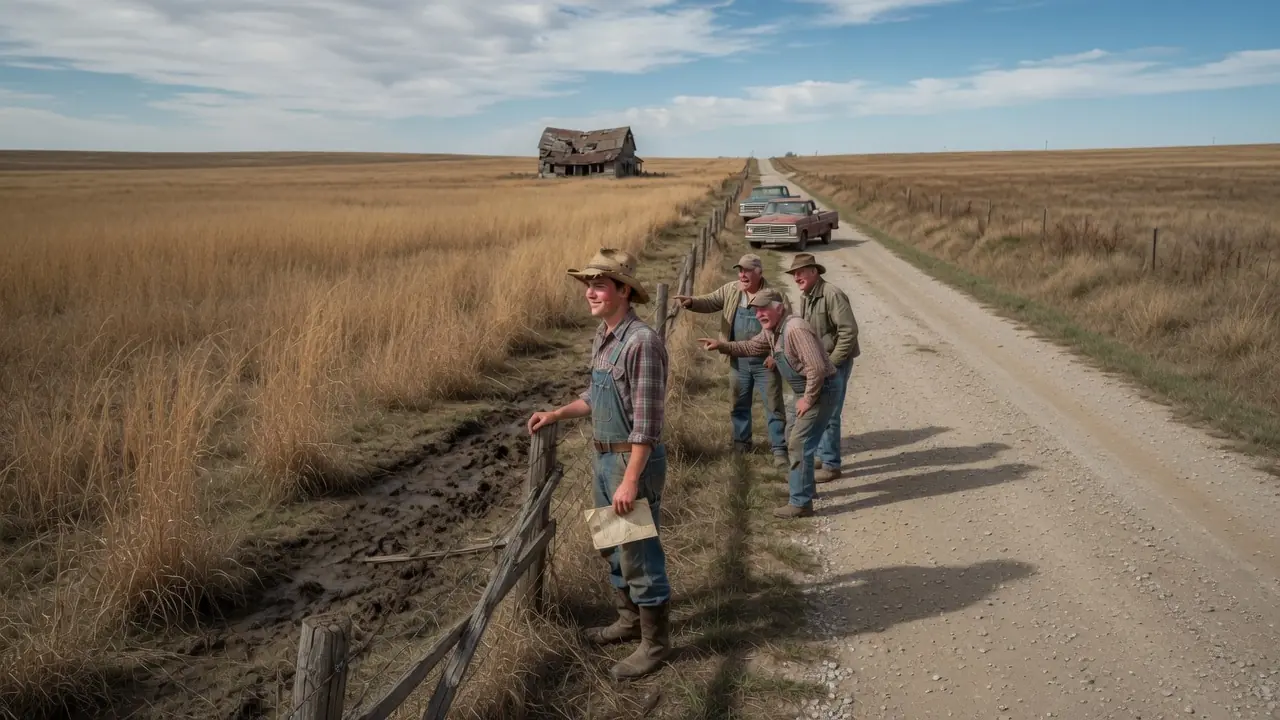
The Callahan farm sat directly between the proposed highway exit and a growing industrial corridor.
Its position had once made it worthless.
Now it made it valuable.
Robert looked toward Daniel.
“How much are they paying your bank?”
“I don’t know anything about a sale.”
“You drove out here because somebody wants the land.”
“I came because the title file contains irregularities.”
Robert pointed toward the farmhouse.
“My deed is inside.”
“We have a copy.”
“It was recorded by the county.”
“Yes.”
“The bank accepted payment.”
“Yes.”
“I’ve paid taxes every year since 1973.”
“I’m aware.”
“Then explain how a bank that sold me the property can suddenly question whether I own it.”
Daniel closed the folder slightly.
Robert stared.
“What?”
“The property came to the bank through foreclosure. One signature in the foreclosure chain may not have been properly authenticated.”
“Whose signature?”
“The previous owner’s.”
“Earl Bennett?”
“Yes.”
Robert remembered him only vaguely.
Earl had inherited the abandoned farm from an uncle, borrowed against it, then stopped making payments. By the time Robert saw the one-dollar advertisement, Earl had left Missouri.
“Earl signed the land over.”
“That is what the file indicates.”
“What does the bank say now?”
“That the acknowledgment page may have been incomplete.”
Robert’s voice became quieter.
“You’re saying the bank may have sold land it didn’t legally own.”
Daniel did not answer.
“And because of that,” Robert continued, “you think the farm might belong to somebody else.”
“The review will determine—”
“Who?”
Daniel looked toward the folder.
“Potential heirs of the prior owner.”
Robert felt his stomach tighten.
“Earl had children?”
“One daughter has been located.”
Robert stepped back.
For a moment, the fields seemed unfamiliar.
Not because they had changed.
Because someone had arrived carrying language capable of separating a man from the life he had built.
Daniel removed a sealed envelope.
“I am required to give you this.”
The words printed across the front were simple.
NOTICE OF TITLE REVIEW AND POTENTIAL OWNERSHIP CLAIM.
Robert did not take it immediately.
“If I refuse?”
“It will still be considered delivered.”
Robert accepted the envelope.
It felt almost weightless.
“You need to leave.”
Daniel nodded.
“I understand.”
“No, you don’t.”
Robert pointed toward the trees lining the creek.
“My wife and I planted every one of those.”
He pointed toward the barn.
“My father helped me rebuild that roof.”
Then toward the field.
“My son learned to drive a tractor there. He’s buried at Fairview Cemetery because he didn’t live long enough to inherit the place he loved.”
Daniel’s face softened.
“I’m sorry.”
“Don’t be.”
Robert looked directly at him.
“Just don’t stand here and call fifty years of work an irregularity.”
Daniel returned to the SUV.
Robert watched until the vehicle disappeared beyond the bend in the driveway.
Only then did he look down at the envelope.
For the first time since Margaret died three years earlier, the farm no longer felt completely safe.
That evening, Robert sat alone at the kitchen table.
The envelope remained unopened beside his coffee.
The room carried traces of Margaret everywhere.
Her flowered curtains.
The wooden spoon she insisted was better than every modern kitchen utensil.
A faded photograph of the two of them standing on the porch in 1976, the year they married.
Robert had been thin then, with dark hair and grease permanently embedded beneath his fingernails. Margaret wore a yellow dress and held a jar filled with wildflowers.
Behind them, the house had peeling paint and no front steps.
They had looked exhausted.
They had also looked certain.
Robert finally opened the notice.
The language was colder than Daniel’s voice.
Heritage Valley Bank claimed that defects in the 1973 foreclosure might invalidate the sale. A woman named Lorraine Bennett Pierce, identified as Earl Bennett’s daughter, had asserted an inherited ownership interest.
Armitage Development Holdings had agreed to fund the title litigation in exchange for an option to purchase the land if the claim succeeded.
Robert read the final paragraph twice.
The bank reserved the right to seek possession pending judicial review.
His daughter arrived forty minutes after he called.
Emily Callahan was forty-six, practical, sharp-eyed, and carried her mother’s habit of entering a room already prepared to solve whatever was wrong inside it.
She placed her handbag on the table.
“Where is the letter?”
Robert handed it over.
Emily read slowly.
Her expression hardened.
“They can’t do this.”
“They already are.”
“You have a deed.”
“So does their file.”
“You’ve owned the farm for half a century.”
“Forty-nine years and seven months.”
Emily looked up.
“That distinction does not help.”
“It may help them.”
She sat opposite him.
“This is about the development project.”
“Yes.”
“The land is worth almost two million now.”
“Depending on who’s buying.”
“Armitage has been trying to acquire everything along the connector route.”
Robert nodded.
“They sent a man last year.”
“You never told me.”
“He offered eight hundred thousand.”
“And?”
“I told him the driveway was behind him.”
Emily closed her eyes.
“Dad.”
“What?”
“You should have told us.”
“It wasn’t a serious offer.”
“It was nearly a million dollars.”
“For my home.”
“That doesn’t make it unserious.”
“It made the answer easy.”
Emily looked toward the framed photograph of Margaret.
“Are you afraid?”
Robert stared at the notice.
“No.”
She waited.
He sighed.
“Yes.”
It cost him more to say than he expected.
“I spent my entire life building something I thought would remain after me.”
He tapped the papers.
“And a company can show up with lawyers and turn the whole thing into a question.”
Emily reached across the table.
“This farm is yours.”
“Courts don’t rule on what feels true.”
“No.”
Her hand closed around his.
“But they do rule on evidence.”
Robert looked toward the dark window.
“Then we’d better find some.”
The following morning, Emily contacted Susan Miller.
Susan had practiced property law in Fairview for more than thirty years. She was sixty-one, wore reading glasses on a silver chain, and distrusted any document containing more than three uses of the phrase pursuant to.
She arrived at the farm carrying two boxes, a laptop, and enough legal caution to make even Emily nervous.
They spread Robert’s records across the dining table.
The original deed.
County tax receipts.
Mortgage releases.
Insurance records.
Farm-improvement grants.
Decades of utility bills.
Susan read the deed twice.
Then the foreclosure documents provided by Heritage Valley.
Her expression became unusually quiet.
Robert noticed.
“Good quiet or bad quiet?”
“Complicated quiet.”
“That’s lawyer language for bad.”
“It means the bank’s theory is not impossible.”
Emily leaned forward.
“How?”
Susan pointed toward the foreclosure acknowledgment.
“The notary seal is present, but the signature line is incomplete. There is also no separate affidavit confirming that Earl Bennett received proper notice before foreclosure.”
“But the county recorded it,” Robert said.
“Yes.”
“And the bank sold the property.”
“Yes.”
“So why does an old technical error matter?”
“Because if the foreclosure itself was invalid, the bank might not have acquired full title.”
Robert stared at her.
“Then Earl’s daughter could own the farm?”
“She might have inherited a claim.”
“After I spent fifty years here?”
Susan nodded reluctantly.
“Possibly.”
Emily stood.
“That is insane.”
“The law and fairness overlap less often than people assume.”
Robert looked toward Susan.
“What happens next?”
“We assert several defenses.”
“Such as?”
“Good-faith purchase. Recorded title. Continuous tax payment. Adverse possession. Estoppel. Laches.”
Robert raised one eyebrow.
“Use farmer language.”
Susan folded her hands.
“You bought the land openly. The bank told you it was theirs to sell. You improved it. Everyone, including the government and the Bennett family, had decades to object and did not.”
“That sounds better.”
“It is strong.”
“But not guaranteed.”
“No.”
The story spread through Fairview within days.
Small towns carried serious news faster than bad weather.
Neighbors began arriving.
Some brought food.
Others brought memories.
Frank Wallace came carrying a metal thermos and a folder of old photographs.
“I took these when we helped clear the western field.”
Robert studied one image.
Six young men stood beside a broken tractor in 1974. Robert held a wrench while Frank pointed toward a tire as though giving instructions nobody wanted.
“You were skinny,” Emily said.
Frank nodded.
“He was foolish too.”
“You told me the ground would never grow anything,” Robert reminded him.
“I was wrong.”
“You were loud about it.”
“I’ve improved.”
Robert looked at him.
“Debatable.”
Frank’s smile faded.
“You’re not losing this place.”
Robert looked toward the fields.
“That may not be our decision.”
The one-dollar purchase had become local legend.
In 1973, Heritage Valley Bank had pinned a small advertisement beside the teller windows.
EIGHTY ACRES. ABANDONED AGRICULTURAL PROPERTY. ONE DOLLAR PLUS TRANSFER COSTS.
Robert had been twenty-four.
He worked twelve-hour shifts at Callahan Auto Repair, a business owned by his father and uncle.
He could rebuild a carburetor in darkness.
Could identify a failing bearing by sound.
Could repair almost any machine except the old refrigerator in his apartment, which he kept alive by kicking the lower door twice each morning.
But he did not dream of owning a repair shop.
He dreamed of land.
When he visited the property, he found collapsed fencing, flooded fields, poison ivy, a barn with half a roof, and a farmhouse occupied by raccoons.
His father stood beside him and said, “The dollar will be the cheapest thing this place ever costs you.”
Robert bought it anyway.
The first five years nearly broke him.
He worked at the garage during the day and at the farm until midnight.
He slept in the farmhouse before it had reliable heat.
During winter, ice formed inside the bedroom windows.
He carried water from the creek until he repaired the well.
Margaret met him at the auto shop when she brought in a station wagon with a failing alternator.
On their second date, he showed her the farm.
She stood in knee-high weeds while rain entered through the barn roof.
“This is terrible,” she said.
Robert’s heart sank.
Then she smiled.
“Where do we start?”
They married three years later.
Together they built the front porch, planted apple trees, repaired fencing, and dug drainage channels.
Their son, Michael, was born in 1978.
Emily followed two years later.
By the mid-1980s, thirty acres produced profitable crops.
By 1990, the cattle pasture had returned.
By 2000, the farm was debt-free.
Robert never became wealthy in the way magazines measured wealth.
But he owned his work.
His mornings.
His mistakes.
The horizon outside his bedroom.
That had always been enough.
Until the lawsuit arrived.
Heritage Valley filed the action in county court six weeks after Daniel’s visit.
Lorraine Bennett Pierce joined as claimant.
Her petition stated that she had recently discovered her father’s interest in the property and had never knowingly surrendered it.
Armitage Development funded her attorneys.
The company insisted its involvement was merely an investment in a legitimate title claim.
Susan called it something else.
“They found a weak link in an old record and purchased a person willing to pull it.”
Robert met Lorraine for the first time during a preliminary hearing.
She was sixty-two, with short auburn hair and a guarded expression.
She sat across the courtroom beside three attorneys.
Robert expected anger.
Instead, she looked uncomfortable.
During a break, he approached her.
“Ms. Pierce?”
One attorney moved between them.
“We prefer all communication through counsel.”
Lorraine looked past him.
“You’re Robert Callahan.”
“Yes.”
She studied his face.
“My father mentioned you once.”
Robert was surprised.
“What did he say?”
The attorney interrupted.
“Lorraine.”
She ignored him.
“He said a young mechanic bought the old place.”
“What else?”
Her eyes shifted.
“That you were either brave or stupid.”
Robert smiled faintly.
“Most people selected the second.”
Lorraine did not smile.
“My father died believing the bank stole that property.”
“He never contacted me.”
“He was ashamed.”
“Of what?”
“He borrowed money after my mother became ill. Then the bank moved faster than he understood.”
Robert looked toward the courtroom doors.
“I didn’t know.”
“That doesn’t change what happened.”
“No.”
He met her eyes.
“But taking it from my family won’t return it to yours.”
Her attorney guided her away before she answered.
The first major discovery came from the old barn.
Robert had entered looking for a grease gun.
Instead, he found a wooden box behind a stack of tractor manuals.
The box belonged to his father, Samuel.
Inside were receipts, farm photographs, repair invoices, and newspaper clippings.
Near the bottom lay a yellow envelope with Robert’s name written across it.
The handwriting belonged to Charles Bennett, the Heritage Valley loan officer who handled the 1973 sale.
Robert opened it carefully.
Inside was a copy of the purchase agreement.
The document included a provision missing from the bank’s current file.
Heritage Valley agreed to transfer immediate possessory title for one dollar. Full equitable ownership would become permanent after Robert maintained and improved the property for five consecutive years.
Attached was a handwritten note.
Robert,
The board agreed because keeping the farm will cost more than selling it. They believe you will fail before five years.
I do not.
Keep receipts.
Pay every tax.
Improve the ground.
When the fifth year ends, come see me.
—Charles Bennett
Emily read the note twice.
“This is it.”
Susan was more cautious.
“It helps.”
“It proves the deal.”
“It proves intent. The bank will argue the handwritten note is not part of the recorded instrument.”
Robert frowned.
“Then why are you smiling?”
“Because Charles told him to keep receipts.”
Susan looked toward the box.
“And Samuel Callahan appears to have obeyed.”
They found equipment invoices.
Seed receipts.
Well-repair records.
Lumber purchases.
Photographs showing improvements each year.
One folder contained copies of letters Charles Bennett sent to Robert’s father.
The final letter, dated April 4, 1978, read:
Mr. Callahan has satisfied the five-year improvement condition. I have instructed the records department to mark the transfer complete and permanent.
Robert sat slowly.
“I never saw this.”
“Your father must have handled it,” Emily said.
“He helped with the business paperwork back then.”
Susan’s expression sharpened.
“Where is the bank’s completion certificate?”
“There wasn’t one in my files.”
“Then we need Charles Bennett’s records.”
“He’d be over ninety.”
“If he’s alive.”
They searched.
Charles Bennett was alive.
He was ninety-six and lived in an assisted-living center near Kansas City.
His memory came and went.
Some days he remembered the names of bank directors from 1973.
Other days he called his nurse by his sister’s name.
Susan arranged an interview.
Robert traveled with her and Emily.
Charles sat near a window overlooking a frozen garden.
He looked frail, wrapped in a blue cardigan.
When Robert entered, the old banker stared for several seconds.
“Samuel?”
Robert stopped.
“No, sir. I’m Robert.”
Charles blinked.
“Robert Callahan.”
“Yes.”
A smile appeared.
“The one-dollar farmer.”
Robert felt his throat tighten.
“You remember?”
“Some things.”
Susan placed the purchase agreement on the table.
“Mr. Bennett, do you recognize this?”
Charles adjusted his glasses.
“I wrote it.”
“Why was the property sold for one dollar?”
The old man looked toward Robert.
“Because the bank wanted it gone.”
“Did Heritage Valley believe it owned the farm?”
“Yes.”
“Was Earl Bennett properly notified of foreclosure?”
Charles’s expression changed.
“That was the question.”
Susan leaned forward.
“What do you mean?”
“The bank president rushed the process. Earl disappeared. Letters came back.”
“Did you know the foreclosure documents were incomplete?”
“Later.”
Robert’s stomach tightened.
“Then why did you sell me the farm?”
Charles looked directly at him.
“Because Earl came to see me.”
The room became still.
“When?” Susan asked.
“Two weeks before Robert signed.”
“What did Earl say?”
Charles closed his eyes, searching memory.
“He said he was leaving Missouri.”
“Did he surrender his claim?”
“Yes.”
“In writing?”
“Yes.”
Susan sat straighter.
“Where is that document?”
Charles looked confused.
“The blue file.”
“What blue file?”
“Private releases. President Alden kept them separate.”
“Does it still exist?”
Charles stared toward the garden.
“Bank basement.”
Heritage Valley claimed no blue file existed.
Its attorneys objected to every request.
They argued Charles’s recollections were unreliable.
Armitage’s counsel suggested the former banker had confused the Callahan property with another foreclosure.
Then Daniel Whitmore called Susan privately.
He asked to meet.
They gathered at Robert’s farmhouse after dark.
Daniel arrived without the leather folder.
He looked nervous.
“I may lose my job for being here.”
Susan answered, “That depends on what you brought.”
Daniel placed a flash drive on the table.
“Heritage Valley digitized basement archives during renovations in 2016. Some boxes were classified as obsolete and scheduled for destruction.”
Robert watched him.
“Were they destroyed?”
“Most.”
“Most?”
Daniel nodded.
“One employee scanned selected files first.”
He opened his laptop.
A list appeared.
BLUE FILE — CALLAHAN PARCEL.
Inside was a notarized affidavit signed by Earl Bennett on March 2, 1973.
I, Earl James Bennett, acknowledge the foreclosure and relinquish any remaining legal or equitable interest in the eighty-acre Fairview parcel to Heritage Valley Bank. I understand the bank intends to transfer the land to another purchaser.
Lorraine’s claim collapsed in a single paragraph.
But Daniel had brought more.
An internal email from Armitage Development to Heritage Valley’s current president stated:
If title pressure persuades Callahan to settle or sell below market, our acquisition offer increases by fifteen percent.
Emily stared.
“They knew the claim was false.”
Daniel looked down.
“The bank knew the affidavit existed before I visited.”
Robert became completely still.
“You came to my farm knowing I owned it.”
“I was told the affidavit might not be enforceable.”
“You told me the bank was reviewing ownership.”
“I followed instructions.”
Robert’s voice hardened.
“You stood beside fields I spent fifty years restoring and delivered a threat you knew was built to frighten me.”
Daniel did not defend himself.
“Yes.”
“Why are you helping now?”
The younger man looked toward Margaret’s photograph.
“My grandfather lost his hardware store after a bank pressured him into signing something he didn’t understand.”
“That did not stop you from coming here.”
“No.”
Daniel met Robert’s eyes.
“But it stopped me from sleeping afterward.”
Susan copied the files immediately.
The following morning, she filed an emergency motion alleging fraud, concealment, and abuse of process.
The courtroom was full when the hearing began.
Farmers filled the benches.
Local reporters stood along the back wall.
Heritage Valley’s attorneys argued the affidavit had not been authenticated.
Armitage insisted the acquisition email described lawful settlement strategy.
Lorraine sat beside her lawyer looking increasingly confused.
Judge Helen Crawford listened without expression.
Then Susan called Charles Bennett by video testimony.
The ninety-six-year-old banker appeared on a screen.
He identified his signature.
Earl Bennett’s signature.
The blue-file procedure.
The five-year improvement agreement.
Heritage Valley’s counsel attacked his memory.
“Mr. Bennett, you could not identify today’s date when we spoke last week.”
Charles nodded.
“That’s true.”
“So your recollection is unreliable.”
“Some of it.”
“How can this court trust what you say about a transaction from fifty years ago?”
Charles looked toward the document.
“Because I forgot breakfast.”
His voice remained weak but clear.
“I did not forget the only time my bank sold a farm for one dollar.”
A murmur moved through the courtroom.
Susan introduced the 1978 completion letter.
Tax records.
Improvement receipts.
The digital archive.
Then Daniel testified.
Heritage Valley’s attorney looked stunned when he took the stand.
“Were you instructed to tell Mr. Callahan that ownership was uncertain?”
“Yes.”
“Did the bank possess Earl Bennett’s release at that time?”
“Yes.”
“Did you know?”
“Yes.”
“Why was the notice delivered?”
Daniel looked toward Robert.
“To pressure him into negotiating a sale.”
The courtroom became silent.
Judge Crawford removed her glasses.
“Was Ms. Pierce informed that her father had relinquished his interest?”
Daniel looked toward Lorraine.
“No.”
Lorraine turned toward her attorney.
“You knew?”
The man whispered for her to remain quiet.
She stood instead.
“You told me the bank found proof my father was cheated.”
Her attorney rose.
“Your Honor, my client—”
Lorraine stepped away from him.
“You used me.”
Judge Crawford ordered a recess.
When court resumed, Lorraine had obtained separate counsel.
Her new attorney withdrew her ownership claim.
Heritage Valley and Armitage continued arguing that the dispute should be dismissed quietly without findings of misconduct.
Judge Crawford refused.
She ruled that Robert Callahan held clear and permanent title.
She found that Heritage Valley knowingly concealed material records and that Armitage financed litigation for the improper purpose of forcing a below-market sale.
Sanctions were imposed.
Legal fees were awarded to Robert.
The matter was referred to state banking regulators and the attorney general.
Then Judge Crawford looked toward Robert.
“Mr. Callahan, courts often say land is merely property.”
She glanced at the photographs of the farm spread across the evidence table.
“This record makes clear that it can also be labor, memory, responsibility, and trust.”
Robert lowered his head.
“Your title is not under review anymore.”
The courtroom erupted in applause.
Judge Crawford struck the gavel.
“I will clear the room if necessary.”
Nobody seemed particularly frightened by the threat.
Outside the courthouse, reporters surrounded Robert.
“How do you feel?”
“Relieved.”
“Are you angry with the bank?”
“Yes.”
“Will you sue?”
“Susan says I should not answer that.”
Susan stood beside him and nodded approvingly.
Another reporter pushed a microphone closer.
“What saved the farm?”
Robert considered.
“People who kept records.”
“Not the law?”
“The law mattered.”
He looked toward Daniel leaving the courthouse alone.
“But the law can only work with the truth somebody preserves.”
Lorraine approached later.
She stood beside Robert beneath the courthouse steps.
“I’m sorry.”
Robert looked at her.
“You believed what they told you.”
“I wanted to.”
“Why?”
“Because my father spent years saying the bank took everything.”
She wiped beneath one eye.
“I thought winning the farm would prove he had not failed.”
Robert’s expression softened.
“Your father didn’t fail because he lost land.”
“He left us.”
“That may be where he failed.”
Lorraine looked away.
Robert continued.
“But he signed that release before he left. He did not want you fighting over this fifty years later.”
“No.”
She looked toward him.
“I think he wanted to escape.”
“Maybe.”
Neither tried to improve the man’s memory.
Some truths remained mixed.
The attorney general’s investigation uncovered similar conduct by Heritage Valley in four other title disputes.
Armitage had funded claims against elderly landowners, using minor record irregularities to pressure them into selling property near planned development zones.
Two families had already accepted reduced offers.
Their cases were reopened.
The bank president resigned.
Armitage paid substantial penalties and abandoned the Fairview development plan.
Daniel lost his position.
Six months later, Robert found him repairing a fence at a community farm outside town.
“You know anything about fencing?” Robert asked.
Daniel looked at the crooked post.
“Apparently not.”
Robert picked up the level.
“You’re leaning it.”
“I noticed.”
“After you set the concrete?”
“Yes.”
“That is an expensive time to notice.”
Daniel smiled faintly.
“I’m learning.”
Robert helped him straighten the post.
They did not become close friends.
Trust did not return simply because someone eventually did the right thing.
But Robert believed late honesty still deserved a place to stand.
A year after the case, the Callahan family held a gathering in the barn.
Neighbors came.
Former mechanics from Robert’s old shop attended.
Charles Bennett joined by video from his assisted-living room.
Lorraine came too, carrying a box of her father’s photographs.
One showed Earl Bennett as a child beside the same creek Robert later restored.
Robert placed it in the workshop.
“He was part of the land before I was,” he said.
Emily looked surprised.
“You’re keeping it?”
“History doesn’t become false because it’s inconvenient.”
The original one-dollar deed was framed beside the 1978 completion letter.
Underneath, Robert placed a photograph from 1973.
He stood alone in an overgrown field beside a rusted truck.
No restored barn.
No healthy pasture.
No farmhouse porch.
Only weeds, broken fences, and a young man too stubborn to understand how much work waited for him.
Below the photograph, Robert added one sentence.
EVERYTHING VALUABLE BEGINS AS SOMETHING SOMEONE ELSE FAILED TO SEE.
At sunset, he walked toward the eastern field with his grandson, Noah.
The boy was twelve and carried questions the way other children carried stones in their pockets.
“Grandpa?”
“Yes?”
“Did you really buy all this for one dollar?”
Robert nodded.
“Was it worth one dollar then?”
“To the bank.”
“What was it worth to you?”
Robert looked across the fields.
The apple trees Margaret planted.
The barn his father helped rebuild.
The pasture where Michael once raced a tractor too fast and broke an axle.
The porch where Emily brought her first child home.
He rested one hand on the old fence post.
“Everything I had.”
Noah considered this.
“Would you ever sell?”
“No.”
“What if someone offered ten million dollars?”
“No.”
“Twenty million?”
Robert smiled.
“You planning to buy it?”
“I have thirteen dollars.”
“That’s thirteen times what I paid.”
Noah laughed.
Then his expression became serious.
“What happens when you’re gone?”
Robert looked toward the farmhouse, where Emily stood beneath the porch light talking with Susan.
“That’s why we made new papers.”
After the lawsuit, Robert transferred the farm into a family trust.
No hidden conditions.
No missing releases.
No gaps left for banks or developers to exploit.
Emily would oversee it.
Noah and his sister would inherit stewardship rights.
The land could not be sold outside the family without unanimous consent.
Robert had once believed a recorded deed was enough.
He now understood that work survived only when memory and documentation traveled together.
Two years later, Robert died peacefully in the farmhouse bedroom he and Margaret had rebuilt with their own hands.
The night before, rain moved across the fields.
Emily sat beside him.
“Are you worried about the farm?”
“No.”
“Really?”
Robert looked toward the window.
“You kept the blue file?”
“In the safe.”
“The original?”
“In the bank deposit box.”
He raised one eyebrow.
“A bank?”
“A different bank.”
“That seems optimistic.”
Emily smiled through tears.
Robert’s final morning arrived clear and quiet.
He could hear cattle moving beyond the barn.
A tractor starting in the distance.
Wind passing through the trees beside the creek.
The farm did not know its owner was dying.
It simply continued.
That comforted him.
At his funeral, Frank Wallace spoke first.
He described the day Robert bought the property.
“I told him it was a swamp,” Frank said.
People laughed softly.
“He told me frogs paid no taxes.”
Noah stood beside the framed one-dollar deed during the reception.
A reporter who had covered the lawsuit asked him what the paper meant.
The boy looked toward the fields.
“It means Grandpa didn’t get the farm for one dollar.”
The reporter frowned.
“But that’s what the deed says.”
Noah shook his head.
“He paid for it every day after.”
The answer appeared in the newspaper the following morning.
Years passed.
The interstate connector opened farther west after Armitage abandoned the original route.
Fairview grew.
Land values increased.
Developers continued making offers.
Emily declined them all.
She converted part of the barn into a workshop where local children learned machinery repair and soil conservation.
The program was named after Robert and Margaret.
Charles Bennett’s completion letter remained framed inside.
So did Earl Bennett’s childhood photograph.
Visitors often came expecting a simple story about an old farmer who bought worthless land for one dollar and later defeated a greedy bank.
Emily corrected them.
“The land was never worthless.”
Neither was the transaction simple.
A struggling owner lost it.
A young mechanic accepted a risk.
A banker preserved a promise.
A father saved receipts.
A frightened employee eventually exposed a lie.
A court recognized what fifty years of work had already made obvious.
The farm survived because many people, across different generations, chose not to let the truth disappear.
Robert Callahan had believed the hardest part of owning land was turning dead soil into something productive.
He was wrong.
Sometimes the hardest part was defending a lifetime from people who saw only current market value.
The black SUV arrived carrying a folder meant to make an old man doubt everything he had built.
For a few weeks, it succeeded.
Then another folder surfaced.
Older.
Faded.
Nearly forgotten.
Inside it was the one thing the bank had hoped time would erase.
The truth.
And while corporations could purchase claims, hire attorneys, and manufacture uncertainty, they could not undo fifty years of taxes, harvests, repairs, births, funerals, promises, and footsteps pressed into the same ground.
Robert did not keep the farm because it had become worth nearly two million dollars.
He kept it because the value had never belonged to the market.
It belonged to the life built there.
And that life had been paid for long before anyone arrived to collect it.