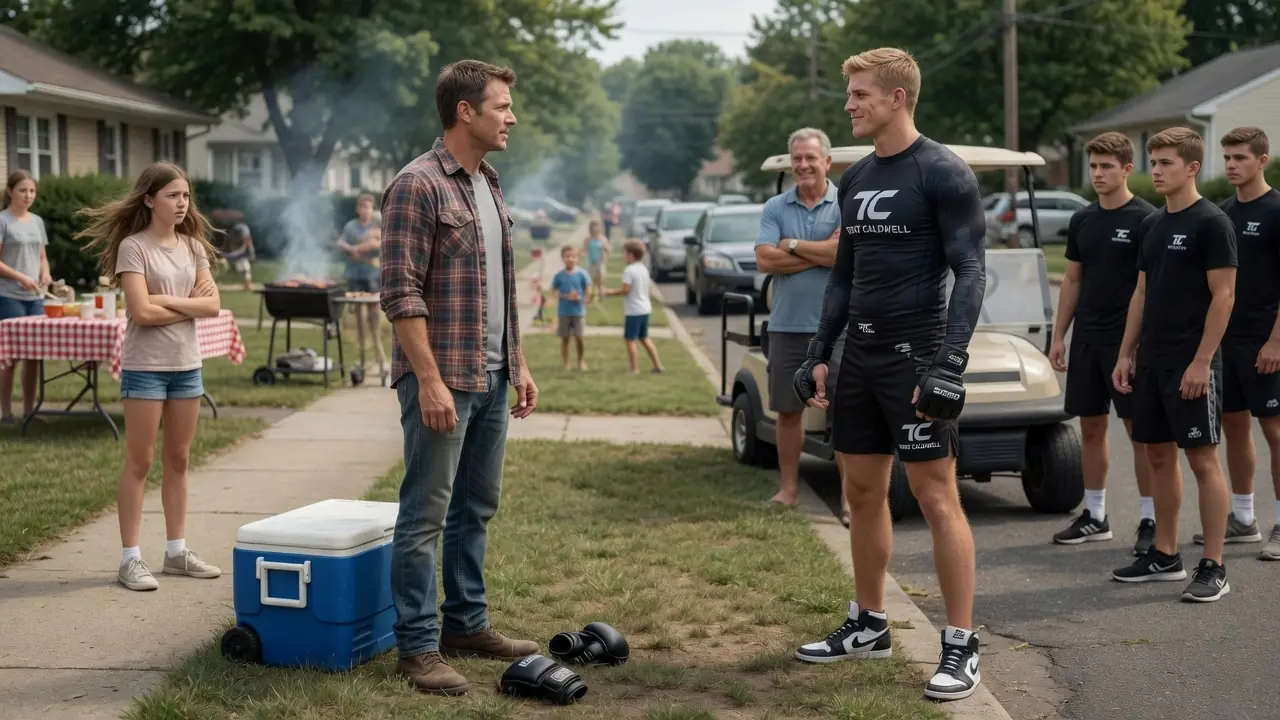
The nineteen-year-old tightened the straps on his expensive fighting gloves and smiled as though the outcome had already been decided.
“You should call an ambulance now,” he said loudly. “I’m putting him in the hospital.”
Dozens of people heard him.
Children stopped running through the sprinklers. Neighbors lowered their paper plates. Conversations faded until the only sounds on the Oak Hollow cul-de-sac were the distant music from a portable speaker and the sharp tearing noise of Velcro around Mason Whitaker’s wrists.
Mason’s father stood beside a golf cart with a beer in one hand and an approving grin on his face.
My daughter, Sophie, was sitting on the curb with several friends. When she realized what was happening, she slowly rose to her feet.
Her face had gone pale.
Mason tossed a second pair of gloves onto the grass in front of me.
“Put them on, old man.”
I looked down at the gloves.
Then I looked at him.
He was nineteen years old, nearly two hundred pounds, and built like someone who spent every afternoon studying himself in a gym mirror. His tight black training shirt displayed the logo of Ironcrest Combat Academy, the most expensive martial arts school in our part of Pennsylvania.
Mason had won a regional sparring tournament earlier that summer.
Since then, he had acted as though a plastic trophy had made him invincible.
To everyone else on the street, I was simply Michael Lawson, Sophie’s quiet forty-two-year-old father. I worked from home, mowed my lawn every Saturday, repaired my own truck, and usually wore loose flannel shirts that made me look softer than I was.
No one in Oak Hollow knew much about the fourteen years before I moved there.
They did not know about the three overseas deployments.
They did not know about the nights spent moving through buildings without lights, or the years I had spent teaching younger men how to remain calm when panic could get everyone killed.
They did not know that before I became a suburban father, I had led a Tier One special operations team.
Mason certainly did not know.
He saw a middle-aged man in faded jeans.
He saw an audience.
And he believed he had finally found the perfect person to humiliate.
“You really want to do this?” I asked.
My voice was low enough that he had to stop talking to hear me.
Mason grinned.
“You scared?”
“No.”
“Then pick up the gloves.”
I glanced toward Sophie and gave her a small nod.
She knew that nod.
It meant I was in control.
I removed my flannel shirt and folded it over the back of a lawn chair.
Then I stepped onto the grass.
I left the gloves where they were.
Six years earlier, I had deliberately traded violence for routine.
After leaving active duty, I moved Sophie and myself to Oak Hollow, a quiet upper-middle-class neighborhood outside Harrisburg. My wife had died after a long illness, and by then Sophie and I had endured enough uncertainty.
I wanted a place where nothing happened.
Oak Hollow was almost perfect.
The houses were clean without being identical. Maple and oak trees lined the sidewalks. People waved while collecting their mail. The biggest neighborhood argument in my first year involved whether recycling bins could remain visible from the street after sunset.
I founded a private security consulting company and worked from a home office. As far as the neighbors knew, I evaluated alarm systems and gave corporations advice about data-center security.
That description was true.
It was simply incomplete.
My company, Sentinel Ridge Solutions, performed physical and cybersecurity risk assessments for companies seeking sensitive federal contracts. We examined supply chains, transportation networks, warehouse security, and the people trusted to move government equipment.
The work was serious, but it was quiet.
Quiet was exactly what I wanted.
Then Grant Whitaker bought the estate beside my ranch house.
The Whitaker property covered nearly three acres and included a stone mansion, a swimming pool, two garages, and more outdoor lighting than a small airport.
Grant had made his fortune purchasing struggling freight companies, stripping away their profitable divisions, and selling what remained.
He drove a matte-black luxury SUV, spoke loudly in every setting, and treated politeness as something required only from people with less money.
His son, Mason, was worse.
Mason drove a modified sports car that backfired loudly enough to shake windows. He wore expensive athletic clothing, designer sunglasses, and a black belt with his name embroidered across it in gold thread.
Within a week of moving in, he suspended a two-hundred-pound punching bag from an old oak tree beside our shared property line.
Every afternoon, I watched him attack it.
His punches were powerful but wide. His kicks were fast but poorly balanced. His chin remained high, his shoulders telegraphed every important movement, and he frequently turned his back while attempting spinning techniques.
He had trained for judges.
He had never trained for survival.
That was not my concern.
A young man was allowed to be overconfident.
The trouble began when Mason started using that confidence against people who did not want to fight him.
He shouted at delivery drivers who parked too close to the entrance of his driveway.
I once watched him chest-bump a UPS driver who looked to be in his fifties. The man raised both hands and backed away while Mason laughed.
On other afternoons, Mason stood across the sidewalk when younger teenagers approached on bicycles. He forced them into the street and then mocked them for avoiding him.
Grant saw these things.
He never corrected his son.
Sometimes he smiled.
My first direct confrontation with Mason happened in July.
Sophie was washing my truck in the driveway. She had music playing through the vehicle’s speakers at an ordinary volume.
Mason crossed the property line without asking permission.
He walked past Sophie, reached through the open driver’s-side window, and twisted the radio knob until it broke off.
“My head hurts,” he told her. “Keep it quiet.”
Sophie froze.
I was on the front porch when it happened.
I stood and walked down the driveway.
I did not rush.
Running toward an aggressive person communicates panic, and panic spreads quickly. I kept my hands open at my sides and my steps measured.
“Is there a problem?” I asked.
Mason turned toward me.
I was six feet one, but loose clothes hid most of my build. To him, I looked like a father who spent weekends in hardware stores and complained about the price of fertilizer.
“Your kid’s music was annoying me.”
“So you broke the radio?”
“I handled it.”
He stepped into my personal space.
His skin smelled of cologne and whatever powdered supplements he drank before training.
“You got a problem with that?”
My pulse remained steady.
Compared with the things I had faced years earlier, an angry teenager in sweatpants did not register as a serious threat.
But he had frightened my daughter.
That made him dangerous in a different way.
“Mason,” I said, “this is my property. You will not touch my vehicle again. You will not approach Sophie like that again. Go home.”
He leaned closer, waiting for me to lower my eyes.
I focused on the bridge of his nose.
My expression stayed empty.
When he realized I would not flinch, he gave a dismissive laugh and stepped away.
“Whatever. Watch your back.”
I let him leave.
The best confrontation is the one that ends before anyone raises a hand.
Unfortunately, Mason interpreted restraint as weakness.
In his world, strength was loud. It shouted, threatened, and performed for an audience.
Because I had spoken calmly, he assumed I was afraid.
By August, his behavior had grown worse.
Mason won a regional semi-contact martial arts tournament, and Grant threw an enormous party to celebrate. A live DJ played until nearly two in the morning while Mason carried his trophy around the backyard and told anyone willing to listen that he would soon dominate professional mixed martial arts.
A few days later, Sophie invited several classmates to our patio for a study session.
Mason dragged his sparring equipment near the property line and began shadowboxing for their attention. He threw kicks close enough to break several branches from the lilac bushes my wife had planted years earlier.
Whenever Sophie or one of the girls looked toward him, he made crude kissing noises.
Sophie texted me from outside.
Dad, can you come out? He’s making everyone uncomfortable.
The anger I felt was immediate.
But anger had never been allowed to make decisions for me.
I stepped into the backyard and stopped at the edge of my property.
“Mason, stop damaging those bushes.”
He lowered his gloves.
Two friends from his gym were sitting behind him in lawn chairs.
“The branches are hanging over our property,” he said.
They were not.
“They are at least a foot inside my line.”
Mason smiled.
“You want to stop me?”
“I care less about the bushes than I care about you harassing my daughter. Move your workout.”
His face darkened.
He walked toward me until his shoes reached the invisible boundary between the two lawns.
“Are you disrespecting me in front of my friends?”
“I’m telling you to leave Sophie alone.”
“Do you know who I am?” he asked. “I’m a black belt under Coach Brennan. I could fold you in half.”
He reached across the property line and grabbed the collar of my flannel shirt.
My body reacted before conscious thought caught up.
I did not punch him.
I pivoted, trapped his wrist against my chest, and applied a short compliance hold to his forearm and elbow.
The movement lasted less than a second.
Mason dropped to one knee with a startled cry, his face nearly touching the grass.
I released him immediately and stepped backward.
“Careful,” I said loudly. “You almost tripped over the roots.”
From where his friends were sitting, the movement had been too fast and too subtle to understand. It looked as though Mason had lost his balance.
He scrambled upright, holding his wrist.
“You tripped me.”
“Then watch where you step.”
I turned my back and walked toward the house.
“Girls, take the study session inside.”
An hour later, someone pounded on my front door.
Grant stood outside with Mason behind him.
“You put your hands on my son?” Grant shouted.
“Mason grabbed my shirt. I moved, and he fell.”
“Trained fighters don’t fall.”
“Your security cameras face the property line. Check them.”
Grant pressed one manicured finger against my chest.
“You pathetic little office worker. You are lucky he did not put you in a coma. Touch him again, and I’ll sue you until this house belongs to me.”
I looked down at the finger.
Grant removed it.
Then he stepped back.
“This is your only warning.”
When they returned home, I poured a glass of water and stood near the kitchen window.
The situation had crossed an important line.
A confrontation was no longer merely possible.
It was inevitable.
The annual Oak Hollow Labor Day barbecue took place several weeks later.
Every family carried grills, coolers, and folding chairs to the center of the cul-de-sac. Children played with water balloons while adults traded food and complained about property taxes.
I stood beside a cooler speaking with Frank Doyle, a retired accountant who had lived on the street for twenty years.
Sophie sat nearby with several girls from school.
Then the Whitakers arrived.
Grant drove down the street in a golf cart loaded with imported beer.
Mason followed him on foot.
He was not dressed for a barbecue.
He wore tight grappling shorts, an Ironcrest training shirt, and carried a gym bag.
Three friends from the academy walked behind him.
Mason crossed directly through a group of children. He bumped a little girl hard enough to make her stumble but never looked back.
He stopped in front of me and dropped the gym bag onto the pavement.
“Hey, Mike.”
The neighborhood conversations began to fade.
“We never finished what happened at the property line.”
“It’s a block party,” I said. “Eat something and go home.”
“I don’t eat garbage.”
He unzipped the bag and removed two pairs of small sparring gloves.
One pair landed at my feet.
“You got lucky when you tripped me. Put those on.”
Several neighbors moved closer.
Howard Benson, president of the homeowners association, raised one hand.
“Mason, this is a family event.”
“Stay out of it.”
He pointed at me.
“This coward embarrassed me in front of my friends. I’m calling him out.”
I saw Grant leaning against the golf cart.
He did not attempt to stop his son.
Instead, he lifted his drink in a small salute.
Mason wanted me trapped between two choices.
Walk away and confirm his belief that he could terrorize Sophie without consequences.
Or fight him and become the middle-aged man who injured a teenager at a neighborhood barbecue.
Calling the police before anything happened would delay the problem, not solve it. Mason would learn to harass us when no witnesses were present.
He had chased the conflict until he finally caught it.
I set my plate on the cooler.
Sophie stood.
I gave her the reassuring nod.
Then I faced Mason.
“You truly want this?”
He pulled the straps tight around his gloves.
“I’m going to make you bleed in front of your daughter.”
“All right.”
I left the second pair of gloves on the ground.
I removed my flannel shirt and walked toward the open grass between two driveways.
Mason followed.
Grant laughed.
“Call an ambulance for him now.”
I turned to face the young man.
My stance was relaxed and slightly angled. My hands remained open at chest height.
Mason saw poor technique.
A trained observer would have recognized readiness.
“What are the rules?” he asked.
“One.”
I met his eyes.
“When you decide you have had enough, stay down.”
He attacked before anyone could respond.
Mason threw a fast jab followed by a wide right hand aimed at my jaw.
The combination impressed the neighbors.
To me, it looked slow.
His shoulder rose before the right punch. His weight shifted too far forward. He expected me to retreat.
Instead, I stepped inside the arc of the punch.
His glove passed over my shoulder.
I placed one open hand near his upper arm and the other against his chest, redirecting the momentum he had already created.
Mason stumbled past me.
He nearly fell onto the pavement before catching himself.
When he turned around, his face showed confusion rather than pain.
A few of his friends exchanged glances.
“Lucky move,” he shouted.
He began bouncing on his toes.
Humiliation flooded his body faster than judgment could control it.
Mason feinted with one hand and turned into a spinning back kick.
It might have earned applause on a padded tournament floor.
On uneven grass, it exposed his back and placed all his balance on one leg.
I stepped forward before the kick fully extended.
My foot hooked behind his supporting ankle. One open-handed push to the shoulder allowed gravity to complete the movement.
Both of Mason’s feet left the ground.
He landed flat on his back with a heavy thud.
The air escaped his lungs in a sharp gasp.
He stared upward, shocked.
I stood several feet away.
“You are on the ground,” I told him. “We are finished.”
Grant slammed his drink onto the golf cart.
“Get up! Stop playing with him!”
Mason rolled over and forced himself upright.
All signs of training had disappeared.
He charged with his head down and wrapped both arms around my waist, trying to drive me backward.
I widened my stance and lowered my center of gravity.
His forward movement stopped.
Before he could adjust, I controlled his upper body and used his position to guide him toward the ground. I applied enough pressure to immobilize him without closing his airway or damaging his neck.
Mason’s face pressed into the grass.
His legs pushed uselessly against the lawn.
“Breathe,” I said near his ear. “Panic is wasting your strength.”
“Let me go.”
“When you are finished, tap the ground.”
He struggled harder.
Muscle could not defeat leverage.
“Tap, Mason.”
For several seconds, pride held him there.
Then his palm struck the grass three times.
Tap.
Tap.
Tap.
I released him immediately and moved backward.
Mason rolled onto his back, coughing and pulling air into his lungs.
His expensive clothes were covered in grass and dirt.
The entire confrontation had lasted less than two minutes.
I had not thrown a punch.
No one in the crowd cheered.
The silence was too complete for celebration.
The neighbors were trying to reconcile the father they thought they knew with the man they had just watched.
Grant broke the silence.
“You attacked my son!”
He threw his beer can onto the pavement and marched toward me.
I turned.
“Take one more step, Grant, and I will consider you a threat.”
The voice that came out was not the friendly voice I used at neighborhood meetings.
It was the command voice that had carried through wind, gunfire, and confusion.
Grant stopped five feet away.
His instincts understood something his pride did not.
“You are going to jail,” he shouted. “I have lawyers who will take your house, your savings, and every dollar you own.”
“Call the police.”
He did.
Two Oak Hollow patrol vehicles arrived within ten minutes.
Sergeant Nolan Pierce stepped out of the first cruiser with a younger officer named Cole Bennett.
Grant rushed toward them.
“Thank God. This psychopath attacked my son. He threw him down and choked him. I want him arrested for aggravated assault.”
Sergeant Pierce raised one hand.
“Slow down.”
He looked at Mason, who remained seated in the grass.
Then he turned to me.
“Sir, what happened?”
Before I answered, Frank Doyle stepped forward.
“Grant is lying.”
Grant spun around.
“Stay out of this.”
Frank’s shoulders straightened.
“It happened in front of my house. That makes it my business.”
He faced the officer.
“Mason came here carrying gloves and looking for a fight. He threatened Michael, threw the first punch, and kept attacking after he was told to stop. Michael never struck him.”
Another voice came from the crowd.
“I recorded it.”
A teenage boy held up his phone.
Sergeant Pierce watched the video from the beginning.
It showed the threats.
It showed Mason throwing the gloves.
It showed every attack and every warning.
When the recording ended, the sergeant handed back the phone.
“Mr. Whitaker, your son clearly initiated the confrontation. Mr. Lawson used controlled force to defend himself and stopped as soon as the threat ended.”
“He used illegal techniques,” Grant protested.
“This was not a sanctioned tournament.”
“Do you know who I am? I employ hundreds of people. I know the mayor.”
“I do not care who you know.”
Pierce’s expression hardened.
“You have two options. Take your son home, or I arrest him for assault and you for threatening a witness. Decide now.”
Grant looked around the cul-de-sac.
For the first time, he saw what the neighborhood thought of him.
No admiration.
No fear.
Only disgust.
Even Mason’s friends had quietly disappeared.
Grant pulled Mason to his feet.
“This is not over,” he told me. “I am going to discover who you work for, and then I’m going to destroy your life.”
I said nothing.
He helped Mason onto the golf cart and drove away.
The party eventually resumed, but the neighborhood had changed.
People spoke to me differently.
Not with fear, but with careful respect.
Sophie wrapped both arms around me.
“Are you hurt?”
“No.”
“You did not even hit him.”
“I did not need to.”
She remained against my shoulder for another moment.
“Is it over?”
I looked toward the Whitaker estate.
Grant had promised retaliation.
Men like him often considered threats to be commitments.
“Not yet.”
Three days later, I was working in my home office when my secure telephone rang.
The man on the other end was Major General Thomas Avery, a former commanding officer who now oversaw regional federal procurement security.
He was laughing.
“Mike, I just received one of the strangest calls of my career.”
“Grant Whitaker?”
“How did you know?”
“He told me he planned to ruin my professional life.”
Avery laughed again.
“He demanded that I remove you from government contract work. According to him, you are an unstable junior employee at Sentinel Ridge Solutions.”
“What did you tell him?”
“I let him talk for five minutes. Then I explained that you founded Sentinel Ridge, own most of it, and personally supervise the final security review for his freight company.”
Grant’s business, Whitaker Transport Group, had spent six months pursuing a federal logistics agreement worth approximately forty million dollars.
The contract would allow the company to move sensitive equipment between secure facilities.
Before any freight company received that responsibility, Sentinel Ridge examined its financial stability, leadership, personnel, facilities, and decision-making culture.
Grant’s company was already under review.
“And then?” I asked.
“His call created an obvious conflict. More importantly, his threats and attempt to misuse political influence raised serious questions about executive judgment. Whitaker Transport has been removed from the bidding process.”
I leaned back in my chair.
“Was that necessary?”
“It was mandatory. A man who threatens federal assessors when he does not get his way cannot be trusted with sensitive logistics.”
I looked through the office window toward Grant’s property.
I had not called anyone.
I had not asked for revenge.
Grant had destroyed the opportunity himself.
“Forty million dollars,” Avery said. “He lost it because he could not stop talking.”
The remaining consequences followed quickly.
The video from the barbecue spread through the local school, then across social media.
Coach Brennan, the head instructor at Ironcrest Combat Academy, saw it.
The following Saturday, Mason arrived for class wearing his black belt.
Coach Brennan called him to the center of the training floor.
In front of every student, he asked whether Mason had threatened an untrained neighbor, brought fighting equipment to a family gathering, and attacked after being warned to stop.
Mason attempted to explain.
The coach removed the belt from his waist.
“A black belt is not proof that you can hurt someone,” Brennan told him. “It is proof that you have learned when not to.”
He expelled Mason from the academy and prohibited him from representing the school in competition.
Mason’s friends stopped visiting.
The heavy bag remained untouched beside the oak tree.
Grant’s problems were more serious.
Losing the federal contract damaged investor confidence. Questions spread about his judgment and leadership. Several partners withdrew from planned expansions.
He no longer confronted delivery drivers.
He no longer shouted across the neighborhood.
The matte-black SUV left the property less frequently.
Two months later, a real estate sign appeared outside the Whitaker estate.
The first snow of the season fell on the morning the moving trucks arrived.
I stood on my porch with a cup of coffee as workers carried furniture through the open front doors.
Grant avoided looking toward my house.
Mason came outside near noon.
For a moment, he stood beneath the old oak tree where the heavy bag had once hung. He seemed smaller than he had during the summer.
He noticed me watching.
Neither of us spoke.
Then he climbed into the vehicle beside his father.
The moving truck pulled away first.
Grant followed behind it.
Their vehicles disappeared around the bend at the end of the street.
The neighborhood became quiet again.
I took another drink of coffee and went inside.
Sophie was waiting at the kitchen table with an open mathematics book.
“Can you help me with this?”
I placed the mug beside her.
“Of course.”
She pointed at the problem.
Outside, snow settled across the empty Whitaker property and covered the damaged grass where Mason had once promised to put me in the hospital.
For six years, I had worked hard to become an ordinary father.
That was still the only life I wanted.
But there are moments when peace survives only because someone is willing to protect it.
Mason believed strength meant forcing weaker people to fear him.
Grant believed money made him untouchable.
Neither understood that the most dangerous person in a confrontation is often the one who has nothing to prove.
I never wanted to fight the boy next door.
I only wanted him to leave my daughter alone.
In the end, I did not destroy Mason’s reputation or Grant’s business.
They did that themselves.
All I did was refuse to step aside.