The bar was loud that Friday night.
Off-duty Marines crowded around scarred wooden tables, beer bottles clinking beneath hanging lights while country music and laughter bounced off the walls. Old photographs of military units covered nearly every open space, and faded flags hung above the bar beside plaques honoring men who had never returned home. It was the kind of place where stories grew larger with every round and young men tried to sound older than they were.
In the far corner sat an elderly man in a wheelchair.
He wore a plain green jacket, a faded Marine Corps cap, and dark trousers folded neatly over legs that no longer moved. A glass of whiskey rested in one weathered hand. He drank slowly, watching the room without asking to be noticed.
Most people left him alone.
Some assumed he was a retired clerk or mechanic who had served years earlier and now came for the atmosphere. Others noticed the cap, gave a respectful nod, and returned to their conversations. The old man seemed content with that.
His name was Samuel Mercer.
He was seventy-eight years old.
He had arrived just after sunset, rolled himself to the same corner table he chose whenever he visited, and ordered one whiskey with no ice. The bartender, Frank Dalton, knew him well enough not to ask questions. He simply placed the glass down and said, “Good to see you, Sam.”
Samuel nodded. “Good to be seen.”
That was usually the most he said all evening.
Across the room, a group of young Marines had been celebrating the end of a difficult training cycle. They were loud, tired, proud, and still young enough to believe confidence and wisdom were the same thing. At the center of the group stood Corporal Tyler Vaughn, twenty-three years old, broad-shouldered, sharp-jawed, and eager to make everyone around him laugh.
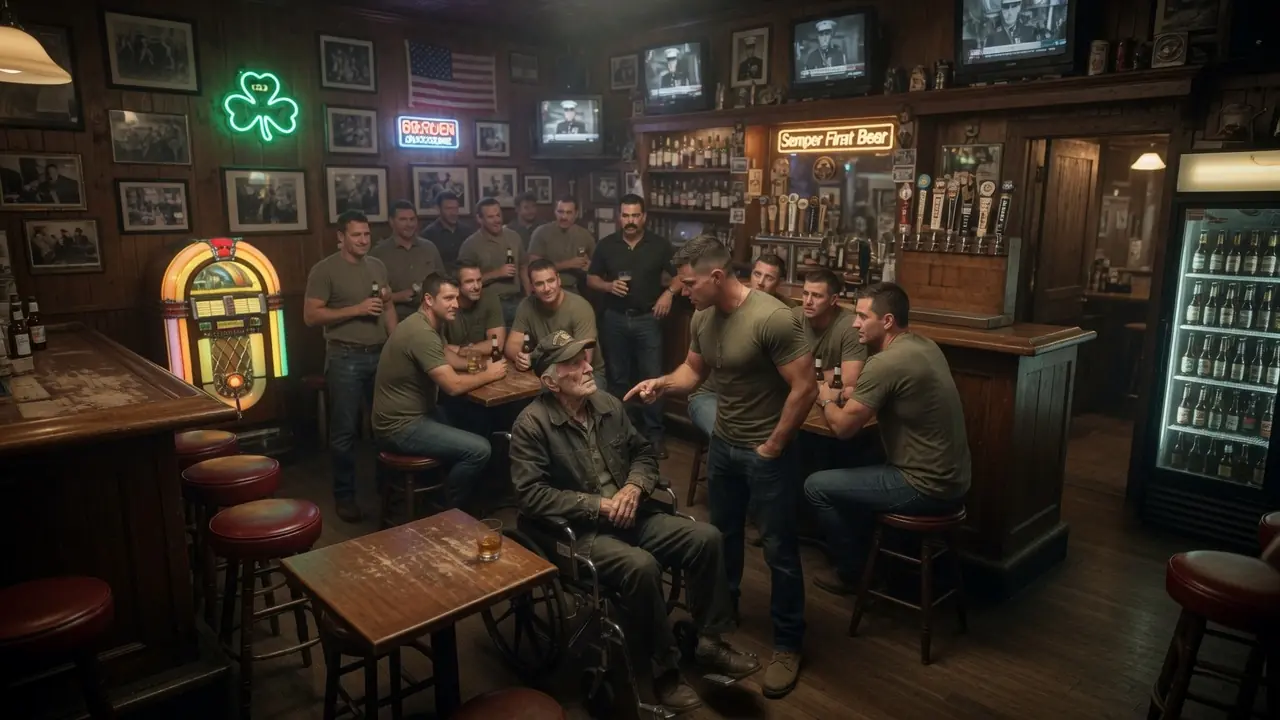
Tyler noticed Samuel’s cap.
He stared at it for several seconds, then grinned.
“Hey, Grandpa.”
The men around him looked over.
Samuel lifted his eyes but said nothing.
Tyler raised his beer bottle toward the old man. “You ever actually serve, or do you just wear that hat for discounts?”
A few of the younger Marines laughed.
Frank stopped polishing a glass.
Several older veterans near the bar turned their heads.
Samuel remained calm.
He took a small sip of whiskey, set the glass down, and looked directly at Tyler.
“Yes,” he said. “I served.”
Tyler leaned back against the table. “Doing what?”
“Different things.”
“That usually means paperwork.”
More laughter followed.
Samuel did not react.
He had heard louder men in more dangerous places. He had learned long ago that some people raised their voices because silence gave them too much room to hear themselves.
Tyler walked closer.
His friends followed, expecting the exchange to become entertainment.
“What unit?”
Samuel looked toward the photographs covering the wall.
“First Force Reconnaissance.”
The laughter softened.
Not completely.
But enough.
One of Tyler’s friends, Lance Corporal Miguel Santos, stopped smiling. He had an uncle who had served in reconnaissance, and he knew the name carried weight.
Tyler, however, had already committed himself to the joke.
“Force Recon?” he said. “You?”
Samuel looked back at him.
“That’s what I said.”
Tyler glanced down at the wheelchair.
The implication in his expression was obvious.
Samuel noticed it.
So did everyone else.
Tyler took another drink. “What happened? Trip over a filing cabinet?”
This time only two men laughed.
Frank placed the glass he had been polishing on the counter.
“That’s enough, Corporal.”
Tyler looked toward him. “We’re just talking.”
“No,” Frank replied. “You’re performing.”
Samuel lifted one hand gently.
“It’s all right, Frank.”
The bartender looked at him for a moment, then reluctantly stepped back.
Tyler smiled as though he had won something.
He pulled out a chair and sat across from Samuel without being invited.
“Okay, old timer. Let’s say I believe you.”
“You don’t have to.”
“What was your call sign?”
The question seemed harmless.
Almost childish.
The kind of question young Marines asked veterans after hearing too many stories where every man had a nickname and every mission had a legend attached to it.
Samuel’s expression did not change.
But Frank did.
His hand stopped halfway toward a bottle.
At a table near the wall, an older man wearing a Vietnam veteran pin looked up sharply.
Samuel rested both hands on the arms of his wheelchair.
“That was a long time ago.”
Tyler grinned.
“So you don’t remember?”
“I remember.”
“Then what was it?”
Samuel looked around the bar.
The noise had begun to fade.
Conversations slowed.
Glasses remained suspended halfway to mouths.
Even the music seemed quieter, though it had not changed.
Samuel returned his eyes to Tyler.
“Reaper One.”
The beer bottle slipped from Tyler’s hand.
It struck the edge of the table, rolled once, and crashed onto the floor.
The room fell completely silent.
Tyler did not look down at the broken glass.
His face had lost its color.
Behind him, Miguel whispered, “No way.”
The older veteran near the wall slowly stood.
His chair scraped across the floor.
He stared at Samuel with an expression caught somewhere between disbelief and recognition.
“Reaper One?” he repeated.
Samuel gave the smallest nod.
The man stepped closer.
His voice trembled. “Operation Iron Valley?”
Samuel looked at him.
“Yes.”
The veteran removed his cap.
Every Marine in the room watched.
Tyler remained frozen in his chair.
He knew the name.
Every reconnaissance Marine knew it.
Not because the full story appeared in textbooks. Most of it did not. But fragments survived in training halls, unit histories, and conversations passed from one generation to the next.
Reaper One had been the call sign of a reconnaissance team leader during one of the most disastrous extraction operations of the war. His team had been sent behind enemy lines to locate a missing patrol and identify artillery positions threatening an entire battalion.
The mission was supposed to last six hours.
It lasted four days.
The team was discovered before reaching the extraction point. Communications failed. Two evacuation helicopters were forced away by heavy fire. By the second night, several men were wounded, ammunition was running low, and enemy forces were closing from three directions.
According to the story, the team leader refused an order to abandon the wounded.
He moved the injured men one at a time through nearly two miles of jungle and rock while calling in air support dangerously close to his own position. When the final helicopter arrived, he remained behind until every surviving member of his team had been lifted out.
The last transmission anyone heard from the ground was only four words.
“Reaper One still standing.”
Then the radio went silent.
For years, many believed he had died there.
The official reports were incomplete. Names had been withheld. Parts of the mission remained classified. Among younger Marines, Reaper One had become less like a person and more like a warning, a legend about what leadership meant when there was no safe choice left.
Tyler stared at the old man in the wheelchair.
“You’re saying that was you?”
Samuel’s eyes remained steady.
“I didn’t say anything except my call sign.”
The older veteran stepped closer. “My brother was on that helicopter.”
Samuel looked up at him.
The man’s lips began to tremble.
“Peter Lawson,” he said. “Corpsman. Twenty-one years old.”
For the first time that evening, something changed in Samuel’s face.
He remembered.
Not vaguely.
Completely.
“Lawson carried two wounded men after he’d been hit himself,” Samuel said. “He kept telling everyone he was fine.”
The veteran covered his mouth with one hand.
“He came home,” he whispered. “He lived another thirty-eight years.”
Samuel nodded.
“He earned every one of them.”
The man reached for Samuel’s hand and held it between both of his.
“My family was told someone stayed behind to get him onto the helicopter.”
Samuel said nothing.
The veteran’s eyes filled.
“It was you.”
Samuel looked down at their joined hands.
“It was all of us.”
No one in the bar moved.
The young Marines who had laughed only minutes earlier now stood with their backs straight and their eyes lowered. The wheelchair no longer looked like evidence of weakness. It looked like the final cost of a story none of them had understood.
Tyler finally found his voice.
“How did you survive?”
Samuel looked toward the whiskey glass on the table.
“The enemy found me before the next helicopter did.”
The sentence was delivered without drama.
That made it heavier.
He had been wounded in the back and legs. He had spent two days moving through dense terrain with almost no feeling below his waist. A search team eventually found him near a dry riverbed, still carrying the radio and the identification tags of two Marines who had not made it home.
He had undergone fourteen operations.
Doctors told him he would never walk again.
He proved them right.
But he lived.
And for fifty years, he carried the memories quietly.
No interviews.
No public speeches.
No attempts to turn survival into fame.
He worked as a high school history teacher. He married. Raised two daughters. Buried his wife after forty-six years together. Every November, he called the families of the men from his team.
That was all.
Tyler slowly stood.
His shoulders no longer carried the same swagger.
“Sir…”
Samuel looked at him.
Tyler swallowed. “I’m sorry.”
The old man waited.
“I saw the chair,” Tyler continued, “and I thought…”
He stopped.
Samuel finished the sentence for him.
“You thought the most important part of my life was the part that no longer worked.”
Tyler lowered his head.
“Yes, sir.”
Samuel looked toward the broken bottle on the floor.
“You’re not the first.”
Tyler’s voice became quieter. “That doesn’t make it right.”
“No.”
The answer came gently, but it offered no escape.
Tyler glanced at the other Marines, then back at Samuel.
“I was disrespectful.”
“You were.”
“I wanted people to laugh.”
“They did.”
Tyler looked ashamed. “I don’t know what else to say.”
Samuel studied him for a long moment.
Then he pointed toward the broken glass.
“Start by cleaning that up.”
A few men almost smiled.
Tyler nodded immediately.
“Yes, sir.”
He found a broom and dustpan behind the bar and knelt on the floor. No one helped him. No one mocked him either. They simply watched as he gathered every piece of glass.
When he finished, he returned the broom and stood before Samuel again.
The old veteran lifted his whiskey.
“Now sit down.”
Tyler obeyed.
Samuel looked around at the other young Marines.
“You can sit too.”
They pulled chairs closer, no longer crowding him as an audience, but gathering around him as students.
For the next hour, Samuel spoke.
Not about heroism.
Not about kills.
Not about medals.
He spoke about fear.
About the sound a wounded Marine made when he tried not to cry out.
About how leadership sometimes meant pretending to know the way when everyone could see you were lost.
He spoke about Peter Lawson giving away his last morphine injector because another man was hurting worse.
He spoke about a radio operator named Billy Hart who kept transmitting with blood running down one side of his face.
He spoke about the men who came home and could not explain why ordinary life felt harder than combat.
The younger Marines listened without interrupting.
At some point, Frank placed fresh drinks on the table.
Samuel’s remained whiskey.
Tyler asked for water.
Near midnight, the bar began to empty.
The older veteran who had recognized Peter Lawson’s name embraced Samuel before leaving. Several Marines shook Samuel’s hand. Others simply nodded, understanding that too many words would cheapen the moment.
Tyler remained until the end.
When Samuel reached for the wheels of his chair, Tyler stepped forward.
“May I?”
Samuel looked at him.
“You asking permission this time?”
“Yes, sir.”
Samuel nodded.
Tyler carefully pushed the wheelchair toward the door.
Outside, the night air was cool and still. The laughter from inside had faded. A row of cars sat beneath the parking lot lights, and somewhere in the distance, traffic moved along the highway.
Samuel’s van waited near the accessible ramp.
Before helping him inside, Tyler asked one last question.
“Why didn’t you tell us who you were when I first spoke to you?”
Samuel looked out across the dark parking lot.
“Because a man’s respect shouldn’t depend on whether the person in front of him is famous.”
Tyler absorbed the words quietly.
Samuel added, “You should have been decent before you knew my name.”
“Yes, sir.”
Tyler helped secure the wheelchair inside the van.
As Samuel prepared to close the door, the young Marine stepped back and raised his hand in a formal salute.
For a moment, Samuel simply looked at him.
Then he returned it.
Not as a legend.
Not as Reaper One.
As one Marine acknowledging another who still had time to become a better man.
The van pulled away a few minutes later.
Tyler remained in the parking lot until its taillights disappeared.
The following week, a small framed photograph appeared on the bar wall. It showed a much younger Samuel Mercer standing beside seven exhausted Marines near an evacuation helicopter. There was no dramatic inscription beneath it.
Only a call sign.
REAPER ONE
And below that, a single sentence Frank had written by hand:
Never mistake the wounds you can see for the full measure of the man carrying them.