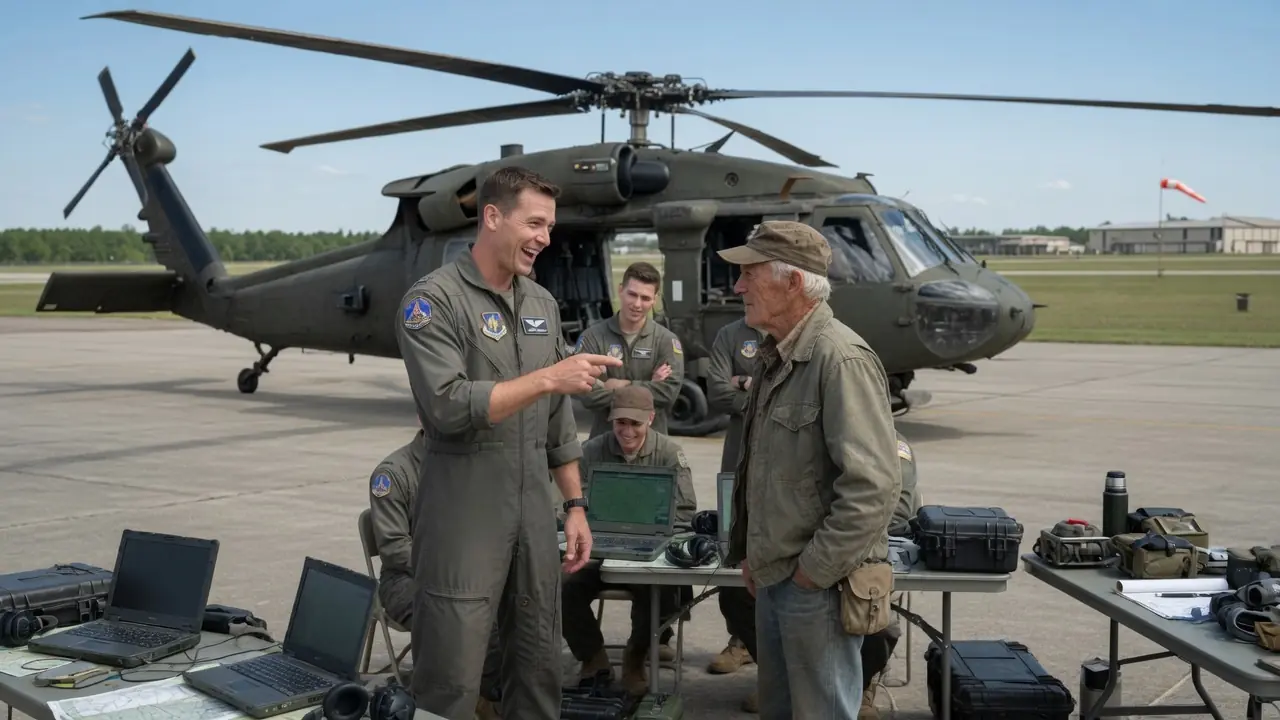
Captain Ryan Cole laughed the moment he saw the old man step out of the government sedan.
Not a polite laugh.
Not the kind a person tried to hide behind a hand.
It was a sharp, open sound that carried across the flight line and made three crew chiefs turn toward him.
The elderly man stood beside the sedan wearing faded work pants, worn brown boots, and a canvas jacket the color of dried dust. He was thin, slightly bent through the shoulders, and carried a small leather pouch beneath one arm.
He looked more like someone’s grandfather arriving to repair a barn door than a retired military aviator summoned to a modern helicopter base.
Ryan lowered his sunglasses.
“That’s the expert?”
Lieutenant Mason Reed, standing beside him, glanced toward the visitor.
“That’s what Colonel Barrett said.”
Ryan smiled.
“We’re grounding two aircraft and delaying the exercise for a man who looks like he still navigates by fence posts?”
Mason did not answer.
The two pilots stood outside Hangar Three at Fort Red Rock, Arizona, where heat rose from the concrete in silver waves. Behind them, four UH-60 Black Hawk helicopters sat beneath the hard morning sun.
Mechanics moved between open panels.
Laptops rested on rolling diagnostic carts.
Fuel trucks idled near the far fence.
Every screen, sensor, checklist, and maintenance procedure told the same story.
Two helicopters were unsafe to fly.
No one could explain why.
The first failure happened six days earlier.
Black Hawk 417 lifted from the training pad during a routine mountain exercise. At four hundred feet, the aircraft rolled suddenly to the left.
The pilot corrected.
The helicopter rolled again.
No warning appeared on the flight display. Hydraulic pressure remained normal. Rotor speed held steady. Wind conditions were mild.
The pilot returned immediately.
Technicians inspected the flight-control system, swashplate, servos, rotor head, and stabilization computers.
They found nothing.
Two days later, a second aircraft developed the same problem.
Same unexplained left roll.
Same altitude range.
Same absence of warning lights.
The second crew landed hard enough to damage one tire.
After that, Colonel Laura Barrett grounded the entire training group.
Factory representatives arrived.
Software engineers downloaded flight data.
Hydraulic specialists replaced a servo they could not prove had failed.
The aircraft passed every ground test.
Then Black Hawk 417 was taken up again.
At three hundred and eighty feet, it rolled left.
Exactly as before.
The exercise was canceled.
Command demanded answers.
That was when someone in Washington recommended a retired warrant officer named Samuel Mercer.
Ryan watched Samuel cross the flight line toward the hangar.
The old man’s canvas jacket moved lightly in the rotor wash from a helicopter starting near the opposite end of the base. He did not hurry.
He did not appear impressed by the aircraft.
And he did not look at Ryan until he stood directly in front of him.
“You Captain Cole?” Samuel asked.
His voice was rough but steady.
Ryan glanced at the leather pouch.
“I am.”
“You flew 417 during the second test?”
“Yes.”
“Describe the roll.”
Ryan looked toward the mechanics nearby.
They had already heard his account several times.
“Sudden left bank. Approximately twelve degrees. Corrective input worked for less than a second, then the aircraft pulled again.”
“What did you feel through the controls?”
“Nothing unusual.”
“Not what the display showed. What did your hands feel?”
Ryan smiled.
“My hands felt a multimillion-dollar aircraft trying to throw me sideways.”
A few crew members laughed.
Samuel did not.
“Did the cyclic resist you?”
“No.”
“Did it become lighter?”
“No.”
“Heavier?”
“No.”
“Did the aircraft yaw?”
“Maybe two degrees.”
“Maybe?”
Ryan removed his sunglasses.
“The data recorder has the exact number.”
“I didn’t ask what the recorder remembers.”
The laughter stopped.
Samuel looked directly at him.
“I asked what you remember.”
Ryan’s jaw tightened.
“One or two degrees right yaw.”
“Before or after the roll?”
“During.”
“Any vibration?”
“Nothing significant.”
Samuel’s pale eyes remained on him.
“Significant is not the same as nothing.”
Ryan folded his arms.
“There was a light pulse through the pedals.”
“How many?”
“I don’t know.”
“One? Two? Repeating?”
“Three, perhaps.”
“Even spacing?”
Ryan thought back.
For the first time, his expression became serious.
“No. The third came later.”
Samuel nodded.
“What altitude?”
“Three eighty.”
“Exact?”
“Close.”
“What was beneath you?”
“Desert.”
“What kind?”
Ryan stared at him.
“Sand, rock, cactus. The usual kind.”
Samuel turned toward Colonel Barrett, who had just entered the hangar.
“Do you have the training map?”
Barrett handed him a folder.
She was forty-eight, disciplined, and visibly tired from nearly a week without an answer.
“Mr. Mercer, thank you for coming.”
“Warrant Officer Mercer is fine.”
“You retired thirty-two years ago.”
“Still answered to worse names than that.”
Ryan smirked.
Samuel opened the map on a worktable.
“Mark both events.”
Mason pointed to the location of the first incident.
Ryan marked the second.
Samuel studied the two points.
They were less than a mile apart.
Both occurred over a dry valley east of Granite Ridge.
He removed a pencil from his pouch but did not yet open the pouch itself.
“What direction were you traveling?”
“Northwest,” Ryan said.
“Ground speed?”
“Eighty-five knots.”
“Aircraft weight?”
“Near maximum training load.”
“Doors?”
“Closed.”
Samuel looked at the maintenance chief.
“Same configuration on both flights?”
Chief Warrant Officer Elena Torres nodded.
“Within two hundred pounds.”
“Same external equipment?”
“Yes.”
“Same aircraft modification package?”
“All four helicopters have the same package.”
“But only two showed the roll.”
“So far.”
Samuel studied the map again.
Ryan leaned toward Mason and spoke loudly enough for the old man to hear.
“Maybe he’s looking for an old cattle trail.”
Samuel continued reading.
Ryan added, “Or buried treasure.”
Several young pilots laughed.
Colonel Barrett looked at him.
“That’s enough, Captain.”
Samuel folded the map.
“No. Let him talk.”
Ryan turned.
Samuel looked him over slowly.
“Men reveal more when they believe no one important is listening.”
The hangar went quiet.
Ryan’s smile disappeared.
“You think I’m the problem?”
“I think you’re a pilot who trusts a screen more than his body and speed more than patience.”
“I have twelve hundred flight hours.”
Samuel nodded.
“That explains the confidence.”
“And you?”
The old man’s expression did not change.
“How many hours do you have?”
Samuel placed the pencil back inside his pocket.
“Enough to stop counting.”
Ryan gave a short laugh.
“That isn’t an answer.”
“It is the only one you need.”
Colonel Barrett stepped between them.
“Captain Cole, return to the briefing room.”
Ryan did not move.
“I want to see what kind of magic he plans to pull from that pouch.”
Samuel looked down at the worn leather bag under his arm.
“Nothing magical.”
He set it on the table.
“Magic is what people call experience when they don’t understand how it works.”
Ryan remained.
Barrett could have ordered him away.
Instead, she let him stay.
Perhaps because Ryan had flown the failing aircraft.
Perhaps because she also wanted to see what was inside the pouch.
Samuel did not open it.
First, he walked around Black Hawk 417.
He moved slowly, touching nothing at first.
The helicopter’s panels were open. Diagnostic cables ran from the aircraft to two laptops. Mechanics had labeled hydraulic lines, actuators, and electrical connections.
Samuel ignored the computers.
He stood beneath the tail rotor.
Then near the left main landing gear.
Then beneath the forward fuselage.
He closed his eyes.
Ryan whispered, “Is he listening to a helicopter that isn’t running?”
Samuel opened one eye.
“I’m listening to you wasting oxygen.”
A crew chief coughed to hide a laugh.
Samuel crouched near the underside of the aircraft.
His knees clearly hurt. He lowered himself carefully, using one hand against the landing gear.
Ryan watched with renewed amusement.
“This is the man who’s supposed to save the exercise?”
Samuel looked at a row of bolt heads near a newly installed equipment housing.
“What modification is this?”
Torres stepped closer.
“Terrain-mapping upgrade. New radar processing unit and antenna assembly.”
“When installed?”
“Six weeks ago.”
“On all aircraft?”
“Yes.”
“By the same team?”
“Two contractor teams.”
Samuel pointed.
“Which team did 417 and 422?”
Torres checked her records.
“Team B.”
“And the other two?”
“Team A.”
Samuel nodded.
“What does Team B say?”
“They passed inspection.”
“That wasn’t my question.”
Torres frowned.
“Team B says installation was completed according to specification.”
“Did anyone inspect behind their work?”
“Yes.”
“Who?”
Torres hesitated.
“Their quality supervisor.”
Samuel stood slowly.
“So they checked themselves.”
Ryan folded his arms.
“The system isn’t connected to flight controls.”
“Everything attached to an aircraft becomes part of flight.”
“That housing cannot command a roll.”
“No.”
Samuel looked toward him.
“But it can change something that does.”
He requested that the aircraft be raised on maintenance jacks.
The mechanics complied.
Samuel asked for rotor blades to be positioned exactly as they had been during the flight test.
Then he examined weight-and-balance records.
The new radar assembly added only forty-seven pounds.
The change had already been calculated.
Nothing exceeded limits.
He moved to the second affected Black Hawk.
Same installation team.
Same equipment.
Same unexplained roll.
Samuel asked for both aircraft to be pushed outside.
The temperature had climbed above one hundred degrees.
Heat shimmered around the wheels.
He stood between the helicopters and looked toward Granite Ridge.
“Take me to the valley.”
Ryan laughed again.
“You want to inspect the sand?”
“I want to inspect what you flew through.”
Colonel Barrett arranged a ground vehicle.
Ryan volunteered to drive.
Not because he respected Samuel.
Because he wanted to watch the old man fail.
Mason joined them, along with Torres and an Army meteorological officer named Captain Priya Shah.
The vehicle followed a rough service road into the desert.
Granite Ridge rose ahead of them, dark against the pale sky.
Samuel sat silently in the passenger seat.
His pouch remained on his lap.
After twenty minutes, he told Ryan to stop.
“This is not the location,” Ryan said.
“It is where the effect begins.”
“What effect?”
Samuel opened the door.
Hot wind entered the vehicle.
He stepped onto the dirt and looked toward a shallow cut between two ridges.
Priya checked the map.
“Both incidents occurred another half mile north.”
Samuel pointed toward a line of scrub brush.
“Wind moves through there.”
Priya nodded.
“Terrain channeling.”
“How strong?”
“Depends on heating. Afternoon gusts can exceed thirty knots.”
“The flights were in the morning,” Ryan said.
Samuel looked at him.
“What heats faster—rock or air?”
“Rock.”
“And what happens when one slope warms faster than the shaded side?”
“Thermal movement.”
“Then perhaps the desert is not empty after all.”
They walked toward the cut.
Near the ridge, the ground dropped into an old quarry depression not shown on current training maps.
Metal structures protruded from the sand.
Torres frowned.
“What is this?”
“Cold War test site,” Samuel said.
“You knew it was here?”
“I flew over it when the structures were new.”
Ryan looked at him.
“When?”
“Before you were born.”
Old ventilation shafts rose from the quarry floor. Their openings faced the direction of the prevailing morning wind.
Samuel asked Priya to measure airflow.
The meteorological officer raised a handheld instrument.
The wind accelerated sharply near the shafts, then became irregular.
“Localized turbulence,” she said.
“Enough to roll a Black Hawk?” Ryan asked.
“Not by itself.”
Samuel nodded.
“Correct.”
He looked toward the aircraft route marked on the map.
“The wind is only one hand.”
“What is the other?” Mason asked.
Samuel finally opened the leather pouch.
Everyone leaned closer.
Ryan expected specialized instruments.
Perhaps an antique navigation device.
Instead, Samuel removed three ordinary objects.
A short length of red yarn.
A small carpenter’s level.
And a dented brass compass.
Ryan stared.
“That’s your magic?”
Samuel tied the yarn to the vehicle antenna.
The loose end snapped violently, then dropped, then pulled sideways again.
“Air does not care whether your instrument is expensive,” Samuel said. “It only needs something free enough to show it.”
He placed the carpenter’s level across the vehicle dashboard.
Then he held the compass beneath the metal edge of the newly installed radar-processing case Torres had brought for comparison.
The needle shifted.
Torres leaned closer.
“That housing should be shielded.”
“Should be.”
The compass needle moved again when Samuel passed it along one corner.
“What does that prove?” Ryan asked.
“That Team B installed something incorrectly.”
“Magnetic interference cannot move the aircraft.”
“No.”
Samuel looked at him.
“But it may lie to something that can.”
Torres’s expression changed.
“The attitude-heading reference system.”
The new radar-processing unit sat near wiring serving the inertial-navigation and stabilization systems.
It was not supposed to create meaningful electromagnetic interference.
But if shielding was incomplete, or if a grounding strap had been installed incorrectly, the unit could produce intermittent corruption.
“Then why no warning?” Mason asked.
“Because the system may believe the false data is real,” Samuel said.
Priya looked toward the ridge.
“And turbulence forces the stabilization system to react.”
“Exactly.”
Samuel drew a quick diagram in the dust.
The aircraft entered localized turbulence near the quarry.
The pilot made a normal correction.
At the same moment, electromagnetic interference from the radar unit corrupted heading or attitude information.
The stability-augmentation system added an incorrect correction.
The pilot corrected against it.
For a second, the aircraft and pilot fought one another.
The result was the sudden left roll.
Ryan shook his head.
“That would happen elsewhere too.”
Samuel looked at him.
“Not necessarily.”
“Why only here?”
“Because the failure needs two conditions. Turbulence strong enough to activate repeated stabilization response, and an interference pattern that appears under a specific electrical load.”
Torres understood next.
“The terrain radar changes operating mode near uneven ground.”
Samuel nodded.
“At approximately the same altitude?”
Ryan looked at the incident map.
Three hundred eighty feet.
The terrain-mapping system shifted modes automatically as the helicopters approached the ridge.
The affected aircraft both carried installation work completed by Team B.
The old quarry created sharp, irregular airflow.
Neither problem alone was enough.
Together, they produced the roll.
Ryan stared at Samuel.
“You figured that out from three pedal pulses?”
“Not only that.”
“What else?”
“The altitude. The route. The modification date. The fact that only two aircraft were affected. And the way you described no resistance in the cyclic.”
Samuel pointed at him.
“If the flight-control hardware had jammed, your hands would have felt it. If the hydraulic system failed, the controls would have changed. If the rotor head were damaged, the vibration would repeat.”
He looked toward the quarry.
“One sudden roll with clean controls meant the aircraft was responding normally to bad information or abnormal air.”
Ryan said nothing.
They returned to the base.
Torres ordered the radar installations opened.
On both affected helicopters, the grounding strap had been installed over painted metal rather than bare conductive surface.
Worse, a shielding braid had been folded beneath the mount, creating an intermittent connection that changed with vibration.
The other two helicopters had been installed correctly.
The factory engineers were called back.
At first, they resisted Samuel’s conclusion.
Then testing reproduced the interference.
A controlled ground simulation showed false heading deviations appearing during high radar-processing load.
When combined with programmed stability inputs, the system commanded an unwanted roll.
The mystery was solved.
But Samuel was not finished.
“Correct the installation,” he said. “Then inspect the software response.”
The lead engineer frowned.
“The software reacted to corrupted data.”
“Yes.”
“That is not a software fault.”
“It is if the software accepts one impossible signal without checking the others.”
The engineer looked annoyed.
“Our system uses multiple sources.”
“Then why did it believe one bad source?”
No one answered.
Further review revealed that a recent software update had shortened the disagreement-check window between navigation sensors. The change made the system respond faster in mountainous terrain.
It also made it more likely to accept brief false data before secondary sensors could reject it.
The faulty grounding created the lie.
The software’s impatience believed it.
Both problems were corrected.
A week later, Black Hawk 417 returned to the same route.
Ryan flew.
Samuel sat behind him wearing a borrowed flight helmet over his silver hair.
At three hundred and eighty feet, they crossed the quarry.
The aircraft shook lightly in the turbulent air.
No roll.
Ryan repeated the route twice.
Nothing.
On the return flight, he glanced at Samuel through the small mirror.
The old man was looking out at the desert.
Not celebrating.
Not smiling.
Simply watching the landscape pass beneath them.
After landing, the entire squad gathered inside Hangar Three.
Colonel Barrett thanked the engineers, maintenance teams, and aircrew.
Then she called Samuel forward.
He stood beside the same worktable where Ryan had mocked his pouch.
Barrett faced the unit.
“Warrant Officer Samuel Mercer served twenty-eight years as an Army aviator and maintenance test pilot.”
Ryan looked toward Mason.
Test pilot.
That explained the questions.
Barrett continued.
“He logged more than eleven thousand flight hours across Vietnam, Germany, Central America, and the Persian Gulf.”
No one spoke.
“He helped write early flight-test procedures for stability systems still used in modern aircraft.”
Ryan’s face tightened.
Samuel had not been some washed-up mechanic dragged from retirement.
He had helped shape the methods the young pilots now trusted.
Colonel Barrett looked at Samuel.
“There is more, but much of it remains classified.”
Ryan stepped forward.
“Sir.”
Samuel turned.
The entire hangar watched.
Ryan removed his sunglasses.
“I owe you an apology.”
“Yes.”
The blunt answer surprised him.
“I mocked you before you even spoke.”
“Yes.”
“I thought the base had brought in someone who didn’t understand modern systems.”
Samuel waited.
Ryan looked toward the leather pouch.
“I was wrong.”
“Yes.”
A few crew members smiled.
Ryan accepted it.
“What was in the pouch?”
“You saw it.”
“Yarn, a level, and a compass.”
“Among other things.”
Samuel placed the pouch on the table and opened it fully.
Inside were several more objects.
A grease pencil.
A folding ruler.
Safety wire.
A magnifying lens.
A small mirror.
A worn notebook.
And a dark cloth bundle tied with cord.
Ryan pointed.
“That.”
Samuel’s expression changed.
For the first time, the confidence in his face softened.
He untied the cord.
Inside was an old pilot’s wing badge, blackened by fire.
Beneath it rested a folded photograph.
Samuel opened the photograph carefully.
It showed four young Army aviators standing in front of an early-model helicopter somewhere in Vietnam.
Samuel was one of them.
The others wore broad smiles.
On the back were three names.
Captain Edward Miles.
Chief Warrant Officer Thomas Avery.
Lieutenant James Cole.
Ryan stopped breathing.
“James Cole?”
Samuel looked at him.
“Your grandfather.”
The hangar became silent.
Ryan stared at the photograph.
“My grandfather died in Vietnam.”
“Yes.”
“My family was told his helicopter went down during a reconnaissance flight.”
“That is true.”
“You knew him?”
Samuel looked toward the blackened wings.
“I was his copilot.”
Ryan’s confidence vanished completely.
He stepped closer.
“What happened?”
Samuel took a slow breath.
Their aircraft had been flying through a mountain valley in 1971 when it developed an unexplained control problem.
The helicopter rolled sharply.
James Cole fought the controls while Samuel searched for the cause.
They managed to remain airborne long enough to move away from a village beneath them.
Then the aircraft struck a ridge.
Samuel survived with burns and a broken spine.
James did not.
“The investigation blamed mechanical failure,” Samuel said.
“What failed?”
“We never proved it.”
Ryan looked toward the grounded Black Hawks.
“The same kind of problem?”
“Similar enough.”
Samuel had spent decades remembering the sudden roll, the clean controls, and James’s final effort to keep the aircraft away from people on the ground.
When Colonel Barrett described the current failures, he accepted the invitation because the symptoms resembled the crash that had killed his friend.
“You came because of him,” Ryan said.
“Yes.”
“Why didn’t you tell me?”
“You had already decided who I was.”
Ryan lowered his eyes.
Samuel handed him the photograph.
“Your grandfather was an excellent pilot.”
Ryan touched the edge carefully.
“My father barely talks about him.”
“Grief makes some families repeat stories. It makes others lock them away.”
“What were his last words?”
Samuel looked toward the hangar doors.
Ryan expected something heroic.
A final message for his wife.
A statement about duty.
Instead, Samuel said, “He told me to stop fighting him for the controls.”
Ryan looked confused.
Samuel almost smiled.
“We were both trying to save the aircraft. James realized our strength was working against itself.”
The words echoed the failure they had just solved.
A pilot and stabilization system both making corrections.
Two forces trying to help.
Together creating danger.
Samuel continued.
“Then he said, ‘Trust me. I can hold her long enough.’”
James kept the aircraft away from the village.
He died at the controls.
Samuel crawled from the wreckage carrying the burned pilot wings he found near James’s seat.
He had kept them for more than fifty years.
Ryan stared at the cloth bundle.
“Those belong to my family.”
“Yes.”
“Why did you keep them?”
“Your grandmother refused everything recovered from the wreck.”
Ryan did not know that.
“She said the military had already returned a coffin she could not open. She wanted nothing else from the aircraft.”
Samuel folded the cloth.
“I told myself I would give these to someone in the family when the time felt right.”
“And today does?”
“No.”
Ryan looked up.
Samuel’s gray eyes held him.
“But you need them more than I do.”
Ryan accepted the wings with both hands.
The young pilot who had laughed at the old man now stood unable to speak.
Crew members turned away to give him privacy.
Samuel closed the leather pouch.
Ryan finally asked, “Was my grandfather afraid?”
“Yes.”
The answer came without hesitation.
“Was he good enough?”
“He was better than good.”
“Then why did he die?”
Samuel looked toward Black Hawk 417.
“Skill does not make a man immortal. It only gives him more choices before the end.”
Ryan pressed the blackened wings into his palm.
“I thought being a great pilot meant never hesitating.”
“Sometimes.”
“I thought confidence kept crews calm.”
“It can.”
“What did I get wrong?”
Samuel stepped closer.
“You believed confidence meant the answer had to come from you.”
Ryan said nothing.
“The best pilots I knew were not the men who spoke first,” Samuel continued. “They were the ones who noticed what everyone else had stopped questioning.”
He tapped the leather pouch.
“Tools are only useful when pride leaves enough room to use them.”
The incident changed Ryan.
Not instantly.
Real change rarely arrived as cleanly as embarrassment.
For the first few weeks, he simply spoke less.
He reviewed flight data without announcing conclusions.
He asked crew chiefs what they had felt before explaining what the instruments showed.
During briefings, he stopped treating questions as challenges to his authority.
Mason noticed first.
Then Torres.
Months later, Ryan was flying a night medical evacuation when the aircraft developed a faint vibration over mountainous terrain.
The display showed normal rotor balance.
His younger copilot suggested continuing.
Ryan remembered Samuel.
Where a symptom appeared was not always where it began.
He reduced speed and asked the crew chief to inspect visually through the side window.
The crew chief saw an external antenna mount beginning to separate.
They landed at a forward site before it tore free and struck the tail rotor.
The maintenance report credited Ryan’s caution.
He corrected it.
“Crew observation prevented the accident.”
Samuel returned to retirement.
But not completely.
Colonel Barrett convinced him to visit Fort Red Rock twice each year for maintenance and flight-safety seminars.
The first time he entered Hangar Three after the incident, no one laughed.
Young pilots gathered around the worktable.
Samuel placed his leather pouch before them.
“What is the first tool?” he asked.
One lieutenant pointed toward the compass.
“That?”
“No.”
“The notebook?”
“No.”
“The mirror?”
Samuel shook his head.
Ryan stood near the rear wearing his grandfather’s restored wings inside a small protective case attached to his flight bag.
He knew the answer.
“Attention.”
Samuel looked at him.
“Good.”
Years later, Ryan became an instructor pilot.
On the first day of every new class, he placed three objects on the briefing table.
A piece of yarn.
A carpenter’s level.
A brass compass.
Students usually smiled.
Some laughed.
Ryan allowed it.
Then he displayed a photograph of four young aviators standing beside a helicopter in Vietnam.
He told them about James Cole.
About Samuel Mercer.
About the mysterious roll that modern computers could not explain until an eighty-year-old pilot began with the oldest question in aviation:
What changed when the trouble began?
Ryan never told the story as proof that old methods were better than modern technology.
They were not.
The computers found the corrupted data.
Engineering tests reproduced the failure.
Software analysis corrected it.
But none of those tools mattered until someone asked the right question.
The lesson was not to reject technology.
It was to reject the belief that technology removed the need to observe.
Samuel Mercer carried no magic in his leather pouch.
Only simple tools, old memories, and enough humility to let the aircraft describe its own problem.
The final item in the pouch shocked the crew because it was not a tool at all.
It was a debt.
A burned pair of wings carried for more than fifty years.
A promise to return part of a dead pilot to his family.
And a reminder that the old man Ryan mocked had once sat beside his grandfather in a falling helicopter, trusting him until the final second.
At Samuel’s funeral seven years later, Ryan stood beside the flag-draped casket wearing his grandfather’s wings over his dress uniform.
He carried the leather pouch.
Samuel had left it to him with one handwritten note.
Captain Cole,
The pouch is not valuable.
The habit is.
Before blaming the machine, listen.
Before trusting the screen, look outside.
Before proving you are right, make sure everyone survives your answer.
And never laugh at an old pilot until you know what aircraft he had to walk away from.
Ryan folded the note and returned it to the pouch.
After the service, a young lieutenant approached.
“Sir, is that the famous bag?”
Ryan looked down at the worn leather.
“Yes.”
“What is inside?”
He thought about the yarn.
The level.
The compass.
The photograph.
The burned wings now resting with Samuel.
Then he looked toward the young pilot.
“Nothing magical.”
The lieutenant smiled.
Ryan did not.
“Only everything we forget when we start believing the aircraft needs us more than we need to understand it.”