The first shove sent the mop bucket rolling across the wrestling gym.
Dirty water splashed over the rubber floor, slid beneath the benches, and soaked the edge of the championship mat while nearly forty athletes turned toward the sound. In the center of the commotion stood seventeen-year-old Marcus Reed, a thin after-school janitor in an oversized gray uniform, one hand still gripping the wooden mop handle.
Towering over him was Blake Maddox.
At twenty-seven, Blake was the most celebrated wrestler to come through Ironclad Training Center in nearly a decade. He stood six feet five inches tall, weighed almost two hundred and eighty pounds, and carried the kind of heavy muscle that made doorways seem too narrow when he entered.
He had won thirty-one professional matches.
He had never been pinned.
His face appeared on banners hanging above the gym, on advertisements near the locker rooms, and across the glossy posters younger wrestlers asked him to sign after practice. Coaches praised his strength, sportswriters called him unstoppable, and the men around him laughed whenever he laughed because being close to Blake’s success made them feel important.
That afternoon, his expensive metal water bottle had been knocked from a bench.
It had rolled across the floor and collected a shallow dent near the bottom.
Marcus had been mopping several feet away.
Blake decided that was enough evidence.
“You did that,” he said.
Marcus looked at the bottle, then at Blake.
“No, sir.”
The answer was quiet.
Respectful.
It should have ended there.
Blake stepped closer.
“You calling me a liar?”
Marcus tightened his hands around the mop handle.
“I said I didn’t touch it.”
Several wrestlers began watching from the edge of the mat. One of them lifted his phone. Another whispered something to a teammate, and both smiled as though the afternoon had suddenly become more interesting.
Blake glanced toward them.
He liked an audience.
He reached forward, grabbed Marcus by the front of his uniform, and shoved him backward into the padded wall.
The impact knocked the breath from the boy’s lungs.
Laughter echoed through the gym.
Marcus did not raise his hands.
He did not push back.
He simply stood there, shoulders pressed against the wall, looking up at a man nearly twice his size.
Blake held the damaged bottle near his face.
“This cost more than you make in a month.”
Marcus looked at the dent.
Then he looked back into Blake’s eyes.
“I still didn’t do it.”
The laughter weakened.
There was no fear in the boy’s voice.
That bothered Blake.
He shoved him again, harder this time.
The mop slipped from Marcus’s hand and struck the floor.
“You think that uniform makes you invisible?” Blake asked. “You walk around here listening to everything, watching real athletes train, pretending you belong.”
Marcus’s jaw tightened.
He had worked at Ironclad for eleven months. Every weekday, he arrived at four after finishing classes at Jefferson High. He cleaned the locker rooms, carried trash bags, wiped down benches, disinfected mats, and stayed until the final coach locked the doors.
The paycheck helped his mother cover groceries and electricity.
That was why he wore the uniform.
Not because he wanted to be noticed.
Marcus had learned long ago that quiet work often became invisible to people who benefited from it. Athletes dropped tape on floors he had just cleaned. Coaches left empty cups beside trash cans instead of inside them. Some wrestlers thanked him.
Most did not.
He never complained.
Ironclad paid nine dollars and fifty cents an hour, and every dollar mattered at home.
Blake released the boy’s shirt.
Then he noticed the worn wrestling shoes sticking halfway out of Marcus’s open backpack near the supply closet.
They were old.
The black fabric had faded to gray, and white tape wrapped both soles where the stitching had begun to separate.
Blake pointed toward them.
“What are those?”
Marcus followed his gaze but said nothing.
One of the younger athletes laughed.
“Looks like the janitor thinks he’s a wrestler.”
Blake walked to the backpack, pulled out the shoes, and held them up by the laces.
The gym grew louder again.
“You train when nobody’s here?”
Marcus stepped away from the wall.
“Put those back.”
Blake raised an eyebrow.
That was the first time the boy’s voice had carried any force.
“What did you say?”
“They were my brother’s.”
Blake looked at the taped shoes.
Then back at Marcus.
“Your brother must have been pretty broke too.”
The laughter that followed was smaller.
Uneasy.
A few wrestlers looked away.
Marcus’s face changed.
Only slightly.
His shoulders remained relaxed, but the softness left his eyes.
“Put them back.”
Blake smiled.
He tossed the shoes toward the center of the mat.
One landed upright.
The other slid several feet.
“Come get them.”
Marcus looked toward the shoes.
He could feel every phone aimed in his direction. He could hear whispers from the benches and the low chuckle of men who expected him to lower his head, retrieve the shoes, and return to work.
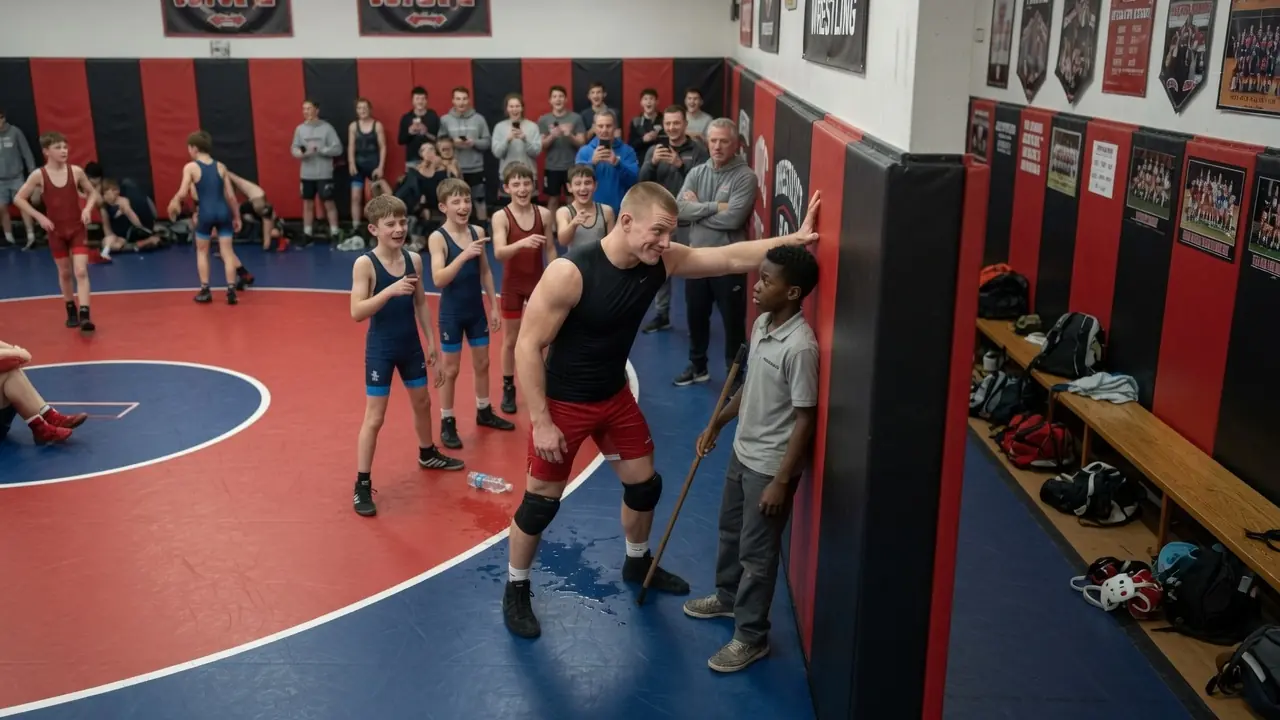
That was probably what he should have done.
His mother needed the money.
He could not afford to lose the job.
But the shoes had belonged to his older brother, Andre.
Andre had been the first person to teach Marcus how to wrestle.
Not in a gym like Ironclad.
In the narrow living room of their apartment, where they moved the coffee table aside and used an old mattress as a mat. Andre had wrestled in high school and earned a partial college scholarship before a drunk driver crossed the center line one rainy night.
He died at nineteen.
Marcus had been twelve.
The shoes were one of the few things he had left.
He walked past Blake and stepped onto the mat.
The laughter faded.
Marcus bent down, picked up the first shoe, then crossed to the second. He placed them carefully beside his backpack.
Blake followed him.
“You angry?”
Marcus did not answer.
“Good. Anger might make this interesting.”
Head coach Raymond Foster finally stepped out of his office.
He was fifty-six, thick through the shoulders, with a whistle hanging around his neck and twenty years of coaching behind him. He surveyed the spilled water, overturned bucket, and crowd around the mat.
“What’s going on?”
Blake answered before Marcus could.
“Your janitor damaged my bottle and called me a liar.”
Marcus looked at the coach.
“I didn’t touch it.”
Raymond glanced toward Blake.
Then toward the phones recording.
He knew Blake’s temper.
He also knew Blake’s sponsors, influence, and ability to attract paying athletes to the facility.
“Everybody calm down,” Raymond said. “Marcus, clean the water. Blake, get back to training.”
Blake laughed.
“That’s it?”
Raymond’s expression hardened.
“What do you want?”
Blake looked toward Marcus.
The boy had already picked up the mop.
“I want him to learn something.”
Marcus stopped.
Blake walked to the center circle.
“One round.”
Raymond shook his head.
“No.”
“I won’t hurt him.”
“You outweigh him by at least a hundred and twenty pounds.”
Blake spread his arms toward the crowd.
“I said one move.”
The athletes began murmuring.
Blake pointed directly at Marcus.
“Survive one takedown, and I’ll bow to you.”
Marcus stared at him.
Blake continued.
“You stay on your feet for ten seconds, I replace the shoes and apologize for the bottle.”
“And if I don’t?”
Blake’s smile widened.
“You admit you lied, pay for the damage, and stop pretending you belong anywhere near a wrestling mat.”
Raymond stepped between them.
“This is stupid.”
Blake looked over the coach’s shoulder.
“What’s wrong, kid? Scared?”
Marcus lowered his eyes toward the mop.
He remembered Andre’s voice.
Never wrestle angry.
Angry men push too hard.
Let them.
His brother had repeated those words every time Marcus became frustrated during practice.
Let the other man believe strength is enough.
Then show him what balance means.
Marcus slowly leaned the mop against the wall.
Raymond looked at him.
“Don’t.”
Marcus removed the oversized work shirt.
Beneath it, he wore a plain black T-shirt. His arms were thin, but not weak. The muscles along his shoulders and forearms were tight and defined from years of quiet practice no one at Ironclad had ever seen.
He sat on the bench and began changing shoes.
The gym went silent.
Not because he looked dangerous.
He did not.
He still looked like a skinny seventeen-year-old facing a professional heavyweight champion.
But the way he tied the laces was calm.
Exact.
He wrapped the loose tape around one sole, pressed it flat with his thumb, and stood.
Then he stepped onto the mat.
Blake laughed.
Phones rose higher.
Marcus walked to the center circle and stopped.
His feet settled shoulder-width apart.
His knees bent slightly.
His hands remained loose near his waist.
His chin lowered.
Nothing about the stance looked theatrical.
That was what made Raymond stare.
The coach had spent most of his adult life studying movement. He recognized beginners by the tension in their shoulders. He recognized fear by the way athletes shifted weight toward their heels. He recognized false confidence by hands held too high and feet planted too wide.
Marcus showed none of those things.
His balance was centered.
His breathing slow.
His eyes fixed not on Blake’s face, but on the upper line of his chest where every movement would announce itself before the attack began.
Raymond took one step closer.
“Where did you learn that stance?”
Marcus did not look away from Blake.
“My brother.”
Blake rolled his neck.
“Ten seconds.”
Marcus nodded.
“Whenever you’re ready.”
That answer ended the remaining laughter.
Raymond lifted one hand.
He did not want to officiate the challenge.
But he wanted even less to let Blake charge without warning.
“Controlled contact,” he said. “No slams. Stop when I call it.”
Blake bounced lightly on his feet.
Marcus remained still.
Raymond lowered his hand.
“Go.”
Blake exploded forward.
For a man his size, he moved with astonishing speed. His right foot drove into the mat, his shoulders dropped, and both arms reached for Marcus’s waist in a powerful double-leg takedown that had folded trained heavyweights.
Several people gasped.
Marcus waited.
One step.
That was all.
At the final instant, he moved his right foot backward and slightly outward. His left hand pressed against Blake’s shoulder while his right forearm guided the larger man’s momentum past his hip.
He did not try to stop the force.
He redirected it.
Blake’s hands closed around empty space.
His own power carried him forward.
Marcus pivoted behind him, hooked one ankle, and placed two fingers lightly between Blake’s shoulder blades.
The giant champion dropped to one knee.
The room froze.
Marcus had not thrown him.
Had not struck him.
Had barely appeared to touch him.
Yet Blake was kneeling at the center of the mat.
Phones remained raised, but nobody spoke.
Blake looked down at his knee.
Then over his shoulder at the boy standing behind him.
His expression carried more confusion than anger.
Raymond checked the clock.
Three seconds.
Marcus stepped back.
“You said one move.”
A whisper moved through the gym.
Blake stood slowly.
His face reddened.
“That wasn’t a takedown.”
Marcus met his eyes.
“No. You missed.”
Several athletes lowered their phones.
Nobody laughed.
Blake turned toward Raymond.
“Again.”
The coach shook his head.
“You made the challenge.”
“He got lucky.”
Raymond looked at Marcus.
The boy’s breathing had not changed.
“That wasn’t luck.”
Blake’s jaw tightened.
He pointed toward the center.
“One real round.”
Marcus glanced toward his work shirt.
“I need to finish cleaning.”
The dismissal stung more than any insult.
Blake grabbed his shoulder.
Marcus turned.
Blake swung one heavy arm around the boy’s neck, attempting to pull him into a standing headlock. It was no longer controlled practice.
Raymond shouted.
“Blake!”
Marcus moved before the coach reached them.
He dropped his weight, stepped across Blake’s stance, and twisted his hips. The champion’s grip broke. Marcus trapped the arm, turned beneath it, and used Blake’s forward pressure to send him over one shoulder.
The giant man hit the mat flat on his back.
The impact shook the floor.
Silence followed.
Absolute silence.
Marcus remained standing, holding Blake’s wrist without bending it. He could have applied pressure.
He did not.
He released the arm and stepped away.
Raymond hurried between them.
Blake stared upward, stunned.
The ceiling banners carrying his own face hung above him.
Around the mat, dozens of fighters looked from the champion to the teenage janitor.
Marcus crossed to the bench, removed Andre’s shoes, and placed them back inside his bag.
Raymond followed him.
“Marcus.”
The boy pulled on his work shirt.
“I still have an hour left.”
“Who trained your brother?”
Marcus paused.
“Coach Samuel Reed.”
Raymond’s face changed.
The name was familiar.
Very familiar.
Samuel Reed had been a respected wrestling coach in the city for more than thirty years. He had trained state champions, college athletes, and several professionals before retiring after the death of his oldest son.
Raymond had once attended one of his clinics.
Samuel’s philosophy had been simple.
Balance before strength.
Control before victory.
Character before everything.
“Samuel Reed is your father?” Raymond asked.
Marcus shook his head.
“My grandfather.”
The coach looked toward the mat.
Blake had finally sat up.
His teammates gave him space.
“Why didn’t you tell anyone you could wrestle?”
Marcus picked up the mop.
“No one asked.”
The words settled heavily.
Raymond looked around the gym.
At the young athletes who had laughed.
At the phones that had recorded everything.
At the champion who had judged a boy by a uniform and learned too late that quiet people could carry entire histories without announcing them.
Blake pushed himself to his feet.
His pride had been wounded more deeply than his body.
For a moment, Raymond expected another outburst.
Instead, Blake looked toward the dented water bottle on the floor.
One of the younger wrestlers stepped forward nervously.
“I knocked it over.”
Everyone turned.
The boy could not have been older than fifteen.
“I was reaching for my towel. I didn’t say anything because Blake started blaming Marcus.”
Blake stared at him.
“You let this happen?”
The teenager lowered his head.
“I was scared.”
Blake looked toward Marcus.
The janitor was already mopping the spilled water.
The sight changed something in the room.
Marcus had won.
Everyone knew it.
Yet he had returned to cleaning the mess created by people who had mocked him.
Blake walked slowly toward him.
Marcus stopped moving.
The champion stood several feet away.
His hands opened and closed at his sides.
Apologies had never come easily to Blake. He had built a career on never showing uncertainty. Even now, with dozens of cameras recording, pride fought every word.
“You didn’t damage the bottle,” he said.
Marcus waited.
Blake glanced toward the athletes.
Then back at the boy.
“I was wrong.”
The room stayed quiet.
Marcus rested both hands on the mop handle.
“You shoved me before you knew.”
Blake lowered his eyes.
“Yes.”
“You insulted my brother.”
“Yes.”
“You challenged someone you thought couldn’t fight back.”
Blake’s jaw tightened.
“Yes.”
Marcus looked at him for a long moment.
“And you promised to bow.”
Several athletes held their breath.
Blake looked toward the center mat.
His face flushed again.
For one terrible second, it seemed he might refuse.
Then he walked to the circle where Marcus had dropped him.
The undefeated champion lowered himself onto both knees.
He placed his hands on the mat.
Then he bowed his head.
No one laughed.
Marcus stood several feet away, still wearing the oversized janitor’s uniform.
He did not smile.
He did not celebrate.
He simply nodded once.
“Get up.”
Blake rose.
Marcus handed him the damaged bottle.
“It still holds water.”
Blake looked at the dent.
Then at Marcus.
“Yes.”
The phones slowly lowered.
Raymond stepped onto the mat.
“Practice is over.”
Several wrestlers looked surprised.
The coach pointed toward the spilled water, overturned bucket, discarded tape, and trash scattered across the benches.
“Everybody cleans.”
No one argued.
For the next forty minutes, professional athletes swept floors, wiped benches, emptied bins, and disinfected mats beside the boy they had treated as invisible.
Blake cleaned the padded wall where he had shoved Marcus.
The younger wrestler who had knocked over the bottle worked beside him.
Neither spoke much.
When the gym was finally clean, Raymond asked Marcus to remain.
The others left slowly, still glancing back.
Blake was the last athlete near the door.
Before leaving, he stopped beside Marcus’s backpack.
The taped wrestling shoes were visible inside.
“What size?”
Marcus looked up.
“Why?”
“You said they belonged to your brother.”
“They did.”
Blake nodded.
“What size?”
“Ten.”
The champion left without another word.
The following afternoon, a new pair of wrestling shoes sat beside Marcus’s mop bucket.
They were not expensive collector’s shoes or a sponsor’s special edition. They were simple, durable, and the correct size.
A note rested on top.
The old ones cannot be replaced. These are for whatever comes next.
There was no signature.
None was needed.
Marcus placed the new shoes in his locker.
He kept wearing Andre’s pair.
Not because he rejected the gift.
Because some things were used for moving forward, and others reminded a person where the journey began.
Raymond offered him a place in the youth training program.
Marcus hesitated.
“My shift starts at four.”
“Training begins at three.”
“I have school.”
“We’ll adjust it.”
“I can’t lose the job.”
“You won’t.”
Raymond folded his arms.
“You’ll continue working two evenings a week. The rest of the time, you train. Your wages stay the same.”
Marcus stared at him.
“That isn’t fair to the gym.”
The coach looked across the spotless mat.
“The gym owes you more than that.”
Marcus began training the following Monday.
At first, the other athletes treated him carefully.
Too carefully.
They were ashamed of what had happened and uncertain how to behave around someone they had underestimated so publicly.
Marcus made it easier by acting as though nothing had changed.
He cleaned when it was time to clean.
He trained when it was time to train.
He helped younger wrestlers with footwork, listened when coaches spoke, and never mentioned the video spreading across social media.
Within a week, millions of people had watched the giant champion fall.
Reporters contacted the gym.
Raymond declined every interview involving Marcus without his family’s permission.
Marcus’s mother watched the clip once.
Then she turned off the phone and cried.
Not because her son had defeated Blake Maddox.
Because Andre’s movements were alive again in the way Marcus stood.
Samuel Reed returned to the gym two weeks later.
He was seventy-one years old, with silver hair, a narrow frame, and a cane he disliked using. When he entered, every coach recognized him.
Marcus crossed the mat and embraced him.
Samuel looked toward Blake, who had been training alone near the far wall.
“That him?”
Marcus nodded.
His grandfather studied the champion.
“He apologize?”
“Yes.”
“Mean it?”
Marcus looked across the gym.
Blake was helping the fifteen-year-old wrestler practice a basic takedown. He corrected the boy without shouting and reset the position each time he made a mistake.
“I think he’s learning.”
Samuel nodded.
“That’s harder than losing.”
The confrontation changed Blake slowly.
He did not become gentle overnight.
Real change rarely happened that way.
He still became impatient. Still hated losing. Still carried too much pride into every room. But he began noticing people he had ignored before.
He learned the names of the cleaning staff.
He picked up his own tape.
When young athletes made mistakes, he corrected them instead of humiliating them.
And every Friday afternoon, he trained with Marcus.
At first, those sessions were private.
Blake did not want an audience.
Marcus did not care whether there was one.
They worked on balance, timing, and control. Blake taught Marcus how to manage a heavier opponent’s grip. Marcus showed Blake how often his own confidence made his movements predictable.
They never became close friends.
Not in the ordinary sense.
What grew between them was quieter.
Respect.
Earned slowly.
Tested honestly.
A year later, Marcus won the state high school championship at one hundred and fifty-two pounds.
His mother cried from the front row.
Samuel stood beside her, leaning heavily on his cane.
Raymond shouted himself hoarse.
Blake watched from the tunnel near the mat entrance, away from cameras and attention.
After the medal ceremony, Marcus found him there.
“You didn’t have to come.”
Blake shrugged.
“You stayed on your feet longer than ten seconds.”
Marcus smiled.
Blake extended one hand.
Marcus took it.
Neither mentioned the first day.
They did not need to.
Years later, athletes at Ironclad still told the story of the enormous undefeated champion who bullied a skinny teenage janitor and ended up flat on his back.
But Raymond always corrected them.
“That wasn’t the important part.”
He would point toward the center mat.
“The important part happened afterward.”
It happened when a champion bowed because he had given his word.
When athletes cleaned a room they had treated as someone else’s responsibility.
When a boy chose control over revenge.
And when a man accustomed to winning finally understood that strength was not measured by how easily he could overpower someone smaller.
Real strength was knowing what to do once he discovered he had been wrong.