Camille O’Shea had only been unemployed for forty-three minutes when she saw a teenage boy holding a blue stuffed rabbit above a frightened child’s head in the park. It was a cool Tuesday afternoon in October, the kind of afternoon that should have felt gentle, with leaves scattered along the walking path and sunlight moving softly through the trees. But Camille did not feel gentle. She felt hollow, angry, and freshly aware that four years of loyalty to a company could be packed into a cardboard box and handed back before lunch.
She had left the office before noon with her name written on the side of the box in black marker. Human resources called it restructuring, her manager called it unfortunate, and Camille called it what it felt like. They no longer needed her, and they had known it long before she walked into that conference room. She carried the box to her car, sat behind the wheel for several minutes, then drove without deciding where she was going.
Going home had felt impossible. Her apartment was too small for the size of the fear waiting for her there. Rent was due in less than three weeks, groceries were low, and her savings were the kind people described as emergency money until an actual emergency arrived. So she walked into Crestwood Park with her hands in her jacket pockets, telling herself she just needed air.
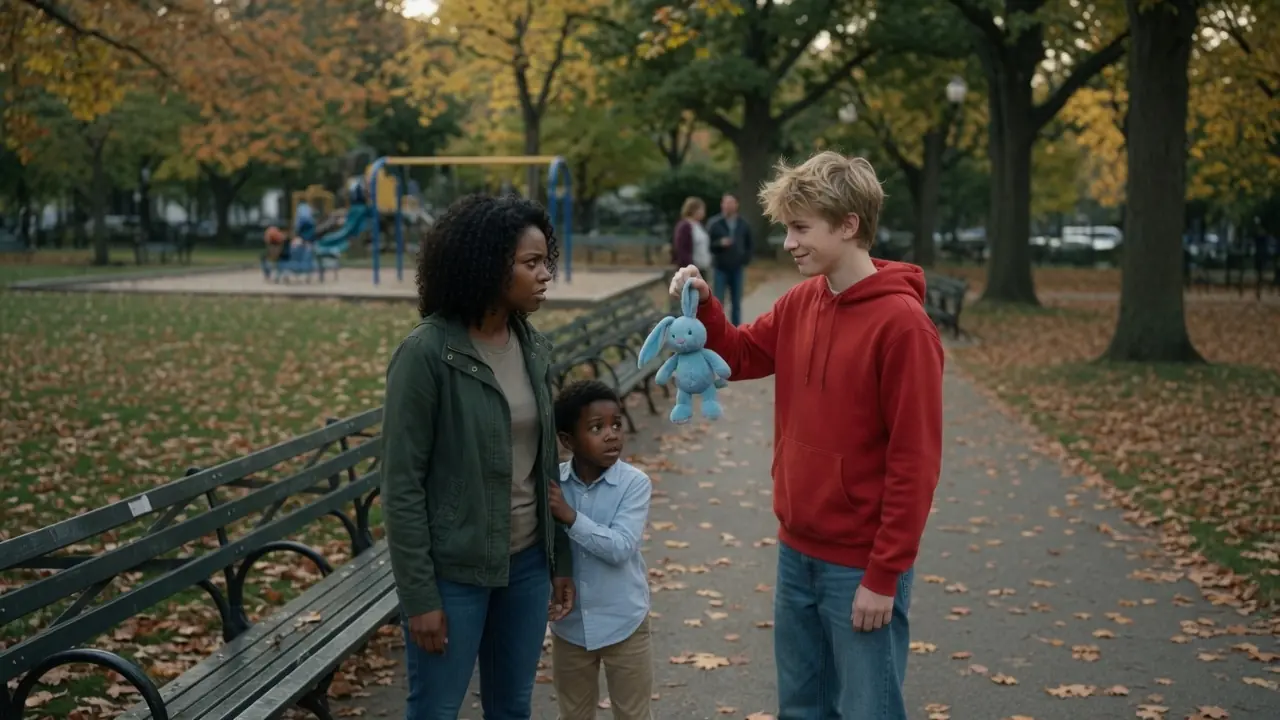
That was when she heard laughter near the swings. It was not loud enough to alarm the whole park, but it had a sharpness to it that made Camille turn her head. Three boys stood near the playground path, two of them laughing while the tallest held something blue in one hand. In front of them stood a much smaller boy, no older than six, completely still.
The little boy was Black, small and neatly dressed, with short curls, frightened dark eyes, and a light blue collared shirt tucked into small trousers. He was not crying, and somehow that made the scene worse. His arms hung stiffly at his sides, his mouth pressed tight, his whole body frozen in the way children freeze when they have already decided that moving might make things worse. The blue stuffed rabbit belonged to him; anyone with eyes could see that.
The older boy holding it was white, maybe fifteen, tall and lanky in a red hoodie, wearing the smug expression of someone who thought cruelty became harmless if enough people laughed. He dangled the rabbit by one ear and moved it just out of reach, though the little boy was not trying to reach for it anymore. The other two boys hovered behind him, waiting to see how far he would go. A few adults nearby had slowed down, pretending not to stare while staring anyway.
Camille did not think about rent, her job, or the box in her car. She did not think about whether the teenager was bigger than her or whether his friends might start trouble. She was already walking before she had permission from the cautious part of her mind. By the time she reached them, the tallest boy was laughing again.
“Put his rabbit back in his hands,” Camille said. “Right now.”
The boy blinked, surprised that someone had stepped into his little performance. “Why do you care?” he said, smirking. “He was just standing there acting weird.” His friends chuckled weakly, but the sound was already losing confidence because Camille was not smiling.
She moved between the teenager and the child, her body angled protectively without touching the little boy. “He is six years old,” she said, her voice low and sharp. “You are fifteen. If taking a little boy’s toy is the only way you feel strong, then you are weaker than I thought.” The words carried across the path, and this time the adults nearby stopped pretending they were not listening.
The teenager’s face changed. Confidence slipped, replaced by irritation and the first flicker of embarrassment. He glanced around and saw the mother with the stroller watching, an older man on a bench watching, and a woman near the water fountain holding up her phone. Suddenly, the joke did not look like a joke anymore.
“I was only messing around,” he muttered.
“No,” Camille said. “You were showing everybody exactly what kind of coward you are. Give him the rabbit and walk away.” She held out her hand, palm up, waiting.
For a second, it looked as if he might argue. Then one of his friends took a step back, and the other looked down at his shoes. The boy shoved the rabbit toward Camille instead of the child, as if that saved some shred of pride. Camille took it without blinking.
“Now leave,” she said.
The boy gave one last scoff, but it came out thin. He turned and walked toward the path, his friends following faster than they needed to. Camille watched until they were several yards away, then turned toward the little boy. His eyes were fixed on the rabbit in her hand.
She crouched down so she was not towering over him. “This yours?” she asked, though she already knew. The boy nodded once, carefully. Camille held the rabbit out to him. “Here you go.”
He took it with both hands and hugged it against his chest so tightly that its blue ears bent under his chin. His fingers were trembling. Camille noticed that his shoes were clean, his clothes expensive in a quiet way, and his hair freshly cut. But fear looked the same on every child, no matter how much money had been spent on their shirt.
“What is your name?” she asked.
The boy stared at her for a moment, as if deciding whether answering was safe. “Elijah,” he said softly.
“Elijah,” Camille repeated. “That is a good name.” He did not smile, but his shoulders lowered a little. Then one small hand reached forward and caught the edge of Camille’s jacket, not pulling, just holding on as though her sleeve might keep the world steady for another second.
Camille’s anger softened into something else. “You are okay,” she said. “He is gone now.” Elijah nodded again, but he did not let go of her jacket. She looked around the park, trying to find whoever was supposed to be with him.
A woman in a navy coat was hurrying toward them from the far side of the playground, speaking anxiously into a phone. She looked like a nanny or assistant, pale with panic, her eyes moving from Elijah to Camille to the direction the older boys had gone. “Elijah,” she gasped, dropping to her knees beside him. “Oh my God, are you hurt?”
Elijah shook his head and held the rabbit tighter. “She helped me,” he said, pointing at Camille. The woman looked up, gratitude and fear mixing in her face. “Thank you. I turned away for one minute to answer his father’s call, and those boys came over.”
Camille stood, brushing one hand against her jeans. “He is okay. They were trying to scare him, but they left.” The woman’s phone buzzed again before she could answer, and she looked down at it with dread. “His father is already on his way.”
Camille almost left then. She had done what needed doing, and she did not want to stand around waiting for a dramatic thank-you. But Elijah still had one hand on the hem of her jacket, and he was looking at her with an intensity that made walking away feel too abrupt. So she stayed.
A black luxury SUV pulled up near the park entrance less than five minutes later. The man who stepped out moved with controlled urgency, not running but wasting no motion. He was tall, Black, impeccably dressed in a dark tailored suit without looking flashy, his face composed in the way powerful people often appear composed when panic is being forced into order. He scanned the park once and saw Elijah immediately.
“Elijah,” he said, and his voice cracked just enough to reveal the fear beneath the control.
The boy released Camille’s jacket and ran to him. The man dropped to one knee and caught him with both arms, closing his eyes for half a second as though he needed to feel that the child was real. Camille looked away, giving them the privacy of the moment. The woman in the navy coat began explaining quickly, but the man’s attention shifted to Camille.
He stood with Elijah still pressed against his side. “You helped my son.”
“I stepped in,” Camille said. “Those boys were bothering him.”
Elijah lifted the rabbit. “She made him give Tuck back.”
The man looked at the stuffed rabbit, then at Camille again. His expression changed slightly, something like gratitude trying to push through exhaustion. “I am Adrian Carter,” he said. “Elijah’s father.” Camille nodded. “Camille O’Shea.”
“I would like to thank you properly,” Adrian said. “Please let me compensate you for what you did.”
Camille’s face closed a little. “No.”
Adrian paused, clearly unused to that answer. “I only mean that you protected my child.”
“I know what you mean,” Camille said. “But I did not do it for money.” Elijah looked between them, still clutching the rabbit. Camille softened her tone. “Your son is safe. That is enough.”
Adrian studied her, not offended, just surprised. “May I at least have a way to reach you?”
Camille almost laughed. “Why?”
“In case Elijah wants to thank you again.”
“He already did,” she said. Then she looked down at the boy. “Take care of your rabbit, okay?” Elijah nodded solemnly. Camille gave him a small smile, turned, and walked away before Adrian could make another offer.
She did not look back. She did not see Elijah watching her until she disappeared beyond the park gate. She did not see Adrian remain still beside the SUV, his hand resting gently on his son’s shoulder. And she did not know that for the next four days, Elijah would talk about her more than he had talked about anyone in months.
He called her “the brave lady” at dinner that night. He said it again before bed, holding Tuck the rabbit under his chin. During his lesson the next morning, when his tutor asked him to describe a safe place, Elijah did not say home, school, or his father’s office. He said, “Behind the brave lady.”
Adrian noticed. Of course he noticed. He noticed everything about his son because Elijah had grown quieter in the two years since his mother died, and every new word mattered. Adrian Carter was a billionaire because he understood systems, timing, and people, but fatherhood still made him feel clumsy. Money could buy tutors, security, doctors, schools, and houses with too many rooms, but it could not teach a frightened child how to feel safe again.
By the fourth day, Adrian asked his assistant to find Camille O’Shea. It was not difficult. She had worked as a marketing coordinator until Tuesday, lived in a modest apartment on the east side, and had no criminal record, no scandal, no obvious reason to step into a stranger’s life except instinct. Adrian read the short report twice, then closed the folder.
When he knocked on Camille’s apartment door that afternoon, she opened it wearing gray sweatpants and a faded T-shirt. She looked at him, then past him, then back at him. “You found my address,” she said.
“My assistant found it,” Adrian replied.
“That does not make it better.”
He accepted that. “You are right. I apologize. I wanted to speak with you about Elijah.”
Her guarded expression shifted for half a second at the boy’s name. “Is he okay?”
“He has not stopped talking about you.”
Camille crossed her arms. “He does not know me.”
“No,” Adrian said. “But he wants to.” He took a breath, already aware that this was going badly. “I would like to offer you a paid arrangement. Structured, professional. You would spend time with him, help him rebuild confidence, perhaps support his adjustment socially.”
“No,” Camille said.
Adrian blinked. “You have not heard the full offer.”
“I do not need to.”
“It would be generous.”
“That is not the problem.”
Adrian looked at her more carefully. She was not posturing. She was not negotiating. She was simply refusing. “Then what is the problem?”
Camille leaned against the doorframe. “Your son had a bad afternoon. I helped him. That does not make me his teacher, therapist, nanny, or emotional repair project. He is six. He will attach to whoever made him feel safe in a scary moment, but that does not mean you hire the stranger from the park.”
The honesty of it landed harder than Adrian expected. Most people softened their words around him because wealth made them cautious. Camille did not seem interested in cushioning reality for his comfort. “You are thinking about what is best for him,” he said.
“I am trying to,” Camille replied. “You should too.”
He nodded slowly. “I am.”
“Then do not try to buy a solution because you feel guilty.”
The sentence struck him cleanly. Camille saw it, but she did not apologize. Instead, she stepped back slightly and began to close the door. “I hope Elijah does well. I mean that.”
The door shut softly.
Adrian came back two days later. Camille opened the door and looked at him as if she had been expecting him. This time he did not mention money first. He said only, “Elijah asked if the brave lady was real.”
Camille’s expression shifted despite her effort to keep it still. “What does that mean?”
“He asked if he imagined you because he was scared.”
That stayed between them for a moment. Camille looked down the hall, then back at Adrian. “That is unfair.”
“I know.”
“You brought that sentence here because you knew it would work.”
“I brought it because it is true.”
She stared at him for several seconds. “I do not like you very much.”
“I understand.”
“No, I do not think you do.” She opened the door wider. “One hour. No contract. No money. No promises.”
Adrian looked almost relieved. “Thank you.”
“I said one hour,” Camille warned.
When Elijah arrived, he walked past his father and straight into Camille’s apartment as if he had made a decision on the elevator ride. He carried Tuck under one arm, climbed onto her worn couch, and sat there calmly. Camille looked at him, then at Adrian. Adrian raised both hands slightly, helpless.
“He better not touch my remote,” Camille said.
Elijah looked at the remote, then tucked both hands under the rabbit. “I will not,” he said.
Camille blinked. “Well, look at that. He speaks.”
Adrian almost smiled, but stopped himself. Camille sat across from Elijah with a mug of tea, studying him. “You okay?” she asked.
Elijah nodded. Then after a second, he shook his head.
“That is a better answer,” Camille said. “Sometimes okay is not true.”
Elijah looked at her carefully, like he was deciding whether adults were allowed to say things like that. “He was mean,” he said.
“Yes,” Camille replied. “He was.”
“I froze.”
“You did.”
His face tightened. “Bad?”
“No.” Camille leaned forward. “Listen to me. Freezing is what your body did to keep you safe when you were scared. That does not make you weak.” Elijah’s fingers tightened on the rabbit. “But next time, we can teach your voice what to do.”
That was how the lessons began. Not as tutoring, not officially, and not with a contract. Camille taught Elijah sentences he could use in the real world. “Give it back.” “Stop talking to me that way.” “I need help.” “I am not scared of you.”
At first, Elijah said them too softly. Camille corrected him without pity. “Again.” He tried again. “Look at my face, not the floor.” He lifted his eyes. “Say it like you mean it.” His voice grew firmer.
Adrian watched from the doorway, feeling something painful and grateful in equal measure. He had hired speech coaches, child psychologists, confidence specialists, and private tutors. Some had helped, but none had reached Elijah this directly. Camille had no formal system, but she paid attention with the precision of someone who understood fear personally.
After the first week, Elijah asked for Camille every day. After the second, Camille stopped pretending she was only doing this because the child needed help. She began showing up with worksheets, snacks, and ridiculous stories designed to make Elijah laugh before he realized he had laughed. The first time he laughed hard enough to drop Tuck, Adrian had to leave the room.
He stood in the hallway with one hand against the wall, collecting himself. He had not heard that kind of laughter from his son since before the funeral. Camille noticed his absence but did not mention it. Later, when Elijah was coloring at the table, she found Adrian in the kitchen pretending to read an email.
“You okay?” she asked.
“No,” he said honestly.
That answer seemed to surprise both of them. Camille leaned against the counter. “Good. Sometimes okay is not true.”
Adrian looked up, and for the first time since meeting her, he smiled fully. “You are using your own lesson against me.”
“It was a good lesson.”
“It was.”
They stood in silence, but it was not uncomfortable. Camille looked around the apartment, at the marble counters, the expensive art, the perfect furniture that seemed arranged more for display than living. “This place is too quiet,” she said.
Adrian followed her gaze. “It was not always.”
“I figured.”
He did not respond right away. “My wife died two years ago. Elijah became very careful after that. Careful with his voice, his feelings, his wants.” He looked toward the dining room where his son sat. “I thought giving him stability meant controlling everything around him.”
Camille’s voice softened. “Sometimes stability means letting the room get messy.”
He glanced at her. “Are you calling my home sterile?”
“Yes.”
He looked offended for half a second, then laughed quietly. “You are very direct.”
“You keep saying that like it is a medical condition.”
Things changed slowly after that. Camille became part of Elijah’s week, then part of his routine, then part of the space he trusted. She still refused to be treated like staff, and Adrian learned quickly not to offer money as a substitute for conversation. He paid her eventually because she deserved to be paid for her time, but only after they agreed on terms she wrote herself.
Then came the dinner.
Adrian invited Camille to a small family gathering at his penthouse, partly because Elijah insisted and partly because Adrian wanted her there. The room was full of people who knew his world, board members, cousins, old family friends, and elegant guests who smiled without showing what they thought. Camille wore a deep green dress and entered with her shoulders straight, already aware that she was being measured.
Elijah found her immediately and stayed at her side. That helped. But not everyone was pleased. Adrian’s mother, Vivian Carter, watched Camille with a polite expression that never reached warmth, and Adrian’s former sister-in-law made careful comments about boundaries, children, and temporary attachments.
Camille heard every word beneath the words. She had spent too much of her life recognizing when people were placing her just outside the circle. Adrian noticed some of it, but not enough. That hurt more than Camille wanted it to.
The breaking point came near the window. A woman named Sloane, one of Adrian’s family friends, smiled at Camille and said, “It is wonderful what you have done for Elijah. Children attach so easily to available people.” Available. The word was soft, polished, and insulting.
Camille’s jaw tightened, but before she could answer, Elijah stepped in front of her. He reached back and grabbed her hand. “Do not talk to her like that,” he said clearly.
The room went still.
Sloane looked startled. “Elijah, sweetheart, grown-ups are talking.”
Camille gently squeezed his hand, silently telling him he had done enough. But Elijah stood firm, small and serious. “She is my person,” he said. “You talk nice.”
Adrian heard it from across the room. The words hit him harder than any accusation Camille could have made. His son had found the courage to draw a line before he had.
Camille crouched beside Elijah. “You did good,” she whispered. “Now breathe.” He nodded, breathing shakily but proudly. Then she stood and looked at the room.
“He is six,” Camille said, her voice steady. “And he just showed more manners than several adults here.” No one spoke. “If any of you are confused, let me help. I am not available. I am not temporary because you say so. And I am not here to prove my place to people who were comfortable watching a child defend someone they should have respected already.”
Adrian walked to her then. Slowly, deliberately, in front of everyone. He stood beside Camille and placed one hand on Elijah’s shoulder. “Camille is here because I asked her to be here,” he said. “Because Elijah loves her. Because I trust her. And because this family will treat her with respect.”
Vivian Carter looked at her son for a long moment, then at Camille. Something in her expression shifted, not into approval exactly, but into recognition. Camille did not need the room to love her. She only needed Adrian to stop leaving her alone in it.
After the guests left, Camille stood in the quiet kitchen, arms folded, her green dress catching the soft light. Adrian came in slowly. “I should have said that sooner,” he said.
“Yes,” Camille replied.
“I am sorry.”
“Good.”
He almost smiled. “Is that all?”
“No.” She looked at him. “I grew up being the person people considered when their first choice was unavailable. I do not stay in rooms where someone is still deciding whether I belong.” Her voice stayed calm, but the hurt beneath it was clear. “If you want me here, Adrian, you have to be clear before I am forced to defend myself.”
He nodded. “You are right.”
“I usually am.”
This time he did smile. “I know.”
Months passed, and the shape of their lives changed. Camille found work that mattered, not in corporate marketing, but through a foundation Adrian helped fund and she insisted on directing independently. It focused on child confidence, anti-bullying programs, and practical communication skills for children who had learned to disappear when afraid. She called the first program Say It Like You Mean It.
Elijah became the youngest unofficial consultant. He tested exercises, rejected boring worksheets, and insisted that every child needed a sentence for when someone took something from them. Tuck the blue rabbit appeared in the program logo, though Camille pretended that was Elijah’s idea alone. Adrian knew better and said nothing.
One Tuesday in October, almost a year after the park incident, they returned to Crestwood Park. The same swings moved in the wind. The same path curved past the benches. Leaves scattered across the ground again, bright and dry underfoot.
Camille sat on a bench with coffee while Adrian pretended to answer emails beside her. Elijah stood near the water fountain, watching three boys around a smaller child. Camille saw his body go still for one second. Then he moved.
He walked over calmly, Tuck tucked under one arm. He said something Camille could not hear, but she recognized the posture. Shoulders steady, chin lifted, eyes forward. The older boys hesitated, then backed away.
Elijah returned to the bench a minute later. He sat beside Camille, not shaking, not frozen, not small. Camille kept looking forward. “Who taught you that?” she asked.
Elijah leaned back, relaxed. “My person,” he said.
Camille pressed her lips together, pretending not to be moved. Adrian lowered his phone, no longer pretending to read. For a while, none of them said anything. They just sat there together on a regular Tuesday, in the park where everything had begun.
The world had not become perfect. There were still cruel boys, silent adults, complicated families, and rooms where people measured worth before offering respect. But Elijah had learned not to disappear. Camille had learned that being chosen clearly was different from being needed quietly. Adrian had learned that love was not protection if it failed to stand beside someone in public.
A year earlier, Camille had walked into the park with a cardboard box in her car and no idea what came next. She thought she had lost her place in the world that morning. Instead, she found a frightened boy, a blue stuffed rabbit, and a reason to build something that stayed.
Elijah leaned his head lightly against her arm.
“Good day,” he said.
Camille looked at him, then at Adrian, then across the park where the afternoon light settled over the swings.
“Yeah,” she said. “It is.”