At 1:08 in the morning, the parking lot looked abandoned.
Only one vehicle sat beneath the white security lights—a dark Jeep parked near the loading entrance of a private distribution building in Nashville.
Officer Daniel Mercer slowed his patrol car.
He had worked the Hermitage district long enough to know which businesses operated after midnight and which parking lots were usually empty.
He did not recognize the Jeep.
That was all.
No alarm had been triggered.
No business owner had called police.
No door was broken.
No one was running.
No property appeared damaged.
Still, Mercer turned into the lot.
Inside the Jeep, thirty-nine-year-old Rebecca Hale sat in the passenger seat scrolling through messages on her phone while her brother finished a routine pickup inside the building.
Rebecca saw the headlights stop behind her.
A moment later, an officer approached the window.
She lowered it several inches.
“Good evening,” Mercer said.
“Hello.”
“I’m Officer Mercer. I patrol this area pretty regularly. What are you doing here tonight?”
Rebecca had spent years watching police interactions, reading court decisions, and learning the difference between a consensual encounter and a detention.
She did not dislike police.
She disliked the idea that authority automatically created an obligation to explain herself.
“I don’t answer investigative questions,” she said.
Mercer blinked.
“Why not?”
“Because I don’t have to.”
The answer irritated him immediately.
Not because it was threatening.
Because it disrupted the script.
Most people answered.
They explained where they were going, where they worked, who they were meeting, why they were parked.
Mercer was accustomed to cooperation arriving before he had to establish whether he had authority to demand it.
Rebecca’s refusal forced that question too early.
“Well,” Mercer said, “I’m a police officer. This is my zone. I’m here all the time.”
Rebecca nodded.
“Okay.”
“I don’t normally see this vehicle here.”
“That’s fine.”
“So I’m asking why you’re here.”
“And I’m declining to answer.”
Mercer leaned slightly toward the window.
“If you’re not doing anything wrong, there shouldn’t be a problem.”
“That doesn’t mean I have to help you investigate me.”
The words landed badly.
Mercer’s tone hardened.
“You understand I have the right to ask questions.”
“Yes.”
“And I need you to cooperate.”
“No.”
Rebecca kept her voice level.
“You can ask me anything. I’m not obligated to answer simply because you asked.”
Mercer stared at her.
“Then let me see your ID.”
Rebecca looked directly at him.
“For what?”
“Because you’re refusing to cooperate.”
There it was.
The sentence that changed the entire encounter.
Rebecca lifted her phone and began recording.
“So because I didn’t answer your questions, now you want my ID?”
“I want to identify who I’m speaking with.”
“Why?”
“Because you’re in a private parking lot at one in the morning.”
“I’m not committing a crime.”
“I don’t know that.”
“Then investigate.”
“That’s what I’m doing.”
“And I’m not required to do it for you.”
Mercer stepped back.
“You’re making this harder than it needs to be.”
Rebecca almost laughed.
“No. I’m making you establish whether you actually have authority.”
The officer’s jaw tightened.
“Step out of the vehicle.”
Rebecca’s posture changed.
“For what?”
“You’re being detained.”
“What crime do you suspect me of committing?”
“Trespassing.”
“Based on what?”
“You’re here when I don’t normally see this car.”
“That’s not trespassing.”
Mercer pointed toward the building.
“This is private property.”
“Yes.”
“And I don’t know whether you have permission to be here.”
“You also don’t know that I don’t.”
“Exactly.”
Rebecca shook her head.
“That’s not how suspicion works.”
Mercer’s hand moved toward his radio.
“Step out.”
“I’m asking for a supervisor.”
“We can do that after you identify yourself.”
“No. Call one now.”
“Give me your ID and then I’ll call.”
“That’s not a deal you get to make.”
Mercer looked into the Jeep.
“Why are you being difficult?”
Rebecca lowered the phone slightly.
“Because my rights are not difficult.”
The side door of the building opened.
A man in a reflective work jacket stepped outside carrying a small equipment case.
His name was Thomas Hale.
Rebecca’s older brother.
He stopped when he saw the patrol car.
“What’s going on?”
Mercer turned toward him.
“Sir, do you work here?”
“Yes.”
Thomas held up a key card.
“I come here every night. I pick up calibration equipment and drive it to our Knoxville facility.”
“You have access to the building?”
Thomas walked toward the door and held up the card.
“I just unlocked it.”
Mercer’s expression softened instantly.
“Okay.”
Thomas glanced toward Rebecca.
“She’s with me. That’s my sister.”
Mercer looked back at the Jeep.
Rebecca expected the interaction to end.
The original concern—whether they belonged on the property—had just been answered.
Thomas had a key.
He worked there.
He had been inside.
He confirmed Rebecca was with him.
Instead, Mercer held out his hand.
“Can I see your ID, sir?”
Thomas hesitated.
Then handed it over.
“I didn’t do anything.”
“I’m just identifying everyone involved.”
Thomas looked at Rebecca.
She shook her head.
“Don’t answer for me.”
Mercer ran Thomas’s license.
Valid.
No warrants.
No alerts.
The vehicle was registered to him.
Everything about the supposed trespassing concern had disappeared.
Mercer returned to the Jeep.
“Your brother checks out.”
Rebecca stared at him.
“Then we’re done.”
“I still need your ID.”
“Why?”
“Because I have reasonable suspicion.”
“Of what?”
“I already explained it.”
“My brother works here. He has a key. The Jeep belongs to him. I’m with him.”
“I still need to identify you.”
“No.”
Mercer’s voice sharpened.
“You do understand department policy requires us to identify people we contact.”
Rebecca smiled without humor.
“I don’t work for your department.”
“It follows state law.”
“Then tell me the law.”
Mercer hesitated.
Rebecca continued.
“You can have a policy requiring yourself to ask. That doesn’t automatically create a law requiring me to answer.”
Another officer arrived.
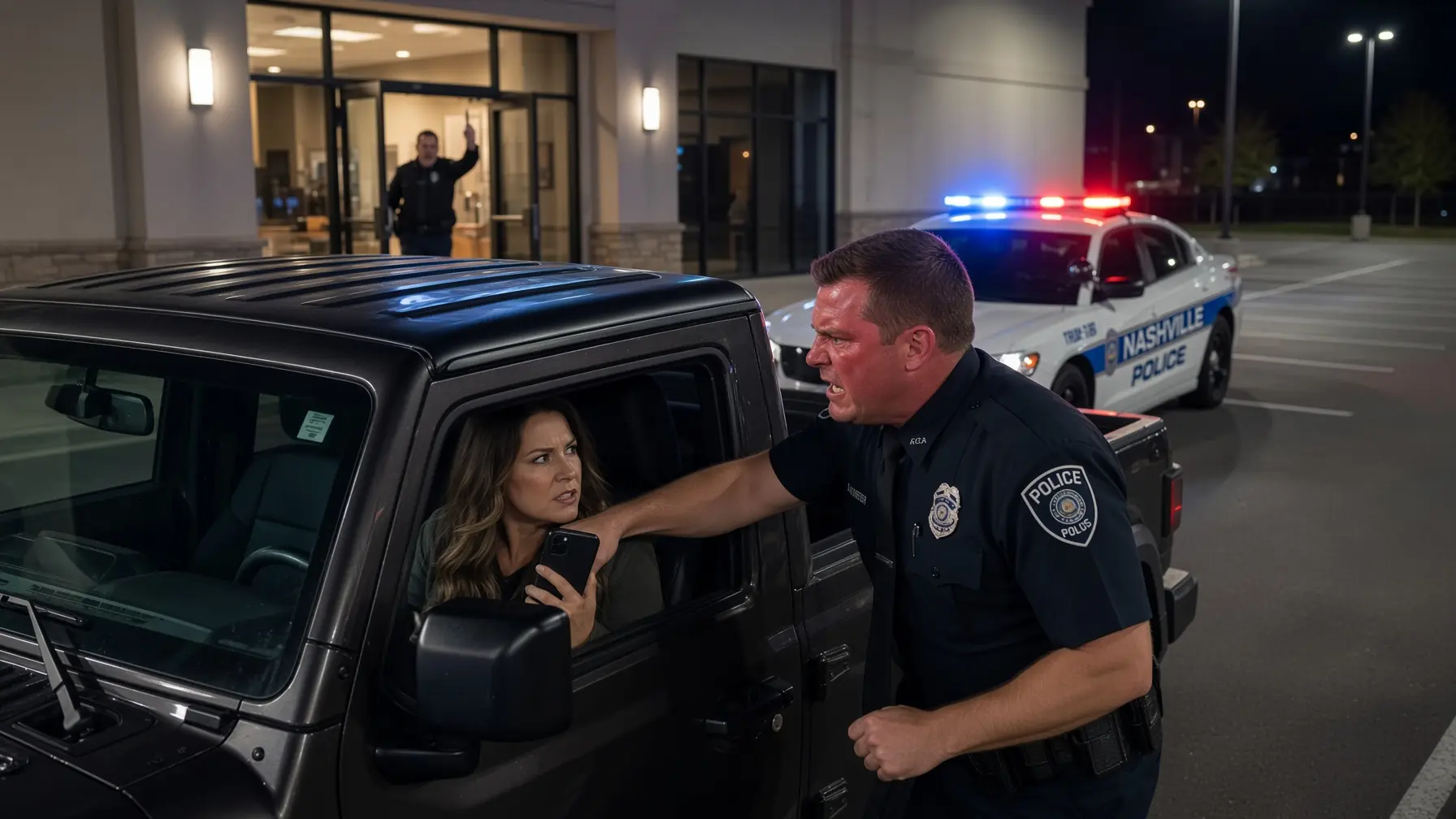
Officer Ryan Malone stepped from his cruiser and approached.
Mercer spoke before Rebecca could.
“She’s refusing to identify herself. She’s being extremely difficult.”
Rebecca held up the phone.
“That’s not what happened.”
Malone looked at her.
“Ma’am, can you just tell us your name so everybody can leave?”
“No.”
“Why not?”
“Because they already know there’s no trespassing.”
Malone turned toward Thomas.
“You work here?”
“Yes.”
“You have access?”
Thomas held up the key card again.
“Yes.”
“The vehicle yours?”
“Yes.”
“And she’s with you?”
“My sister.”
Malone looked at Mercer.
That should have ended it.
Instead, Mercer folded his arms.
“She still refused to cooperate during the investigation.”
Rebecca stared at him.
“So now the investigation is about my refusal to participate in the investigation?”
Mercer ignored the question.
“Ma’am, if you refuse to identify yourself, you can be arrested.”
“For what?”
“Resisting the stop.”
Rebecca’s voice became quieter.
“I am sitting in a vehicle.”
“You’re resisting by refusing lawful commands.”
“What lawful command?”
“Give me your ID.”
“Under what statute?”
Mercer looked toward Malone.
Neither answered immediately.
Rebecca continued recording.
“I’m not pulling away. I’m not running. I’m not threatening you. I’m not giving you false information. I’m simply not answering.”
Mercer’s frustration was visible now.
“You people always think knowing a few legal phrases means you can do whatever you want.”
Rebecca’s eyebrows lifted.
“You people?”
“You know what I mean.”
“No. Explain it.”
Mercer exhaled.
“Are you a sovereign citizen?”
Thomas laughed once.
Rebecca did not.
“Refusing to give up a right does not make someone a sovereign citizen.”
“They think laws don’t apply to them.”
“I’m literally asking you what law applies.”
A long silence followed.
Mercer looked away first.
Rebecca asked again.
“Call your supervisor.”
“I will.”
“When?”
“When I’m ready.”
“You’ve been detaining me because you want information you already discovered another way.”
“That’s not why.”
“Then tell me why I’m still detained.”
Mercer walked back toward his cruiser.
He opened his laptop.
Instead of waiting for a supervisor, he searched Thomas’s known associates.
Rebecca watched him through the windshield.
Several minutes later, Mercer found her.
Rebecca Hale.
No warrants.
No criminal history.
Nothing that justified additional concern.
He called a sergeant.
“Hey,” Mercer said quietly, though his body camera captured every word. “I’ve identified her through the database. She’s clean. She’s just refusing to give me her ID. I think she’s being difficult to be difficult.”
There was a pause.
Mercer listened.
Then:
“Yeah, the guy works here. He has keys. She’s his sister.”
Another pause.
Mercer’s face changed slightly.
“All right.”
He ended the call.
Rebecca saw him returning.
“Supervisor coming?”
Mercer stopped beside the Jeep.
“You’re both free to leave.”
Rebecca almost smiled.
“Am I?”
“Yes.”
“Why?”
“Because we’ve identified you and confirmed why you’re here.”
Rebecca looked toward Thomas.
Then back at Mercer.
“You confirmed why we were here fifteen minutes ago.”
Mercer’s expression hardened again.
“You’re free to leave.”
“Can you acknowledge that you were wrong about me being legally required to provide ID?”
“No.”
“Why not?”
“Because I wasn’t wrong.”
“Then arrest me.”
Thomas turned.
“Rebecca.”
“No.”
She kept her eyes on Mercer.
“If refusing my ID was a crime, arrest me. You asked at least ten times. I refused every time. It’s on video.”
Mercer said nothing.
“Do it,” Rebecca continued. “Or admit refusal by itself wasn’t arrestable.”
“I’m not going to argue law with you on the roadside.”
“You already did for half an hour.”
Mercer looked toward his patrol car.
“I encourage you to research it.”
Rebecca laughed once.
“You are the officer.”
He turned away.
“Have a good night.”
Rebecca waited until the police cars left before lowering the phone.
Thomas climbed into the driver’s seat.
For several seconds, neither spoke.
Then he looked at her.
“You could have just given him your name.”
Rebecca stared through the windshield.
“I know.”
“Then why didn’t you?”
“Because the moment ‘no’ becomes suspicious, it isn’t really a right anymore.”
Thomas sat back.
“I just wanted to go home.”
“So did I.”
She looked at him.
“That’s why it matters.”
Rebecca filed a formal complaint the following morning.
She did not rely only on her own video.
She requested the body-camera footage.
Dispatch audio.
Computer-aided dispatch records.
The database search logs.
Department policy.
Any notes Mercer had written about the encounter.
The complaint was assigned to the department’s Office of Professional Accountability.
The internal investigator began with a question simpler than anything argued in the parking lot.
What lawful basis existed for the detention?
Mercer’s report described an unfamiliar vehicle parked on private property late at night.
No complaint from the owner.
No alarm.
No visible criminal activity.
No attempt to enter a locked space.
No evasive behavior.
Only an unfamiliar Jeep.
That was the beginning.
Then Thomas emerged from the building with a working key and explained his employment.
At that point, even the original suspicion of trespassing became weaker, not stronger.
Yet the detention continued.
The investigator reviewed the body-camera footage.
Mercer repeatedly said Rebecca was obligated to answer questions.
He repeatedly claimed departmental policy required her to identify herself.
He threatened arrest for failing to identify.
He described refusal as “resisting.”
He called her a sovereign citizen.
And even after discovering her identity through a database and confirming she had no warrants, Mercer told his supervisor that refusal to provide ID was still a “chargeable offense.”
The department’s own policy did not support that claim.
Field interviews allowed officers to request identifying information.
They did not transform every request into a command backed by arrest.
More importantly, policy could not create legal authority that state law did not provide.
The internal investigation sustained two violations.
The first concerned deficient performance.
The second concerned knowledge of law.
Mercer received a five-day unpaid suspension.
Rebecca read the disciplinary letter twice.
Five days.
Part of her felt disappointed.
Another part understood that the number of days mattered less than the wording.
The department had officially concluded that the officer had misunderstood his authority.
That record mattered.
She requested the final investigation file.
Then she published the encounter online.
Not simply the argument.
The aftermath too.
The complaint.
The calls.
The findings.
The suspension.
Viewers argued about her attitude.
Some said she had made the situation harder.
Some said she should have handed over identification and complained later.
Others said that was exactly why unconstitutional practices survived—because ordinary people usually chose convenience over principle.
Rebecca understood all three reactions.
She had not enjoyed the encounter.
She had not sat in the Jeep hoping for confrontation.
There was nothing heroic about spending half an hour arguing with an armed stranger over whether silence required permission.
But she kept returning to one moment.
Thomas had walked from the building with a key.
The officer believed him.
The trespassing concern effectively vanished.
Yet Rebecca remained detained.
Why?
Because she had said no.
That was the part she could not accept.
Several months later, Rebecca attended a community police meeting.
Mercer was not there.
A lieutenant explained that officers were being reminded of the difference between voluntary encounters, investigative detentions, and arrests.
During the public-comment period, Rebecca raised her hand.
She did not discuss the officer’s personality.
She did not call him corrupt.
She did not ask for his career to be destroyed.
She asked one question.
“When someone refuses to answer a lawful question they’re allowed to refuse, what are officers taught to do next?”
The lieutenant considered it.
“If there’s no independent legal basis to detain them?”
“Yes.”
“Respect the refusal and continue the investigation through other lawful means.”
Rebecca nodded.
“That’s the entire issue.”
People often remembered her case as an argument about identification.
It was not.
It was an argument about the boundary between asking and commanding.
Police could ask questions.
Citizens could answer.
Sometimes answering was the fastest and safest choice.
Sometimes declining was reasonable.
But the existence of a badge did not automatically erase the difference between those options.
That night in the Nashville parking lot, Mercer saw a Jeep he did not recognize.
He could have approached.
He could have asked why it was there.
Rebecca could have declined.
He could have observed from the road, checked whether the building was secure, spoken with the property owner, or waited for additional facts.
When Thomas walked outside with a key, the mystery effectively solved itself.
Instead, the encounter became a contest over whether Rebecca would submit to a demand that had grown out of her refusal rather than out of evidence.
Months later, when someone asked her whether the argument had been worth it, Rebecca thought about the five-day suspension.
The body-camera footage.
The policy review.
The thousands of people who had watched an officer repeatedly insist that personal preference was law.
Then she thought about what would have happened if she had been wrong.
If she had panicked.
If she had given a false name.
If she had physically resisted.
If she had tried to drive away.
Knowing a right did not guarantee a safe outcome.
It only gave a person a clearer map of the risk.
“I don’t know whether it was worth it,” she finally said.
“That’s not why I did it.”
“Then why?”
“Because rights become habits the same way overreach does.”
She paused.
“If everyone practices surrender because resistance is inconvenient, eventually no one remembers where the line was.”
On the night everything happened, Rebecca and Thomas finally left the parking lot at 1:47 in the morning.
Thomas turned onto the empty road toward Knoxville.
For several miles, neither spoke.
Then he glanced at her.
“You know he still thinks you were wrong.”
Rebecca looked out at the darkness beyond the window.
“That’s fine.”
“You’re not mad?”
“I was.”
“What changed?”
She thought about the body camera.
Her phone.
The dispatch recording.
The database search.
Every statement preserved without requiring Mercer’s agreement.
“He doesn’t have to believe me.”
Thomas waited.
Rebecca leaned back against the seat.
“He just has to answer to the record.”