The barn behind Hetty Vance’s old farm glowed at midnight like a paper lantern, and inside it, Tessa Rowan stood with a brass lamp in one hand while two hundred trays of silkworms rustled in the dark. The sound was soft but endless, a living hiss of pale bodies feeding on chopped mulberry leaves while the whole town of Bell Haven slept beyond the river-bottom fields. Tessa was twenty-four years old, unmarried, poor, and already dismissed by most people as the quiet mending woman who stitched other people’s torn clothes and kept her eyes down. Yet on that night, surrounded by worms the town would have mocked until its sides hurt, she held in her hands the strangest inheritance anyone in Missouri had ever left behind.
Three days earlier, Hetty Vance had died. Before that, she had gripped Tessa’s wrist with cold fingers and pressed a leather notebook into her palm. “Folks judge a thing by how it looks the first day,” the old widow had whispered, her eyes still sharp though the rest of her was fading. “They never wait for what it becomes.” Tessa had thought Hetty was drifting toward death and speaking in riddles, because dying people often said things that sounded larger than the room could hold.
But Hetty had not been rambling. She had left Tessa the house, the river-bottom land, the long rearing shed, and everything inside it. To the town, it was another piece of proof that Hetty had been strange until her final breath. To Chester Dial, the rich cattleman who owned half the loans along the river, it was an opportunity. To Tessa, standing inside that shed with the lamp trembling in her hand, it was a decision so large she could feel it pressing against her ribs.
She had never been inside the shed before. For two years, she had visited Hetty every Sunday, reading aloud while the old woman’s hands grew too weak to hold a page, but Hetty had never unlocked that door. The town used to laugh about it, about the strange widow who planted glossy-leaved bushes instead of corn and kept a shed full of secrets. Children said she grew ghosts in there. Men outside the feed store said she grew foolishness.
Now Tessa knew what Hetty had grown. Two hundred wooden trays lined the shed walls from the dirt floor to shoulder height. Each tray held chopped white mulberry leaves, and across every green bed moved hundreds of pale, plump worms, eating with steady urgency. At first, Tessa recoiled. Then wonder rose beneath the revulsion, because the leather notebook said each one would soon wrap itself in one unbroken thread, a thread so fine and strong it could become silk.
Tessa sat on an overturned crate and read by lamplight until her eyes burned. The worms were nearly grown, and Hetty’s underlined instructions were urgent. They had to be fed fresh mulberry leaves four times a day. If they were neglected for even a short time, they would weaken. If they weakened, they would not spin, and the whole impossible dream would die in the dark before anyone in Bell Haven ever learned what it could become.
Chester Dial had already offered to buy the land. He had waited outside the lawyer’s office after the will was read, hat in hand, smile arranged into false sympathy. He said he would spare Tessa the trouble of managing land she could not possibly work. River-bottom acreage should feed cattle, he said, not sit idle under a dead woman’s foolishness. Tessa had told him she would think on it, because she had not yet known what waited behind the shed door.
Now she knew. She could sell to Chester, take his money, and return to her two-room house as the quiet woman everyone already knew how to ignore. Or she could stay, feed two hundred trays of worms, teach herself an impossible craft from a dead woman’s notebook, and become the town’s newest joke. The choice should have been terrifying. It was terrifying. But somewhere before dawn, her hands decided before her mind did.
When the first gray light came over the fields, Tessa was outside stripping mulberry leaves into her apron. Her fingers were stiff with cold, and her boots sank into the damp soil around the roots. She carried the leaves into the shed and scattered them across the trays, one after another, while the rustling swelled like a strange little rain. The worms lifted and fed. Tessa, absurdly and suddenly, felt needed.
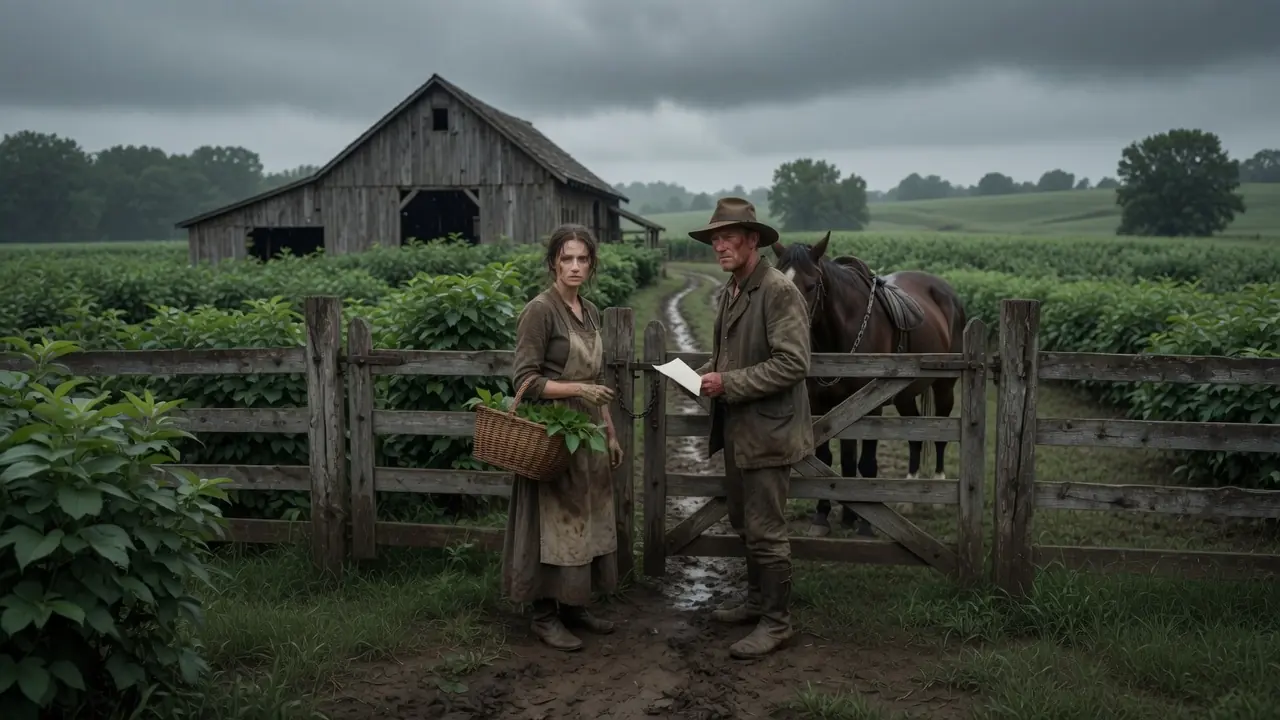
Later that morning, Chester’s hired man rode up to the gate for her answer. He found Tessa with green stains on her hands, her hair coming loose, and a basket of fresh leaves against her hip. He smirked before he spoke, as if her answer had already amused him. “Mr. Dial says this is your last chance to stop embarrassing yourself,” he said, holding out the purchase offer. Tessa looked straight at him and answered, “Tell Mr. Dial my land is not for sale, not today, not when I am tired, and not when he sends a mouthpiece.”
The hired man laughed, glancing toward the shed. “You really think worms will make you more than the town’s lonely little mending girl?” Tessa stepped closer to the gate, her voice sharp enough to cut the morning air. “No,” she said. “I think they will make cloth so fine your boss will wish he had begged instead of sneered.” The man laughed again as he rode back toward town, but Tessa saw the brief change in his eyes before he turned away. Mockery was easy until the person being mocked refused to bend.
The town laughed exactly as expected. By Sunday, people were whispering about the worm woman on the church steps. Children dared one another to run close to the Vance farm and peek into the shed. Someone left a jar of fishing worms on Tessa’s porch with a note that said, “For your herd.” Tessa carried the jar to the edge of the garden, opened it, and let the worms burrow into the soil.
She did not argue with Bell Haven. Arguing only gave the town more to chew. Instead, she worked. She rose before sunrise, cut mulberry branches, kept the leaves crisp in water, fed the fastest trays first, and learned how to read the small signs Hetty had written about. The worms changed from soft pale things into pearl-colored, restless creatures that lifted their heads as if searching for a future only they could feel.
The only person who came to the Vance farm without laughing was Junia Okafor, the dressmaker from town. Junia had come from St. Louis with a Singer machine, practical hands, and a kindness hard enough to survive gossip. She stood in the shed doorway one afternoon, took in the trays, the leaves, the smell, the rustling, and the exhausted young woman moving between them. Instead of laughing, she said, “Show me.” Tessa stared at her for a moment, then opened Hetty’s notebook.
From then on, Junia became the only witness Tessa trusted. She came when she could, sometimes after closing her shop, sometimes with thread still clinging to her sleeve. She did not pretend the work was pretty. She did not soften the truth. When Tessa said the town thought she was mad, Junia replied, “The town thinks anything it cannot price is madness.” That was the kind of comfort Junia offered, and it was better than sweetness.
The day the worms began to spin, Tessa nearly cried. Hetty’s notebook had described the sign clearly: the worms would stop eating, empty themselves, and raise their heads in slow searching motions. Tessa placed the cardboard mounting frames into the trays, each little cubby waiting like a tiny room. One by one, the worms climbed in and began casting invisible thread around themselves. Under lamplight, the thread appeared only when the angle caught it, fine as breath and stronger than it looked.
Over two days, the worms vanished into cocoons. The trays that had once rustled with pale bodies now held rows of golden-white ovals, faintly luminous, like small lanterns arranged by patient hands. Tessa stood in the shed at midnight and understood Hetty’s final warning in her bones. Folks judged the thing by how it looked the first day. They never waited for the treasure it might become.
Then came the part that made the notebook turn grim. The cocoons could not all be allowed to hatch, because a moth would cut the long silk thread when it emerged. The best would be saved for breeding, but the rest had to be heated gently before reeling. Tessa sat with that page a long time. Hetty had written a note in the margin, as if she had known someone tender would one day need permission to continue. “Do it kindly and waste nothing. That is the whole of the bargain.”
So Tessa did it kindly. She saved the finest cocoons for next year’s eggs and processed the rest with care. She did not pretend the cost was nothing. She simply refused to waste what had been given. Then she found Hetty’s reeling contraption under canvas in the corner of the shed: a basin, a brush, a hand crank, and a reel worn smooth from the old woman’s hands.
The first day of reeling was nearly a disaster. Tessa soaked the cocoons in warm water, brushed for the loose ends, gathered several fine threads together, and tried to wind them into one strand. They snapped, tangled, stuck, and slid away. She threw out almost all the first attempt. On the second day, she ruined less. On the third, she found the rhythm.
The silk came slowly, pale and glistening. It gathered on the reel in skeins so delicate Tessa hardly trusted her own eyes. This was thread she had grown, fed, watched, and drawn out with stained fingers and aching shoulders. She carried the first usable skein to Junia’s shop wrapped in cloth like something sacred. Junia touched it, went still, and said, “Lord, Tessa. That is real silk.”
They needed a loom. Junia had one in the back room, taken years earlier for a debt and never used. The two women shut the curtains at first because neither wanted Bell Haven watching them fail. Hetty’s notebook helped with warping and weaving, but not enough to prevent mistakes. They strung the warp wrong once, cut it away, then strung it wrong again in a different fashion. The third time, it held.
Tessa sat at the loom and threw the shuttle of her own silk thread back and forth. An eighth of an inch at a time, cloth appeared. It was the slowest work she had ever done, slower even than invisible mending, and she loved it with a fierce surprise. The silk caught the lamp and returned it changed, pale honey, soft and shifting, warm and cool beneath her fingers. Every inch felt like an answer to people who had laughed before waiting.
The first full length was flawed. The edges wandered, and tension slipped in places. Tessa saw only the mistakes, but Junia saw what mattered. “I sold dresses in St. Louis,” she said, palm flat against the cloth. “I have touched bolts that came off ships. This is that. You made this out of a dead woman’s shed and your own stubbornness.”
They began with handkerchiefs. Junia cut the flawed silk into squares and hemmed them, while Tessa embroidered a tiny mulberry leaf in one corner of each. Her invisible stitches, for the first time, became a signature. Junia placed a basket of pale honey silk handkerchiefs in her shop window with a card that read, “Local silk.” She did not put Tessa’s name on it yet. She wanted the town to judge the cloth before it judged the woman.
The handkerchiefs sold in two days. The doctor’s wife bought three. The banker’s daughter bought two and asked whether more was coming. A traveling drummer passing through Bell Haven bought the last four and offered to purchase any quantity Junia could supply for the St. Louis trade. That evening, Junia came running to the Vance farm with an empty basket, a fistful of money, and eyes bright with victory.
“They did not laugh,” Junia said, almost laughing herself. “Tessa, they fought over them.”
For one bright moment, Tessa stood in the shed and believed the town had turned. The worms rustled. The silk gleamed. Hetty’s notebook lay open on the crate. Then the trouble began in earnest, because Chester Dial had not built his power by ignoring anything that might make money without him.
Chester did not like being wrong. More than that, he did not like the town noticing he had been wrong. He had laughed at Hetty’s shed for years, called it wasted ground, said land was for cattle and grain, not a woman playing at farming. People had laughed because Chester held their notes, and people laugh at the jokes of men who can ruin them. Now those same people were asking for local silk, and Chester could feel opinion slipping from his grip.
He began with the mulberry trees. The forty glossy trees Hetty had planted stood along the property line, and without them there would be no leaves, no worms, no thread, and no silk. Tessa received a lawyer’s letter claiming a new survey showed the trees encroached on Chester’s land and must be removed within thirty days. She read it twice, then rode to the courthouse and checked the plat herself. The trees were inside the Vance boundary, but truth still cost money to defend.
Chester knew that. He was not trying to win in court. He was trying to bleed her until she quit. Then the hauler who had agreed to carry silk to the railhead suddenly became too busy. The boy who helped strip leaves stopped coming because his father owed Chester money. Credit grew cold. Doors that had started to open eased shut again. Bell Haven remembered that admiration could be expensive.
Tessa nearly broke under it. The worms still needed feeding four times a day. The reel still waited. The loom still required hours she no longer had. Junia closed her shop two afternoons to help strip leaves, but even together they were short of hands. A row of trays began to fail because Tessa could not reach them fast enough. Each failing worm felt like a thread cut before it was born.
One evening, Tessa sat on a crate in the shed with Hetty’s notebook closed in her lap and the lamp unlit. Junia came in, lit the lamp herself, sat across from her, and said, “Tell me all of it.” Tessa did. The false survey, the notice, the hauler, the missing boy, the whispers, the shrinking roads. Saying it aloud made it sound worse.
Junia listened without interrupting. Then she said, “He is not doing this because he thinks you will fail. He is doing this because he is afraid you will succeed.” Tessa looked up. Junia leaned forward, her voice hard. “You do not bury a dead thing, Tessa. You bury a thing that is growing.”
The truth helped, but it did not feed the worms. Ten days before the notice expired, Chester lowered his offer for the land by half and called it mercy. He let the new offer float through town like a rope thrown to someone he had shoved into deep water. That night, exhausted and sore, Tessa almost took it. She stood at the reel with cracked hands and thought about how simple surrender could look from the outside.
She could sell. She could stop. She could return to being the quiet mending woman people tolerated. The worms would die, but the worms would not know. Only she would know. She did not accept Chester’s offer that night, but she did not refuse it either, and that hesitation sat in her chest like a stone.
What turned her was Junia’s voice at the shed door. “Hetty carried these worms across an ocean and two railroads as eggs no bigger than a thimble,” Junia said. “She had no welcome, no help, and a whole town calling her a fool. She did not do it for them. She did it for whoever came after.” Junia tied her shawl tighter. “She picked you, Tessa. Chester Dial does not get to decide she was wrong.”
The next morning, Tessa woke to the smell of smoke. She ran barefoot toward the property line and found three mulberry trees scorched black along one side. Someone had set fire to them in the night. Dew had kept the damage from spreading, or else the coward who started it had lost his nerve. The message was plain: if she would not sell, the next trees would burn too.
Tessa sat in the wet grass among the blackened trunks and wept. Not quietly. Not neatly. She wept for Hetty, for her dead parents, for five years of being overlooked, for every laugh swallowed in town, and for the certainty that men like Chester believed a woman alone could always be pushed aside. Then the tears stopped. She looked at the scarred trees and understood that patience had never meant waiting quietly to be ruined.
She went to the courthouse and reported the burned trees. She made no accusation, only stated the facts and who stood to gain. Then she went to Junia and Prudence Aldridge, the church seamstress, a sharp-eyed widow who had sewn for the congregation for thirty years and feared no man’s opinion. Prudence had wanted a new altar cloth for two years, but the church fund had never stretched to silk. When Junia laid Tessa’s pale honey cloth across her table, Prudence touched it and went still.
“Where has this been all my life?” Prudence whispered. Then her practical mind returned. “How much can she make, and how soon?” The plan was simple and public. Tessa would weave the finest altar cloth Bell Haven had ever seen from silk grown in its own soil. It would be unveiled at the harvest service, before the whole town, hung where everyone would look every Sunday.
Tessa nearly refused. It meant weeks more work and standing before people who had laughed at her. Prudence fixed her with a look. “Child, you cannot stop people talking. But you can give them something so plainly good that talking against it makes them look the fool instead of you.” That settled it. Tessa made the cloth.
Now she was not alone. Word of the burned trees had spread, and Bell Haven did not like how ugly the truth looked in daylight. The doctor came out himself, examined the shed, the worms, the reel, and the cloth, then said his wife had not stopped talking about the silk. He also said if anyone troubled Tessa about those trees again, he would have something to say about it. That mattered because every family in the county needed the doctor more than they needed Chester’s approval.
The boy returned to help strip leaves. The hauler suddenly found time. A neighbor brought oil. Another brought baskets. Doors opened again, not because Bell Haven had grown noble overnight, but because the wind had changed and no one wanted to be the last person still laughing at a thing everyone else had decided to praise. Tessa accepted the help, but she did not forget how quickly it had disappeared.
She wove through the summer. Junia helped with finishing, and Prudence embroidered a border of mulberry leaves and ripened sheaves in soft green and gold. In one corner, Tessa stitched two small initials together: T and H. Tessa and Hetty. The patient one and the woman who had known how to wait for what a thing could become.
At the harvest service, the church was full to the walls. Chester Dial sat near the front in his good vest because not coming would have said too much. Prudence stood and told the whole story in her plain widow’s voice: how Hetty Vance had grown silk in Bell Haven while everyone laughed, how she left it to Tessa, and how Tessa had the patience and courage to learn what no one else bothered to understand. Then Prudence and Junia drew back the muslin covering the altar cloth.
The whole church drew breath at once.
The silk caught the morning light and returned it as honey, green, and gold. The mulberry leaves in the border seemed almost alive. It was the most beautiful thing that had ever hung in that plain rural church, and every person in the room knew it had not come from St. Louis or New York or across the ocean. It had come from a shed they had mocked, from worms they had laughed at, and from the hands of a woman they had treated as small.
No one looked at Chester for permission to admire it. That was the victory. In a town where people had arranged their opinions around him for years, not one head turned toward him before being moved. Chester sat still, and something in his face told Tessa he understood. His power had always depended on people waiting for him to decide what was valuable. Now the cloth had decided without him.
A year later, the barn glowed again at midnight. Two hundred trays rustled softly in the dark, but now a second shed stood beside the first. Three young women from town worked the reels by day for honest wages. A painted sign near the road read: Bell Haven Silk, Rowan and Okafor. St. Louis houses ordered more than Tessa could weave, and Junia handled contracts with the same hard practical kindness that had saved Tessa when she nearly quit.
The burned mulberry trees leafed again along their unscarred sides. Scarred, but living. Tessa thought Hetty would have laughed at that. Mulberry was hard to kill, and so, apparently, was a woman who had finally stopped mistaking loneliness for weakness.
At midnight, Tessa still walked the trays with a lamp in hand. She still fed the worms herself when the hour was late and the world was quiet. On the shed wall hung a framed page from Hetty’s notebook, the old woman’s slanting hand preserved beneath glass. For the patient one.
Outside, Bell Haven slept.
Inside, in the warm rustling dark, something quietly became what it was always meant to be.