Patricia Whitmore decided Mateo Alvarez did not belong in Silver Creek Estates before he had finished unloading his first box.
She did not ask where he came from.
She did not ask what he did for a living.
She did not ask whether the moving truck blocking half the driveway belonged to him.
She looked at his work boots, the grease beneath one fingernail, and the dark blue shirt with rolled sleeves.
Then she looked at the pale stone house behind him.
Her conclusion arrived before the facts had a chance.
“Excuse me,” she called from the sidewalk. “Are the new owners inside?”
Mateo stood beside an open cardboard box containing framed photographs.
He turned toward her.
Patricia wore white pants, a pale green blouse, and sunglasses large enough to hide most of her face. A gold bracelet moved loosely around her wrist as she gestured toward the front door.
“I’m sorry?” Mateo asked.
“The homeowners,” she repeated. “I wanted to introduce myself before the movers leave.”
Mateo looked at the house.
Two stories of cream-colored stone stood beneath a red tile roof. The windows reflected the late-afternoon sun. A small fountain sat near the entrance, though it had not yet been connected.
“I’m Mateo Alvarez.”
Patricia smiled impatiently.
“That’s nice. Are they inside?”
“I’m the homeowner.”
The smile remained on her face, but it no longer looked natural.
For several seconds, she appeared to be waiting for him to admit he was joking.
Mateo extended his hand.
“Nice to meet you.”
Patricia looked at it without accepting.
“You bought this house?”
“Yes.”
“This house?”
Mateo glanced behind him again.
“Unless someone moved a second one onto the property while I was unloading.”
Patricia removed her sunglasses.
She was fifty-three, carefully styled, and accustomed to people treating her questions as requests rather than intrusions.
“I didn’t realize it had sold.”
“Closed last Friday.”
“I’m Patricia Whitmore. I live across the street.”
“Then I suppose we’ll be seeing each other.”
Her eyes moved toward the garage.
A silver Porsche 911 was parked inside beside several tool cabinets.
“Oh,” she said. “That must belong to the owner.”
Mateo’s expression remained calm.
“It belongs to me.”
Patricia laughed once.
Not because anything was funny.
“Do you maintain it?”
“I work with cars.”
“I thought so.”
Her confidence returned.
“My husband says good mechanics are impossible to find. Laborers can do very well if they build the right reputation.”
Mateo could have corrected her.
He could have explained that Alvarez Motor Group owned nine dealerships, three collision centers, and one of the largest independent restoration shops in Texas.
He could have mentioned the Porsche was a trade-in he had purchased for himself after thirty years of working six-day weeks.
He could have told her that the house had been purchased without a mortgage after he sold a minority share of his company.
Instead, he picked up the box.
“Have a good afternoon, Patricia.”
She remained in place.
“Wait. Are you renting from the owner?”
“No.”
“Managing the property?”
“No.”
“Then how—”
A man in a moving-company shirt stepped through the front door.
“Mr. Alvarez, we finished the upstairs office. Do you want the large desk against the window?”
“Yes. Thanks, Sam.”
The mover nodded.
“Anything else before we go?”
“No. You’ve all been excellent.”
Mateo reached into his pocket, removed several folded bills, and handed them over.
“Dinner is on me.”
Sam smiled.
“Thank you, sir.”
Patricia watched him leave.
Her eyes returned to Mateo.
“So you really live here.”
“That’s what I’ve been saying.”
She looked toward the Porsche once more.
“Well, Silver Creek has certain standards.”
“I read the association rules before buying.”
“We care about quiet streets, property values, and knowing who comes into the neighborhood.”
Mateo adjusted the box in his arms.
“I care about those things too.”
Patricia put on her sunglasses.
“We’ll see.”
She crossed the street toward her own house.
Mateo watched her go.
Then he carried the photographs inside.
The first frame he unpacked showed his parents standing in front of a two-bay repair shop in San Antonio in 1989.
His father wore stained coveralls.
His mother held a bookkeeping ledger against her chest.
Above them, a hand-painted sign read:
ALVAREZ AUTO SERVICE.
Mateo placed the photograph on the mantel.
Everything he owned had begun in that small shop.
He had been sixteen when his father suffered a stroke and could no longer work full-time.
Mateo repaired brakes before school and engines after it.
His mother handled customers, bills, and three children while refusing to let anyone describe the business as charity.
They kept the shop alive.
Mateo studied business at night.
He purchased a failing used-car lot at twenty-seven, repaired the vehicles himself, and built trust one sale at a time.
Over three decades, the small lot became a dealership group.
He still wore work shirts because he spent more time on service floors than in executive offices.
He still carried a diagnostic scanner in the trunk.
He still believed a person should understand the work being done by the people signing his paychecks.
Silver Creek Estates was supposed to represent a quieter chapter.
Mateo’s wife, Elena, had died from breast cancer four years earlier.
Their two daughters lived in different states.
The large family home they once shared had become too full of empty rooms.
He purchased the Silver Creek house because it was closer to his oldest dealership, had a workshop large enough for restoration projects, and included a courtyard Elena would have loved.
He had not moved there to prove anything.
He wanted a home where the evenings felt peaceful.
Patricia Whitmore had other ideas.
She lived with her nineteen-year-old son, Connor, in one of the largest homes on the street.
Her husband had died seven years earlier, leaving her several rental properties, investments, and a lifestyle she protected carefully.
Patricia chaired the neighborhood social committee and served as vice president of the homeowners association.
She organized holiday decorations, approved landscaping vendors, and monitored every contractor vehicle entering the community.
Many neighbors found her exhausting.
Few challenged her.
That evening, Connor entered the kitchen while Patricia stood near the window watching Mateo’s moving crew leave.
“New guy?” he asked.
“He claims he bought the Jamison house.”
Connor looked across the street.
“The one with the Porsche?”
“You noticed that?”
“It’s a 911 Carrera S.”
Patricia turned.
“You know the car?”
“I have eyes.”
She folded her arms.
“He says he works with cars.”
“Maybe he owns it.”
Patricia gave him a look.
Connor opened the refrigerator.
“What?”
“A man dressed like a mechanic does not buy a three-million-dollar home and a Porsche without something unusual going on.”
“Maybe mechanics make more than you think.”
“Not that much.”
Connor took a bottle of water.
“Can I borrow your car tonight?”
“No.”
“I have a date.”
“Use your own.”
“My car is in the shop.”
“That is because you drove it after the oil warning appeared.”
“It was one light.”
“It was a red light.”
Connor closed the refrigerator.
“You never let me use anything.”
“I bought you a car.”
“A seven-year-old BMW.”
Patricia stared at him.
“Leave the kitchen.”
Connor muttered something and walked away.
Across the street, Mateo stood in the garage with the Porsche’s hood open.
Connor watched through the upstairs window.
The following Saturday, Mateo hosted a small housewarming dinner.
He invited his sisters, three cousins, several employees, and two neighboring families who had welcomed him during the week.
The gathering began at five.
Music played quietly in the courtyard.
Children chased one another near the fountain.
A grill smoked beside the patio while guests carried food through the open kitchen doors.
Patricia heard the music from her home.
She stepped onto her front porch.
Several cars lined Mateo’s driveway and part of the curb.
None blocked traffic.
No one stood in the street.
Still, Patricia’s expression hardened.
Connor joined her.
“Looks like a family party.”
“Look at all those people.”
“There are maybe fifteen.”
“One gathering becomes another. Then every weekend we have cars everywhere.”
Connor pointed toward a man beside the grill.
“Is that the owner of Reyes Steak Company?”
Patricia followed his gaze.
“I don’t know.”
“I saw him on a business podcast.”
Another guest arrived carrying two bottles in a wooden case.
Connor recognized him too.
“That guy owns Cielo Agave.”
Patricia frowned.
“You seem very informed about alcohol for someone under twenty-one.”
“I follow business accounts.”
Mateo saw them watching and walked across the lawn.
“Good evening.”
Patricia remained on her porch.
“What is going on?”
“Housewarming dinner.”
“You invited half the city.”
“Mostly family.”
Several men near the courtyard raised their hands.
“Primos,” Mateo called, “come meet my neighbor.”
Three cousins approached.
Rafael Alvarez owned a regional restaurant group.
Francisco Vega managed a large agave-growing cooperative in Jalisco and Texas.
Gabriel Soto founded a premium tequila company that had recently expanded into national distribution.
All three had grown up within several streets of Mateo.
All three remembered sharing one bedroom during family visits and repairing cars for extra money.
Mateo introduced them.
Patricia looked from one man to another.
“The restaurant business,” she said. “Mexican food?”
Rafael smiled politely.
“Steakhouses.”
“Oh.”
Mateo gestured toward Francisco.
“Francisco works in agriculture.”
Patricia looked at his boots.
“I assumed so.”
“He coordinates production for more than four hundred farms.”
Francisco said nothing.
“And Gabriel owns Sol de Plata Spirits.”
Patricia’s smile became rigid.
“I see.”
Gabriel lifted the wooden case.
“I brought a bottle for the host. Not for Connor.”
Connor laughed.
Patricia ignored him.
“The neighborhood has quiet hours.”
“Ten o’clock,” Mateo replied. “We’ll finish before nine.”
“And the cars?”
“All legally parked.”
Patricia looked toward the guests.
A few wore jeans and work shirts. One man had tattoos along both forearms. Another arrived in a pickup with equipment cases in the back.
“These people may be family to you, but some of them look concerning.”
Mateo’s expression changed.
“How?”
“You know what I mean.”
“No. I’d like you to explain.”
Patricia glanced toward the gathering.
“I don’t want troublemakers wandering around Silver Creek.”
Rafael’s smile disappeared.
Mateo remained calm.
“They’re accountants, restaurant managers, engineers, sales directors, and relatives.”
“That doesn’t mean—”
“Patricia.”
His voice was not loud.
It carried enough firmness to stop her.
“You are welcome to come over, eat with us, and meet people before judging them.”
“I don’t need to attend your party.”
“Then have a good evening.”
He turned back toward the house.
Patricia called after him.
“I will contact your landlord if this becomes a problem.”
Mateo stopped.
He looked over his shoulder.
“You should contact me. I own the house.”
She crossed her arms.
“We’ll see how long that lasts.”
Mateo returned to his guests.
Rafael handed him a plate.
“Friendly neighborhood?”
“She’s adjusting.”
“To what?”
Mateo looked across the street.
“Reality.”
The dinner ended at eight forty.
Guests carried dishes inside and gathered near the front driveway to say goodbye.
At eight fifty-two, Patricia called the police.
She described loud music, intoxicated guests, and people “possibly casing vehicles” along the street.
Two officers arrived at nine twelve.
By then, the music was off.
Most guests had left.
Mateo and his cousins stood in the driveway beside several empty food containers.
Officer Hannah Brooks approached.
Her partner, Officer Daniel Kim, remained near the patrol vehicle.
“Evening. We received a noise complaint.”
Mateo looked toward the quiet courtyard.
“The dinner ended twenty minutes ago.”
Patricia hurried across the street.
“Thank goodness you’re here.”
Officer Brooks turned.
“Are you the caller?”
“Yes. They have been blasting music and holding a wild party for hours.”
Rafael looked at Mateo.
Mateo lifted one hand, signaling him to remain calm.
Brooks listened.
“Did you hear the music after ten?”
“No, but—”
“Did you observe anyone fighting, damaging property, or threatening someone?”
“They were drinking.”
“Adults are allowed to drink on private property.”
Patricia’s face tightened.
“There were suspicious people looking at my Porsche.”
Connor’s bedroom window remained dark behind her.
Mateo glanced toward her driveway.
The Porsche was not there.
Patricia followed his eyes.
For a second, she did not understand.
Then she looked again.
“My car.”
She rushed toward the empty space.
“My car is gone.”
Officer Kim moved closer.
“When did you last see it?”
“An hour ago. Maybe less.”
“Who has access to the keys?”
“Only me.”
“Any family members?”
“My son is upstairs sleeping.”
Brooks asked, “Do you have camera footage?”
“The front camera has been malfunctioning.”
Patricia spun toward Mateo and his cousins.
“They stole it.”
The accusation struck the driveway like a thrown object.
No one spoke.
Then Gabriel shook his head.
“That’s ridiculous.”
“I saw you looking at it.”
Connor had looked at the Porsche earlier.
So had several guests.
It was difficult not to notice a new sports car displayed beneath bright driveway lights.
Patricia pointed toward Mateo.
“You knew exactly what kind of car it was.”
“I own dealerships.”
“You admitted you work on cars.”
“I do.”
“This is how it starts. You move into a neighborhood, bring your people in, and suddenly property disappears.”
Officer Brooks stepped between them.
“Ma’am, stop.”
Patricia continued.
“They probably moved it into his garage.”
Mateo’s face became still.
For most of his life, he had heard assumptions wrapped in different language.
Mechanic when he said automobile industry.
Laborer when he wore work clothes.
Criminal when he paid cash.
Gang when relatives gathered.
He had learned that anger often gave prejudiced people a distraction from what they had done.
So he spoke carefully.
“You are accusing me and my family of stealing a vehicle without evidence.”
“You were all here.”
“Yes.”
“My Porsche vanished.”
“That does not make us thieves.”
“You expect me to believe a group like this just happens to gather on the same night my car is stolen?”
Rafael stepped forward.
“What group?”
Mateo placed one hand against his chest.
“Let me handle it.”
Officer Kim looked toward the neighboring houses.
“Does anyone have exterior cameras?”
A man two doors down raised his hand.
“My doorbell camera faces part of the street.”
“We’ll need the footage.”
Patricia shook her head.
“You’re wasting time. Search his garage.”
Brooks looked at Mateo.
“Do you consent to us checking whether the vehicle is visible inside?”
Mateo opened the garage with his phone.
The doors lifted.
Inside stood the silver Porsche he had shown Patricia earlier, two classic cars beneath covers, and several tool cabinets.
Patricia pointed.
“There. That’s my car.”
Connor’s Porsche was black.
Patricia’s was white.
Mateo’s was silver.
Officer Brooks examined the plate.
“This vehicle is registered to Mr. Alvarez.”
Patricia stared.
“How do you know?”
“Registration information.”
Mateo folded his arms.
“You mentioned you bought your Porsche recently.”
“Yes.”
“From Whitmore European Motors?”
“Of course.”
“That dealership purchased it from Alvarez Motor Group eight months ago.”
Patricia looked at him.
“You own Alvarez Motor Group?”
“Yes.”
“How many locations?”
“Nine.”
She glanced toward his relatives.
“That still doesn’t explain them.”
Mateo’s patience finally thinned.
“It does not need to.”
Officer Brooks spoke firmly.
“Mrs. Whitmore, these men do not have to explain their careers or income to prove they didn’t steal your car.”
Patricia looked toward Rafael.
“He said he worked in restaurants.”
“I own seventeen,” Rafael replied.
She turned to Francisco.
“You said agriculture.”
“I manage land and contracts for a cooperative supplying several large beverage companies.”
Gabriel lifted one shoulder.
“And I manufacture tequila. I do not work at a liquor store.”
Patricia looked overwhelmed rather than apologetic.
“So all of you are wealthy?”
Mateo shook his head.
“That is not the point.”
“What is the point?”
“The point is that our worth should not depend on whether you discover we have money.”
The sentence silenced the driveway.
Mateo continued.
“A mechanic deserves respect.”
“A farmworker deserves respect.”
“A restaurant employee deserves respect.”
“A person renting a home deserves the same dignity as someone buying one with cash.”
He looked directly at her.
“You did not become wrong only after learning our job titles.”
Before Patricia could answer, the sound of an engine came from the entrance to the street.
Headlights appeared around the corner.
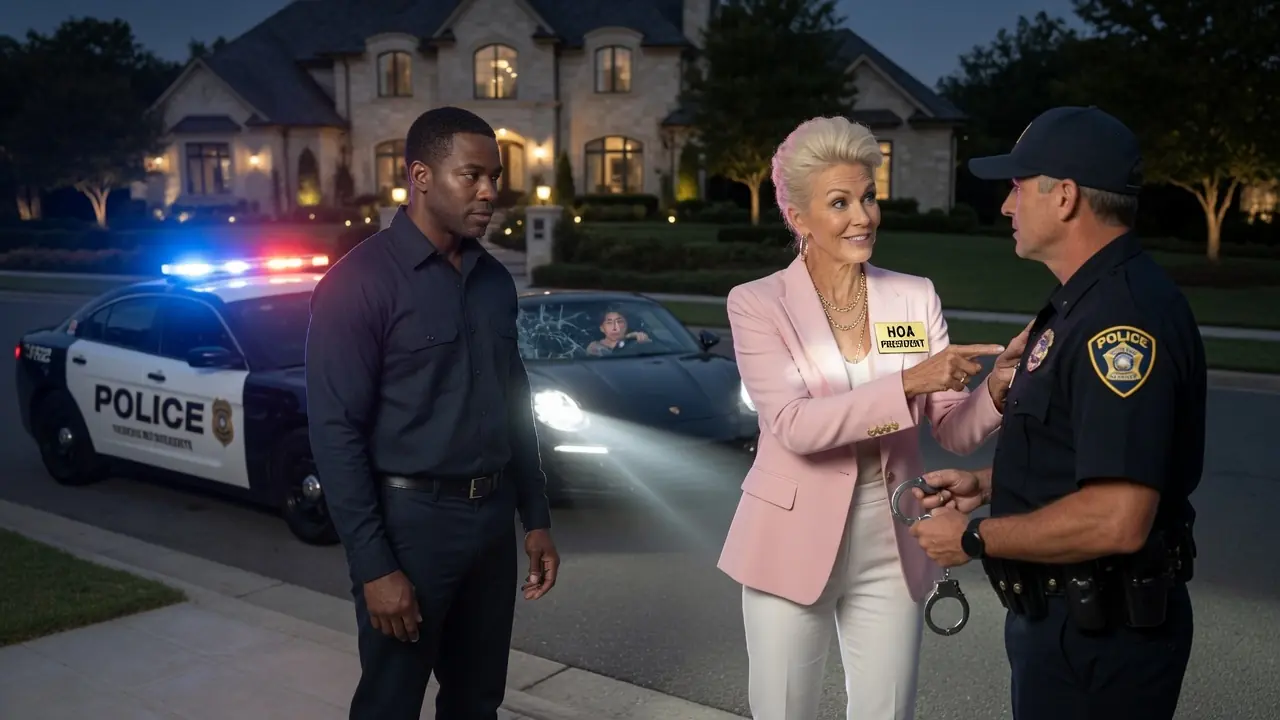
A white Porsche moved slowly toward them.
The front windshield carried a long crack extending from the lower passenger side.
The car turned into Patricia’s driveway.
Connor sat behind the wheel.
His face went pale when he saw the police vehicles.
Patricia stared at him.
“Connor?”
He stopped the car.
For several seconds, no one moved.
Then he opened the door.
“Mom, I can explain.”
“You took my car?”
“My date canceled, and then some friends wanted to go downtown.”
“You told me you were sleeping.”
“I was going to return before you noticed.”
Patricia looked at the windshield.
“What happened?”
“A truck threw a rock.”
Officer Kim approached.
“Do you have a driver’s license?”
“Yes.”
“Were you drinking?”
“No.”
“Step out of the car.”
Connor obeyed.
Officer Brooks performed a brief field assessment and found no signs of impairment.
The neighbor’s camera footage later showed Connor leaving alone shortly after eight.
The mystery ended without a chase, theft ring, or criminal gang.
A privileged teenager had taken his mother’s car after being told no.
Patricia stood beside the damaged Porsche, surrounded by the people she had publicly accused.
Her face changed slowly.
Defensiveness gave way to humiliation.
Then something closer to shame.
Officer Brooks closed her notebook.
“There is no stolen vehicle.”
Patricia lowered her eyes.
“No.”
“There is no evidence Mr. Alvarez or his guests committed any crime.”
“No.”
“You made a serious accusation.”
“I was frightened.”
Mateo looked toward her.
“You were certain.”
Patricia did not answer.
Brooks gave Connor a citation related to unauthorized use after Patricia insisted she wanted the matter documented but declined to pursue a more serious complaint.
The officers warned Patricia that knowingly making false or exaggerated reports could carry consequences.
Then they apologized to Mateo and his relatives for the disruption.
After the patrol cars left, Rafael collected the final food container.
“We should go.”
Mateo nodded.
The cousins hugged him.
Gabriel handed over a business card.
“For the windshield.”
Patricia looked up.
“Why would you help me after this?”
Gabriel’s expression remained polite.
“The card belongs to Mateo’s collision center.”
Mateo took it from him and held it toward Patricia.
She accepted it slowly.
“We can replace the glass,” he said.
“I don’t deserve a favor.”
“It is not a favor. You will receive a written estimate like any other customer.”
Something in his answer made her flinch.
She had expected either anger or immediate forgiveness.
Mateo offered neither.
He gave her professionalism and a boundary.
Patricia looked toward the dark street.
“I am sorry.”
Mateo waited.
“For accusing you of stealing the car,” she added.
“And?”
She looked confused.
“You accused my relatives.”
“I’m sorry to them too.”
“You called them a gang.”
Patricia swallowed.
“I should not have.”
“You assumed I was a laborer who could not afford this house.”
“I was surprised.”
“No. You were certain.”
She lowered her eyes.
“You are right.”
Mateo looked toward Connor, who stood near the Porsche with his hands in his pockets.
Then he turned back to Patricia.
“An apology is a beginning. It is not the end.”
“What do you want me to do?”
“Think before you call the police on someone because they make you uncomfortable.”
She nodded.
“Meet people before deciding what they are.”
“Yes.”
“And stop using money as proof of character.”
Patricia glanced at the stone homes lining Silver Creek.
That lesson appeared to reach deeper.
“I understand.”
Mateo shook his head gently.
“I hope you will.”
He closed the garage door and went inside.
For several weeks, the relationship between the neighbors remained distant.
Patricia waved once.
Mateo returned the gesture.
Nothing more.
The collision center replaced the Porsche windshield.
Patricia paid the full invoice.
Connor began working after school to reimburse her.
At Mateo’s suggestion, he applied for a position at a different repair shop so the job would not become another favor.
He spent his first week washing vehicles and removing trash from service bays.
The experience did not transform him overnight.
But it taught him that the people maintaining expensive cars often worked harder than those driving them.
Patricia’s change came more slowly.
At the next homeowners association meeting, several residents discussed introducing stricter rules for large family gatherings.
The proposal clearly followed Mateo’s housewarming.
Patricia surprised the room by opposing it.
“The existing quiet-hour rules are sufficient,” she said. “We should not create new restrictions because some residents are uncomfortable with people they do not know.”
A board member looked at her.
“You filed the complaint.”
“I did.”
“And?”
“I was wrong.”
The room became quiet.
Patricia continued.
“I confused unfamiliarity with danger. The association should not turn that mistake into policy.”
The proposal failed.
Months later, Silver Creek held its annual neighborhood charity dinner.
Mateo’s dealership group donated a van to a local vocational program teaching automotive repair to teenagers.
Rafael catered the meal.
Francisco’s cooperative funded agricultural scholarships.
Gabriel contributed to a safe-ride program providing free transportation during holidays.
Patricia helped organize the event.
She did not introduce the men by describing their wealth.
She introduced them by name.
Near the end of the evening, she found Mateo standing beside the courtyard fountain.
“I owe you something better than the apology I gave that night.”
Mateo looked at her.
“You do not owe me a speech.”
“I owe you changed behavior.”
“That would be useful.”
Patricia smiled faintly.
“I have been trying.”
“I noticed.”
“Do you forgive me?”
Mateo considered the question.
“Forgiveness does not mean pretending it never happened.”
“I know.”
“It also does not mean we immediately become friends.”
“I understand.”
“But I don’t intend to carry anger across the street every morning.”
Her shoulders relaxed slightly.
“That is more generous than I deserve.”
“Probably.”
She laughed.
For the first time, the sound was genuine.
A year after Mateo moved into Silver Creek, he hosted another housewarming celebration.
He called it an anniversary dinner.
The same cousins attended.
So did several neighbors.
Patricia arrived carrying a pie she admitted came from a bakery.
Connor drove his own repaired BMW and parked carefully along the curb.
Before entering, Patricia paused beside Mateo’s Porsche.
“I still think this is a beautiful car.”
“It should be. You helped finance the dealership that sold it.”
She smiled.
“Fair point.”
Inside, Rafael stood near the grill.
He lifted a plate toward her.
“Steak?”
“Yes, please.”
“Not tacos?”
Patricia covered her face.
“I deserved that.”
“Yes,” Rafael said. “But the steak is still good.”
The evening ended before quiet hours.
No one called the police.
Years later, people in Silver Creek remembered the night Patricia accused the new neighbor of stealing her Porsche.
Most retellings focused on the satisfying moment the car returned with her son behind the wheel.
Mateo remembered something else.
He remembered Patricia learning that he owned dealerships and immediately treating him differently.
That shift revealed the deeper problem.
Respect based on money was not respect.
It was calculation.
A man did not become worthy because he owned a home in cash.
A family did not become harmless because its members operated successful businesses.
A mechanic was not beneath the executive who owned the shop.
A farmworker was not less important than the investor profiting from the crop.
A person should not need an impressive title before a neighbor decided not to call him a criminal.
Mateo kept the photograph of his parents above the mantel.
His father in stained coveralls.
His mother holding the ledger.
The old repair shop behind them.
Whenever visitors asked how he had afforded the house, Mateo pointed toward the photograph.
“Work,” he said.
Not the kind of work Patricia originally imagined as an insult.
The kind that built families, businesses, and entire neighborhoods.
The grease beneath his fingernails had never been evidence that he did not belong.
It was evidence of exactly how he arrived.