The three riders came just after noon.
Elias Mercer saw them from the south pasture, dark shapes moving along the road beneath a sky the color of old iron. They rode close together, not like travelers sharing company, but like men who had arrived with a purpose.
He set down the length of fencing wire in his hands.
At the ranch house, Nora Whitfield stood on the porch with her baby against her chest.
Even from half a field away, Elias saw the way her body changed when she recognized the man riding in front.
Her shoulders went rigid.
Her hand closed around the gray blanket wrapped beneath little Rose.
The lead rider dismounted without waiting for the others.
He was tall, clean-shaven, and dressed too carefully for the muddy road. His coat was good wool. His boots were polished beneath the dust. A folded document protruded from the inside pocket near his heart as though he wanted everyone to know he carried something official.
“Nora.”
She did not answer.
The man looked toward Elias approaching from the pasture.
“You Mercer?”
“I am.”
“My name is Silas Whitfield.”
Elias stopped beside the hitching post.
“I know who you are.”
Silas’s expression sharpened.
“Then you know why I’m here.”
Elias glanced at Nora.
She had come down from the porch.
She did not stand behind him.
That mattered.
She stood beside him, holding Rose on one hip, her chin raised and her eyes fixed on the man who had followed her halfway across the country.
Silas drew out the folded paper.
“This woman is my late brother’s widow. The child is my brother’s daughter. Mrs. Whitfield left Kentucky while a guardianship petition was pending.”
“A petition,” Nora said.
Silas turned toward her.
“Rosemary.”
“My name is Nora.”
“You were baptized Rosemary.”
“My husband called me Nora. You have always known that.”
Silas’s jaw moved.
The two men behind him remained near their horses. They were hired company rather than family. Elias could see it in the way they watched the road instead of the woman and child Silas claimed to be rescuing.
Silas unfolded the document.
“I have authority from Harlan County to return the child until a hearing can be held.”
“No,” Nora said. “You have a petition requesting a hearing. It was never heard.”
“The local justice agreed there were serious concerns about your ability to provide.”
“The local justice has known you for twenty years.”
“He knows the facts.”
“He knows your mill owns half the town.”
Silas looked toward Elias.
“You see how unreasonable she is.”
Elias did not answer immediately.
He had learned that silence often forced a man to reveal more than argument would.
Silas took a step forward.
“My brother left valuable land behind. Nora has no money, no family, and no means of caring properly for an infant. I paid for my brother’s burial. I covered the doctor’s costs. I kept creditors from taking the farm.”
“You paid for a coffin,” Nora said. “You did not purchase my daughter.”
The wind moved through the yard.
Rose stirred against her mother’s shoulder but did not cry.
Silas’s face hardened.
“That property belongs with the Whitfield family.”
“It belongs to Rose and me.”
“You abandoned it.”
“I fled before your friend in the courthouse could declare me unfit.”
“That sounds like guilt.”
“It sounds like survival.”
Silas looked at Elias again.
“You have no place in this.”
Elias nodded toward the document.
“Neither does that paper in Montana Territory.”
Silas’s confidence wavered.
“Law is law.”
“Not the way you’re using it.”
“You a lawyer?”
“No.”
“Then step aside.”
Elias remained where he was.
“Justice Amos Reed is in Coulter Creek. He has already heard Nora’s account. If you want a hearing, you can present yourself Monday morning.”
Silas looked toward Nora.
“You went to a judge?”
“A justice of the peace,” she said. “Before you could tell the story for me.”
Silas folded the document carefully.
The gesture was controlled, but anger had begun showing around his eyes.
“You think this rancher can protect you forever?”
Nora shifted Rose higher against her shoulder.
“I don’t need him to speak for me.”
She looked directly at Silas.
“If you believe you have a lawful claim, take it before Justice Reed. Bring witnesses. Bring records. Bring whatever truth you think supports you.”
Her voice remained steady.
“But you will not take my daughter from this yard.”
Silas glanced toward his companions.
Neither man moved.
They had been hired to escort a document.
They had not expected a woman who understood what the document did not say.
Elias stepped closer to Nora, not in front of her, but enough that Silas saw he would not be allowed to turn intimidation into force.
“Monday,” Elias said. “Eight in the morning.”
Silas stared at them for a long moment.
Then he returned to his horse.
“This isn’t finished.”
“No,” Nora said. “It’s finally being done properly.”
The riders left the way they came.
Hooves struck the hardening road until the sound faded into the valley.
Nora remained in the yard.
Rose lifted one small hand from the blanket and reached toward the empty road as though she wanted to examine what had just gone away.
Elias watched Nora’s face.
“You didn’t need me.”
“No.”
She looked at him.
“But I was glad you stood there.”
He nodded.
The October wind moved between them.
Ten days earlier, Elias had almost driven past her.
The storm began shortly after four in the afternoon.
By half past, rain crossed the valley in hard, silver sheets. The road became mud that pulled at the wagon wheels with each rotation.
Elias leaned into the weather, holding the reins tight while his bay horse, August, worked steadily toward home.
Two miles remained between him and a dry barn.
He saw the shape near the roadside only because lightning briefly flattened the landscape into white and black.
Too upright for a post.
Too small for a tree.
A woman.
Elias pulled August to a stop.
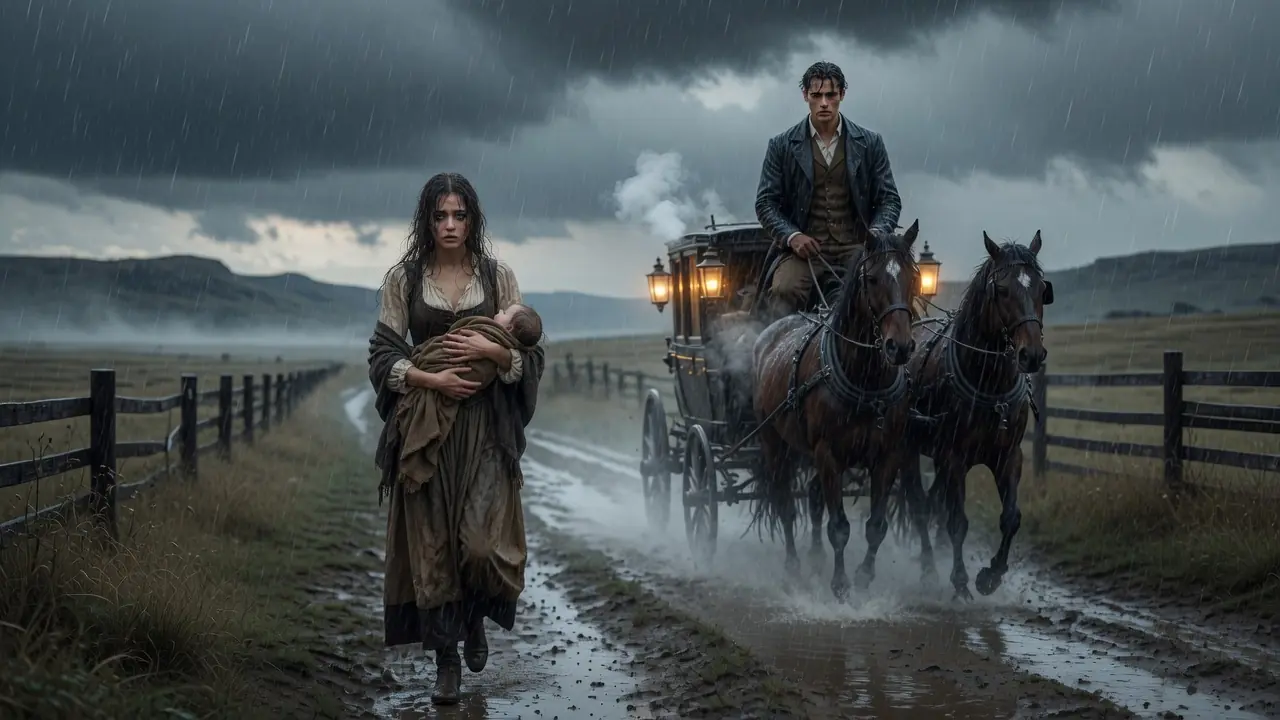
The woman stood with her back toward the wind, bent slightly forward in the posture of someone who had been walking against bad weather for so long that she no longer expected it to end.
A blue dress clung to her body.
Her black hair was plastered against her face.
Mud covered her boots past the ankles.
She held something beneath a gray blanket against her chest.
The bundle moved.
Elias set the brake.
“Ma’am?”
She looked up.
Her face was young, perhaps twenty-seven, but exhaustion had added years around her eyes.
“I’m fine.”
Nothing about her appeared fine.
“You’re soaked through.”
“I know.”
“It’ll be dark soon.”
“I know that too.”
The blanket moved again.
“Is that a baby?”
“My daughter.”
“How old?”
The woman’s arms tightened.
“Four months.”
Elias looked toward the open valley.
The nearest settlement was six miles north. Nothing but grassland and low hills lay ahead.
His ranch stood two miles south.
“My house is close.”
She looked at him carefully.
He understood the calculation in her eyes.
A woman traveling alone with a child could not assume a man offering shelter was safer than the storm.
He moved farther along the wagon bench.
“My name is Elias Mercer. I have a house, a barn, a fire, and no interest in knowing more than you want to tell me.”
She looked toward the road ahead.
Rain ran down her face.
“May we sleep in the barn?”
“You can sleep in the house.”
“You don’t know me.”
“No.”
“Then why?”
Elias thought of his father.
Daniel Mercer had been gone eleven years, but certain sentences remained as clearly as if he stood beside the wagon.
You stop for people on the road, Elias. You help first. Explanations come later, if they come at all.
Elias held out his hand.
“Because you have a child and the temperature is falling.”
The woman looked at the hand.
Then she took it.
Her fingers were nearly numb.
He pulled her onto the bench and gave her his coat. She wrapped it over the gray blanket instead of around herself.
“My name is Nora,” she said.
Elias clicked at August.
The wagon turned south.
The Mercer ranch house had been built for a family.
For three years, it had held only one man.
The absence was visible without anything being neglected.
One coat hung beside the door though there were three hooks.
One chair remained pulled from the kitchen table.
Two coffee cups sat in the cupboard, but only one showed signs of regular use.
A framed wedding photograph rested above the fireplace.
Beside it stood an empty space in the dust where another photograph had once been.
Nora noticed all of it.
She also noticed the cradle.
It stood in the corner of the main room, pushed back against the wall. Dust covered the rails lightly but evenly, showing it had been preserved rather than forgotten.
The cradle was small.
Hand-built.
Unused.
Nora did not ask.
Elias pointed toward the spare room.
“There are blankets in the chest. I’ll heat water.”
She entered the room and closed the door.
The baby beneath the gray blanket had red hair and a serious expression.
“Rose,” Nora whispered, placing her on the bed, “you are entirely too calm.”
Rose blinked.
She appeared to accept the storm, the strange house, and the damp clothes as one more set of facts requiring consideration.
Nora removed the wet layers and changed her into the only dry garments she had managed to preserve inside her traveling bag.
For the first time in six days, she stopped moving.
Train cars.
Freight wagons.
A diligence stage as far west as her remaining money allowed.
Then borrowed rides and long stretches on foot toward no destination except away.
The stillness almost frightened her.
She allowed herself one minute.
Then she carried Rose into the kitchen.
Elias had placed beef stock, potatoes, onions, and carrots into a pot.
“You need help,” Nora said.
“It’s soup.”
“Soup still needs watching.”
“I’ve made it alone before.”
“I can see that.”
He looked toward her.
She nodded at a bread heel near the edge of the counter.
“It’s about to burn.”
Elias moved it.
Nora held out her free hand.
“Give it to me.”
He did.
She sliced the bread and placed it near the heat without scorching it.
They ate at the kitchen table while rain struck the windows.
Rose sat in Nora’s lap, watching Elias with the intense attention she gave every unfamiliar face.
“She’s staring at me,” he said.
“She doesn’t stare at walls.”
“What does that mean?”
“She thinks you might be interesting.”
Elias looked toward the baby.
“What is her name?”
“Rose.”
“Four months?”
“Four months and six days.”
He nodded.
Rose continued looking at him.
After several minutes, she seemed satisfied and rested her head against Nora’s shoulder.
Elias finished his soup.
He did not ask why they had been walking alone.
Nora noticed that too.
The fever came after midnight.
Nora woke to Rose’s skin hot against her arm.
She checked the baby’s breathing.
Too fast, but not failing.
Color high.
No blueness around the lips.
She needed water, clean cloths, and a stronger fire.
In the kitchen, she had just begun waking the coals when lamplight filled the doorway.
Elias stood there fully dressed.
“You weren’t asleep,” she said.
“I was in the chair.”
“Why?”
He looked toward the spare room.
“What’s wrong?”
“Fever.”
He took the pot from her.
“How high?”
“Enough to concern me.”
“Doctor?”
“Not yet. If her breathing worsens, yes.”
“Go sit with her.”
He heated water, brought cloths, and added wood to the fire.
Then he took the chair in the corner of the spare room.
Nora cooled Rose’s forehead and kept her nursing. She whispered without forming complete sentences, letting her voice do what medicine could not.
Elias watched the child.
Something moved through his face each time Rose’s breathing caught.
Fear, perhaps.
Memory.
Whatever it was, he contained it quickly.
At three in the morning, Rose finally slept.
Nora touched her forehead.
“Coming down.”
Elias nodded.
“You can go,” she said.
“I’m fine here.”
“This is your house.”
“I know.”
“You don’t have to stay.”
“I know that too.”
Nora looked at him.
At the man sitting awake in a corner beside a stranger’s sick child.
At the cradle in the main room.
One grief sometimes recognized another without introduction.
“Thank you for stopping,” she said.
“My father told me to stop for people.”
“That does not make it less kind.”
“It makes it habit.”
“Some habits are kindness practiced long enough to become instinct.”
Elias looked toward Rose.
“Is she going to be all right?”
“Yes.”
Nora wanted the word to be true.
“She was strong from the beginning.”
The fever broke before dawn.
When Nora woke again, Elias’s chair was empty, the fire rebuilt, and the lamp turned low.
Through the window, she saw him walking toward the barn.
She went to the kitchen and found flour, lard, and dried fruit.
She made breakfast the way she had learned in her mother’s house in the Appalachian foothills.
Biscuits in cast iron.
Coffee measured properly instead of thrown into the pot by habit.
Dried apples warmed with a little sugar.
Elias returned at half past six.
He stopped in the doorway.
“Rose?”
“Sleeping. Fever’s gone.”
Only then did he look at the food.
They ate quietly.
Outside, the road dried beneath a weak October sun.
“It’ll be passable by noon,” Elias said.
“I know.”
He looked toward the window.
Nora looked at her coffee.
Neither said what noon required.
After a long silence, Elias spoke.
“A few days.”
She raised her eyes.
“Rose needs rest,” he said.
“Yes.”
“You should stay until she’s stronger.”
Nora studied him.
He was watching the road too.
For a different reason, perhaps.
“We’ll stay a few days.”
Those days developed a pattern without discussion.
Elias worked the ranch.
Nora restored order to the house.
She reorganized the pantry.
Moved the coffee.
Balanced accounts he had been keeping with the confidence of a man who did not know they were wrong.
On the second morning, Elias opened the pantry and stood there for nearly ten seconds.
“Where’s the coffee?”
“Second shelf.”
“It used to be on the bottom.”
“It used to be hidden behind beans.”
“It stayed dry.”
“It also remained invisible.”
He found the coffee.
Two days later, he found flour, preserves, and salt without searching.
He did not thank her for reorganizing anything.
He also never moved an item back.
The evenings changed the house most.
During the day, labor kept them separate.
At night, they sat near the fire.
Nora mended clothing while Rose lay on a blanket examining her own hands.
Elias read.
Or appeared to read.
Often he did not turn a page for long stretches.
“Why is the horse called August?” Nora asked one night.
“He came to me in August.”
“That is your entire naming system?”
“I’m not complicated.”
“Rose was born in June.”
“You nearly named her June?”
“I considered it.”
“What stopped you?”
Nora looked toward the baby.
“She opened her eyes and looked at me as though she had already formed an opinion. June sounded too agreeable.”
Elias watched Rose attempt to place both fists into her mouth at once.
“She has opinions.”
“About everything.”
“The hands?”
“Major subject of study.”
“She’s learning how they work.”
“She’s learning who she is. The hands are simply where she began.”
Elias looked at Nora.
She kept sewing.
Something warm and uncertain passed through the room.
On the sixth day, Elias returned from Coulter Creek with a small knitted cap.
He placed it on the table.
“For Rose.”
Nora touched the soft wool.
“You didn’t have to buy this.”
“She was cold outside.”
“I can provide for her.”
Elias heard the meaning beneath the words.
Not rejection.
A boundary.
“You’re right,” he said. “I should have asked.”
Nora looked up.
He continued.
“Next time, I will.”
She put the cap on Rose.
It fit.
The baby tolerated it with the solemn patience of someone accepting an imperfect arrangement.
Elias watched.
Nora saw that he had been paying attention.
Not simply to the existence of a child in his home, but to the size of her head, the cold on the porch, and the way the wind reached beneath a blanket.
On the eighth evening, Nora told him why she had come west.
Her husband, Thomas Whitfield, died three weeks after Rose’s birth.
A fever took him in eleven days.
His brother Silas arrived for the funeral and immediately began discussing land.
Thomas owned a small Kentucky property with reliable water access. Silas had tried to purchase it for years.
Thomas left it to Nora and Rose.
Silas paid for the burial when Nora could not produce money quickly enough. Then he treated the debt as ownership.
He filed a guardianship petition claiming Nora had no family, no income, and no ability to provide for an infant.
The petition had not been heard.
But the local justice drank with Silas, purchased lumber from his mill, and owed him money.
Nora did not wait for a decision.
“He wants the land,” Elias said.
“He wants the water rights.”
“And Rose?”
“She is the key to controlling the inheritance.”
Elias looked toward the sleeping child.
“How far behind you?”
“Four or five days when I reached your road.”
“He may already be in the territory.”
“I know.”
Elias sat quietly.
“A Kentucky petition is not a Montana order.”
“No.”
“Justice Reed will not surrender a child based on an untested document.”
“You cannot promise that.”
“No.”
He met her eyes.
“But I can ask him to hear you before Silas arrives.”
Nora’s hands tightened around the cup.
“You don’t have to involve yourself.”
“I know.”
“Why are you?”
“Because he is coming to take something that isn’t his.”
“He may bring men.”
“I have seen men before.”
“This could become dangerous.”
Elias looked toward the fire.
“It became dangerous before I met you.”
The following morning, he rode to Coulter Creek.
Justice Amos Reed had known Elias for fifteen years.
He listened carefully.
“A petition is not an order,” Amos said. “And I won’t recognize it without a hearing.”
“Good.”
“But bring her tomorrow.”
Elias frowned.
“You don’t believe me?”
“I believe you are telling me what she told you.”
Amos leaned back.
“That is not the same as hearing her.”
Elias nodded.
“You’re right.”
Amos studied him.
“You’re going to ask her to stay.”
The statement caught him unprepared.
“I haven’t decided how.”
“That was not my question.”
Elias looked at his hat.
“The trouble is making me say it sooner.”
“And without the trouble?”
Elias thought of breakfast.
The corrected accounts.
Rose discovering her hands.
Nora standing in his kitchen as though the house had been waiting for someone to understand it.
“Yes.”
Amos smiled faintly.
“Bring her at eight.”
Nora gave her testimony the next morning.
Thomas’s will.
The funeral debt.
Silas’s petition.
The justice in Kentucky.
Her decision to leave before her daughter became property inside a dispute over land.
Amos asked four questions.
Then he said, “If Mr. Whitfield arrives, he will be heard. So will you. His document will carry no authority here unless evidence supports it.”
Nora left the office breathing more easily than when she entered.
That afternoon, Silas came to the ranch.
After he left, Elias and Nora remained in the yard watching the road.
Rose began tugging at Nora’s collar.
Elias looked toward her.
“Will you go somewhere else now?”
“No.”
The answer came without hesitation.
He nodded.
Nora studied him.
“You said the trouble made you speak sooner.”
“Yes.”
“Speak now.”
Elias removed his hat.
He held it with both hands.
“Nora Whitfield, would you stay here?”
“For how long?”
“As long as you choose.”
Her eyes remained on his.
“If Silas had never followed me?”
“Yes.”
“If there were no petition?”
“Yes.”
“If I owned no land?”
“Yes.”
“Why?”
Elias looked toward the house.
“For three years, I kept that place from falling apart.”
He looked back at her.
“You made it feel lived in.”
Nora’s expression softened.
“That isn’t the same as asking me to become your housekeeper.”
“No.”
“Then what are you asking?”
He took a breath.
“I’m asking you not to leave before we learn what this might become.”
The wind moved through the grass.
Rose made a quiet sound between them.
Nora looked toward the valley.
Then back at Elias.
“Yes.”
That evening, he told her about Ruth.
They had been married fourteen years.
In the spring of 1883, she became pregnant after believing for years it would never happen.
They chose the name James.
The baby came too early in October.
Ruth died before morning.
James never breathed long enough to cry.
Elias buried them together.
His father had built the cradle.
Elias could not burn it, sell it, or place it in the barn.
So it remained in the house.
Proof of what had not happened.
Nora listened.
When he finished, she went to the main room.
She returned holding Rose.
“The cradle,” she said.
Elias looked up.
“She is starting to roll.”
He remained still.
“She could sleep there,” Nora continued. “Only if you want.”
Elias entered the main room.
From an old chest, he removed a small folded blanket.
Ruth had sewn it during the summer.
He placed it inside the cradle.
Nora lowered Rose carefully onto it.
The baby stretched once, opened her eyes, examined Elias, and went back to sleep.
Elias stood over the cradle.
Nora placed her hand beside his on the rail.
Neither spoke.
The moment did not erase James.
It did not replace Ruth.
It allowed the cradle to carry more than one meaning.
On Monday, Silas appeared before Justice Reed.
He argued that Nora had abandoned marital property, traveled without protection, and accepted shelter from an unrelated man.
Nora answered every claim.
Two letters produced by Silas supposedly proved neighbors questioned her fitness.
Under examination, both letters were revealed as statements written by men employed at his mill.
Amos dismissed the guardianship petition.
“If you wish to challenge Thomas Whitfield’s will,” he said, “you may do so in Kentucky. You will not use this jurisdiction to seize a child while that dispute continues.”
Silas left Coulter Creek two days later.
In December, a letter arrived from the former clerk in Harlan County.
He had witnessed Thomas’s will.
He confirmed the land belonged to Nora and Rose. He also wrote that several neighbors were prepared to testify Silas had threatened Nora after the funeral.
“Honest people keep records,” Elias said.
“Sometimes frightened people do too.”
Nora folded the letter carefully.
They decided not to sell the Kentucky property immediately.
“It belongs to Rose,” Nora said.
“She should choose when she is older.”
Elias nodded.
“She should.”
Winter closed around the ranch.
Snow narrowed the world to the house, barn, and immediate work.
Nora and Elias disagreed properly for the first time over feed accounts.
She believed the supplier had overcharged him.
He believed she had copied a figure incorrectly.
They checked.
She was right.
Elias admitted it without anger.
Nora stored that fact beside the others she had collected about him.
He could be wrong without becoming cruel.
In January, Rose began sitting without support.
In February, she discovered that spoons produced useful sounds when struck against tables.
In March, Elias came in from repairing the south fence and found Nora holding Rose upright while the child attempted to stand.
Rose took one uneven step.
Then another.
Then sat down with deliberate dignity.
Elias remained in the doorway.
The house smelled of bread.
Accounts lay open on the table.
A knitted cap hung near the fire.
The cradle waited in the bedroom.
He understood suddenly that this ordinary morning was what he had been waking earlier to find.
Not rescue.
Not danger.
Not a dramatic second chance.
This.
They married in April.
Nora wore blue because it was the color she had worn in the rain.
Elias wore the coat Ruth once said made him look respectable.
Beginning something new did not require pretending nothing had come before.
Rose walked two steps during the ceremony and sat down in the aisle.
Every person in the church considered this the most important event of the morning.
Mrs. Fenner, who had monitored the ranch since her first visit, told Nora she had known a marriage was coming the moment Elias found the coffee in thirty seconds.
“He stood in front of the pantry for ten,” Nora said.
“That was thirty for him,” Mrs. Fenner replied.
The ranch changed.
Nora managed the accounts.
Elias ran the cattle.
Rose supervised everything.
The house that had been maintained for three years became inhabited.
In November, one year after the storm, Nora sat at the kitchen table while Elias read near the fire.
He had not turned a page in ten minutes.
“Elias.”
He looked up.
“If it is a boy,” she said.
The book lowered.
She placed one hand over her stomach.
Elias looked toward the cradle.
Rose had outgrown it months earlier, but it remained near the bedroom wall.
“James,” he said quietly.
“Not because anyone can be replaced.”
“No.”
“Because the name still belongs here.”
Elias set the book aside.
“Yes,” he said. “It does.”
Outside, the Montana Territory night stretched cold and immense across the valley.
Inside, Rose slept.
The fire burned steadily.
Nora’s account book remained open beside two cups of coffee.
The cradle no longer stood only as evidence of loss.
It had become part of a house large enough to hold memory and hope without forcing one to destroy the other.
Years later, people in Coulter Creek told the story as though the storm had delivered Nora and Rose directly to Elias.
Nora always corrected them.
“The storm did not deliver us,” she would say. “It nearly killed us.”
Then Elias would add, “But it made me stop.”
That part was true.
A man saw a woman standing in the rain and remembered what his father had taught him.
A woman accepted help without surrendering her voice.
A child entered a silent house and taught everyone inside it how to begin again.
No miracle removed their grief.
No single act solved their future.
They built their life through smaller things.
A hand extended from a wagon.
Water heated at midnight.
Coffee moved to the correct shelf.
A question asked rather than an assumption made.
A man standing beside a woman instead of in front of her.
And a cradle that waited until the people living in the house were ready to understand that holding something new did not betray what it had once been meant to hold.
Some storms only destroy.
Others reveal the shelter that was already there.