The little pink cake box was already waiting on the bakery counter when Rachel Hale quietly pushed it back toward the cashier.
Her hands trembled.
She tried to hide it by gripping the strap of her purse, but the movement only made the worn leather shake more visibly.
“I’m sorry,” she said. “I can’t take it.”
The young woman behind the counter looked from Rachel to the cake box.
Bright blue frosting showed through the clear window. Small sugar balloons climbed the sides. Across the top, written in careful white letters, were the words:
HAPPY 7TH BIRTHDAY, NOAH
“Mrs. Hale, the cake is finished,” the cashier said gently. “You already paid the deposit.”
“I know.”
“If the problem is the remaining balance, perhaps we can hold it until tomorrow.”
Rachel swallowed.
Tomorrow would not solve anything.
The ninety-six dollars in her wallet had become twenty-one overnight after her car refused to start outside the nursing home where she worked evening shifts. The mechanic had accepted a partial payment because he knew she needed the car to keep both of her jobs.
The rest of the repair bill was due Friday.
Her rent was due Monday.
The electricity company had already granted one extension.
Twenty-one dollars was not enough to purchase a birthday cake.
It was barely enough to keep gas in the car until payday.
Rachel forced a smile.
“No. Thank you. You’ve already been very kind.”
The cashier lowered her voice.
“Is there someone you could call?”
Rachel looked toward the window.
Outside, people walked along the busy street carrying shopping bags and cups of coffee. A mother held one child’s hand while pushing another in a stroller. Two teenagers laughed beneath a red umbrella even though the morning was clear.
Across town, Noah was sitting in his second-grade classroom believing his mother would collect a cake after work.
He had drawn it himself when they placed the order.
Blue frosting.
Seven candles.
A small chocolate rocket on top because he had recently decided he wanted to become an astronaut.
He had counted down the days for three weeks.
Rachel had promised.
“No,” she said. “There’s nobody to call.”
The cashier’s eyes filled with sympathy.
Rachel could not bear that.
She reached for the receipt, folded it, and placed it inside her purse.
“I’m sorry for wasting the ingredients.”
“You didn’t waste anything.”
Rachel nodded as if she believed her.
Then she turned toward the door.
Near the window, Daniel Cross sat with a paper cup of coffee cooling between his hands.
He had heard only fragments.
Remaining balance.
Car repair.
Cancel the order.
But pain rarely required complete sentences to be understood.
Daniel recognized the careful way Rachel held her shoulders, as though one relaxed muscle might cause everything inside her to collapse.
He had carried himself that way for nearly a year after his wife died.
Four years had passed since Laura’s illness took her from him at thirty-eight. Their daughter, Lily, had been five.
Daniel still remembered returning home from the hospital and discovering one of Laura’s coffee cups beside the sink.
He had stood there for twenty minutes, unable to wash it because doing so felt like admitting she would never use it again.
Grief did not always arrive as tears.
Sometimes it appeared as an ordinary object that had outlived the person connected to it.
Rachel reached the bakery door.
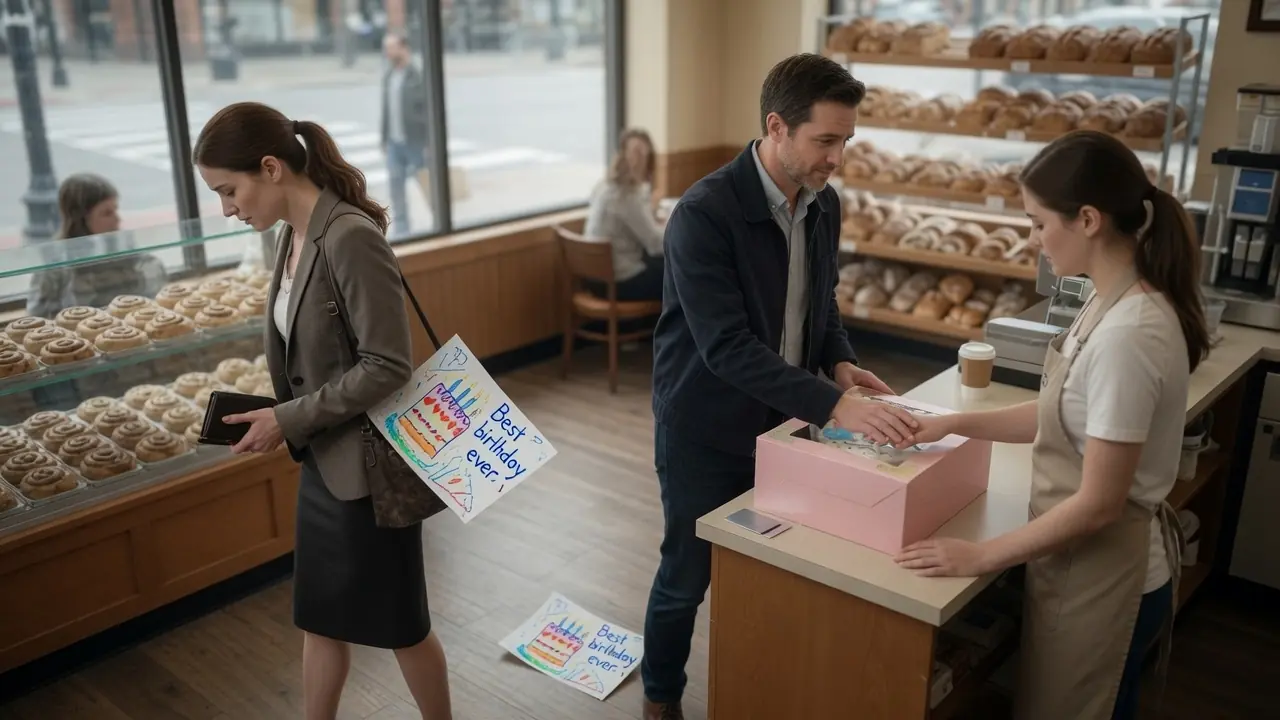
A folded card slipped from her purse and landed near Daniel’s chair.
He picked it up.
Colorful balloons had been drawn across the front in crayon.
Inside, a child had written:
NOAH IS TURNING 7
Beneath the words was a picture of a boy standing beside a giant cake. Seven candles leaned in different directions. The boy had drawn himself with both arms raised.
At the bottom, in smaller letters, he had added:
THIS WILL BE MY BEST BIRTHDAY EVER
Daniel stood.
“Excuse me.”
Rachel turned outside the bakery.
He handed her the invitation.
“You dropped this.”
For a second, she stared at the card as though it were evidence of a failure she had hoped to hide.
Then she accepted it.
“Thank you.”
“Your son drew it?”
“Yes.”
“He’s talented.”
“He thinks every person should have unusually long arms.”
Daniel smiled.
Rachel almost did too.
“Tell him happy birthday,” he said.
“I will.”
She walked toward an aging blue sedan parked across the street.
Daniel watched until she drove away.
When he returned inside, the cake remained on the counter.
The cashier began carrying it toward the refrigerated display.
“Wait.”
She looked up.
Daniel approached.
“How much is left on it?”
“You know her?”
“No.”
The cashier hesitated.
“Seventy-eight dollars.”
Daniel took out his wallet.
“I’ll pay it.”
Her eyebrows rose.
“Are you sure?”
“Yes.”
“Should I tell her who—”
“No.”
The answer came too quickly.
Daniel softened his voice.
“Please don’t tell her.”
The cashier looked toward the window.
“She’ll ask.”
“Tell her there was an accounting mistake.”
“That would be lying.”
Daniel considered this.
“Does the bakery have a community fund?”
“We collect donations for school lunch accounts at Christmas.”
“Then start one for birthdays.”
The cashier smiled faintly.
“With one donor?”
“Every program begins badly.”
She called the manager.
Together, they created a simple explanation. A customer had made an anonymous contribution toward children’s birthday orders. Rachel’s cake had been selected.
Daniel paid for the cake and added another hundred dollars to the envelope the manager placed beneath the register.
“Use that for the next family.”
He collected his coffee and left before Rachel returned.
An hour later, Rachel received the call while folding towels in the supply room of the nursing home.
She assumed the bakery wanted to discuss the lost deposit.
Instead, the manager explained that the remaining balance had been covered through a new community birthday fund.
Rachel sat down on a carton of cleaning supplies.
“There must be a mistake.”
“There isn’t.”
“I didn’t apply for anything.”
“You didn’t need to.”
Rachel pressed one hand against her mouth.
For months, every unexpected phone call had brought another demand.
A late notice.
A school form.
A medical bill left from her husband’s final hospital stay.
A warning light from the car.
She had forgotten that surprises could be kind.
“Who paid for it?”
“The donor asked to remain anonymous.”
Rachel closed her eyes.
“I don’t know whether I can accept that.”
“The cake already has your son’s name on it. Letting it go to waste would help no one.”
She laughed through the beginning of tears.
“That sounds very carefully rehearsed.”
“It is.”
Rachel collected the cake during her lunch break.
She held the box against her chest all the way to the car.
Once inside, she placed it carefully on the passenger seat.
Then she lowered her forehead to the steering wheel and cried.
Not because a birthday cake had solved her problems.
It had not.
She still owed the mechanic.
The rent remained unpaid.
Her second job began in six hours.
But someone had seen one small part of her struggle and decided that Noah’s joy mattered.
For the first time in many months, life had shown her mercy without first demanding proof that she deserved it.
Noah’s birthday party took place that evening in the small apartment Rachel rented above a laundromat.
There were five children from school, paper decorations taped to the walls, and pizzas purchased with a coupon.
Noah wore a cardboard astronaut helmet he had made from a cereal box.
When Rachel carried out the cake, he gasped.
“You got the rocket!”
“I promised.”
He hugged her around the waist.
“You always keep promises.”
Rachel held him tightly enough that he complained.
She smiled against his hair.
“Not always.”
“Yes, you do.”
The children sang.
Noah blew out the candles.
For several hours, the apartment contained no overdue notices, no empty refrigerator shelves, and no questions about what came next.
Only laughter.
Frosting.
Paper rockets.
And a seven-year-old boy convinced that his mother could make anything happen.
Daniel believed his part in the story ended when he paid the bill.
Three days later, Lily changed that.
His nine-year-old daughter stood inside their kitchen surrounded by canned food, cereal boxes, and three bags of rice.
“We have to deliver these tonight.”
Daniel looked over the paperwork from his small construction company.
“To the community center?”
“To families.”
“I thought the school collected the food.”
“They did. Now people have to take it.”
Daniel checked the time.
“Could we do it tomorrow?”
Lily crossed her arms.
Daniel knew the expression. It belonged to Laura.
“You said helping people matters more when it’s inconvenient.”
“I said that?”
“At Thanksgiving.”
“I need to be more careful around you.”
They loaded the food into Daniel’s truck and drove to the Eastwood Community Center.
A volunteer handed them two addresses.
The second was above a laundromat on Turner Street.
Rachel opened the apartment door.
For a moment, neither adult spoke.
Daniel recognized her immediately.
Rachel recognized the man from the bakery sidewalk.
“You found my invitation,” she said.
“And you found my groceries.”
Lily stepped around him holding a cereal box.
“They’re not ours. Our school collected them.”
Noah appeared behind Rachel wearing the cardboard astronaut helmet.
Lily stared.
“Are you an astronaut?”
“Not yet.”
“My dad builds houses.”
Daniel looked down at her.
“That is less impressive than space travel.”
Noah lifted the helmet.
“You can come see my rocket.”
Within minutes, both children disappeared into the apartment.
Rachel looked at the food.
“I didn’t request this.”
“The center assigned your address.”
“I’m working.”
“That wasn’t a criticism.”
She folded her arms.
Daniel understood the defensive movement.
Pride was often the final possession poverty allowed a person to keep.
“If you don’t need it,” he said, “we’ll take it back.”
Rachel looked toward the kitchen.
The refrigerator contained half a gallon of milk, eggs, and the remains of Noah’s cake.
“No.”
She stepped aside.
“We need it.”
Daniel carried the boxes inside.
He noticed the apartment was clean, organized, and carefully maintained. A row of envelopes rested near the telephone, each marked with a due date. Rachel was not irresponsible.
She was simply outnumbered by expenses.
On the wall above the sofa hung a photograph of Rachel beside a man wearing a construction helmet. Noah, much younger, sat on his shoulders.
“Your husband?” Daniel asked.
“Evan.”
“He worked construction?”
“Commercial roofing.”
Daniel nodded.
He remembered the accident.
Three years earlier, a warehouse roof had collapsed during renovation. One worker died.
“I’m sorry.”
Rachel looked toward the photograph.
“Thank you.”
Noah and Lily returned carrying a paper rocket almost as tall as they were.
“It needs wings,” Noah announced.
“Fins,” Lily corrected.
“They look like wings.”
“Rockets don’t have wings.”
Daniel crouched.
“They can have stabilizing fins.”
Noah pointed at him.
“He knows.”
Lily rolled her eyes.
“He builds garages.”
They stayed for twenty minutes.
Then forty.
Rachel made coffee.
The children argued about space.
When Daniel left, Noah asked whether Lily could return.
Rachel and Daniel answered at the same time.
“We’ll see.”
The children interpreted that as yes.
Over the following weeks, their paths crossed repeatedly.
Some meetings were arranged by the children.
Others happened through the community center.
Daniel discovered Rachel worked mornings as a receptionist for an insurance office and evenings as a nursing assistant. She slept five hours on good nights.
Rachel learned Daniel owned Cross Renovation, a small business specializing in restoring old homes. He was not wealthy, though he lived comfortably enough to forget what counting dollars at the grocery store felt like.
Their friendship grew cautiously.
Daniel repaired the broken lock on Rachel’s apartment door after she mentioned it sticking.
She tried to pay him.
He refused.
The following week, Rachel reviewed a stack of invoices Daniel had brought while waiting for the children at the library.
“You’re being overcharged.”
“For what?”
“Lumber deliveries.”
She showed him duplicate fees from a supplier.
Daniel stared at the papers.
“How did you see that?”
“I studied accounting before Noah was born.”
“You work as a receptionist.”
“Life changed.”
Rachel spent two evenings reviewing his business records.
She identified repeated billing errors, unnecessary service charges, and one subcontractor submitting inflated hours.
The corrections saved Daniel nearly twelve thousand dollars.
When he tried to pay her, she shook her head.
“You fixed my door.”
“That took thirty minutes.”
“This took six hours.”
“Then we’re even.”
“We are not.”
Rachel smiled.
“Now you understand how I felt.”
Daniel hired her as a part-time bookkeeper.
She initially refused because she believed the offer was charity.
He placed the corrected invoices in front of her.
“This is not charity. You are better at this than I am.”
“I already have two jobs.”
“This pays more than the evening shift.”
Rachel hesitated.
The nursing home work left her exhausted and kept her away from Noah.
She accepted.
Gradually, the arrangement changed both households.
Rachel organized Daniel’s business finances and created a system he could understand without pretending to enjoy it.
Daniel adjusted her apartment windows before winter and taught Noah how to use basic tools.
Lily spent afternoons beside Rachel learning to bake.
Noah followed Daniel through hardware stores asking questions about everything.
Neither adult called it family.
Not yet.
They were both careful with that word.
Daniel still wore his wedding ring on a chain beneath his shirt.
Rachel kept Evan’s work boots near the apartment door, though no one had worn them in three years.
Grief had not disappeared.
It had simply learned to share space with daily life.
One evening in December, snow began falling while the four of them decorated cookies in Daniel’s kitchen.
Lily played music from a small speaker.
Noah used too much frosting.
Rachel laughed when Daniel produced a cookie shaped vaguely like a horse.
“That is supposed to be a reindeer.”
“It has no antlers.”
“They broke.”
“You never made them.”
“The structural integrity was poor.”
Rachel looked at him.
“You blame engineering for everything.”
“Engineering is usually responsible.”
The children ran into the living room to watch a holiday movie.
Rachel began washing bowls.
Daniel stood beside her.
“You don’t have to clean.”
“I know.”
“Then why are you?”
“Because your kitchen looks like frosting exploded in it.”
He handed her a towel.
For several minutes, they worked in comfortable silence.
Then Rachel noticed the photograph near the window.
Laura sat on a beach beside a younger Lily. Daniel stood behind them with both hands on their shoulders.
“She was beautiful,” Rachel said.
“Yes.”
“Do you still talk to her?”
Daniel looked toward the photograph.
“Sometimes.”
Rachel waited.
“Mostly when I’m angry,” he continued. “I tell her what she missed. School plays. Lost teeth. Lily learning to ride a bicycle.”
“Does it help?”
“No.”
“Then why do it?”
“Because anger is easier than admitting I still need her.”
Rachel dried one plate slowly.
“I talk to Evan when something breaks.”
Daniel looked at her.
“He could fix anything,” she explained. “I still find myself thinking I’ll wait until he comes home.”
“Then you remember.”
“Every time.”
Their eyes met.
There was no dramatic shift.
No sudden certainty.
Only recognition.
Two people who understood that loving someone new did not erase the person who died.
Daniel reached for her hand.
Rachel allowed him to hold it.
Nothing more happened that night.
Their first kiss came nearly two months later.
It occurred in the parking lot outside Noah’s school after a winter concert.
Noah had forgotten half the words.
Lily sang loudly enough for three children.
The four of them walked toward their cars beneath light snow.
Rachel slipped.
Daniel caught her.
They laughed.
Then stopped.
His hand remained at her waist.
Rachel’s fingers rested against his coat.
“Is this a bad idea?” she whispered.
“Probably.”
“We have children.”
“I noticed.”
“We’re both carrying too much.”
“Also noticed.”
“If it goes wrong—”
“It could hurt them.”
Rachel looked toward Noah and Lily, who were attempting to catch snowflakes with their tongues.
Daniel released her slightly.
“We don’t have to.”
Rachel considered the life she had built around caution.
Then she kissed him.
It was brief.
Gentle.
Less like the beginning of a romance than the acknowledgment of one that had already been developing in ordinary rooms.
They told the children nothing for several weeks.
The children already knew.
“You look at my mom differently,” Noah told Daniel one Saturday.
“How?”
“Like when you’re checking whether a wall is straight.”
Daniel frowned.
“That does not sound romantic.”
Noah shrugged.
“You look for a long time.”
Lily was more direct with Rachel.
“My dad likes you.”
“What makes you think that?”
“He cleans before you visit.”
Their relationship did not solve every problem.
Rachel’s car failed again.
A major client delayed payment to Daniel’s company.
Noah had difficulty at school after another child told him Daniel was trying to replace his father.
Lily became frightened that loving Rachel meant betraying her mother.
They attended family counseling.
They spoke honestly even when honesty created uncomfortable evenings.
Daniel never asked Noah to call him Dad.
Rachel never removed Laura’s photographs.
They did not merge their lives because loneliness made it convenient.
They did it slowly because trust required evidence.
One year after the morning at the bakery, Noah turned eight.
Rachel returned to Maple Hearth to order another cake.
This time, she had enough money.
The same cashier recognized her.
“You want the rocket again?”
“No. He wants Saturn.”
“That sounds more complicated.”
“He has become demanding with age.”
Daniel entered carrying coffee.
Rachel looked from him to the cashier.
The woman’s expression changed.
Understanding moved across her face.
“Oh,” she said.
Rachel noticed.
“What?”
The cashier looked at Daniel.
He shook his head slightly.
Too late.
Rachel became still.
“You paid for the cake.”
Daniel did not answer immediately.
The silence confirmed it.
Rachel looked toward the pink boxes behind the counter.
“You were the anonymous donor.”
“Yes.”
“Why didn’t you tell me?”
“Because it wasn’t supposed to become a debt.”
Her face tightened.
“You watched me come back.”
“I was in my truck.”
“You watched me cry?”
“I didn’t intend to.”
Rachel stepped away from the counter.
Daniel followed her outside.
“I did not want you to feel ashamed.”
“So you lied.”
“The bakery manager created the explanation.”
“And you allowed it.”
“Yes.”
Rachel crossed her arms against the cold.
“I have spent a year believing some community program helped us.”
“There is one now.”
“What?”
“The bakery kept the fund. Other customers contribute.”
“That is not the point.”
“I know.”
“Do you?”
Her anger came not from the money.
It came from remembering how powerless she had felt that day.
Daniel’s silence had allowed her to believe the kindness came from nowhere. Learning it came from a man now deeply involved in her life changed the memory.
“I would have thanked you,” she said.
“I didn’t want thanks.”
“That was not your decision to make.”
Daniel looked down.
She was right.
“I’m sorry.”
Rachel expected explanation.
Defense.
Instead, he simply accepted the fault.
“I wanted to protect your dignity,” he said. “But I decided what dignity should look like for you. That was wrong.”
Her anger softened, though it did not disappear.
“I’m still upset.”
“You should be.”
“I may remain upset all day.”
“I’ll prepare.”
She looked through the bakery window.
The cashier was pretending not to watch.
“Did you really start the fund?”
“With one hundred dollars.”
“How many cakes has it paid for?”
“Twenty-three.”
Rachel closed her eyes briefly.
A single act had continued without either of them noticing.
“I hate that this makes it harder to stay angry.”
“I can do something irritating.”
“You usually do.”
They returned inside.
Rachel ordered the Saturn cake.
Before leaving, she added fifty dollars to the community fund.
Noah’s eighth birthday took place at a small planetarium.
Lily gave him a model rocket.
Daniel helped assemble it.
Rachel carried out the cake.
This time, she did not need mercy.
But she remembered the year she had.
Months later, Daniel proposed in the kitchen while Rachel was reviewing quarterly expenses.
There was no expensive restaurant.
No public audience.
He placed a small ring beside the calculator.
Rachel looked at it.
“Is this a business expense?”
“I asked my accountant. She said no.”
“She sounds competent.”
“She is terrifying.”
Daniel became serious.
“I don’t want to replace Evan.”
Rachel’s expression changed.
“I don’t want you to.”
“And I don’t want you to replace Laura.”
“I couldn’t.”
“I want us to build something that respects what came before without living entirely inside it.”
Rachel looked toward the living room.
Noah and Lily were doing homework at the same table, arguing over colored pencils.
“What exactly are you proposing?”
“A complicated household.”
“We already have one.”
“A permanent complicated household.”
She smiled.
“That is the least romantic proposal I have ever heard.”
“I could mention sunsets.”
“You don’t like sunsets.”
“I’m willing to learn.”
Rachel held out her hand.
Daniel slid the ring onto her finger.
“Yes,” she said.
They married the following spring in the community-center garden.
The ceremony was small.
Noah carried the rings.
Lily read a passage from one of Laura’s favorite books.
Rachel placed a small photograph of Evan near the flowers.
Nobody pretended the absent parents had been erased.
They were part of the path that brought everyone there.
After the ceremony, Maple Hearth Bakery delivered the cake.
Pink boxes filled one table.
Instead of gifts, Daniel and Rachel asked guests to contribute to the bakery’s birthday fund.
The donations paid for cakes throughout the following year.
At the reception, Noah stood beside Daniel.
“Did you buy my cake when I was seven?”
Daniel looked down.
“Your mother told you?”
“I heard you talking.”
“Yes.”
“Why?”
Daniel considered offering a simple answer.
Instead, he told the truth.
“Because your mother looked like she had been carrying too much by herself.”
Noah looked toward Rachel, who was dancing badly with Lily.
“She’s strong.”
“Yes.”
“Then why did she need help?”
Daniel crouched until they were eye level.
“Strong people need help too.”
Noah considered this.
“Did she help you?”
Daniel looked across the garden.
Rachel had found the billing mistakes that nearly damaged his business. She helped Lily speak about her mother without fear of making Daniel sad. She brought warmth into rooms he had allowed grief to keep quiet.
“She helped me more than I knew I needed.”
Noah nodded.
“That seems fair.”
Years later, people who heard their story often described it incorrectly.
They said Daniel rescued a struggling widow by purchasing her son’s cake.
That was only the beginning.
He bought one cake.
Rachel saved his business thousands of dollars.
He repaired a door.
She taught his daughter that remembering one mother did not prevent her from loving another.
He gave Noah tools.
Rachel gave Daniel permission to grieve without pretending strength meant silence.
They did not save each other.
They noticed each other.
That was different.
The pink cake box had contained sugar, flour, frosting, and a small chocolate rocket.
It did not contain destiny.
It did not solve rent, loss, parenthood, fear, or loneliness.
But it created a pause.
One morning when Rachel believed the world would demand more than she had left, a stranger quietly made one burden lighter.
That pause gave her enough room to breathe.
Years later, on Noah’s fifteenth birthday, Rachel found the original invitation inside a drawer.
The crayon balloons had faded.
The stick figure still raised impossibly long arms beside the giant cake.
At the bottom, Noah’s careful childhood handwriting remained:
THIS WILL BE MY BEST BIRTHDAY EVER
Rachel carried the card into the kitchen.
Daniel was preparing coffee.
“Do you remember this?”
He looked at it.
“I remember picking it up.”
“You almost kept walking.”
“I almost did.”
“What changed your mind?”
Daniel poured two cups.
“Laura used to say kindness becomes useless when postponed.”
Rachel smiled.
“I wish I had known her.”
“She would have liked you.”
“You don’t know that.”
“I do.”
Rachel placed the invitation on the refrigerator.
Outside, Noah and Lily argued while loading camping equipment into Daniel’s truck.
The house was loud.
Complicated.
Crowded with photographs belonging to more than one life.
Rachel looked around.
There had been a time when she believed accepting help meant admitting failure.
Now she understood that no family was built by one person carrying everything alone.
Sometimes love began dramatically.
With music.
With instant certainty.
With a moment people could easily recognize.
Theirs began more quietly.
With a woman pushing away a birthday cake.
A man noticing.
And one small decision made before he could convince himself that someone else would help.
The cake did not change two families forever.
People did that.
Slowly.
Awkwardly.
By showing up.
By apologizing.
By accepting that strong people could still need support.
And by learning that dignity was not the refusal of kindness.
Sometimes dignity was being seen clearly in a difficult moment—and discovering that the person who saw you did not think less of you for needing help.