The clerk lifted his gavel.
Adelaide Morgan knew exactly what that meant.
One more decision.
One more signature.
And then someone would begin deciding which of her children went where.
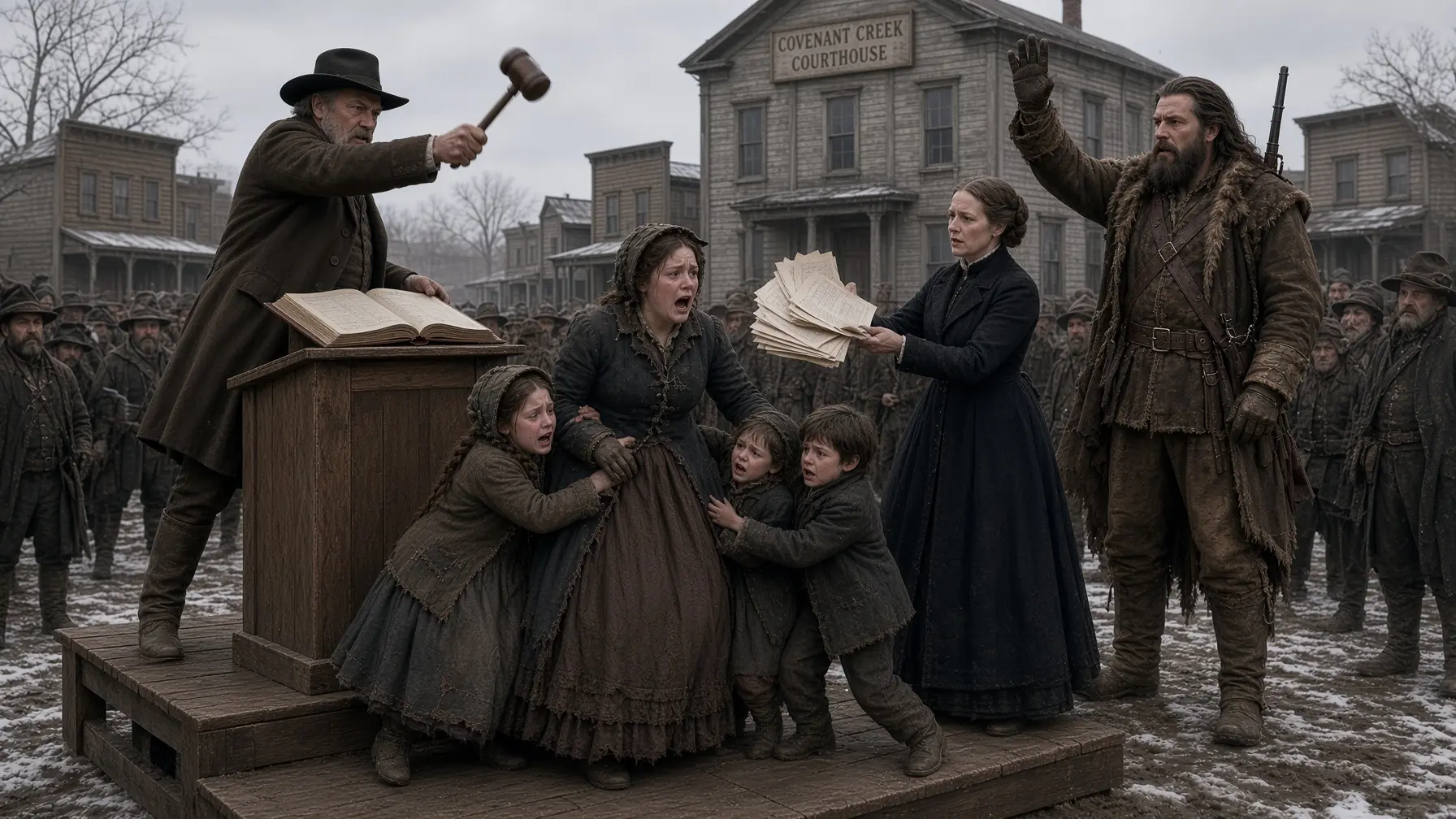
Seven small bodies crowded against her coat on the courthouse steps in Covenant Creek, Wyoming Territory, while January wind swept dirt and snow across the street.
Her oldest daughter, Eliza, thirteen, stood rigid at Adelaide’s right side.
Henry, eleven, was trying very hard to look older.
Samuel and Owen watched the crowd with the distrust of boys who had learned too quickly that adults with papers could be more frightening than strangers with guns.
Ruth and Nell held hands.
Three-year-old Toby hid behind Adelaide’s skirt.
Inside the courthouse, the county guardianship board had spent nearly two hours discussing Adelaide’s future as though she were not sitting ten feet away.
Widow.
Thirty-two.
No property.
No local relatives.
Seven dependent children.
Less than nine dollars remaining after railroad fare and boarding costs.
The facts sounded terrible when read aloud.
They sounded even worse when men began attaching conclusions to them.
One rancher had offered to take Henry and Samuel as hired boys.
Another family said they could accept the two youngest girls.
A church household west of town might take Toby.
Eliza, because she was thirteen and “useful,” could probably be placed as a domestic servant.
Adelaide listened to the officials divide her children into practical categories.
Strong boys.
Young girls.
Toddler.
Older girl.
Not once did anyone use the word family.
Then the county clerk announced one final option.
A household contract.
A local unmarried landholder could assume legal responsibility for Adelaide and all seven children if Adelaide consented to marriage and the man satisfied the court that he had land, provisions, and no outstanding criminal warrant.
It was not an auction.
No one was buying Adelaide.
But standing there while men looked her over and decided whether eight mouths were worth supporting did not feel much different.
The clerk read the requirement twice.
“If no qualified household agrees to take responsibility by sundown, the board will proceed with separate placements.”
Toby began crying quietly.
Adelaide crouched.
“Hush, sweetheart.”
“Are they taking us?”
“No.”
She touched his cold cheek.
“No one is taking you.”
She said it because he needed to hear it.
Not because she knew how to make it true.
Forty-six men had already declined.
Some politely.
Some not.
One said seven children were enough to ruin a good ranch in a year.
Another looked at Adelaide’s broad hips and thick waist, then muttered that he had asked for a wife, not another draft horse.
A third laughed.
“Too much woman and too many brats.”
Adelaide heard all of it.
She did not cry.
She had cried enough in Philadelphia.
When influenza took her husband, Joseph, two winters earlier.
When the textile mill cut her hours.
When rent increased.
When the landlord threatened to put their belongings on the street.
When she sold Joseph’s watch.
Then the furniture.
Then her wedding silver.
Tears had never once produced bread.
So Adelaide stood straight.
Her wool coat had been mended three times.
Her gloves were thin.
She was tired enough to feel it in her teeth.
But when men looked at her as though poverty had made her less human, she met their eyes until they looked away.
The clerk cleared his throat.
“One final call.”
Nobody moved.
Adelaide felt Eliza’s hand find hers.
“Mother?”
Adelaide squeezed back.
“It’s all right.”
Eliza whispered:
“No, it isn’t.”
No.
It wasn’t.
Behind the clerk stood Mrs. Delia Cromwell of the Territorial Aid Society.
In her hands were the placement forms.
Seven separate files.
Adelaide looked at them.
Then at her children.
She had crossed more than eighteen hundred miles because a widow-assistance circular promised work and settlement opportunities in the West.
The circular had not mentioned what happened when no household wanted a widow with seven children.
The clerk lifted the gavel.
“If no qualified petitioner comes forward—”
“I will.”
The voice came from the back of the crowd.
Deep.
Rough.
Not loud.
The street still went silent.
Men turned.
Then moved aside.
The man approaching looked as though he had been carved out of the mountains beyond town.
Tall.
Broad.
Dark hair touching his collar, streaked heavily with gray.
Buckskin coat.
Heavy boots.
A faded scar running from his right temple almost to the jaw.
He carried no visible sidearm, but a rifle remained strapped to his saddle at the hitching post.
People whispered immediately.
“Ronan McCrae.”
“Jesus.”
“Mountain man.”
Adelaide had heard the name.
Everyone arriving in Covenant Creek eventually did.
Ronan McCrae lived nearly two days into the northern mountains.
Former Union scout.
Trapper once.
Now cattle, timber, horses.
Rarely came to town.
Never attended church.
Had supposedly killed three men in one winter.
Or five.
Or twelve.
Depending on who told it.
One shopkeeper claimed he buried strangers on his land.
Another swore McCrae had been hunted by federal marshals after the war.
Nobody seemed to know why a man supposedly wanted by the law bought supplies openly under his own name.
Facts rarely improved frontier gossip.
Ronan stopped before the clerk.
The clerk stared.
“You’re volunteering to enter household responsibility?”
“I heard the question.”
“You understand Mrs. Morgan has seven children.”
Ronan looked toward Adelaide.
Then the children.
His gaze moved slowly across them.
Not judging beauty.
Not counting cost.
Assessing.
Adelaide recognized the look because she used it herself before buying potatoes.
What is healthy?
What is damaged?
What can be carried?
What needs immediate attention?
Then Ronan looked at her.
“How old is the youngest?”
“Three.”
“Oldest?”
“Thirteen.”
“You read?”
Adelaide blinked.
“Yes.”
“Numbers?”
“Yes.”
“Cook?”
“Yes.”
“Keep accounts?”
“I managed my husband’s delivery books before he died.”
“Preserve food?”
“Yes.”
“Stitch?”
“Yes.”
“Handle animals?”
“Not cattle.”
“Horses?”
“A little.”
Ronan nodded.
Then looked at Henry.
“You willing to work?”
Henry’s chin lifted.
“Yes, sir.”
“Can you swing an axe?”
“No, sir.”
“Good.”
Several men laughed.
Henry looked embarrassed.
Ronan continued:
“Means nobody taught you wrong yet.”
The laughter stopped.
He looked back at the clerk.
“What does the court require?”
The clerk recovered.
“Proof of sufficient land and provisions.”
Ronan pulled a folded document from inside his coat.
Deed.
Tax receipts.
Livestock inventory.
The clerk read.
His eyebrows rose.
“You own this outright?”
“Yes.”
“No mortgage?”
“No.”
“Livestock?”
“Twenty-three cattle. Six horses. Chickens. Two milk cows.”
“Cabin capacity?”
Ronan hesitated.
“Not enough.”
The clerk looked up.
“Then—”
“I have a loft and a second room.”
“For eight people?”
“For winter.”
Ronan continued.
“I can add two rooms before thaw.”
The clerk stared.
“You’re seriously offering to take responsibility for all seven children?”
“All.”
A man near the back called:
“McCrae, you’ll regret that before spring!”
Ronan did not turn around.
“Good thing it’s not your problem.”
The clerk cleared his throat.
“There is also the marriage requirement.”
Ronan’s expression tightened.
“So I heard.”
He looked toward Adelaide.
For the first time, something almost like uncertainty appeared on his face.
“Mrs. Morgan.”
She stepped forward.
He spoke low enough that only the nearest people heard.
“I’m not asking you to pretend this is romance.”
Adelaide appreciated that immediately.
“I need someone capable of running a household and keeping books.”
“I have land.”
“Food.”
“Work.”
“Your children stay together.”
His eyes held hers.
“But you should know what you’re agreeing to.”
“Winters are hard.”
“Nearest doctor is hours away.”
“House is isolated.”
“Everyone works according to age.”
“I don’t beat children.”
“I don’t drink.”
“I don’t tolerate cruelty in my house.”
He paused.
“And I will not force a husband’s rights on a woman who came to me because officials put a clock on her.”
Adelaide stopped breathing.
The crowd had become irrelevant.
Ronan continued.
“If you choose this, we enter the contract.”
“But you keep your own room until you decide otherwise.”
Mrs. Cromwell looked sharply toward him.
The clerk frowned.
“That is not customary.”
Ronan finally looked at him.
“Neither is splitting seven children because their mother is poor.”
Nobody answered.
Adelaide looked at her children.
Seven faces.
Then Ronan.
“What do you get?”
He considered.
“A functioning household.”
“Help with livestock accounts.”
“Food that didn’t come out of a skillet.”
A few men laughed.
Ronan ignored them.
“And noise.”
Adelaide frowned.
“Noise?”
“My place has been quiet ten years.”
Something in the way he said it made the word feel heavier than loneliness.
Adelaide extended her hand.
“I accept.”
Ronan looked at it.
Then took it.
His palm was rough and warm.
No squeezing.
No claiming.
Just agreement.
The gavel came down.
And for the first time that day, Adelaide heard the sound without feeling that someone was taking something from her.
Mrs. Cromwell pulled Adelaide aside while the clerk prepared the documents.
“You know nothing about him.”
“I know he kept my children together.”
“There are stories.”
“There are stories about me too.”
Mrs. Cromwell frowned.
“Such as?”
“That I’m lazy because I’m heavy.”
“Desperate because I’m poor.”
“Unfit because I have too many children.”
Adelaide looked toward Ronan.
“He answered more questions honestly in five minutes than most men here answered all morning.”
“That doesn’t make him safe.”
“No.”
Adelaide nodded.
“But neither does wearing a clean coat.”
Mrs. Cromwell had no answer.
The marriage certificate was signed in the courthouse.
No flowers.
No kiss.
No congregation.
Ronan signed first.
Adelaide signed second.
When the clerk asked whether she understood that she would legally become Adelaide McCrae, her hand trembled.
Not because she loved the man.
Because names carried endings.
Hayes had been Joseph’s.
Now even that would change.
Ronan noticed.
He said quietly:
“You can keep Morgan if you want.”
The clerk looked annoyed.
Adelaide looked at him.
“You mean that?”
“It’s your name.”
She swallowed.
“I’ll use McCrae where the law requires.”
“But the children keep Morgan.”
Ronan nodded immediately.
“Fine.”
The clerk muttered something about complications.
Ronan paid the settlement fees.
Then turned toward the door.
“We leave within the hour.”
Adelaide blinked.
“Today?”
“Storm coming tomorrow.”
“Road will close if we wait.”
He looked at the children.
“Feed them before we go.”
That was the first order he gave as her husband.
Feed them.
Adelaide decided she could tolerate that.
Ronan’s wagon was built for freight, not comfort.
He had added blankets before arriving.
A canvas cover.
Two crates of dried food.
Extra mittens.
Adelaide noticed the mittens.
Different sizes.
He had bought them that morning.
He had known before stepping forward that children might come with her.
Or perhaps he had been considering it longer than he admitted.
The thought unsettled her.
As they left Covenant Creek, people watched.
Some curious.
Some amused.
Some openly pitying.
Adelaide did not look back.
By afternoon the town had disappeared behind rolling sage country.
Then foothills.
Then pine.
The children spoke quietly at first.
Toby fell asleep in Eliza’s lap.
Henry sat near Ronan on the wagon bench.
After two hours, he asked:
“Did you really kill twelve men?”
Adelaide nearly choked.
“Henry!”
Ronan continued driving.
“No.”
Henry looked disappointed.
“How many?”
“Henry.”
Ronan glanced at Adelaide.
“Two.”
The wagon became silent.
Then Ronan added:
“In war.”
Henry swallowed.
“Oh.”
“Any outside war?”
“No.”
“Town says—”
“Town says many things.”
Adelaide looked at Ronan.
“So the stories are wrong.”
“Some.”
“Which ones are true?”
He considered.
“I keep to myself.”
“Yes.”
“I was a scout.”
“Yes.”
“I don’t like crowds.”
“Yes.”
“I broke a man’s jaw in Covenant Creek seven years ago.”
Henry leaned forward.
“Why?”
“He hit his wife.”
Adelaide looked away so Ronan would not see her expression change.
Near sunset, they camped beneath pines.
Ronan built the fire.
Adelaide cooked beans with salt pork.
Ruth whispered:
“He eats a lot.”
Ronan heard.
“Yes.”
Ruth went red.
He handed her his bowl.
“You want some?”
She shook her head violently.
Ronan almost smiled.
That night he slept outside near the horses while Adelaide and the children used the wagon.
She woke once.
Saw him sitting beside the dying fire.
Rifle across his knees.
Watching the dark.
He had said he wanted noise.
Yet he seemed built for silence.
The storm arrived before dawn on the second day.
Snow came hard.
Sideways.
Within an hour, wagon tracks disappeared behind them.
Ronan’s posture changed immediately.
Adelaide noticed.
He knew the mountains.
That made his concern frightening.
“We need shelter.”
“How far?”
“Old trapping cabin.”
“Half mile if I read the ridge right.”
“If?”
“Storm changes distance.”
The wagon slid once.
Children screamed.
Ronan calmed the horses without shouting.
“Easy.”
“Easy, boys.”
Something about that surprised Adelaide.
Joseph had been kind, but impatient with animals.
Most men she knew used volume when afraid.
Ronan became quieter.
He guided them through trees until a log structure emerged from the white.
Half buried.
Leaning.
Alive enough.
He carried Toby inside first.
Then Nell.
Then Ruth.
The older children stumbled after him.
Adelaide slipped at the doorway.
Ronan caught her elbow.
Not waist.
Not body.
Elbow.
He released immediately after she was steady.
Inside, they found a stone hearth.
Dry wood beneath a bench.
Ronan started a fire.
Adelaide unpacked food.
Eliza helped.
Henry watched Ronan.
“You always know what to do?”
Ronan looked at him.
“No.”
“You look like you do.”
“That’s different.”
Henry considered that.
The storm trapped them for two days.
Something changed there.
Not love.
Trust.
Small pieces.
Ronan gave Adelaide and the children the warmest sleeping space.
He took the floor near the door.
When Toby cried at night, Ronan did not complain.
When Nell spilled broth, he handed her a rag without anger.
When Samuel asked six consecutive questions about the rifle, Ronan answered four before finally saying:
“Ask me the other two tomorrow.”
The second morning, heavy snow threatened the cabin roof.
Ronan prepared to go outside.
Henry stood.
“I’ll help.”
Adelaide immediately said:
“No.”
Ronan looked at Henry.
“How old?”
“Eleven.”
“Strong enough to shovel?”
“Yes.”
“Smart enough to come in when told?”
Henry hesitated.
Ronan nodded.
“That hesitation worries me.”
Henry almost smiled.
Adelaide stepped closer.
“Is it safe?”
“No.”
Ronan answered honestly.
“But manageable.”
He showed Henry how to wrap his scarf.
How to plant his feet.
How to lift snow instead of throwing his back into it.
Adelaide watched through the small window.
Henry had spent two years trying to become the man of the family.
Ronan never treated him as one.
He treated him as a boy learning useful work.
That difference mattered.
When they came inside, Ronan said:
“He listens well.”
Henry glowed.
Adelaide had not seen that expression since Joseph died.
That evening, after the younger children slept, Adelaide repaired Eliza’s torn skirt beside the fire.
Ronan sharpened a knife near the door.
“Why were you in town?”
She asked.
“Supplies.”
“That’s not all.”
His hand stopped.
Adelaide waited.
Finally:
“I heard about the settlement gathering.”
“You went looking for a wife?”
“No.”
He resumed sharpening.
“Then why?”
“My place is too quiet.”
Adelaide looked up.
Ronan’s eyes remained on the blade.
“My younger brother lived with me after the war.”
“What happened?”
“Fever.”
“How long ago?”
“Ten years.”
That explained the silence.
“I thought maybe I’d see if there was someone who could tolerate the mountains.”
“You watched forty-six men refuse me?”
“Yes.”
“Why didn’t you step forward earlier?”
His jaw tightened.
“Because I hated what the whole thing was.”
Adelaide waited.
“Women standing there while men decided whether they were worth feeding.”
“You were one of the men.”
“I know.”
“That’s why I stayed in back.”
“Then why finally speak?”
Ronan looked toward the sleeping children.
“Because those officials started talking about separating them.”
His voice became harder.
“I know what it is to lose family.”
“That was enough.”
Adelaide’s needle stopped.
“No.”
“What?”
“That wasn’t the only reason.”
Ronan looked at her.
“What else?”
“You watched me.”
“Yes.”
“What did you see?”
Ronan thought a long time.
“A woman everyone insulted who still fixed her daughter’s scarf.”
“A mother scared half to death who kept telling her children the truth except where hope required a small lie.”
“You didn’t beg any man.”
“You didn’t flatter.”
“You looked at every one of them like they were the ones being evaluated.”
Adelaide’s throat tightened.
Ronan added:
“I thought you might survive the mountain.”
She almost laughed.
“That is the least romantic thing anyone has ever said to me.”
“I warned you.”
“Yes.”
“And somehow…”
She looked at him.
“It was better than the romantic lies.”
For the first time, Ronan smiled fully.
It changed his face.
Made him look younger.
Adelaide looked back down at her sewing.
Her hands were no longer steady.
The storm passed the following morning.
They traveled another four hours before Ronan suddenly raised one hand.
“Quiet.”
The children obeyed.
He looked behind them.
Adelaide heard it next.
Hooves.
Fast.
Three riders emerged between the trees.
Ronan muttered:
“Damn.”
“Who?”
“Buford Sykes.”
The name meant nothing to Adelaide.
Ronan’s expression said enough.
“What does he want?”
“Usually money.”
“And today?”
Ronan looked at her.
“I don’t know.”
The riders caught them at a narrow bend.
Buford Sykes was forty or so.
Thin face.
Scar on his cheek.
Expensive pistol.
Eyes Adelaide distrusted immediately.
He smiled at Ronan.
“Heard you got married.”
Ronan’s hand remained near the rifle.
“News travels.”
Sykes looked into the wagon.
His gaze lingered on Adelaide.
Then Eliza.
Adelaide moved slightly, blocking his view.
“Seven kids too.”
Sykes laughed.
“You always did like punishment.”
“State your business.”
“I heard the Aid Society had that widow scheduled for placement.”
“She was.”
“Man down in Cheyenne said there was money for strong boys.”
Henry stiffened.
Adelaide felt cold.
Ronan’s voice changed.
“Ride away.”
Sykes smiled.
“Easy.”
“I’m just saying you took property out of circulation.”
Adelaide spoke before Ronan could.
“We are not property.”
Sykes looked at her as though noticing furniture had spoken.
“Ma’am, out here everything belongs to whoever can hold it.”
Ronan lifted the rifle slightly.
“That philosophy is about to become expensive.”
Sykes’s men shifted.
For several seconds, nobody moved.
Then Sykes reached toward his coat.
Ronan raised the rifle.
Adelaide grabbed Toby.
The horses danced.
One of Sykes’s men suddenly said:
“Buford.”
Warning.
Sykes stopped.
Ronan’s barrel remained steady.
“You want to test whether the stories are true?”
Silence.
Sykes looked at him.
Then at the children.
His smile disappeared.
“Another time.”
“No.”
Ronan’s voice remained flat.
“There is no another time.”
“You come near my land, my wife, or these children again, I take your name to the territorial marshal with what I know about the stolen horses outside Laramie.”
Sykes’s face changed.
Adelaide noticed.
So did his men.
One said:
“You told us those weren’t stolen.”
Sykes snapped:
“Shut up.”
Ronan smiled without humor.
“Ride.”
They did.
No gunfight.
No bodies in the snow.
Just three men disappearing down the trail after learning Ronan McCrae knew exactly which lawmen to speak to.
Adelaide released a breath.
“You could have killed them.”
“Yes.”
“But you didn’t.”
“No need.”
She looked at him.
“Town stories leave that part out.”
“Town likes endings with blood.”
Ronan flicked the reins.
“So do boys.”
Henry looked offended.
Then admitted:
“A little.”
The McCrae homestead appeared shortly after noon.
Adelaide expected a crude cabin.
Instead she saw a carefully built valley holding.
Large log house.
Barn.
Smokehouse.
Workshop.
Fenced pasture.
Root cellar.
Stacks of seasoned firewood covered against snow.
Nothing decorative.
Everything maintained.
The children stared.
Toby whispered:
“Is this ours?”
Ronan heard.
He looked toward Adelaide before answering.
“If your mother says yes.”
That mattered too.
Adelaide climbed down.
Ronan opened the cabin door.
Inside were two downstairs rooms and a loft.
Clean.
Sparse.
A woodstove.
Heavy table.
Shelves of preserved food.
One bedroom.
Ronan pointed.
“You and the girls take that.”
“Boys in the loft.”
“I’ll sleep near the stove.”
Adelaide frowned.
“This is your bedroom.”
“Was.”
“No.”
He looked at her.
“No?”
“I’m not throwing you out of your own bed.”
“You have three girls.”
“You have a back that needs a mattress.”
He almost smiled.
They compromised.
Adelaide and the girls took the room.
Ronan added a cot near the workshop until spring.
The marriage remained on paper.
Everything else began as work.
The first month was hard.
Ruth cried for Philadelphia.
Owen hated collecting eggs.
Eliza resented Ronan for existing.
Henry worshiped him.
Samuel broke a lantern.
Nell developed a cough.
Toby wet the bed twice.
Adelaide burned bread because Ronan’s oven ran hotter than hers.
Ronan tried cooking breakfast once.
Nobody allowed him a second attempt.
Then routines formed.
Adelaide discovered his account books were a disaster.
“You’ve written ‘feed’ for six different purchases.”
“It was feed.”
“For horses?”
“Yes.”
“Cattle?”
“Yes.”
“Chickens?”
“Yes.”
She stared.
“You need categories.”
“I need fewer animals.”
“You need categories.”
She won.
Ronan discovered Adelaide could calculate winter stores almost without pencil.
She could turn cheap cuts into supper.
Repair clothing.
Teach Ruth letters.
Calm Toby’s nightmares.
And she was stronger than men assumed.
Not because she could lift the most.
Because she did not stop.
Spring came late.
Ronan began building two extra rooms exactly as promised.
Henry helped.
Samuel carried nails.
Owen complained about carrying nails.
Eliza slowly stopped glaring whenever Ronan entered the house.
One afternoon Adelaide found him teaching her to use a plane on a piece of pine.
“You’re holding it wrong,” he said.
Eliza snapped:
“I’m not.”
“You are.”
“I know how.”
“Then why is the board shaped like Wyoming?”
Adelaide covered a laugh.
Eliza looked at her.
“Mother.”
“Sorry.”
Ronan handed the plane back.
“Again.”
Eliza tried.
Better.
He nodded.
“There.”
No praise beyond that.
Eliza smiled anyway.
The truth about Ronan’s reputation arrived in May.
A territorial marshal rode into the valley.
Adelaide’s heart stopped when she saw the badge.
Ronan simply said:
“Coffee?”
The marshal accepted.
His name was Isaac Bell.
He had served with Ronan during the war.
Over supper Adelaide finally asked.
“Were you ever wanted?”
Isaac laughed so hard he nearly choked.
Ronan looked annoyed.
“People in Covenant Creek say—”
“People in Covenant Creek couldn’t find truth with a lantern.”
Isaac wiped his eyes.
“Ronan tracked deserters and horse thieves for the Army.”
“After the war, he testified against two men who later got friends to spread stories that he’d murdered civilians.”
Adelaide looked at Ronan.
“You never corrected anybody?”
“What for?”
“So people would know.”
“I know.”
Isaac shook his head.
“This is what he does.”
Ronan looked at him.
“Eat.”
The mystery disappeared that evening.
Adelaide discovered she was almost disappointed.
Not because she wanted him dangerous.
Because people often preferred dramatic explanations for solitude.
The truth was simpler.
Ronan had lost a brother.
Lost friends in war.
Disliked crowds.
Stayed home.
The town converted silence into menace because silence refused to defend itself.
Adelaide understood that better than most.
Their marriage changed slowly.
First came shared jokes.
Then the habit of sitting together after the children slept.
Then Ronan began bringing Adelaide small things from town.
Needles.
A better ledger.
Tea because he noticed she drank it when nervous.
Never jewelry.
Never flowers.
Useful things.
Adelaide liked that.
One night in June, they sat on the porch watching lightning far beyond the mountains.
Ronan said:
“You regret it?”
“What?”
“Choosing this.”
Adelaide looked toward the house.
Laughter came through an open window.
Henry and Samuel arguing.
Eliza correcting them.
Toby shouting something incomprehensible.
“No.”
Ronan nodded.
She looked at him.
“Do you?”
“No.”
“That was fast.”
“I decided months ago.”
“When?”
“The storm cabin.”
“Why?”
“You yelled at Henry for putting wet socks too close to the fire.”
Adelaide stared.
“That convinced you?”
Ronan smiled.
“Sounded like home.”
She laughed.
Then became quiet.
“Ronan.”
“Yes?”
“We are married.”
“So the papers insist.”
“I’m serious.”
He looked at her.
She continued.
“You kept your promise.”
“No force.”
“No expectation.”
“You gave me time.”
He said nothing.
Adelaide reached for his hand.
This time she chose it.
Not because a clerk waited.
Not because children might be taken.
Because she wanted to.
Ronan stared at their hands.
Then at her.
“Are you certain?”
“Yes.”
He leaned toward her slowly enough that she could stop him.
She did not.
Their first kiss was quiet.
Brief.
Nothing like rescue.
Better.
Choice.
Years later, people still told the story incorrectly.
They said Ronan McCrae bought an unwanted widow and seven children at auction.
Adelaide corrected anyone foolish enough to say it in front of her.
“I was not livestock.”
They said he paid three hundred dollars for her.
“No.”
“He paid fees so officials wouldn’t scatter my children.”
They said he rescued her.
Adelaide disliked that one too.
“He gave us a place.”
“We built the rest together.”
The seven Morgan children grew.
Eliza became a teacher.
Henry took over most of the cattle operation.
Samuel became a carpenter.
Owen surprised everyone by becoming a doctor.
Ruth married a blacksmith.
Nell ran the household books better than Adelaide ever had.
Toby remembered almost nothing of Philadelphia.
When asked about his childhood, he described mountain snow, cattle, and a large quiet man who taught him to split wood without losing toes.
All seven eventually called Ronan Father.
Never because he asked.
The first was Henry.
He was fifteen.
Working fence.
He shouted across the pasture:
“Pa, bring the hammer!”
Then froze.
Ronan froze too.
Neither looked at the other.
Ronan brought the hammer.
That was how the word entered the family.
Adelaide never became thin.
The fact deserves mentioning because stories often act as though a woman must transform physically once her life improves.
She remained broad.
Strong.
Soft around the middle.
Gray came into her hair.
Ronan loved her body because it belonged to Adelaide.
Not because suffering had reshaped it into something more acceptable.
Years after Covenant Creek, a merchant once joked that Ronan had gotten “more wife than expected.”
Ronan stared at him.
Then said:
“I got exactly enough.”
The merchant never tried another joke.
Ronan died first.
Sixty-nine.
A winter illness his body could no longer fight.
By then their children were grown.
Grandchildren filled the house.
Adelaide sat beside his bed holding the same scarred hand she had taken outside the courthouse decades earlier.
Ronan’s breathing was shallow.
He looked toward her.
“You still choose it?”
She knew exactly what he meant.
The mountain.
The marriage.
Him.
All of it.
Adelaide smiled through tears.
“Every morning.”
Ronan closed his eyes.
“Good.”
Those were nearly his last words.
Adelaide lived another nine years.
Near the end, Eliza once asked whether she ever thought about the courthouse.
“All the time.”
“Were you afraid of him?”
“Terrified.”
Eliza laughed.
“He never seemed frightening.”
“You met him after he became your father.”
“He was still a mountain man.”
“Yes.”
Adelaide smiled.
“But mountain men are easier than bureaucrats.”
Eliza laughed again.
Then grew serious.
“Do you think he saved us?”
Adelaide looked toward the window.
Outside stood the house Ronan had expanded.
The barn Henry rebuilt.
The orchard Ruth planted.
The workshop Samuel inherited.
A family spreading across a valley that once belonged to one lonely man.
“He stopped them from separating us.”
“Yes.”
“That saved something.”
“But your father would hate being made into a hero for giving us what should never have been threatened.”
Eliza nodded.
“And you?”
Adelaide thought.
“I saved things too.”
“What?”
“His house.”
“It was fine.”
“No.”
Adelaide smiled.
“The building was fine.”
“The house was dying.”
She looked at Eliza.
“He gave us shelter.”
“We gave him reasons to come inside before dark.”
That was the truth.
Not rescuer and rescued.
Not buyer and bride.
Two households already broken in different ways.
One woman with too many people depending on her.
One man with nobody depending on him at all.
They met because a cruel system threatened to divide a family.
They stayed because, slowly, each discovered the other had something they needed.
Years after Adelaide died, one of her grandchildren found the original household contract among her papers.
The document was plain.
Government paper.
Legal language.
Signatures.
Nothing romantic.
At the bottom, beside Adelaide’s name, Ronan had later added a sentence in pencil.
Nobody knew when.
It read:
She was never mine because a clerk said so. She stayed because every morning she chose to.
That became the sentence the family kept.
Not the story about a desperate widow no man wanted.
Not the legend of the frightening mountain man who purchased a family.
Those were frontier exaggerations.
The truth was better.
A woman stood in a courthouse with seven children clinging to her coat while strangers measured her worth in food, labor, and inconvenience.
A quiet man at the back looked at the same eight people and saw something different.
Work.
Noise.
Difficulty.
Responsibility.
A chance at family.
He stepped forward before officials could separate them.
But that was only the beginning.
What mattered came afterward.
A storm cabin.
A boy learning to shovel snow.
A man sleeping beside the stove because he had promised not to force anything.
A woman reorganizing terrible cattle ledgers.
Seven children discovering that chores could exist without cruelty.
A lonely homestead becoming loud enough to feel alive.
And two adults who had entered a marriage because survival required it, then spent years turning obligation into trust, trust into friendship, and friendship into a love neither one had been desperate enough to demand at the beginning.
Adelaide Morgan had once been told she was too much.
Too heavy.
Too poor.
Too many children.
Too much trouble.
Ronan McCrae looked at everything the world called excessive and made room for all of it.
And Ronan, whom the world called dangerous because he lived alone and refused to explain himself, discovered that solitude was not the same as peace.
Neither rescued the other completely.
People rarely do.
They simply refused to let the world finish breaking what remained.
Then they built from there.