Emily Carter stood on the front porch of her lonely Kansas homestead with a stack of unpaid papers pressed against her chest. The morning wind moved across the dry fields, lifting dust from the road and rattling the loose boards beneath her boots. Beyond the porch, her late husband’s small ranch stretched toward the pale horizon, quiet and wounded after two hard seasons. She had spent the night reading the same notice again and again, hoping the words would somehow become less final.
The paper said Walter Briggs would take possession of the land by sundown if the debt was not paid. Emily knew the debt was not real, or at least not honest, because her husband Thomas had warned her before he died that Briggs had been trying to swallow every small ranch in the county. Briggs owned cattle, banks, hired men, and half the sheriff’s courage. Now Thomas was buried behind the cottonwoods, and Emily was standing alone with a farm she could barely protect.
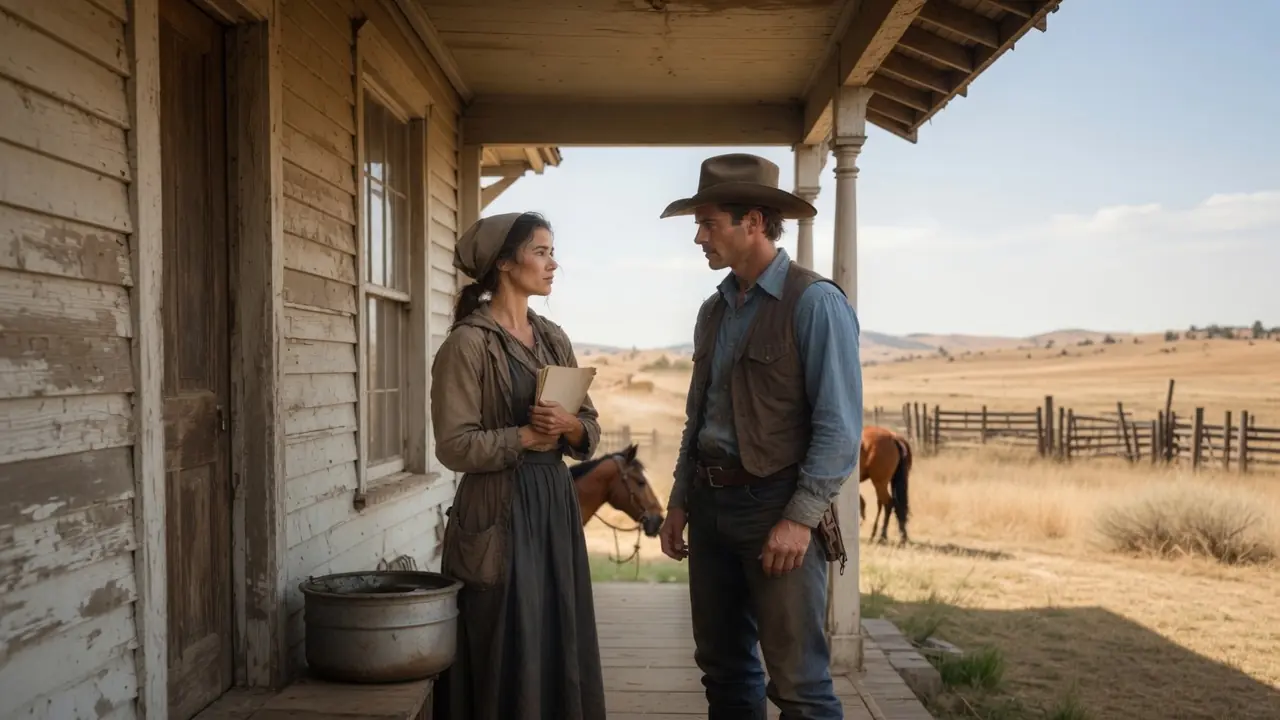
She was thirty-two years old, but grief and worry had made her look older in certain lights. Her gray dress was faded from wash and sun, and her dark hair was tied beneath a worn headscarf. Her hands had become rough from hauling water, mending fence, and chopping wood through a winter that nearly broke her. Still, she had kept the ranch alive because it was the last promise she had made to Thomas.
That morning, Jake Lawson rode up the road on a bay horse just as Emily stepped out with the papers. He was tall, broad-shouldered, and sun-browned from years of range work, wearing a dusty brown hat, blue work shirt, dark vest, and a gun belt he carried like a tool rather than a threat. Jake had worked for neighboring ranches, driven cattle through storms, and slept under more open skies than roofs. He had come to repair Emily’s broken well pump, but one look at her face told him the pump was not the worst trouble on the property.
Emily tried to fold the papers before he saw them, but her trembling hands betrayed her. Jake stepped onto the porch slowly, keeping his eyes on her face instead of the notice. “Walter Briggs says he’ll take the ranch before sunset,” she said before he could ask. Her voice stayed steady for the first half of the sentence, then cracked on the last word.
Jake’s jaw tightened as he read the paper she handed him. The notice was written in polished language, but the meaning beneath it was ugly and plain. Briggs claimed Thomas had borrowed against the land one month before his death, signing away the homestead if payment was not made in full. Emily knew Thomas had been sick by then, barely strong enough to sit upright, much less ride into town and sign anything.
“This signature doesn’t look right,” Jake said, holding the paper closer to the light. Emily gave a tired nod, her fingers curling around the porch rail. “I told the clerk that, but he wouldn’t listen.” She looked toward the road as if expecting Briggs’s men to appear any moment. “A widow can shout truth all day, but powerful men only hear paper.”
Jake lowered the notice and looked at the fields beyond the porch. He had seen Briggs’s work before: small ranches lost through crooked notes, families pushed out after droughts, widows paid pennies for land worth thousands. Most people grumbled in private and bowed in public because Briggs owned too many favors. Jake had bowed once too, and the memory still burned.
Years earlier, Briggs had taken land from Jake’s father after a cattle disease ruined one season’s profit. Jake had been nineteen then, too young and angry to understand how law could be twisted by men who wore clean coats and shook hands in church. His father died two years later, a broken man working land that no longer belonged to him. Since then, Jake had carried a quiet hatred for Walter Briggs, but hatred without purpose had done nothing.
Emily saw the change in his face. “You should go,” she said softly, wiping one damp palm against her skirt. “Briggs doesn’t forgive anyone who stands in his way.” Jake turned back to her. “Then he’s been forgiven too often.”
She shook her head as if she could not afford hope. “Jake, I have no money for lawyers and no family close enough to help.” Her voice lowered, and she looked ashamed of needing to say the next words. “If he takes this place, I have nowhere to go.” Jake folded the notice carefully and held it between them.
“You have until sunset,” he said. Emily laughed once, but there was no joy in it. “That sounds like a preacher trying to make a funeral feel hopeful.” Jake stepped closer, his boots creaking against the porch boards. “No, ma’am. It sounds like time enough to find the truth.”
They rode into town together in Emily’s small wagon, the forged notice tucked safely inside Jake’s vest. Emily sat beside him with her hands clasped tightly in her lap, trying not to look afraid as the homestead disappeared behind them. The road to Abilene was dry and rutted, bordered by yellow grass and broken fence lines. Every mile felt like walking closer to judgment.
Town was already awake when they arrived. Men stood outside the general store, women moved in and out of the mercantile, and horses shifted near the hitching posts. Emily felt eyes turn toward her, then toward Jake, then away again with practiced caution. People knew what Briggs was doing, but knowing and speaking were two different things.
Jake led her first to the land office, where the county clerk sat behind a desk stacked with ledgers. Mr. Pritchard was thin, nervous, and too eager to avoid eye contact. When Jake placed the notice on the desk, the clerk’s fingers twitched. Emily noticed that twitch and felt a small spark of anger break through her fear.
“I already told Mrs. Carter the document is filed,” Pritchard said. Jake rested both hands on the edge of the desk. “Then show us the original.” Pritchard swallowed, glancing toward the front window. “That is not necessary.”
“It is necessary if you expect a widow to lose her land over a signature her dying husband could not have made,” Jake said. His voice was calm, but the room seemed to tighten around it. Emily stood beside him, feeling the first unfamiliar stir of strength. She had come to plead, but Jake was not pleading.
Pritchard opened a ledger reluctantly and pulled a folded document from a locked drawer. Jake studied it, then looked at Emily. “Did Thomas write with his right hand?” Emily frowned at the question. “Yes, always.” Jake pointed to the signature. “This was written by a left-handed man.”
Pritchard’s face drained of color. Before he could answer, the office door opened and Walter Briggs walked in as if the building belonged to him. He was a large man in a dark suit, with silver hair, polished boots, and a smile that never warmed his eyes. Two hired men stood behind him, broad and silent. Emily’s stomach turned cold.
“Mrs. Carter,” Briggs said, removing his hat with false courtesy. “I had hoped you would accept the situation with dignity.” Emily gripped the edge of the desk. “Dignity is not surrender.” Briggs’s smile narrowed, and his eyes moved to Jake. “And you brought a stray cowboy to explain the law?”
Jake did not move back. “I came to read a signature.” Briggs glanced at the paper on the desk, then at Pritchard, whose face had gone slick with sweat. “The matter is settled,” Briggs said. “The widow owes what her husband borrowed, and by sundown, the ranch is mine.”
Emily stepped forward before fear could stop her. “Thomas never signed that loan.” Her voice shook, but she kept going. “He was too sick to ride into town, and you know it.” Briggs leaned closer, lowering his voice so only they could hear. “Careful, Mrs. Carter. Grief can make a woman sound unstable.”
Jake’s hand curled at his side, but Emily lifted her chin. “Grief has made me many things, Mr. Briggs, but not a fool.” The words surprised even her. Pritchard looked down at the ledger, and Briggs’s hired men exchanged a glance. For the first time, Walter Briggs looked irritated instead of amused.
Briggs turned his attention fully to Jake. “You’re trespassing in business beyond your station, Lawson.” Jake’s eyes hardened. “My father used to say the same thing when honest men kept quiet.” Briggs’s smile disappeared. “Your father lost his land because he was weak.”
The room went silent. Emily saw Jake’s shoulders stiffen, but his voice stayed level. “No, he lost it because men like you learned to dress theft in legal paper.” Briggs stepped closer, his face darkening. “You should leave town while you can.”
Jake looked toward Emily instead of Briggs. “We’re not done here.” Then he turned to Pritchard. “Who witnessed Thomas Carter’s signature?” The clerk opened his mouth, closed it, and looked helplessly at Briggs.
That silence told the room more than an answer could have. Emily felt her pulse beating in her wrists. “You witnessed it, didn’t you?” she asked Pritchard. His lips trembled. “Mrs. Carter, I only filed what I was given.” Briggs slammed one hand on the desk, making the ink bottle jump.
“Enough,” Briggs said. “I will return at sundown with men and a lawful claim.” He looked at Emily with cold satisfaction. “You may pack what you can carry.” Then he turned and left, his hired men following him into the bright street. The office felt smaller after he was gone.
Pritchard sank into his chair. Jake leaned across the desk, his voice quiet now. “If that signature is false, you are part of it.” The clerk wiped his brow with a handkerchief. Emily watched him struggle between fear of Briggs and fear of the truth. Finally, he whispered, “I did not write it.”
“But you know who did,” Emily said. Pritchard looked at her, and for a moment he seemed almost ashamed. “There is a man named Silas Vane who copies documents for Briggs,” he said. “He drinks at the Red Lantern most afternoons.”
Jake and Emily found Silas Vane at the back of the saloon, hunched over a glass of whiskey with ink stains still dark beneath his fingernails. He was a narrow man with nervous eyes and a face that looked like it had spent years avoiding daylight. When Jake sat across from him, Silas immediately tried to stand. Jake placed one hand on the table, not touching him, only stopping the escape.
“We need to talk about Thomas Carter’s signature,” Jake said. Silas’s eyes flicked toward Emily. “I don’t know anything about that.” Emily set the forged paper on the table. “You know the shape of every letter.” Silas stared at it too long, and that was enough.
He reached for his glass, but his hand shook so badly that whiskey spilled across the table. “Briggs will kill me if I talk,” he muttered. Jake leaned in slightly. “And if you stay silent, he will let you take the blame when this turns ugly.” Silas looked up sharply because the truth had found him.
Emily sat down across from him. “My husband is dead,” she said. “My land is all I have left of him.” Her voice softened, but her eyes did not. “If you helped steal it, then at least have the decency to stop pretending you did not.”
Silas covered his face with both hands. For a long moment, the saloon noise continued around them: cards snapping, boots scraping, men laughing at jokes they had already told before. Then Silas reached inside his coat and pulled out a folded scrap of practice signatures. Emily’s breath caught when she saw Thomas Carter’s name written again and again in imperfect copies.
Jake took the paper carefully. “Why keep this?” Silas laughed bitterly. “Because Briggs never pays a man enough to trust him.” He looked at Emily with something like apology. “Your husband never signed that loan. Briggs brought me old letters and told me to make it look close enough.”
Emily felt the room tilt around her. She had known, but knowing and holding proof were not the same thing. Her knees weakened, and Jake moved half a step closer, steadying her only with his presence. She pressed one hand against the table until the feeling passed.
They took Silas to Sheriff Amos Reed before he could lose his courage. Reed was a broad man with tired eyes and a reputation for staying just brave enough to keep his badge. He listened to the story, studied the forged practice sheet, and then looked out the window toward Briggs’s office. Emily saw fear move across his face like a cloud.
“Briggs will not like this,” Reed said. Jake gave him a hard look. “No criminal likes evidence.” The sheriff sighed, rubbing a hand over his jaw. “Lawson, you know how much trouble this can bring.” Emily stepped forward before Jake could answer.
“Sheriff, my husband is dead, and I am being thrown off my land because everyone is afraid of one man.” Her voice trembled, but she did not stop. “If the law only works when the guilty are weak, then it is not law at all.” Reed looked at her for a long time. Then he stood and reached for his hat.
By late afternoon, the whole town seemed to know something was happening. Sheriff Reed gathered two deputies, Silas Vane, Emily, and Jake, then rode with them back toward the Carter homestead. The sun had begun lowering toward the west, painting the fields in pale orange light. Emily sat in the wagon with the forged practice sheet in her lap, her fingers pressed to it like a prayer.
They arrived before Briggs. The homestead stood quiet beneath the wide sky, the porch boards glowing in the late light. Emily stepped down and looked at the house where she had loved Thomas, buried him, and fought loneliness one chore at a time. For the first time all day, she whispered, “Please don’t let me lose this.”
Jake stood beside her. “You won’t lose it alone.” Emily looked at him, and something passed between them that neither had time to name. It was not romance yet, not fully, but it was trust taking root in dry ground. She had forgotten what it felt like to have someone stand close without wanting to take something.
At sundown, Walter Briggs arrived with four hired men and a wagon meant to carry away Emily’s belongings. He rode at the front, confident and polished, like a man attending business rather than committing theft. When he saw the sheriff waiting on the porch, his expression tightened. When he saw Silas Vane, his confidence cracked.
“Sheriff,” Briggs said coldly. “You are interfering with a lawful transfer.” Reed stepped down from the porch. “No, Walter. I’m investigating forgery, fraud, and attempted land theft.” A murmur moved through the hired men. Briggs’s eyes cut to Silas like a blade.
Silas flinched but did not run. Jake held up the practice sheet. “Your copy man kept souvenirs.” Briggs’s face turned red. “That drunk would say anything for coin.” Emily stepped forward, her grief finally burning into courage. “Then let a judge hear him say it.”
Briggs looked at her with pure contempt. “You think this ends well for you?” Emily’s hands shook, but she kept them at her sides. “It already ends better than it would have if I stayed quiet.” Jake moved beside her, not in front of her, and that mattered. He was not taking her voice; he was standing beside it.
Briggs’s hired men began to shift uneasily. None of them had signed up to face the sheriff over forged papers. One turned his horse away first, then another. Briggs shouted at them, but fear of the law had finally become stronger than fear of him. The power he wore like armor began falling apart in the open air.
Sheriff Reed placed a hand on his pistol. “Walter Briggs, you will come with me to town.” Briggs’s face twisted with fury. “You will regret this.” Reed nodded wearily. “Maybe. But tonight, I’ll regret it with my badge still on.”
They took Briggs away as the last light faded from the fields. Emily stood beside the porch, watching the dust settle behind the horses. The forged notice lay torn at her feet, useless at last. For a long time, she did not move.
Then her knees buckled. Jake stepped close but stopped before touching her, letting her decide if she needed help. Emily turned and gripped his sleeve with both hands, her face crumpling after hours of holding herself together. “I thought I was going to lose the last thing Thomas left me,” she whispered.
Jake’s expression softened. “You kept it because you fought.” Emily shook her head through tears. “I fought because you made me believe I could.” The wind moved across the porch, carrying the smell of dry grass and horses. For the first time since Thomas died, the ranch did not feel like a burden too large to bear.
The next morning, Sheriff Reed returned with official papers confirming that Briggs’s claim was suspended pending trial. Silas Vane testified, Pritchard confessed to filing the document under pressure, and two other ranchers came forward with similar stories. The county that had whispered for years finally found its voice. Briggs’s empire did not fall in one day, but the first crack had opened on Emily Carter’s porch.
Weeks passed, and Jake stayed to help repair the ranch before winter. He fixed the north fence, patched the barn roof, and taught Emily how to spot weak wire before cattle broke through it. Emily worked beside him, learning fast, arguing often, and laughing more than she expected. Grief did not leave her, but it stopped filling every room.
One evening, they stood near the repaired well pump as the sky turned pink over the fields. Emily wiped dust from her cheek and looked across the land. “Thomas would have liked you,” she said. Jake smiled faintly. “Would he?” She nodded. “He respected men who did not talk more than they worked.”
Jake looked at her then, serious and quiet. “I can move on when the repairs are done if that is what you want.” Emily turned toward him, surprised by the ache the words created. The thought of the ranch without Jake’s steady presence felt suddenly empty. Still, she appreciated that he offered her a choice.
“I don’t want you staying out of pity,” she said. Jake shook his head. “I don’t pity you, Emily.” His voice was low and certain. “I admire you.” She looked down quickly, but he saw the color rise in her face.
Winter came softly that year, with early frost on the fields and smoke rising from the chimney each morning. Jake moved into the bunkhouse and helped manage the cattle through the cold months. Emily kept the books, planned the spring planting, and learned how to bargain in town without lowering her eyes. People who once pitied her began greeting her with respect.
In March, Walter Briggs was convicted of fraud and forgery. Several properties he had stolen were returned or compensated, and men who had bowed to him for years suddenly pretended they never feared him. Emily did not attend the sentencing. She stayed home, planted beans in the kitchen garden, and let the news reach her by mail.
That evening, Jake found her on the porch holding the letter. “It’s done,” she said. He sat beside her with a respectful distance between them. “How do you feel?” Emily watched the sun settle over the open land.
“Free,” she said after a while. “And sad. And angry. And grateful.” Jake nodded as if all those answers made sense together. “That sounds about right.”
By summer, the Carter ranch had begun to thrive again. The cattle were healthy, the fences held, and Emily’s name carried weight in town. She did not become rich, and life did not become easy. But the land was hers, and she had earned the right to stand on it without fear.
One night, after a long day moving cattle, Jake stood beside her at the porch rail. The stars were sharp above the prairie, and the house behind them glowed with lamplight. Emily looked at him and realized she no longer saw only the man who had saved her ranch. She saw the man who had taught her that help did not have to become ownership.
“Jake,” she said softly. He turned toward her. “Yes, ma’am?” She smiled because he still called her that when he was nervous. “Would you stay through another season?”
His eyes warmed. “Only another season?” Emily’s heart beat faster, but she did not look away. “Maybe longer, if you can stand my cooking.” Jake laughed quietly. “I’ve eaten trail beans in a thunderstorm, Emily. Your cooking is a blessing.”
They did not rush toward promises. Emily still loved Thomas, and Jake respected that grief as part of her heart rather than competition for it. Their love grew the way strong things grow on difficult land: slowly, honestly, with roots deep enough to survive weather. By the time another autumn arrived, no one in town was surprised when Jake Lawson became part of the Carter ranch for good.
Years later, Emily would tell the story differently depending on who asked. To neighbors, she would say Walter Briggs tried to steal her land and failed because the truth finally came out. To young widows, she would say fear is loud, but it is not always right. To herself, on quiet evenings, she would remember Jake stepping onto her porch and refusing to let her stand alone.
The old forged notice remained folded inside a box in her desk. She kept it not because she wanted to remember Briggs, but because she wanted to remember the woman she had been that day. A frightened widow with trembling hands had faced a powerful man and survived. She had not done it alone, but the courage had still been hers.
And every sundown after that felt different. It no longer marked the hour Walter Briggs had promised to take her home. It marked the hour she had kept it. It marked the moment a widow stopped being cornered and started being heard.