The nameless gunman had planned to pass through Millhaven before noon and forget the town by sundown. It was the kind of place he had seen too many times to count, with a dusty main street, a wooden general store, a tired saloon, a sheriff’s office that looked busier than it was, and horses tied to rails under a sky the color of old tin. He had ridden in for breakfast, water for Scout, and maybe a few cartridges before turning north again. He was good at leaving towns before they became anything more than dust on his coat.
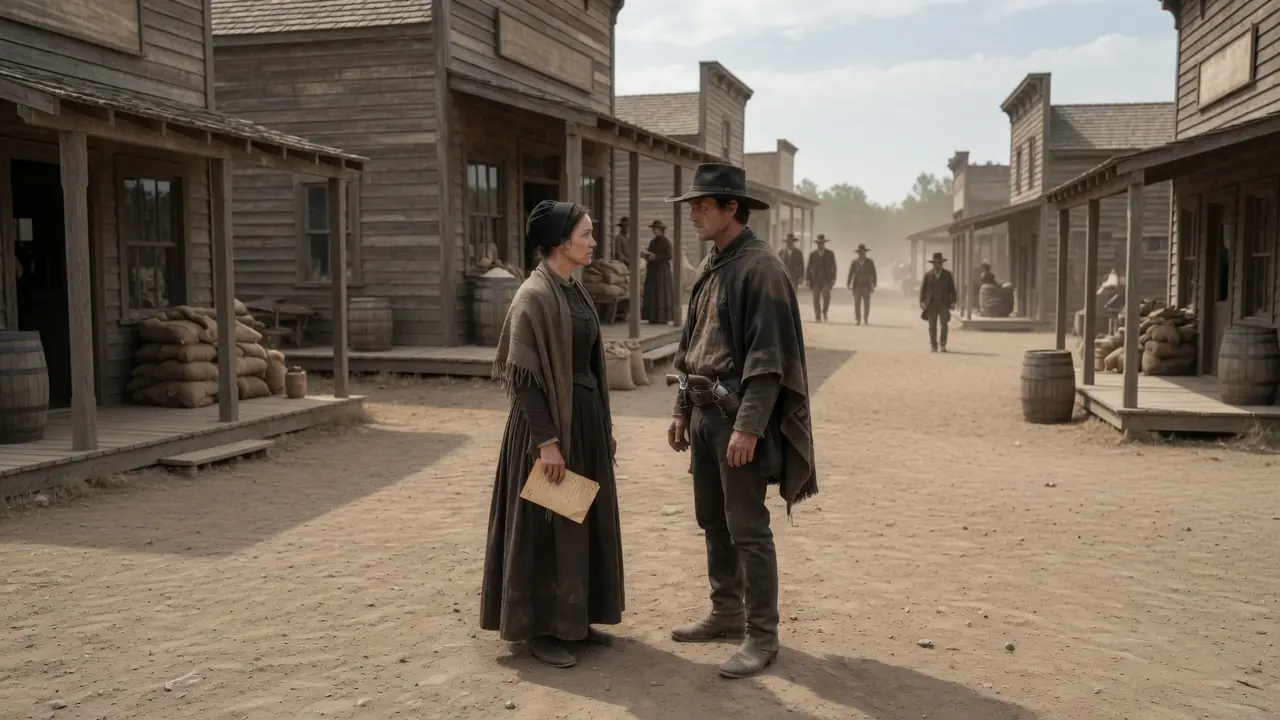
Then he saw Catherine Aldridge outside the general store, standing still while two large men blocked her path. She held a folded supply list in one gloved hand, her knuckles tight enough to turn pale against the paper, but her chin stayed lifted. The men were not shouting, and that made it worse, because quiet threats were the kind that had already been practiced. The stranger stopped near a hitching rail and listened long enough to understand that whatever they wanted from her, it was not a conversation.
Catherine was a widow in her mid-thirties, dressed in a dark brown frontier dress, worn boots, and a faded shawl pinned neatly at her throat. She had tired hazel eyes and the still face of a woman who had learned not to give fear the satisfaction of showing itself. One of the men leaned toward her and said something low enough that the street could pretend not to hear. The stranger stepped away from Scout and crossed the dust without hurry.
He did not announce himself. He simply stopped beside Catherine and looked at the two men with gray eyes, a scar along one cheek, and both Colts resting loose in their holsters. The two men looked at his hat, his poncho, his gun belt, and then his hands. Men who made a living frightening widows knew when fear had failed to travel in the right direction. After a few seconds, they backed away and crossed the street without another word.
Catherine did not thank him immediately. She turned and studied him with sharp, tired intelligence, as if deciding whether the man beside her was help, danger, or both. Her eyes fell briefly to the twin Colts, then returned to his face. “You’re the one they call the nameless gunman.” He looked down the street where the men had disappeared, then back at her.
He answered with the smallest nod. Catherine folded the supply list more carefully, though her hands still betrayed her by shaking once before she controlled them. She told him her name and said the Aldridge ranch lay twelve miles south on the best water land in the range. Then she said the words every desperate person says differently when desperation has been disciplined into courage: she needed help the law would not give.
She had done none of those things. The Aldridge ranch had been built by her and Thomas over fifteen years of early mornings, hard winters, loan papers, fence lines, and cattle drives that left them both too tired to speak by supper. When Thomas died of fever, the land did not become less hers simply because the county preferred men’s names on hard things. Catherine kept the hands, kept the herd, balanced the accounts, and learned which merchants smiled kindly while quietly raising prices on a woman alone.
At first, the pressure was polite. Credit grew harder, supplies arrived late, and cattle buyers offered less than they offered men for comparable stock. Then the Calloway gang moved into the territory, and the pressure put on a darker coat. Three ranches south of Millhaven had sold within months, all to the same St. Louis land company, and all after visits from men who were careful with their words and careless with other people’s futures.
Catherine explained that her ranch was the last independent operation on the south range. More important than grass, more important than cattle, it held the water rights that fed half the surrounding country in dry years. Someone had found a way to turn those rights into a railroad investment, and her land had become the missing piece in a map drawn far away by men with clean hands. Six weeks earlier, four Calloway men had ridden to her property and given her sixty days to sell.
The stranger listened without interrupting. He watched her hands, her posture, the way she said Thomas’s name without letting it break her voice. She was not asking him to save a helpless woman; she was hiring him to defend something she had already carried alone for too long. When she finished, he drank the last of his coffee and told her he needed to see the land before deciding how many men were coming and where they would try to break it.
They rode out that afternoon under a high pale sky. Catherine rode a chestnut mare with a steady seat and a straight back, and the stranger rode Scout, a tall dark horse that seemed to read trouble before men could smell it. The twelve miles south of town told him what the breakfast table had not. Good grass ran along the low ground, the creek cut clean through cottonwoods, and the ranch house sat solid against the rise with a barn large enough for ambition.
The Aldridge place had the look of a ranch built by two people who had argued, planned, worked, and improved as they went. The corrals were practical, the barn doors were reinforced, and the house had a front porch wide enough to watch weather from three directions. But the stranger saw the wrong things too. A trough had been shifted to expose a line of approach, three fence posts had been replaced recently, and the ground near the north pasture carried boot marks too deliberate to belong to passing cowhands.
Someone had already studied the ranch. Not raided it, not vandalized it, not frightened it with drunken stupidity, but studied it like a problem to be solved later. That made the Calloway men dangerous in a way loud men usually were not. The stranger did not tell Catherine everything at once, because fear poorly handled can make a person careless, and Catherine Aldridge had earned the right to receive facts in order.
That night, they sat at her kitchen table while a lamp burned low and the wind moved against the shutters. He asked about the men who came six weeks earlier, the one who did the speaking, the one who stayed quiet, the horses, the weapons, the direction they took leaving, and every detail she could remember. Catherine answered with precision, sometimes pausing, sometimes closing her eyes to place herself back in the yard. Her memory was not dramatic, but it was exact, and the stranger respected exactness more than courage spoken loudly.
The man who spoke for Calloway was called Crane. The stranger learned that in Millhaven the next day from men who looked into their drinks before naming him. Crane was a professional, lean and methodical, not a man who wasted bullets when fear would work cheaper. He had been present when a McAllister ranch hand died in what the sheriff called an accident and the whole town called nothing at all because saying the true word required more courage than Millhaven had left.
The sheriff, meanwhile, had a new horse, new saddle leather, and no interest in Catherine’s complaints. The stranger watched him through the jailhouse window and saw a man who had already sold the part of himself a badge was supposed to protect. There was no point asking the law to stand where it had already knelt. So he sent a telegram to an old contact in a federal land office and waited for the kind of answer that usually mattered more than rumor.
The answer came four days later. The St. Louis land company belonged to railroad investors hidden behind two intermediary corporations, and the railroad did not want Catherine’s house, herd, or memories. It wanted water. Whoever controlled the Aldridge water rights controlled the south range and every future dry year that passed through it.
When he told Catherine, she stood on the porch and looked out at the creek as evening settled purple over the pasture. Her face tightened, not with surprise, but with the ache of hearing something Thomas had warned her about become real. He had once told her that land with water was never just land. She said he believed ownership was responsibility, and the stranger told her the men coming for her ranch believed ownership was only leverage.
In the days that followed, the ranch changed shape under his eyes. He placed Gus, her oldest hand, near the north fence line because Gus had steady nerves and knew how to wait. He moved feed wagons to block an easy rush into the yard, reinforced the barn loft, shifted lanterns, checked ammunition, and walked every approach until he could have crossed the property blind in the dark. Catherine watched without hovering, asked questions without pretending to know more than she did, and never once begged him to promise what he could not control.
In the evenings, they sat on the porch after supper. At first, they spoke only of fences, water rights, horses, and the deadline. Then the conversations widened. Catherine told him about Thomas with a steady tenderness that did not ask the stranger to replace a dead man, only to understand the weight of the land he was defending.
He told her very little about himself, because there was little he had not already left behind. Towns, jobs, dead men, grateful people, ungrateful people, roads running north, and the private discipline of never staying long enough to become part of anything. Catherine did not press him the way others had. She listened to his silences as if they were answers shaped differently.
On the eighth evening, she found him in the barn checking Scout’s legs. The horse shifted but did not pull away, trusting the man’s hands as much as any living creature seemed to. Catherine stood in the doorway, lamp in hand, and said she had asked around Millhaven about him. Nobody knew his name, where he came from, or who had first called him nameless.
He should have disliked that. Instead, he felt something close to sorrow and did not know what to do with it. Catherine stepped farther into the barn and looked at him as if the lack of a name did not make him less real. “Doesn’t it trouble you,” she asked softly, “being nobody’s history?” He looked down at Scout’s hoof, then said he was somebody’s history, just not anybody who was still looking.
Catherine did not answer right away. The lantern light moved across her face, catching the tiredness there and the strength beneath it. Then she said he was becoming part of hers, and she went back to the house before he could decide whether to run from the sentence or keep it. The stranger stood in the barn a long time after she left, one hand resting against Scout’s shoulder, listening to the wind move through the cracks in the boards.
They came three days early, just before dawn. Scout heard them first, lifting his head in the corral while the dark still lay thick over the yard. The stranger was awake before the first rider showed on the north ridge. Twelve men came in two groups, eight from the north and four from the west, spread with the practiced spacing of men who had done this before and survived doing it.
The stranger stood in the yard with both hands low, coat hanging open, twin Colts resting where they belonged. Catherine was inside the house, not because she was afraid, but because he had told her the window line gave her a better view and a better chance if the yard broke bad. Gus waited at the fence line. Another hand watched from the barn loft, breathing slow and hard through his nose.
The lead riders came faster once they saw him alone. They believed numbers made courage unnecessary, and that was the mistake men made when they confused arithmetic with certainty. The first rider fired too soon. The stranger moved left before the shot finished traveling, drew with the kind of speed that did not look human until the result proved it had happened.
The yard cracked open with gunfire. Horses reared, dust jumped from the earth, and the north group lost its shape in seconds. Scout slammed his weight against a loosened fence rail exactly where the stranger had prepared it, breaking the angle of a rider trying to flank left. Gus fired at the ground ahead of the west group’s lead horse, scattering the formation before it could close.
The stranger moved like a man who had made a private arrangement with time. One Colt spoke, then the other, both in controlled bursts that stopped the nearest threats without wasting motion. Catherine watched from the window with both hands around the rifle he had left her, her heart striking hard against her ribs. She did not see a legend in that yard; she saw a man standing between her home and the men who had come to erase it.
Crane sat back from the first violence, just as the stranger had expected. He watched, calculated, measured losses, and understood faster than ordinary men would have. Within less than a minute, the attack had become more expensive than the contract promised. The remaining riders pulled hard on their reins, uncertain whether the next step forward belonged to courage or stupidity.
The stranger stood with smoke drifting from both Colts and his face unchanged. Crane looked at the fallen men, the ruined angle, the broken pincer, and the dark windows of the house where Catherine waited. He had come expecting a widow, a frightened crew, and one hired gun. He had found a ranch prepared like a fort and a gunman fast enough to make twelve men feel like poor planning.
Crane turned his horse first. That mattered. Men like him did not run if they could rename the motion into strategy. The remaining riders followed, and their hoofbeats faded north into the gray edge of morning. The stranger reloaded both Colts before taking a full breath.
Catherine came out of the house after the sound was gone. She walked into the yard with the rifle lowered and her face pale but steady. Her eyes moved over the damage, then to the stranger. The fear she had been carrying for weeks did not vanish all at once, but something in her shoulders released. For the first time since he met her, she looked almost young beneath the exhaustion.
Four days later, the federal investigator arrived in Millhaven. He was a precise man in a good coat who asked quiet questions and wrote down answers that made important men nervous. The land company’s acquisitions were suspended, three ranch transfers were flagged for review, and the water rights claims were frozen pending investigation. The Calloway gang did not return to Aldridge land.
The job was done, but the stranger stayed two more days. He told himself the ranch still needed watching, that Crane might change his mind, that federal men could stir trouble before ending it. Catherine did not challenge these excuses. She simply set another cup at breakfast, another plate at supper, and another silence on the porch that gave him room to admit the truth to himself.
On the last evening, they walked the property boundary together. The same fence lines he had studied for danger now looked different in the low light. The south pasture rolled dark and quiet, the creek shone between cottonwoods, and the barn Thomas had built stood solid against the fading sky. Catherine walked beside him with her hands folded around her shawl, saying little because the land was speaking enough.
At the north fence line, she stopped and looked over the country that was still hers. He told her it was good land, and she said she and Thomas had known that. The correction was gentle, but it mattered. He looked at her then and said yes, they both had known, and the acknowledgment moved across her face like the last light.
Catherine turned toward him. She did not reach for his arm, did not plead, did not dress the question in anything softer than truth. She asked him to stay. The word stood between them under the darkening sky, plain and dangerous, because it was not a command and not a bargain, only an open door.
He wanted to say yes. That surprised him more than any gunfight ever had. He wanted the porch, the table, Scout in the barn, Catherine crossing the yard at dawn, the creek in dry years, the fence lines that needed repair, and a name spoken by someone who would remember it. Wanting those things did not make him able to take them.
He told her he did not stay. He said there were towns that needed what he did, places where the law had failed and people had stopped expecting help. The explanation sounded true because it was true, but it was not the whole truth. The rest was fear, old habit, and the terrifying weight of belonging somewhere after so many years of refusing to belong anywhere.
Catherine listened without anger. That kindness made leaving harder than accusation would have. She told him she knew, and the way she said it was not surrender. It was understanding offered to a man who perhaps deserved less tenderness than she was giving.
Before dawn, he saddled Scout in the dark barn. He worked by feel, tightening straps, checking the bit, and moving through the sequence that had ended a hundred places before this one. But this time every familiar motion hurt. Scout stepped into the yard, and the stranger stopped when he saw the upstairs window.
A lamp was burning there. Catherine was awake. She had known he would leave before dawn and had lit the lamp anyway, not to stop him, not to shame him, but to make sure he did not ride away from a dark house. The sight nearly undid him.
He mounted Scout and rode north. At the first rise, he looked back. He had not looked back at a town, a ranch, or a woman in years, but the Aldridge place stood below him in the blue edge before sunrise, with one small window lit like a promise he had no right to ask for and every intention of keeping.
The road north waited, as it always did. There would be another town, another frightened person, another piece of land, water, or dignity that greedy men believed they could take. The nameless gunman rode toward it because that was what he did. But for the first time, the road behind him mattered too.
Catherine Aldridge had hired a stranger with two fast Colts to defend her ranch. She had expected a weapon, perhaps a shield, perhaps a temporary answer to a permanent threat. She had received all of that, but she had also given the nameless gunman something he had spent years avoiding. A place in someone’s history.
And south of Millhaven, in a house built by a dead husband and defended by a living legend, one lamp remained ready in the window. Not every night, not because Catherine was foolish enough to wait like a girl in a storybook, but because some promises did not need to be spoken again to keep breathing. The ranch remained hers. The water remained free. And somewhere on the northern trail, a man with no name carried the memory of that light like the first home he had ever meant to return to.