Ruth Callaway knew something was terribly wrong when her four-year-old daughter stopped shivering. Emmy had been trembling for hours beneath every blanket Ruth could find inside the stranded stagecoach, but now the little girl's body had gone frighteningly still, her lips blue and her breathing so shallow Ruth had to press her cheek near the child's mouth to feel it. Beside them, seven-year-old Nora held the carpetbag containing everything the three of them still owned and stared through the frost-covered window with eyes that had grown far too old during the previous six months. Then Nora whispered, “Mama, I don't think Mr. Mercer is breathing anymore.”
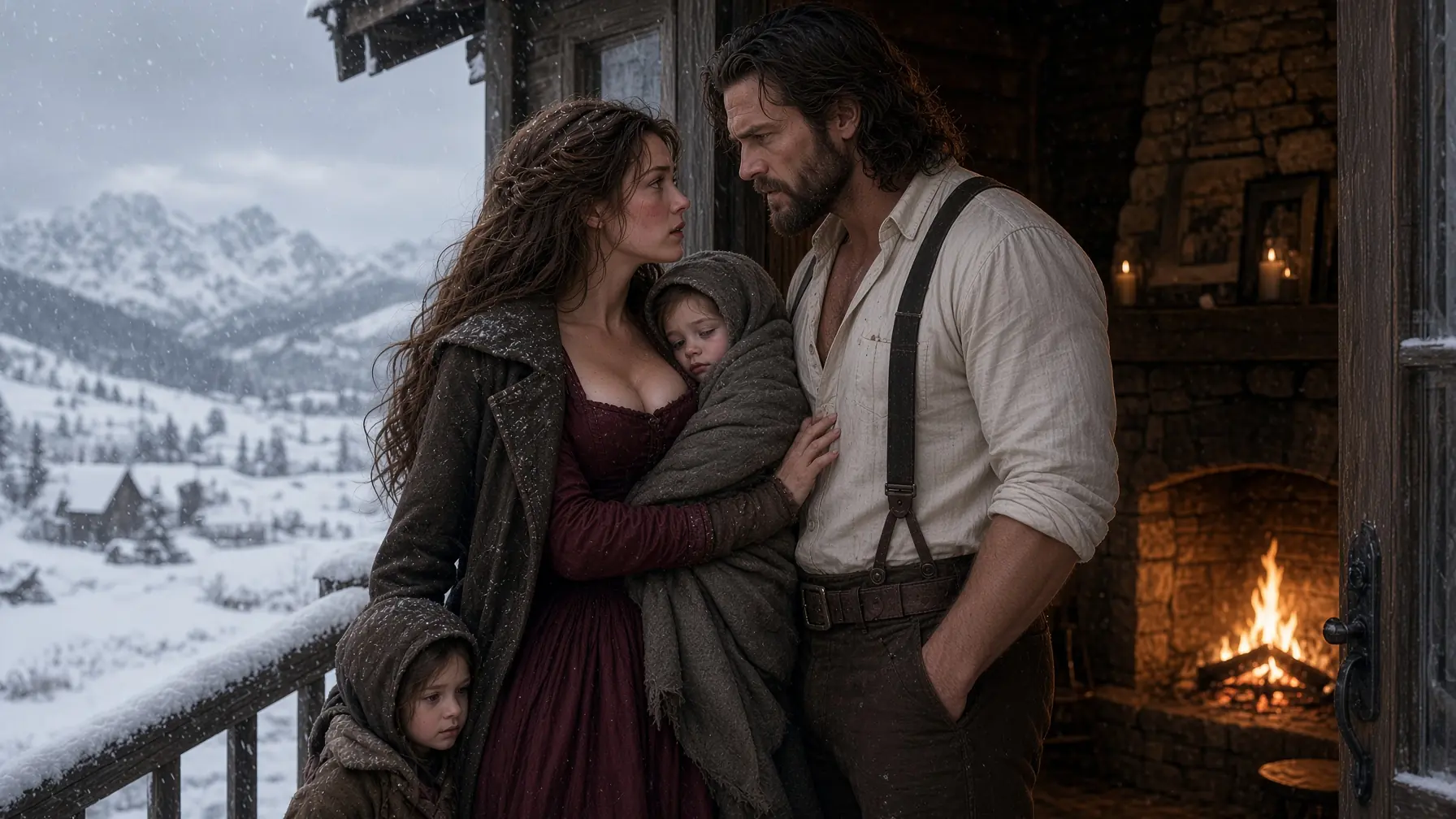
Outside, the Wyoming wind struck the coach with such force that the wooden walls groaned around them. Ruth wrapped Emmy inside her own coat, buttoned the fabric over the child's small body, and forced herself to open the door even though every instinct told her the storm would kill them the moment she stepped into it. She climbed toward the driver's seat and found Bill Mercer exactly as Nora had feared, frozen upright with snow crusted across his hat and his hands still curled around the reins. Ruth pressed two fingers beneath his jaw, waited through ten terrible seconds, and understood that the man who had promised to deliver them safely had died less than a mile from the place that might still save them.
She climbed back inside and closed the door against the wind. Nora watched her without crying because Nora had almost stopped crying after Henry died, as though tears had become another resource the child believed the family could no longer afford to waste. Ruth had promised her eldest daughter the night they fled Missouri that she would never lie to her about danger again, not after so many adults had disguised threats as reassurance. “He's gone,” Ruth said, and Nora swallowed once before asking the question Ruth had been dreading.
“Are we going to die too?” Nora asked. Ruth looked at Emmy's blue lips, then through the window at a world erased by snow, and answered with the certainty of a woman who did not possess certainty but understood that children sometimes needed courage before facts. “No,” she said, tightening her coat around Emmy. “We're going to walk.”
Somewhere beyond the white emptiness stood a ranch belonging to Jesse Hawkins, a man Ruth had never met and had already deceived. Four months earlier, desperate advertisements had carried her attention westward until she found one from a Wyoming widower looking for a woman of good character who could cook, keep books, mend clothes, preserve food, and manage a lonely ranch household through difficult seasons. Jesse had written plainly that he was not promising romance, only wages, a respectable room, and the possibility of marriage later if both people discovered they suited each other. Ruth had answered that advertisement truthfully about almost everything except the two most important people in her life.
She had told Jesse she was alone. She had not mentioned Nora or Emmy because every previous inquiry she sent west had ended the moment an employer learned she came with children, and the few men who remained interested had written things that made her burn their letters rather than answer them. Jesse's advertisement had seemed different because it asked about character before beauty, competence before youth, and work before obedience. Ruth convinced herself that if she could simply reach Wyoming and stand before him with her daughters beside her, he would see three human beings instead of three burdens.
The lie had begun in Missouri, although Ruth rarely allowed herself to think about those first weeks after Henry's death. Henry Callaway had worked underground in a lead mine and died when a support failed during a night shift, leaving Ruth with two daughters, eighteen dollars in savings, and no legal ownership of the small house where the family lived because it belonged to a partnership controlled by Henry's older brother Silas. Silas arrived with sympathy, groceries, and candy for the girls, promising Ruth that nothing would change while she found her footing. For exactly nine days, he behaved like a grieving brother trying to protect his dead brother's family.
On the tenth day, he asked how soon Ruth planned to leave. When she reminded him that Henry had spent years improving the house and that she had nowhere else to take the children, Silas's sympathy hardened into something Ruth would eventually recognize as possession disguised as generosity. He began appearing at night, sometimes after drinking, standing in the doorway while Ruth and the girls tried to sleep and explaining what might happen if people decided a penniless widow was incapable of raising children properly. He never struck Nora or Emmy, but Emmy heard every threat, and one morning the child who once sang while Ruth brushed her hair simply stopped speaking above a whisper.
Ruth endured three months because leaving without money felt impossible. Then Silas grabbed her wrist during an argument and told her that if she was not gone by the end of the week, he would make sure the county considered whether the girls needed a more stable guardian. Ruth looked past him and saw Nora standing behind the kitchen doorway with Emmy pressed against her side, watching everything. That night Ruth packed a carpetbag, emptied the household jar where she had been hiding coins from sewing work, and walked away before dawn.
For six months they moved west in fragments. They slept in church basements, barns, cheap boardinghouses, the home of a Kansas widow who kept them two weeks, and once inside a freight depot where Ruth pretended they were waiting for a train until the stationmaster noticed they had nowhere to go. Ruth cooked for meals, stitched clothes for beds, treated fevers with the remedies her grandmother had taught her, and taught Nora lessons whenever they found enough light to read. Emmy stayed close and whispered only to her sister.
The advertisement from Jesse Hawkins finally gave Ruth a destination. She wrote to him from Kansas City, describing her skills, her widowhood, and her willingness to work through winter, then added the lie that had weighed on her through every mile afterward. Jesse responded with a train ticket as far as the rail line reached and money for the remaining coach passage, along with short directions to his ranch. His final sentence said, The room at the end of the hall has a lock on the inside, and the key will be yours.
That sentence was why Ruth chose him. Silas had removed the lock from her bedroom after accusing her of hiding things from him, and Nora still tested every door before sleeping anywhere new. Jesse had not known that history when he mentioned the lock, but Ruth carried the sentence inside her like a small promise. Now, with a dead coachman behind them and Emmy fading against her chest, that promise was somewhere ahead in the storm.
Ruth remembered fence posts before the road vanished completely beneath snow. She told Nora to grip the back of her coat and never release it, then stepped into drifts that swallowed her boots almost to the knee. Emmy's small weight pressed against her ribs while Ruth kept one hand on the fence wire and moved from post to post, counting because counting gave fear a shape. One post, then another, then another, each piece of wood becoming proof they had not yet disappeared into the white.
The wind pushed against them like an animal. Twice Ruth fell, once hard enough to bite her tongue, and both times Nora planted her little boots in the snow and pulled on her mother's coat until Ruth managed to rise again. After what might have been twenty minutes or an hour, Ruth's fingers became too numb to feel the wire properly. Then the wind shifted, and beneath the cold she smelled wood smoke.
“Nora, do you smell that?” Ruth shouted. The girl lifted her face and nodded, snow covering her eyebrows and lashes. Ruth followed the smell until a yellow square appeared through the storm, then another, and suddenly the outline of a house emerged beyond the fence. She screamed for help even though the wind tore the sound away.
By the time Ruth reached the porch, she could no longer feel her feet. She hammered on the door with a frozen fist, once, twice, then a third time, and nearly collapsed when it opened. A broad-shouldered man stood there wearing long underwear, boots, and a half-buttoned shirt, his dark hair disordered from sleep and a rifle hanging in one hand. His gray eyes went first to Ruth, then to the child tucked inside her coat.
“Who the hell are you?” he asked. Ruth could barely make her mouth form the words. “Ruth Callaway,” she gasped, “the woman you sent for, and my driver is dead on the road, and my daughter is freezing to death.” She met his eyes and said the only thing that mattered. “Let us in.”
Jesse Hawkins stepped aside immediately. Whatever questions crossed his face vanished beneath urgency when Ruth opened her coat and revealed Emmy's blue lips. He put the rifle against the wall, threw fresh logs onto the dying fire, carried blankets from a cedar chest, and set water to warm when Ruth ordered him to make certain it was not hot. He did everything without asking why the woman who had promised to arrive alone had a dying child in her arms.
Nora entered last, dragging the carpetbag behind her. She stopped when she saw the rifle and instantly positioned herself between Jesse and her mother, an almost invisible movement that would have escaped most adults. Jesse noticed. His expression changed.
Ruth stripped Emmy's wet clothes near the hearth and wrapped her in dry blankets. She pressed the child's small hands between her own, checked her breathing, and asked for broth, sugar, and another blanket while Jesse moved around the kitchen with the startled obedience of a man who had never expected to be taking orders from a half-frozen stranger before sunrise. When color finally began returning to Emmy's face, Ruth's body threatened to surrender from exhaustion. Only then did Jesse look toward Nora and perform the calculation he had postponed.
“Your letter said you were alone.” His voice contained anger now, but it was controlled. Ruth nodded without apology. “I know what it said.” Jesse looked from seven-year-old Nora to Emmy curled against Ruth's chest. “You wrote that you had no family traveling with you.”
“I lied,” Ruth said. Nora stiffened beside her, but Ruth continued because she would not teach her daughters that survival required pretending wrongdoing had never happened. “I had already written to four places that sounded respectable, and every one disappeared the moment I mentioned children.” Jesse's jaw tightened. “That doesn't make the lie fair to me.”
“No,” Ruth answered. “It doesn't.” She drew Emmy closer and held Jesse's gaze. “But if I had told you the truth, would you have paid for three people to come out here?”
Jesse did not answer. He did not need to. Ruth nodded once. “That's why.”
His silence lasted several seconds. Then Nora moved when Jesse stood, only half a step backward, but enough that her fingers caught Ruth's sleeve and her body angled protectively toward Emmy. Jesse looked down at the child. “Who taught you to be afraid of men?”
Nora's chin lifted. “I'm not afraid.” Jesse did not smile. “Didn't say you were weak, girl.” Ruth answered for her. “My husband's brother taught her.”
Jesse's attention returned to Ruth. “He hurt them?” Ruth shook her head. “He hurt me, and he made sure they heard enough to imagine the rest.” Jesse looked again at Nora, who stared back like a guard at a gate. “I ain't him,” he told her quietly.
Nora said nothing. Jesse continued without approaching her. “This is my ranch, and nobody gets hurt in this house because I lose my temper, because I'm drunk, or because I think I'm owed something.” Nora kept watching him. “I'll decide that myself,” she said.
Something almost like respect passed across Jesse's face. “Fair enough.” He turned toward Ruth. “The coachman?”
“Bill Mercer,” she said. “A mile back, maybe less.” Jesse rubbed a hand over his face. “Tom and I will bring him in when the storm settles enough.”
“Tom?” Ruth asked. Jesse explained that Tom Greenfield was his nineteen-year-old ranch hand who slept in the bunkhouse near the barn. Then he looked around his suddenly crowded room, at two children he had never agreed to house and a woman he had invited under false pretenses. “You picked a hell of a day to arrive, Mrs. Callaway.”
“I didn't order the blizzard.” Jesse looked at her. “No, but you did order the lie.” Ruth nodded. “That's true.”
The argument did not come immediately because Emmy made a faint sound. Ruth bent over her and found that the child's pulse felt stronger, though she warned Jesse that warming had to happen slowly and that they needed to watch for confusion, pain, and changes in breathing. Jesse stared at her hands while she checked Emmy's fingers. “You know doctoring?”
“My grandmother treated mining families,” Ruth said. “Mostly because the company doctor charged money people didn't have.” Jesse glanced toward the storm. “Closest doctor to us is more than twenty miles when the road is good.” Ruth looked up. “Then I may be more useful than you expected.”
“Useful doesn't erase dishonest.” Jesse's tone sharpened. Ruth lifted her chin. “I didn't say it did.”
She listed what she could do. Cook, preserve, sew, keep accounts, make soap, read contracts, teach children, tend minor injuries, help with calving, manage stores, and work until her hands stopped functioning if work was what kept her daughters fed. Jesse listened without interruption. Ruth finished with the only condition that mattered.
“Nora and Emmy are not negotiable.” Jesse's eyes narrowed slightly. “Meaning?” Ruth answered, “Meaning if spring comes and you decide you cannot have us here, we all leave, but you don't ask me to send them anywhere else to make myself more convenient.”
Jesse stared at her for a long moment. She had almost nothing and both of them knew it, yet she was negotiating like a person standing on land she owned. “You really think you're in a position to give me conditions?” he asked. Ruth looked down at Emmy. “A mother is always in a position to give that one.”
The fire cracked between them. Jesse's face softened only slightly. “I'm not throwing anybody into a Wyoming storm.”
Ruth let out a breath. “Thank you.” Jesse grabbed his coat. “Don't thank me yet.”
He pointed toward the hall. “Last room on the right, clean sheets, lock on the inside.” Nora looked toward him immediately. Jesse noticed. “I oiled it yesterday because I knew a woman was coming to live in a house with two men around.”
Ruth's throat tightened. Jesse pulled on his hat before she could answer. “I'm going to the barn, and when I come back we are going to have a real conversation about everything you left out of that letter.” He opened the door, allowing a wall of cold air to enter. “For tonight, keep the girls warm.”
After he disappeared, Nora watched the closed door. “He's angry.” Ruth nodded. “He has a right to be.”
“He gave us a lock.” Ruth turned toward her. Nora swallowed. “Uncle Silas took ours away.”
Ruth pulled both daughters against her. “This isn't Silas's house.” Nora rested her head against her mother but kept watching the door. “I'm still going to watch him.”
“I know.” Ruth kissed her hair. “Watch carefully.”
They found the guest room exactly where Jesse promised. The bed was small but clean, the quilt smelled faintly of soap and cedar, and the lock turned smoothly when Ruth tested it twice. Nora climbed into bed beside Emmy and curled one arm around her sister exactly as she had done in barns and church basements for half a year. Ruth sat in the chair by the window and finally allowed herself to shake.
Emmy slept for almost three hours. When she stirred, she reached one hand into the empty space beside her and whispered a single word that barely carried across the room. “Warm.” Ruth covered her mouth so neither child would hear her cry.
Warm was the first word Emmy had spoken directly to her in nearly three months. Ruth had begun to fear the silence would become permanent, that Silas had taken something from her daughter no distance could restore. She crossed the room, touched Emmy's forehead, and found the skin properly warm instead of frighteningly cold. Outside the storm still raged, but inside a stranger's house her child had spoken.
Ruth found food because survival never waited for emotion. Jesse's kitchen looked like a room abandoned halfway through a war, with dirty dishes stacked around the basin, flour hardened on one counter, muddy tracks crossing the floor, and a pot on the stove containing something that might once have been stew. She found bread hard enough to challenge a knife, butter stored near the cold back wall, and several jars of preserved fruit labeled in a woman's neat handwriting. Margaret Hawkins, August.
Ruth opened a jar of peaches and stopped after removing the lid. The fruit smelled of summer, and suddenly the dead woman who had once lived there became real. Margaret had stood in this same kitchen peeling peaches, planning for a winter she would never survive. Ruth closed her eyes before serving a few pieces to Nora.
“Eat slowly.” Nora tore into the bread like a child who still believed somebody might take it away. Ruth watched and quietly put a slice on her own plate because she had learned that starving herself would eventually become another danger to her children. For six months she had fed them first.
Through the kitchen window, Ruth saw lantern light moving inside the barn. Jesse was out there with his horses, perhaps furious, perhaps grieving, perhaps wondering what kind of fool answered a widow's letter and received an entire family instead. Ruth remembered Henry talking to mine mules when he needed to think. “Animals listen better than people,” he used to say.
That memory hurt differently than Silas. Henry's death remained grief rather than fear, which somehow made it cleaner and worse at the same time. He had been a patient man who allowed Nora to follow him everywhere and sang badly enough to make Emmy laugh before breakfast. The morning he went down the mine for the final time, he had knelt before Nora and told her to watch over her mother and sister because she was his strong girl. Ruth had hated those words ever since.
Nora had taken them literally. She had become watchful, suspicious, and emotionally older than seven, carrying a dead father's final sentence like an assignment that could never be completed. Ruth sometimes wondered whether Henry had understood what he was giving the child. He had meant love, but grief had turned it into duty.
Ruth carried Emmy into the room and locked the door. Nora touched the brass mechanism, turned it once herself, and climbed beneath the quilt. “Are we staying?”
“Through the storm.” Ruth sat on the mattress. “After that, I'm going to make myself so useful Jesse Hawkins will have trouble imagining this ranch without us.”
Nora thought about that. “Like Henderson's farm?” Ruth shook her head. “Better.”
“We make ourselves necessary.” The words escaped Ruth before she realized how sad they sounded. Nora accepted them because necessity had become the family's closest substitute for security. “Plants with roots don't blow away,” the girl said.
Ruth touched her cheek. “Then we're planting roots.” She hoped that was true.
Before dawn, Ruth woke and immediately started working. Not because Jesse had ordered her to prove herself, but because idleness had become dangerous during the months on the road, leaving too much room for fear to breathe. She rebuilt the fireplace, heated water, washed dishes, and found enough coffee to produce something strong enough to wake a dead miner. When Jesse entered carrying firewood, he stopped in the doorway.
“You nearly froze to death yesterday.” Ruth kept scrubbing. “Nearly doesn't count.”
“You should rest.” She looked around. “Your kitchen has rested enough for both of us.”
The corner of Jesse's mouth moved. It was not quite a smile, but Ruth saw the possibility. “Margaret kept it better.”
“I imagine she did.” Ruth dried her hands. “Do you have eggs?”
“Tom collects them.” Jesse pulled out a chair. “And before you feed me, we still have a conversation coming.”
“After breakfast.” Ruth pointed at the chair. “Hungry men make bad negotiators.”
Jesse actually smiled then, small and unwilling. “You negotiate everything?” Ruth cracked eggs into a skillet. “Everything worth surviving.”
Tom Greenfield entered through the back door five minutes later, saw Ruth, and nearly dropped the basket. He was long-limbed and thin with weather-red hands, the expression of a young man who had spent the previous night hearing from his employer that one expected housekeeper had somehow become a widow and two children. Jesse introduced them. Tom removed his hat so quickly he almost struck himself.
“Mrs. Callaway.” Ruth nodded. “Mr. Greenfield.”
“Tom.” He placed the eggs down. “Everybody calls me Tom.”
“Nora will interrogate you.” Tom looked confused. Ruth added, “Don't take it personally.”
Jesse told Ruth that Tom had checked on Bill Mercer and found the coach nearly buried. They would retrieve the body when visibility improved, then take him to town for burial whenever the road became passable. Ruth went quiet because she had pushed the dead man from her mind to keep Emmy alive. Bill had died bringing them to Jesse's door.
“His family?” she asked. Jesse shook his head. “Widower, as far as I know, grown son somewhere in Montana.”
Ruth swallowed. “I want to help with burial expenses.” Jesse looked at her patched dress. “With what money?”
“With work.” Jesse's expression softened. “We'll talk about it when the ground decides human beings are allowed to dig again.”
After Tom retreated toward the barn, Jesse finished breakfast and wrapped both hands around his coffee. “All right.” Ruth leaned against the counter. “Ask.”
“Why did you leave Missouri?” Jesse asked. Ruth told him more than she intended.
She described Henry's accident, the partnership house controlled by Silas, the first weeks of false kindness, the threats, the nights when Silas stood in the doorway, and the morning Emmy stopped singing. Jesse listened without interrupting, although the muscles in his jaw grew tighter every time Ruth mentioned Silas. When she described leaving before dawn, Jesse's eyes shifted toward the hall where her daughters slept. “Does Silas have any lawful claim over them?”
“Not automatically.” Ruth appreciated the precision of the question. “I'm their mother, but a man with money can still petition a court and claim I'm incapable, immoral, unstable, or whatever word buys him an advantage.”
“Why would he want them?” Jesse asked. Ruth looked down. “Control.”
Jesse understood that answer without further explanation. He stood and walked toward the window, staring into the whitening yard. “Does he know where you are?”
“I don't think so.” Jesse turned. “That wasn't my question.”
Ruth met his eyes. “I don't know.” He nodded. “Better.”
“Better?” Jesse faced the glass again. “Knowing you don't know is better than pretending you're safe.”
Ruth folded her arms. “You regret opening the door?” Jesse turned sharply. “No.”
The certainty surprised her. Jesse continued, “I regret that you lied before I had a chance to decide what I could handle.” Ruth lowered her eyes. “Fair.”
“I advertised for one woman.” His voice grew quieter. “I lost a wife and a baby fourteen months ago, Ruth, and I wasn't looking for children because children mean you have something else to lose.”
Ruth understood then. The loneliness in the house was not neglect alone. It was defense.
“How did Margaret die?” she asked. Jesse froze. “You don't need to know that.”
“If we're staying through winter, I do.” Ruth held his gaze. “I can't live honestly in a house where everybody pretends the dead aren't still occupying rooms.”
Nobody had spoken that directly about Margaret since her funeral. Jesse's hands tightened around the chair. “Childbirth.”
“And the baby?” Ruth asked softly. Jesse's eyes lowered. “Never breathed.”
Ruth closed her eyes. “I'm sorry.” Jesse looked toward the hall. “Don't be sorry, just understand why opening that door and seeing two girls was not simple for me.”
“I understand.” Ruth did.
That afternoon she discovered the cradle. It sat in a back storage room beneath a sheet, small and beautifully built from cedar, its joints so careful Ruth knew Jesse's hands had made it. She did not move it. She closed the door.
She spent the rest of the day cleaning. Nora wiped shelves, counted jars, and practiced reading labels while Emmy sat near the fire drawing with charcoal on brown wrapping paper. By noon the kitchen smelled of soap instead of old grease. By evening a pot of beef stew simmered on the stove.
Jesse and Tom returned at dusk. Tom crossed the room, inhaled once, and looked almost emotional. Jesse simply stopped.
The floor had been scrubbed. His shirts had been mended and stacked. His coffee cup sat in the place where Margaret had always kept it.
“You didn't have to do all this.” Ruth ladled stew into his bowl. “Yes, I did.”
“Why?” She sat opposite him for the first time. “Because apologies made without changed behavior are just noise.”
Jesse looked at her, then took a spoonful. His expression shifted. “This is good.”
“Margaret's carrots helped.” The name landed hard, but Jesse nodded. “She knew how to preserve food.”
“So did my grandmother.” Ruth tasted her own bowl. “Apparently dead women are feeding us from both sides of the table.”
Tom choked on his stew. Jesse stared at Ruth, then something extraordinary happened. He laughed.
It lasted only two seconds. Still, the sound changed the room. Nora looked up sharply, and even Emmy glanced toward him before returning to her drawing.
After dinner, Ruth told Jesse about the cradle. His laughter disappeared instantly. “Don't.”
“I didn't touch it.” He stood as though preparing to leave.
“You made it beautifully.” Jesse's voice broke. “I said don't.”
Ruth dried her hands and sat again. “Fine.” Jesse remained standing.
She continued more softly. “But I'm not going to clean every room in this house and pretend grief isn't sitting in the corners.” Jesse put both hands on the table. “What exactly do you want from me?”
“Nothing.” Ruth's voice was quiet. “I have ghosts too.”
That stopped him. Ruth looked toward the hallway. “We can carry them separately, but we're going to admit they're here.”
Jesse sank back into the chair. “You're a hard woman.” Ruth shook her head. “I'm a surviving woman.”
They sat in silence. Eventually Jesse said, “Use Margaret's preserves.”
“I wasn't going to without asking.” Jesse rubbed his thumb across the table. “She made them for people to eat.”
“I'll use them well.” He nodded.
That night Ruth found one of Emmy's drawings on the floor. It showed the house, the chimney, three figures standing together, and a fourth larger figure standing several inches away. Nora explained that the distant figure was Jesse. “Emmy says he looks cold by himself.”
Ruth studied the charcoal man. “Maybe she can draw him closer tomorrow.” Emmy took the paper back.
She did not move the figure. Instead, she drew a line connecting him to the others. Ruth stared at that thin black line until tears threatened again.
Winter settled over the Hawkins ranch with a patience more frightening than the original storm. Roads vanished, cattle crowded near windbreaks, water froze in buckets overnight, and the nearest town became a rumor beyond miles of white ground. Ruth baked bread, stretched dried meat into stews, inventoried stores, and helped Jesse discover they were losing more grain to mice than he realized. Jesse spoke to her mostly about practical things and seemed relieved that practical things did not require anyone to discuss feelings.
He kept his distance from the girls. Nora accepted that as evidence in his favor because she distrusted adults who demanded affection. Emmy rarely looked directly at him.
Yet gifts began appearing. A wooden horse arrived on the kitchen table one morning, carved smoothly enough for a four-year-old hand, without a note or explanation. Emmy carried it everywhere for the next three days.
Another morning Ruth woke late after staying beside Emmy through a cough. She rushed toward the kitchen expecting a disaster and discovered Jesse teaching Tom how not to burn porridge. Nobody commented on why he had done it. Ruth ate anyway.
Jesse also began stacking firewood beside the kitchen door before sunrise. Ruth noticed because the pieces were always dry despite overnight snow. She never thanked him.
Their household developed a strange language of things unsaid. Ruth mended his coat without mentioning the tear. Jesse repaired the loose leg on the girls' bed while they were eating supper.
Nora watched everything. She watched Jesse's hands, his temper, his drinking, his voice, and the difference between how he behaved when people were present and when he thought nobody could see. Fifteen days after the storm, she confronted him in the barn.
“You leave wood for Mama.” Jesse looked up from a bridle. “Do I?”
“You know you do.” Nora approached one of the stalls but kept distance from the horse. “And you carved Emmy that horse.”
Jesse shrugged. “Had scrap wood.” Nora's eyes narrowed. “You're not very good at lying.”
He almost smiled. “Neither is your mama.”
Nora did not laugh. “Uncle Silas was nice at first.”
Jesse's hands stopped. “I know.”
“He brought candy.” Nora hugged the egg basket against her coat. “He said he'd take care of us.”
Jesse set the bridle aside. He did not stand.
“Then he stopped being nice.” Nora's voice stayed eerily flat. “So I'm watching you.”
“I figured.” Jesse leaned forward, elbows on his knees. “What have you seen?”
Nora considered carefully. “You leave wood so Mama doesn't go outside before daylight.” Jesse nodded.
“You carved Emmy something but didn't make her take it from you.” Another nod.
“You told Tom not to slam the bunkhouse door because Emmy jumps when doors slam.” Jesse looked away.
“And you talk to your wife at night.” Jesse's eyes returned to her.
Nora immediately added, “I'm not spying.” Her chin trembled despite her effort to appear unaffected. “The walls are thin, and sometimes I don't sleep.”
Jesse asked, “What do you think about a man talking to somebody who's dead?” Nora looked toward the stalls. “I talk to my daddy too.”
That answer struck Jesse harder than accusation could have. “What do you tell him?”
“That I'm taking care of them.” Nora's voice dropped. “He told me before he went to work that last day that I was the strong one and I should watch Mama and Emmy.”
Jesse stared at her. “That's a hell of a burden for a seven-year-old.”
“I'm not a baby.” Nora lifted her chin. “I'm the strong one.”