At 4:12 on a Saturday afternoon, Marcus Johnson was standing over a charcoal grill with a pair of tongs in one hand and a bottle of barbecue sauce in the other when his eight-year-old daughter stopped chasing soap bubbles and pointed toward the street.
“Dad?”
Marcus looked over his shoulder.
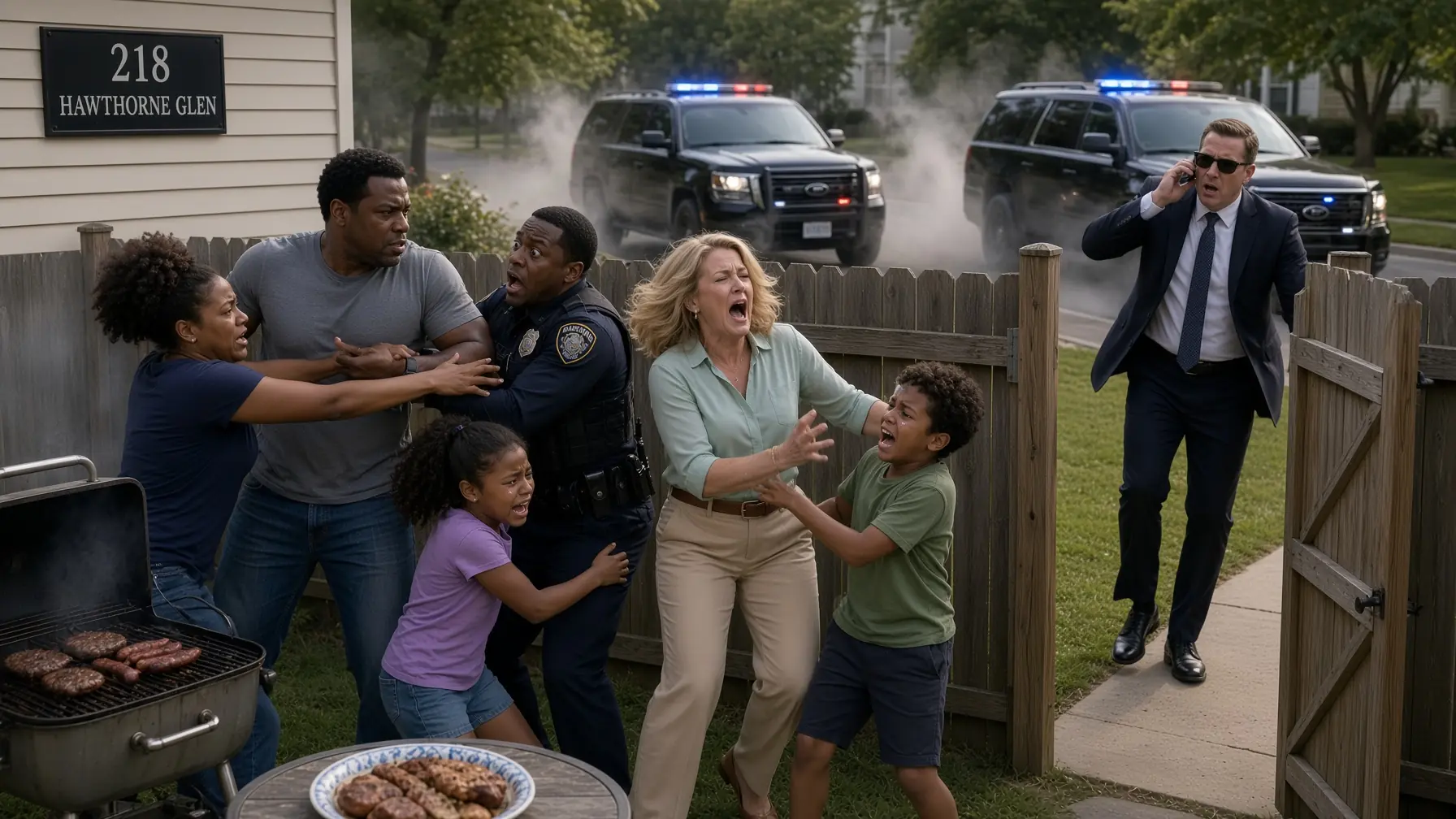
Three police cruisers had turned into Hawthorne Glen.
The first one slowed directly in front of his house.
The second stopped behind it.
The third blocked part of the driveway.
The laughter in the Johnson backyard died almost instantly.
Only the music kept playing—a low jazz song coming from a small Bluetooth speaker on the patio table.
Marcus lowered the tongs.
“What in the world?”
His wife Tasha stepped out through the sliding glass door carrying a bowl of potato salad. Their ten-year-old son Jordan stopped throwing a foam football with his cousin. Little Mia hurried toward her mother, suddenly frightened by the red and blue lights reflecting across the wooden fence.
Nothing about the afternoon had been unusual.
Marcus and Tasha had lived at 218 Hawthorne Glen for six years. They had bought the house when Jordan started elementary school, planted two maple trees in the front yard, replaced the old deck themselves, and spent nearly every warm Saturday doing some version of exactly what they were doing now—cooking outside while their children turned the yard into a battlefield of toys.
That afternoon, twelve people had come over.
Marcus’s sister and her husband.
Tasha’s cousin Renee.
Two neighboring families.
Three children.
No wild party.
No strangers moving in and out.
No shouting match.
No drugs.
No weapons.
No problem.
Across the street, however, their newest neighbor had spent nearly forty minutes telling herself there was one. The source story similarly centers on Marcus and Tasha’s ordinary backyard barbecue being transformed into a police scene after new neighbor Karen Whitman calls 911 based on suspicion rather than specific misconduct.
Karen Whitman had moved into number 225 less than three weeks earlier.
She was fifty-three, recently divorced, and had purchased the house after leaving a larger property outside Marietta. She knew almost nobody in Hawthorne Glen yet. Most of what she knew about the Johnsons had been assembled from glimpses through windows.
Two Black children riding bicycles.
A Black man washing an SUV.
A Black woman leaving early in professional clothes.
Relatives arriving on weekends.
Laughter.
Music.
None of those things were dangerous.
But Karen had spent years confusing unfamiliarity with warning.
At 3:36, she looked through her front window and saw several Black adults in the Johnson backyard.
At 3:41, she stepped onto her porch.
At 3:48, she heard someone laugh loudly.
At 3:53, Marcus’s brother-in-law Terrence carried a cooler through the side gate.
At 3:59, Karen convinced herself she had seen him looking toward her house.
He had actually been checking whether his truck was blocking a mailbox.
By 4:03, unease had become certainty.
Karen called 911.
The dispatcher answered.
“911. What is the address of your emergency?”
“I’m on Hawthorne Glen. There’s a suspicious gathering across the street.”
“What is happening?”
Karen stared through the blinds.
“There are a lot of people over there.”
“Are they fighting?”
“No.”
“Is anyone injured?”
“No.”
“Do you see a weapon?”
“I’m not sure.”
“What makes you think there may be one?”
Karen hesitated.
“One man keeps reaching toward his waist.”
Terrence had a barbecue thermometer clipped to his belt.
The dispatcher could not know that.
“Has anyone threatened you?”
“No.”
“Come onto your property?”
“No.”
“Damaged anything?”
“No.”
Karen’s frustration grew.
“They’re being extremely loud.”
“Is there loud music?”
“Some.”
The dispatcher listened.
What came through Karen’s open window was faint enough that she had to ask:
“Is that the music in question?”
“Yes.”
Another pause.
Karen added:
“It doesn’t feel right.”
The dispatcher asked the question that should have ended the call emotionally, even if officers still came to check.
“What specifically are they doing that concerns you?”
Karen looked through the blinds again.
Marcus was laughing while lifting ribs from the grill.
Jordan ran past carrying the football.
Tasha handed a plate to an elderly neighbor.
Nothing.
“They’re watching houses.”
“Who?”
“The men.”
“Did you see them trying doors or windows?”
“No.”
“Photographing homes?”
“No.”
Karen’s voice tightened.
“They just don’t look like they’re from around here.”
There was silence on the line.
The dispatcher typed.
“Ma’am, is race part of the description you’re giving?”
Karen stiffened.
“I’m not making this about race.”
“I’m asking for an accurate description.”
“They’re Black.”
“How many people?”
“Maybe fifteen.”
There were twelve.
“Adults?”
“Mostly.”
There were five adult guests besides Marcus and Tasha.
The dispatcher continued.
“Officers will check the area. Stay on your property and do not approach anyone.”
Karen should have hung up.
Instead she said:
“Please make sure they actually do something.”
“Officers will determine whether an offense has occurred.”
“I don’t want to wait until something happens.”
That sentence entered the recorded call at 4:07 p.m.
Five minutes later, the cruisers arrived.
Sergeant Daniel Mercer stepped from the first vehicle.
He was forty-five and had spent seventeen years with the county police department. Officer Leah Grant climbed from the passenger side. A second unit contained Officer Tyler Brooks, only nine months out of field training.
Daniel had read the dispatch notes before turning onto Hawthorne Glen.
CALLER REPORTS SUSPICIOUS LARGE GATHERING / POSSIBLE WEAPON UNKNOWN / SUBJECTS OBSERVING NEIGHBORING HOMES / LOUD MUSIC.
The wording bothered him.
Possible weapon unknown meant nothing by itself.
Observing homes might mean something.
Or nothing.
He approached Karen before the Johnson property.
She was already standing on her front lawn.
“That’s them.”
Daniel stopped.
“Ma’am, please stay over here while we figure out what’s happening.”
“I told dispatch. They’ve been watching my house.”
“Who?”
She pointed toward Terrence.
“The tall one.”
Terrence was standing beside the grill holding a paper plate.
“What did he do?”
“He kept looking over here.”
“Anything else?”
“He went through the side gate several times.”
Daniel looked.
The side gate belonged to the Johnson property.
“Does he live there?”
“I don’t know.”
“Did he enter your yard?”
“No.”
“Approach your house?”
“No.”
“Threaten you?”
“No.”
Karen folded her arms.
“That isn’t the point.”
“What is the point?”
“There are all these people over there.”
Daniel looked toward the yard.
Children.
Balloons.
Plastic cups.
Food.
A man in an apron.
An elderly couple sitting beneath a patio umbrella.
He looked back.
“Do you know the Johnsons?”
“No.”
“How long have you lived here?”
“Almost three weeks.”
Daniel glanced toward Leah.
That answer mattered.
Not because new residents had fewer rights.
Because Karen had repeatedly described the family as though they were the unfamiliar element.
Daniel asked:
“How long have they lived here?”
Karen hesitated.
“I don’t know.”
“Okay.”
He nodded toward his officers.
“We’ll check.”
Karen stepped after them.
“I’m coming.”
“No.”
“I’m the caller.”
“And we need separate accounts.”
“They’ll pretend everything is normal.”
Daniel stopped.
“What exactly would you like us to find?”
Karen’s mouth opened.
Nothing came.
Daniel waited.
Finally she said:
“I want to know what they’re doing.”
He looked toward the smoking grill.
“I suspect they may tell us.”
Marcus walked around the side of the house before the officers reached the backyard.
His heart was beating harder than he wanted it to.
He knew his children were watching.
So were his guests.
“Afternoon, officers.”
Daniel stopped several feet away.
“Afternoon. You live here?”
“Yes. Marcus Johnson.”
“This your gathering?”
“My family’s, yes.”
“Everything okay?”
Marcus looked toward the cruisers.
“It was.”
Daniel nodded.
“Fair answer.”
That surprised Marcus slightly.
Daniel continued.
“We got a call about noise and some concerns about people watching neighboring homes. Caller also mentioned she wasn’t sure whether she saw a weapon.”
Marcus stared.
“A weapon?”
“Do you have any firearms out here?”
“No.”
“Anyone carrying that you know of?”
“No.”
Marcus looked toward Terrence.
“Unless somebody brought a Nerf gun.”
From behind him Jordan called:
“It’s foam!”
Marcus closed his eyes briefly.
Daniel almost smiled.
“Understood.”
Leah asked:
“Mind if we stay here at the gate while we talk?”
Marcus noticed the wording.
Not we’re coming in.
“Sure.”
Daniel remained outside the fence.
That mattered more than Marcus could explain at the moment.
“What’s the occasion?”
“No occasion.”
Marcus shrugged.
“It’s Saturday.”
Leah looked toward the food.
“Smells like a serious occasion.”
“My ribs don’t require one.”
Daniel asked:
“Music been louder earlier?”
“No. That speaker’s been at the same setting since lunch.”
Tasha joined Marcus.
She still held Mia’s hand.
“Who called?”
Daniel looked across the street.