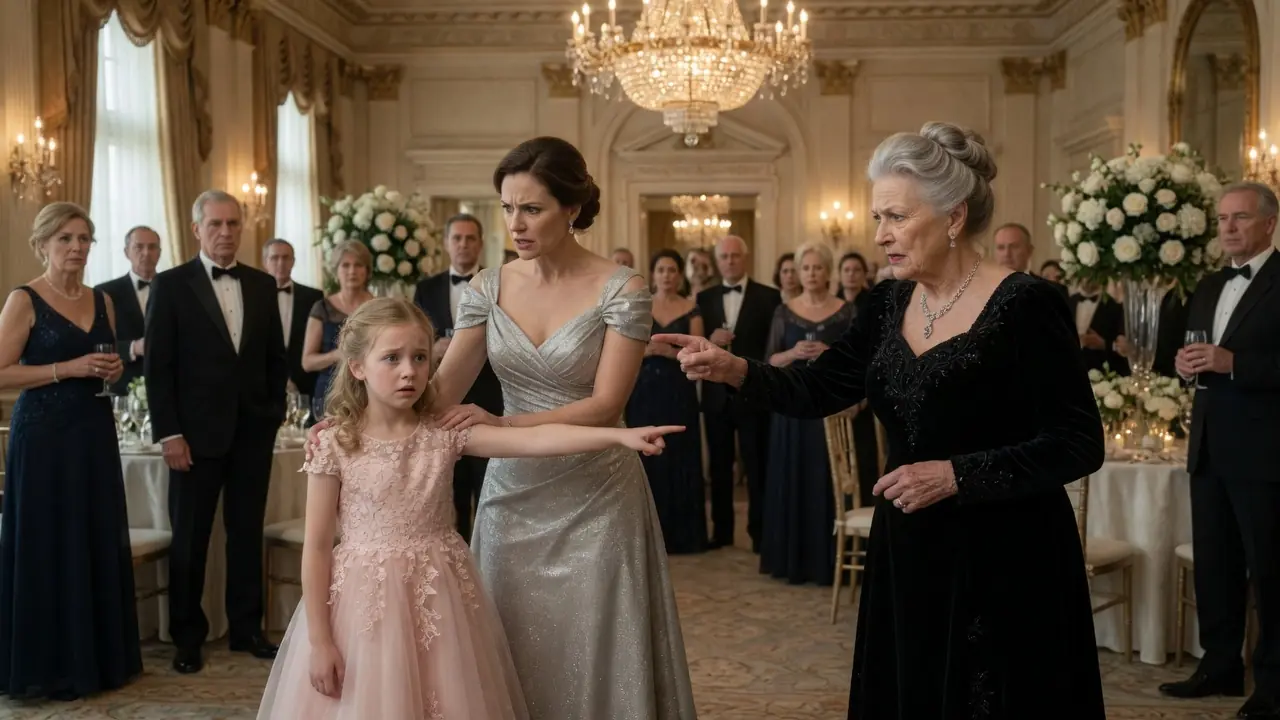
The richest people in Newport saw what happened. A United States senator stood 10 feet away with a champagne flute in his hand. Two hedge-fund executives watched from beside the string quartet. A hospital trustee, a retired federal judge, and three women whose family names appeared on buildings across Rhode Island all turned toward the little girl in the pink dress.
Not one of them moved. Six-year-old Lily Harrington stood beneath the crystal chandelier in the Grand Ballroom of Whispering Pines, her small hands gripping the layers of her skirt while Evelyn Vance leaned over her. “You and your mother have confused an invitation with acceptance,” Evelyn said. Her voice was soft enough to sound civilized and sharp enough to leave a scar.
Lily tried to step away. Evelyn moved with her. The elderly woman’s silver hair was arranged in a severe twist, and the black velvet of her gown seemed to swallow the late-afternoon light. She had spent nearly seventy years learning how to humiliate people without raising her voice.
She did not shout. She did not need to. People lowered their eyes when Evelyn Vance looked at them. Boards changed their votes after she made a phone call.
Charities moved dates to accommodate her calendar. Families who had lived along Bellevue Avenue for generations still worried about where she seated them at dinner. Lily knew none of that. She only knew that the tall woman smelled like roses and cold air and that her smile did not reach her eyes.
“I—I was looking for my mommy,” Lily whispered. Her speech caught slightly on the first word. Evelyn noticed. Of course she noticed.
Cruel people were often excellent observers. “Then perhaps you should learn to speak properly before addressing adults,” Evelyn replied. “This is not a playground.” Lily’s cheeks turned red.
Across the ballroom, Victoria Harrington was speaking with Arthur Pendleton, chairman of the Pendleton Family Foundation and host of the gala. Victoria had kept Lily in sight all afternoon. She had chosen a table near the children’s art display, packed crackers in her silver clutch, and promised they could leave before dessert if the crowd became too much. But for less than a minute, a group of donors had stepped between them.
One minute was all Evelyn needed. Whispering Pines sat on 30 acres outside Newport, where old stone walls crossed fields that had not been farmed in a century. The estate had belonged to the Pendleton family since the 1890s. Its ballroom had hosted governors, ambassadors, summer concerts, and weddings covered by magazines displayed at grocery-store checkout lanes.
That evening, it was hosting a fundraiser for the Harbor House Children’s Center, a proposed clinic that would provide speech therapy, occupational therapy, and legal support for families who could not afford private care. Victoria had spent 14 months helping the foundation obtain the property and permits. Evelyn had spent 14 months trying to stop it. The proposed center would be built on the abandoned site of the old Vance Textile warehouse outside Fall River, near the Massachusetts border.
The building had been empty for almost 20 years. Its windows were boarded, the roof leaked, and weeds grew through the loading dock. Evelyn did not need the warehouse. She simply did not want low-income families driving through land her family once controlled.
At a county planning meeting, she had called the center “a magnet for undesirable traffic.” Victoria had answered with zoning maps, traffic studies, environmental reports, and a voice so calm that Evelyn could not provoke her. The board approved the project. Evelyn never forgave her.
Victoria had grown up in a two-bedroom apartment above a hardware store in Worcester. Her father repaired boilers. Her mother worked the pharmacy counter at CVS until arthritis forced her to retire. Victoria attended public school, earned scholarships, and rode a Greyhound bus to Boston with one suitcase when she started college.
She knew exactly what women like Evelyn meant when they said someone did not belong. Usually, she let the words pass. She had learned that the most powerful answer to contempt was competence. But Lily was not a zoning attorney.
Lily was six. She liked strawberry milk, library story hour, and the bakery samples at Costco. She collected smooth stones from the beach and kept them in a shoebox under her bed. She practiced difficult words with a speech therapist every Tuesday and celebrated each one with a sticker.
She had worn the pink dress because she said it made her feel brave. Evelyn glanced toward Victoria through the moving crowd. Then she looked back at the child. “This room is filled with people who have earned the right to be here,” she said.
“Your mother should have left you with a sitter.” Lily blinked rapidly. “My mommy said I could see the paintings.” “Your mother says many things.”
Evelyn leaned closer. “She believes that because she bought an expensive gown and learned which fork to use, people will forget where she came from.” Lily looked toward the ballroom entrance, searching for Victoria’s silver dress. “I want my mommy.”
A woman nearby heard her. She turned, hesitated, then looked down at her champagne. Evelyn followed Lily’s gaze and smiled. “She is busy pretending to be important.”
Lily’s lower lip trembled. “Please let me go.” “Let you go?” Evelyn asked.
“No one is holding you.” But when Lily tried to move, Evelyn placed one hand on her shoulder. The gesture might have looked harmless from a distance, but it was not. Her fingers tightened against the child’s small frame.
“You will walk to the side entrance,” Evelyn said. “You will find one of the staff members, and you will wait somewhere you cannot embarrass anyone.” Lily froze. Evelyn gave her a small push.
The little girl stumbled against the edge of a display table. A glass bowl filled with white roses shifted. Water spilled across the linen cloth. Several guests gasped.
Not because Lily had nearly fallen. Because the centerpiece had been disturbed. Evelyn’s face hardened. “Look what you’ve done.”
“I’m sorry,” Lily whispered. “You should be.” “I didn’t mean—”“You people never do.” Lily’s eyes filled.
Evelyn’s fingers tightened again. “Street trash in a pretty dress is still street trash.” Lily screamed. The sound rose through the ballroom with such naked fear that the musicians stopped in the middle of a song.
A violin note died beneath the chandelier. Conversation vanished. Victoria turned. She saw the pink dress first.
Then Evelyn’s hand. Then her daughter’s face. The world narrowed. Arthur was still speaking beside her, but his voice became meaningless noise.
Victoria set down her water glass. It struck the edge of a passing tray and tipped, but she did not notice. She crossed the ballroom. She did not run wildly or scream across the room.
She moved with the terrifying focus of a woman who understood exactly what she was seeing. Guests stepped out of her path. By the time Evelyn looked up, Victoria was already there. “Take your hand off my daughter.”
Victoria’s voice was low. Evelyn did not release Lily. Instead, she straightened as though the child beneath her hand were evidence in an argument she intended to win. “Your daughter caused a disturbance.”
“She is six years old.” “She spilled water on an eighteenth-century table covering.” “You put your hands on her.” “I was directing her toward the staff entrance.”
“You were frightening her.” Evelyn’s mouth curved. “Perhaps she is too fragile for public life.” Lily made a broken sound and tried to reach for her mother.
Victoria stepped between them. Evelyn’s hand slid from Lily’s shoulder, but she caught the child’s sleeve as Victoria moved. The pink fabric pulled tight. Victoria seized Evelyn’s wrist and removed it.
“Do not touch her again.” The ballroom remained silent. Evelyn stared at Victoria’s hand around her wrist. No one held Evelyn Vance, interrupted her, or corrected her in public.
“Release me,” she said. Victoria did. Then Evelyn lifted her chin and delivered the sentence she would regret for the rest of her life. “This is precisely why women from your background should not be welcomed into decent society.”
Victoria looked at her. For one second, everything remained still. Then Evelyn reached around her, trying to take hold of Lily again. Victoria reacted before thought could catch up.
Her open hand struck Evelyn across the cheek. The sound cracked through the ballroom. It was not theatrical and did not send Evelyn spinning across the floor. It was one sharp, instinctive movement from a mother who had just watched an adult grab her terrified child twice.
Evelyn staggered half a step and pressed her palm to her face. The senator lowered his glass. Someone dropped a dessert fork. Lily began to sob.
Victoria immediately turned away from Evelyn and crouched, gathering her daughter into her arms. “I’ve got you,” she whispered. “I’m right here.” Lily buried her face against Victoria’s shoulder.
“She said I was trash.” Victoria closed her eyes. A different kind of anger passed through her then. Colder.
Deeper. Far more dangerous than the reflex that had moved her hand. She stood with Lily in her arms. Evelyn’s shock was already becoming calculation.
“You struck me,” she said. Victoria did not answer. “You assaulted me in front of witnesses.” “I saw what happened,” said a voice near the musicians.
Arthur Pendleton stepped into the open space between the guests. At seventy-two, Arthur had the straight posture and measured speech of a man who had spent decades in courtrooms. Before retiring, he had served as a federal judge in Providence. He disliked scenes, gossip, and people who mistook manners for morality.
Evelyn turned toward him. “Arthur, call the police.” Arthur looked at Lily’s tear-streaked face. Then he looked at the red marks forming where Evelyn’s fingers had pressed against the child’s shoulder.
His expression changed. “Security is already coming.” “Good,” Evelyn said. “This woman must be removed.”
“I wasn’t referring to Victoria.” A murmur moved through the ballroom. Evelyn stared at him. Arthur gestured toward a dark glass dome above the musicians’ balcony.
“The entire room is recorded.” For the first time, uncertainty entered Evelyn’s face. Arthur continued. “I watched you corner that child.
I watched you prevent her from leaving. I watched you push her and take hold of her again after her mother told you to stop.” “She knocked over a centerpiece.” “She is a frightened six-year-old.”
“She does not belong at an adult event.” “This gala benefits children.” Evelyn looked around the room as though searching for someone who would restore the natural order of things. She found hundreds of eyes and very little courage.
“You all heard how that woman threatened me,” she said. No one responded. Victoria shifted Lily higher in her arms. “I did not threaten you,” she said.
“I told you not to touch my child.” “You hit me.” “Yes.” The simple admission silenced the room again.
Victoria did not sound proud. She did not sound afraid. “I should not have struck you,” she continued. “But you will not rewrite what happened before it.”
Evelyn’s eyes brightened with triumph. “So you admit it.” “I admit that I reacted after you physically cornered my daughter. The cameras will show the rest.”
Arthur glanced toward the security officers entering through the ballroom doors. They were not off-duty police dressed like nightclub bouncers. They were retired professionals in dark suits, trained to keep problems quiet. That was exactly why Evelyn looked frightened.
Quiet consequences were often the most permanent. Arthur addressed the lead officer. “Please escort Mrs. Vance to the west sitting room while we preserve the footage and contact Lily’s father.” Victoria’s expression changed.
“My husband died three years ago.” Arthur paused. “I’m sorry. I didn’t know.”
Evelyn did. Victoria saw it in her face. The older woman had researched her. She knew about Daniel’s death from pancreatic cancer.
She knew Victoria was raising Lily alone. She knew there was no husband standing across the room who might have made her think twice. The realization made the insult uglier. Arthur corrected himself.
“Then contact local authorities and the child’s physician, if Victoria requests it.” “I am not going anywhere,” Evelyn said. “You are leaving this ballroom.” “This event would not exist without families like mine.”
Arthur’s gaze remained steady. “This event exists for children like Lily.” Evelyn laughed once. It was a small, brittle sound.
“You cannot be serious.” “I have rarely been more serious.” She turned toward the foundation’s board members. “Margaret?”
Margaret Lowell, who had known Evelyn for forty years, looked away. “Charles?” Charles Baird studied the floor. Evelyn’s voice rose.
“I have donated more to this foundation than half the people in this room combined.” Arthur nodded. “And tonight you demonstrated why money is not character.” One of the security officers stepped forward.
“Mrs. Vance, please come with us.” Evelyn recoiled. “Do not touch me.” The officer stopped.
“That is your choice. You may walk voluntarily.” Every face in the ballroom was turned toward her. For decades, Evelyn had controlled rooms by making other people fear humiliation.
Now humiliation had found her. She looked at Victoria one last time. “This is not over.” Victoria held her gaze.
“No,” she said. “It isn’t.” The words landed differently than Evelyn expected. Victoria was not speaking as an angry mother anymore.
She was speaking as an attorney. Evelyn left between the security officers. No one applauded; Arthur would never have allowed it, and Victoria would not have wanted it. Applause would have turned Lily’s fear into entertainment.
Instead, the guests stood in a silence more condemning than noise. Victoria carried her daughter toward a small library off the main hall. Arthur asked the staff to clear the room and bring water, ice, and a first-aid kit. Inside, away from the chandelier and the watching crowd, Lily finally began to shake.
Victoria sat on a leather sofa and held her. “You didn’t do anything wrong,” she said. “I spilled the flowers.” “That was an accident.”
“She said I shouldn’t talk.” “She was wrong.” “She said you were pretending.” Victoria brushed damp hair from Lily’s forehead.
“Look at me, sweetheart.” Lily raised her face. “I am your mother. I am an attorney.
I am a woman who worked very hard to build a life for us. None of those things are pretend.” “Are we going home?” “Yes.”
“Will she come there?” “No.” Lily studied her. “Did you hit her?”
Victoria did not lie. “Yes.” “Am I in trouble?” The question nearly broke her.
“No, baby. You are not in trouble.” “But you hit her because of me.” Victoria drew a breath.
“I hit her because I lost my temper when she frightened you. Grown-ups are responsible for their own choices. That was my choice, not yours.” Lily leaned against her.
“Was it bad?” “It was not the best choice.” “Are you sorry?” Victoria looked toward the library doors.
“I’m sorry you had to see it.” That answer was honest enough for a six-year-old and not yet complete enough for herself. A few minutes later, Arthur entered with a woman from the Harbor House medical team. Dr. Naomi Feld examined Lily’s shoulder and found no serious injury, only redness and tenderness.
“She should be fine,” Naomi said. “But I recommend documenting it tonight.” Victoria nodded. “I will.”
Arthur waited until Naomi stepped away. “The Newport police are outside,” he said quietly. “Evelyn is demanding to file a complaint.” “I expected that.”
“The footage is being copied.” “Good.” “I have also asked every staff member who witnessed the incident to provide a written statement before leaving.” Victoria looked at him.
“You moved quickly.” “I spent thirty-five years watching powerful people count on delay.” Arthur sat in the chair opposite her. “There is something else.”
Victoria waited. “The board received an anonymous packet this morning regarding Evelyn’s campaign against Harbor House. We believed it was political pressure. After tonight, I am no longer certain.”
“What was in it?” “Emails. Payments to a consulting firm. Communications with two zoning officials.”
Victoria’s fatigue disappeared. “Bribery?” “Possibly.” “Who sent the packet?”
“We don’t know.” Arthur glanced at Lily, then lowered his voice. “Your firm’s name appears several times.” Victoria understood.
This had not begun in the ballroom. Evelyn had not insulted Lily merely because she disliked a pink dress or a working-class attorney. She had wanted Victoria frightened, embarrassed, and removed from the project. She had chosen the one person Victoria loved more than her career.
Evelyn believed a mother’s love was a weakness. She was about to learn how badly she had misunderstood it. By nine o’clock that evening, the gala had become the most discussed private event in Newport. No photographs had been released, but wealthy people had never needed social media to spread a scandal.
They used text chains, country-club dinners, church parking lots, and conversations disguised as concern. Victoria took Lily home to their cedar-shingled house in Middletown. She made buttered toast, found the old red blanket Lily had loved since preschool, and sat beside her until she fell asleep. Only then did Victoria open her laptop.
Three messages waited from the managing partner of her Boston law firm. Two were from reporters. One came from Evelyn Vance’s attorney. It accused Victoria of assault, demanded a public apology, and threatened damages for “reputational and emotional harm.”
Victoria read it twice. Then she forwarded it to her own attorney with four words. Preserve everything. No response.
At ten thirty, Arthur sent her the ballroom footage. Victoria watched only once. The recording was clearer than she expected. It captured Evelyn blocking Lily’s path, placing a hand on her shoulder, pushing her toward the display table, and gripping her again after Victoria arrived.
It also recorded every word. Street trash. People like you. Stay hidden.
Victoria closed the file. The anger returned, but she did not let it choose her next move. She called Detective Marcus Bell of the Newport Police Department and gave a full statement. She acknowledged striking Evelyn.
She did not excuse it. She explained the sequence and provided Lily’s medical documentation. At midnight, another email arrived. It came from an address Victoria did not recognize.
The subject line read: SHE HAS DONE THIS BEFORE. Attached were scans of letters, canceled checks, and minutes from the Vance Family Trust. The documents revealed that Evelyn had secretly funded a campaign to block Harbor House. She had paid residents to file objections, hired a consultant to exaggerate environmental risks, and pressured a zoning official whose wife served on the board of a Vance-funded museum.
There was more. Evelyn had arranged for a private investigator to examine Victoria’s finances, childhood, marriage, and daughter’s medical history. One report included notes about Lily’s speech therapy. Victoria stared at the page until the words blurred.
Evelyn had known about Lily’s impediment before approaching her. The insult had not been spontaneous. It had been prepared. By morning, Victoria’s fear was gone.
In its place was strategy. She met her attorney at a diner on West Main Road, where retirees drank coffee beneath framed photographs of old Newport. They sat in a back booth while rain moved across the windows. “We have two separate matters,” her attorney said.
“Your strike and her conduct toward Lily.” “I know.” “The district attorney may decline charges against you given the circumstances, but there are no guarantees.” “I understand.”
“And the documents?” “Potential corruption, invasion of privacy, interference with a public project, perhaps misuse of trust assets.” Her attorney leaned back. “She thought you would be too ashamed to fight.”
Victoria looked down at her untouched coffee. “She thought I would protect my place in the room.” “Will you?” Victoria remembered Lily asking whether she was in trouble.
“No,” she said. “I’m going to protect my daughter.” Evelyn’s lawyers moved first. By noon, they released a statement describing her as the victim of an “unprovoked attack” by an unstable attorney.
They did not mention Lily. They did not mention the security recording. They assumed the foundation would keep the footage private to avoid scandal. Arthur released it instead.
Not to the public. Not yet. He sent it to the police, both legal teams, the Harbor House board, and every major donor who had attended the gala. Along with the video, he included a brief message.
Silence is not neutrality when a child is being harmed. Within hours, resignations began. Evelyn was removed from the Harbor House advisory committee. The Newport Preservation League canceled her keynote speech.
A private bank placed her family trust accounts under review after seeing the payment records. Two zoning officials hired attorneys. Margaret Lowell called Victoria personally. “I should have stepped in,” she said.
“Yes,” Victoria replied. Margaret seemed surprised by the lack of reassurance. “I was shocked.” “So was Lily.”
“I did not know what to do.” “You could have walked 10 feet.” The line went quiet. Victoria was no longer interested in making comfortable people feel forgiven before they had changed.
That afternoon, Detective Bell informed her that prosecutors would not pursue charges against her. The available footage showed that she had reacted during an escalating confrontation involving her child, and Evelyn had declined to cooperate once investigators requested access to her communications. The decision did not make Victoria proud of striking her. It simply ended one question.
The larger questions were only beginning. Federal investigators contacted Arthur regarding the payments connected to the Harbor House project. Victoria removed herself from the foundation’s legal team to avoid any appearance of conflict, then provided every relevant document her firm possessed. For three weeks, she said nothing publicly.
Evelyn filled the silence with statements. She claimed the footage was misleading. She accused Arthur of betrayal. She described Lily as “an excitable child” whose reaction had been misunderstood.
That phrase ended what remained of her support. Even people accustomed to defending privilege understood that blaming a six-year-old looked indecent. The final collapse came from inside Evelyn’s own family. Her grandson, Thomas Vance, had sent the anonymous documents.
For years, he had watched Evelyn use family money to punish rivals, silence employees, and preserve influence. Harbor House was the first project that served children near the shuttered mill towns where the Vance fortune had been made. He had asked her to stop. She told him compassion was a hobby for people without responsibilities.
After seeing the ballroom footage, Thomas gave investigators everything. Six months later, Victoria returned to Whispering Pines. The ballroom looked different in spring. The chandeliers were still bright, the windows were still tall, and the guests still wore clothes chosen carefully enough to appear effortless.
But the room no longer felt untouchable. Perhaps no room ever was. Lily walked beside her in a blue dress and white cardigan, holding Victoria’s hand. “You can stay with me the whole time,” Victoria said.
“I know.” “And we can leave whenever you want.” “I know.” Lily’s speech was clearer now.
Not perfect. Real. At the center of the ballroom stood a scale model of the Harbor House Children’s Center. The restored brick warehouse would include therapy rooms, a legal clinic, a family kitchen, and a bright reading space overlooking a community garden.
Construction had begun two weeks earlier. The Vance Family Trust, under new oversight, had been ordered to repay funds used in the illegal campaign against the project. Thomas had directed his portion of the family settlement toward Harbor House. Evelyn had not been imprisoned.
Real life rarely arranged consequences that neatly. But she lost her position on three boards, control over the trust, and the social authority she had treated as a birthright. She sold her Newport house and moved to a smaller property in Connecticut, where invitations arrived less often than they once had. Her name remained on an old museum wing.
People simply stopped saying it with admiration. Arthur stepped onto the ballroom platform. He spoke briefly about Harbor House, the families it would serve, and the responsibility of institutions to protect people rather than appearances. Then he invited Victoria and Lily forward.
Lily hesitated. Victoria bent down. “You don’t have to.” Lily looked at the crowd.
“I want to.” They walked together. Arthur presented Lily with a small brass key mounted in a shadow box. “The first key to Harbor House,” he said.
“For the bravest guest we have ever welcomed here.” The audience stood. Lily looked frightened by the sudden movement, but Victoria felt her fingers tighten rather than pull away. Arthur waited until the room quieted.
Lily stepped toward the microphone. She had practiced one sentence with her therapist for three weeks. “My name is Lily Harrington, and every child belongs somewhere safe.” Her voice trembled on the word child.
It caught slightly on belongs. No one rushed her. No one looked away. When she finished, the applause rose slowly and warmly through the ballroom.
Victoria did not watch the donors. She watched her daughter. Lily smiled. Later, while guests gathered around the Harbor House model, Margaret Lowell approached them.
She carried no champagne and wore no expression of practiced sympathy. “I owe both of you an apology,” she said. Victoria waited. Margaret knelt so she was level with Lily.
“I saw someone treating you badly, and I was afraid to speak. That was wrong.” Lily looked at her mother. Victoria gave a small nod.
Margaret continued. “I cannot change what I did, but I am trying to become someone who would act differently.” Lily considered this with the seriousness children often brought to matters adults tried to soften. “Are you still afraid?”
“Sometimes.” “But you can move your feet when you’re afraid.” Margaret’s eyes filled. “Yes,” she said.
“I can.” Lily accepted the answer and wandered toward the table displaying paint colors for the therapy rooms. Margaret stood. “She is remarkable.”
“She is six,” Victoria said. “She should never have needed to be remarkable that night.” “I understand.” “I hope you do.”
Margaret nodded and walked away. Arthur joined Victoria near the windows. “You could have destroyed Evelyn publicly,” he said. Victoria watched Lily arrange color samples beside the model.
“The truth did enough.” “You also could have sued every person involved.” “I considered it.” “What changed your mind?”
“I didn’t want Lily’s childhood organized around Evelyn Vance.” Arthur smiled faintly. “That may be the one consequence Evelyn would understand least.” Outside, the lawns sloped toward old stone walls softened by new grass.
Cars moved along the long drive, passing maples just beginning to leaf. Victoria thought about the night of the gala. For months, strangers had debated the strike. Some called it justified.
Some called it reckless. Some treated it like the most important moment in the room. They were wrong. The most important moment came before it.
A child cried out. A room full of powerful adults heard her. Most of them remained still. That was the failure worth remembering.
The strike lasted less than a second. The silence around it had been built over generations. Victoria had apologized to Lily for losing control. She had explained that protecting someone did not give you permission to forget yourself.
She had also made one promise. No matter how wealthy, respected, connected, or politely cruel a person might be, Lily would never be required to endure mistreatment merely to keep a room comfortable. Near the ballroom entrance, Lily called to her. “Mommy, come see.”
Victoria crossed the floor. Lily had placed a pink paint sample beside the model’s reading room. “This one,” she said. Victoria looked at the shade.
It was almost the same color as the dress Lily had worn that night. “Are you sure?” Lily nodded. “It doesn’t scare me anymore.”
Victoria rested a hand against her daughter’s back. Across the ballroom, people were watching them again. This time, Victoria did not care.
Lily picked up the little brass key and held it tightly in her hand. Then mother and daughter walked together through the center of the room, beneath the same chandelier, past the same polished tables, and toward doors that opened to the spring light. No one tried to stop them. And no one would ever mistake their silence for weakness again.