They called me insane for planting clover in my dying corn after Dad’s funeral.
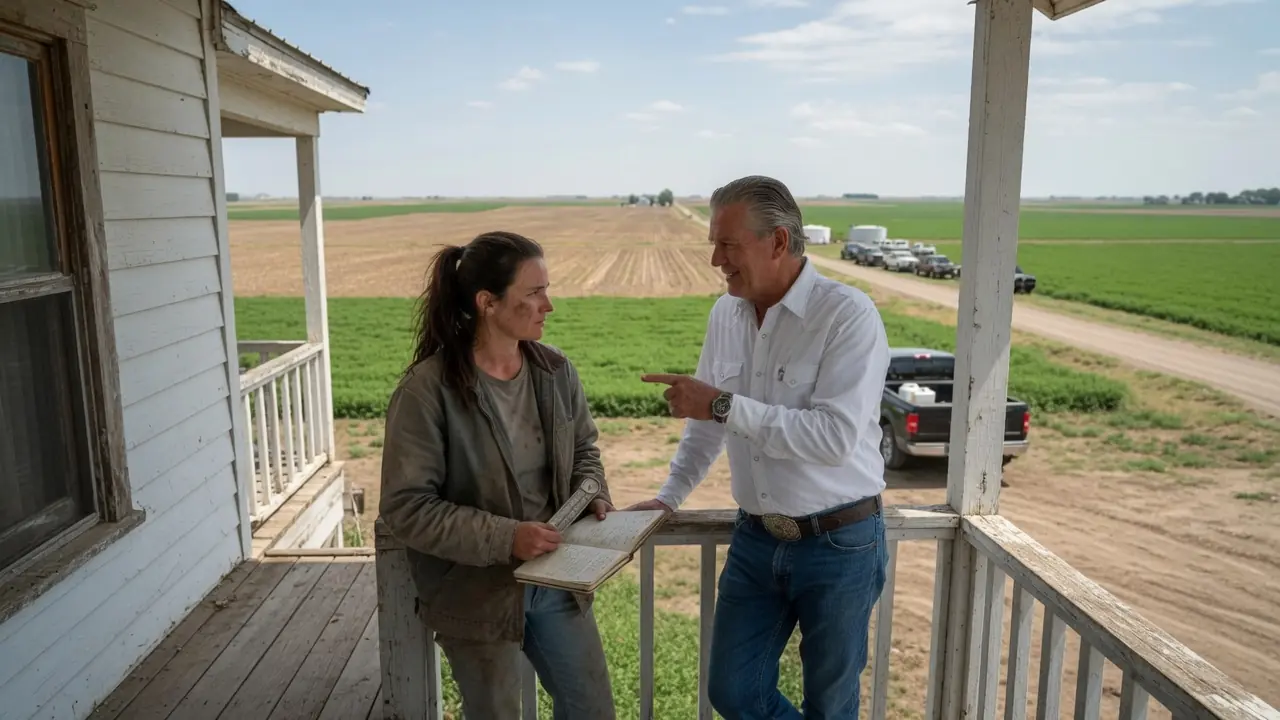
Then my wealthy neighbor leaned over my porch rail and said, “Sell before I poison every green acre and make the bank bury you with this dirt.”
I did not answer.
At dawn, his tire tracks were cut into my poisoned field.
The summer heat in Kearney County did not feel like weather anymore.
It felt personal.
Every morning, I walked my father’s four hundred acres before sunrise because after eight o’clock the soil turned hot enough to sting through the soles of my boots. The corn should have been knee-high by then. Mine barely reached my ankles in some rows, yellow at the tips and curling inward as though it were trying to hide from the sky.
Dad had died in that same field six months earlier.
He left me a tractor that coughed smoke, a farmhouse roof patched with feed sacks, and a bank note so heavy it felt like another body inside the house.
I had come home from Chicago wearing clean office shoes and carrying a stupid amount of confidence. I thought grief would be the hardest thing waiting for me.
I was wrong.
The drought was harder.
Across the county road, Harrison Caldwell’s five thousand acres stretched like a kingdom.
New combines.
New center pivots.
New trucks.
Rows of polished chemical tanks large enough to make the air smell sharp from my porch.
Harrison had wanted my father’s land for years. He wanted the western forty because it connected his north and south fields. He wanted the creek bottom because it held water during dry summers. Most of all, he wanted the Harper name removed from the map.
He had offered Dad money three times.
Dad refused him three times.
The final offer came while Dad was already ill, though none of us knew how ill.
Harrison arrived in a black pickup, placed a contract on the kitchen table, and told my father the price was generous.
Dad read the first page.
Then he folded the contract in half and pushed it back.
“You are not buying soil,” he said. “You are buying the right to exhaust it.”
Harrison smiled.
“Land does not care who owns it.”
Dad looked through the window toward the fields.
“That is what men like you tell yourselves.”
Three months later, Dad died of a heart attack while checking a plugged seed tube.
Nine days after the funeral, Harrison came back.
This time, he did not bring a contract.
He brought sympathy in a dark coat and an offer worth less than half the land’s appraised value.
“You have no operating history,” he told me. “No local income. No husband. No reason to throw your life away.”
“The farm is not for sale.”
He looked around the kitchen.
The cracked linoleum.
The bucket beneath the leaking ceiling.
Dad’s work coat still hanging beside the door.
“You do not know what you have inherited.”
“I know exactly what I inherited.”
Harrison’s eyes moved toward the bank papers on the table.
“No. You inherited a deadline.”
He was right about that.
Liberty Ag Credit held a note against the farm. Dad had borrowed to replace a failed irrigation pump and cover two poor harvests. The principal was not impossible, but the payment due in October required a crop.
No crop meant foreclosure.
Foreclosure meant auction.
At auction, Harrison would buy the land for less than he had offered me.
He knew it.
The bank knew it.
By June, half the county knew it.
At Rusty’s Diner, in front of farmers who had known me since I was a child, Harrison slid into the booth beside me and ordered coffee he never drank.
He leaned close enough that only the nearest tables were supposed to hear.
My father had been drowning for years, he said.
“Sell to me now. Thirty cents on the dollar, and you can run back to the city before you embarrass that family name any worse.”
I wrapped both hands around my cup so no one would see them shake.
“The farm is not for sale.”
That was when the laughter started.
Not everyone laughed.
But enough did.
Some laughed because Harrison controlled trucking contracts, chemical discounts, storage rates, and nearly every large custom-harvest crew in the county.
Some laughed because they believed he was right.
And some laughed because watching another person fail made their own fear easier to carry.
The laughter became louder when I spent the last of my operating credit on crimson clover and hairy vetch instead of synthetic nitrogen.
Dennis Croft, the county chemical representative, heard about the purchase before I returned home.
By evening, he had told half the coffee shop that grief had cracked my head open.
“You are planting weeds in corn that is already starving,” he said when he drove to the farm.
“They are cover crops.”
“You need nitrogen.”
“The fertilizer will burn if we do not get rain.”
“You need a stronger herbicide program.”
“I need the soil covered.”
Dennis stared at me.
“You worked in advertising.”
“Accounting.”
“That is worse.”
He kicked at the dry ground.
“This is farming, Nora. Not one of those city sustainability projects.”
“My father planted clover between corn rows in 1988.”
“And stopped.”
“Because the sprayer dealer convinced him clean soil looked like good management.”
Dennis smiled.
“Your father understood progress.”
“My father regretted it.”
That was true.
I found his old field notebooks during the week after the funeral.
Most contained ordinary farm records.
Planting dates.
Seed varieties.
Fuel use.
Rainfall.
Repairs.
But inside a binder marked WEST GROUND, I found notes from the late 1980s describing clover, vetch, rye, and field peas.
Dad had recorded lower soil temperatures, stronger aggregation, better water absorption, and reduced fertilizer use.
Then the entries ended abruptly.
A final note had been written in the margin.
Stopped under pressure from lender and chemical adviser. Soil began crusting again within two seasons. Never should have listened.
The handwriting was darker than the rest.
Angrier.
That note became my plan.
I did not pretend the cover crops would make rain.
They would not.
But they could protect what moisture remained.
Their roots could open compacted ground.
The clover could add nitrogen.
The living canopy could reduce surface heat.
At least, that was what Dad’s numbers said.
So I loaded crimson clover and hairy vetch into his modified grain drill and pulled it through the failing corn.
Old men parked along the county road to watch.
One leaned against his truck and called, “Planting lawn, Nora?”
Another asked whether I intended to graze sheep in the corn.
I kept driving.
The tractor overheated twice.
One seed tube clogged every six acres.
The drill chain jumped off near the west boundary.
It took me four days to finish.
Bradley Jenkins from Liberty Ag Credit arrived on the fifth.
He stepped from his sedan wearing a white shirt already darkening beneath the arms.
Bradley was thirty-six, careful, and afraid of every decision that might later appear in a board meeting.
He carried my loan file under one arm.
“The board heard about the cover-crop purchase.”
“That was fast.”
“They are concerned you diverted operating funds.”
“I purchased seed for the farm.”
“Seed not included in the approved crop plan.”
“Neither was a drought.”
He exhaled slowly.
“Nora, I am trying to help.”
“No. You are trying to make certain the paperwork shows that you warned me.”
His eyes narrowed.
“This is a serious situation.”
“I know.”
“If the corn fails, we foreclose in October.”
I looked over the field.
Tiny clover and vetch seeds lay beneath the dead-looking surface.
“No extensions?” I asked.
“No.”
“No restructuring?”
“Not without outside income or additional collateral.”
I nodded.
“It will not fail.”
Bradley looked toward the yellow corn.
“You cannot know that.”
“No.”
“Then why say it?”
“Because everyone else has already decided how this ends.”
For seventeen days, nothing happened.
The ground remained bare.
Each morning, I knelt between rows and searched for green.
Nothing.
By the tenth day, I began wondering whether the seed had died in the heat.
By the fourteenth, I considered calling Dennis and purchasing nitrogen on credit I did not have.
By the seventeenth, I sat at Dad’s kitchen table and calculated how much time remained before foreclosure.
Then the weather changed.
Not enough for rain.
Only a humid night.
Warm air moved north from the Gulf and laid a thick dew across Kearney County.
At sunrise, the soil opened.
Millions of green shoots pushed through the crust.
At first, they were no taller than eyelashes.
By afternoon, the field had a faint green haze beneath the corn.
Within a week, crimson clover and hairy vetch spread between the rows like living armor.
The covered soil remained soft.
Moisture persisted beneath the surface.
The corn leaves began uncurling.
I purchased a cheap soil thermometer from the hardware store and pressed it four inches into the covered rows.
Eighty-two degrees.
Across the road, Harrison’s bare ground measured more than one hundred and thirty near the surface.
His corn was taller than mine because he had irrigated early and applied more nitrogen than I could afford.
But his leaves were beginning to fire along the lower stalks.
Mine had stopped yellowing.
By mid-July, the laughter ended.
People slowed their trucks instead.
They stared at the only field in the county changing from brown to green.
Farmers began stopping near the gate.
They did not come onto the property.
They watched from the road because curiosity did not yet feel like respect.
Dennis Croft returned.
This time, he did not make jokes.
“What did you spray?”
“Nothing.”
“What foliar product?”
“None.”
“You had to put something down.”
“I put down clover and vetch.”
“That does not reverse nitrogen deficiency in two weeks.”
“It did not reverse anything. It kept the roots alive long enough to use what was already there.”
Dennis crouched and pushed his fingers into the soil.
He looked surprised by the moisture.
“How much irrigation?”
“None since planting.”
He stood quickly.
“You should terminate this before it competes with the crop.”
“It is not competing yet.”
“It will.”
“Then I will manage it when it does.”
Dennis looked across the road toward Harrison’s fields.
“You are making this look easier than it is.”
“No. I am making it look different.”
Harrison came to the porch that evening.
He did not knock.
He walked up the steps, leaned against the rail, and looked over my field.
“What did you apply?”
“Nothing you sell.”
His jaw tightened.
“You think one green field makes you an expert?”
“No.”
“People are talking.”
“They always do.”
“You are making fools of men who have farmed longer than you have been alive.”
“I did not ask them to laugh.”
Harrison leaned closer.
“Sell now.”
“No.”
“My offer expires when the bank files.”
“No.”
His expression changed.
The polite mask slipped.
“You should not become too attached to that green.”
I looked at him.
He smiled again, but there was nothing pleasant in it.
“Sell before I poison every acre and make the bank bury you with this dirt.”
The threat was so direct that for a second I thought I had misunderstood him.
“You just threatened to destroy my crop.”
“I said drought is unpredictable.”
“No. You did not.”
He straightened.
“Be careful, Nora. Grief can make a person hear things.”
He walked back to his truck.
I watched him drive away.
For several minutes, I considered calling Sheriff Miller.
Then I imagined how the conversation would go.
Harrison Caldwell contributes to every county campaign.
His brother sits on the grain cooperative board.
His cousin manages the largest agricultural law office in the district.
A threat spoken on a porch with no witnesses was not proof.
I locked the chemical shed.
Checked the fuel tanks.
Closed the gates.
Then I slept badly.
Two mornings later, I woke to the smell of poison.
It entered the farmhouse before I opened the door.
Sharp.
Bitter.
Industrial.
I ran outside.
Fifty acres along the western edge had turned sickly yellow overnight.
The corn hung limp.
The clover’s crimson flowers had blackened.
Vetch leaves curled into themselves.
Between the rows, fresh four-wheeler tracks curved through the field with a precision no wind, drift, or accident could explain.
The tracks entered from the county ditch.
They followed three long passes.
Then exited near the western fence.
I called Sheriff Miller.
He arrived forty minutes later with a toothpick in his mouth and no evidence bags.
He stood at the edge of the damage.
“Could be drift.”
“From where?”
He looked across the road.
“Harrison sprayed yesterday.”
“The wind was from the west.”
“Wind changes.”
“The damaged rows follow tire tracks.”
“Could be teenagers.”
“Teenagers with a boom sprayer and restricted herbicide?”
That made him look at me.
Not bored anymore.
“Careful making accusations without proof.”
“He threatened me.”
“When?”
“Two nights ago.”
“Witness?”
“No.”
“Recording?”
“No.”
He removed the toothpick and pointed toward the field.
“Then what you have is a damaged crop and a suspicion.”
“I have tracks.”
“Tracks do not identify a driver.”
“Will you take samples?”
He looked uncomfortable.
“I can contact the state agriculture office.”
“When?”
“They will schedule someone.”
“By then the chemical will degrade.”
Sheriff Miller returned the toothpick to his mouth.
“You seem to know a lot about evidence.”
“I worked in corporate audits.”
“This is not Chicago.”
“No. In Chicago, people at least pretend records matter.”
His face hardened.
“Watch yourself.”
He drove away.
I stood alone in the chemical stink.
Fifty acres gone meant my margin was gone too.
The bank’s October deadline beat inside my head.
For one minute, perhaps two, I folded into the poisoned clover and allowed myself to break.
I pressed both hands into the ground.
The plants above were dying.
But beneath the burned surface, the soil remained cool.
The roots were still holding.
That was when I remembered one of Dad’s sayings.
Soil keeps records.
Every pass of a machine.
Every chemical.
Every flood.
Every season of neglect.
A field cannot speak in court, but it carries evidence.
I wiped my face with the back of my hand.
Then I went to the farmhouse and opened Dad’s old address book.
Near the back was a name circled twice.
DR. ELIAS WARD.
Beside it, Dad had written one sentence.
Call him when the dirt needs a doctor.
I dialed at sunrise.
A man answered on the sixth ring.
“Ward.”
“My name is Nora Harper.”
Silence.
“Frank Harper’s daughter?”
“Yes.”
“How is Frank?”
I looked toward Dad’s empty chair.
“He died in January.”
The man breathed out slowly.
“I am sorry.”
“He left your number.”
“Did he?”
“He said to call when the dirt needed a doctor.”
A pause.
“What happened?”
“My field was poisoned.”
“What chemical?”
“I do not know.”
“Do not touch anything else. Do not wash your boots. Photograph every track before the sun changes the shadows. Collect no samples yourself.”
“Can you come?”
“Where are you?”
“Kearney County.”
“I can be there by noon.”
Dr. Elias Ward arrived in a faded station wagon carrying equipment that looked older than I was.
He was seventy-two, tall and narrow, with a white beard cut close to his jaw. He wore canvas pants, a straw hat, and boots stained with several different colors of soil.
He did not introduce himself twice.
He walked directly into the damaged field.
For three hours, Elias photographed tracks, measured spray width, marked wind direction, and collected soil, leaf, and water samples into numbered containers.
He examined the four-wheeler impressions.
“Aftermarket tires,” he said.
“How can you tell?”
“Center blocks are cut deeper than factory tread.”
He measured the distance between the tracks.
“Wide axle kit.”
I looked across the road.
Harrison used wide-axle four-wheelers to move between his pivot tracks.
“That proves nothing,” Elias said before I could speak.
“You know what I was thinking.”
“You are angry. Angry people run ahead of evidence.”
He followed the damaged pattern.
The western fifty acres had not been sprayed randomly.
The applicator targeted the healthiest sections.
He avoided the drainage ditch and stopped before the eastern field became visible from the farmhouse.
“This person knew your layout,” Elias said.
“Yes.”
“He also understood herbicides.”
“Can you identify it?”
“Probably.”
He opened a scorched clover stem with a small knife.
“Contact damage is too fast for glyphosate. Corn and broadleaf injury together suggest paraquat or a tank mixture. There is also leaf twisting farther inward. Could be dicamba contamination.”
“Why mix them?”
“To create immediate damage and residual confusion.”
“What does that mean?”
“Someone may want investigators to call it drift instead of deliberate application.”
Elias looked at me.
“Who benefits if the crop fails?”
“Harrison Caldwell.”
“Who else?”
“The bank.”
“Does the bank want your land?”
“I do not know.”
“Find out.”
I stared at him.
“You knew my father?”
“For thirty-six years.”
“How?”
“We met at a soil-health meeting in 1987.”
I remembered the old cover-crop notes.
“Did you help him?”
“He helped me.”
Elias crouched and picked up a handful of earth.
“Your father was one of the first farmers in this county to understand that drought damage begins long before the rain stops.”
“Why did he abandon the system?”
“He did not abandon it willingly.”
“What happened?”
Elias looked across the road.
“Harrison’s father happened.”
Calvin Caldwell had controlled agricultural lending and chemical distribution in Kearney County during the 1980s.
He offered farmers discounts if they followed a standardized production package.
Synthetic nitrogen.
Bare soil.
Herbicide programs.
New equipment financing.
Farmers who refused often found operating credit more difficult to obtain.
“Frank resisted,” Elias said. “Then your mother became ill.”
I had been five when Mom died. I remembered hospital rooms more than explanations.
“Medical bills forced him to refinance,” Elias continued. “The lender required an approved production plan.”
“Liberty Ag Credit?”
“Before the merger, it was Caldwell Rural Finance.”
Harrison’s family had once owned part of the lending company now holding my note.
My stomach tightened.
“Dad never told me.”
“He was ashamed.”
“Of what?”
“Needing help.”
Elias sealed the final sample.
“The system worked. That made his surrender harder.”
He drove the samples to an independent laboratory in Omaha.
The state agriculture office finally sent an inspector two days later.
His name was Paul Keener.
He collected three additional samples, took a short statement, and repeated Sheriff Miller’s suggestion that chemical drift remained possible.
“What direction was the wind?” I asked.
“We will review weather records.”
“The wind blew away from my field.”
“We do not make conclusions on site.”
“Will you inspect Caldwell’s spray records?”
“If evidence supports it.”
“What evidence would support it?”
Paul looked toward the burned crop.
“That is what we are determining.”
He left after forty-five minutes.
Elias’s laboratory results returned first.
The samples contained paraquat, dicamba, and a blue tracer dye used in professional spray systems.
The combination was not approved for application over standing corn.
More importantly, the concentration was highest inside the tire tracks and decreased outward in a consistent boom pattern.
It had not drifted.
It had been sprayed directly.
Elias called Sheriff Miller.
The sheriff promised to review the report.
Nothing happened.
Three days later, Bradley Jenkins arrived from Liberty Ag Credit.
He carried a notice of default review.
“The bank has been informed of severe crop damage,” he said.
“You were informed quickly.”
“Insurance adjusters communicate with lenders.”
“I have not filed an insurance claim yet.”
Bradley went still.
“Then perhaps the county office contacted us.”
“Which office?”
“I do not know.”
“You drove here with prepared documents. Someone knew before I called the bank.”
He opened the folder.
“The source does not change the financial issue.”
“What issue?”
“Your projected yield no longer supports the October payment.”
“Only fifty acres were damaged.”
“Fifty acres may eliminate your margin.”
“My crop insurance may cover malicious damage.”
“Only if malicious damage is proven.”
I placed Elias’s laboratory report in front of him.
“It was.”
Bradley read the first page.
His eyes moved more slowly after he reached the chemical concentrations.
“This is not a state report.”
“It is an accredited laboratory.”
“The bank will require official findings.”
“You mean the findings Harrison can delay.”
Bradley closed the report.
“Nora, accusations will not change your balance.”
“No. But they may change who is responsible for it.”
He pushed the default notice toward me.
The document gave Liberty Ag Credit authority to accelerate the loan if projected repayment became unlikely.
I read every line.
Near the bottom, one paragraph allowed the lender to demand immediate control of harvested grain proceeds and restrict further operating expenditures.
“You want control before harvest.”
“We want to protect collateral.”
“You want the farm unable to recover.”
“That is not fair.”
“Neither is arriving before I report the loss.”
Bradley left the notice.
After he drove away, Elias asked to see the original loan file.
I removed it from Dad’s metal cabinet.
We spent the evening reading.
Buried among renewal papers was a land-option agreement I had never seen.
It had been signed three years earlier.
If the farm entered default, Liberty Ag Credit possessed the right to solicit a private purchase offer before public foreclosure.
The designated preferred purchaser was Caldwell Agricultural Holdings.
My hands went cold.
“Harrison does not need to win an auction,” I said.
“No.”
“He only needs the bank to declare default.”
Elias looked at the document.
“Did your father understand this clause?”
“He signed it.”
“That was not my question.”
The signature appeared genuine.
But beside it was a notary stamp dated four days after Dad had been admitted to the hospital for pneumonia.
I checked his calendar.
He had not left the hospital that week.
The notary was Dennis Croft’s sister.
The chemical representative’s sister had certified a signature Dad supposedly made while hospitalized.
I called a lawyer named Amelia Torres.
She practiced in Lincoln but grew up on a farm twenty miles from mine. Elias trusted her.
Amelia arrived the following morning with two legal pads and an expression that suggested she had already lost patience with someone she had not met.
She examined the option agreement.
“This may be forged,” she said.
“Can we prove it?”
“Hospital records. Notary log. Ink analysis if necessary.”
“What about the poisoning?”
“That may be easier.”
“Sheriff Miller disagrees.”
“Sheriff Miller’s campaign received sixteen thousand dollars from Caldwell interests last year.”
I looked at her.
“How do you know?”
“Public records.”
The investigation widened.
Amelia subpoenaed Liberty’s communications after filing an emergency action to prevent acceleration of the loan.
The bank resisted.
A judge granted temporary protection because of the suspected forged agreement and deliberate crop damage.
For the first time since Dad’s death, the October deadline moved farther away.
Not gone.
But held.
Then Elias found the first piece of physical evidence tying Harrison to the field.
The blue tracer dye in the soil matched a proprietary colorant sold only through Caldwell Agricultural Supply.
That alone was not enough. Hundreds of gallons had been sold.
But the paraquat mixture contained a rare surfactant with a distinctive chemical marker.
Only three purchases of that product had been made in the county that year.
All three were charged to Harrison Caldwell’s account.
Sheriff Miller still refused to obtain a warrant.
Amelia sent the evidence to the state attorney general’s agricultural crimes unit.
Two investigators arrived within forty-eight hours.
They measured Harrison’s four-wheelers.
One had a wide axle matching the field tracks.
Its tires matched the aftermarket tread.
The machine had been washed recently.
Too recently.
Chemical residue remained beneath the rear rack.
Paraquat.
Dicamba.
Blue tracer dye.
Harrison claimed an employee had used the machine for fence-line spraying.
The employee denied it.
Then the second twist surfaced.
The four-wheeler’s onboard maintenance unit stored operating hours and GPS data.
Harrison did not know that.
The dealership had added the device after repeated thefts of equipment from his operation.
At 3:42 in the morning on the night my field was poisoned, the machine left Caldwell property.
It crossed the county road.
It traveled through my western fifty acres.
It returned thirty-seven minutes later.
The operator ID belonged to Dennis Croft.
Dennis disappeared before investigators could question him.
His truck was found at the airport.
He had purchased a ticket to Phoenix.
State police arrested him before boarding.
At first, Dennis claimed Harrison ordered the spraying.
Then, after learning the charges could include attempted financial fraud and environmental contamination, he offered a more complicated story.
Harrison had not acted alone.
Bradley Jenkins at Liberty Ag Credit had supplied the field maps and payment deadline.
Dennis provided the chemicals.
Sheriff Miller agreed to call the incident drift.
Harrison would acquire the land through the private option.
After the purchase, the western acreage would be transferred to Dennis as repayment for his involvement.
The plan had begun before Dad died.
The forged option agreement was the foundation.
The drought merely created the opportunity.
But there was still something Dennis did not know.
Why Harrison wanted my four hundred acres badly enough to risk prison.
The answer lay beneath the clover.
Elias discovered it while reviewing Dad’s soil records.
One notebook contained water-table measurements from the western field dating back to 1985.
Dad had drilled a test well there and recorded unusually stable groundwater during drought years.
The county’s official aquifer maps showed the deepest water farther east.
Dad’s readings contradicted them.
Elias overlaid the measurements with old geological surveys.
My farm sat above a narrow, highly productive section of the Ogallala Aquifer that had never been properly recorded on county maps.
Harrison’s wells across the road were declining.
His five thousand acres depended on water.
He had not wanted my land only for field access.
He wanted the groundwater beneath it.
The forged agreement included all water and mineral rights.
Amelia found correspondence between Harrison and a private irrigation company.
He had already planned six high-capacity wells on the Harper property.
The proposed system would pull enough water to support nearly two thousand additional acres.
If he acquired the land through foreclosure, he would pay a fraction of what the water rights were worth.
The story spread beyond Kearney County.
Local newspapers first described it as a crop-vandalism case.
Then the forged documents appeared.
Then the water maps.
Soon, cameras lined the county road.
Harrison stopped speaking publicly.
His attorneys called the allegations political, emotional, and technically unreliable.
They portrayed me as a grieving daughter desperate to save a failing farm.
That argument weakened when the corn recovered.
The poisoned fifty acres remained damaged.
But the remaining three hundred and fifty acres survived the drought better than any field around them.
The clover canopy reduced soil temperature.
The roots preserved structure.
A late August rain soaked into the covered ground instead of running away.
My corn added weight during the final weeks.
Harrison’s bare fields shed water into the ditches.
At harvest, the county average fell below ninety bushels per acre.
My surviving fields averaged one hundred and forty-six.
Not a record.
Enough.
More than enough.
The crop paid the legitimate loan balance after the forged agreement was removed.
The bank’s emergency restrictions were lifted.
Liberty Ag Credit’s board fired Bradley and opened an internal investigation.
He later pleaded guilty to fraud, conspiracy, and falsifying lending records.
Dennis accepted a plea agreement in exchange for testimony.
Sheriff Miller resigned before charges were filed. Investigators found that he had accepted money through a consulting company owned by his brother-in-law.
Harrison went to trial.
His attorneys argued that Dennis acted independently.
Then prosecutors played a recording.
Dennis had recorded Harrison during one of their planning meetings because he did not trust him.
Harrison’s voice filled the courtroom.
The girl will either sell or fail. If the clover works, kill enough of it to break the bank projection. Miller will call it drift. Bradley will trigger the option. After that, the water is ours.
Harrison sat completely still as the recording ended.
He was convicted of conspiracy, attempted fraud, criminal destruction of property, environmental violations, and forgery-related offenses.
The court ordered restitution.
His company lost several chemical licenses.
Banks called his loans.
For the first time in decades, the Caldwell operation began shrinking.
People expected me to celebrate.
I did not.
Harrison’s fall did not restore Dad.
It did not unpoison the fifty acres.
It did not erase the months I spent waking before dawn convinced someone else might come through the field.
But it gave the land time.
That mattered.
The following spring, Elias and I walked the western acreage.
The dead stalks were gone.
Clover returned in patches.
Vetch climbed along the old corn residue.
Elias dug a soil pit and examined the layers.
“Paraquat does not persist long in soil,” he said. “The biological damage is less severe than it looked.”
“Can we restore it?”
He smiled.
“The dirt kept more than the poison.”
I planted rye, clover, sunflowers, radishes, and field peas.
Not for sale.
For repair.
People parked along the county road again.
This time, they did not laugh.
They asked questions.
What mixture?
What seeding rate?
How much moisture did the cover hold?
Could it work after wheat?
Would cattle graze it?
I answered when I knew.
When I did not, I said so.
Dennis Croft once told everyone grief had cracked my head open.
In a way, he had been right.
Grief broke open the part of me that believed expertise always wore clean clothes and carried approval.
Dad had known better.
Knowledge could live in field notebooks.
In roots.
In the difference between covered and bare soil at noon.
In records kept by a farmer no lender considered sophisticated.
Three years later, Liberty Ag Credit sold its Kearney County portfolio to another lender.
Before the sale, the board offered me a public apology.
I declined the ceremony.
I accepted a written release confirming the farm was free of every forged option and private purchase right.
Then I paid the final note twelve years early.
The bank officer asked whether I wanted to open a new operating line.
“No.”
“You may need credit in the future.”
“Maybe.”
“What will you do then?”
I looked toward the soil notebooks on my kitchen table.
“I will decide when the year comes.”
Harrison’s five-thousand-acre operation was divided among creditors.
At auction, several local families recovered parcels they had lost during earlier debt cycles.
I purchased nothing.
People found that surprising.
The western section adjoining my farm would have been useful.
But Dad never wanted a kingdom.
He wanted a farm capable of surviving its owner’s mistakes.
That became my goal too.
I rebuilt the farmhouse roof.
Repaired the old tractor.
Added livestock slowly.
Rotated corn with small grains, legumes, and pasture.
The soil organic matter increased.
Water infiltration improved.
During dry years, the crops no longer curled as quickly.
During wet years, the fields no longer ponded along the western edge.
Elias continued visiting until his health failed.
On his final trip, he sat on my porch and watched crimson clover blooming beneath young corn.
“Frank would have liked this,” he said.
“He should have done it himself.”
“He tried.”
“He stopped.”
“He was carrying your mother’s medical debt, a farm note, and three bad seasons.”
Elias looked at me.
“Do not judge a man’s whole life by the year pressure finally bent him.”
I knew he was right.
Dad’s greatest gift was not that he had always followed the correct method.
It was that he recorded the mistake honestly enough for me to reverse it.
After Elias died, his family gave me one of his field bags.
Inside was a small magnifying lens, a soil knife, and a note.
Nora,
Never defend a method because it belongs to your father, to me, or to you.
Make the land prove it.
Then keep listening.
I carried the note in Dad’s old address book.
Years later, young farmers began visiting the Harper place.
Some came from agricultural colleges.
Others came from farms nearly lost to debt.
They expected a formula.
I gave them Dad’s notebooks.
Temperature readings.
Water measurements.
Cover-crop failures.
Successful mixes.
Costs.
I showed them the poisoned western field, now the healthiest ground on the farm.
One student asked how the soil survived.
“It did not survive untouched,” I said. “It survived because the roots were already there.”
That was true of the farm.
It was also true of me.
Harrison believed poisoning the visible crop would destroy the system beneath it.
He believed the green was the weakness because it was the part everyone could see.
He did not understand that the clover’s real work was underground.
Holding moisture.
Feeding organisms.
Opening soil.
Keeping roots alive after the surface looked finished.
Dad’s work had been like that too.
So quiet that even I failed to understand it until he was gone.
The notebooks.
The address.
The water records.
The warning about Caldwell.
The old seed drill modified to place cover crops between rows.
He had left me more than debt and broken machinery.
He left roots.
People still tell the story as though the miracle happened when clover turned a dying cornfield green.
That was only the beginning.
The real story began when someone tried to kill it.
The poison exposed the tracks.
The tracks exposed the machine.
The machine exposed the conspiracy.
The conspiracy exposed the forged loan.
And the forged loan exposed the water beneath the farm—the reason powerful men had been waiting for my family to fail.
Harrison once stood on my porch and promised the bank would bury me with the dirt.
He misunderstood both the bank and the dirt.
The bank kept paper.
The soil kept evidence.
Paper could be hidden, altered, or forged.
The land recorded everything honestly.
Every tire.
Every chemical.
Every root.
Every hand that tried to take more than it returned.
The summer after the trial, I stood in the western field at sunrise.
The clover reached my ankles.
Corn leaves moved softly above it.
Across the road, Harrison’s former acreage belonged to three smaller families.
The county was still dry.
Farming was still difficult.
Nothing had become easy.
But the soil beneath my boots was cool.
I pressed my hand into it and found moisture.
Dad had written one sentence on the final page of his field notebook.
I had read it a hundred times before I understood what it meant.
A farm does not survive because no one ever harms it.
It survives because someone knows what is still alive beneath the damage.
I closed the notebook.
Then I walked the rows before the heat arrived, listening to the land my father had taught me not to abandon.