The dead man’s signature appeared on the screen at 10:43 on a Thursday morning.
Until that moment, Vivian Blackwood had been smiling.
She sat in the first row of the county commission chamber wearing a white blazer, one hand resting on a leather portfolio and the other holding a silver pen she had not used. Behind her sat four members of the Sunset Meadows Homeowners Association, all dressed as though they had arrived for a ribbon-cutting ceremony rather than an emergency hearing.
Across the aisle, Rex Thornfield watched the image enlarge on the wall.
The document looked ordinary.
A county stamp.
A parcel description.
A boundary adjustment supposedly approved six months earlier.
Then his daughter Emma moved to the second page.
At the bottom was the signature of Harold Masterson, licensed land surveyor.
Emma faced the commissioners.
“Mr. Masterson died on February 11, 2021.”
No one spoke.
She let the date remain in the room.
“The HOA filed this document in August 2023.”
The silver pen slipped from Vivian’s fingers and struck the floor.
One of the news cameras swung toward her.
Commissioner Janet Walsh leaned toward the microphone.
“Counsel, are you stating that the boundary amendment used to include the Thornfield ranch inside the Sunset Meadows HOA was forged?”
Emma did not look at Vivian.
“I’m stating that a man who had been dead for two and a half years could not have surveyed, signed, or certified this expansion.”
A murmur rose from the back of the chamber.
Rex remained still.
He had spent forty years practicing property law. He knew the most damaging evidence rarely arrived with shouting. Sometimes it was a date beneath a signature.
Sometimes it was a single piece of paper that turned months of confident deception into a criminal question.
Vivian stood.
“This is theatrical nonsense.”
Emma finally looked at her.
“Then explain the signature.”
“I relied on professionals.”
“Which professionals?”
“Our legal counsel.”
The young attorney sitting beside Vivian suddenly became very interested in the table.
Emma picked up another document.
“And did your professionals also advise you to purchase my father’s ranch through a company you secretly controlled?”
The chamber fell silent again.
Rex looked toward Marcus Blackwood, Vivian’s brother-in-law.
Marcus had submitted the winning bid at the foreclosure auction three months earlier.
Fifty thousand dollars.
For a 3,500-acre cattle ranch appraised at more than eight million.
At the time, Marcus claimed he intended to preserve the property while deciding its future.
The corporate records on the screen showed something else.
Marcus’s company had signed an exclusive development agreement with Mountain Vista Planning LLC.
Mountain Vista was owned by Summit Holdings.
Summit Holdings belonged to Desert Vista Investments.
And Desert Vista was controlled by Vivian Marie Blackwood.
Rex watched the color leave her face.
She had spent months describing him as an aging rancher who could not accept progress.
She had told reporters that his cattle threatened children.
She had called his irrigation system an environmental hazard.
She had convinced residents that his grandfather’s tractor, roosters, hay barns, and cattle trailers violated the standards of a subdivision built seventy years after the ranch.
Now the county commissioners were looking at the machinery behind her concern.
Not safety.
Not property values.
Land.
Rex leaned back.
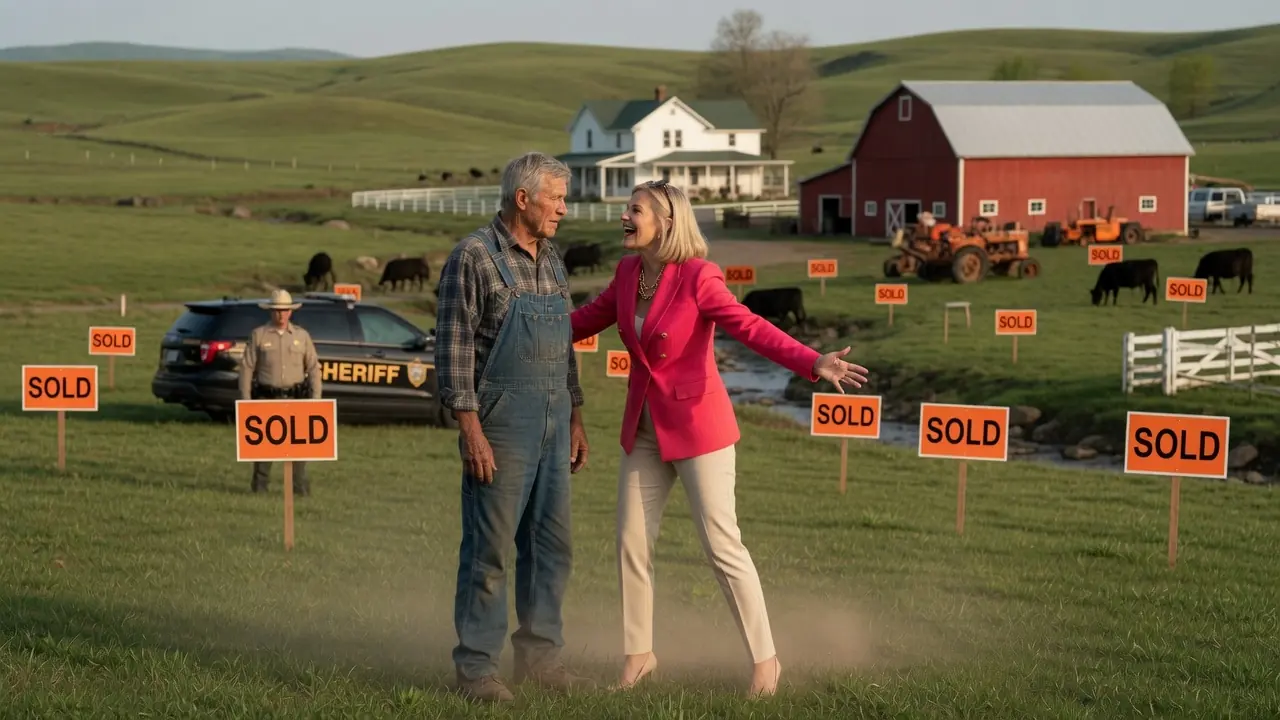
Three months earlier, he had stood across the street from the courthouse while a gavel transferred his family’s ranch to Marcus for less than the price of a new pickup.
At that moment, everyone believed the Thornfield story had ended.
It had actually begun much earlier.
The first certified letter arrived on a Monday in October.
Rex found it wedged inside the ranch mailbox after feeding cattle before sunrise. The envelope carried the seal of the Sunset Meadows Homeowners Association.
He almost threw it away.
The Bar T Ranch had existed since 1952.
Sunset Meadows had existed since 2019.
The two properties shared an eastern boundary, but nothing else.
Rex opened the letter at the kitchen table.
NOTICE OF VIOLATION
Unauthorized agricultural machinery visible from residential parcels.
The machinery in question was his grandfather’s faded blue Ford tractor.
Ezra Thornfield bought it used in 1967.
It had plowed snow, pulled hay wagons, hauled injured calves, and spent more years working the valley than most Sunset Meadows residents had spent living in the state.
The letter demanded that Rex remove the tractor from public view or face daily fines.
A second letter arrived the following day.
DISRUPTIVE AGRICULTURAL NOISE
His roosters began crowing shortly before six.
A third notice accused him of storing unsightly materials.
Hay.
Actual hay stacked inside a ranch barn.
Rex created a folder and labeled it SUNSET MEADOWS — JURISDICTION DISPUTE.
His late wife, Sarah, would have laughed at the formality.
“You retired,” she used to remind him whenever he turned household disagreements into case files.
Rex had retired from active practice six months after Sarah died.
Cancer took her the previous spring.
She was fifty-seven.
For thirty-two years, she had been the person who prevented his arguments from becoming obsessions.
She taught agricultural science at the county high school, judged 4-H events, and could identify more native plants than Rex knew existed.
They met at the county fair when she criticized the grooming of his prize bull and then complimented the animal’s eyes.
They raised two children on the ranch.
Emma became a corporate attorney in Denver.
Jake joined the Army.
Sarah and Rex planned to spend retirement restoring old cabins near the northern creek and turning part of the ranch into an educational program.
Then she died.
The ranch house became too large.
Rex moved through it quietly, repairing things that did not need repair because grief was easier when given tools.
Sunset Meadows arrived at exactly the wrong moment.
Or perhaps, from Vivian’s perspective, the perfect one.
She first appeared at his gate wearing a white linen blazer and holding a clipboard.
“Mr. Thornfield, we need to discuss your compliance situation.”
Rex rested both hands on the top rail.
“My what?”
“Recent county adjustments place the ranch within the jurisdiction of the Sunset Meadows HOA.”
“No, they don’t.”
Vivian smiled.
“Oh, Mr. Thornfield. I don’t make claims without documentation.”
“Then show it to me.”
Her smile sharpened.
“You will receive everything formally.”
“Good.”
Rex nodded toward the gate.
“Until then, this conversation is over.”
Within forty-eight hours, the letters began.
Five hundred dollars per day for the tractor.
Five hundred for agricultural noise.
Five hundred for visible hay storage.
Additional penalties for cattle odors, livestock trailers, unapproved fencing materials, and what the HOA called industrial land use incompatible with community character.
Rex documented every notice.
He photographed his fences.
Recorded gate locations.
Retrieved the original Bar T land patent, the 1952 deed, zoning records, water rights, easements, and the 2019 Sunset Meadows incorporation map.
The map excluded his ranch clearly.
The HOA boundary ended at the eastern fence.
Rex attended the next board meeting carrying copies.
The community center smelled of stale coffee and lemon cleaner. Vivian sat at the center of a folding table, flanked by board members who avoided eye contact when Rex entered.
During public comment, he spread the maps in front of them.
“Show me one lawful document that moved the HOA boundary across my property.”
Vivian shuffled papers.
“The amendment is a matter of county record.”
“Which recording number?”
“Our counsel can provide it.”
“Which surveyor signed it?”
“That information is available through the clerk.”
Rex waited.
The silence became uncomfortable.
Several residents looked toward Vivian.
Rex had spent decades conducting depositions. He knew the value of leaving a false witness alone with a direct question.
Vivian eventually said, “You are disrupting the meeting.”
“No.”
Rex gathered his maps.
“I am asking you to prove you have authority you are already using.”
She produced nothing.
Two days later, a law firm sent a cease-and-desist letter.
It accused his cattle of trespassing onto HOA common areas.
Rex walked every section of the eastern fence.
Posts solid.
Wire tight.
Gates locked.
The cattle remained on Thornfield land.
Then, before dawn on a Tuesday, Rex woke to frantic bawling near the road.
He pulled on boots and carried a flashlight into the darkness.
The herd had gathered close to the eastern boundary. Several animals had crossed into the open grass between the ranch and Sunset Meadows.
Three sections of wire had been cut cleanly.
Not broken.
Cut.
The sheriff’s deputy who responded examined the ends.
“Bolt cutters.”
“Cattle don’t generally carry them,” Rex said.
The deputy almost smiled.
By six thirty, Vivian had called a television station.
Channel 7 arrived before Rex finished temporary repairs.
The morning broadcast showed cattle standing near manicured subdivision landscaping beneath the caption:
ROGUE LIVESTOCK THREATEN RESIDENTIAL COMMUNITY
Vivian stood before the camera.
“This is exactly what we have warned about. Mr. Thornfield refuses to control an industrial livestock operation beside family homes.”
Behind her, Rex drove a steel post into the earth.
Hammer against metal.
Cattle calling.
Diesel engine idling.
The reporter never asked who cut the fence.
That afternoon, Rex installed trail cameras.
Near sunset, a teenage boy walked up the driveway.
He wore a Sunset Meadows football sweatshirt and kept both hands inside his pockets.
“Mr. Thornfield?”
Rex recognized him.
Tyler Blackwood.
Marcus’s sixteen-year-old son.
“I need to tell you something.”
They sat on the porch.
Tyler stared at the floorboards.
“Aunt Vivian paid me.”
“For what?”
“To cut openings in the fence.”
Rex did not react.
“She called it community service,” Tyler continued. “She said your cattle needed to get out so people would understand the danger.”
“How much?”
“Five hundred dollars.”
“Did your father know?”
“No.”
“You willing to say this to him?”
Tyler looked terrified.
“I think so.”
Rex gave him a choice.
Tell the truth to Marcus and the sheriff, or let the evidence proceed without cooperation.
By evening, Marcus stood on Rex’s porch with his son beside him.
Sarah’s rose bushes moved gently in the wind.
“I didn’t know,” Marcus said.
Rex believed him.
Not because Marcus deserved immediate trust, but because the shock on his face was difficult to manufacture.
“Vivian told Tyler he was helping the community,” Marcus said.
“She used your son to commit felony vandalism.”
Marcus closed his eyes.
“This ends now.”
Rex looked toward the subdivision.
“No. It doesn’t.”
He had seen escalation patterns before.
A party that invented authority rarely retreated after one failed tactic.
The next letter proved him right.
SPECIAL ASSESSMENT: $47,000
The HOA claimed Rex’s cattle damaged county roads, his irrigation affected storm drainage, and his agricultural noise required mitigation.
Rex called the county.
No department had approved the assessment.
The HOA imposed it anyway.
When he refused to pay, it recorded a lien.
Thirty days later, Vivian initiated foreclosure.
That was the point at which Rex’s legal instincts overruled his grief.
He began examining every filing.
The foreclosure process appeared legitimate on the surface.
Certified notices.
Recorded lien.
Auction date.
Legal advertisements.
But legitimacy depended on one missing fact.
Jurisdiction.
If the ranch was outside the HOA, the assessment was void.
If the assessment was void, the lien was void.
If the lien was void, the foreclosure was theft wearing a clerk’s stamp.
Rex filed for an emergency injunction.
The judge denied temporary relief because the HOA produced the amended boundary document bearing Harold Masterson’s signature.
Rex recognized the name.
He had worked with Harold on easement disputes for twenty years.
The signature looked close enough to survive a hurried review.
With the amendment in the record, the court allowed the auction to proceed while the broader lawsuit continued.
It was a narrow procedural decision.
Vivian presented it to reporters as a final legal victory.
She announced a “voluntary retirement auction” for Rex’s equipment.
Channel 7 ran a nostalgic segment about the end of a family ranching era.
No reporter asked Rex whether the retirement was voluntary.
The foreclosure auction took place on the courthouse steps.
Only two bidders appeared.
Marcus Blackwood.
And Mountain Vista Development LLC.
Marcus won at fifty thousand dollars.
Rex stood across the street documenting every bid.
When the gavel fell, he felt something inside him become completely still.
The Bar T had been Thornfield land since his grandfather purchased 3,500 acres of sagebrush and dry washes in 1952.
Ezra dug wells.
Built fences.
Cleared stone.
Rex’s father expanded the barns and irrigation system.
Rex learned to drive on ranch roads Ezra cut with a borrowed bulldozer.
Sarah planted roses beside the porch.
Emma learned to ride near the southern pasture.
Jake broke his first arm falling from a gate he had been told not to climb.
Now the entire place belonged, on paper, to a man who had paid less than one percent of its value.
Marcus walked toward the county clerk’s office carrying the deed documents.
Rex followed.
Inside the filing packet, he saw Mountain Vista listed as development coordinator.
That night, he traced the company.
Mountain Vista belonged to Summit Holdings.
Summit belonged to Desert Vista Investments.
Desert Vista belonged to Vivian.
The foreclosure had never been about enforcement.
Vivian had built a pipeline.
Create false jurisdiction.
Issue fabricated penalties.
Record liens.
Force auctions.
Transfer properties to relatives.
Move development rights to her own companies.
The Bar T was not the first.
Rex found three earlier foreclosures.
An elderly couple lost a horse property over alleged drainage violations.
A widowed farmer lost forty acres after refusing an assessment for road improvements.
A mechanic lost a five-acre parcel over building standards imposed years after his workshop existed.
Every property went to a relative of an HOA board member.
Every parcel was later transferred to a development company.
Rex’s grief changed shape.
For months, it had made him quiet.
Now it became focus.
At three in the morning, he made coffee and returned to the records.
The original Sunset Meadows map excluded the ranch.
The amended map included it.
Rex compared the signatures.
Harold Masterson’s license number was correct.
His professional seal looked accurate.
But Harold had died two years before the filing.
Rex found the obituary.
Then the state licensing record.
He called Emma.
She answered on the fourth ring.
“Dad?”
“I need you in Arizona.”
“What happened?”
“They forged a dead man’s signature and stole the ranch.”
Silence.
Then her voice changed from daughter to attorney.
“Send me everything.”
She arrived the following afternoon.
Rex’s former law partner, Jasper Mills, joined the case.
So did Dale Garrison, a retired detective who had spent years investigating financial crimes.
Janet Reeves, owner of the county’s largest title company, reviewed the foreclosure transfers.
Within a week, Rex’s kitchen became a war room.
Corporate records covered the dining table.
Bank statements filled banker’s boxes.
Property maps covered one wall.
Sarah’s old reading chair disappeared beneath deposition transcripts.
Emma identified millions moving through HOA-linked entities.
Janet confirmed defective notice in every prior foreclosure.
Dale found that Vivian had been involved in failed real-estate investment schemes in three states.
The team also discovered $340,000 in unpaid property taxes tied to HOA common areas and shell companies.
Vivian had accused Rex of delinquency while her organization ignored its own obligations for three years.
Then Dale obtained the recording.
Vivian and two associates met regularly at a coffee shop near Highway 87.
From a public parking area, Dale captured a conversation through an open patio window.
“The commissioner wants another ten thousand for the variance,” Vivian said.
A man replied, “And the assessor?”
“He’ll reclassify three more farms as blighted agricultural before winter.”
“What about Thornfield?”
Vivian laughed.
“Finished. We have the ranch, the bar association complaint, health inspections, and enough liens to bankrupt him before he gets near a jury.”
The recording continued.
Once the remaining ranchers were removed, investors planned to purchase nearly twelve thousand acres for forty million dollars.
The HOA was only a tool.
Its board meetings, fines, safety campaigns, and neighborhood concern concealed a coordinated land-acquisition scheme.
Emma sent the recording and supporting documents to the state attorney general and federal investigators.
They did not promise arrests.
They asked for preservation of evidence and silence.
Rex understood.
Real investigations moved more slowly than television justice.
Vivian continued escalating because she believed no one could stop her.
She filed anonymous health complaints.
Inspectors tested ranch water and found no contamination.
She arranged fraudulent contractor liens against Rex’s truck, tractor, and cattle.
Emma obtained emergency orders releasing them.
Vivian complained to the state bar that Rex was practicing law improperly.
The complaint was dismissed after the bar confirmed he was representing himself and working through licensed counsel.
Every failed attack created another document.
Another witness.
Another pattern.
Then Vivian organized a community safety summit.
She rented the high school gymnasium.
Printed banners.
Invited commissioners, reporters, and the sheriff.
Her presentation included maps showing cattle odor zones, charts predicting groundwater contamination, and photographs edited to make ordinary pastures appear dangerous.
Residents described sleepless children, declining property values, and fear of livestock they had chosen to live beside.
Vivian introduced Dr. Edmund Blackstone as an agricultural-safety expert.
Emma searched his credentials during the presentation.
He was not an agricultural scientist.
He was a junior attorney at the firm representing the HOA.
His graduate degree concerned environmental regulation.
He had never conducted a livestock-health study.
Rex sat in the back row recording everything.
Vivian believed she was creating public pressure.
She was actually documenting misrepresentation.
Two days later, the county commission called a special hearing.
That was where Harold Masterson’s dead signature appeared on the screen.
After Emma exposed the forged survey, she moved to the corporate structure.
Then the prior foreclosures.
Then the unpaid taxes.
Then the audio.
Vivian’s own voice filled the chamber.
“The beauty is that we’re using their legal system against them.”
No one moved.
Commissioner Walsh looked toward the county attorney.
“Have law enforcement agencies received this material?”
County Attorney Sarah Mitchell stood.
“Yes. The state attorney general’s office and federal investigators were notified before today’s hearing.”
Vivian pushed back from the table.
“This is a conspiracy.”
Rex spoke for the first time.
“No.”
Every face turned toward him.
“A conspiracy requires agreement.”
He looked at the board members sitting behind her.
“I think several of your people are about to disagree with you very quickly.”
He was right.
The HOA treasurer requested separate counsel before the hearing ended.
The secretary offered investigators access to internal records.
Marcus stood and addressed the commission.
“I purchased the Thornfield property, but I did not understand Vivian controlled Mountain Vista.”
Rex looked at him.
That was only partly true.
Marcus had understood he was receiving an impossibly valuable ranch through a questionable process.
Perhaps he had not known the full scheme.
Ignorance did not make him innocent.
But cooperation still mattered.
Deputies did not arrest everyone inside the chamber.
The criminal process remained less theatrical than the news wanted.
Search warrants came first.
Bank accounts were frozen.
Development offices were searched.
County employees were interviewed.
The court temporarily suspended the foreclosure deeds and appointed a receiver over HOA-controlled properties.
Rex returned to the Bar T under an emergency possession order while ownership litigation continued.
The first morning back, he stood beside the gate at 4:47.
Frost cracked beneath his boots.
The old Ford tractor coughed blue smoke.
Cattle called from the winter pasture.
For three months, every sound had felt borrowed.
Now the ranch seemed to breathe again.
Rex entered the house.
Sarah’s coffee mug remained on the shelf where he had left it.
He sat at the kitchen table and cried for the first time since the auction.
Not because the case was over.
It was not.
Because he had returned to the place where grief belonged to him rather than to Vivian’s paperwork.
The civil court vacated the foreclosure six months later.
The judge found that Sunset Meadows never possessed jurisdiction over the Bar T Ranch.
The boundary amendment was fraudulent.
The assessment was void.
The lien was void.
The auction deed was canceled.
Three prior property transfers were also reopened.
Two families recovered their land.
The third chose financial compensation because their former property had already been developed beyond restoration.
The criminal cases took longer.
Vivian eventually pleaded guilty to conspiracy, mail fraud, forgery, bribery, and participating in fraudulent property transfers.
She received a substantial prison sentence and was ordered to pay restitution.
The county clerk who knowingly accepted forged filings lost his position and pleaded guilty.
An assessor admitted taking payments to classify farms as distressed.
The HOA’s outside lawyer was disbarred after investigators proved he had prepared documents he knew were false.
Marcus received a reduced sentence after cooperating and surrendering the development rights attached to the Bar T.
Tyler was not charged.
He completed community service at the ranch, repairing the same fence he once cut.
On his first morning, Rex handed him fencing pliers.
Tyler looked at them nervously.
“Are these the same kind I used?”
“Probably.”
“I’m sorry.”
“I know.”
Rex pointed toward the damaged section.
“Apologies are stronger when they hold cattle.”
The boy worked all summer.
He became good with wire.
The legal victories returned the ranch.
They did not return Sarah.
That truth became clearer after the noise ended.
For months, fighting Vivian gave Rex a reason to wake before dawn. Once the hearings stopped and reporters disappeared, the house became quiet again.
Emma noticed.
She moved part of her practice from Denver to the ranch, using Sarah’s former sewing room as an office.
Jake returned from deployment and stayed through calving season.
Neither child pretended they could replace their mother.
They simply occupied the rooms grief had emptied.
Rex considered suing every Sunset Meadows homeowner.
Jasper told him the law allowed claims against the association but not necessarily innocent residents who had paid assessments without knowing the scheme.
Rex chose not to punish an entire subdivision for Vivian’s crimes.
Instead, the court placed Sunset Meadows under independent administration.
Residents elected a new board.
The forged boundary was removed.
Agricultural activity predating the subdivision received permanent legal protection.
The HOA was prohibited from pursuing liens or foreclosures without independent review and full notice.
Some residents apologized.
Others blamed Vivian and denied their own role in supporting her campaigns.
Rex accepted that accountability rarely arrived evenly.
The county settlement funded a property-rights clinic named for Sarah.
Emma directed it.
The clinic helped rural landowners challenge fraudulent liens, coercive assessments, and development pressure.
Janet taught workshops about title records.
Dale explained how to preserve evidence.
Rex taught one lesson repeatedly.
“Do not ignore ridiculous paperwork because it looks too absurd to be dangerous.”
A notice about a tractor could become a lien.
A lien could become an auction.
A forged map could take a ranch unless someone checked the signature.
The Bar T also became the agricultural education center Sarah once imagined.
Jake converted unused HOA common land—voluntarily transferred through the settlement—into demonstration pastures and community gardens.
School buses arrived in spring.
Children learned why cattle rotated between fields.
Why water rights mattered.
Why ranch roads looked different from suburban streets.
Why food did not begin inside grocery stores.
Rex watched children climb onto Ezra’s old tractor for photographs.
The machine remained faded.
Its rust still violated every aesthetic standard Vivian once tried to impose.
Nobody cared.
The state legislature later passed reforms requiring judicial review before an HOA could foreclose on occupied property.
Associations had to prove jurisdiction, provide independent accounting of assessments, disclose conflicts of interest, and offer meaningful appeal procedures.
Reporters called it the Thornfield Act.
Rex disliked the name.
Sarah would have enjoyed teasing him about it.
One afternoon, he found Emma standing in the rose garden with a legal folder beneath one arm.
“You won,” she said.
Rex looked toward the hills.
“We got the ranch back.”
“That’s usually called winning.”
“No.”
He touched one of Sarah’s roses.
“Winning would be your mother standing in that kitchen complaining about all the television trucks.”
Emma looked down.
“You think she’d approve?”
“Of the lawsuit?”
“Of what came after.”
Rex considered the schoolchildren in the northern pasture.
The families receiving legal help.
Tyler repairing fence.
Landowners learning to read documents before signing them.
“Yes.”
His voice softened.
“She would tell me I enjoyed the depositions too much.”
“You did.”
“I’m allowed one flaw.”
Emma laughed.
Years later, people told the story as though Rex destroyed an HOA through one brilliant courtroom ambush.
The truth was less clean.
He nearly lost the ranch.
A judge initially accepted a forged document.
News stations repeated Vivian’s version.
Officials ignored warning signs.
Neighbors allowed fear of agriculture to become contempt for the people who practiced it.
Rex did not win because he was smarter than everyone else.
He won because evidence survived.
The original survey.
Corporate records.
Tyler’s confession.
Cut fence wire.
Tax filings.
Audio recordings.
A dead surveyor’s license history.
And because other people eventually chose to tell the truth before the lie became permanent.
Rex framed two documents inside the ranch office.
The first was the voided foreclosure deed showing the Bar T sold for fifty thousand dollars.
The second was the court order canceling it.
Between them, he placed a photograph of Ezra Thornfield in 1952.
His grandfather stood beside a rusted truck on empty high-desert ground.
No barns.
No wells.
No fences.
Only sagebrush, distance, and a man who did not yet know whether his idea would work.
Beneath the photograph, Rex added one sentence.
LAND IS NOT SAVED BY OWNERSHIP ALONE. IT IS SAVED BY PEOPLE WILLING TO DEFEND THE TRUTH ABOUT IT.
At seventy, Rex still woke before sunrise.
He fed cattle.
Checked water.
Drove the old tractor.
Some mornings, he imagined Sarah standing at the kitchen window with coffee, watching him work while pretending not to worry about his knees.
The subdivision remained along the eastern boundary.
Its beige houses did not disappear.
Children played in its yards.
Residents walked dogs along its sidewalks.
The fence between them and the ranch remained too.
But the meaning had changed.
It no longer marked a line one side intended to erase.
It marked the place where authority ended.
Vivian Blackwood believed the Bar T was an aging man’s vulnerable inheritance.
She saw 3,500 acres beside an expanding development corridor.
She saw debt, grief, and an opportunity to turn neighborhood rules into a property-acquisition machine.
She expected Rex to pay.
Then to surrender.
Then to leave quietly while she rewrote theft as progress.
Instead, she created a record.
Every false notice.
Every assessment.
Every cut fence.
Every shell company.
Every forged signature.
By the time she understood what Rex had assembled, the evidence was already larger than the ranch dispute.
It exposed a system that had preyed on families who lacked his legal experience.
That became the part of the story Rex valued most.
Recovering the Bar T protected one legacy.
The clinic protected dozens more.
And whenever a frightened property owner entered Sarah’s old sewing room carrying an impossible lien or a threatening letter, Rex made coffee and opened a new file.
He always began with the same question.
“Show me the first piece of paper they sent.”
Because corruption rarely introduced itself honestly.
It arrived as a violation notice.
A community assessment.
A safety concern.
A technical boundary correction.
Something small enough to ignore.
Vivian’s mistake was believing Rex Thornfield was only a lonely widower standing behind an old fence.
She did not understand that he had spent forty years learning how false authority was built.
Or that the ranch carried more than cattle and property value.
It carried seventy years of work.
Ezra’s wells.
His father’s barns.
Sarah’s roses.
Emma’s childhood rides.
Jake’s first broken arm.
Every sunrise Rex had watched from the eastern field.
The gavel had sold those things for fifty thousand dollars.
The law eventually returned the deed.
But the deed was never the whole ranch.
The ranch lived in the labor, memory, and responsibility no forged survey could transfer.
And when Harold Masterson’s dead signature appeared before the county commission, everyone finally saw what Rex had known from the beginning.
The HOA had never owned his land.
It had only borrowed the appearance of power long enough to steal it.