The apology arrived nine years late.
Walter Briggs stood in the shade of Silas Mercer’s equipment shed on an August morning in 1983, turning his hat slowly between both hands.
He had rehearsed the words during the drive.
He had rehearsed them the night before while sitting at his kitchen table beneath three geological reports that all reached the same conclusion.
His wells were failing.
Not one well.
All three.
The deepest had supplied Walter’s four hundred acres since 1962. For two decades, it had seemed inexhaustible. Even during dry summers, the pump pulled enough water to keep his corn green while neighboring fields curled beneath the heat.
Then the pressure began to fall.
At first, the decline was small enough to dismiss.
A little less flow during afternoon irrigation.
A pump that needed several extra minutes to build pressure.
A field at the far end of the line that no longer received water evenly.
Walter spent money before he admitted fear.
He replaced pipes.
Rebuilt pumps.
Deepened one of the southern wells.
For a season, the improvements seemed to work.
Then the water level dropped again.
The hydrogeologist from Indianapolis called it a perched water table—a pocket trapped above an impermeable layer of clay, separated from the deeper regional aquifer.
“It was never as permanent as it appeared,” the man explained.
Walter disliked the sentence.
The well had been reliable for twenty-one years. To Walter, that felt permanent.
The hydrogeologist disagreed.
“At your current rate of use, you may have two years of dependable production left.”
A second specialist gave Walter the same answer with different words.
Three drilling companies surveyed the property. Each studied maps, previous records, elevations, and known formations.
None recommended a new location with confidence.
By the summer of 1983, Walter’s corn showed stress before July ended.
His soybean yields had already fallen nearly twenty percent from their five-year average.
That was why he stood at Silas Mercer’s shed with his hat in his hands.
Silas watched him without offering help or hostility.
At seventy, Silas was thinner than he had been nine years earlier. His hair had turned almost entirely white, and arthritis had bent two fingers on his left hand.
But his posture remained straight.
Behind him, an old tractor sat with its side panel removed. Tools were arranged across the workbench in the exact order he intended to use them.
Walter cleared his throat.
“My wells are failing.”
Silas waited.
“I’ve had two hydrogeologists and three drilling companies out there.”
Still Silas said nothing.
“Not one of them can tell me where to drill.”
Walter looked down at the packed dirt between his boots.
“I know what I said to you in ’74.”
That finally changed Silas’s expression.
Not much.
Only a slight narrowing of the eyes.
Walter continued.
“I know how I said it too.”
The memory had followed him for nine years.
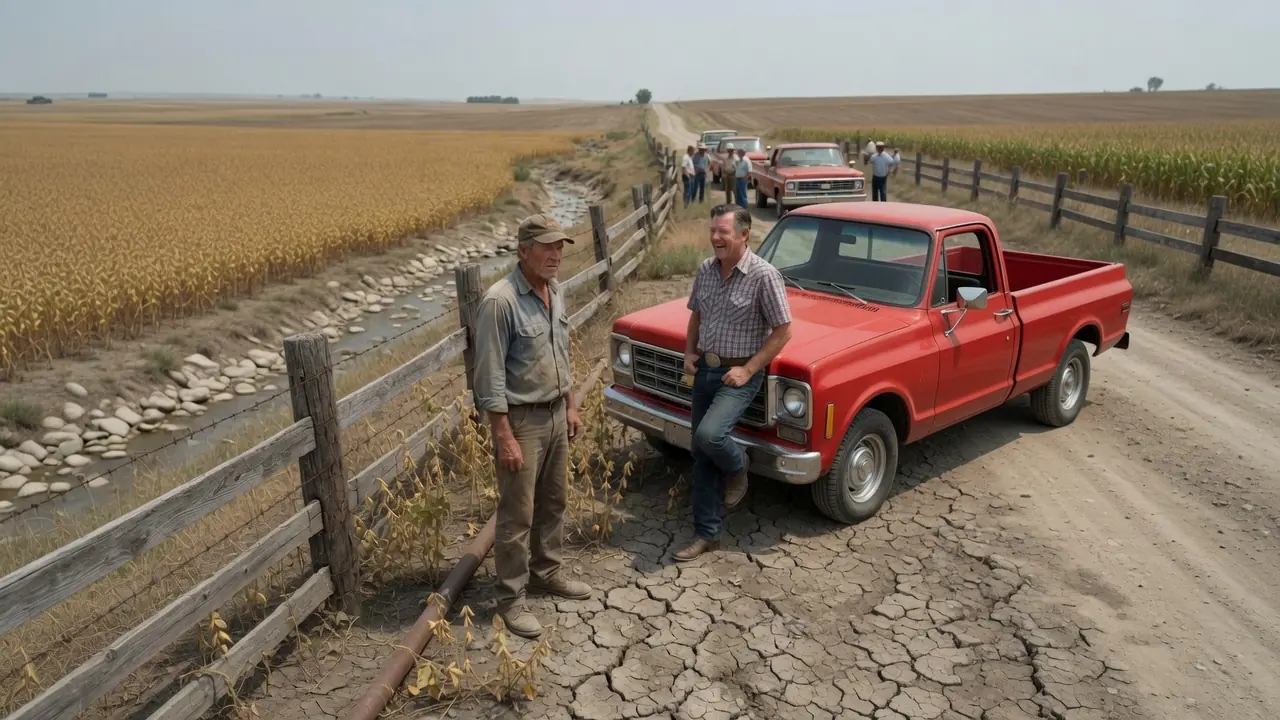
The new red Chevrolet.
The fence line.
His boot on the bumper.
His laughter carrying across the dry ground while Silas stood beside sixty-three acres of dying soybeans.
At the time, Walter had believed himself practical.
Successful men protected their own operations.
Struggling men accepted reality.
That was how he explained it later.
The truth was less respectable.
He enjoyed having something Silas needed.
“I should never have laughed,” Walter said.
Silas looked beyond him toward the driveway.
“You came here for more than an apology.”
“Yes.”
“What do you want?”
Walter forced himself to meet the older man’s eyes.
“I’m asking for your help.”
Silence filled the shed.
A cicada rattled from the maple tree near the farmhouse. Somewhere behind the barn, a loose piece of metal moved in the wind.
Silas did not answer immediately.
Walter wondered whether this was punishment.
Perhaps Silas wanted him to remain there long enough to feel the humiliation he had once inflicted from across the fence.
But Silas had never been a man who performed cruelty for an audience.
He was simply allowing the request to settle before deciding what it deserved.
Finally, he nodded toward the farmhouse.
“Come inside. Coffee’s still warm.”
They sat at the kitchen table where Silas had once calculated whether one final gamble could save his farm.
Walter spread the geological reports between them.
He explained the pressure decline.
The failed deepening attempt.
The drawdown from twenty years of irrigating four hundred acres.
The expensive recommendations that offered no certainty.
Silas listened without interrupting.
He asked only practical questions.
“When did the north well first lose pressure?”
“Late summer of ’79.”
“Did it recover after winter?”
“Partially.”
“How quickly does the water level fall under continuous pumping?”
“Four feet in the first hour. Nearly eight by the third.”
“Any difference after rain?”
“Some, but not enough.”
Silas placed one finger on the property map.
“Your northeastern corner.”
Walter looked at him.
“What about it?”
“The part where the land falls toward the old fence row.”
“That’s four hundred yards from my existing wells.”
“I know.”
“You’ve never farmed that ground.”
“No.”
Silas moved his finger along a faint contour.
“But I’ve looked at it from my side of the fence for thirty years.”
Walter leaned closer.
“There’s a shallow depression there,” Silas continued. “Runs roughly north to south. Barely visible. Maybe eighteen inches across a hundred yards.”
“The surveyors saw it.”
“They measured it.”
Silas looked toward the window.
“That isn’t the same as seeing it.”
Walter waited.
Silas folded the property map closed.
“We’ll walk it this afternoon.”
“Do you think there’s water?”
“I think there may be an old channel beneath it.”
“How deep?”
“Maybe one hundred and twenty feet. Maybe one hundred and forty.”
“The specialists found nothing.”
“They were reading maps.”
“What will you read?”
“The land.”
Walter almost objected.
Nine years earlier, he would have laughed.
But laughter had not filled his irrigation pond.
So he said nothing.
Silas lifted his coffee.
“My father taught me what to look for in 1930.”
Walter had heard that part of the story dozens of times.
Everyone in Vander County had.
The old creek.
The dry well.
The seventeen-year-old boy walking behind his father.
The water found ninety-five feet beneath a bend that everyone else had abandoned.
Yet Walter had always reduced the story to luck.
Good geology.
A fortunate drill site.
A tale farmers polished each time they repeated it at the co-op.
Sitting across from Silas, he understood the story might contain something he had refused to hear.
“What exactly did your father teach you?” he asked.
Silas looked down into his coffee.
Then he began with the drought of 1930.
He had been seventeen.
The county had seen dry years before, but that summer seemed determined to empty everything.
The creek along the western edge of the Mercer farm narrowed in June. By July, it disappeared completely.
The family well stopped producing a week later.
Silas’s father, Amos, did not call a driller immediately.
For three mornings, he walked the western fence line alone.
He stopped at different points in the dry creek bed.
Pressed his boot into the earth.
Picked up soil.
Crushed it between his fingers.
Smelled it.
Watched where weeds survived longest.
On the fourth morning, Amos woke Silas before sunrise.
“Put on your boots.”
“Where are we going?”
“To look for what we lost.”
The creek bed remained cool beneath the early light. Cracks split the mud into rough shapes. Dead minnows had dried near the deepest holes.
Amos moved slowly.
Silas followed without asking questions.
At one bend, the old channel narrowed and curved slightly north.
The soil there appeared darker than the ground upstream.
Amos crouched.
He pressed both palms flat against the earth and remained still.
Silas waited.
Nearly two minutes passed.
Then Amos looked up.
“The water didn’t disappear.”
Silas glanced along the empty creek bed.
“It looks gone.”
“Surface water is gone.”
“Then where is it?”
“Somewhere easier.”
Amos explained without geological vocabulary.
Water remembered the paths it had followed for centuries.
Even after streams dried at the surface, deeper movement could continue through gravel, sand, and fractured stone beneath the old channel.
The shape remained.
At bends where the path narrowed, underground flow could concentrate.
Amos showed Silas the signs.
Places where frost lingered longer during early spring.
Ground that remained darker after surrounding soil dried.
Plants that held green several days beyond neighboring growth.
Subtle depressions marking drainage routes older than any fence.
“The land keeps old roads,” Amos told him. “Water uses them even after men forget.”
They hired Denton Well Service.
The driller questioned the location.
The barn stood hundreds of feet away.
Most farmers wanted wells close to buildings and power.
Amos insisted.
At ninety-five feet, they reached water.
Seventeen gallons per minute.
Cold.
Clean.
Stable.
The well carried the farm through the drought and every dry summer that followed.
On the day water first rose through the pipe, Amos sat beside Silas on the running board of the drilling truck.
“The men who survive dry years are not always the men with the biggest machinery,” he said. “They’re the ones who understand the land before the crisis arrives.”
Silas remembered every word.
“When the well goes dry, it is too late to begin learning. The knowledge has to already be inside you.”
Amos died eleven years later.
Silas inherited the farm, the debt, the tools, and the habit of walking the western fence line every spring.
He checked the frost.
The soil color.
The weeds.
The old creek bend.
He pressed both palms against the ground the way his father had shown him.
For more than twenty years, the ritual seemed unnecessary.
The farm well worked.
Rain returned.
Technology improved.
Neighbors installed deeper pumps and larger irrigation systems.
Still, Silas walked.
Knowledge unused could become a story.
A story repeated without practice could become decoration.
Silas refused to let his father’s lesson become decoration.
Then July 1974 arrived.
It was the driest summer since 1958.
Silas’s wife had been dead five years.
His son worked at a mill in Evansville and sent home forty dollars whenever he could.
Silas had sixty-three acres of soybeans in the ground, a mortgage with nine years remaining, and twelve hundred dollars in the bank.
Four days before Walter drove his new Chevrolet to the fence, Silas’s well stopped producing.
One morning, it pumped water.
The next, it pulled air.
No warning.
No gradual decline.
The soybeans had nine weeks before harvest.
Without water, irreversible damage would begin within days.
Silas did the practical thing first.
He went to Walter.
Walter’s north well had been producing strongly for twelve years. The property line lay close enough that a temporary irrigation line could reach Silas’s south field.
Silas did not ask for charity.
“I’ll pay whatever you believe is fair,” he said.
Walter had leaned against the door of his machine shed.
“I’ve got my own operation to protect.”
“I understand.”
“I can’t run water lines every time somebody’s well fails.”
“I’m not asking you to.”
“That’s what this becomes. I help one man, everyone comes.”
Silas looked toward Walter’s irrigated field.
“Then sell me the access for one week.”
Walter smiled.
Not kindly.
“Some farms reach the end, Silas.”
Silas left.
The following afternoon, Walter drove his new red Chevrolet to the property line.
He parked where field workers and passing neighbors could see.
Then he laughed.
“Well, Silas,” he called, “looks like God himself has given up on you.”
Silas stood on his side of the fence.
Cracked ground spread behind him.
He did not argue.
He did not explain what his father had taught him.
He simply returned to the farmhouse.
Walter interpreted the silence as defeat.
Silas sat at the kitchen table and performed the arithmetic.
A new well might cost nine hundred dollars.
He had twelve hundred.
If the drilling failed, he would have three hundred dollars and a dead crop.
If he did nothing, the crop would die anyway.
Then the farm would follow.
The answer had been beneath his land for forty-four years.
He picked up the telephone and called Denton Well Service.
Phil Denton arrived two days later in a 1966 International truck carrying a cable-tool drilling rig.
His father had drilled the 1930 well.
Phil walked the site Silas marked beside the old creek bend.
“Most men put the well closer to the barn.”
“My father drilled near here.”
“That well is farther upstream.”
“Different opening. Same channel.”
Phil crouched and touched the soil.
He studied the topography.
Then he looked at Silas.
“You’re certain?”
“I’ve checked this ground every spring for twenty years.”
“That isn’t what I asked.”
Silas looked toward the dry soybeans.
“No. I’m not certain.”
Phil appreciated the answer.
“All right.”
The rig began striking the earth.
Forty feet of clay produced nothing encouraging.
At fifty, the soil changed.
At sixty, sandstone appeared.
Farmers began arriving to watch.
Not to mock.
Most understood the risk too well for that.
But skepticism was honest in farming communities. Everyone had seen a family spend its final money on a dry hole.
Walter drove past in the late afternoon.
He slowed.
He did not stop.
On the second morning, the drill reached gravel at sixty-two feet.
Phil examined the cuttings.
“Water-bearing material.”
“Enough?”
“Too early.”
At eighty feet, the gravel thickened.
At ninety-one, the drill broke through.
Water surged upward.
Not a seep.
Not mud darkening at the bottom.
Cold, clear water climbed around the casing.
Phil installed a test pump.
They ran it for two hours.
Eighteen gallons per minute.
No measurable drop.
Phil removed his cap.
“Your father’s well gave seventeen?”
“At ninety-five feet.”
Phil looked toward the old creek bed.
“He was right.”
Silas watched water spill across the dry earth.
“And so were you,” Phil added.
Silas did not feel victory over Walter.
Triumph depended too much on another person losing.
What he felt was quieter.
His father had reached across forty-four years and placed an answer in his hands.
The well cost eight hundred and seventy dollars.
Silas had three hundred and thirty left.
Within three days, irrigation lines crossed the soybean field.
The plants responded within a week.
Leaves that had curled inward began flattening.
The pale canopy deepened toward green.
Growth resumed from the lower stems upward.
The crop would not become the best Silas had ever grown.
It would survive.
The story spread.
At the co-op.
The grain elevator.
The highway diner.
Farmers repeated the numbers.
Ninety-one feet.
Eighteen gallons per minute.
Eight hundred and seventy dollars.
But the numbers were not the part they remembered longest.
They remembered that Silas had walked the same creek bed every spring for twenty years.
He had kept an old lesson alive in his feet and hands.
When the crisis arrived, the answer was already inside him.
The soybeans yielded thirty-seven bushels per acre that fall.
Below Silas’s best season.
Above the drought-year county average.
He covered the mortgage payment, paid his operating costs, and returned a small amount to the bank.
The farm survived.
Walter watched from across the fence.
He never apologized.
Not then.
For nine years, he told himself Silas had been lucky.
Any competent driller might have found the water.
Modern surveys would have identified the same channel.
The father’s lesson made a better story than science.
Walter repeated those explanations privately because saying them publicly would force him to mention his own part in the story.
The laughter.
The red truck.
The refusal.
The new well continued producing eighteen gallons per minute.
In 1976.
In 1980.
During every dry period when neighboring farms paid trucks to haul water.
Then Walter’s wells began failing.
By 1983, luck no longer explained the difference.
That afternoon, Silas and Walter drove to the northeastern corner of the Briggs property.
The land appeared almost flat.
Walter pointed toward several small flags left by the drilling companies.
“They tested there and there.”
Silas ignored the flags.
He walked north along the old fence row.
Slowly.
He stopped every twenty or thirty steps.
Pressed his boot into the ground.
Picked up soil.
At one point, he crushed a handful and smelled it.
Walter followed.
“What does that tell you?”
“Less than you think.”
“Then why do it?”
“Because one sign means little. Several signs pointing the same way mean something.”
They reached the shallow depression Silas had noticed from his own property.
It ran so gently through the field that machinery had crossed it for decades without anyone giving it a name.
Silas followed the line south.
At a point where it curved slightly west, he stopped.
He crouched and placed both palms against the earth.
Walter watched.
Nothing visibly changed.
No instrument moved.
No hidden spring appeared.
Silas simply remained there, listening through hands trained by repetition.
After a long moment, he stood.
“Here.”
Walter looked around.
“Why?”
“The depression narrows before turning west. Soil’s cooler than the ridge. It held moisture after the last rain.”
“That was two weeks ago.”
“I know.”
“The hydrogeologist found nothing.”
“He studied regional maps.”
“And you touched dirt.”
Silas met his eyes.
“Then trust the maps.”
Walter looked down.
“I already did.”
Silas pointed to the ground.
“Drill one hundred and twenty feet. If you find fractured stone before that, continue into the gravel below it.”
“You believe the same channel runs beneath both farms?”
“At depth, yes.”
“Why doesn’t it appear clearly here?”
“The surface changed. The deeper path didn’t.”
Walter stared across the field.
“If you’re wrong—”
“You’ll spend money.”
“A great deal.”
“Yes.”
“My farm may not survive another failed well.”
Silas nodded.
“That is also true.”
Walter almost laughed at the lack of reassurance.
Then he remembered that Silas had risked nearly everything in 1974 without demanding certainty from anyone.
“Call Denton,” Walter said.
The rig arrived two days later.
Phil Denton remembered Walter from the fence-line story.
He was professional enough not to mention it.
The drilling began at sunrise.
At forty feet, clay.
At seventy, dense stone.
At one hundred and one, fractured limestone appeared.
Walter watched every bucket of cuttings as though he could force water into them.
At one hundred and eleven feet, the drill dropped.
The cable went suddenly slack.
Phil raised one hand.
The rig stopped.
Cuttings came up mixed with wet gravel.
They installed the test pump.
Water began rising through the casing.
Twenty-one gallons per minute.
Three more than Silas’s well.
The flow remained steady through three hours of testing.
Walter stood beside the rig with both hands resting against the hood of his old truck.
The red Chevrolet from 1974 was long gone.
He had traded it after six years.
The memory remained newer than the replacement.
Phil handed him the test sheet.
“That’s a strong well.”
Walter looked toward Silas.
The older farmer sat on a fence post, watching water collect in the drainage ditch.
Phil left before sunset.
Walter drove to the Mercer farmhouse after dark.
Silas poured coffee.
They sat at the same table where Walter had asked for help.
For several minutes, Walter held the warm cup without drinking.
“Why did you do it?”
Silas looked at him.
“Do what?”
“Help me.”
“You asked.”
“That wasn’t enough in 1974.”
“No.”
Walter lowered his eyes.
“I left you without water.”
“Yes.”
“I laughed where other people could hear.”
“Yes.”
“You could have told me to live with what I’d done.”
“I could have.”
“Why didn’t you?”
Silas considered the question.
Then he looked toward the dark fields beyond the window.
“The land doesn’t keep score.”
Walter said nothing.
“It needs tending,” Silas continued. “A dry field doesn’t become less dry because its owner was cruel nine years earlier.”
“That sounds too simple.”
“Most useful things do.”
Silas took a drink of coffee.
“A neighbor in trouble becomes part of the community’s trouble. My father taught me that too.”
Walter’s face tightened.
“I didn’t act like your neighbor.”
“No.”
“Then why treat me like one?”
“Because if kindness depends entirely on whether the other man deserves it, it isn’t much use during a drought.”
Walter looked toward him.
“You forgive me?”
Silas was quiet.
“I accepted your apology.”
“That isn’t what I asked.”
“No.”
Silas did not rescue him from the discomfort.
Forgiveness was not water pumped on demand.
It required more than one request at a kitchen table.
But Silas had helped.
That fact gave Walter a place to begin becoming different.
The new well saved the Briggs operation.
Walter reduced his irrigated acreage, improved soil cover, and changed how he managed water.
For the first time, he asked Silas why rye mattered after soybeans.
Why residue should remain between seasons.
Why roots were part of water management even when a pump seemed strong.
Silas answered without reminding him how long the information had been available.
The neighbors did not become inseparable friends.
They remained different men.
Walter preferred newer machinery and larger fields.
Silas distrusted debt and repaired equipment long after dealers recommended replacement.
They argued about planting dates, fertilizer, and whether coffee at the highway diner had become too weak.
But when one machine failed, the other appeared.
When Silas needed surgery on his right shoulder, Walter finished planting the western field.
When Walter’s barn roof tore loose in a storm, Silas’s son arrived with lumber before sunrise.
The fence between the farms remained.
Its meaning changed.
Silas continued farming his sixty-three acres for another seventeen years.
Each spring, he walked the western creek bed.
As he grew older, his daughter Ruth joined him.
At first, she treated the walk as family tradition.
Silas did not accept that.
“Tradition is what people repeat after forgetting why.”
He showed her where frost lingered.
How soil temperature changed near underground water.
How surface depressions could reveal ancient channels.
How one sign meant little, but several signs together formed a language.
He taught her to press both palms against the ground.
“What am I supposed to feel?” she asked the first time.
“Nothing yet.”
“Then why are we doing this?”
“So one day you might.”
She laughed.
Silas did not.
“Knowledge has to live in the body,” he said. “Not only in the story.”
Ruth kept walking with him.
Years passed.
She began noticing the differences herself.
The darker soil.
The late frost.
The shallow curve where vegetation remained green after dry weeks.
One spring morning, she stopped at the exact place Silas intended to show her.
He said nothing.
She crouched and placed her hands against the earth.
Silas smiled.
The lesson had moved.
In 1991, Ruth took over the farm.
The ninety-one-foot well continued producing.
So did Walter’s well on the northeastern corner.
Farmers began using more advanced surveys, electrical-resistance testing, satellite imagery, and computer models.
Silas respected all of it.
He never claimed hands were magical or that observation should replace sound science.
He believed maps and instruments were tools.
But tools worked best in the hands of people who also knew the place being measured.
“A map tells you what someone recorded,” he told Ruth. “The land tells you what has remained true.”
Silas died in 2000 at eighty-seven.
At his funeral, Phil Denton spoke about the two wells.
One found by Amos in 1930.
One found by Silas in 1974.
Then he mentioned the Briggs well in 1983.
Walter sat in the front row.
He was eighty by then.
When the service ended, he approached Ruth.
“I owe your father more than I ever repaid.”
Ruth looked toward the cemetery hill.
“He never kept that kind of account.”
“I know.”
Walter removed an envelope from his coat.
Inside was a legal agreement transferring a permanent easement across part of his northeastern field.
The easement protected the underground channel and prevented future commercial drilling near the three wells without consent from both families.
“I had the lawyers prepare it last year,” Walter said.
“Why?”
“Developers started asking about the highway land.”
Ruth read the document.
“This limits your own property.”
“It protects the water.”
She looked at him.
“You could sell that corner for a great deal.”
Walter nodded.
“Your father taught me that the person who owns the ground for one lifetime doesn’t own the water’s whole future.”
Ruth accepted the agreement.
That was how Walter finally repaid part of the debt.
Not through money.
Through restraint.
The red Chevrolet, the laughter, and the dying soybeans eventually became a story told across three generations.
Some versions made Walter crueler than he had been.
Others made Silas almost supernatural.
Ruth corrected both.
“My father did not guess where the water was,” she explained. “He observed the land for decades, combined what he saw with inherited knowledge, and hired experienced drillers.”
“And Walter?” people asked.
“He was proud, selfish, and afraid.”
“Did your father forgive him?”
Ruth usually answered the same way.
“He helped him.”
That mattered more.
The lesson survived because it contained more than a hidden aquifer.
It was about the knowledge a father placed in a son before the son understood why he would need it.
It was about practicing that knowledge during ordinary years so it remained alive during desperate ones.
It was about a man who asked his neighbor before risking everything and endured public laughter without allowing bitterness to become his next decision.
And it was about another man who spent nine years learning that success did not make him wiser than the land or better than the people beside him.
When Walter came asking for help, Silas could have closed the door.
Instead, he made coffee.
Then he walked the northeastern corner, placed both hands against the earth, and found a channel that had carried water long before either family owned a fence.
The water had never disappeared.
It had only gone somewhere else.
So had the lesson Amos Mercer gave his son in 1930.
For forty-four years, it traveled quietly through Silas.
Then it rose again in 1974 and saved one farm.
Nine years later, it crossed a property line and saved another.
And long after both men were gone, their daughters and grandchildren continued walking the fields each spring, listening for what the surface could not show.
Because droughts arrive suddenly.
Wells fail.
Equipment breaks.
Pride makes men foolish.
But knowledge that is practiced, preserved, and given freely can remain beneath a family for generations—cold, deep, and waiting for the moment someone finally remembers where to look.